Sudan academy ofscience
Social and economic studies unit
Master of Business Administration Program
Project Management Course
Using the
Work Breakdown Structure
to Plan a Project
Prepared by:
‫إسحق‬ ‫عثمان‬ ‫الدين‬ ‫محي‬
1
Planning the Project:
A major problem in project planning is determining how long tasks will take and
what it will cost to do them. Inaccurate estimates are a leading cause of project failures,
and missed cost targets are a common cause of stress and recrimination in project
management.
The most useful tool for accomplishing all of these tasks is the work breakdown
structure (WBS). The idea behind the WBS is simple: You can subdivide a complicated
task into smaller tasks until you reach a level that cannot be further subdivided. At that
point, it is usually easier to estimate how long the small task will take and how much it
will cost to perform than it would have been to estimate these factors for the higher
levels. That doesn’t means a work breakdown structure show the sequence in which
work is performed! Such sequencing is determined when a schedule is developed.
Thus WBS is an identification of all of the tasks that must be performed in order
to achieve project objectives.
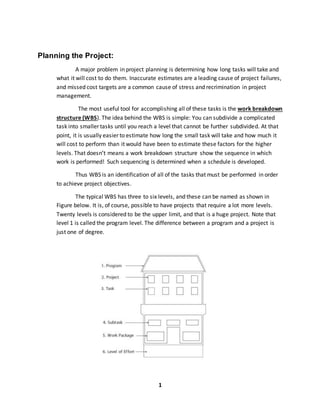
The typical WBS has three to six levels, and these can be named as shown in
Figure below. It is, of course, possible to have projects that require a lot more levels.
Twenty levels is considered to be the upper limit, and that is a huge project. Note that
level 1 is called the program level. The difference between a program and a project is
just one of degree.
2
Guidelines for Developing the WBS:
 Stop breaking down work when you reach a low enough level to do an estimate of the
desired accuracy
 Remember the rule that the people who must do the work should participate in
planning it. Usually a core group identifies top-level parts of the WBS; those parts are
further refined by other members of the team and then integrated to obtain the entire
WBS.
 The WBS should always be developed before the schedule is worked out, but without
trying to identify the sequence of the activities. The reason is quite simple: Until
everyone has agreed that all tasks have been identified, it is misleading to develop a
schedule. You cannot be sure that the critical path identified by a partial schedule will
be the same for the full schedule.
 A WBS does not have to symmetrical. All paths do not have to go down to the same
level
Benefits of the WBS:
 The WBS is a good way to portray the scope of the project.
 Also assigning responsibility for tasks is another important use of WBS
Estimating Time, Costs, and Resources:
Once the work is broken down, you can estimate how long it will take. An estimate
can be made only by starting with the assumption that a certain resource will be assigned.
You cannot do a time or cost estimate without considering who will actually perform the
task. Second, you must base the estimate on historical data or a mental model. Historical
data are best. Putting in mind that Parkinson law always apply “Work expand to fill the time
allowed).
The hazard of estimating:
It is important to be precise and avoid ballpark estimate which is a primary causes of
project failures.
Guidelines for documenting estimates:
3
 Show the percent tolerance that is likely to apply.
 Tell how the estimate was made and what assumptions were used.
 Specify any factors that might affect the validity of the estimate (such as whether the
estimate will still be valid in six months).
Consensual Estimating:
Rather than have individuals estimate task durations, asks at least three people to
estimate each activity in the project that they know something about. They do this without
discussing their ideas with one another. They then meet to find out what they have put on
paper.
There are three advantages to this approach. First, no one person is on the hook for
the final number. Second, inexperienced people learn to estimate from those more
experienced. Third, several people are likely to collectively consider more issues than any
one person would do working alone. For that reason, we are more likely to get an accurate
estimate, although it is important to remember that it is still by definition not exact!

Using the work breakdown structure to plan a project

  • 1.
    Sudan academy ofscience Socialand economic studies unit Master of Business Administration Program Project Management Course Using the Work Breakdown Structure to Plan a Project Prepared by: ‫إسحق‬ ‫عثمان‬ ‫الدين‬ ‫محي‬
  • 2.
    1 Planning the Project: Amajor problem in project planning is determining how long tasks will take and what it will cost to do them. Inaccurate estimates are a leading cause of project failures, and missed cost targets are a common cause of stress and recrimination in project management. The most useful tool for accomplishing all of these tasks is the work breakdown structure (WBS). The idea behind the WBS is simple: You can subdivide a complicated task into smaller tasks until you reach a level that cannot be further subdivided. At that point, it is usually easier to estimate how long the small task will take and how much it will cost to perform than it would have been to estimate these factors for the higher levels. That doesn’t means a work breakdown structure show the sequence in which work is performed! Such sequencing is determined when a schedule is developed. Thus WBS is an identification of all of the tasks that must be performed in order to achieve project objectives. The typical WBS has three to six levels, and these can be named as shown in Figure below. It is, of course, possible to have projects that require a lot more levels. Twenty levels is considered to be the upper limit, and that is a huge project. Note that level 1 is called the program level. The difference between a program and a project is just one of degree.
  • 3.
    2 Guidelines for Developingthe WBS:  Stop breaking down work when you reach a low enough level to do an estimate of the desired accuracy  Remember the rule that the people who must do the work should participate in planning it. Usually a core group identifies top-level parts of the WBS; those parts are further refined by other members of the team and then integrated to obtain the entire WBS.  The WBS should always be developed before the schedule is worked out, but without trying to identify the sequence of the activities. The reason is quite simple: Until everyone has agreed that all tasks have been identified, it is misleading to develop a schedule. You cannot be sure that the critical path identified by a partial schedule will be the same for the full schedule.  A WBS does not have to symmetrical. All paths do not have to go down to the same level Benefits of the WBS:  The WBS is a good way to portray the scope of the project.  Also assigning responsibility for tasks is another important use of WBS Estimating Time, Costs, and Resources: Once the work is broken down, you can estimate how long it will take. An estimate can be made only by starting with the assumption that a certain resource will be assigned. You cannot do a time or cost estimate without considering who will actually perform the task. Second, you must base the estimate on historical data or a mental model. Historical data are best. Putting in mind that Parkinson law always apply “Work expand to fill the time allowed). The hazard of estimating: It is important to be precise and avoid ballpark estimate which is a primary causes of project failures. Guidelines for documenting estimates:
  • 4.
    3  Show thepercent tolerance that is likely to apply.  Tell how the estimate was made and what assumptions were used.  Specify any factors that might affect the validity of the estimate (such as whether the estimate will still be valid in six months). Consensual Estimating: Rather than have individuals estimate task durations, asks at least three people to estimate each activity in the project that they know something about. They do this without discussing their ideas with one another. They then meet to find out what they have put on paper. There are three advantages to this approach. First, no one person is on the hook for the final number. Second, inexperienced people learn to estimate from those more experienced. Third, several people are likely to collectively consider more issues than any one person would do working alone. For that reason, we are more likely to get an accurate estimate, although it is important to remember that it is still by definition not exact!