
INFORMATION TECHNOLOGY
PROJECT MANAGEMENT
Project
 Short   term efforts to create a specific business-related outcome
IS project management


 Directed   effort to plan, organizes and manage resources to bring

about the successful achievement of specific IS goals
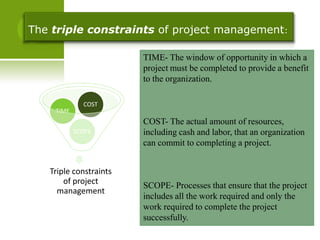
The triple constraints of project management:

                        TIME- The window of opportunity in which a
                        project must be completed to provide a benefit
                        to the organization.

             COST
    TIME
                        COST- The actual amount of resources,
           SCOPE        including cash and labor, that an organization
                        can commit to completing a project.


   Triple constraints
       of project       SCOPE- Processes that ensure that the project
     management
                        includes all the work required and only the
                        work required to complete the project
                        successfully.
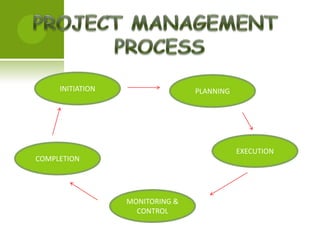
INITIATION                  PLANNING


                                            EXECUTION
COMPLETION


                  MONITORING &
                    CONTROL
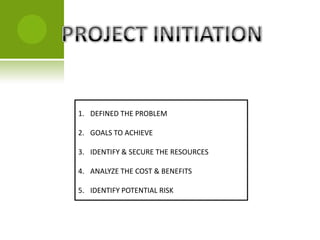
1. DEFINED THE PROBLEM

2. GOALS TO ACHIEVE

3. IDENTIFY & SECURE THE RESOURCES

4. ANALYZE THE COST & BENEFITS

5. IDENTIFY POTENTIAL RISK
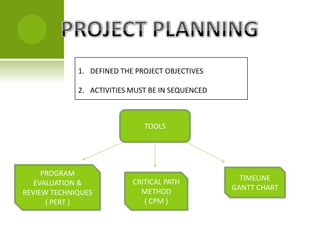
1. DEFINED THE PROJECT OBJECTIVES

             2. ACTIVITIES MUST BE IN SEQUENCED


                              TOOLS


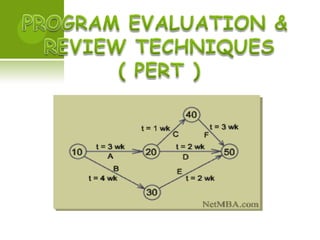
     PROGRAM
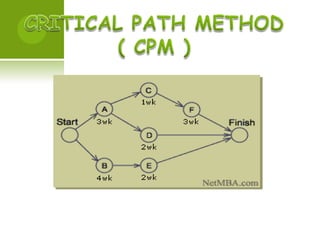
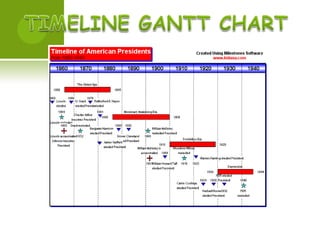
                           CRITICAL PATH            TIMELINE
   EVALUATION &
                             METHOD               GANTT CHART
REVIEW TECHNIQUES
      ( PERT )                ( CPM )
1. CARRY OUT THE PROJECT / PERFORM

2. PERFORM IT TO FULFILL PROJECT’S

   REQUIREMENTS

3. COORDINATE PEOPLE & RESOURCES BASED ON

   PLAN
• Monitoring – collecting,
  recording, and reporting
  information concerning project
  performance that project manger
  and others wish to know

• Controlling – uses data from
  monitor activity to bring actual
  performance to planned performance
• Why do we monitor?
 To detect and react appropriately to deviations and
  changes to plans

• What do we monitor?
Men (human resources), Machines, Materials, Money,
Space
Time, Tasks, Quality/Technical Performance


• When to we monitor?
End of the project
Continuously
Regularly
Depends


•How do we monitor?
Meeting, Test, Etc.
Project Management

Failure
Information technology project management

Information technology project management

  • 1.
  • 2.
    Project  Short term efforts to create a specific business-related outcome IS project management  Directed effort to plan, organizes and manage resources to bring about the successful achievement of specific IS goals
  • 3.
    The triple constraintsof project management: TIME- The window of opportunity in which a project must be completed to provide a benefit to the organization. COST TIME COST- The actual amount of resources, SCOPE including cash and labor, that an organization can commit to completing a project. Triple constraints of project SCOPE- Processes that ensure that the project management includes all the work required and only the work required to complete the project successfully.
  • 4.
    INITIATION PLANNING EXECUTION COMPLETION MONITORING & CONTROL
  • 5.
    1. DEFINED THEPROBLEM 2. GOALS TO ACHIEVE 3. IDENTIFY & SECURE THE RESOURCES 4. ANALYZE THE COST & BENEFITS 5. IDENTIFY POTENTIAL RISK
  • 6.
    1. DEFINED THEPROJECT OBJECTIVES 2. ACTIVITIES MUST BE IN SEQUENCED TOOLS PROGRAM CRITICAL PATH TIMELINE EVALUATION & METHOD GANTT CHART REVIEW TECHNIQUES ( PERT ) ( CPM )
  • 10.
    1. CARRY OUTTHE PROJECT / PERFORM 2. PERFORM IT TO FULFILL PROJECT’S REQUIREMENTS 3. COORDINATE PEOPLE & RESOURCES BASED ON PLAN
  • 11.
    • Monitoring –collecting, recording, and reporting information concerning project performance that project manger and others wish to know • Controlling – uses data from monitor activity to bring actual performance to planned performance
  • 12.
    • Why dowe monitor?  To detect and react appropriately to deviations and changes to plans • What do we monitor? Men (human resources), Machines, Materials, Money, Space Time, Tasks, Quality/Technical Performance • When to we monitor? End of the project Continuously Regularly Depends •How do we monitor? Meeting, Test, Etc.
  • 15.