1
1
PROGRAM MANAGEMENT 2.0
WORK BREAKDOWN STRUCTURE (WBS)
Jeanne Bradford, John Carter, Scott Elliott
April, 2018
2
22
AGENDA
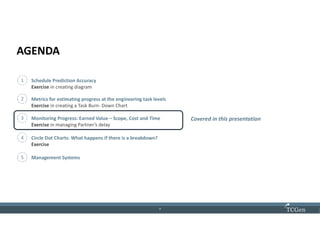
1 Schedule Prediction Accuracy
Exercise in creating diagram
2 Metrics for estimating progress at the engineering task levels
Exercise in creating a Task Burn- Down Chart
3 Monitoring Progress: Earned Value – Scope, Cost and Time
Exercise in managing Partner’s delay
4 Circle Dot Charts: What happens if there is a breakdown?
Exercise
5 Management Systems
Covered in this presentation
3
33
KEY LEARNING POINTS
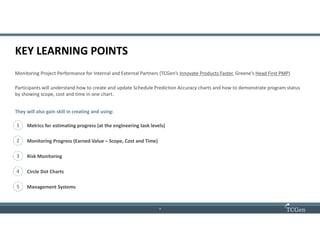
Monitoring Project Performance for Internal and External Partners (TCGen’s Innovate Products Faster, Greene’s Head First PMP)
1 Metrics for estimating progress (at the engineering task levels)
2 Monitoring Progress (Earned Value – Scope, Cost and Time)
3 Risk Monitoring
4 Circle Dot Charts
5 Management Systems
Participants will understand how to create and update Schedule Prediction Accuracy charts and how to demonstrate program status
by showing scope, cost and time in one chart.
They will also gain skill in creating and using:
4
44
WBS: MANAGING EXECUTION THROUGH EARNED VALUE
• WBS is one of the most effective ways to manage AND monitor execution
• You first plan the work, and then you work the plan
• Results in a very well managed program HOWEVER
• It requires more work to plan, and more work to monitor
• Earned Value allows you to understand both cost and schedule at the same time
WBS -> EV
SmartWatch
WBS
Scoping
CRD
Industrial
Design
Hardware
Dev
Bluetooth
Device
Firmware
Dev
Integration
Validation
Testing
Ramp-up &
Stock
Hardware
Integration
System
Integration
Case Dev
Touch
Screen
Component
Board
INTERNAL
PARTNER
5
55
CONTEXT: WHY EARNED VALUE?
Many ways of monitoring budgets
• Invoices
• Deliverables
• Tracking project time
• Resource tracking
• Spreadsheets
• Earned Value (EV)
• EV is most precise/robust tool for pinpointing exactly where the project stands – relative not just to progress but to
completion in terms of both budget and schedule!
• You can learn so much from an EV chart
• Where you are re: schedule
• Where you are re: budget
• Where you are with cost to complete and time to complete!
6
66
PROJECT TRACKING: FIVE KEY ELEMENTS
BCWS
BCWP
ACWP
BAC
EAC
Budgeted Cost of Work Scheduled
Budgeted Cost of Work Performed
Actual Cost of Work Performed
Budget at Completion
Estimate at Completion
7
77
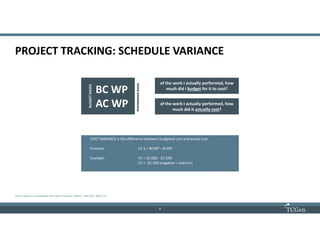
PROJECT TRACKING: SCHEDULE VARIANCE
SCHEDULE VARIANCE is the difference between work scheduled and work
performed (expressed in terms of budget dollars)
Formula: SV $ = BCWP - BCWS
Example: SV = BCWP - BCWS = $1,000 - $2,000
SV = -$1,000 (negative = behind schedule)
Source: Resource Consumption and Project Tracking – Metrics , Hale, MIT, 2003, p 21
BC WS
BC WP
BUDGETBASED
of the work I actually performed, how
much did I budget for it to cost?
of the work I scheduled to have done,
how much did I budget for it to cost?
8
88
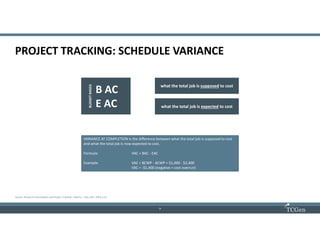
PROJECT TRACKING: SCHEDULE VARIANCE
COST VARIANCE is the difference between budgeted cost and actual cost
Formula: CV $ = BCWP - ACWP
Example: CV = $5,000 - $7,500
CV = -$2,500 (negative = overrun)
Source: Resource Consumption and Project Tracking – Metrics , Hale, MIT, 2003, p 21
BC WP
AC WP
BUDGETBASED
of the work I actually performed, how
much did it actually cost?
of the work I actually performed, how
much did I budget for it to cost?
PERFORMANCEBASED
9
99
PROJECT TRACKING: SCHEDULE VARIANCE
VARIANCE AT COMPLETION is the difference between what the total job is supposed to cost
and what the total job is now expected to cost.
Formula: VAC = BAC - EAC
Example: VAC = BCWP - ACWP = $1,000 - $2,400
VAC = -$1,400 (negative = cost overrun)
Source: Resource Consumption and Project Tracking – Metrics , Hale, MIT, 2003, p 21
B AC
E AC
BUDGETBASED
what the total job is expected to cost
what the total job is supposed to cost
10
1010
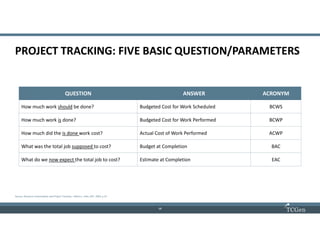
PROJECT TRACKING: FIVE BASIC QUESTION/PARAMETERS
Source: Resource Consumption and Project Tracking – Metrics , Hale, MIT, 2003, p 24
QUESTION ANSWER ACRONYM
How much work should be done? Budgeted Cost for Work Scheduled BCWS
How much work is done? Budgeted Cost for Work Performed BCWP
How much did the is done work cost? Actual Cost of Work Performed ACWP
What was the total job supposed to cost? Budget at Completion BAC
What do we now expect the total job to cost? Estimate at Completion EAC
11
1111
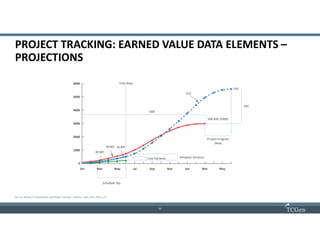
PROJECT TRACKING: EARNED VALUE DATA ELEMENTS –
PROJECTIONS
Source: Resource Consumption and Project Tracking – Metrics , Hale, MIT, 2003, p 27
Jan
6000
Mar May Jul Sep Nov Jan Mar May
5000
4000
3000
2000
1000
0
Time Now
CBB
Schedule VarianceCost Variance
Project Program
Delay
EAC
VAC
MR BAC (PMB)
ETC
BCWP
BCWS ACWP
Schedule Slip
12
1212
ACCOUNTING AND BUDGETS
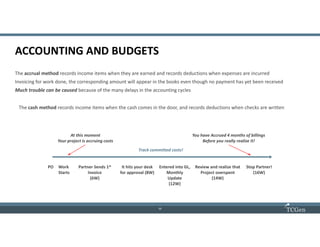
The accrual method records income items when they are earned and records deductions when expenses are incurred
Invoicing for work done, the corresponding amount will appear in the books even though no payment has yet been received
Much trouble can be caused because of the many delays in the accounting cycles
The cash method records income items when the cash comes in the door, and records deductions when checks are written
PO Work
Starts
At this moment
Your project is accruing costs
Partner Sends 1st
Invoice
(6W)
It hits your desk
for approval (8W)
Entered into GL,
Monthly
Update
(12W)
Review and realize that
Project overspent
(14W)
Stop Partner!
(16W)
You have Accrued 4 months of billings
Before you really realize it!
Track committed costs!
13
1313
EARNED VALUE AND DELINQUENT PARTNERS: EXERCISE
Exercise
• Linear spending trend from Partners
• But you find that partner is not doing the work
• They are continuing to bill us, but we are behind
• What should we do with Partner?
• To stop the overage
• To correct things going forward
• So where is the budget to date?
• How much to finish?
14
14
TCGen Inc.
Menlo Park
CA, 94025
jcarter@tcgen.com
(650) 733-5310

Program Management 2.0: Work Breakdown Structure

  • 1.
    1 1 PROGRAM MANAGEMENT 2.0 WORKBREAKDOWN STRUCTURE (WBS) Jeanne Bradford, John Carter, Scott Elliott April, 2018
  • 2.
    2 22 AGENDA 1 Schedule PredictionAccuracy Exercise in creating diagram 2 Metrics for estimating progress at the engineering task levels Exercise in creating a Task Burn- Down Chart 3 Monitoring Progress: Earned Value – Scope, Cost and Time Exercise in managing Partner’s delay 4 Circle Dot Charts: What happens if there is a breakdown? Exercise 5 Management Systems Covered in this presentation
  • 3.
    3 33 KEY LEARNING POINTS MonitoringProject Performance for Internal and External Partners (TCGen’s Innovate Products Faster, Greene’s Head First PMP) 1 Metrics for estimating progress (at the engineering task levels) 2 Monitoring Progress (Earned Value – Scope, Cost and Time) 3 Risk Monitoring 4 Circle Dot Charts 5 Management Systems Participants will understand how to create and update Schedule Prediction Accuracy charts and how to demonstrate program status by showing scope, cost and time in one chart. They will also gain skill in creating and using:
  • 4.
    4 44 WBS: MANAGING EXECUTIONTHROUGH EARNED VALUE • WBS is one of the most effective ways to manage AND monitor execution • You first plan the work, and then you work the plan • Results in a very well managed program HOWEVER • It requires more work to plan, and more work to monitor • Earned Value allows you to understand both cost and schedule at the same time WBS -> EV SmartWatch WBS Scoping CRD Industrial Design Hardware Dev Bluetooth Device Firmware Dev Integration Validation Testing Ramp-up & Stock Hardware Integration System Integration Case Dev Touch Screen Component Board INTERNAL PARTNER
  • 5.
    5 55 CONTEXT: WHY EARNEDVALUE? Many ways of monitoring budgets • Invoices • Deliverables • Tracking project time • Resource tracking • Spreadsheets • Earned Value (EV) • EV is most precise/robust tool for pinpointing exactly where the project stands – relative not just to progress but to completion in terms of both budget and schedule! • You can learn so much from an EV chart • Where you are re: schedule • Where you are re: budget • Where you are with cost to complete and time to complete!
  • 6.
    6 66 PROJECT TRACKING: FIVEKEY ELEMENTS BCWS BCWP ACWP BAC EAC Budgeted Cost of Work Scheduled Budgeted Cost of Work Performed Actual Cost of Work Performed Budget at Completion Estimate at Completion
  • 7.
    7 77 PROJECT TRACKING: SCHEDULEVARIANCE SCHEDULE VARIANCE is the difference between work scheduled and work performed (expressed in terms of budget dollars) Formula: SV $ = BCWP - BCWS Example: SV = BCWP - BCWS = $1,000 - $2,000 SV = -$1,000 (negative = behind schedule) Source: Resource Consumption and Project Tracking – Metrics , Hale, MIT, 2003, p 21 BC WS BC WP BUDGETBASED of the work I actually performed, how much did I budget for it to cost? of the work I scheduled to have done, how much did I budget for it to cost?
  • 8.
    8 88 PROJECT TRACKING: SCHEDULEVARIANCE COST VARIANCE is the difference between budgeted cost and actual cost Formula: CV $ = BCWP - ACWP Example: CV = $5,000 - $7,500 CV = -$2,500 (negative = overrun) Source: Resource Consumption and Project Tracking – Metrics , Hale, MIT, 2003, p 21 BC WP AC WP BUDGETBASED of the work I actually performed, how much did it actually cost? of the work I actually performed, how much did I budget for it to cost? PERFORMANCEBASED
  • 9.
    9 99 PROJECT TRACKING: SCHEDULEVARIANCE VARIANCE AT COMPLETION is the difference between what the total job is supposed to cost and what the total job is now expected to cost. Formula: VAC = BAC - EAC Example: VAC = BCWP - ACWP = $1,000 - $2,400 VAC = -$1,400 (negative = cost overrun) Source: Resource Consumption and Project Tracking – Metrics , Hale, MIT, 2003, p 21 B AC E AC BUDGETBASED what the total job is expected to cost what the total job is supposed to cost
  • 10.
    10 1010 PROJECT TRACKING: FIVEBASIC QUESTION/PARAMETERS Source: Resource Consumption and Project Tracking – Metrics , Hale, MIT, 2003, p 24 QUESTION ANSWER ACRONYM How much work should be done? Budgeted Cost for Work Scheduled BCWS How much work is done? Budgeted Cost for Work Performed BCWP How much did the is done work cost? Actual Cost of Work Performed ACWP What was the total job supposed to cost? Budget at Completion BAC What do we now expect the total job to cost? Estimate at Completion EAC
  • 11.
    11 1111 PROJECT TRACKING: EARNEDVALUE DATA ELEMENTS – PROJECTIONS Source: Resource Consumption and Project Tracking – Metrics , Hale, MIT, 2003, p 27 Jan 6000 Mar May Jul Sep Nov Jan Mar May 5000 4000 3000 2000 1000 0 Time Now CBB Schedule VarianceCost Variance Project Program Delay EAC VAC MR BAC (PMB) ETC BCWP BCWS ACWP Schedule Slip
  • 12.
    12 1212 ACCOUNTING AND BUDGETS Theaccrual method records income items when they are earned and records deductions when expenses are incurred Invoicing for work done, the corresponding amount will appear in the books even though no payment has yet been received Much trouble can be caused because of the many delays in the accounting cycles The cash method records income items when the cash comes in the door, and records deductions when checks are written PO Work Starts At this moment Your project is accruing costs Partner Sends 1st Invoice (6W) It hits your desk for approval (8W) Entered into GL, Monthly Update (12W) Review and realize that Project overspent (14W) Stop Partner! (16W) You have Accrued 4 months of billings Before you really realize it! Track committed costs!
  • 13.
    13 1313 EARNED VALUE ANDDELINQUENT PARTNERS: EXERCISE Exercise • Linear spending trend from Partners • But you find that partner is not doing the work • They are continuing to bill us, but we are behind • What should we do with Partner? • To stop the overage • To correct things going forward • So where is the budget to date? • How much to finish?
  • 14.
    14 14 TCGen Inc. Menlo Park CA,94025 jcarter@tcgen.com (650) 733-5310