Incident Analysis Learning Program - Module Six


Multi-Incident Analysis Method

February 21, 2013
Welcome


Tina Cullimore   Sandi Kossey   Erin Pollock   Nadine Glenn   Ioana Popescu
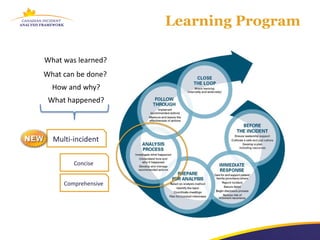
Learning Program

What was learned?
What can be done?
  How and why?
 What happened?


  Multi-incident

        Concise


     Comprehensive
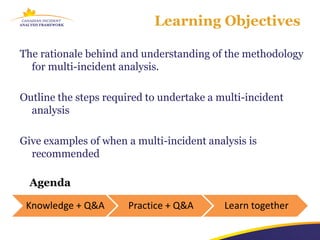
Learning Objectives

The rationale behind and understanding of the methodology
  for multi-incident analysis.

Outline the steps required to undertake a multi-incident
  analysis

Give examples of when a multi-incident analysis is
  recommended

  Agenda

 Knowledge + Q&A       Practice + Q&A      Learn together
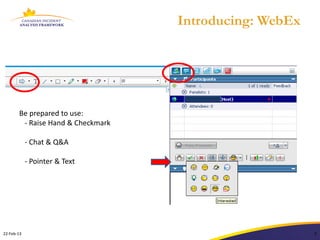
Introducing: WebEx


       Be prepared to use:
        - Raise Hand & Checkmark

            - Chat & Q&A

            - Pointer & Text


                                   5
22-Feb-13                                                   5
About You


0   Knowledge of [any] MULTI-INCIDENT analysis   10
Presentation


Polly Stevens, Faculty
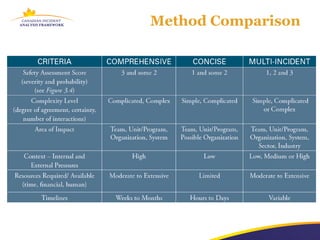
Method Comparison
Types of Multi-Patient Incident
                                    Analyses
Type 1 – Analysis of Many Previous Single-Patient
   Incidents/Reviews
  A. Homogeneous incidents/reviews over a period of
     time
  B. Heterogeneous incidents/reviews over a period of
     time
   Varying degrees of harm (including near miss)
   AKA: cluster, aggregate, meta-analysis
Type 2 – Analysis of a Group of Patients Who Have /
   May Have Been Impacted by an Incident
     Varying degrees of harm (unknown to severe)
     AKA: look-backs
Why?

Type 1 – Analysis of Many Previous Single-Patient
   Incidents/Reviews
     To identify themes, relative frequencies of incidents
      and/or contributing factors; assess trends over time;
      assess implementation of recommendations; obtain
      “forest” perspective
Type 2 – Analysis of a Group of Patients Who Have / May
   Have Been Impacted by an Incident
     To identify if harm occurred (threshold determination
      key); and if so, who was impacted
     Then, as per single (comprehensive) analysis, to identify
      how and why it occurred, what can be done to reduce risk
     Usually feeds into multi-patient notification
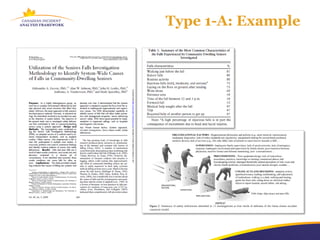
Type 1-A: Example
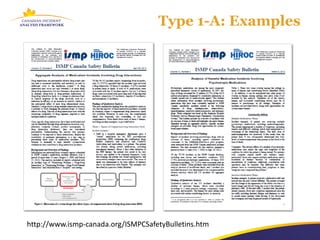
Type 1-A: Examples


http://www.ismp-canada.org/ISMPCSafetyBulletins.htm
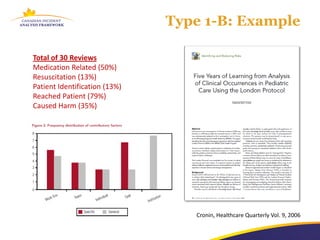
Type 1-B: Example

Total of 30 Reviews
Medication Related (50%)
Resuscitation (13%)
Patient Identification (13%)
Reached Patient (79%)
Caused Harm (35%)


                                  Cronin, Healthcare Quarterly Vol. 9, 2006
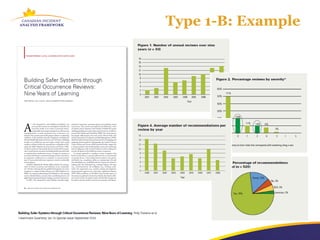
Type 1-B: Example
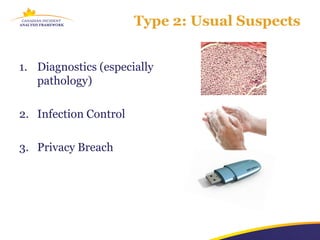
Type 2: Usual Suspects


1. Diagnostics (especially
   pathology)

2. Infection Control

3. Privacy Breach
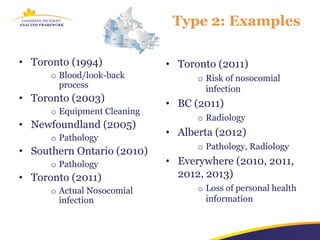
Type 2: Examples

• Toronto (1994)             • Toronto (2011)
      o Blood/look-back            o Risk of nosocomial
        process                      infection
• Toronto (2003)             • BC (2011)
      o Equipment Cleaning
                                   o Radiology
• Newfoundland (2005)
      o Pathology
                             • Alberta (2012)
                                   o Pathology, Radiology
• Southern Ontario (2010)
      o Pathology            • Everywhere (2010, 2011,
• Toronto (2011)               2012, 2013)
      o Actual Nosocomial          o Loss of personal health
        infection                    information
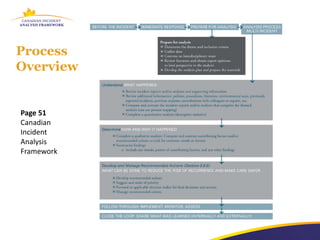
Process
Overview


Page 51
Canadian
Incident
Analysis
Framework
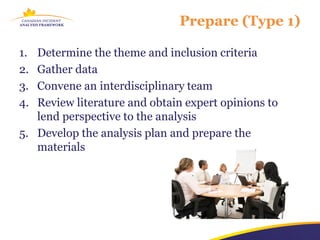
Prepare (Type 1)

1. Determine the theme and inclusion criteria
2. Gather data
3. Convene an interdisciplinary team
4. Review literature and obtain expert opinions to
   lend perspective to the analysis
5. Develop the analysis plan and prepare the
   materials
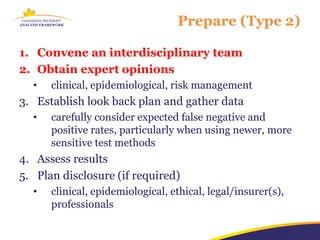
Prepare (Type 2)

1. Convene an interdisciplinary team
2. Obtain expert opinions
  •   clinical, epidemiological, risk management
3. Establish look back plan and gather data
  •   carefully consider expected false negative and
      positive rates, particularly when using newer, more
      sensitive test methods
4. Assess results
5. Plan disclosure (if required)
  •   clinical, epidemiological, ethical, legal/insurer(s),
      professionals
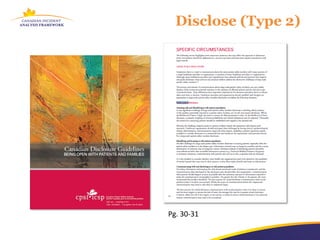
Disclose (Type 2)


Pg. 30-31
What (Type 1)

• Review incident reports and/or analyses and
  supporting information
• Review additional information: policies, procedures,
  literature, environmental scan, previously reported
  incidents, previous analyses, consultations with
  colleagues or experts, etc.
• Compare and contrast the incident reports and/or
  analyses that comprise the themed analysis (can use
  process mapping)
• Complete quantitative analysis (descriptive
  statistics)
How and Why (Type 1)

• Complete a qualitative analysis:
   • Compare and contrast contributing factors
     and/or recommended actions to look for
     common trends or themes
• Summarize findings
   • Include any trends, patterns of contributing
     factors, and any other findings
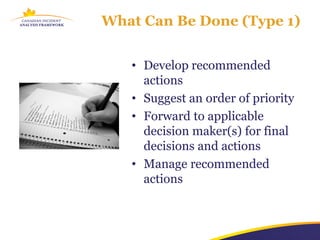
What Can Be Done (Type 1)


   • Develop recommended
     actions
   • Suggest an order of priority
   • Forward to applicable
     decision maker(s) for final
     decisions and actions
   • Manage recommended
     actions
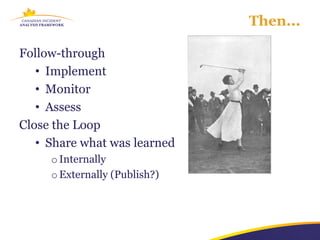
Then...

Follow-through
   • Implement
   • Monitor
   • Assess
Close the Loop
   • Share what was learned
     o Internally
     o Externally (Publish?)
Questions?
Real-life Experience


Kate Wilkinson
Multi-incident Analyses

                   An Analysis of Common Causes
                   Identified in Near Miss Reporting


© Bridgepoint Active Healthcare 2013
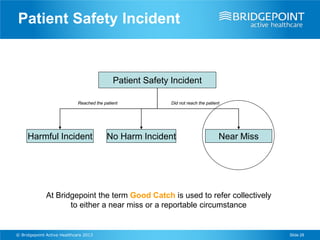
Patient Safety Incident


                                             Patient Safety Incident

                             Reached the patient            Did not reach the patient


     Harmful Incident                     No Harm Incident                          Near Miss


              At Bridgepoint the term Good Catch is used to refer collectively
                     to either a near miss or a reportable circumstance


© Bridgepoint Active Healthcare 2013                                                            Slide 28
Why Near Misses

• Valuable source of knowledge on how safe
  is your system
• Provides data for development of strategies
  for patient safety improvement
• Determine system and process issues that
  may contribute to errors reaching the
  patient
• Enhance reporting by providing meaningful
  feedback to staff
© Bridgepoint Active Healthcare 2013       Slide 29
Driving Improvement

 • Review ‘clusters’ of
   no harm events or
   near misses
 • Looking for common
   themes
 • Understand system
   vulnerabilities


© Bridgepoint Active Healthcare 2013   Slide 30
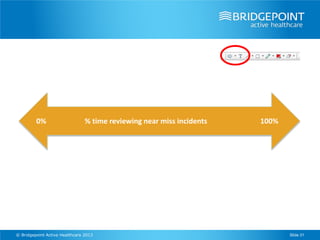
0%                     % time reviewing near miss incidents   100%


© Bridgepoint Active Healthcare 2013                                          Slide 31
Prepare for Analysis


 • Determine theme or focus of review
 • Determine what type of data you have or
   may need to collect
 • Develop a framework to record information


© Bridgepoint Active Healthcare 2013         Slide 32
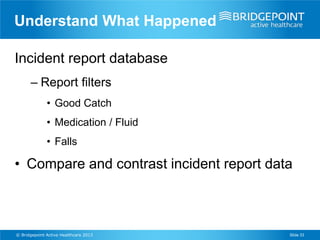
Understand What Happened

Incident report database
      – Report filters
              • Good Catch
              • Medication / Fluid
              • Falls

• Compare and contrast incident report data


© Bridgepoint Active Healthcare 2013      Slide 33
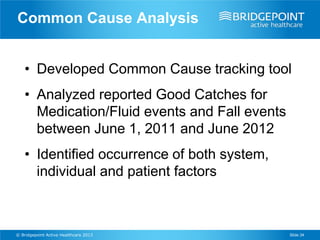
Common Cause Analysis


    • Developed Common Cause tracking tool
    • Analyzed reported Good Catches for
      Medication/Fluid events and Fall events
      between June 1, 2011 and June 2012
    • Identified occurrence of both system,
      individual and patient factors


© Bridgepoint Active Healthcare 2013            Slide 34
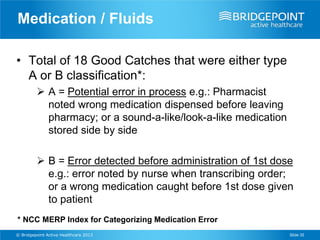
Medication / Fluids

• Total of 18 Good Catches that were either type
  A or B classification*:
          A = Potential error in process e.g.: Pharmacist
           noted wrong medication dispensed before leaving
           pharmacy; or a sound-a-like/look-a-like medication
           stored side by side

          B = Error detected before administration of 1st dose
           e.g.: error noted by nurse when transcribing order;
           or a wrong medication caught before 1st dose given
           to patient
* NCC MERP Index for Categorizing Medication Error
© Bridgepoint Active Healthcare 2013                            Slide 35
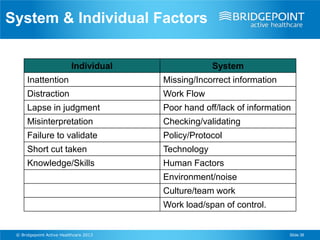
System & Individual Factors


                          Individual                 System
      Inattention                       Missing/Incorrect information
      Distraction                       Work Flow
      Lapse in judgment                 Poor hand off/lack of information
      Misinterpretation                 Checking/validating
      Failure to validate               Policy/Protocol
      Short cut taken                   Technology
      Knowledge/Skills                  Human Factors
                                        Environment/noise
                                        Culture/team work
                                        Work load/span of control.


 © Bridgepoint Active Healthcare 2013                                   Slide 36
What Did We Learn…

    • Failure to validate was the highest cause of
      the potential error
    • Missing or incorrect information noted primarily
      occurs as part of admission process
             – Medication reconciliation by pharmacist caught
               errors before reached patient
    • Sound-a-like errors occurred on a small
      number of occasions


© Bridgepoint Active Healthcare 2013                            Slide 37
Near Miss Falls

• 116 reported Good Catches for risk of Falls
• Number one contributing factors relate to
  Behavioral /Cognitive issues resulting in:
                • Not requesting assistance with transfers or for
                  other comfort measures
                • Not using mobility devices appropriately
• Failing to comply with the documented plan of
  care was noted on two occasions
• 33% files had documented changes to the plan of
  care as a result of the report

© Bridgepoint Active Healthcare 2013                                Slide 38
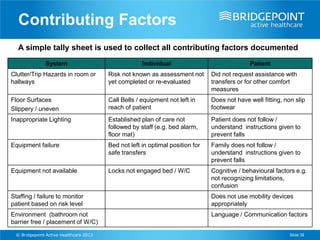
Contributing Factors
  A simple tally sheet is used to collect all contributing factors documented
               System                                 Individual                              Patient
Clutter/Trip Hazards in room or          Risk not known as assessment not       Did not request assistance with
hallways                                 yet completed or re-evaluated          transfers or for other comfort
                                                                                measures
Floor Surfaces                           Call Bells / equipment not left in     Does not have well fitting, non slip
Slippery / uneven                        reach of patient                       footwear
Inappropriate Lighting                   Established plan of care not           Patient does not follow /
                                         followed by staff (e.g. bed alarm,     understand instructions given to
                                         floor mat)                             prevent falls
Equipment failure                        Bed not left in optimal position for   Family does not follow /
                                         safe transfers                         understand instructions given to
                                                                                prevent falls
Equipment not available                  Locks not engaged bed / W/C            Cognitive / behavioural factors e.g.
                                                                                not recognizing limitations,
                                                                                confusion
Staffing / failure to monitor                                                   Does not use mobility devices
patient based on risk level                                                     appropriately
Environment (bathroom not                                                       Language / Communication factors
barrier free / placement of W/C)
  © Bridgepoint Active Healthcare 2013                                                                        Slide 39
Close the Loop


    • Follow up with managers where information
      lead the team to believe the information
      related to an actual incident and did not meet
      the definition of a Good Catch


© Bridgepoint Active Healthcare 2013                   Slide 40
What Can Be Done…

 • Presentation to PCM group
        – Staff meetings
        – Safety Huddles
 • Management follow-up on file improved
   from 61% in Q1 to 84% in Q2
 • Importance of Medication reconciliation
   and checking information on transitions in
   care
© Bridgepoint Active Healthcare 2013        Slide 41
Share What Was Learned


 •         Annual Good Catch Awards 2009 - 2012
         1. Pharmacist – ‘Most Serious’ – ‘Life Saver’
                •       Hydromorphone / Morphine pump

         2. PCM - Best Management Follow-Up
         3. Highest Reporting Unit or Department.


© Bridgepoint Active Healthcare 2013                     Slide 42
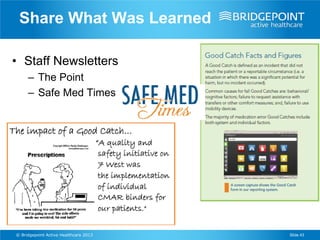
Share What Was Learned

• Staff Newsletters
     – The Point
     – Safe Med Times


© Bridgepoint Active Healthcare 2013   Slide 43
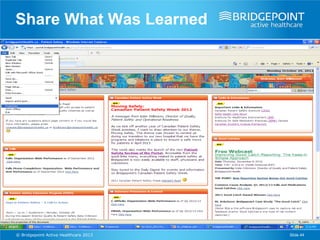
Share What Was Learned


© Bridgepoint Active Healthcare 2013   Slide 44
Next Steps


    • Reporting frequency: quarterly
    • Expand interprofessional team
      involvement
    • Disseminate information more broadly
    • Include no harm or minor harm incidents


© Bridgepoint Active Healthcare 2013        Slide 45
Questions?
Learn from Each Other
Options

Q&A with the 2 presenters
  •   Main room


Learn from each other
  •   Whiteboard 1: Meta-analysis
      o     Analysis of many previous single-patient incidents


  •       Whiteboard 2: Multi-patient
      o     Analysis of a group of patients impacted by an incident
Recap and Next Steps

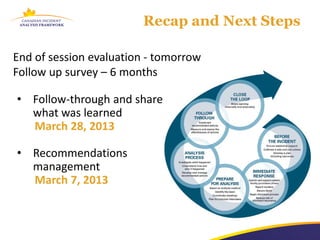
End of session evaluation - tomorrow
Follow up survey – 6 months

• Follow-through and share
  what was learned
  March 28, 2013

• Recommendations
  management
  March 7, 2013
Resources

Learning Program – previous modules:
  http://www.patientsafetyinstitute.ca/English/news/Inci
  dentAnalysisLearningProgram/Pages/Session-
  Recordings-and-Documents.aspx

Incident Analysis Tools
  http://www.patientsafetyinstitute.ca/English/toolsReso
  urces/IncidentAnalysis/Pages/Tools.aspx
Mulţumesc
  Thank You

Module 6 - Multi-Incident Analysis Method

  • 1.
    Incident Analysis LearningProgram - Module Six Multi-Incident Analysis Method February 21, 2013
  • 2.
    Welcome Tina Cullimore Sandi Kossey Erin Pollock Nadine Glenn Ioana Popescu
  • 3.
    Learning Program What waslearned? What can be done? How and why? What happened? Multi-incident Concise Comprehensive
  • 4.
    Learning Objectives The rationalebehind and understanding of the methodology for multi-incident analysis. Outline the steps required to undertake a multi-incident analysis Give examples of when a multi-incident analysis is recommended Agenda Knowledge + Q&A Practice + Q&A Learn together
  • 5.
    Introducing: WebEx Be prepared to use: - Raise Hand & Checkmark - Chat & Q&A - Pointer & Text 5 22-Feb-13 5
  • 6.
    About You 0 Knowledge of [any] MULTI-INCIDENT analysis 10
  • 7.
  • 8.
  • 9.
    Types of Multi-PatientIncident Analyses Type 1 – Analysis of Many Previous Single-Patient Incidents/Reviews A. Homogeneous incidents/reviews over a period of time B. Heterogeneous incidents/reviews over a period of time  Varying degrees of harm (including near miss)  AKA: cluster, aggregate, meta-analysis Type 2 – Analysis of a Group of Patients Who Have / May Have Been Impacted by an Incident  Varying degrees of harm (unknown to severe)  AKA: look-backs
  • 10.
    Why? Type 1 –Analysis of Many Previous Single-Patient Incidents/Reviews  To identify themes, relative frequencies of incidents and/or contributing factors; assess trends over time; assess implementation of recommendations; obtain “forest” perspective Type 2 – Analysis of a Group of Patients Who Have / May Have Been Impacted by an Incident  To identify if harm occurred (threshold determination key); and if so, who was impacted  Then, as per single (comprehensive) analysis, to identify how and why it occurred, what can be done to reduce risk  Usually feeds into multi-patient notification
  • 11.
  • 12.
  • 13.
    Type 1-B: Example Totalof 30 Reviews Medication Related (50%) Resuscitation (13%) Patient Identification (13%) Reached Patient (79%) Caused Harm (35%) Cronin, Healthcare Quarterly Vol. 9, 2006
  • 14.
  • 15.
    Type 2: UsualSuspects 1. Diagnostics (especially pathology) 2. Infection Control 3. Privacy Breach
  • 16.
    Type 2: Examples •Toronto (1994) • Toronto (2011) o Blood/look-back o Risk of nosocomial process infection • Toronto (2003) • BC (2011) o Equipment Cleaning o Radiology • Newfoundland (2005) o Pathology • Alberta (2012) o Pathology, Radiology • Southern Ontario (2010) o Pathology • Everywhere (2010, 2011, • Toronto (2011) 2012, 2013) o Actual Nosocomial o Loss of personal health infection information
  • 17.
  • 18.
    Prepare (Type 1) 1.Determine the theme and inclusion criteria 2. Gather data 3. Convene an interdisciplinary team 4. Review literature and obtain expert opinions to lend perspective to the analysis 5. Develop the analysis plan and prepare the materials
  • 19.
    Prepare (Type 2) 1.Convene an interdisciplinary team 2. Obtain expert opinions • clinical, epidemiological, risk management 3. Establish look back plan and gather data • carefully consider expected false negative and positive rates, particularly when using newer, more sensitive test methods 4. Assess results 5. Plan disclosure (if required) • clinical, epidemiological, ethical, legal/insurer(s), professionals
  • 20.
  • 21.
    What (Type 1) •Review incident reports and/or analyses and supporting information • Review additional information: policies, procedures, literature, environmental scan, previously reported incidents, previous analyses, consultations with colleagues or experts, etc. • Compare and contrast the incident reports and/or analyses that comprise the themed analysis (can use process mapping) • Complete quantitative analysis (descriptive statistics)
  • 22.
    How and Why(Type 1) • Complete a qualitative analysis: • Compare and contrast contributing factors and/or recommended actions to look for common trends or themes • Summarize findings • Include any trends, patterns of contributing factors, and any other findings
  • 23.
    What Can BeDone (Type 1) • Develop recommended actions • Suggest an order of priority • Forward to applicable decision maker(s) for final decisions and actions • Manage recommended actions
  • 24.
    Then... Follow-through • Implement • Monitor • Assess Close the Loop • Share what was learned o Internally o Externally (Publish?)
  • 25.
  • 26.
  • 27.
    Multi-incident Analyses An Analysis of Common Causes Identified in Near Miss Reporting © Bridgepoint Active Healthcare 2013
  • 28.
    Patient Safety Incident Patient Safety Incident Reached the patient Did not reach the patient Harmful Incident No Harm Incident Near Miss At Bridgepoint the term Good Catch is used to refer collectively to either a near miss or a reportable circumstance © Bridgepoint Active Healthcare 2013 Slide 28
  • 29.
    Why Near Misses •Valuable source of knowledge on how safe is your system • Provides data for development of strategies for patient safety improvement • Determine system and process issues that may contribute to errors reaching the patient • Enhance reporting by providing meaningful feedback to staff © Bridgepoint Active Healthcare 2013 Slide 29
  • 30.
    Driving Improvement •Review ‘clusters’ of no harm events or near misses • Looking for common themes • Understand system vulnerabilities © Bridgepoint Active Healthcare 2013 Slide 30
  • 31.
    0% % time reviewing near miss incidents 100% © Bridgepoint Active Healthcare 2013 Slide 31
  • 32.
    Prepare for Analysis • Determine theme or focus of review • Determine what type of data you have or may need to collect • Develop a framework to record information © Bridgepoint Active Healthcare 2013 Slide 32
  • 33.
    Understand What Happened Incidentreport database – Report filters • Good Catch • Medication / Fluid • Falls • Compare and contrast incident report data © Bridgepoint Active Healthcare 2013 Slide 33
  • 34.
    Common Cause Analysis • Developed Common Cause tracking tool • Analyzed reported Good Catches for Medication/Fluid events and Fall events between June 1, 2011 and June 2012 • Identified occurrence of both system, individual and patient factors © Bridgepoint Active Healthcare 2013 Slide 34
  • 35.
    Medication / Fluids •Total of 18 Good Catches that were either type A or B classification*:  A = Potential error in process e.g.: Pharmacist noted wrong medication dispensed before leaving pharmacy; or a sound-a-like/look-a-like medication stored side by side  B = Error detected before administration of 1st dose e.g.: error noted by nurse when transcribing order; or a wrong medication caught before 1st dose given to patient * NCC MERP Index for Categorizing Medication Error © Bridgepoint Active Healthcare 2013 Slide 35
  • 36.
    System & IndividualFactors Individual System Inattention Missing/Incorrect information Distraction Work Flow Lapse in judgment Poor hand off/lack of information Misinterpretation Checking/validating Failure to validate Policy/Protocol Short cut taken Technology Knowledge/Skills Human Factors Environment/noise Culture/team work Work load/span of control. © Bridgepoint Active Healthcare 2013 Slide 36
  • 37.
    What Did WeLearn… • Failure to validate was the highest cause of the potential error • Missing or incorrect information noted primarily occurs as part of admission process – Medication reconciliation by pharmacist caught errors before reached patient • Sound-a-like errors occurred on a small number of occasions © Bridgepoint Active Healthcare 2013 Slide 37
  • 38.
    Near Miss Falls •116 reported Good Catches for risk of Falls • Number one contributing factors relate to Behavioral /Cognitive issues resulting in: • Not requesting assistance with transfers or for other comfort measures • Not using mobility devices appropriately • Failing to comply with the documented plan of care was noted on two occasions • 33% files had documented changes to the plan of care as a result of the report © Bridgepoint Active Healthcare 2013 Slide 38
  • 39.
    Contributing Factors A simple tally sheet is used to collect all contributing factors documented System Individual Patient Clutter/Trip Hazards in room or Risk not known as assessment not Did not request assistance with hallways yet completed or re-evaluated transfers or for other comfort measures Floor Surfaces Call Bells / equipment not left in Does not have well fitting, non slip Slippery / uneven reach of patient footwear Inappropriate Lighting Established plan of care not Patient does not follow / followed by staff (e.g. bed alarm, understand instructions given to floor mat) prevent falls Equipment failure Bed not left in optimal position for Family does not follow / safe transfers understand instructions given to prevent falls Equipment not available Locks not engaged bed / W/C Cognitive / behavioural factors e.g. not recognizing limitations, confusion Staffing / failure to monitor Does not use mobility devices patient based on risk level appropriately Environment (bathroom not Language / Communication factors barrier free / placement of W/C) © Bridgepoint Active Healthcare 2013 Slide 39
  • 40.
    Close the Loop • Follow up with managers where information lead the team to believe the information related to an actual incident and did not meet the definition of a Good Catch © Bridgepoint Active Healthcare 2013 Slide 40
  • 41.
    What Can BeDone… • Presentation to PCM group – Staff meetings – Safety Huddles • Management follow-up on file improved from 61% in Q1 to 84% in Q2 • Importance of Medication reconciliation and checking information on transitions in care © Bridgepoint Active Healthcare 2013 Slide 41
  • 42.
    Share What WasLearned • Annual Good Catch Awards 2009 - 2012 1. Pharmacist – ‘Most Serious’ – ‘Life Saver’ • Hydromorphone / Morphine pump 2. PCM - Best Management Follow-Up 3. Highest Reporting Unit or Department. © Bridgepoint Active Healthcare 2013 Slide 42
  • 43.
    Share What WasLearned • Staff Newsletters – The Point – Safe Med Times © Bridgepoint Active Healthcare 2013 Slide 43
  • 44.
    Share What WasLearned © Bridgepoint Active Healthcare 2013 Slide 44
  • 45.
    Next Steps • Reporting frequency: quarterly • Expand interprofessional team involvement • Disseminate information more broadly • Include no harm or minor harm incidents © Bridgepoint Active Healthcare 2013 Slide 45
  • 46.
  • 47.
  • 48.
    Options Q&A with the2 presenters • Main room Learn from each other • Whiteboard 1: Meta-analysis o Analysis of many previous single-patient incidents • Whiteboard 2: Multi-patient o Analysis of a group of patients impacted by an incident
  • 49.
    Recap and NextSteps End of session evaluation - tomorrow Follow up survey – 6 months • Follow-through and share what was learned March 28, 2013 • Recommendations management March 7, 2013
  • 50.
    Resources Learning Program –previous modules: http://www.patientsafetyinstitute.ca/English/news/Inci dentAnalysisLearningProgram/Pages/Session- Recordings-and-Documents.aspx Incident Analysis Tools http://www.patientsafetyinstitute.ca/English/toolsReso urces/IncidentAnalysis/Pages/Tools.aspx
  • 51.