Mental Process:
1. Beliefs
2. Attitudes
3. Values
4. Needs
5. Motives & Behavior
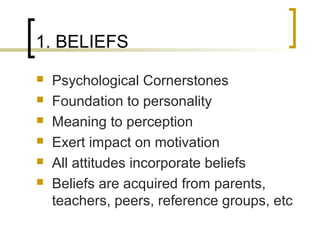
1. BELIEFS
 Psychological Cornerstones
 Foundation to personality
 Meaning to perception
 Exert impact on motivation
 All attitudes incorporate beliefs
 Beliefs are acquired from parents,
teachers, peers, reference groups, etc
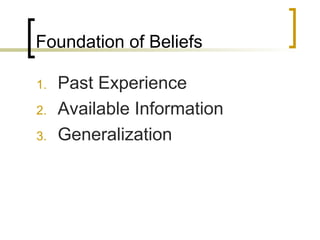
Foundation of Beliefs
1. Past Experience
2. Available Information
3. Generalization
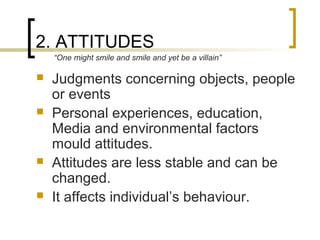
2. ATTITUDES
 Judgments concerning objects, people
or events
 Personal experiences, education,
Media and environmental factors
mould attitudes.
 Attitudes are less stable and can be
changed.
 It affects individual’s behaviour.
“One might smile and smile and yet be a villain”
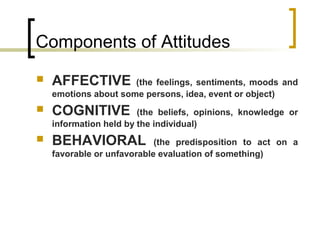
Components of Attitudes
 AFFECTIVE (the feelings, sentiments, moods and
emotions about some persons, idea, event or object)
 COGNITIVE (the beliefs, opinions, knowledge or
information held by the individual)
 BEHAVIORAL (the predisposition to act on a
favorable or unfavorable evaluation of something)
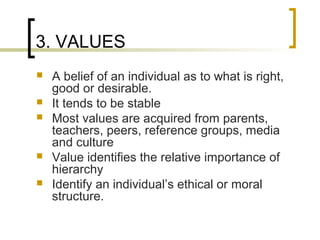
3. VALUES
 A belief of an individual as to what is right,
good or desirable.
 It tends to be stable
 Most values are acquired from parents,
teachers, peers, reference groups, media
and culture
 Value identifies the relative importance of
hierarchy
 Identify an individual’s ethical or moral
structure.
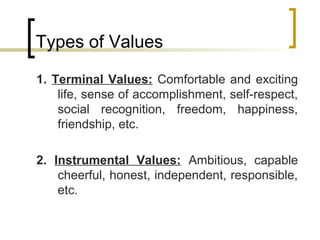
Types of Values
1. Terminal Values: Comfortable and exciting
life, sense of accomplishment, self-respect,
social recognition, freedom, happiness,
friendship, etc.
2. Instrumental Values: Ambitious, capable
cheerful, honest, independent, responsible,
etc.
4. NEEDS
 Needs are deficiencies that energies
us to satisfy them.
 Needs influence individual motivation.
 Needs varies within individuals.
 Unsatisfied needs causes tension
within the individuals.
Types of Needs
1. Physiological Needs: Food, Cloth &
Shelter.
2. Safety Needs: Security, protection.
3. Social Needs: Belongingness,
Friendship.
4. Esteem Needs: Recognition, Status.
5. Self-actualization Needs: Self-
development, Personal achievement.
MOTIVES & BEHAVIOR
 Motives are internal drives in an individual.
 Motives are unsatisfied needs.
 Motives are created due to the imbalance of
physiological and psychological needs.
 Motives prompt and individual to act in a
certain way.
 Behavior is the result of motives.
Mental process

Mental process

  • 1.
    Mental Process: 1. Beliefs 2.Attitudes 3. Values 4. Needs 5. Motives & Behavior
  • 2.
    1. BELIEFS  PsychologicalCornerstones  Foundation to personality  Meaning to perception  Exert impact on motivation  All attitudes incorporate beliefs  Beliefs are acquired from parents, teachers, peers, reference groups, etc
  • 3.
    Foundation of Beliefs 1.Past Experience 2. Available Information 3. Generalization
  • 4.
    2. ATTITUDES  Judgmentsconcerning objects, people or events  Personal experiences, education, Media and environmental factors mould attitudes.  Attitudes are less stable and can be changed.  It affects individual’s behaviour. “One might smile and smile and yet be a villain”
  • 5.
    Components of Attitudes AFFECTIVE (the feelings, sentiments, moods and emotions about some persons, idea, event or object)  COGNITIVE (the beliefs, opinions, knowledge or information held by the individual)  BEHAVIORAL (the predisposition to act on a favorable or unfavorable evaluation of something)
  • 6.
    3. VALUES  Abelief of an individual as to what is right, good or desirable.  It tends to be stable  Most values are acquired from parents, teachers, peers, reference groups, media and culture  Value identifies the relative importance of hierarchy  Identify an individual’s ethical or moral structure.
  • 7.
    Types of Values 1.Terminal Values: Comfortable and exciting life, sense of accomplishment, self-respect, social recognition, freedom, happiness, friendship, etc. 2. Instrumental Values: Ambitious, capable cheerful, honest, independent, responsible, etc.
  • 8.
    4. NEEDS  Needsare deficiencies that energies us to satisfy them.  Needs influence individual motivation.  Needs varies within individuals.  Unsatisfied needs causes tension within the individuals.
  • 9.
    Types of Needs 1.Physiological Needs: Food, Cloth & Shelter. 2. Safety Needs: Security, protection. 3. Social Needs: Belongingness, Friendship. 4. Esteem Needs: Recognition, Status. 5. Self-actualization Needs: Self- development, Personal achievement.
  • 10.
    MOTIVES & BEHAVIOR Motives are internal drives in an individual.  Motives are unsatisfied needs.  Motives are created due to the imbalance of physiological and psychological needs.  Motives prompt and individual to act in a certain way.  Behavior is the result of motives.