AP Psychology
NCVPS
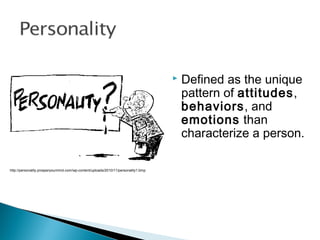
 Defined as the unique
pattern of attitudes,
behaviors, and
emotions than
characterize a person.
http://personality.prosperyourmind.com/wp-content/uploads/2010/11/personality1.bmp
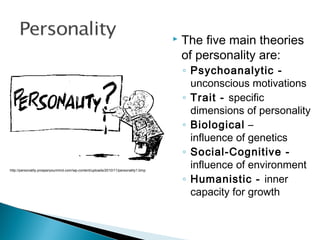
 The five main theories
of personality are:
◦ Psychoanalytic -
unconscious motivations
◦ Trait - specific
dimensions of personality
◦ Biological –
influence of genetics
◦ Social-Cognitive -
influence of environment
◦ Humanistic - inner
capacity for growth
http://personality.prosperyourmind.com/wp-content/uploads/2010/11/personality1.bmp
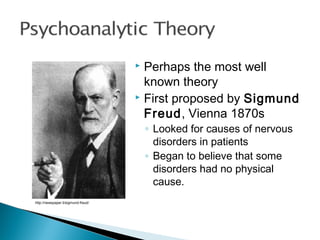
 Perhaps the most well
known theory
 First proposed by Sigmund
Freud, Vienna 1870s
◦ Looked for causes of nervous
disorders in patients
◦ Began to believe that some
disorders had no physical
cause.
http://newspaper.li/sigmund-freud/
http://members.shaw.ca/rgtonks/IntroB/Personality/iceberg.jpg
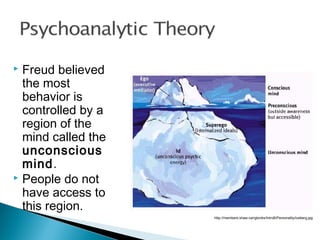
 Freud believed
the most
behavior is
controlled by a
region of the
mind called the
unconscious
mind.
 People do not
have access to
this region.
http://members.shaw.ca/rgtonks/IntroB/Personality/iceberg.jpg
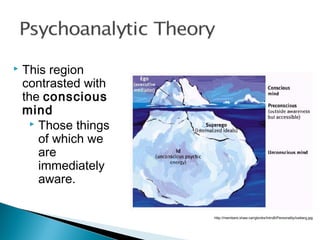
 This region
contrasted with
the conscious
mind
 Those things
of which we
are
immediately
aware.
http://members.shaw.ca/rgtonks/IntroB/Personality/iceberg.jpg
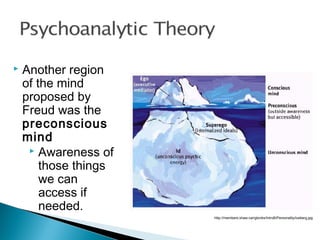
 Another region
of the mind
proposed by
Freud was the
preconscious
mind
 Awareness of
those things
we can
access if
needed.
http://reflow.scribd.com/16ud6w5c011t6xp/images/image-2.jpg
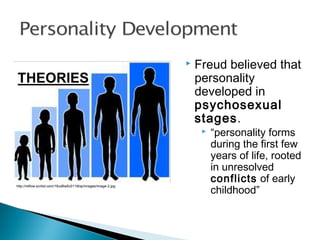
 Freud believed that
personality
developed in
psychosexual
stages.
 “personality forms
during the first few
years of life, rooted
in unresolved
conflicts of early
childhood”
http://www.makingthemodernworld.org.uk/learning_modules/p
sychology/02.TU.04/?section=12
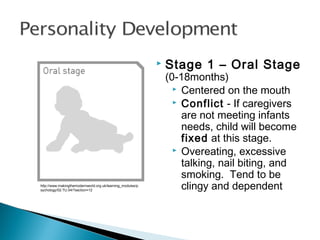
 Stage 1 – Oral Stage
(0-18months)
 Centered on the mouth
 Conflict - If caregivers
are not meeting infants
needs, child will become
fixed at this stage.
 Overeating, excessive
talking, nail biting, and
smoking. Tend to be
clingy and dependent
http://www.makingthemodernworld.org.uk/learnin
g_modules/psychology/02.TU.04/?section=12
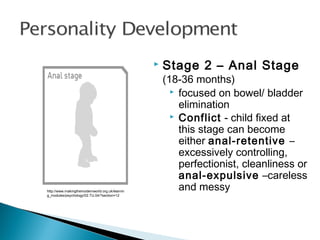
 Stage 2 – Anal Stage
(18-36 months)
 focused on bowel/ bladder
elimination
 Conflict - child fixed at
this stage can become
either anal-retentive –
excessively controlling,
perfectionist, cleanliness or
anal-expulsive –careless
and messy
http://www.makingthemodernworld.org.uk/learnin
g_modules/psychology/02.TU.04/?section=12
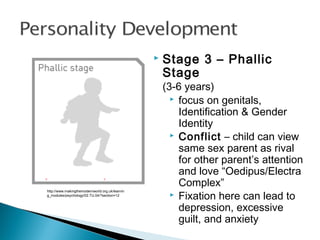
 Stage 3 – Phallic
Stage
(3-6 years)
 focus on genitals,
Identification & Gender
Identity
 Conflict – child can view
same sex parent as rival
for other parent’s attention
and love “Oedipus/Electra
Complex”
 Fixation here can lead to
depression, excessive
guilt, and anxiety
http://www.makingthemodernworld.org.uk/learnin
g_modules/psychology/02.TU.04/?section=12
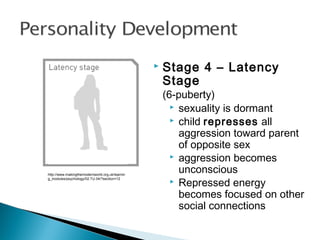
 Stage 4 – Latency
Stage
(6-puberty)
 sexuality is dormant
 child represses all
aggression toward parent
of opposite sex
 aggression becomes
unconscious
 Repressed energy
becomes focused on other
social connections
http://www.makingthemodernworld.org.uk/learning
_modules/psychology/02.TU.04/?section=12
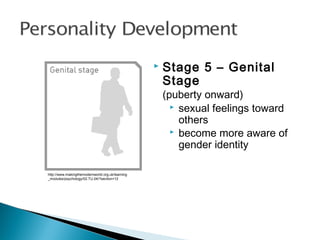
 Stage 5 – Genital
Stage
(puberty onward)
 sexual feelings toward
others
 become more aware of
gender identity
http://www.makingthemodernworld.org.uk/learning_modules/psychology/02.TU.04/?section=11
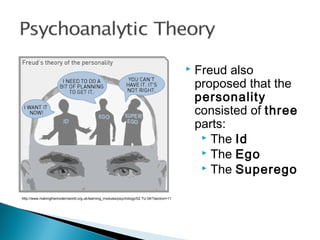
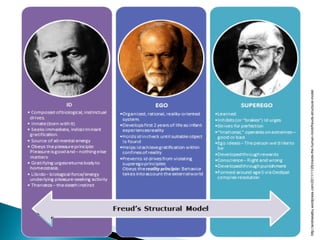
 Freud also
proposed that the
personality
consisted of three
parts:
 The Id
 The Ego
 The Superego
http://andreealbu.wordpress.com/2011/11/25/inside-the-human-mind/freuds-structural-model
http://www.makingthemodernworld.org.uk/learning_modules/psychology/02.TU.04/?section=11
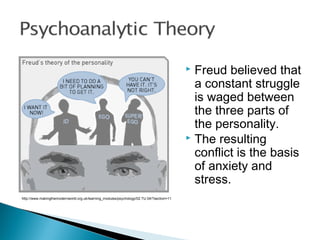
 Freud believed that
a constant struggle
is waged between
the three parts of
the personality.
 The resulting
conflict is the basis
of anxiety and
stress.
http://www.dynamicflight.com/avcfibook/human_behavior/
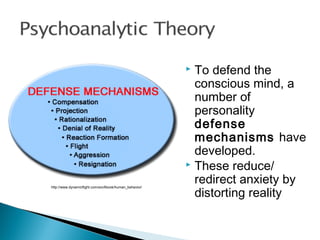
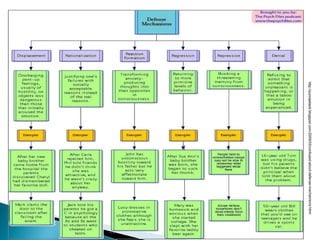
 To defend the
conscious mind, a
number of
personality
defense
mechanisms have
developed.
 These reduce/
redirect anxiety by
distorting reality
http://pumaattack.blogspot.com/2009/03/confused-about-defense-mechanisms.html
http://www.infowars.com/court-ordered-communism/
 Several of Freud’s
followers proposed
variants of his
psychoanalytical
theory.
 These theories are
often grouped as the
psychodynamic
perspective.
Carl Jung
http://www.counter-currents.com/2010/10/last-
encounter-with-carl-jung/
Alfred Adler
 Carl Jung also
believed in the
unconscious mind,
which he believed had
two parts.
 The first part he call
the personal
unconscious
(resembling Freud’s
theory)
http://www.schuelers.com/ChaosPsyche/part_1_17.htm
 The second part he
called the collective
unconscious,
universal memories of
the common human
past.
 These memories,
called archetypes,
have the same
meaning for all
human beings. http://everwalker.wordpress.com/2012/06/13/character-archetypes/
 Alfred Adler focused
on the role of the ego,
rather than the
unconscious.
 He believed the desire
for superiority
motivated behavior,
not sexual or
aggressive urges.
http://www.thesocialleader.com/2011/07/transcending-ego/
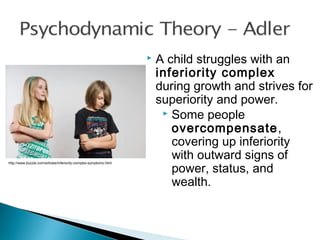
 A child struggles with an
inferiority complex
during growth and strives for
superiority and power.
 Some people
overcompensate,
covering up inferiority
with outward signs of
power, status, and
wealth.
http://www.buzzle.com/articles/inferiority-complex-symptoms.html
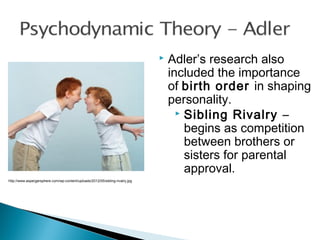
 Adler’s research also
included the importance
of birth order in shaping
personality.
 Sibling Rivalry –
begins as competition
between brothers or
sisters for parental
approval.
http://www.aspergersphere.com/wp-content/uploads/2012/05/sibling-rivalry.jpg
 Critics argue it is not possible to scientifically verify the
existence of Freud’s concepts.
 Others believe the theories are base on
overgeneralizations of small sample groups.
 Some critics believe it overestimates the importance of
early childhood and sex.
 Some find Freud’s theories do not portray female
personalities correctly.
 Finally, Freud’s theories, based on case studies, may be
based on memories that could be faulty.
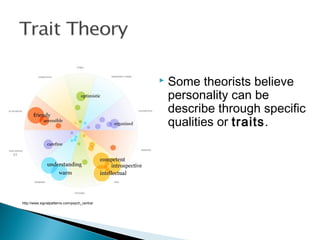
 Some theorists believe
personality can be
describe through specific
qualities or traits.
http://www.signalpatterns.com/psych_central
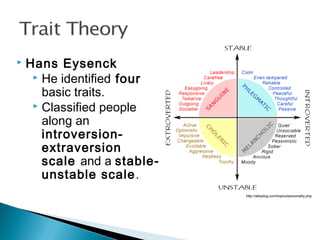
 Hans Eysenck
 He identified four
basic traits.
 Classified people
along an
introversion-
extraversion
scale and a stable-
unstable scale.
http://alleydog.com/topics/personality.php
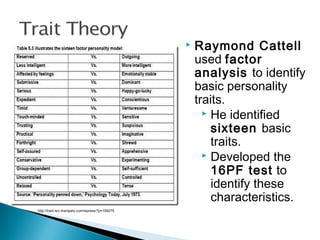
 Raymond Cattell
used factor
analysis to identify
basic personality
traits.
 He identified
sixteen basic
traits.
 Developed the
16PF test to
identify these
characteristics.
http://train-srv.manipalu.com/wpress/?p=159275
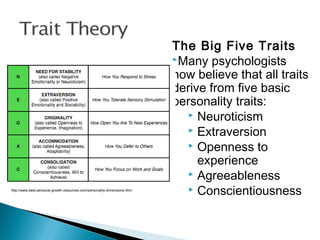
The Big Five Traits
Many psychologists
now believe that all traits
derive from five basic
personality traits:
 Neuroticism
 Extraversion
 Openness to
experience
 Agreeableness
 Conscientiousnesshttp://www.best-personal-growth-resources.com/personality-dimensions.html
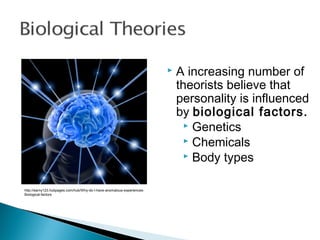
 A increasing number of
theorists believe that
personality is influenced
by biological factors.
 Genetics
 Chemicals
 Body types
http://earny123.hubpages.com/hub/Why-do-I-have-anomalous-experiences-
Biological-factors
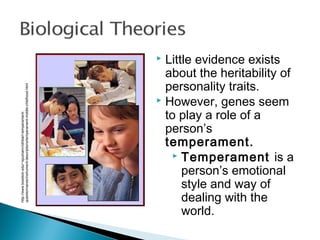
 Little evidence exists
about the heritability of
personality traits.
 However, genes seem
to play a role of a
person’s
temperament.
 Temperament is a
person’s emotional
style and way of
dealing with the
world.
http://www.bowdoin.edu/~sputnam/rothbart-temperament-
questionnaires/instrument-descriptions/temperament-middle-childhood.html
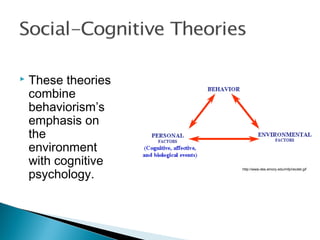
 These theories
combine
behaviorism’s
emphasis on
the
environment
with cognitive
psychology.
http://www.des.emory.edu/mfp/recdet.gif
 Albert Bandura believed
that personality is the result
of an interaction that takes
place between a person and
their social context.
 His model is called
reciprocal
determinism
 Each of three factors
influence the others in
determining personality.
http://theworldbiography.blogspot.com/2012/03/albert-
bandura-biography.html
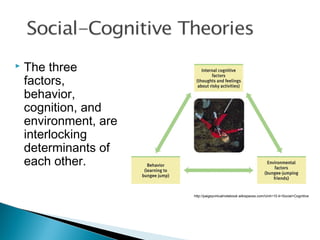
 The three
factors,
behavior,
cognition, and
environment, are
interlocking
determinants of
each other.
http://paigeyvirtualnotebook.wikispaces.com/Unit+10.4+Social+Cognitive
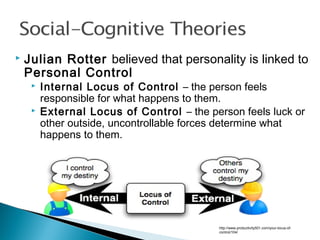
 Julian Rotter believed that personality is linked to
Personal Control
 Internal Locus of Control – the person feels
responsible for what happens to them.
 External Locus of Control – the person feels luck or
other outside, uncontrollable forces determine what
happens to them.
http://www.productivity501.com/your-locus-of-
control/104/
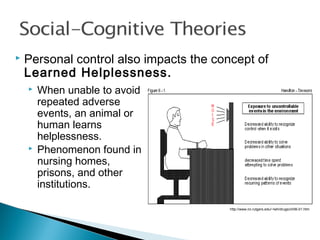
 Personal control also impacts the concept of
Learned Helplessness.
http://www.rci.rutgers.edu/~lwh/drugs/ch06-01.htm
 When unable to avoid
repeated adverse
events, an animal or
human learns
helplessness.
 Phenomenon found in
nursing homes,
prisons, and other
institutions.
http://wilderdom.com/personality/personality.html
 Humanists believe that
other theories are too
deterministic
 Emphasize the
positive qualities of
humans
 Believe humans
possess free will -
can choose their
own destiny.
http://thamisgith.hubpages.com/hub/Humanistic-Theory-Hierarchy-Of-Needs
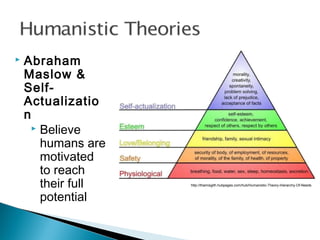
 Abraham
Maslow &
Self-
Actualizatio
n
 Believe
humans are
motivated
to reach
their full
potential
http://www.healthandphysicaleducationteacher.com/
mental-health/self-actualization.html/attachment/self-
actualization
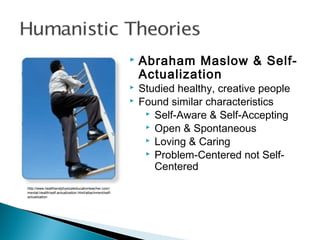
 Abraham Maslow & Self-
Actualization
 Studied healthy, creative people
 Found similar characteristics
 Self-Aware & Self-Accepting
 Open & Spontaneous
 Loving & Caring
 Problem-Centered not Self-
Centered
http://www.positive-parenting-ally.com/unconditional-
positive-regard.html
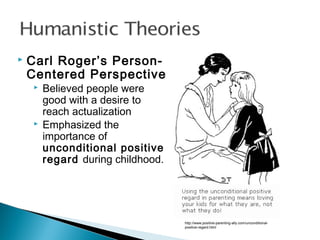
 Carl Roger’s Person-
Centered Perspective
 Believed people were
good with a desire to
reach actualization
 Emphasized the
importance of
unconditional positive
regard during childhood.
http://www.simplypsychology.org/carl-rogers.html
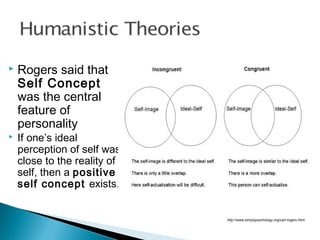
 Rogers said that
Self Concept
was the central
feature of
personality
 If one’s ideal
perception of self was
close to the reality of
self, then a positive
self concept exists.
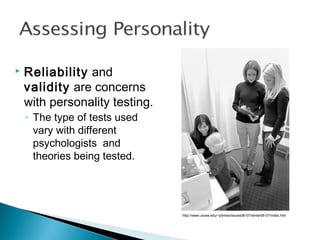
 Reliability and
validity are concerns
with personality testing.
◦ The type of tests used
vary with different
psychologists and
theories being tested.
http://www.uiowa.edu/~ptimes/issues06-07/winter06-07/index.htm
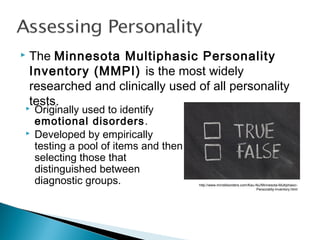
 The Minnesota Multiphasic Personality
Inventory (MMPI) is the most widely
researched and clinically used of all personality
tests. Originally used to identify
emotional disorders.
 Developed by empirically
testing a pool of items and then
selecting those that
distinguished between
diagnostic groups. http://www.minddisorders.com/Kau-Nu/Minnesota-Multiphasic-
Personality-Inventory.html
http://tonks.disted.camosun.bc.ca/courses/psyc130/Personality/personality.htm
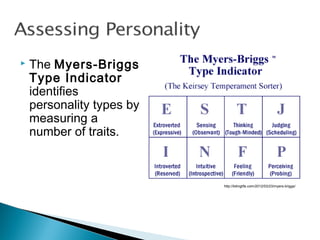
 The Myers-Briggs
Type Indicator
identifies
personality types by
measuring a
number of traits.
http://bitinglife.com/2012/03/23/myers-briggs/
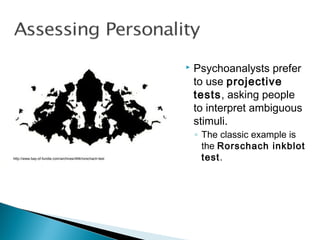
 Psychoanalysts prefer
to use projective
tests, asking people
to interpret ambiguous
stimuli.
◦ The classic example is
the Rorschach inkblot
test.http://www.bay-of-fundie.com/archives/494/rorschach-test
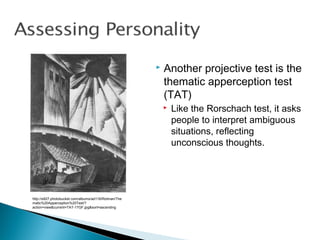
 Another projective test is the
thematic apperception test
(TAT)
 Like the Rorschach test, it asks
people to interpret ambiguous
situations, reflecting
unconscious thoughts.
http://s927.photobucket.com/albums/ad116/Rotman/The
matic%20Apperception%20Test/?
action=view&current=TAT-17GF.jpg&sort=ascending
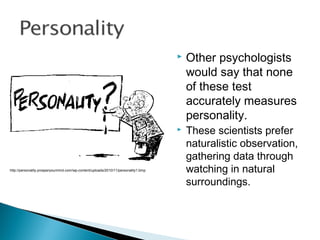
 Other psychologists
would say that none
of these test
accurately measures
personality.
 These scientists prefer
naturalistic observation,
gathering data through
watching in natural
surroundings.
http://personality.prosperyourmind.com/wp-content/uploads/2010/11/personality1.bmp
 Baucum, Don. Psychology. Hauppauge, NY: Barron's, 2006. Print.
 Baucum, Don. Psychology. Hauppauge, NY: Barron's Educational Series, 1999.
Print.
 Davis, Jennifer. Personality. Digital Presentation, Fayetteville, NC, 2012.
 "Motivation." SparkNotes. SparkNotes, n.d. Web. 23 June 2012.
<http://www.sparknotes.com/psychology/psych101/motivation/section2.rhtml>.
 Myers, David G. Myers' Psychology for AP. New York, NY: Worth, 2011. Print.
 Stangor, Charles. "Introduction to Psychology, v. 1.0." Flat World Knowledge. N.p.,
n.d. Web. 23 June 2012.
<http://catalog.flatworldknowledge.com/bookhub/reader/127?cid=>.
 Weseley, Allyson, and Robert McEntarffer. AP® Psychology. Hauppauge, NY:
Barron's Educational Series, 2010. Print.

Personality ppt

  • 1.
  • 2.
     Defined asthe unique pattern of attitudes, behaviors, and emotions than characterize a person. http://personality.prosperyourmind.com/wp-content/uploads/2010/11/personality1.bmp
  • 3.
     The fivemain theories of personality are: ◦ Psychoanalytic - unconscious motivations ◦ Trait - specific dimensions of personality ◦ Biological – influence of genetics ◦ Social-Cognitive - influence of environment ◦ Humanistic - inner capacity for growth http://personality.prosperyourmind.com/wp-content/uploads/2010/11/personality1.bmp
  • 4.
     Perhaps themost well known theory  First proposed by Sigmund Freud, Vienna 1870s ◦ Looked for causes of nervous disorders in patients ◦ Began to believe that some disorders had no physical cause. http://newspaper.li/sigmund-freud/
  • 5.
    http://members.shaw.ca/rgtonks/IntroB/Personality/iceberg.jpg  Freud believed themost behavior is controlled by a region of the mind called the unconscious mind.  People do not have access to this region.
  • 6.
    http://members.shaw.ca/rgtonks/IntroB/Personality/iceberg.jpg  This region contrastedwith the conscious mind  Those things of which we are immediately aware.
  • 7.
    http://members.shaw.ca/rgtonks/IntroB/Personality/iceberg.jpg  Another region ofthe mind proposed by Freud was the preconscious mind  Awareness of those things we can access if needed.
  • 8.
    http://reflow.scribd.com/16ud6w5c011t6xp/images/image-2.jpg  Freud believedthat personality developed in psychosexual stages.  “personality forms during the first few years of life, rooted in unresolved conflicts of early childhood”
  • 9.
    http://www.makingthemodernworld.org.uk/learning_modules/p sychology/02.TU.04/?section=12  Stage 1– Oral Stage (0-18months)  Centered on the mouth  Conflict - If caregivers are not meeting infants needs, child will become fixed at this stage.  Overeating, excessive talking, nail biting, and smoking. Tend to be clingy and dependent
  • 10.
    http://www.makingthemodernworld.org.uk/learnin g_modules/psychology/02.TU.04/?section=12  Stage 2– Anal Stage (18-36 months)  focused on bowel/ bladder elimination  Conflict - child fixed at this stage can become either anal-retentive – excessively controlling, perfectionist, cleanliness or anal-expulsive –careless and messy
  • 11.
    http://www.makingthemodernworld.org.uk/learnin g_modules/psychology/02.TU.04/?section=12  Stage 3– Phallic Stage (3-6 years)  focus on genitals, Identification & Gender Identity  Conflict – child can view same sex parent as rival for other parent’s attention and love “Oedipus/Electra Complex”  Fixation here can lead to depression, excessive guilt, and anxiety
  • 12.
    http://www.makingthemodernworld.org.uk/learnin g_modules/psychology/02.TU.04/?section=12  Stage 4– Latency Stage (6-puberty)  sexuality is dormant  child represses all aggression toward parent of opposite sex  aggression becomes unconscious  Repressed energy becomes focused on other social connections
  • 13.
    http://www.makingthemodernworld.org.uk/learning _modules/psychology/02.TU.04/?section=12  Stage 5– Genital Stage (puberty onward)  sexual feelings toward others  become more aware of gender identity
  • 14.
    http://www.makingthemodernworld.org.uk/learning_modules/psychology/02.TU.04/?section=11  Freud also proposedthat the personality consisted of three parts:  The Id  The Ego  The Superego
  • 15.
  • 16.
    http://www.makingthemodernworld.org.uk/learning_modules/psychology/02.TU.04/?section=11  Freud believedthat a constant struggle is waged between the three parts of the personality.  The resulting conflict is the basis of anxiety and stress.
  • 17.
    http://www.dynamicflight.com/avcfibook/human_behavior/  To defendthe conscious mind, a number of personality defense mechanisms have developed.  These reduce/ redirect anxiety by distorting reality
  • 18.
  • 19.
    http://www.infowars.com/court-ordered-communism/  Several ofFreud’s followers proposed variants of his psychoanalytical theory.  These theories are often grouped as the psychodynamic perspective. Carl Jung http://www.counter-currents.com/2010/10/last- encounter-with-carl-jung/ Alfred Adler
  • 20.
     Carl Jungalso believed in the unconscious mind, which he believed had two parts.  The first part he call the personal unconscious (resembling Freud’s theory) http://www.schuelers.com/ChaosPsyche/part_1_17.htm
  • 21.
     The secondpart he called the collective unconscious, universal memories of the common human past.  These memories, called archetypes, have the same meaning for all human beings. http://everwalker.wordpress.com/2012/06/13/character-archetypes/
  • 22.
     Alfred Adlerfocused on the role of the ego, rather than the unconscious.  He believed the desire for superiority motivated behavior, not sexual or aggressive urges. http://www.thesocialleader.com/2011/07/transcending-ego/
  • 23.
     A childstruggles with an inferiority complex during growth and strives for superiority and power.  Some people overcompensate, covering up inferiority with outward signs of power, status, and wealth. http://www.buzzle.com/articles/inferiority-complex-symptoms.html
  • 24.
     Adler’s researchalso included the importance of birth order in shaping personality.  Sibling Rivalry – begins as competition between brothers or sisters for parental approval. http://www.aspergersphere.com/wp-content/uploads/2012/05/sibling-rivalry.jpg
  • 25.
     Critics argueit is not possible to scientifically verify the existence of Freud’s concepts.  Others believe the theories are base on overgeneralizations of small sample groups.  Some critics believe it overestimates the importance of early childhood and sex.  Some find Freud’s theories do not portray female personalities correctly.  Finally, Freud’s theories, based on case studies, may be based on memories that could be faulty.
  • 26.
     Some theoristsbelieve personality can be describe through specific qualities or traits. http://www.signalpatterns.com/psych_central
  • 27.
     Hans Eysenck He identified four basic traits.  Classified people along an introversion- extraversion scale and a stable- unstable scale. http://alleydog.com/topics/personality.php
  • 28.
     Raymond Cattell usedfactor analysis to identify basic personality traits.  He identified sixteen basic traits.  Developed the 16PF test to identify these characteristics. http://train-srv.manipalu.com/wpress/?p=159275
  • 29.
    The Big FiveTraits Many psychologists now believe that all traits derive from five basic personality traits:  Neuroticism  Extraversion  Openness to experience  Agreeableness  Conscientiousnesshttp://www.best-personal-growth-resources.com/personality-dimensions.html
  • 30.
     A increasingnumber of theorists believe that personality is influenced by biological factors.  Genetics  Chemicals  Body types http://earny123.hubpages.com/hub/Why-do-I-have-anomalous-experiences- Biological-factors
  • 31.
     Little evidenceexists about the heritability of personality traits.  However, genes seem to play a role of a person’s temperament.  Temperament is a person’s emotional style and way of dealing with the world. http://www.bowdoin.edu/~sputnam/rothbart-temperament- questionnaires/instrument-descriptions/temperament-middle-childhood.html
  • 32.
     These theories combine behaviorism’s emphasison the environment with cognitive psychology. http://www.des.emory.edu/mfp/recdet.gif
  • 33.
     Albert Bandurabelieved that personality is the result of an interaction that takes place between a person and their social context.  His model is called reciprocal determinism  Each of three factors influence the others in determining personality. http://theworldbiography.blogspot.com/2012/03/albert- bandura-biography.html
  • 34.
     The three factors, behavior, cognition,and environment, are interlocking determinants of each other. http://paigeyvirtualnotebook.wikispaces.com/Unit+10.4+Social+Cognitive
  • 35.
     Julian Rotterbelieved that personality is linked to Personal Control  Internal Locus of Control – the person feels responsible for what happens to them.  External Locus of Control – the person feels luck or other outside, uncontrollable forces determine what happens to them. http://www.productivity501.com/your-locus-of- control/104/
  • 36.
     Personal controlalso impacts the concept of Learned Helplessness. http://www.rci.rutgers.edu/~lwh/drugs/ch06-01.htm  When unable to avoid repeated adverse events, an animal or human learns helplessness.  Phenomenon found in nursing homes, prisons, and other institutions.
  • 37.
    http://wilderdom.com/personality/personality.html  Humanists believethat other theories are too deterministic  Emphasize the positive qualities of humans  Believe humans possess free will - can choose their own destiny.
  • 38.
  • 39.
    http://www.healthandphysicaleducationteacher.com/ mental-health/self-actualization.html/attachment/self- actualization  Abraham Maslow& Self- Actualization  Studied healthy, creative people  Found similar characteristics  Self-Aware & Self-Accepting  Open & Spontaneous  Loving & Caring  Problem-Centered not Self- Centered
  • 40.
    http://www.positive-parenting-ally.com/unconditional- positive-regard.html  Carl Roger’sPerson- Centered Perspective  Believed people were good with a desire to reach actualization  Emphasized the importance of unconditional positive regard during childhood.
  • 41.
    http://www.simplypsychology.org/carl-rogers.html  Rogers saidthat Self Concept was the central feature of personality  If one’s ideal perception of self was close to the reality of self, then a positive self concept exists.
  • 42.
     Reliability and validityare concerns with personality testing. ◦ The type of tests used vary with different psychologists and theories being tested. http://www.uiowa.edu/~ptimes/issues06-07/winter06-07/index.htm
  • 43.
     The MinnesotaMultiphasic Personality Inventory (MMPI) is the most widely researched and clinically used of all personality tests. Originally used to identify emotional disorders.  Developed by empirically testing a pool of items and then selecting those that distinguished between diagnostic groups. http://www.minddisorders.com/Kau-Nu/Minnesota-Multiphasic- Personality-Inventory.html
  • 44.
  • 45.
     The Myers-Briggs TypeIndicator identifies personality types by measuring a number of traits. http://bitinglife.com/2012/03/23/myers-briggs/
  • 46.
     Psychoanalysts prefer touse projective tests, asking people to interpret ambiguous stimuli. ◦ The classic example is the Rorschach inkblot test.http://www.bay-of-fundie.com/archives/494/rorschach-test
  • 47.
     Another projectivetest is the thematic apperception test (TAT)  Like the Rorschach test, it asks people to interpret ambiguous situations, reflecting unconscious thoughts. http://s927.photobucket.com/albums/ad116/Rotman/The matic%20Apperception%20Test/? action=view&current=TAT-17GF.jpg&sort=ascending
  • 48.
     Other psychologists wouldsay that none of these test accurately measures personality.  These scientists prefer naturalistic observation, gathering data through watching in natural surroundings. http://personality.prosperyourmind.com/wp-content/uploads/2010/11/personality1.bmp
  • 49.
     Baucum, Don.Psychology. Hauppauge, NY: Barron's, 2006. Print.  Baucum, Don. Psychology. Hauppauge, NY: Barron's Educational Series, 1999. Print.  Davis, Jennifer. Personality. Digital Presentation, Fayetteville, NC, 2012.  "Motivation." SparkNotes. SparkNotes, n.d. Web. 23 June 2012. <http://www.sparknotes.com/psychology/psych101/motivation/section2.rhtml>.  Myers, David G. Myers' Psychology for AP. New York, NY: Worth, 2011. Print.  Stangor, Charles. "Introduction to Psychology, v. 1.0." Flat World Knowledge. N.p., n.d. Web. 23 June 2012. <http://catalog.flatworldknowledge.com/bookhub/reader/127?cid=>.  Weseley, Allyson, and Robert McEntarffer. AP® Psychology. Hauppauge, NY: Barron's Educational Series, 2010. Print.

Editor's Notes

  • #3 Personality Defined as the unique pattern of attitudes, behaviors, and emotions than characterize a person.
  • #4 The four main theories of personality are: Psychoanalytic - unconscious motivations Trait - specific dimensions of personality Biological – influence of genetics Social-Cognitive - influence of environment Humanistic - inner capacity for growth
  • #5 Psychoanalytic Theory Perhaps the most well known theory First proposed by Sigmund Freud, Vienna 1870s Looked for causes of nervous disorders in patients Began to believe that some disorders had no physical cause.
  • #6 Personality Freud believed the most behavior is controlled by a region of the mind called the unconscious mind. People do not have access to this region.
  • #7 Personality This region contrasted with the conscious mind Those things of which we are immediately aware.
  • #8 Personality Another region of the mind proposed by Freud was the preconscious mind Awareness of those things we can access if needed.
  • #9 Personality Development Freud believed that personality developed in psychosexual stages. “personality forms during the first few years of life, rooted in unresolved conflicts of early childhood”
  • #10 Stage 1 – Oral Stage (0-18mos) Centered on the mouth Conflict - If caregivers are not meeting infants needs, child will become fixed at this stage. Overeating, excessive talking, nail biting, and smoking. Tend to be clingy and dependent
  • #11 Stage 2 – Anal Stage(18-36 months) focused on bowel/ bladder elimination Conflict - child fixed at this stage can become either anal-retentive – excessively controlling, perfectionist, cleanliness or anal-expulsive –careless and messy
  • #12 Stage 3 – Phallic Stage(3-6 years) focus on genitals, Identification &amp; Gender Identity Conflict – child can view same sex parent as rival for other parent’s attention and love “Oedipus/Electra Complex” Fixation here can lead to depression, excessive guilt, and anxiety
  • #13 Stage 4 – Latency Stage(6-puberty) sexuality is dormant child represses all aggression toward parent of opposite sex aggression becomes unconscious
  • #14 Stage 5 – Genital Stage(puberty onward) sexual feelings toward others become more aware of gender identity
  • #15 Freud also proposed that the personality consisted of three parts: The Id The Ego The Superego
  • #16 Image illustrating characteristics of Freud’s Structural Model
  • #17 Freud believed that a constant struggle is waged between the three parts of the personality. The resulting conflict is the basis of anxiety and stress.
  • #18 To defend the conscious mind (ego), a number of personality defense mechanisms have developed. These reduce/ redirect anxiety by distorting reality
  • #19 Chart describing key defense mechanisms with examples.
  • #20 Psychodynamic Theory Several of Freud’s followers proposed variants of his psychoanalytical theory. These theories are often grouped as the psychodynamic perspective.
  • #21 Psychodynamic Theory – Jung Jung also believed in the unconscious mind, which he believed had two parts. The first part he call the personal unconscious (resembling Freud’s theory)
  • #22 Psychodynamic Theory – Jung The second part he call the collective unconscious, universal memories of the common human past. These memories, called archetypes, have the same meaning for all human beings.
  • #23 Psychodynamic Theory – Adler Alfred Adler focused on the role of the ego, rather than the unconscious. He believed the desire for superiority motivated behavior, not sexual or aggressive urges.
  • #24 Psychodynamic Theory – Adler A child struggles with an inferiority complex during growth and strives for superiority and power. Some people overcompensate, covering up inferiority with outward signs of power, status, and wealth.
  • #25 Psychodynamic Theory – Adler Adler’s research also included the importance of birth order in shaping personality. Sibling Rivalry –begins as competition between brothers or sisters for parental approval.
  • #26 Critics argue it is not possible to empirically verify the existence of Freud’s constructs. Some critics believe it overestimates the importance of early childhood and sex. Some find Freud’s theories do not portray female personalities correctly. Finally, Freud’s theories can be used to explain behavior, but not predict future behaviors.
  • #27 Trait Theory Some theorists believe personality can be describe through specific qualities or traits.
  • #28 Trait Theory Hans Eysenck He identified four basic traits. Classified people along an introversion-extraversion scale and a stable-unstable scale.
  • #29 Trait Theory Raymond Cattell used factor analysis to identify basic personality traits. He identified sixteen basic traits. Developed the 16PF test to identify these characteristics.
  • #30 Trait Theory The Big Five Traits Many psychologists now believe that all traits derive from five basic personality traits: Neuroticism Extraversion Openness to experience Agreeableness Conscientiousness
  • #31 Biological Theories A increasing number of theorists believe that personality is influenced by biological factors. Genetics Chemicals Body types
  • #32 Biological Theories Little evidence exists about the heritability of personality traits. However, genes seem to play a role of a person’s temperament. Temperament is a person’s emotional style and way of dealing with the world.
  • #33 Social-Cognitive Theories These theories combine behaviorism’s emphasis on the environment with cognitive psychology.
  • #34 Social-Cognitive Theories Albert Bandura believed that personality is the result of an interaction that takes place between a person and their social context. His model is called reciprocal determinism Each of three factors influence the others in determining personality.
  • #35 Reciprocal Influences The three factors, behavior, cognition, and environment, are interlocking determinants of each other.
  • #36 Social-Cognitive Theories Julian Rotter believed that a person has either an internal or external Locus of Control Internal Locus of Control – the person feels responsible for what happens to them. External Locus of Control – the person feels luck or other outside, uncontrollable forces determine what happens to them.
  • #37 Social-Cognitive Theories Personal control also impacts the concept of Learned Helplessness. When unable to avoid repeated adverse events, an animal or human learns helplessness. Phenomenon found in nursing homes, prisons, and other institutions.
  • #38 Humanistic Theories Humanists believe that other theories are too deterministic Emphasize the positive qualities of humans Believe humans possess free will can choose their own destiny.
  • #39 Humanistic Theories Abraham Maslow &amp; Self-Actualization Believe humans are motivated to reach their full potential
  • #40 Humanistic Theories Abraham Maslow &amp; Self-Actualization Studied healthy, creative people Found similar characteristics Self-Aware &amp; Self-Accepting Open &amp; Spontaneous Loving &amp; Caring Problem-Centered not Self-Centered
  • #41 Humanistic Theories Carl Roger’s Person-Centered Perspective Believed people were good with a desire to reach actualization Emphasized the importance of unconditional positive regard during childhood.
  • #42 Humanistic Theories Rogers said that Self Concept was the central feature of personality If one’s ideal perception of self was close to the reality of self, then a positive self concept exists.
  • #43 Assessing Personality Reliability and validity are concerns with personality testing. The type of tests used vary with different psychologists and theories being tested.
  • #44 Assessing Personality The Minnesota Multiphasic Personality Inventory (MMPI) is the most widely researched and clinically used of all personality tests. Originally used to identify emotional disorders. Developed by empirically testing a pool of items and then selecting those that distinguished between diagnostic groups.
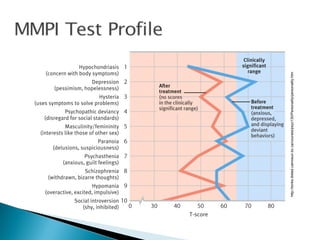
  • #45 Image showing an example MMPI Test Profile
  • #46 Assessing Personality The Myers-Briggs Type Indicator identifies personality types by measuring a number of traits.
  • #47 Assessing Personality Psychoanalysts prefer to use projective tests, asking people to interpret ambiguous stimuli. The classic example is the Rorschach inkblot test.
  • #48 Assessing Personality Another projective test is the thematic apperception test (TAT) Like the Rorschach test, it asks people to interpret ambiguous situations, reflecting unconscious thoughts.
  • #49 Personality Other psychologists would say that none of these test accurately measures personality. These scientists prefer naturalistic observation, gathering data through watching in natural surroundings.