Management of post extraction
bleeding
Dr. Naveed Iqbal
Prevention of excessive bleeding
• Obtain history of prolonged bleeding, previous
episode of bleeding, family history and drug
history.
• Use atraumatic surgical technique
• Obtain good hemostasis at surgery
• Provide excellent patient instruction.
• INR is used to measure therapeutic
anticoagulation effects. Minor surgery can be
performed if INR is 3.0. if INR is more than 3.0
consult physician.
Primary control of bleeding
• Give clean incisions avoid crushing of soft tissues.
• Smooth sharp bony spicules.
• Curette all granulation tissue but avoid maxillary sinus and ID
canal.
• Inspect the soft tissue wound to locate obvious bleeding
vessels. If present apply pressure or ligate the artery with
resorbable sutures.
• Inspect bleeding from bone, bleeding from small isolated
vessel from bleeding foramen. Foramen should be crushed
with closed end of hemostat.
• Apply damp gauze pack directly over extraction socket.
• Patient should bite firmly on gauze for 30 min.
• Do not dismiss the patient until hemostasis is achieved.
• Check extraction socket after 30 min if bleeding is under
control apply a new damp gauze pack and instruct the patient
to bite on it for 30 min.
Primary control of bleeding
• If bleeding persists and it is not of arterial
origin surgeon should take additional
measures to control bleeding
• Application of gelatin sponge (gel foam)
• Application of oxidized regenerated cellulose.
• Application of topical thrombin.
• Application of collagen
Gelfoam
• Gelfoam is one of the more commonly employed
agents for the control of minor bleeding. It is a
porous, pliable sponge made from dried and
sterilized porcine skin gelatin.
• Gelfoam’s mode of action is not completely
understood, but unlike collagen, it is believed to
be related to formation of a mechanical matrix
that facilitates clotting rather than affecting the
blood-clotting mechanism.
Oxidized regenerated cellulose
( surgicel)
• Cellulose, oxidized regenerated is saturated
with blood at the bleeding site and swells into
a brownish or black gelatinous mass which
aids in the formation of a clot. When used in
small amounts, it is absorbed from the sites of
implantation with little or no tissue reaction.
In addition to providing hemostasis, oxidized
regenerated cellulose also has been shown to
have bactericidal properties.
Absorable Collagen (avitene, Collaplug,
Collatape)
• On contact with blood, collagen is known to
cause aggregation of platelets. Platelets
deposit in large numbers on the collagen
structure, degranulate, and release
coagulation factors that, together with plasma
factors, enable the formation of fibrin.
• It is of bovine origin.
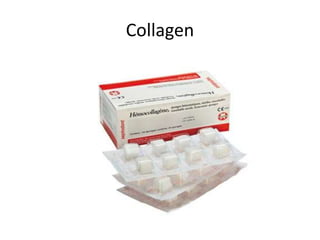
Collagen
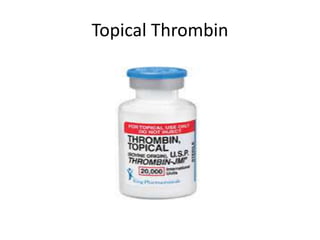
Topical Thrombin
• Bovine origin Thrombin converts fibrinogen
into fibrin thus helps in clotting.
• It is available as powder and applied in
combination with gelfoam on bleeding
surface.
Topical Thrombin
Secondary Bleeding
• Occasionally even after primary control of bleeding is
achieved patient report the dental surgeon regarding
bleeding this bleeding is termed as secondary
haemorrhage.
• In these cases when patient calls from home instruct
the patient to rinse the mouth gently with chilled
water, and place a damp gauze over extraction site and
bite firmly for 30 minutes.
• If bleeding continues instruct to rinse mouth with
chilled water and bite over damp tea bag.
• If these measures fails instruct the patient to return to
dental office.
Management of secondary bleeding
• Place the patient on dental chair, suction all fluids
from mouth, and inspect the bleeding site with
good light to determine precise source of
bleeding.
• If there is generalized oozing, the bleeding site is
covered with damp gauze and surgeon should
apply finger pressure for 5 minutes.
• The cause of bleeding is secondary trauma
caused by negative pressure or excessive spitting.
Management of secondary bleeding
• If 5 minutes of this treatment fails to control bleeding,
administer local anesthesia block, its better to avoid
infiltration as temporary vasoconstriction effects of
epinephrine fades and reactionary bleeding occurs.
• After local anesthesia, curette the socket, and locate
point of bleeding. Bleeding can be from soft tissue or
nutrient artery from bone.
• Place gelatin sponge with topical thrombin in the
socket with the help of figure of 8 suture and damp
gauze pack should placed over it.
• Monitor the patient in office for 30 minutes, give
instructions and discharge.
Management of secondary bleeding
• If bleeding persists perform coagulation
profile screening tests to detect any major
clotting defect. PT, APTT, BT
• Take opinion of hematologist and manage
accordingly.

Management of post extraction bleeding

  • 1.
    Management of postextraction bleeding Dr. Naveed Iqbal
  • 2.
    Prevention of excessivebleeding • Obtain history of prolonged bleeding, previous episode of bleeding, family history and drug history. • Use atraumatic surgical technique • Obtain good hemostasis at surgery • Provide excellent patient instruction. • INR is used to measure therapeutic anticoagulation effects. Minor surgery can be performed if INR is 3.0. if INR is more than 3.0 consult physician.
  • 3.
    Primary control ofbleeding • Give clean incisions avoid crushing of soft tissues. • Smooth sharp bony spicules. • Curette all granulation tissue but avoid maxillary sinus and ID canal. • Inspect the soft tissue wound to locate obvious bleeding vessels. If present apply pressure or ligate the artery with resorbable sutures. • Inspect bleeding from bone, bleeding from small isolated vessel from bleeding foramen. Foramen should be crushed with closed end of hemostat. • Apply damp gauze pack directly over extraction socket. • Patient should bite firmly on gauze for 30 min. • Do not dismiss the patient until hemostasis is achieved. • Check extraction socket after 30 min if bleeding is under control apply a new damp gauze pack and instruct the patient to bite on it for 30 min.
  • 4.
    Primary control ofbleeding • If bleeding persists and it is not of arterial origin surgeon should take additional measures to control bleeding • Application of gelatin sponge (gel foam) • Application of oxidized regenerated cellulose. • Application of topical thrombin. • Application of collagen
  • 5.
    Gelfoam • Gelfoam isone of the more commonly employed agents for the control of minor bleeding. It is a porous, pliable sponge made from dried and sterilized porcine skin gelatin. • Gelfoam’s mode of action is not completely understood, but unlike collagen, it is believed to be related to formation of a mechanical matrix that facilitates clotting rather than affecting the blood-clotting mechanism.
  • 6.
    Oxidized regenerated cellulose (surgicel) • Cellulose, oxidized regenerated is saturated with blood at the bleeding site and swells into a brownish or black gelatinous mass which aids in the formation of a clot. When used in small amounts, it is absorbed from the sites of implantation with little or no tissue reaction. In addition to providing hemostasis, oxidized regenerated cellulose also has been shown to have bactericidal properties.
  • 7.
    Absorable Collagen (avitene,Collaplug, Collatape) • On contact with blood, collagen is known to cause aggregation of platelets. Platelets deposit in large numbers on the collagen structure, degranulate, and release coagulation factors that, together with plasma factors, enable the formation of fibrin. • It is of bovine origin.
  • 8.
  • 9.
    Topical Thrombin • Bovineorigin Thrombin converts fibrinogen into fibrin thus helps in clotting. • It is available as powder and applied in combination with gelfoam on bleeding surface.
  • 10.
  • 11.
    Secondary Bleeding • Occasionallyeven after primary control of bleeding is achieved patient report the dental surgeon regarding bleeding this bleeding is termed as secondary haemorrhage. • In these cases when patient calls from home instruct the patient to rinse the mouth gently with chilled water, and place a damp gauze over extraction site and bite firmly for 30 minutes. • If bleeding continues instruct to rinse mouth with chilled water and bite over damp tea bag. • If these measures fails instruct the patient to return to dental office.
  • 12.
    Management of secondarybleeding • Place the patient on dental chair, suction all fluids from mouth, and inspect the bleeding site with good light to determine precise source of bleeding. • If there is generalized oozing, the bleeding site is covered with damp gauze and surgeon should apply finger pressure for 5 minutes. • The cause of bleeding is secondary trauma caused by negative pressure or excessive spitting.
  • 13.
    Management of secondarybleeding • If 5 minutes of this treatment fails to control bleeding, administer local anesthesia block, its better to avoid infiltration as temporary vasoconstriction effects of epinephrine fades and reactionary bleeding occurs. • After local anesthesia, curette the socket, and locate point of bleeding. Bleeding can be from soft tissue or nutrient artery from bone. • Place gelatin sponge with topical thrombin in the socket with the help of figure of 8 suture and damp gauze pack should placed over it. • Monitor the patient in office for 30 minutes, give instructions and discharge.
  • 14.
    Management of secondarybleeding • If bleeding persists perform coagulation profile screening tests to detect any major clotting defect. PT, APTT, BT • Take opinion of hematologist and manage accordingly.