CASTING DEFECTS
CONTENTS:
• Introduction
• Classification of casting defects
• Types of casting defects
• Conclusion
• References
INTRODUCTION
• The dental profession has used precision-type
castings for the most part of century. Using the
lost wax technique, Taggart in 1907 developed a
process for making castings used in restoration of
prepared teeth. Since the process did not take into
account all the dimensional changes associated
with the casting technique, the resultant product
did exhibit some problems in terms of
dimensional accuracy.
Casting :
• It is the process in which molten material is
thrown into a mold and allowed to harden into
the shape of the mold.
Casting defect:
• Casting defects occur when there is discrepancy in
any of the steps followed right through impression
making , pouring cast, fabrication of wax pattern to
investing and casting procedure's.
Mahalaxmi chp 27 pg no. 532
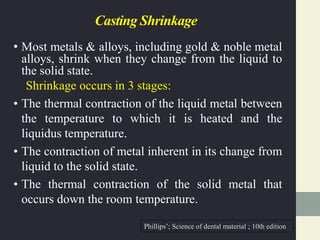
Casting Shrinkage
• Most metals & alloys, including gold & noble metal
alloys, shrink when they change from the liquid to
the solid state.
Shrinkage occurs in 3 stages:
• The thermal contraction of the liquid metal between
the temperature to which it is heated and the
liquidus temperature.
• The contraction of metal inherent in its change from
liquid to the solid state.
• The thermal contraction of the solid metal that
occurs down the room temperature.
Phillips’; Science of dental material ; 10th edition
CASTING- LOST WAX PROCEDURE
The process involves producing a metal casting using
a refractory mould made from a wax replica pattern.
The steps involved in the process or the lost wax
casting are:
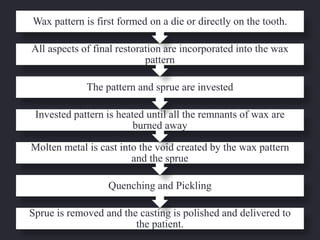
Sprue is removed and the casting is polished and delivered to
the patient.
Quenching and Pickling
Molten metal is cast into the void created by the wax pattern
and the sprue
Invested pattern is heated until all the remnants of wax are
burned away
The pattern and sprue are invested
All aspects of final restoration are incorporated into the wax
pattern
Wax pattern is first formed on a die or directly on the tooth.
CLASSIFICATION CASTING
DEFECTS
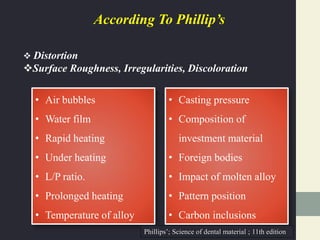
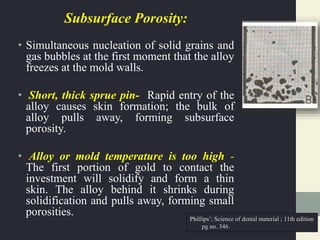
According To Phillip’s
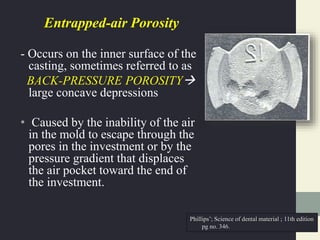
 Distortion
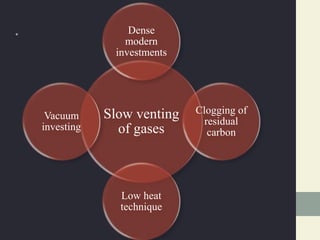
Surface Roughness, Irregularities, Discoloration
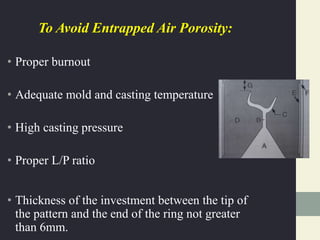
• Air bubbles
• Water film
• Rapid heating
• Under heating
• L/P ratio.
• Prolonged heating
• Temperature of alloy
• Casting pressure
• Composition of
investment material
• Foreign bodies
• Impact of molten alloy
• Pattern position
• Carbon inclusions
Phillips’; Science of dental material ; 11th edition
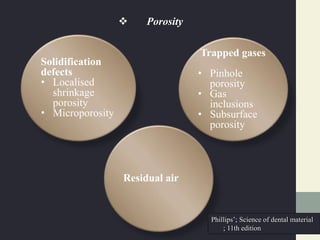
Solidification
defects
• Localised
shrinkage
porosity
• Microporosity
Trapped gases
• Pinhole
porosity
• Gas
inclusions
• Subsurface
porosity
Residual air
 Porosity
Phillips’; Science of dental material
; 11th edition
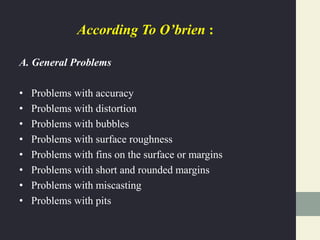
According To O’brien :
A. General Problems
• Problems with accuracy
• Problems with distortion
• Problems with bubbles
• Problems with surface roughness
• Problems with fins on the surface or margins
• Problems with short and rounded margins
• Problems with miscasting
• Problems with pits
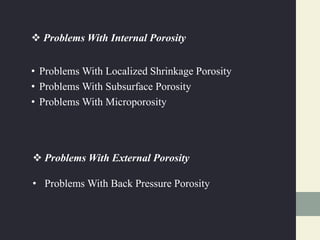
 Problems With Internal Porosity
• Problems With Localized Shrinkage Porosity
• Problems With Subsurface Porosity
• Problems With Microporosity
 Problems With External Porosity
• Problems With Back Pressure Porosity
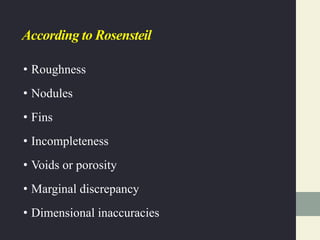
According to Rosensteil
• Roughness
• Nodules
• Fins
• Incompleteness
• Voids or porosity
• Marginal discrepancy
• Dimensional inaccuracies
TYPES OF CASTING DEFECTS
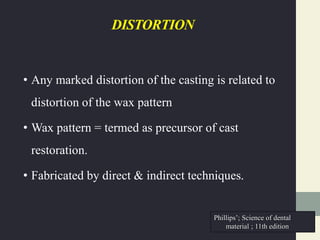
DISTORTION
• Any marked distortion of the casting is related to
distortion of the wax pattern
• Wax pattern = termed as precursor of cast
restoration.
• Fabricated by direct & indirect techniques.
Phillips’; Science of dental
material ; 11th edition
Causes Of Distortion :
• Improper handling during removal of wax pattern
• Wax too hot- Excessive shrinkage results on
cooling.
• Wax too cool- The pattern undergoes stress
release with change in shape.
• Setting and hygroscopic expansions of the
investment may produce a non uniform expansion
of the walls of the pattern.
Phillips’; Science of dental material ; 11th edition
& Mahalaxmi chp 27
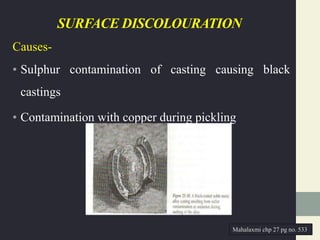
SURFACE DISCOLOURATION
Causes-
• Sulphur contamination of casting causing black
castings
• Contamination with copper during pickling
Mahalaxmi chp 27 pg no. 533
SURFACE DISCOLOURATION
Solution-
• Avoid overheating of investment
• Avoid use of torch flame
• Avoid use of steel tongs to hold casting during
pickling
• Castings should never be placed with amalgam dies
or kept on a table where amalgam scrap is present
Mahalaxmi chp 27 pg no. 533
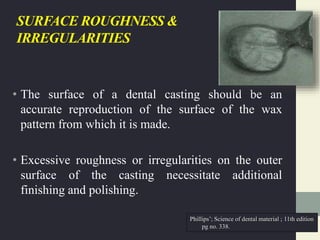
SURFACE ROUGHNESS &
IRREGULARITIES
• The surface of a dental casting should be an
accurate reproduction of the surface of the wax
pattern from which it is made.
• Excessive roughness or irregularities on the outer
surface of the casting necessitate additional
finishing and polishing.
Phillips’; Science of dental material ; 11th edition
pg no. 338.
Surface Roughness
Defined:
• Relatively finely spaced surface imperfections
whose height, width, and direction establish the
predominant surface pattern.
Phillips’; Science of dental material ; 11th edition
pg no. 338.
 Causes Of Surface Roughness:
• Breakdown of the investment at excessive
burnout temperature.
• Alloy pre heated to higher temperature.
• More force is generated in flow of molten
alloy.
• Water/powder ratio- a high ratio increases the
roughness of the mold.
• Excess wetting agent or salivary contamination -
this may form a film on the pattern surface and
be reproduced on the casting surface.
• Prolonged heating or overheating of the mold -
may cause investment disintegration, roughness
appears general and feels sharp.
Surface Irregularities
• Surface irregularities are isolated imperfections,
such as nodules, that are not characteristic of the
entire surface area.
Phillips’; Science of dental material ; 11th edition
pg no. 338.
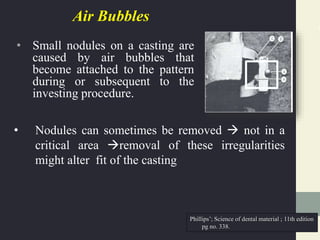
Air Bubbles
• Small nodules on a casting are
caused by air bubbles that
become attached to the pattern
during or subsequent to the
investing procedure.
• Nodules can sometimes be removed  not in a
critical area removal of these irregularities
might alter fit of the casting
Phillips’; Science of dental material ; 11th edition
pg no. 338.
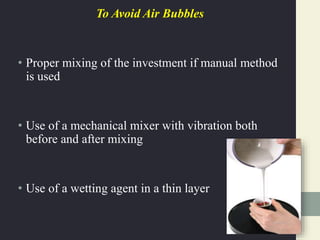
To Avoid Air Bubbles
• Proper mixing of the investment if manual method
is used
• Use of a mechanical mixer with vibration both
before and after mixing
• Use of a wetting agent in a thin layer
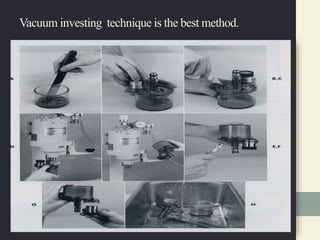
Vacuum investing technique is the best method.
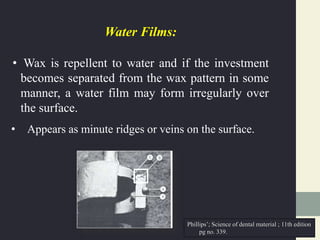
Water Films:
• Wax is repellent to water and if the investment
becomes separated from the wax pattern in some
manner, a water film may form irregularly over
the surface.
• Appears as minute ridges or veins on the surface.
Phillips’; Science of dental material ; 11th edition
pg no. 339.
• Too high P/L ratios .
• Pattern is slightly moved, or vibrated after
investing or if the painting procedure does not
result in an intimate contact of the investment
with the wax pattern .
Phillips’; Science of dental material ; 11th edition
pg no. 339
To Avoid Water Films
• Use of a wetting agent in a thin layer
• Using Correct water - powder ratio
Phillips’; Science of dental material ; 11th edition
pg no. 339.
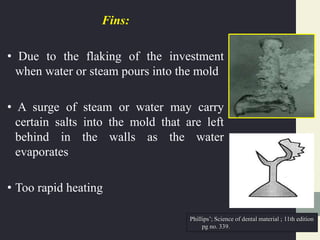
Fins:
• Due to the flaking of the investment
when water or steam pours into the mold
• A surge of steam or water may carry
certain salts into the mold that are left
behind in the walls as the water
evaporates
• Too rapid heating
Phillips’; Science of dental material ; 11th edition
pg no. 339.
To Avoid Fins Or Spines
• Gradual heating of the mold- at least 60 min should
elapse during the heating of the investment from
room temperature to 700º C.
• Greater the bulk of the investment, more slowly it
should be heated.
Phillips’; Science of dental material ; 11th edition
pg no. 339.
Underheating:
• Incomplete elimination of wax residues
• Voids or porosity may occur in the casting from the
gases formed when the hot alloy comes in contact with
the carbon residues.
• Casting may be covered with a tenacious carbon
coating that is virtually impossible to remove by
pickling
Phillips’; Science of dental material ; 11th edition
pg no. 340.
Prolonged Heating:
• High-heat casting technique  a prolonged
heating of mold at the casting temperature 
disintegration of the gypsum-bonded investment,
and the walls of the mold are roughened.
• Products of decomposition are sulfur compounds
that may contaminate the alloy to the extent that the
surface texture is affected.
Phillips’; Science of dental material ; 11th edition
pg no. 340.
To Avoid :
• Thermal expansion technique is employed mold
heated to the casting temperature and never higher.
• The casting should be made immediately.
Phillips’; Science of dental material ; 11th edition
pg no. 340.
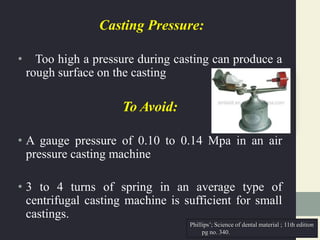
Casting Pressure:
• Too high a pressure during casting can produce a
rough surface on the casting
To Avoid:
• A gauge pressure of 0.10 to 0.14 Mpa in an air
pressure casting machine
• 3 to 4 turns of spring in an average type of
centrifugal casting machine is sufficient for small
castings.
Phillips’; Science of dental material ; 11th edition
pg no. 340.
Investment material:
Types of Investment Material:
1. Gypsum- bonded
2. Phosphate bonded
3. Ethy silicate bonded
GYPSUM- BONDED
• Used for casting of gold alloy inlays, onlays,
crowns and fixed partial dentures.
Main Constituents:-
a - hemihydrate of gypsum and quartz which
serves as a binder and gives strength to the
investment.
Mahalaxmi chp 26 pg no. 503- 511..
• Gypsum shrinks at a temperature range between
200 and 400˚C, it slightly expands between 400
and 700˚C and than it undergoes significant
shrinkage beyond 700˚C.
• In order to compensate for this shrinkage , Silica
is added to provide a refractory component. If
silica is added to the investment, this shrinkage
can be reduced or even turned into expansion.
Mahalaxmi chp 26 pg no. 503- 511..
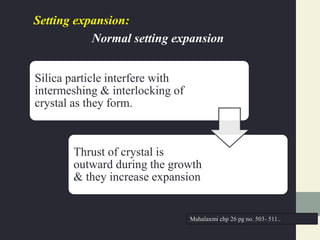
Setting expansion:
Normal setting expansion
Silica particle interfere with
intermeshing & interlocking of
crystal as they form.
Thrust of crystal is
outward during the growth
& they increase expansion
Mahalaxmi chp 26 pg no. 503- 511..
Hygroscopic expansion (low heat technique)
• Gypsum product when allowed to set in contact
with water.
• Ring is submerged in water bath at 37°C For 1 hour
immediately after investing.
• The water then replaces the water of hydration ,
thus preventing confinement of crystals growth.
• Hence crystal tends to grow outward in presence of
water and result in more expansion.
Mahalaxmi chp 26 pg no. 503- 511..
Thermal expansion (high heat technique)
• Mold is heated to eliminate wax thermal
expansion occurs .
• Silica refractory material is mainly responsible
because of solid- state phase transformation.
• This transition produces decrease in density
increase in volume and increase in linear
expansion.
Mahalaxmi chp 26 pg no. 503- 511..
PHOSPHATE BONDED
• Mainly used for metals requiring high melting point
• Types:
• Type I : for inlay ,crowns .
• Type II: for partial denture and removable prosthesis.
Composition:
Refractory material – silica in the form of cristobalite/
quartz / both.
Binder: magnesium oxide and monoammonium
phosphate.
Mahalaxmi chp 26 pg no. 503- 511..
• Carbon is also often added to the investment in
order to help to produce a clean casting and to
encourage easier divesting of the casting from the
mould.
• Differently to the gypsum based investments, these
investment in practice do not show signs of setting
shrinkage, but rather of slight expansion.
Mahalaxmi chp 26 pg no. 503- 511..
• At temperature above 300°C ammonium and water are
liberated – degradation of magnesium ammonium
phosphate- shrinkage – compensated by outward thrust
of expanding silica forms.
• At higher temperature phosphate + silica –
silicophosphates ( strength of investment increases)-
which withstand the impact of high melting alloys
without decomposition.
Mahalaxmi chp 26 pg no. 503- 511..
ETHYL SILICATE BONDED
• Rarely used in dentistry due to time consuming and
complicated procedures.
• Like other investment it does not show any setting
expansion it only undergo shrinkage.
• But when heated to sufficiently high temperature
considerable expansion takes place.
• Disadvantage being ethyl alcohol vapor liberation at
elevated temperature
3. Porosity:
• Porosity may occur both within the interior region
of a casting and on the external surface.
• The latter is a factor in surface roughness, but also it
is generally a manifestation of internal porosity.
• Not only does the internal porosity weaken the
casting but if it also extends to the surface, it may be
a cause for discoloration.
• .
Phillips’; Science of dental material ; 11th edition
pg no. 342.
• If severe, it can cause plaque accumulation at the
tooth-restoration interface, and secondary caries may
result.
• Although the porosity in a casting cannot be
prevented entirely, it can be minimized by use of
proper techniques.
Phillips’; Science of dental material ; 11th edition
pg no. 342.
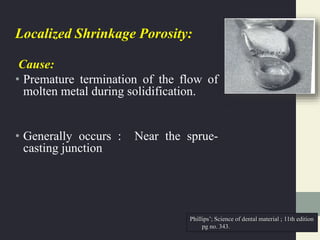
Localized Shrinkage Porosity:
Cause:
• Premature termination of the flow of
molten metal during solidification.
• Generally occurs : Near the sprue-
casting junction
Phillips’; Science of dental material ; 11th edition
pg no. 343.
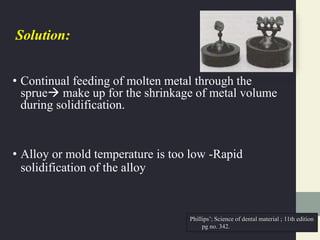
Solution:
• Continual feeding of molten metal through the
sprue make up for the shrinkage of metal volume
during solidification.
• Alloy or mold temperature is too low -Rapid
solidification of the alloy
Phillips’; Science of dental material ; 11th edition
pg no. 342.
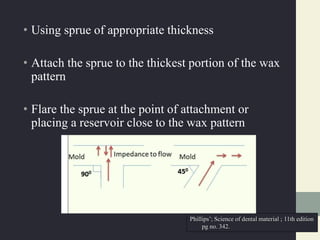
• Using sprue of appropriate thickness
• Attach the sprue to the thickest portion of the wax
pattern
• Flare the sprue at the point of attachment or
placing a reservoir close to the wax pattern
Phillips’; Science of dental material ; 11th edition
pg no. 342.
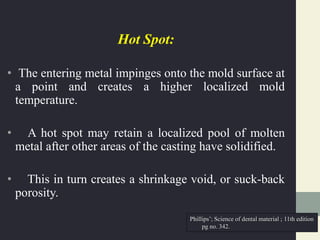
Hot Spot:
• The entering metal impinges onto the mold surface at
a point and creates a higher localized mold
temperature.
• A hot spot may retain a localized pool of molten
metal after other areas of the casting have solidified.
• This in turn creates a shrinkage void, or suck-back
porosity.
Phillips’; Science of dental material ; 11th edition
pg no. 342.
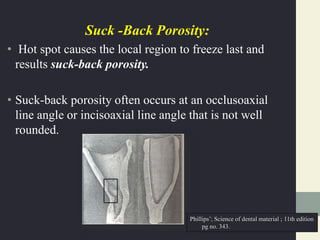
Suck -Back Porosity:
• Hot spot causes the local region to freeze last and
results suck-back porosity.
• Suck-back porosity often occurs at an occlusoaxial
line angle or incisoaxial line angle that is not well
rounded.
Phillips’; Science of dental material ; 11th edition
pg no. 343.
To Avoid Suck Back Porosity:
• Flare the sprue at the point of attachment to the wax
pattern
• Reduce the mold – melt temperature differential,
that is lowering the casting temperature by about
30ºC.
Phillips’; Science of dental material ; 11th edition
pg no. 343.
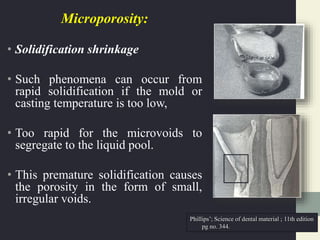
Microporosity:
• Solidification shrinkage
• Such phenomena can occur from
rapid solidification if the mold or
casting temperature is too low,
• Too rapid for the microvoids to
segregate to the liquid pool.
• This premature solidification causes
the porosity in the form of small,
irregular voids.
Phillips’; Science of dental material ; 11th edition
pg no. 344.
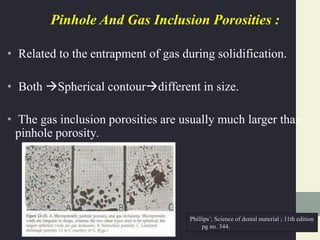
Pinhole And Gas Inclusion Porosities :
• Related to the entrapment of gas during solidification.
• Both Spherical contourdifferent in size.
• The gas inclusion porosities are usually much larger than
pinhole porosity.
Phillips’; Science of dental material ; 11th edition
pg no. 344.
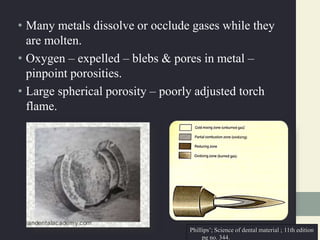
• Many metals dissolve or occlude gases while they
are molten.
• Oxygen – expelled – blebs & pores in metal –
pinpoint porosities.
• Large spherical porosity – poorly adjusted torch
flame.
Phillips’; Science of dental material ; 11th edition
pg no. 344.
Subsurface Porosity:
• Simultaneous nucleation of solid grains and
gas bubbles at the first moment that the alloy
freezes at the mold walls.
• Short, thick sprue pin- Rapid entry of the
alloy causes skin formation; the bulk of
alloy pulls away, forming subsurface
porosity.
• Alloy or mold temperature is too high -
The first portion of gold to contact the
investment will solidify and form a thin
skin. The alloy behind it shrinks during
solidification and pulls away, forming small
porosities. Phillips’; Science of dental material ; 11th edition
pg no. 346.
Entrapped-air Porosity
- Occurs on the inner surface of the
casting, sometimes referred to as
BACK-PRESSURE POROSITY
large concave depressions
• Caused by the inability of the air
in the mold to escape through the
pores in the investment or by the
pressure gradient that displaces
the air pocket toward the end of
the investment.
Phillips’; Science of dental material ; 11th edition
pg no. 346.
•
Slow venting
of gases
Dense
modern
investments
Clogging of
residual
carbon
Low heat
technique
Vacuum
investing
To Avoid Entrapped Air Porosity:
• Proper burnout
• Adequate mold and casting temperature
• High casting pressure
• Proper L/P ratio
• Thickness of the investment between the tip of
the pattern and the end of the ring not greater
than 6mm.
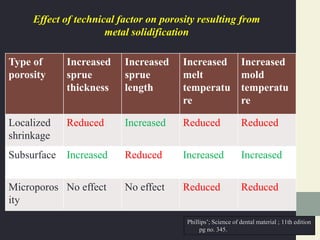
Type of
porosity
Increased
sprue
thickness
Increased
sprue
length
Increased
melt
temperatu
re
Increased
mold
temperatu
re
Localized
shrinkage
Reduced Increased Reduced Reduced
Subsurface Increased Reduced Increased Increased
Microporos
ity
No effect No effect Reduced Reduced
Effect of technical factor on porosity resulting from
metal solidification
Phillips’; Science of dental material ; 11th edition
pg no. 345.
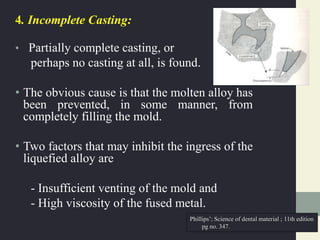
4. Incomplete Casting:
• Partially complete casting, or
perhaps no casting at all, is found.
• The obvious cause is that the molten alloy has
been prevented, in some manner, from
completely filling the mold.
• Two factors that may inhibit the ingress of the
liquefied alloy are
- Insufficient venting of the mold and
- High viscosity of the fused metal.
Phillips’; Science of dental material ; 11th edition
pg no. 347.
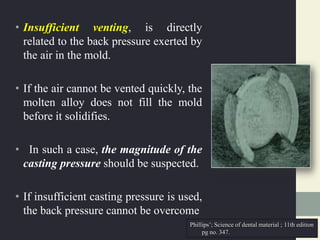
• Insufficient venting, is directly
related to the back pressure exerted by
the air in the mold.
• If the air cannot be vented quickly, the
molten alloy does not fill the mold
before it solidifies.
• In such a case, the magnitude of the
casting pressure should be suspected.
• If insufficient casting pressure is used,
the back pressure cannot be overcome
Phillips’; Science of dental material ; 11th edition
pg no. 347.
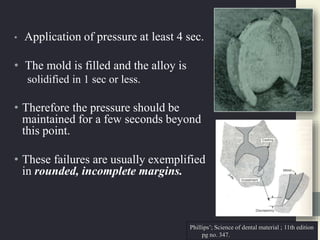
• Application of pressure at least 4 sec.
• The mold is filled and the alloy is
solidified in 1 sec or less.
• Therefore the pressure should be
maintained for a few seconds beyond
this point.
• These failures are usually exemplified
in rounded, incomplete margins.
Phillips’; Science of dental material ; 11th edition
pg no. 347.
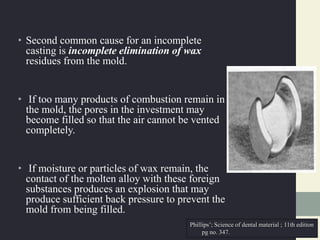
• Second common cause for an incomplete
casting is incomplete elimination of wax
residues from the mold.
• If too many products of combustion remain in
the mold, the pores in the investment may
become filled so that the air cannot be vented
completely.
• If moisture or particles of wax remain, the
contact of the molten alloy with these foreign
substances produces an explosion that may
produce sufficient back pressure to prevent the
mold from being filled.
Phillips’; Science of dental material ; 11th edition
pg no. 347.
• Avoided:
• Lower L/P ratio – less porosities.
• Increase in casting pressure .
• Temperature of alloy should raised above the
liquidus temperature – viscosity and surface
tension is lowered – to enhance the flow of
molten metal.
Phillips’; Science of dental material ; 11th edition
pg no. 347.
CONCLUSION
CONCLUSION
Thus, these are the various causes for the failure of
the castings and methods by which these defects
can be avoided, thereby producing a casting of
good quality for clinical success.
REFERENCES
• Phillips–Science Of Dental Materials-11thedition
• Craig’s- Restorative Dental Materials-12th Edition
• Dental Materials & Their Selection – William J.O’brien-3rd
Edition
• Contemporary Fixed Prosthodontics-Rosenstiel-4th Edition
• Journal Of Prosthetic Dentistry-1987,57,362-368
• Journal Of Prosthetic Dentistry -1989,61,418-424
• Dental Materials Journal -1993 Dec 12 (2) 245-52.
•
• Dental Materials Journal-2009 May 25 (5) 629-33.
• Journal Of Prosthetic Dentistry -2009 Oct 102 224-8.
Casting defects

Casting defects

  • 1.
  • 2.
    CONTENTS: • Introduction • Classificationof casting defects • Types of casting defects • Conclusion • References
  • 3.
  • 4.
    • The dentalprofession has used precision-type castings for the most part of century. Using the lost wax technique, Taggart in 1907 developed a process for making castings used in restoration of prepared teeth. Since the process did not take into account all the dimensional changes associated with the casting technique, the resultant product did exhibit some problems in terms of dimensional accuracy.
  • 5.
    Casting : • Itis the process in which molten material is thrown into a mold and allowed to harden into the shape of the mold. Casting defect: • Casting defects occur when there is discrepancy in any of the steps followed right through impression making , pouring cast, fabrication of wax pattern to investing and casting procedure's. Mahalaxmi chp 27 pg no. 532
  • 6.
    Casting Shrinkage • Mostmetals & alloys, including gold & noble metal alloys, shrink when they change from the liquid to the solid state. Shrinkage occurs in 3 stages: • The thermal contraction of the liquid metal between the temperature to which it is heated and the liquidus temperature. • The contraction of metal inherent in its change from liquid to the solid state. • The thermal contraction of the solid metal that occurs down the room temperature. Phillips’; Science of dental material ; 10th edition
  • 7.
    CASTING- LOST WAXPROCEDURE The process involves producing a metal casting using a refractory mould made from a wax replica pattern. The steps involved in the process or the lost wax casting are:
  • 8.
    Sprue is removedand the casting is polished and delivered to the patient. Quenching and Pickling Molten metal is cast into the void created by the wax pattern and the sprue Invested pattern is heated until all the remnants of wax are burned away The pattern and sprue are invested All aspects of final restoration are incorporated into the wax pattern Wax pattern is first formed on a die or directly on the tooth.
  • 9.
  • 10.
    According To Phillip’s Distortion Surface Roughness, Irregularities, Discoloration • Air bubbles • Water film • Rapid heating • Under heating • L/P ratio. • Prolonged heating • Temperature of alloy • Casting pressure • Composition of investment material • Foreign bodies • Impact of molten alloy • Pattern position • Carbon inclusions Phillips’; Science of dental material ; 11th edition
  • 11.
    Solidification defects • Localised shrinkage porosity • Microporosity Trappedgases • Pinhole porosity • Gas inclusions • Subsurface porosity Residual air  Porosity Phillips’; Science of dental material ; 11th edition
  • 12.
    According To O’brien: A. General Problems • Problems with accuracy • Problems with distortion • Problems with bubbles • Problems with surface roughness • Problems with fins on the surface or margins • Problems with short and rounded margins • Problems with miscasting • Problems with pits
  • 13.
     Problems WithInternal Porosity • Problems With Localized Shrinkage Porosity • Problems With Subsurface Porosity • Problems With Microporosity  Problems With External Porosity • Problems With Back Pressure Porosity
  • 14.
    According to Rosensteil •Roughness • Nodules • Fins • Incompleteness • Voids or porosity • Marginal discrepancy • Dimensional inaccuracies
  • 15.
  • 16.
    DISTORTION • Any markeddistortion of the casting is related to distortion of the wax pattern • Wax pattern = termed as precursor of cast restoration. • Fabricated by direct & indirect techniques. Phillips’; Science of dental material ; 11th edition
  • 17.
    Causes Of Distortion: • Improper handling during removal of wax pattern • Wax too hot- Excessive shrinkage results on cooling. • Wax too cool- The pattern undergoes stress release with change in shape. • Setting and hygroscopic expansions of the investment may produce a non uniform expansion of the walls of the pattern. Phillips’; Science of dental material ; 11th edition & Mahalaxmi chp 27
  • 18.
    SURFACE DISCOLOURATION Causes- • Sulphurcontamination of casting causing black castings • Contamination with copper during pickling Mahalaxmi chp 27 pg no. 533
  • 19.
    SURFACE DISCOLOURATION Solution- • Avoidoverheating of investment • Avoid use of torch flame • Avoid use of steel tongs to hold casting during pickling • Castings should never be placed with amalgam dies or kept on a table where amalgam scrap is present Mahalaxmi chp 27 pg no. 533
  • 20.
    SURFACE ROUGHNESS & IRREGULARITIES •The surface of a dental casting should be an accurate reproduction of the surface of the wax pattern from which it is made. • Excessive roughness or irregularities on the outer surface of the casting necessitate additional finishing and polishing. Phillips’; Science of dental material ; 11th edition pg no. 338.
  • 21.
    Surface Roughness Defined: • Relativelyfinely spaced surface imperfections whose height, width, and direction establish the predominant surface pattern. Phillips’; Science of dental material ; 11th edition pg no. 338.
  • 22.
     Causes OfSurface Roughness: • Breakdown of the investment at excessive burnout temperature. • Alloy pre heated to higher temperature. • More force is generated in flow of molten alloy. • Water/powder ratio- a high ratio increases the roughness of the mold.
  • 23.
    • Excess wettingagent or salivary contamination - this may form a film on the pattern surface and be reproduced on the casting surface. • Prolonged heating or overheating of the mold - may cause investment disintegration, roughness appears general and feels sharp.
  • 24.
    Surface Irregularities • Surfaceirregularities are isolated imperfections, such as nodules, that are not characteristic of the entire surface area. Phillips’; Science of dental material ; 11th edition pg no. 338.
  • 25.
    Air Bubbles • Smallnodules on a casting are caused by air bubbles that become attached to the pattern during or subsequent to the investing procedure. • Nodules can sometimes be removed  not in a critical area removal of these irregularities might alter fit of the casting Phillips’; Science of dental material ; 11th edition pg no. 338.
  • 26.
    To Avoid AirBubbles • Proper mixing of the investment if manual method is used • Use of a mechanical mixer with vibration both before and after mixing • Use of a wetting agent in a thin layer
  • 27.
    Vacuum investing techniqueis the best method.
  • 28.
    Water Films: • Waxis repellent to water and if the investment becomes separated from the wax pattern in some manner, a water film may form irregularly over the surface. • Appears as minute ridges or veins on the surface. Phillips’; Science of dental material ; 11th edition pg no. 339.
  • 29.
    • Too highP/L ratios . • Pattern is slightly moved, or vibrated after investing or if the painting procedure does not result in an intimate contact of the investment with the wax pattern . Phillips’; Science of dental material ; 11th edition pg no. 339
  • 30.
    To Avoid WaterFilms • Use of a wetting agent in a thin layer • Using Correct water - powder ratio Phillips’; Science of dental material ; 11th edition pg no. 339.
  • 31.
    Fins: • Due tothe flaking of the investment when water or steam pours into the mold • A surge of steam or water may carry certain salts into the mold that are left behind in the walls as the water evaporates • Too rapid heating Phillips’; Science of dental material ; 11th edition pg no. 339.
  • 32.
    To Avoid FinsOr Spines • Gradual heating of the mold- at least 60 min should elapse during the heating of the investment from room temperature to 700º C. • Greater the bulk of the investment, more slowly it should be heated. Phillips’; Science of dental material ; 11th edition pg no. 339.
  • 33.
    Underheating: • Incomplete eliminationof wax residues • Voids or porosity may occur in the casting from the gases formed when the hot alloy comes in contact with the carbon residues. • Casting may be covered with a tenacious carbon coating that is virtually impossible to remove by pickling Phillips’; Science of dental material ; 11th edition pg no. 340.
  • 34.
    Prolonged Heating: • High-heatcasting technique  a prolonged heating of mold at the casting temperature  disintegration of the gypsum-bonded investment, and the walls of the mold are roughened. • Products of decomposition are sulfur compounds that may contaminate the alloy to the extent that the surface texture is affected. Phillips’; Science of dental material ; 11th edition pg no. 340.
  • 35.
    To Avoid : •Thermal expansion technique is employed mold heated to the casting temperature and never higher. • The casting should be made immediately. Phillips’; Science of dental material ; 11th edition pg no. 340.
  • 36.
    Casting Pressure: • Toohigh a pressure during casting can produce a rough surface on the casting To Avoid: • A gauge pressure of 0.10 to 0.14 Mpa in an air pressure casting machine • 3 to 4 turns of spring in an average type of centrifugal casting machine is sufficient for small castings. Phillips’; Science of dental material ; 11th edition pg no. 340.
  • 37.
    Investment material: Types ofInvestment Material: 1. Gypsum- bonded 2. Phosphate bonded 3. Ethy silicate bonded
  • 38.
    GYPSUM- BONDED • Usedfor casting of gold alloy inlays, onlays, crowns and fixed partial dentures. Main Constituents:- a - hemihydrate of gypsum and quartz which serves as a binder and gives strength to the investment. Mahalaxmi chp 26 pg no. 503- 511..
  • 39.
    • Gypsum shrinksat a temperature range between 200 and 400˚C, it slightly expands between 400 and 700˚C and than it undergoes significant shrinkage beyond 700˚C. • In order to compensate for this shrinkage , Silica is added to provide a refractory component. If silica is added to the investment, this shrinkage can be reduced or even turned into expansion. Mahalaxmi chp 26 pg no. 503- 511..
  • 40.
    Setting expansion: Normal settingexpansion Silica particle interfere with intermeshing & interlocking of crystal as they form. Thrust of crystal is outward during the growth & they increase expansion Mahalaxmi chp 26 pg no. 503- 511..
  • 41.
    Hygroscopic expansion (lowheat technique) • Gypsum product when allowed to set in contact with water. • Ring is submerged in water bath at 37°C For 1 hour immediately after investing. • The water then replaces the water of hydration , thus preventing confinement of crystals growth. • Hence crystal tends to grow outward in presence of water and result in more expansion. Mahalaxmi chp 26 pg no. 503- 511..
  • 42.
    Thermal expansion (highheat technique) • Mold is heated to eliminate wax thermal expansion occurs . • Silica refractory material is mainly responsible because of solid- state phase transformation. • This transition produces decrease in density increase in volume and increase in linear expansion. Mahalaxmi chp 26 pg no. 503- 511..
  • 43.
    PHOSPHATE BONDED • Mainlyused for metals requiring high melting point • Types: • Type I : for inlay ,crowns . • Type II: for partial denture and removable prosthesis. Composition: Refractory material – silica in the form of cristobalite/ quartz / both. Binder: magnesium oxide and monoammonium phosphate. Mahalaxmi chp 26 pg no. 503- 511..
  • 44.
    • Carbon isalso often added to the investment in order to help to produce a clean casting and to encourage easier divesting of the casting from the mould. • Differently to the gypsum based investments, these investment in practice do not show signs of setting shrinkage, but rather of slight expansion. Mahalaxmi chp 26 pg no. 503- 511..
  • 45.
    • At temperatureabove 300°C ammonium and water are liberated – degradation of magnesium ammonium phosphate- shrinkage – compensated by outward thrust of expanding silica forms. • At higher temperature phosphate + silica – silicophosphates ( strength of investment increases)- which withstand the impact of high melting alloys without decomposition. Mahalaxmi chp 26 pg no. 503- 511..
  • 46.
    ETHYL SILICATE BONDED •Rarely used in dentistry due to time consuming and complicated procedures. • Like other investment it does not show any setting expansion it only undergo shrinkage. • But when heated to sufficiently high temperature considerable expansion takes place. • Disadvantage being ethyl alcohol vapor liberation at elevated temperature
  • 47.
    3. Porosity: • Porositymay occur both within the interior region of a casting and on the external surface. • The latter is a factor in surface roughness, but also it is generally a manifestation of internal porosity. • Not only does the internal porosity weaken the casting but if it also extends to the surface, it may be a cause for discoloration. • . Phillips’; Science of dental material ; 11th edition pg no. 342.
  • 48.
    • If severe,it can cause plaque accumulation at the tooth-restoration interface, and secondary caries may result. • Although the porosity in a casting cannot be prevented entirely, it can be minimized by use of proper techniques. Phillips’; Science of dental material ; 11th edition pg no. 342.
  • 49.
    Localized Shrinkage Porosity: Cause: •Premature termination of the flow of molten metal during solidification. • Generally occurs : Near the sprue- casting junction Phillips’; Science of dental material ; 11th edition pg no. 343.
  • 50.
    Solution: • Continual feedingof molten metal through the sprue make up for the shrinkage of metal volume during solidification. • Alloy or mold temperature is too low -Rapid solidification of the alloy Phillips’; Science of dental material ; 11th edition pg no. 342.
  • 51.
    • Using sprueof appropriate thickness • Attach the sprue to the thickest portion of the wax pattern • Flare the sprue at the point of attachment or placing a reservoir close to the wax pattern Phillips’; Science of dental material ; 11th edition pg no. 342.
  • 52.
    Hot Spot: • Theentering metal impinges onto the mold surface at a point and creates a higher localized mold temperature. • A hot spot may retain a localized pool of molten metal after other areas of the casting have solidified. • This in turn creates a shrinkage void, or suck-back porosity. Phillips’; Science of dental material ; 11th edition pg no. 342.
  • 53.
    Suck -Back Porosity: •Hot spot causes the local region to freeze last and results suck-back porosity. • Suck-back porosity often occurs at an occlusoaxial line angle or incisoaxial line angle that is not well rounded. Phillips’; Science of dental material ; 11th edition pg no. 343.
  • 54.
    To Avoid SuckBack Porosity: • Flare the sprue at the point of attachment to the wax pattern • Reduce the mold – melt temperature differential, that is lowering the casting temperature by about 30ºC. Phillips’; Science of dental material ; 11th edition pg no. 343.
  • 55.
    Microporosity: • Solidification shrinkage •Such phenomena can occur from rapid solidification if the mold or casting temperature is too low, • Too rapid for the microvoids to segregate to the liquid pool. • This premature solidification causes the porosity in the form of small, irregular voids. Phillips’; Science of dental material ; 11th edition pg no. 344.
  • 56.
    Pinhole And GasInclusion Porosities : • Related to the entrapment of gas during solidification. • Both Spherical contourdifferent in size. • The gas inclusion porosities are usually much larger than pinhole porosity. Phillips’; Science of dental material ; 11th edition pg no. 344.
  • 57.
    • Many metalsdissolve or occlude gases while they are molten. • Oxygen – expelled – blebs & pores in metal – pinpoint porosities. • Large spherical porosity – poorly adjusted torch flame. Phillips’; Science of dental material ; 11th edition pg no. 344.
  • 58.
    Subsurface Porosity: • Simultaneousnucleation of solid grains and gas bubbles at the first moment that the alloy freezes at the mold walls. • Short, thick sprue pin- Rapid entry of the alloy causes skin formation; the bulk of alloy pulls away, forming subsurface porosity. • Alloy or mold temperature is too high - The first portion of gold to contact the investment will solidify and form a thin skin. The alloy behind it shrinks during solidification and pulls away, forming small porosities. Phillips’; Science of dental material ; 11th edition pg no. 346.
  • 59.
    Entrapped-air Porosity - Occurson the inner surface of the casting, sometimes referred to as BACK-PRESSURE POROSITY large concave depressions • Caused by the inability of the air in the mold to escape through the pores in the investment or by the pressure gradient that displaces the air pocket toward the end of the investment. Phillips’; Science of dental material ; 11th edition pg no. 346.
  • 60.
    • Slow venting of gases Dense modern investments Cloggingof residual carbon Low heat technique Vacuum investing
  • 61.
    To Avoid EntrappedAir Porosity: • Proper burnout • Adequate mold and casting temperature • High casting pressure • Proper L/P ratio • Thickness of the investment between the tip of the pattern and the end of the ring not greater than 6mm.
  • 62.
    Type of porosity Increased sprue thickness Increased sprue length Increased melt temperatu re Increased mold temperatu re Localized shrinkage Reduced IncreasedReduced Reduced Subsurface Increased Reduced Increased Increased Microporos ity No effect No effect Reduced Reduced Effect of technical factor on porosity resulting from metal solidification Phillips’; Science of dental material ; 11th edition pg no. 345.
  • 63.
    4. Incomplete Casting: •Partially complete casting, or perhaps no casting at all, is found. • The obvious cause is that the molten alloy has been prevented, in some manner, from completely filling the mold. • Two factors that may inhibit the ingress of the liquefied alloy are - Insufficient venting of the mold and - High viscosity of the fused metal. Phillips’; Science of dental material ; 11th edition pg no. 347.
  • 64.
    • Insufficient venting,is directly related to the back pressure exerted by the air in the mold. • If the air cannot be vented quickly, the molten alloy does not fill the mold before it solidifies. • In such a case, the magnitude of the casting pressure should be suspected. • If insufficient casting pressure is used, the back pressure cannot be overcome Phillips’; Science of dental material ; 11th edition pg no. 347.
  • 65.
    • Application ofpressure at least 4 sec. • The mold is filled and the alloy is solidified in 1 sec or less. • Therefore the pressure should be maintained for a few seconds beyond this point. • These failures are usually exemplified in rounded, incomplete margins. Phillips’; Science of dental material ; 11th edition pg no. 347.
  • 66.
    • Second commoncause for an incomplete casting is incomplete elimination of wax residues from the mold. • If too many products of combustion remain in the mold, the pores in the investment may become filled so that the air cannot be vented completely. • If moisture or particles of wax remain, the contact of the molten alloy with these foreign substances produces an explosion that may produce sufficient back pressure to prevent the mold from being filled. Phillips’; Science of dental material ; 11th edition pg no. 347.
  • 67.
    • Avoided: • LowerL/P ratio – less porosities. • Increase in casting pressure . • Temperature of alloy should raised above the liquidus temperature – viscosity and surface tension is lowered – to enhance the flow of molten metal. Phillips’; Science of dental material ; 11th edition pg no. 347.
  • 68.
  • 69.
    CONCLUSION Thus, these arethe various causes for the failure of the castings and methods by which these defects can be avoided, thereby producing a casting of good quality for clinical success.
  • 70.
  • 71.
    • Phillips–Science OfDental Materials-11thedition • Craig’s- Restorative Dental Materials-12th Edition • Dental Materials & Their Selection – William J.O’brien-3rd Edition • Contemporary Fixed Prosthodontics-Rosenstiel-4th Edition
  • 72.
    • Journal OfProsthetic Dentistry-1987,57,362-368 • Journal Of Prosthetic Dentistry -1989,61,418-424 • Dental Materials Journal -1993 Dec 12 (2) 245-52. • • Dental Materials Journal-2009 May 25 (5) 629-33. • Journal Of Prosthetic Dentistry -2009 Oct 102 224-8.

Editor's Notes

  • #11  a. Air bubbles b. Water film c. Rapid heating d. Under heating e. L/P ratio. f. Prolonged heating g.Temperature of alloy h.Casting pressure i.Composition of investment j. Foreign bodies k. Impact of molten alloy l. Pattern position m. Carbon inclusions
  • #12 4. INCOMPLETE CASTING I. Solidification defects A. Localized shrinkage porosity B. Microporosity II. Trapped gases A. Pinhole porosity B. Gas inclusions C. Subsurface porosity III. Residual air
  • #18 STUDY: Cast post made with an unlined metal casting ring may exhibit anisotropic shrinkage which could result in distortion.
  • #22  Problems with surface roughness Water/powder ratio- a high ratio increases the roughness of the mold. Excess wetting agent or salivary contamination - this may form a film on the pattern surface and be reproduced on the casting surface. Prolonged heating or overheating of the mold - may cause investment disintegration, roughness appears general and feels sharp. Premature heating of casting investment- wait a minimum of 45 minutes for burnout.
  • #29 Appears as minute ridges or veins on the surface. Too high L/P ratios . Pattern is slightly moved, or vibrated after investing or if the painting procedure does not result in an intimate contact of the investment with the wax pattern .
  • #32  Wax burnout : Heating of the casting ring with the invested wax pattern in the furnace with a temperature controlled thermostat until all traces of wax are vaporized / eliminated, leaving a cavity or mold in which molten metal can be casted.
  • #34 Incomplete elimination of wax residues may occur if the heating time is too short or if insufficient air is available in the furnace.
  • #48 Sprue: Defined as a channel created in the investment through which the molten metal enter the mold space created by burnout of wax patterns. Dimension: Diameter – Diameter should be approximately equal to thickest portion of wax pattern. Too small – localized shrinkage porosity (suck back porosity) Prevented – adding reservoir Direction : Attached to the angle of 45° to the thickest part of wax pattern. If attached at 90 ° - turbulence in the flow of molten metal and porosities in casting. If on the thinnest portion of wax pattern – molten metal may abrade/ fracture investment material resulting in casting failure.
  • #49 Location : Widest part of wax pattern Placed towards the center of the casting ring. Normally attach to the non centric cusp If on margins – distortion of the margins
  • #53 Attachment : Sprue should be flared - molten metal to flow from the thicker portion of mold to surrounding thinner areas such as margins. If reversed- Hot Spot
  • #55 Length : Sprue should be – within 6mm (1/4th inch) of the open end of casting ring for gypsum bonded investment . 3- 4 mm (1/8th inch ) for phosphate bonded investments. Too short / placed too far from open end – gases released cant be sufficiently vented out- porosities
  • #59 Controlled  Rate of molten metal that enters the mold
  • #61 The incidence of entrapped  increased by - Use of the dense modern investments, - By an increase in mold density produced by vacuum investing. - By the tendency for the mold to clog with residual carbon when the low-heat technique is used. Slow the venting of gases from the mold during casting.