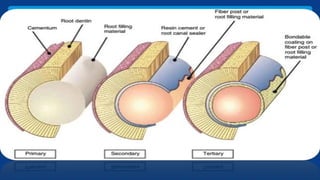
OBTURATION MATERIALS
CONTENTS
• INTRODUCTION
• HISTORY
• OBJECTIVES FOR OBTURATION
• CLASSIFICATION OF MATERIAL USED FOR OBTURATION
• GUTTA PERCHA
• RESILON
• SILVER CONES
• PASTE FILLING MATERIALS
• CONCLUSION
INTRODUCTION
• It is the three dimensional filling of the entire root canal system as close to
the CDJ as possible to obtain a fluid impervious seal which will hinder the
invasion of microorganisms and potential nutrients that would support
biological growth.
• Obturation is the method used to fill and seal a cleaned and shaped root
canal using a root canal sealer and a core filling material.
• A Three dimensional obturation with a fluid tight seal at the apical
area, laterally and coronally is the primary requirement for ensuring
successful treatment.
• Washington Study has revealed that 56-68% of all endodontic
treatment fails due to incomplete obturation, thus the development of
obturation materials & techniques has gained more importance.
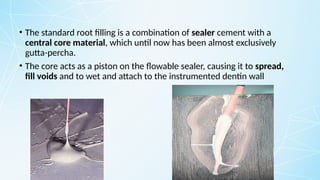
• The standard root filling is a combination of sealer cement with a
central core material, which until now has been almost exclusively
gutta-percha.
• The core acts as a piston on the flowable sealer, causing it to spread,
fill voids and to wet and attach to the instrumented dentin wall
OBJECTIVES OF OBTURATION
• Substitution of an inert filling in the space previously occupied by the pulp tissue
• To eliminate all avenues of leakage from the oral cavity or the periradicular tissues into
the root canal system (i.e. to attain a three dimensional fluid impervious seal apicaly,
laterally and coronally within the confines of the root canal system)
• To seal within the system any irritants that cannot be fully removed during canal
cleaning and shaping procedures
• To adequately seal iatrogenic causes such as perforations, ledges and zipped apices
RADIOGRAPHICALLY
• To attain a radiographic appearance of a dense three dimensional filling which
extends as close as possible to the cemento dentinal junction without gross
over extension or under filling in the presence of a patent canal
• Obturated root canal should reflect a shape that is approximately the same
shape as the root morphology
• Shape of the obturated canal should reflect a continuously tapering funnel
preparation without excess removal of tooth structure at any level of the canal
system
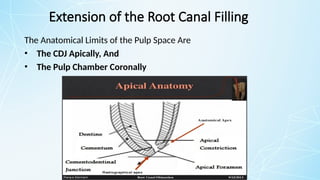
Extension of the Root Canal Filling
The Anatomical Limits of the Pulp Space Are
• The CDJ Apically, And
• The Pulp Chamber Coronally
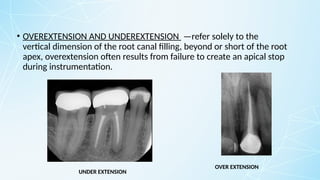
• OVEREXTENSION AND UNDEREXTENSION —refer solely to the
vertical dimension of the root canal filling, beyond or short of the root
apex, overextension often results from failure to create an apical stop
during instrumentation.
OVER EXTENSION
UNDER EXTENSION
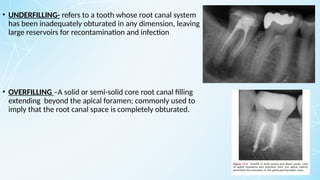
• UNDERFILLING- refers to a tooth whose root canal system
has been inadequately obturated in any dimension, leaving
large reservoirs for recontamination and infection
• OVERFILLING –A solid or semi-solid core root canal filling
extending beyond the apical foramen; commonly used to
imply that the root canal space is completely obturated.
• Seltzer et al. (1968) found that tissue reactions following instrumentation short of
the apex were milder than those reactions which followed instrumentation
beyond the apex.
• Gutierrez & Aguayo (1995) All the root canals were found to deviate from the long
axis of their roots. The number of foramina ranged from 1 to 6. The openings
always ended short of the apices by 0.20±3.80 mm
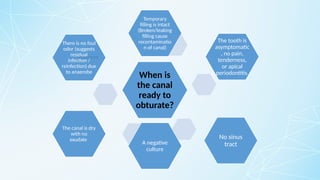
When is
the canal
ready to
obturate?
Temporary
filling is intact
(Broken/leaking
filling cause
recontaminatio
n of canal)
The tooth is
asymptomatic
, no pain,
tenderness,
or apical
periodontitis.
No sinus
tract
A negative
culture
The canal is dry
with no
exudate
There is no foul
odor (suggests
residual
infection /
reinfection) due
to anaerobe
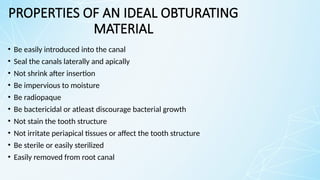
PROPERTIES OF AN IDEAL OBTURATING
MATERIAL
• Be easily introduced into the canal
• Seal the canals laterally and apically
• Not shrink after insertion
• Be impervious to moisture
• Be radiopaque
• Be bactericidal or atleast discourage bacterial growth
• Not stain the tooth structure
• Not irritate periapical tissues or affect the tooth structure
• Be sterile or easily sterilized
• Easily removed from root canal
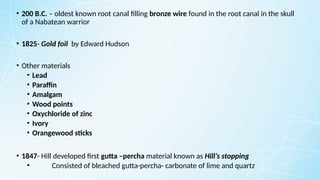
HISTORY
• 200 B.C. – oldest known root canal filling bronze wire found in the root canal in the skull
of a Nabatean warrior
• 1825- Gold foil by Edward Hudson
• Other materials
• Lead
• Paraffin
• Amalgam
• Wood points
• Oxychloride of zinc
• Ivory
• Orangewood sticks
• 1847- Hill developed first gutta –percha material known as Hill’s stopping
• Consisted of bleached gutta-percha- carbonate of lime and quartz
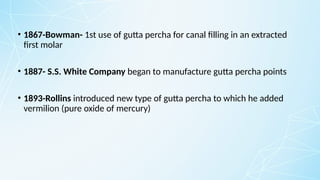
• 1867-Bowman- 1st use of gutta percha for canal filling in an extracted
first molar
• 1887- S.S. White Company began to manufacture gutta percha points
• 1893-Rollins introduced new type of gutta percha to which he added
vermilion (pure oxide of mercury)
• 1930- Elmer A. Jasper introduced silver points
• 1977- Yee et al introduced the injectable thermoplasticized gutta-percha
technique
• 1978- W. Ben Johnson described a technique of obturation with gutta percha
coated endondontic file (forerunner of Thermafil)
• 1979- Mc Spadden introduced a special compactor for softening gutta percha by
friction
• 1984- Michanowicz introduced a low temperature (70C) injectable
thermoplasticized gutta-percha technique- Ultrafil
CLASSIFICATION OF MATERIALS USED FOR
OBTURATION
• Solid core materials
1. Silver cones
2. Resilon
• Semi solid core materials
1. Gutta – percha
2. MGP [medicated gutta-percha points]
Eg : Gutta-percha with calcium hydroxide
According to Ingle
3. Thermoplastisized gutta-Percha
4. Thermomechanical Compaction of Gutta Percha
5. Carrier based gutta percha
• Paste /Cement Filling Materials
GUTTA PERCHA
• The word ‘Gutta-percha' comes from 'Getah Percha' in Malay
Peninsula ( South east Asia). ‘Getah’ means gum &
Percha is the name of the tree. It is natural latex produced from
the sap of trees
• The trees are mainly found in Malay Archipelago, Singapore,,
Philippines, Brazil, South America, and other tropical countries.
• These trees are medium to tall (approximately 30 m) in height, . It is
usually imported from Central South America for its use in
dentistry, which is one of the reasons for its high cost.
• There are many species of Palaquium genus that yield GP of which four are found in India:
1. P. obovatum-Assam
2. P. polyanthum-Assam
3. P. ellipticum-Western ghats
4. P. gutta-, Bengaluru, Karnataka
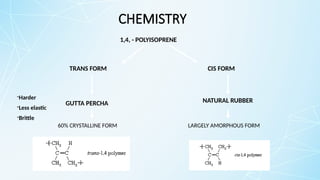
• Chemically, gutta-percha is a polyterprene, a polymer of isoprene(trans-1,4-polyisoprene).
• ADA No. for obturating gutta percha points is 78.
• Initially used for insulation of cables under sea.
CHEMISTRY
1,4, - POLYISOPRENE
TRANS FORM CIS FORM
GUTTA PERCHA NATURAL RUBBER
~ 60% CRYSTALLINE FORM LARGELY AMORPHOUS FORM
-Harder
-Less elastic
-Brittle
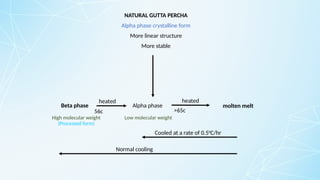
NATURAL GUTTA PERCHA
Alpha phase crystalline form
More linear structure
More stable
Alpha phase molten melt
Cooled at a rate of 0.50
C/hr
Normal cooling
Beta phase
heated
>65c
High molecular weight Low molecular weight
heated
56c
(Processed form)
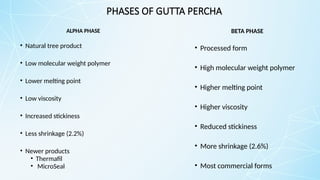
PHASES OF GUTTA PERCHA
ALPHA PHASE
• Natural tree product
• Low molecular weight polymer
• Lower melting point
• Low viscosity
• Increased stickiness
• Less shrinkage (2.2%)
• Newer products
• Thermafil
• MicroSeal
BETA PHASE
• Processed form
• High molecular weight polymer
• Higher melting point
• Higher viscosity
• Reduced stickiness
• More shrinkage (2.6%)
• Most commercial forms
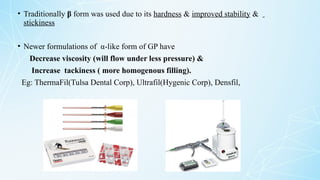
• Traditionally β form was used due to its hardness & improved stability &
stickiness
• Newer formulations of α-like form of GP have
Decrease viscosity (will flow under less pressure) &
Increase tackiness ( more homogenous filling).
Eg: ThermaFil(Tulsa Dental Corp), Ultrafil(Hygenic Corp), Densfil,
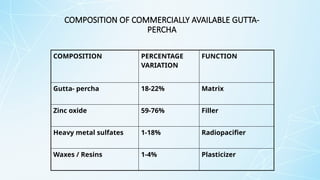
COMPOSITION OF COMMERCIALLY AVAILABLE GUTTA-
PERCHA
COMPOSITION PERCENTAGE
VARIATION
FUNCTION
Gutta- percha 18-22% Matrix
Zinc oxide 59-76% Filler
Heavy metal sulfates 1-18% Radiopacifier
Waxes / Resins 1-4% Plasticizer
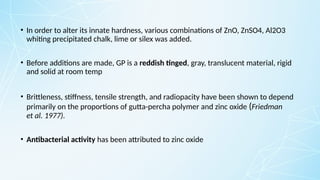
• In order to alter its innate hardness, various combinations of ZnO, ZnSO4, Al2O3
whiting precipitated chalk, lime or silex was added.
• Before additions are made, GP is a reddish tinged, gray, translucent material, rigid
and solid at room temp
• Brittleness, stiffness, tensile strength, and radiopacity have been shown to depend
primarily on the proportions of gutta-percha polymer and zinc oxide (Friedman
et al. 1977).
• Antibacterial activity has been attributed to zinc oxide
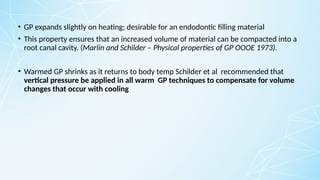
• GP expands slightly on heating; desirable for an endodontic filling material
• This property ensures that an increased volume of material can be compacted into a
root canal cavity. (Marlin and Schilder – Physical properties of GP OOOE 1973).
• Warmed GP shrinks as it returns to body temp Schilder et al recommended that
vertical pressure be applied in all warm GP techniques to compensate for volume
changes that occur with cooling
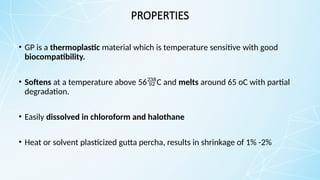
PROPERTIES
• GP is a thermoplastic material which is temperature sensitive with good
biocompatibility.
• Softens at a temperature above 56C and melts around 65 oC with partial
degradation.
• Easily dissolved in chloroform and halothane
• Heat or solvent plasticized gutta percha, results in shrinkage of 1% -2%
AGING
• Gutta percha should be stored in a cool location with low humidity.
• Gutta percha oxidizes and becomes brittle when exposed to light and air
• Revival
• Immersing cone in hot water (55C) and immediately immersing in cold tap water
( <20o
C) for several seconds.
• Kolokruis et al – high humidity causes absorption of water by gutta percha , lowers
tensile strength, strain resistence .
STERILIZATION OF GUTTA PERCHA CONES
• Disinfected by
• 1% NaOCl – 1min
• 0.5% NaOCl – 5min
• After disinfection, gutta percha cones must be rinsed in 96% ethyl alcohol,
70% isopropyl alcohol or distilled water to remove crystallized NaOCl before
obturation
• Herbal extracts such as lemon grass oil, basil oil, and obicure tea extract, are
alternatives for chairside disinfection of GP cones and have shown good
results)
Forms of GP available
• Solid core GuttaPercha points.
-Standardised.
-Nonstandardised.
• Thermoplasticised GuttaPercha.
-solid core system.
-injectable form
• Modified Gutta Percha
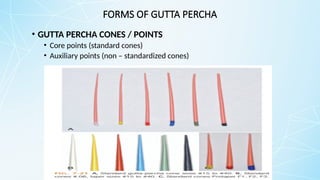
FORMS OF GUTTA PERCHA
• GUTTA PERCHA CONES / POINTS
• Core points (standard cones)
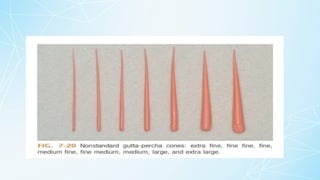
• Auxiliary points (non – standardized cones)
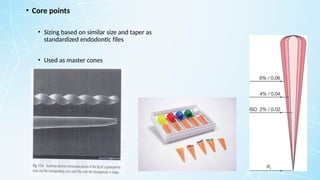
• Core points
• Sizing based on similar size and taper as
standardized endodontic files
• Used as master cones
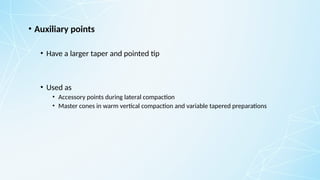
• Auxiliary points
• Have a larger taper and pointed tip
• Used as
• Accessory points during lateral compaction
• Master cones in warm vertical compaction and variable tapered preparations
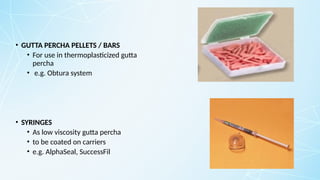
• GUTTA PERCHA PELLETS / BARS
• For use in thermoplasticized gutta
percha
• e.g. Obtura system
• SYRINGES
• As low viscosity gutta percha
• to be coated on carriers
• e.g. AlphaSeal, SuccessFil
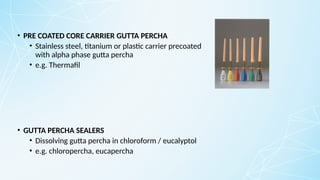
• PRE COATED CORE CARRIER GUTTA PERCHA
• Stainless steel, titanium or plastic carrier precoated
with alpha phase gutta percha
• e.g. Thermafil
• GUTTA PERCHA SEALERS
• Dissolving gutta percha in chloroform / eucalyptol
• e.g. chloropercha, eucapercha
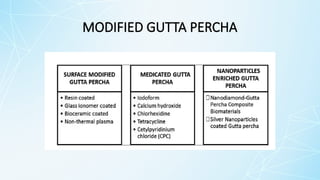
MODIFIED GUTTA PERCHA
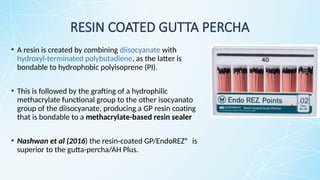
RESIN COATED GUTTA PERCHA
• A resin is created by combining diisocyanate with
hydroxyl-terminated polybutadiene, as the latter is
bondable to hydrophobic polyisoprene (PI).
• This is followed by the grafting of a hydrophilic
methacrylate functional group to the other isocyanato
group of the diisocyanate, producing a GP resin coating
that is bondable to a methacrylate-based resin sealer
• Nashwan et al (2016) the resin-coated GP/EndoREZ® is
superior to the gutta-percha/AH Plus.
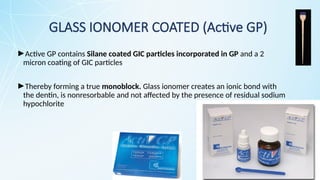
►Active GP contains Silane coated GIC particles incorporated in GP and a 2
micron coating of GIC particles
►Thereby forming a true monoblock. Glass ionomer creates an ionic bond with
the dentin, is nonresorbable and not affected by the presence of residual sodium
hypochlorite
GLASS IONOMER COATED (Active GP)
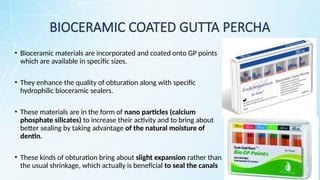
BIOCERAMIC COATED GUTTA PERCHA
• Bioceramic materials are incorporated and coated onto GP points
which are available in specific sizes.
• They enhance the quality of obturation along with specific
hydrophilic bioceramic sealers.
• These materials are in the form of nano particles (calcium
phosphate silicates) to increase their activity and to bring about
better sealing by taking advantage of the natural moisture of
dentin.
• These kinds of obturation bring about slight expansion rather than
the usual shrinkage, which actually is beneficial to seal the canals
• Bioceramic-based products use the moisture naturally present in the
dentinal tubules to commence and complete their setting reaction
because they are hydrophilic and insoluble.
• Tubular diffusion is considered to be the process by which bioceramic-
based sealers bind to dentin
causing mechanical linkages to interlock,
resulting in the formation of a bond,
the production of hydroxyapatite along the mineral infiltration zone.
MEDICATED GUTTA PERCHA CONES
• IODOFORM CONTAINING GUTTA PERCHA
• Developed by H. Martin, T.R. Martin – 1999
• Contains 10% iodoform
• Antimicrobial activity against
• Streptococcus viridans, sanguis
• Staphylococcus aureus
• Bacteroides fragilis
• To be used with MCS (Medicated Canal Sealer), a Z0E sealer that also contains 10% iodoform
• They interact with cell walls of microorganisms causing pore
formation or generate solid-liquid interfaces at the lipid membrane
level, which lead to loss of cytosol material and enzyme denaturation.
• It is said to inhibit the growth of Staphylococcus aureus, Streptococcus
sanguis, Actinomyces odontolyticus, and Fusobacterium nucleatum,
but not Enterococcus faecalis, Escherichia coli
• Iodoform is centrally located and takes 24 hrs to leach to the surface
• Remains inert until it comes in contact with tissue fluids that activate the free
iodine
• A canal filled with MGP could serve as a protection against bacterial
contamination from coronal microleakage reaching the apical tissue.
• The use of heat during obturation does not effect either the release of iodoform
or its chemical composition.
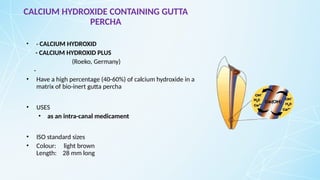
CALCIUM HYDROXIDE CONTAINING GUTTA
PERCHA
• - CALCIUM HYDROXID
- CALCIUM HYDROXID PLUS
(Roeko, Germany)
-
• Have a high percentage (40-60%) of calcium hydroxide in a
matrix of bio-inert gutta percha
• USES
• as an intra-canal medicament
• ISO standard sizes
• Colour: light brown
Length: 28 mm long
ROEKO's Calcium Hydroxide PLUS Points
• Calcium hydroxide Gutta percha (CGG) points combine the efficiency of calcium hydroxide
and bio-inertness of GP to be used as temporary intracanal medicaments
• More effective over longer period
• Technique
• Moisture in the canal activates the Calcium Hydroxide and the pH in the canal rises to a level
of 12 + within minutes
• Average treatment time is 1 to 3 weeks
• Once Ca(OH)2 has leached out, the point is no longer useful as a filling material and must be
removed
• Available in
• packages of 60 points each, ISO sizes 15 through 140
• 3 assortment boxes, 15-40, 45-80 and 90-140, 10 points each size
Advantages
• Clean:
• No smearing around the access cavity during insertion
• Removable without any residue
• Time-saving:
• The points are ready to use
• No mixing
• Easy to apply and remove
• Safe:
• The insertion of the points down to the apex is easy
• Ensures that calcium hydroxide is released throughout the canal
CHLORHEXIDINE – IMPREGNATED GUTTA
PERCHA
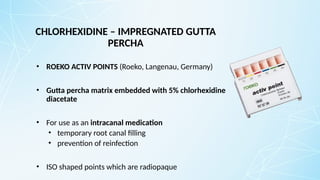
• ROEKO ACTIV POINTS (Roeko, Langenau, Germany)
• Gutta percha matrix embedded with 5% chlorhexidine
diacetate
• For use as an intracanal medication
• temporary root canal filling
• prevention of reinfection
• ISO shaped points which are radiopaque
Medicated gutta percha points are site specific, surface acting antimicrobial
obturating materials.
• It acts by the interaction of the positively charged CHX molecule and
negatively charged phosphate groups on microbial cell walls causing a
change in osmotic equilibrium.
• CHX is both bacteriostatic (0.2%) and bactericidal (2%) and can penetrate
the microbial cell wall by altering its permeability.
• Chlorhexidine impregnated GP points (Activ points) are known to be effective
against E. faecalis and Candida albicans
TECHNIQUE
• An Activ point corresponding to the last used root canal instrument, or one size
smaller, should be marked with the predetermined length and applied into the
canal without condensation
• A drop of moisture (e.g. sterile H2O) may be used together with the Activ point to
accelerate the release of CHX
• Further dissociation will be initiated by moisture flowing into the canal through
the dentine tubules and apex
TETRACYCLINE GP POINTS
Melker et al 2006 tetracycline containing GP points.
• Gutta Percha-20%
• Zinc Oxide-57%
• Barium Sulfate-10%
• Beeswax-3%
Tetracycline HC 1-10%
Tetracycline acts by inhibiting ….
• lyophilized bacteria within dentinal tubules.
• Bacteria along the surface of the gutta percha points that have become contaminated due
to microleakage after obturation.
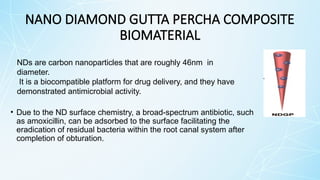
NANO DIAMOND GUTTA PERCHA COMPOSITE
BIOMATERIAL
• Due to the ND surface chemistry, a broad-spectrum antibiotic, such
as amoxicillin, can be adsorbed to the surface facilitating the
eradication of residual bacteria within the root canal system after
completion of obturation.
NDs are carbon nanoparticles that are roughly 46nm in
diameter.
It is a biocompatible platform for drug delivery, and they have
demonstrated antimicrobial activity.
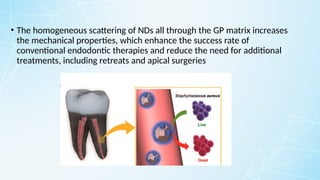
• The homogeneous scattering of NDs all through the GP matrix increases
the mechanical properties, which enhance the success rate of
conventional endodontic therapies and reduce the need for additional
treatments, including retreats and apical surgeries
SILVER NANOPARTICLES COATED GUTTA
PERCHA
• Accordingly, Iranian researchers (Dainet and Ataie)have introduced nanosilver-gutta-
percha, as an attempt to improve the antibacterial effect of gutta-percha, sustained
ion release
• Significant effect against-
 Enterococcus faecalis,
 Staphylococcus aureus,
 Candida albicans, and
 Escherichia coli.
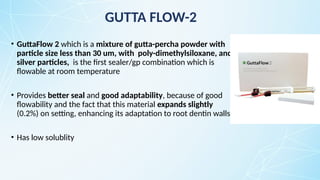
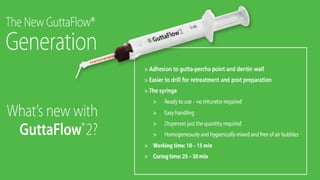
• GuttaFlow 2 which is a mixture of gutta-percha powder with
particle size less than 30 um, with poly-dimethylsiloxane, and
silver particles, is the first sealer/gp combination which is
flowable at room temperature
• Provides better seal and good adaptability, because of good
flowability and the fact that this material expands slightly
(0.2%) on setting, enhancing its adaptation to root dentin walls.
• Has low solublity
GUTTA FLOW-2
ADVANTAGES OF GUTTA PERCHA
• COMPACTIBILITY
• Adapts to the root canal walls
• BIOLOGICALLY INERT
• least reactive
• minimal toxicity
• minimal tissue irritability
• least allergenic
• well tolerated by periradicular tissues
• DIMENSIONAL STABILITY AND BECOMES PLASTIC WHEN WARMED
• DISSOLVED IN SOLVENTS
• Chloroform
• Xylol
DISADVANTAGES
• Undergoes shrinkage when plasticized
• Does not possess adhesive qualities
• Lack of rigidity
• Undergoes vertical distortion during compaction( easily displaced by
pressure so lack of length control)
REMOVAL OF GUTTA PERCHA
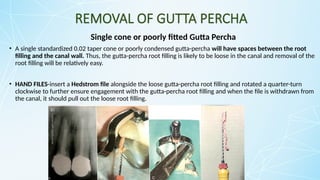
Single cone or poorly fitted Gutta Percha
• A single standardized 0.02 taper cone or poorly condensed gutta-percha will have spaces between the root
filling and the canal wall. Thus, the gutta-percha root filling is likely to be loose in the canal and removal of the
root filling will be relatively easy.
• HAND FILES-insert a Hedstrom file alongside the loose gutta-percha root filling and rotated a quarter-turn
clockwise to further ensure engagement with the gutta-percha root filling and when the file is withdrawn from
the canal, it should pull out the loose root filling.
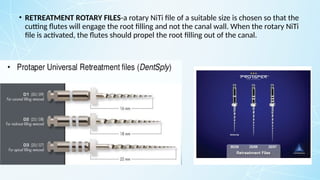
• RETREATMENT ROTARY FILES-a rotary NiTi file of a suitable size is chosen so that the
cutting flutes will engage the root filling and not the canal wall. When the rotary NiTi
file is activated, the flutes should propel the root filling out of the canal.
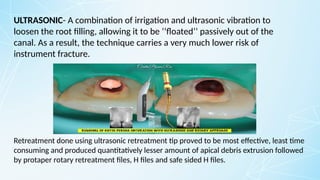
ULTRASONIC- A combination of irrigation and ultrasonic vibration to
loosen the root filling, allowing it to be ‘‘floated’’ passively out of the
canal. As a result, the technique carries a very much lower risk of
instrument fracture.
Retreatment done using ultrasonic retreatment tip proved to be most effective, least time
consuming and produced quantitatively lesser amount of apical debris extrusion followed
by protaper rotary retreatment files, H files and safe sided H files.
CONDENSED GUTTA PERCHA
• Must first be softened with heat or solvents. This has the effect of loosening the
root filling and also creating the necessary space to allow the placement of
instruments in order to remove the gutta-percha.
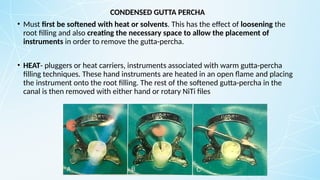
• HEAT- pluggers or heat carriers, instruments associated with warm gutta-percha
filling techniques. These hand instruments are heated in an open flame and placing
the instrument onto the root filling. The rest of the softened gutta-percha in the
canal is then removed with either hand or rotary NiTi files
SOLVENTS
• Gutta-percha and most sealers are miscible in chloroform and solvents and, once
in solution, can be absorbed and removed with appropriately-sized paper points.
• The sequential technique involves refilling the created reservoir in the canal
orifice with drops of solvent and picking into the dissolving gutta-percha while
filing with a size 10, 15 and 20 stainless steel files.
• Wennberg concluded that methyl chloroform was the best alternative to
chloroform as it was effective and less toxic, but its action was significantly
slower.
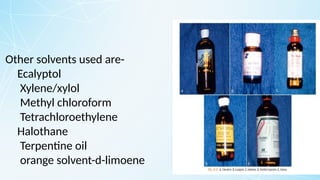
Other solvents used are-
Ecalyptol
Xylene/xylol
Methyl chloroform
Tetrachloroethylene
Halothane
Terpentine oil
orange solvent-d-limoene
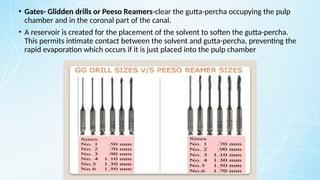
• Gates- Glidden drills or Peeso Reamers-clear the gutta-percha occupying the pulp
chamber and in the coronal part of the canal.
• A reservoir is created for the placement of the solvent to soften the gutta-percha.
This permits intimate contact between the solvent and gutta-percha, preventing the
rapid evaporation which occurs if it is just placed into the pulp chamber
RESILON
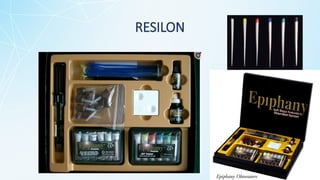
RESILON
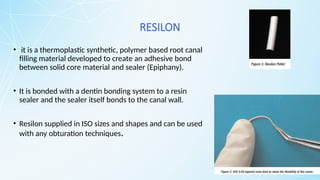
• it is a thermoplastic synthetic, polymer based root canal
filling material developed to create an adhesive bond
between solid core material and sealer (Epiphany).
• It is bonded with a dentin bonding system to a resin
sealer and the sealer itself bonds to the canal wall.
• Resilon supplied in ISO sizes and shapes and can be used
with any obturation techniques.
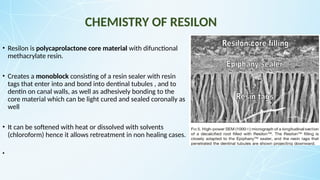
CHEMISTRY OF RESILON
• Resilon is polycaprolactone core material with difunctional
methacrylate resin.
• Creates a monoblock consisting of a resin sealer with resin
tags that enter into and bond into dentinal tubules , and to
dentin on canal walls, as well as adhesively bonding to the
core material which can be light cured and sealed coronally as
well
• It can be softened with heat or dissolved with solvents
(chloroform) hence it allows retreatment in non healing cases.
•
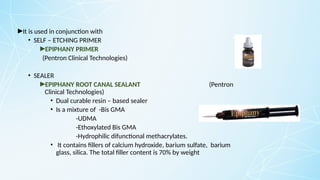
►It is used in conjunction with
• SELF – ETCHING PRIMER
►EPIPHANY PRIMER
(Pentron Clinical Technologies)
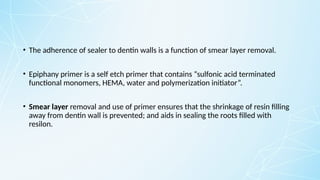
• SEALER
►EPIPHANY ROOT CANAL SEALANT (Pentron
Clinical Technologies)
• Dual curable resin – based sealer
• Is a mixture of -Bis GMA
-UDMA
-Ethoxylated Bis GMA
-Hydrophilic difunctional methacrylates.
• It contains fillers of calcium hydroxide, barium sulfate, barium
glass, silica. The total filler content is 70% by weight
• The adherence of sealer to dentin walls is a function of smear layer removal.
• Epiphany primer is a self etch primer that contains “sulfonic acid terminated
functional monomers, HEMA, water and polymerization initiator”.
• Smear layer removal and use of primer ensures that the shrinkage of resin filling
away from dentin wall is prevented; and aids in sealing the roots filled with
resilon.
REMOVAL OF RESILON
• The complete removal of Resilon may be challenging since the resin sealer can penetrate
into the dentinal tubules. It was hypothesized that even if the Resilon were removed, it
would leave more residual material than the removal of gutta-percha.
• Use of chloroform to aid in the removal of Resilon root fillings and endodontic files to
remove the sealer, however, resin sealers are not affected by chloroform
• The removal of Resilon root fillings left cleaner canals in the apical third, this may simply
because the material is easier to remove.
• Alternatively, it may be because removal of the smear layer in the apical third of root
canals has been shown to be relatively poor and this may have hindered the effective
bonding of the Resilon to the canal wall at this level
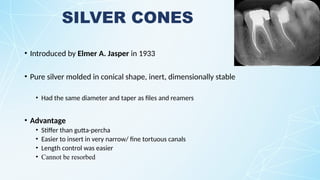
SILVER CONES
• Introduced by Elmer A. Jasper in 1933
• Pure silver molded in conical shape, inert, dimensionally stable
• Had the same diameter and taper as files and reamers
• Advantage
• Stiffer than gutta-percha
• Easier to insert in very narrow/ fine tortuous canals
• Length control was easier
• Cannot be resorbed
DISADVANTAGES
• They do not seal well both apically and laterally because of their lack of plasticity
• They maintain their round shape and no canal is completely round even after
instrumentation, which leaves too much space to be filled by sealer or cement
leading to leakage
• Leakage allows corrosion of silver points and formation of silver salts which are
cytotoxic
INDICATIONS
• In mature teeth with small well calcified round tapered canals.
Eg: maxillary first premolars with 2 or 3 canals, buccal roots of mature maxillary
molar and mesial roots of mandibular molars.
CONTRAINDICATION
• In youngsters with canals that are too large or ovoid for single silver point use.
• Anterior teeth, single canal premolars, large single canal in molars.
SILVER CONE OBTURATION METHOD
• Select cone corresponding to largest instrument used.
• Sterilize cone by alcohol flaming 3 times.
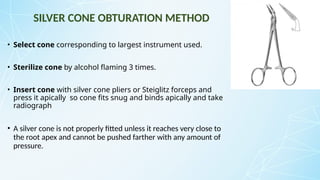
• Insert cone with silver cone pliers or Steiglitz forceps and
press it apically so cone fits snug and binds apically and take
radiograph
• A silver cone is not properly fitted unless it reaches very close to
the root apex and cannot be pushed farther with any amount of
pressure.
• In wider, more tapering canals, gutta percha or additional silver cones may be
condensed laterally beside the main silver cone.
• Place warm pellets of gutta percha in the floor of the pulp chamber adjacent to
the silver cone or cones, and to press the gutta percha apically around the silver
cones with narrow root canal pluggers
• The gutta percha may be rewarmed from time to time with a heated spreader
and the softened mass forced repeatedly into the mouth of the root canal. Many
lateral canals are filled in this manner
CORROSION OF SILVER CONES
• Seltzer and Co. have showed that failed silver cones are always black and corroded
when removed from canal. Found silver sulfides, silver sulphates, silver amine
sulfate amide hyfrate as corrosion products on cones.
• Goldberg reported even in cases that are clinically and radiographically successful
corrosion may be seen microscopically.
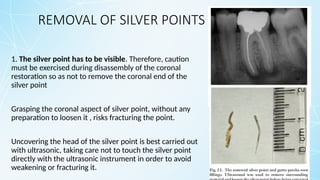
REMOVAL OF SILVER POINTS
1. The silver point has to be visible. Therefore, caution
must be exercised during disassembly of the coronal
restoration so as not to remove the coronal end of the
silver point
Grasping the coronal aspect of silver point, without any
preparation to loosen it , risks fracturing the point.
Uncovering the head of the silver point is best carried out
with ultrasonic, taking care not to touch the silver point
directly with the ultrasonic instrument in order to avoid
weakening or fracturing it.
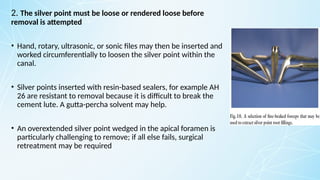
2. The silver point must be loose or rendered loose before
removal is attempted
• Hand, rotary, ultrasonic, or sonic files may then be inserted and
worked circumferentially to loosen the silver point within the
canal.
• Silver points inserted with resin-based sealers, for example AH
26 are resistant to removal because it is difficult to break the
cement lute. A gutta-percha solvent may help.
• An overextended silver point wedged in the apical foramen is
particularly challenging to remove; if all else fails, surgical
retreatment may be required
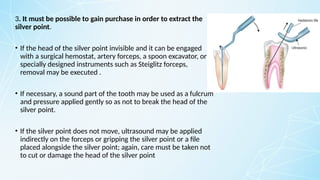
3. It must be possible to gain purchase in order to extract the
silver point.
• If the head of the silver point invisible and it can be engaged
with a surgical hemostat, artery forceps, a spoon excavator, or
specially designed instruments such as Steiglitz forceps,
removal may be executed .
• If necessary, a sound part of the tooth may be used as a fulcrum
and pressure applied gently so as not to break the head of the
silver point.
• If the silver point does not move, ultrasound may be applied
indirectly on the forceps or gripping the silver point or a file
placed alongside the silver point; again, care must be taken not
to cut or damage the head of the silver point
CEMENT/ PASTE FILLS
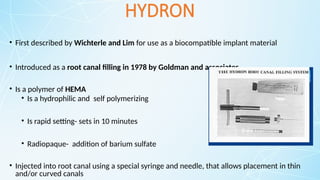
HYDRON
• First described by Wichterle and Lim for use as a biocompatible implant material
• Introduced as a root canal filling in 1978 by Goldman and associates
• Is a polymer of HEMA
• Is a hydrophilic and self polymerizing
• Is rapid setting- sets in 10 minutes
• Radiopaque- addition of barium sulfate
• Injected into root canal using a special syringe and needle, that allows placement in thin
and/or curved canals
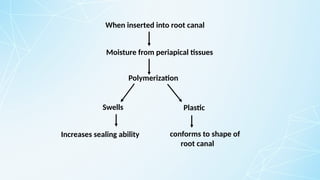
When inserted into root canal
Moisture from periapical tissues
Polymerization
Swells Plastic
Increases sealing ability conforms to shape of
root canal
• Disadvantages
• Concerns of tissue toxicity by the unset material
• Lack of homogeneity
• Questionable ability to seal the root canal system
• Clinical use – proved unsatisfactory
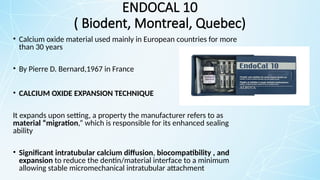
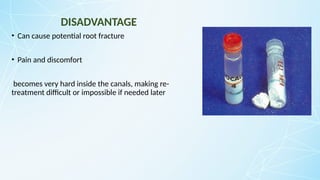
ENDOCAL 10
( Biodent, Montreal, Quebec)
• Calcium oxide material used mainly in European countries for more
than 30 years
• By Pierre D. Bernard,1967 in France
• CALCIUM OXIDE EXPANSION TECHNIQUE
It expands upon setting, a property the manufacturer refers to as
material “migration,” which is responsible for its enhanced sealing
ability
• Significant intratubular calcium diffusion, biocompatibility , and
expansion to reduce the dentin/material interface to a minimum
allowing stable micromechanical intratubular attachment
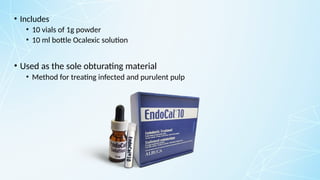
• Includes
• 10 vials of 1g powder
• 10 ml bottle Ocalexic solution
• Used as the sole obturating material
• Method for treating infected and purulent pulp
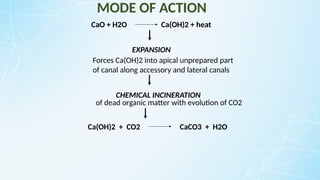
MODE OF ACTION
CaO + H2O Ca(OH)2 + heat
EXPANSION
Forces Ca(OH)2 into apical unprepared part
of canal along accessory and lateral canals
CHEMICAL INCINERATION
of dead organic matter with evolution of CO2
Ca(OH)2 + CO2 CaCO3 + H2O
DISADVANTAGE
• Can cause potential root fracture
• Pain and discomfort
becomes very hard inside the canals, making re-
treatment difficult or impossible if needed later
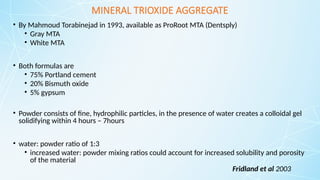
MINERAL TRIOXIDE AGGREGATE
• By Mahmoud Torabinejad in 1993, available as ProRoot MTA (Dentsply)
• Gray MTA
• White MTA
• Both formulas are
• 75% Portland cement
• 20% Bismuth oxide
• 5% gypsum
• Powder consists of fine, hydrophilic particles, in the presence of water creates a colloidal gel
solidifying within 4 hours – 7hours
• water: powder ratio of 1:3
• increased water: powder mixing ratios could account for increased solubility and porosity
of the material
Fridland et al 2003
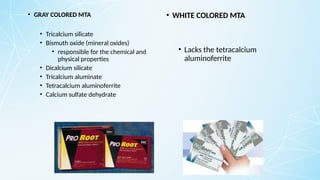
• GRAY COLORED MTA
• Tricalcium silicate
• Bismuth oxide (mineral oxides)
• responsible for the chemical and
physical properties
• Dicalcium silicate
• Tricalcium aluminate
• Tetracalcium aluminoferrite
• Calcium sulfate dehydrate
• WHITE COLORED MTA
• Lacks the tetracalcium
aluminoferrite
• Matt et al 2004
• Gray MTA demonstrated significantly less leakage than white MTA
• The elimination of tetracalcium aluminoferrite – responsible for altered properties
of the material
• Light volumetric shrinkage occurred with the white MTA that accounts for the
increased leakage
• 5mm thick barrier was significantly harder than 2mm barrier: regardless of type of
MTA or number of steps
PHYSIOCHEMICAL PROPERTIES
• Biocompatibility of the cement might be attributable to the release of hydroxyl ions and
formation of calcium hydroxide during the hydration process
• When mixed MTA is compacted against dentin, a dentin-MTA interfacial layer forms in
the presence of phosphates which resembles hydroxyapatite in composition and
structure which shows superior marginal adaptation.
• Moreover, the particle size and dimensional shape of MTA can occlude and penetrate
dentinal tubules that might harbor microorganisms after cleaning and shaping
• Bacteriostatic and bactericidal properties
• Creates impervious seal against bacteria
DISADVANTAGES
• Discolouration of teeth due to reduction of ferrous ions (FeO) in
dentinal tubules
• Voids in obturation can be seen
• Slow setting time of Proroot MTA
• Obturation in curved canals and retreatment is difficult .
CALCIUM – PHOSPHATE CEMENT
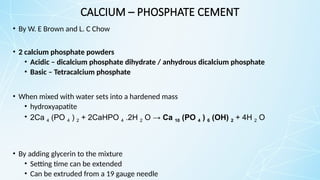
• By W. E Brown and L. C Chow
• 2 calcium phosphate powders
• Acidic – dicalcium phosphate dihydrate / anhydrous dicalcium phosphate
• Basic – Tetracalcium phosphate
• When mixed with water sets into a hardened mass
• hydroxyapatite
• 2Ca 4 (PO 4 ) 2 + 2CaHPO 4 .2H 2 O → Ca 10 (PO 4 ) 6 (OH) 2 + 4H 2 O
• By adding glycerin to the mixture
• Setting time can be extended
• Can be extruded from a 19 gauge needle
Final set cement
• Rowne (1983) showed this cement penetrated on occluded radicular dentinal
tubules &enhanced hydroxyapatite formation.
• Wefel (1984) found it effectively plugged apical foramen & penetrated dentinal
tubules upto 10mm
• All-crystalline material
• As radiopaque as bone, insoluble in water, saliva and blood
• Has a porosity that is in direct ratio to the amount of solvent (water) used
DISADVANTAGES OF PASTE FILLS
• Toxicity – from components of some paste that either leach out of the paste or are in contact with
the periradicular tissues
• Porosities in paste fills
• Most pastes resorb in time resulting in leakage, percolation and strong possibility of ultimate
endodontic failure
• Systemic recovery of certain components in blood samples and various vital organs
• Antigenic chemical components – causing immunologic response
• Apical control of pastes fills is all but impossible especially when no apical stop is present or a root
perforation exists
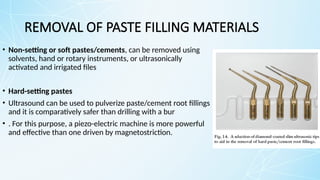
REMOVAL OF PASTE FILLING MATERIALS
• Non-setting or soft pastes/cements, can be removed using
solvents, hand or rotary instruments, or ultrasonically
activated and irrigated files
• Hard-setting pastes
• Ultrasound can be used to pulverize paste/cement root fillings
and it is comparatively safer than drilling with a bur
• . For this purpose, a piezo-electric machine is more powerful
and effective than one driven by magnetostriction.
• Paste/cement root fillings may require a combination of drilling, ultrasonic dispersion, or
if soluble they have to be dissolved slowly with a solvent.
• Gound et al. reported that in more than 50% of the cases analyzed, in resin paste root
canal filling large voids remain within the root filling .
• It may be possible to remove the resin with ultrasound; this will break up the residual
material as the ultrasonic tip is advanced into the created space.
REFERENCES
Endodontics- Ingle 7th
edition
Endodontic therapy – Weine
Pathways of the pulp – Cohen 11th
edition
Gutta-percha in endodontics - A comprehensive review of material science
( review article)
 Bioceramic –based Root Canal sealers: A review
Grossman 14th
edition

Recent Advances in Obturating materials.pptx

  • 1.
  • 2.
    CONTENTS • INTRODUCTION • HISTORY •OBJECTIVES FOR OBTURATION • CLASSIFICATION OF MATERIAL USED FOR OBTURATION • GUTTA PERCHA • RESILON • SILVER CONES • PASTE FILLING MATERIALS • CONCLUSION
  • 3.
    INTRODUCTION • It isthe three dimensional filling of the entire root canal system as close to the CDJ as possible to obtain a fluid impervious seal which will hinder the invasion of microorganisms and potential nutrients that would support biological growth. • Obturation is the method used to fill and seal a cleaned and shaped root canal using a root canal sealer and a core filling material.
  • 4.
    • A Threedimensional obturation with a fluid tight seal at the apical area, laterally and coronally is the primary requirement for ensuring successful treatment. • Washington Study has revealed that 56-68% of all endodontic treatment fails due to incomplete obturation, thus the development of obturation materials & techniques has gained more importance.
  • 5.
    • The standardroot filling is a combination of sealer cement with a central core material, which until now has been almost exclusively gutta-percha. • The core acts as a piston on the flowable sealer, causing it to spread, fill voids and to wet and attach to the instrumented dentin wall
  • 6.
  • 7.
    • Substitution ofan inert filling in the space previously occupied by the pulp tissue • To eliminate all avenues of leakage from the oral cavity or the periradicular tissues into the root canal system (i.e. to attain a three dimensional fluid impervious seal apicaly, laterally and coronally within the confines of the root canal system) • To seal within the system any irritants that cannot be fully removed during canal cleaning and shaping procedures • To adequately seal iatrogenic causes such as perforations, ledges and zipped apices
  • 8.
    RADIOGRAPHICALLY • To attaina radiographic appearance of a dense three dimensional filling which extends as close as possible to the cemento dentinal junction without gross over extension or under filling in the presence of a patent canal • Obturated root canal should reflect a shape that is approximately the same shape as the root morphology • Shape of the obturated canal should reflect a continuously tapering funnel preparation without excess removal of tooth structure at any level of the canal system
  • 9.
    Extension of theRoot Canal Filling The Anatomical Limits of the Pulp Space Are • The CDJ Apically, And • The Pulp Chamber Coronally
  • 10.
    • OVEREXTENSION ANDUNDEREXTENSION —refer solely to the vertical dimension of the root canal filling, beyond or short of the root apex, overextension often results from failure to create an apical stop during instrumentation. OVER EXTENSION UNDER EXTENSION
  • 11.
    • UNDERFILLING- refersto a tooth whose root canal system has been inadequately obturated in any dimension, leaving large reservoirs for recontamination and infection • OVERFILLING –A solid or semi-solid core root canal filling extending beyond the apical foramen; commonly used to imply that the root canal space is completely obturated.
  • 12.
    • Seltzer etal. (1968) found that tissue reactions following instrumentation short of the apex were milder than those reactions which followed instrumentation beyond the apex. • Gutierrez & Aguayo (1995) All the root canals were found to deviate from the long axis of their roots. The number of foramina ranged from 1 to 6. The openings always ended short of the apices by 0.20±3.80 mm
  • 13.
    When is the canal readyto obturate? Temporary filling is intact (Broken/leaking filling cause recontaminatio n of canal) The tooth is asymptomatic , no pain, tenderness, or apical periodontitis. No sinus tract A negative culture The canal is dry with no exudate There is no foul odor (suggests residual infection / reinfection) due to anaerobe
  • 14.
    PROPERTIES OF ANIDEAL OBTURATING MATERIAL • Be easily introduced into the canal • Seal the canals laterally and apically • Not shrink after insertion • Be impervious to moisture • Be radiopaque • Be bactericidal or atleast discourage bacterial growth • Not stain the tooth structure • Not irritate periapical tissues or affect the tooth structure • Be sterile or easily sterilized • Easily removed from root canal
  • 15.
  • 16.
    • 200 B.C.– oldest known root canal filling bronze wire found in the root canal in the skull of a Nabatean warrior • 1825- Gold foil by Edward Hudson • Other materials • Lead • Paraffin • Amalgam • Wood points • Oxychloride of zinc • Ivory • Orangewood sticks • 1847- Hill developed first gutta –percha material known as Hill’s stopping • Consisted of bleached gutta-percha- carbonate of lime and quartz
  • 17.
    • 1867-Bowman- 1stuse of gutta percha for canal filling in an extracted first molar • 1887- S.S. White Company began to manufacture gutta percha points • 1893-Rollins introduced new type of gutta percha to which he added vermilion (pure oxide of mercury)
  • 18.
    • 1930- ElmerA. Jasper introduced silver points • 1977- Yee et al introduced the injectable thermoplasticized gutta-percha technique • 1978- W. Ben Johnson described a technique of obturation with gutta percha coated endondontic file (forerunner of Thermafil) • 1979- Mc Spadden introduced a special compactor for softening gutta percha by friction • 1984- Michanowicz introduced a low temperature (70C) injectable thermoplasticized gutta-percha technique- Ultrafil
  • 19.
    CLASSIFICATION OF MATERIALSUSED FOR OBTURATION • Solid core materials 1. Silver cones 2. Resilon • Semi solid core materials 1. Gutta – percha 2. MGP [medicated gutta-percha points] Eg : Gutta-percha with calcium hydroxide According to Ingle
  • 20.
    3. Thermoplastisized gutta-Percha 4.Thermomechanical Compaction of Gutta Percha 5. Carrier based gutta percha • Paste /Cement Filling Materials
  • 21.
    GUTTA PERCHA • Theword ‘Gutta-percha' comes from 'Getah Percha' in Malay Peninsula ( South east Asia). ‘Getah’ means gum & Percha is the name of the tree. It is natural latex produced from the sap of trees • The trees are mainly found in Malay Archipelago, Singapore,, Philippines, Brazil, South America, and other tropical countries. • These trees are medium to tall (approximately 30 m) in height, . It is usually imported from Central South America for its use in dentistry, which is one of the reasons for its high cost.
  • 22.
    • There aremany species of Palaquium genus that yield GP of which four are found in India: 1. P. obovatum-Assam 2. P. polyanthum-Assam 3. P. ellipticum-Western ghats 4. P. gutta-, Bengaluru, Karnataka • Chemically, gutta-percha is a polyterprene, a polymer of isoprene(trans-1,4-polyisoprene). • ADA No. for obturating gutta percha points is 78. • Initially used for insulation of cables under sea.
  • 23.
    CHEMISTRY 1,4, - POLYISOPRENE TRANSFORM CIS FORM GUTTA PERCHA NATURAL RUBBER ~ 60% CRYSTALLINE FORM LARGELY AMORPHOUS FORM -Harder -Less elastic -Brittle
  • 24.
    NATURAL GUTTA PERCHA Alphaphase crystalline form More linear structure More stable Alpha phase molten melt Cooled at a rate of 0.50 C/hr Normal cooling Beta phase heated >65c High molecular weight Low molecular weight heated 56c (Processed form)
  • 25.
    PHASES OF GUTTAPERCHA ALPHA PHASE • Natural tree product • Low molecular weight polymer • Lower melting point • Low viscosity • Increased stickiness • Less shrinkage (2.2%) • Newer products • Thermafil • MicroSeal BETA PHASE • Processed form • High molecular weight polymer • Higher melting point • Higher viscosity • Reduced stickiness • More shrinkage (2.6%) • Most commercial forms
  • 26.
    • Traditionally βform was used due to its hardness & improved stability & stickiness • Newer formulations of α-like form of GP have Decrease viscosity (will flow under less pressure) & Increase tackiness ( more homogenous filling). Eg: ThermaFil(Tulsa Dental Corp), Ultrafil(Hygenic Corp), Densfil,
  • 27.
    COMPOSITION OF COMMERCIALLYAVAILABLE GUTTA- PERCHA COMPOSITION PERCENTAGE VARIATION FUNCTION Gutta- percha 18-22% Matrix Zinc oxide 59-76% Filler Heavy metal sulfates 1-18% Radiopacifier Waxes / Resins 1-4% Plasticizer
  • 28.
    • In orderto alter its innate hardness, various combinations of ZnO, ZnSO4, Al2O3 whiting precipitated chalk, lime or silex was added. • Before additions are made, GP is a reddish tinged, gray, translucent material, rigid and solid at room temp • Brittleness, stiffness, tensile strength, and radiopacity have been shown to depend primarily on the proportions of gutta-percha polymer and zinc oxide (Friedman et al. 1977). • Antibacterial activity has been attributed to zinc oxide
  • 29.
    • GP expandsslightly on heating; desirable for an endodontic filling material • This property ensures that an increased volume of material can be compacted into a root canal cavity. (Marlin and Schilder – Physical properties of GP OOOE 1973). • Warmed GP shrinks as it returns to body temp Schilder et al recommended that vertical pressure be applied in all warm GP techniques to compensate for volume changes that occur with cooling
  • 30.
    PROPERTIES • GP isa thermoplastic material which is temperature sensitive with good biocompatibility. • Softens at a temperature above 56C and melts around 65 oC with partial degradation. • Easily dissolved in chloroform and halothane • Heat or solvent plasticized gutta percha, results in shrinkage of 1% -2%
  • 31.
    AGING • Gutta perchashould be stored in a cool location with low humidity. • Gutta percha oxidizes and becomes brittle when exposed to light and air • Revival • Immersing cone in hot water (55C) and immediately immersing in cold tap water ( <20o C) for several seconds. • Kolokruis et al – high humidity causes absorption of water by gutta percha , lowers tensile strength, strain resistence .
  • 32.
    STERILIZATION OF GUTTAPERCHA CONES • Disinfected by • 1% NaOCl – 1min • 0.5% NaOCl – 5min • After disinfection, gutta percha cones must be rinsed in 96% ethyl alcohol, 70% isopropyl alcohol or distilled water to remove crystallized NaOCl before obturation • Herbal extracts such as lemon grass oil, basil oil, and obicure tea extract, are alternatives for chairside disinfection of GP cones and have shown good results)
  • 33.
    Forms of GPavailable • Solid core GuttaPercha points. -Standardised. -Nonstandardised. • Thermoplasticised GuttaPercha. -solid core system. -injectable form • Modified Gutta Percha
  • 34.
    FORMS OF GUTTAPERCHA • GUTTA PERCHA CONES / POINTS • Core points (standard cones) • Auxiliary points (non – standardized cones)
  • 35.
    • Core points •Sizing based on similar size and taper as standardized endodontic files • Used as master cones
  • 36.
    • Auxiliary points •Have a larger taper and pointed tip • Used as • Accessory points during lateral compaction • Master cones in warm vertical compaction and variable tapered preparations
  • 38.
    • GUTTA PERCHAPELLETS / BARS • For use in thermoplasticized gutta percha • e.g. Obtura system • SYRINGES • As low viscosity gutta percha • to be coated on carriers • e.g. AlphaSeal, SuccessFil
  • 39.
    • PRE COATEDCORE CARRIER GUTTA PERCHA • Stainless steel, titanium or plastic carrier precoated with alpha phase gutta percha • e.g. Thermafil • GUTTA PERCHA SEALERS • Dissolving gutta percha in chloroform / eucalyptol • e.g. chloropercha, eucapercha
  • 40.
  • 41.
    RESIN COATED GUTTAPERCHA • A resin is created by combining diisocyanate with hydroxyl-terminated polybutadiene, as the latter is bondable to hydrophobic polyisoprene (PI). • This is followed by the grafting of a hydrophilic methacrylate functional group to the other isocyanato group of the diisocyanate, producing a GP resin coating that is bondable to a methacrylate-based resin sealer • Nashwan et al (2016) the resin-coated GP/EndoREZ® is superior to the gutta-percha/AH Plus.
  • 42.
    ►Active GP containsSilane coated GIC particles incorporated in GP and a 2 micron coating of GIC particles ►Thereby forming a true monoblock. Glass ionomer creates an ionic bond with the dentin, is nonresorbable and not affected by the presence of residual sodium hypochlorite GLASS IONOMER COATED (Active GP)
  • 44.
    BIOCERAMIC COATED GUTTAPERCHA • Bioceramic materials are incorporated and coated onto GP points which are available in specific sizes. • They enhance the quality of obturation along with specific hydrophilic bioceramic sealers. • These materials are in the form of nano particles (calcium phosphate silicates) to increase their activity and to bring about better sealing by taking advantage of the natural moisture of dentin. • These kinds of obturation bring about slight expansion rather than the usual shrinkage, which actually is beneficial to seal the canals
  • 45.
    • Bioceramic-based productsuse the moisture naturally present in the dentinal tubules to commence and complete their setting reaction because they are hydrophilic and insoluble. • Tubular diffusion is considered to be the process by which bioceramic- based sealers bind to dentin causing mechanical linkages to interlock, resulting in the formation of a bond, the production of hydroxyapatite along the mineral infiltration zone.
  • 46.
    MEDICATED GUTTA PERCHACONES • IODOFORM CONTAINING GUTTA PERCHA • Developed by H. Martin, T.R. Martin – 1999 • Contains 10% iodoform • Antimicrobial activity against • Streptococcus viridans, sanguis • Staphylococcus aureus • Bacteroides fragilis • To be used with MCS (Medicated Canal Sealer), a Z0E sealer that also contains 10% iodoform
  • 47.
    • They interactwith cell walls of microorganisms causing pore formation or generate solid-liquid interfaces at the lipid membrane level, which lead to loss of cytosol material and enzyme denaturation. • It is said to inhibit the growth of Staphylococcus aureus, Streptococcus sanguis, Actinomyces odontolyticus, and Fusobacterium nucleatum, but not Enterococcus faecalis, Escherichia coli
  • 48.
    • Iodoform iscentrally located and takes 24 hrs to leach to the surface • Remains inert until it comes in contact with tissue fluids that activate the free iodine • A canal filled with MGP could serve as a protection against bacterial contamination from coronal microleakage reaching the apical tissue. • The use of heat during obturation does not effect either the release of iodoform or its chemical composition.
  • 49.
    CALCIUM HYDROXIDE CONTAININGGUTTA PERCHA • - CALCIUM HYDROXID - CALCIUM HYDROXID PLUS (Roeko, Germany) - • Have a high percentage (40-60%) of calcium hydroxide in a matrix of bio-inert gutta percha • USES • as an intra-canal medicament • ISO standard sizes • Colour: light brown Length: 28 mm long
  • 50.
    ROEKO's Calcium HydroxidePLUS Points • Calcium hydroxide Gutta percha (CGG) points combine the efficiency of calcium hydroxide and bio-inertness of GP to be used as temporary intracanal medicaments • More effective over longer period • Technique • Moisture in the canal activates the Calcium Hydroxide and the pH in the canal rises to a level of 12 + within minutes • Average treatment time is 1 to 3 weeks • Once Ca(OH)2 has leached out, the point is no longer useful as a filling material and must be removed • Available in • packages of 60 points each, ISO sizes 15 through 140 • 3 assortment boxes, 15-40, 45-80 and 90-140, 10 points each size
  • 51.
    Advantages • Clean: • Nosmearing around the access cavity during insertion • Removable without any residue • Time-saving: • The points are ready to use • No mixing • Easy to apply and remove • Safe: • The insertion of the points down to the apex is easy • Ensures that calcium hydroxide is released throughout the canal
  • 52.
    CHLORHEXIDINE – IMPREGNATEDGUTTA PERCHA • ROEKO ACTIV POINTS (Roeko, Langenau, Germany) • Gutta percha matrix embedded with 5% chlorhexidine diacetate • For use as an intracanal medication • temporary root canal filling • prevention of reinfection • ISO shaped points which are radiopaque
  • 53.
    Medicated gutta perchapoints are site specific, surface acting antimicrobial obturating materials. • It acts by the interaction of the positively charged CHX molecule and negatively charged phosphate groups on microbial cell walls causing a change in osmotic equilibrium. • CHX is both bacteriostatic (0.2%) and bactericidal (2%) and can penetrate the microbial cell wall by altering its permeability. • Chlorhexidine impregnated GP points (Activ points) are known to be effective against E. faecalis and Candida albicans
  • 54.
    TECHNIQUE • An Activpoint corresponding to the last used root canal instrument, or one size smaller, should be marked with the predetermined length and applied into the canal without condensation • A drop of moisture (e.g. sterile H2O) may be used together with the Activ point to accelerate the release of CHX • Further dissociation will be initiated by moisture flowing into the canal through the dentine tubules and apex
  • 55.
    TETRACYCLINE GP POINTS Melkeret al 2006 tetracycline containing GP points. • Gutta Percha-20% • Zinc Oxide-57% • Barium Sulfate-10% • Beeswax-3% Tetracycline HC 1-10% Tetracycline acts by inhibiting …. • lyophilized bacteria within dentinal tubules. • Bacteria along the surface of the gutta percha points that have become contaminated due to microleakage after obturation.
  • 56.
    NANO DIAMOND GUTTAPERCHA COMPOSITE BIOMATERIAL • Due to the ND surface chemistry, a broad-spectrum antibiotic, such as amoxicillin, can be adsorbed to the surface facilitating the eradication of residual bacteria within the root canal system after completion of obturation. NDs are carbon nanoparticles that are roughly 46nm in diameter. It is a biocompatible platform for drug delivery, and they have demonstrated antimicrobial activity.
  • 57.
    • The homogeneousscattering of NDs all through the GP matrix increases the mechanical properties, which enhance the success rate of conventional endodontic therapies and reduce the need for additional treatments, including retreats and apical surgeries
  • 58.
    SILVER NANOPARTICLES COATEDGUTTA PERCHA • Accordingly, Iranian researchers (Dainet and Ataie)have introduced nanosilver-gutta- percha, as an attempt to improve the antibacterial effect of gutta-percha, sustained ion release • Significant effect against-  Enterococcus faecalis,  Staphylococcus aureus,  Candida albicans, and  Escherichia coli.
  • 59.
    • GuttaFlow 2which is a mixture of gutta-percha powder with particle size less than 30 um, with poly-dimethylsiloxane, and silver particles, is the first sealer/gp combination which is flowable at room temperature • Provides better seal and good adaptability, because of good flowability and the fact that this material expands slightly (0.2%) on setting, enhancing its adaptation to root dentin walls. • Has low solublity GUTTA FLOW-2
  • 61.
    ADVANTAGES OF GUTTAPERCHA • COMPACTIBILITY • Adapts to the root canal walls • BIOLOGICALLY INERT • least reactive • minimal toxicity • minimal tissue irritability • least allergenic • well tolerated by periradicular tissues • DIMENSIONAL STABILITY AND BECOMES PLASTIC WHEN WARMED • DISSOLVED IN SOLVENTS • Chloroform • Xylol
  • 62.
    DISADVANTAGES • Undergoes shrinkagewhen plasticized • Does not possess adhesive qualities • Lack of rigidity • Undergoes vertical distortion during compaction( easily displaced by pressure so lack of length control)
  • 63.
    REMOVAL OF GUTTAPERCHA Single cone or poorly fitted Gutta Percha • A single standardized 0.02 taper cone or poorly condensed gutta-percha will have spaces between the root filling and the canal wall. Thus, the gutta-percha root filling is likely to be loose in the canal and removal of the root filling will be relatively easy. • HAND FILES-insert a Hedstrom file alongside the loose gutta-percha root filling and rotated a quarter-turn clockwise to further ensure engagement with the gutta-percha root filling and when the file is withdrawn from the canal, it should pull out the loose root filling.
  • 64.
    • RETREATMENT ROTARYFILES-a rotary NiTi file of a suitable size is chosen so that the cutting flutes will engage the root filling and not the canal wall. When the rotary NiTi file is activated, the flutes should propel the root filling out of the canal.
  • 65.
    ULTRASONIC- A combinationof irrigation and ultrasonic vibration to loosen the root filling, allowing it to be ‘‘floated’’ passively out of the canal. As a result, the technique carries a very much lower risk of instrument fracture. Retreatment done using ultrasonic retreatment tip proved to be most effective, least time consuming and produced quantitatively lesser amount of apical debris extrusion followed by protaper rotary retreatment files, H files and safe sided H files.
  • 66.
    CONDENSED GUTTA PERCHA •Must first be softened with heat or solvents. This has the effect of loosening the root filling and also creating the necessary space to allow the placement of instruments in order to remove the gutta-percha. • HEAT- pluggers or heat carriers, instruments associated with warm gutta-percha filling techniques. These hand instruments are heated in an open flame and placing the instrument onto the root filling. The rest of the softened gutta-percha in the canal is then removed with either hand or rotary NiTi files
  • 67.
    SOLVENTS • Gutta-percha andmost sealers are miscible in chloroform and solvents and, once in solution, can be absorbed and removed with appropriately-sized paper points. • The sequential technique involves refilling the created reservoir in the canal orifice with drops of solvent and picking into the dissolving gutta-percha while filing with a size 10, 15 and 20 stainless steel files. • Wennberg concluded that methyl chloroform was the best alternative to chloroform as it was effective and less toxic, but its action was significantly slower.
  • 68.
    Other solvents usedare- Ecalyptol Xylene/xylol Methyl chloroform Tetrachloroethylene Halothane Terpentine oil orange solvent-d-limoene
  • 69.
    • Gates- Gliddendrills or Peeso Reamers-clear the gutta-percha occupying the pulp chamber and in the coronal part of the canal. • A reservoir is created for the placement of the solvent to soften the gutta-percha. This permits intimate contact between the solvent and gutta-percha, preventing the rapid evaporation which occurs if it is just placed into the pulp chamber
  • 70.
  • 71.
    RESILON • it isa thermoplastic synthetic, polymer based root canal filling material developed to create an adhesive bond between solid core material and sealer (Epiphany). • It is bonded with a dentin bonding system to a resin sealer and the sealer itself bonds to the canal wall. • Resilon supplied in ISO sizes and shapes and can be used with any obturation techniques.
  • 72.
    CHEMISTRY OF RESILON •Resilon is polycaprolactone core material with difunctional methacrylate resin. • Creates a monoblock consisting of a resin sealer with resin tags that enter into and bond into dentinal tubules , and to dentin on canal walls, as well as adhesively bonding to the core material which can be light cured and sealed coronally as well • It can be softened with heat or dissolved with solvents (chloroform) hence it allows retreatment in non healing cases. •
  • 73.
    ►It is usedin conjunction with • SELF – ETCHING PRIMER ►EPIPHANY PRIMER (Pentron Clinical Technologies) • SEALER ►EPIPHANY ROOT CANAL SEALANT (Pentron Clinical Technologies) • Dual curable resin – based sealer • Is a mixture of -Bis GMA -UDMA -Ethoxylated Bis GMA -Hydrophilic difunctional methacrylates. • It contains fillers of calcium hydroxide, barium sulfate, barium glass, silica. The total filler content is 70% by weight
  • 74.
    • The adherenceof sealer to dentin walls is a function of smear layer removal. • Epiphany primer is a self etch primer that contains “sulfonic acid terminated functional monomers, HEMA, water and polymerization initiator”. • Smear layer removal and use of primer ensures that the shrinkage of resin filling away from dentin wall is prevented; and aids in sealing the roots filled with resilon.
  • 75.
    REMOVAL OF RESILON •The complete removal of Resilon may be challenging since the resin sealer can penetrate into the dentinal tubules. It was hypothesized that even if the Resilon were removed, it would leave more residual material than the removal of gutta-percha. • Use of chloroform to aid in the removal of Resilon root fillings and endodontic files to remove the sealer, however, resin sealers are not affected by chloroform • The removal of Resilon root fillings left cleaner canals in the apical third, this may simply because the material is easier to remove. • Alternatively, it may be because removal of the smear layer in the apical third of root canals has been shown to be relatively poor and this may have hindered the effective bonding of the Resilon to the canal wall at this level
  • 76.
    SILVER CONES • Introducedby Elmer A. Jasper in 1933 • Pure silver molded in conical shape, inert, dimensionally stable • Had the same diameter and taper as files and reamers • Advantage • Stiffer than gutta-percha • Easier to insert in very narrow/ fine tortuous canals • Length control was easier • Cannot be resorbed
  • 77.
    DISADVANTAGES • They donot seal well both apically and laterally because of their lack of plasticity • They maintain their round shape and no canal is completely round even after instrumentation, which leaves too much space to be filled by sealer or cement leading to leakage • Leakage allows corrosion of silver points and formation of silver salts which are cytotoxic
  • 78.
    INDICATIONS • In matureteeth with small well calcified round tapered canals. Eg: maxillary first premolars with 2 or 3 canals, buccal roots of mature maxillary molar and mesial roots of mandibular molars. CONTRAINDICATION • In youngsters with canals that are too large or ovoid for single silver point use. • Anterior teeth, single canal premolars, large single canal in molars.
  • 79.
    SILVER CONE OBTURATIONMETHOD • Select cone corresponding to largest instrument used. • Sterilize cone by alcohol flaming 3 times. • Insert cone with silver cone pliers or Steiglitz forceps and press it apically so cone fits snug and binds apically and take radiograph • A silver cone is not properly fitted unless it reaches very close to the root apex and cannot be pushed farther with any amount of pressure.
  • 80.
    • In wider,more tapering canals, gutta percha or additional silver cones may be condensed laterally beside the main silver cone. • Place warm pellets of gutta percha in the floor of the pulp chamber adjacent to the silver cone or cones, and to press the gutta percha apically around the silver cones with narrow root canal pluggers • The gutta percha may be rewarmed from time to time with a heated spreader and the softened mass forced repeatedly into the mouth of the root canal. Many lateral canals are filled in this manner
  • 81.
    CORROSION OF SILVERCONES • Seltzer and Co. have showed that failed silver cones are always black and corroded when removed from canal. Found silver sulfides, silver sulphates, silver amine sulfate amide hyfrate as corrosion products on cones. • Goldberg reported even in cases that are clinically and radiographically successful corrosion may be seen microscopically.
  • 82.
    REMOVAL OF SILVERPOINTS 1. The silver point has to be visible. Therefore, caution must be exercised during disassembly of the coronal restoration so as not to remove the coronal end of the silver point Grasping the coronal aspect of silver point, without any preparation to loosen it , risks fracturing the point. Uncovering the head of the silver point is best carried out with ultrasonic, taking care not to touch the silver point directly with the ultrasonic instrument in order to avoid weakening or fracturing it.
  • 83.
    2. The silverpoint must be loose or rendered loose before removal is attempted • Hand, rotary, ultrasonic, or sonic files may then be inserted and worked circumferentially to loosen the silver point within the canal. • Silver points inserted with resin-based sealers, for example AH 26 are resistant to removal because it is difficult to break the cement lute. A gutta-percha solvent may help. • An overextended silver point wedged in the apical foramen is particularly challenging to remove; if all else fails, surgical retreatment may be required
  • 84.
    3. It mustbe possible to gain purchase in order to extract the silver point. • If the head of the silver point invisible and it can be engaged with a surgical hemostat, artery forceps, a spoon excavator, or specially designed instruments such as Steiglitz forceps, removal may be executed . • If necessary, a sound part of the tooth may be used as a fulcrum and pressure applied gently so as not to break the head of the silver point. • If the silver point does not move, ultrasound may be applied indirectly on the forceps or gripping the silver point or a file placed alongside the silver point; again, care must be taken not to cut or damage the head of the silver point
  • 85.
  • 86.
    HYDRON • First describedby Wichterle and Lim for use as a biocompatible implant material • Introduced as a root canal filling in 1978 by Goldman and associates • Is a polymer of HEMA • Is a hydrophilic and self polymerizing • Is rapid setting- sets in 10 minutes • Radiopaque- addition of barium sulfate • Injected into root canal using a special syringe and needle, that allows placement in thin and/or curved canals
  • 87.
    When inserted intoroot canal Moisture from periapical tissues Polymerization Swells Plastic Increases sealing ability conforms to shape of root canal
  • 88.
    • Disadvantages • Concernsof tissue toxicity by the unset material • Lack of homogeneity • Questionable ability to seal the root canal system • Clinical use – proved unsatisfactory
  • 89.
    ENDOCAL 10 ( Biodent,Montreal, Quebec) • Calcium oxide material used mainly in European countries for more than 30 years • By Pierre D. Bernard,1967 in France • CALCIUM OXIDE EXPANSION TECHNIQUE It expands upon setting, a property the manufacturer refers to as material “migration,” which is responsible for its enhanced sealing ability • Significant intratubular calcium diffusion, biocompatibility , and expansion to reduce the dentin/material interface to a minimum allowing stable micromechanical intratubular attachment
  • 90.
    • Includes • 10vials of 1g powder • 10 ml bottle Ocalexic solution • Used as the sole obturating material • Method for treating infected and purulent pulp
  • 91.
    MODE OF ACTION CaO+ H2O Ca(OH)2 + heat EXPANSION Forces Ca(OH)2 into apical unprepared part of canal along accessory and lateral canals CHEMICAL INCINERATION of dead organic matter with evolution of CO2 Ca(OH)2 + CO2 CaCO3 + H2O
  • 92.
    DISADVANTAGE • Can causepotential root fracture • Pain and discomfort becomes very hard inside the canals, making re- treatment difficult or impossible if needed later
  • 93.
    MINERAL TRIOXIDE AGGREGATE •By Mahmoud Torabinejad in 1993, available as ProRoot MTA (Dentsply) • Gray MTA • White MTA • Both formulas are • 75% Portland cement • 20% Bismuth oxide • 5% gypsum • Powder consists of fine, hydrophilic particles, in the presence of water creates a colloidal gel solidifying within 4 hours – 7hours • water: powder ratio of 1:3 • increased water: powder mixing ratios could account for increased solubility and porosity of the material Fridland et al 2003
  • 94.
    • GRAY COLOREDMTA • Tricalcium silicate • Bismuth oxide (mineral oxides) • responsible for the chemical and physical properties • Dicalcium silicate • Tricalcium aluminate • Tetracalcium aluminoferrite • Calcium sulfate dehydrate • WHITE COLORED MTA • Lacks the tetracalcium aluminoferrite
  • 95.
    • Matt etal 2004 • Gray MTA demonstrated significantly less leakage than white MTA • The elimination of tetracalcium aluminoferrite – responsible for altered properties of the material • Light volumetric shrinkage occurred with the white MTA that accounts for the increased leakage • 5mm thick barrier was significantly harder than 2mm barrier: regardless of type of MTA or number of steps
  • 96.
    PHYSIOCHEMICAL PROPERTIES • Biocompatibilityof the cement might be attributable to the release of hydroxyl ions and formation of calcium hydroxide during the hydration process • When mixed MTA is compacted against dentin, a dentin-MTA interfacial layer forms in the presence of phosphates which resembles hydroxyapatite in composition and structure which shows superior marginal adaptation. • Moreover, the particle size and dimensional shape of MTA can occlude and penetrate dentinal tubules that might harbor microorganisms after cleaning and shaping • Bacteriostatic and bactericidal properties • Creates impervious seal against bacteria
  • 97.
    DISADVANTAGES • Discolouration ofteeth due to reduction of ferrous ions (FeO) in dentinal tubules • Voids in obturation can be seen • Slow setting time of Proroot MTA • Obturation in curved canals and retreatment is difficult .
  • 98.
    CALCIUM – PHOSPHATECEMENT • By W. E Brown and L. C Chow • 2 calcium phosphate powders • Acidic – dicalcium phosphate dihydrate / anhydrous dicalcium phosphate • Basic – Tetracalcium phosphate • When mixed with water sets into a hardened mass • hydroxyapatite • 2Ca 4 (PO 4 ) 2 + 2CaHPO 4 .2H 2 O → Ca 10 (PO 4 ) 6 (OH) 2 + 4H 2 O • By adding glycerin to the mixture • Setting time can be extended • Can be extruded from a 19 gauge needle
  • 99.
    Final set cement •Rowne (1983) showed this cement penetrated on occluded radicular dentinal tubules &enhanced hydroxyapatite formation. • Wefel (1984) found it effectively plugged apical foramen & penetrated dentinal tubules upto 10mm • All-crystalline material • As radiopaque as bone, insoluble in water, saliva and blood • Has a porosity that is in direct ratio to the amount of solvent (water) used
  • 100.
    DISADVANTAGES OF PASTEFILLS • Toxicity – from components of some paste that either leach out of the paste or are in contact with the periradicular tissues • Porosities in paste fills • Most pastes resorb in time resulting in leakage, percolation and strong possibility of ultimate endodontic failure • Systemic recovery of certain components in blood samples and various vital organs • Antigenic chemical components – causing immunologic response • Apical control of pastes fills is all but impossible especially when no apical stop is present or a root perforation exists
  • 101.
    REMOVAL OF PASTEFILLING MATERIALS • Non-setting or soft pastes/cements, can be removed using solvents, hand or rotary instruments, or ultrasonically activated and irrigated files • Hard-setting pastes • Ultrasound can be used to pulverize paste/cement root fillings and it is comparatively safer than drilling with a bur • . For this purpose, a piezo-electric machine is more powerful and effective than one driven by magnetostriction.
  • 102.
    • Paste/cement rootfillings may require a combination of drilling, ultrasonic dispersion, or if soluble they have to be dissolved slowly with a solvent. • Gound et al. reported that in more than 50% of the cases analyzed, in resin paste root canal filling large voids remain within the root filling . • It may be possible to remove the resin with ultrasound; this will break up the residual material as the ultrasonic tip is advanced into the created space.
  • 103.
    REFERENCES Endodontics- Ingle 7th edition Endodontictherapy – Weine Pathways of the pulp – Cohen 11th edition Gutta-percha in endodontics - A comprehensive review of material science ( review article)  Bioceramic –based Root Canal sealers: A review Grossman 14th edition