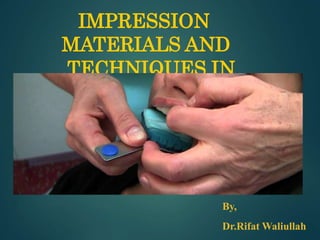
IMPRESSION
MATERIALS AND
TECHNIQUES IN
ORTHODONTICS
By,
Dr.Rifat Waliullah
In orthodontics, impression gives a negative imprint of the
tissues and by filling it with dental stone or other model material a
positive cast is made that can be removed after model material has
set; which in turn are used for-
1. STUDY PURPOSE
2. FABRICATION OF APPLIANCES
3. MAINTAINING RECORDS
IDEAL REQUISITES OF AN IMPRESSION
MATERIAL
• Be non toxic to the tissues.
• Should have an adequate shelf life .
• Be sufficiently fluid on insertion to give accurate surface
detail.
• Have pleasant taste, smell and appearance .
• Have no dimensionsal changes either in or out of the
mouth at all normal degrees of temperature and
humidity.
•Set or harden, at or near mouth temperature .
•It should have suitable working and setting time.
•Be compatible with die and model materials
•Be inexpensive
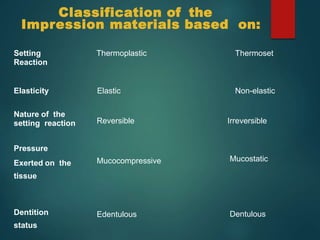
Classification of the
Impression materials based on:
Setting Thermoplastic Thermoset
Reaction
Elasticity Elastic Non-elastic
Reversible Irreversible
Nature of the
setting reaction
Pressure
Exerted on the
tissue
Mucocompressive Mucostatic
Dentition
status
Edentulous Dentulous
In orthodontics we require impression materials that are elastic
since we deal with dentulous patients
The most commonly employed materials include
I. Hydrocolloid – Agar Agar (reversible)
- Alginate (irreversible)
II. Elastomeric impression materials.
IRREVERSIBLE
HYDROCOLLOID
ALGINATE:
A SODIUM SALT ANHYDRO-ß-D-MANURONIC ACID/
ALGINIC ACID
TYPES:
TYPE I – RAPID OR FAST SETTING
TYPE II – NORMAL SETTING
Properties
# Alginates are sufficiently flexible to record fine detail in the mouth..
# The reaction is faster at higher temperature and so the material is contact
with the tissues sets first.
# Any pressure on the gel due to movement of the tray will set up stresses
within the materials which will distort the alginate after its removal from the
mouth.
# The material is sufficiently elastic to be withdrawn over undercuts;
occasionally tearing of the impression materials may occur with serious
undercuts.
# Alginate are not stable on storage because of evaporation
# Short shelf life.Alginate impression material deteriorates rapidly at elevated
temperature and The material should be stored in cool dry place.(not above 37c)
# Alginate impression loses water by evaporation and shrinks on standing in air
# If it is placed in water it absorbs water and swells .Therefore, cast should be
poured immediately after making the impression.
# If storage is unavoidable keeping in a humid temperature of 100% results in
least dimensional changes.
• Inexpensive and hydrophillic (contact angle 37°)
• Easy to manipulate
• Displace blood and saliva and pour well with gypsum stone
• Minimum requirement of equipments
• Accurate if proprely handled
WORKING TIME -
#for fast setting materials -1.25 to 2 min (mixing time-45 sec)
#for regular setting times is - 2 to 4.5 min (m.t.-60 sec)
Disadvantages of alginate
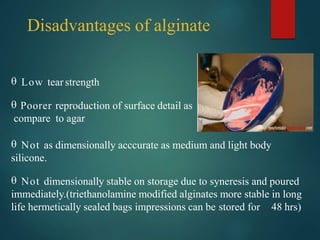
 Low tearstrength
 Poorer reproduction of surface detail as
compare to agar
 Not as dimensionally acccurate as medium and light body
silicone.
 Not dimensionally stable on storage due to syneresis and poured
immediately.(triethanolamine modified alginates more stable in long
life hermetically sealed bags impressions can be stored for 48 hrs)
Impression Trays
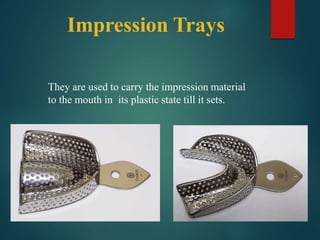
They are used to carry the impression material
to the mouth in its plastic state till it sets.
TRAYS
STOCK CUSTOM
PERFORATED NONPERFORTED
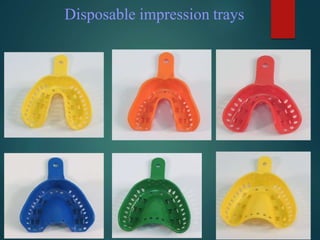
Disposable impression trays
 MAXILLARY TRAY
• The tray must completely cover the tuberosity
• Must be 4mm wider than the most apical portion of the alveolar process at the
molar region.
• The tray must cover the anteriors with the incisors contacting the flat portion of
the tray about 4 mm from the raised palatal part of the tray.
Selection Of Impression Tray
• The tray should cover all the teeth as well as the retromolar pad
• The tray should be 4-6 mm wider than the buccal and lingual portion of the
anterior teeth
• It must be possible to center the tray
 MANDIBULAR TRAY
Prepration Of The Patient
• Explain the procedure to the patient in the simplest of
terms so that the patient is aware of the procedure and
therefore the fear of the unknown is over come.
•Seat the patient upright so as to prevent the gagging due
to the backward flow of the excess material into the
throat.
•Advice the patient to breath through the nose and in case
of gagging try and distract the patient’s attention and ask
the patient to look down wards.
•Practice the placement of the empty tray into the patient’s
mouth
MANIPULATION
The recommended water powder ratio should be used. In general it is 38 ml of water per 16
gms of powder but slight variation can be presented depending on the manufacturer. The
weighed power is incorporated into the water by carefully mixing with the spatula. Care should
be taken to ensure that air is not incorporated into the mix by spatulating the mix against the
side of the bowl while using the vigorous figure of 8 motion till a smooth creamy mix is
obtained.
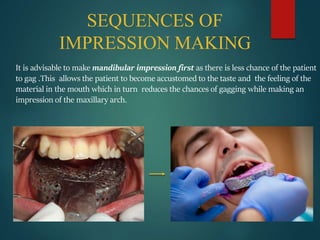
SEQUENCES OF
IMPRESSION MAKING
It is advisable to make mandibular impression first as there is less chance of the patient
to gag .This allows the patient to become accustomed to the taste and the feeling of the
material in the mouth which in turn reduces the chances of gagging while making an
impression of the maxillary arch.
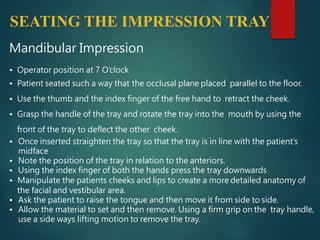
SEATING THE IMPRESSION TRAY
Mandibular Impression
• Operator position at 7 O’clock
• Patient seated such a way that the occlusal plane placed parallel to the floor.
• Use the thumb and the index finger of the free hand to retract the cheek.
• Grasp the handle of the tray and rotate the tray into the mouth by using the
front of the tray to deflect the other cheek.
• Once inserted straighten the tray so that the tray is in line with the patient’s
midface
• Note the position of the tray in relation to the anteriors.
• Using the index finger of both the hands press the tray downwards
• Manipulate the patients cheeks and lips to create a more detailed anatomy of
the facial and vestibular area.
• Ask the patient to raise the tongue and then move it from side to side.
• Allow the material to set and then remove. Using a firm grip on the tray handle,
use a side ways lifting motion to remove the tray.
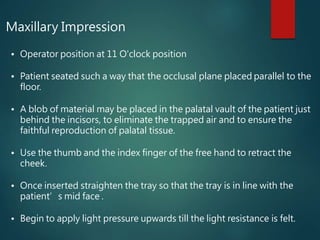
Maxillary Impression
• Operator position at 11 O'clock position
• Patient seated such a way that the occlusal plane placed parallel to the
floor.
• A blob of material may be placed in the palatal vault of the patient just
behind the incisors, to eliminate the trapped air and to ensure the
faithful reproduction of palatal tissue.
• Use the thumb and the index finger of the free hand to retract the
cheek.
• Once inserted straighten the tray so that the tray is in line with the
patient’s mid face .
• Begin to apply light pressure upwards till the light resistance is felt.
Impression Taking Technique
Disinfecting The Impression
Disinfection of impression is a concern due to viral diseases such as Hepatitis
B,A I D S and herpes simplex
• Gently rinse the impression under the tap water to remove any debris
that may be retained in the impression.
• Gently shake the excess water.
• Spray the entire impression with an O.S.H.A. (occupational health and safety
administration) approved disinfecting solution.
OR
May immerse the impression in a disinfectant such as :
gluteraldehyde solution
Iodophors
1:10 dilution of sodium hypochlorite synthetic phenols
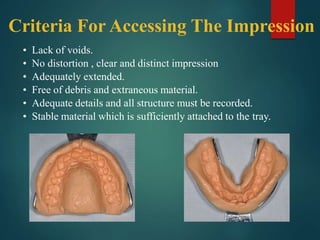
Criteria For Accessing The Impression
• Lack of voids.
• No distortion , clear and distinct impression
• Adequately extended.
• Free of debris and extraneous material.
• Adequate details and all structure must be recorded.
• Stable material which is sufficiently attached to the tray.
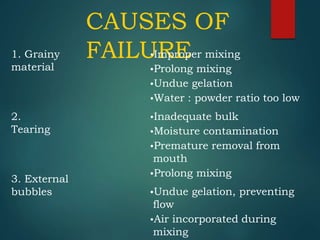
CAUSES OF
FAILURE1. Grainy
material
2.
Tearing
3. External
bubbles
•Improper mixing
•Prolong mixing
•Undue gelation
•Water : powder ratio too low
•Inadequate bulk
•Moisture contamination
•Premature removal from
mouth
•Prolong mixing
•Undue gelation, preventing
flow
•Air incorporated during
mixing
4. Irregularly shaped
voids
•Moisture or debris on
tissue
5. Rough and chalky
stone model
•Inadequate cleansing
of impression
•Excess water or
potassium sulfate
solution left in
impression
•Premature removal of
model
6.
Distortion
•Impression not
poured immediately
•Movement of tray
during gelation
•Premature removal from
mouth
CONCLUSION
•One must not depend on a material to provide good impressions.
•Any material is good and shouldbe used till the operator is familiar
with its characteristics
•Selecting the impression material depends on the convenience of the
dentist and clinical situation.
ALL WE NEED IS AN ACCURATE IMPRESSION.
Thank You

Impression Taking By Alginate

  • 1.
  • 2.
    In orthodontics, impressiongives a negative imprint of the tissues and by filling it with dental stone or other model material a positive cast is made that can be removed after model material has set; which in turn are used for- 1. STUDY PURPOSE 2. FABRICATION OF APPLIANCES 3. MAINTAINING RECORDS
  • 3.
    IDEAL REQUISITES OFAN IMPRESSION MATERIAL • Be non toxic to the tissues. • Should have an adequate shelf life . • Be sufficiently fluid on insertion to give accurate surface detail. • Have pleasant taste, smell and appearance . • Have no dimensionsal changes either in or out of the mouth at all normal degrees of temperature and humidity. •Set or harden, at or near mouth temperature . •It should have suitable working and setting time. •Be compatible with die and model materials •Be inexpensive
  • 4.
    Classification of the Impressionmaterials based on: Setting Thermoplastic Thermoset Reaction Elasticity Elastic Non-elastic Reversible Irreversible Nature of the setting reaction Pressure Exerted on the tissue Mucocompressive Mucostatic Dentition status Edentulous Dentulous
  • 5.
    In orthodontics werequire impression materials that are elastic since we deal with dentulous patients The most commonly employed materials include I. Hydrocolloid – Agar Agar (reversible) - Alginate (irreversible) II. Elastomeric impression materials.
  • 6.
    IRREVERSIBLE HYDROCOLLOID ALGINATE: A SODIUM SALTANHYDRO-ß-D-MANURONIC ACID/ ALGINIC ACID TYPES: TYPE I – RAPID OR FAST SETTING TYPE II – NORMAL SETTING
  • 7.
    Properties # Alginates aresufficiently flexible to record fine detail in the mouth.. # The reaction is faster at higher temperature and so the material is contact with the tissues sets first. # Any pressure on the gel due to movement of the tray will set up stresses within the materials which will distort the alginate after its removal from the mouth. # The material is sufficiently elastic to be withdrawn over undercuts; occasionally tearing of the impression materials may occur with serious undercuts. # Alginate are not stable on storage because of evaporation # Short shelf life.Alginate impression material deteriorates rapidly at elevated temperature and The material should be stored in cool dry place.(not above 37c) # Alginate impression loses water by evaporation and shrinks on standing in air # If it is placed in water it absorbs water and swells .Therefore, cast should be poured immediately after making the impression. # If storage is unavoidable keeping in a humid temperature of 100% results in least dimensional changes.
  • 8.
    • Inexpensive andhydrophillic (contact angle 37°) • Easy to manipulate • Displace blood and saliva and pour well with gypsum stone • Minimum requirement of equipments • Accurate if proprely handled WORKING TIME - #for fast setting materials -1.25 to 2 min (mixing time-45 sec) #for regular setting times is - 2 to 4.5 min (m.t.-60 sec)
  • 9.
    Disadvantages of alginate Low tearstrength  Poorer reproduction of surface detail as compare to agar  Not as dimensionally acccurate as medium and light body silicone.  Not dimensionally stable on storage due to syneresis and poured immediately.(triethanolamine modified alginates more stable in long life hermetically sealed bags impressions can be stored for 48 hrs)
  • 10.
    Impression Trays They areused to carry the impression material to the mouth in its plastic state till it sets.
  • 11.
  • 12.
  • 13.
     MAXILLARY TRAY •The tray must completely cover the tuberosity • Must be 4mm wider than the most apical portion of the alveolar process at the molar region. • The tray must cover the anteriors with the incisors contacting the flat portion of the tray about 4 mm from the raised palatal part of the tray. Selection Of Impression Tray • The tray should cover all the teeth as well as the retromolar pad • The tray should be 4-6 mm wider than the buccal and lingual portion of the anterior teeth • It must be possible to center the tray  MANDIBULAR TRAY
  • 14.
    Prepration Of ThePatient • Explain the procedure to the patient in the simplest of terms so that the patient is aware of the procedure and therefore the fear of the unknown is over come. •Seat the patient upright so as to prevent the gagging due to the backward flow of the excess material into the throat. •Advice the patient to breath through the nose and in case of gagging try and distract the patient’s attention and ask the patient to look down wards. •Practice the placement of the empty tray into the patient’s mouth
  • 15.
    MANIPULATION The recommended waterpowder ratio should be used. In general it is 38 ml of water per 16 gms of powder but slight variation can be presented depending on the manufacturer. The weighed power is incorporated into the water by carefully mixing with the spatula. Care should be taken to ensure that air is not incorporated into the mix by spatulating the mix against the side of the bowl while using the vigorous figure of 8 motion till a smooth creamy mix is obtained.
  • 16.
    SEQUENCES OF IMPRESSION MAKING Itis advisable to make mandibular impression first as there is less chance of the patient to gag .This allows the patient to become accustomed to the taste and the feeling of the material in the mouth which in turn reduces the chances of gagging while making an impression of the maxillary arch.
  • 17.
    SEATING THE IMPRESSIONTRAY Mandibular Impression • Operator position at 7 O’clock • Patient seated such a way that the occlusal plane placed parallel to the floor. • Use the thumb and the index finger of the free hand to retract the cheek. • Grasp the handle of the tray and rotate the tray into the mouth by using the front of the tray to deflect the other cheek. • Once inserted straighten the tray so that the tray is in line with the patient’s midface • Note the position of the tray in relation to the anteriors. • Using the index finger of both the hands press the tray downwards • Manipulate the patients cheeks and lips to create a more detailed anatomy of the facial and vestibular area. • Ask the patient to raise the tongue and then move it from side to side. • Allow the material to set and then remove. Using a firm grip on the tray handle, use a side ways lifting motion to remove the tray.
  • 18.
    Maxillary Impression • Operatorposition at 11 O'clock position • Patient seated such a way that the occlusal plane placed parallel to the floor. • A blob of material may be placed in the palatal vault of the patient just behind the incisors, to eliminate the trapped air and to ensure the faithful reproduction of palatal tissue. • Use the thumb and the index finger of the free hand to retract the cheek. • Once inserted straighten the tray so that the tray is in line with the patient’s mid face . • Begin to apply light pressure upwards till the light resistance is felt.
  • 19.
  • 20.
    Disinfecting The Impression Disinfectionof impression is a concern due to viral diseases such as Hepatitis B,A I D S and herpes simplex • Gently rinse the impression under the tap water to remove any debris that may be retained in the impression. • Gently shake the excess water. • Spray the entire impression with an O.S.H.A. (occupational health and safety administration) approved disinfecting solution. OR May immerse the impression in a disinfectant such as : gluteraldehyde solution Iodophors 1:10 dilution of sodium hypochlorite synthetic phenols
  • 21.
    Criteria For AccessingThe Impression • Lack of voids. • No distortion , clear and distinct impression • Adequately extended. • Free of debris and extraneous material. • Adequate details and all structure must be recorded. • Stable material which is sufficiently attached to the tray.
  • 22.
    CAUSES OF FAILURE1. Grainy material 2. Tearing 3.External bubbles •Improper mixing •Prolong mixing •Undue gelation •Water : powder ratio too low •Inadequate bulk •Moisture contamination •Premature removal from mouth •Prolong mixing •Undue gelation, preventing flow •Air incorporated during mixing
  • 23.
    4. Irregularly shaped voids •Moistureor debris on tissue 5. Rough and chalky stone model •Inadequate cleansing of impression •Excess water or potassium sulfate solution left in impression •Premature removal of model 6. Distortion •Impression not poured immediately •Movement of tray during gelation •Premature removal from mouth
  • 24.
    CONCLUSION •One must notdepend on a material to provide good impressions. •Any material is good and shouldbe used till the operator is familiar with its characteristics •Selecting the impression material depends on the convenience of the dentist and clinical situation. ALL WE NEED IS AN ACCURATE IMPRESSION. Thank You