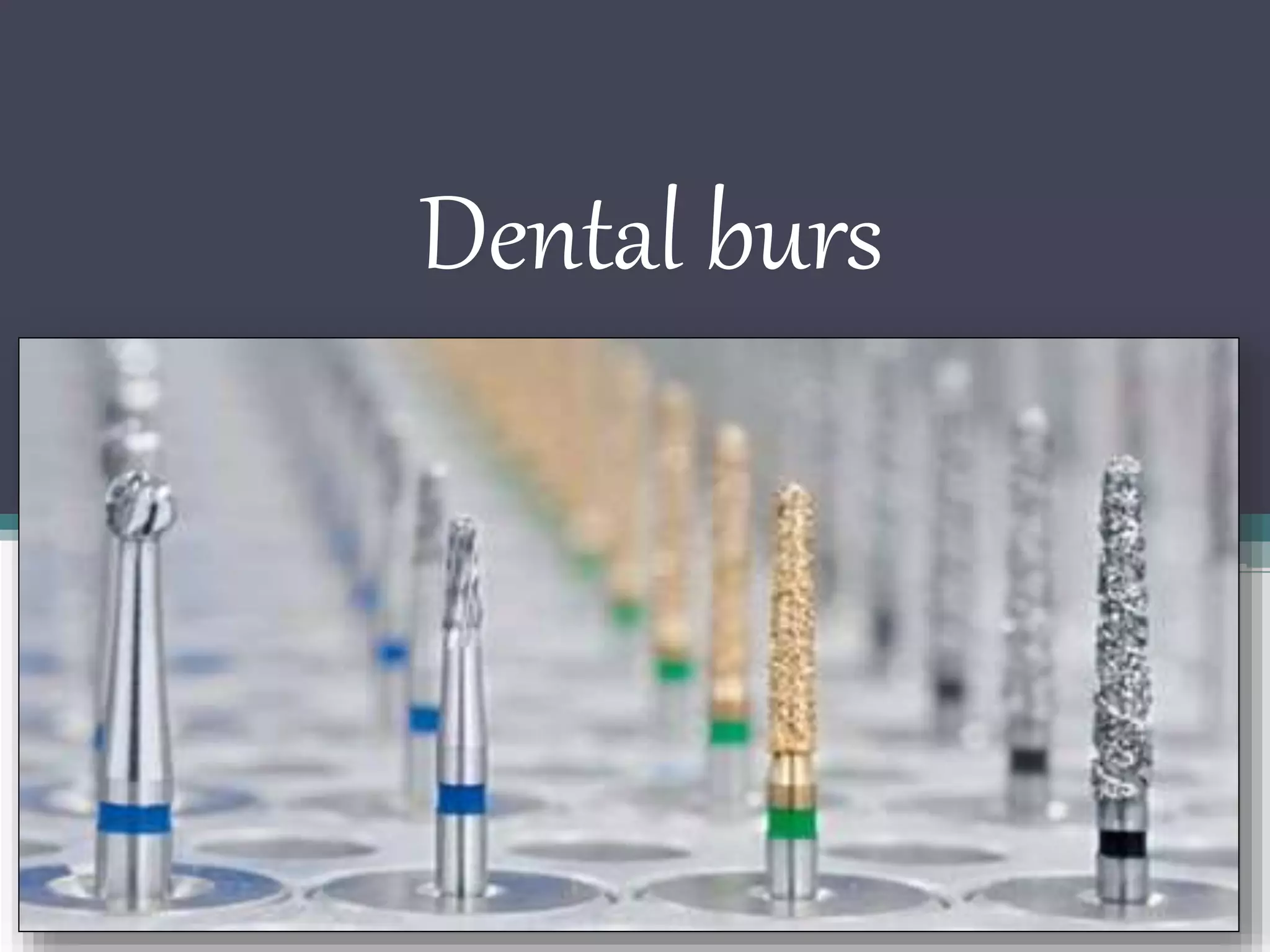
Dental burs
• Rotary cutting instruments are those instruments
which rotate on an axis to do the work of abrading
and cutting on tooth structure.
Types of Rotary Cutting
• Handpiece: It is a power device
• Bur: It is a cutting tool.
Handpiece
1728 Drill was provided by a socket fitting against the palm
and the ring was adapted to the index or middle finger
1864 British dentist George fellows invented the “clockwork”
drill.
1868 American dentist GF Green developed a pneumatic
handpiece powered by pedal operated bellows.
1871 Dr James B Morrison. First “dental engine” to provide
enough power to spin The bur with sufficient speed for
tooth cutting
1957 The Borden, airotor was developed as the prototype for
today’s modern air-turbine handpiece. It had speed up to
250,000 rpm.
1970 Electrically driven handpieces were introduced
Classification according to their driving
mechanisms.
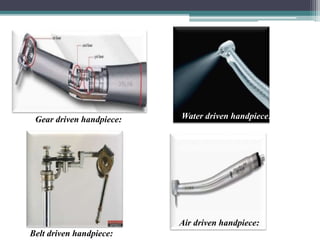
Gear driven
handpiece:
Rotary power is transferred by a belt which
runs from an electric engine. Power is
transferred from the straight handpiece by a
shaft and gears inside the angle section.
Water driven
handpiece:
It was discovered in 1953. It operates at
speed up to 100,000 rpm. In this handpiece,
a small inner piece transports water under
high pressure to rotate the turbine in the
handpiece and the larger outer tube returns
the water to the reservoir.
Classification according to their driving
mechanisms.
Belt driven
handpiece:
Belt driven angle handpiece was made
available in 1955. It runs at speed of >
100,000 rpm. This handpieces has excellent
performance and great versatility.
Air driven
handpiece:
This handipiece became available in the later
part of 1956. It runs at speed of
approximately 300,000 rpm.
Gear driven handpiece: Water driven handpiece:
Belt driven handpiece:
Air driven handpiece:
Types of Handpiece:
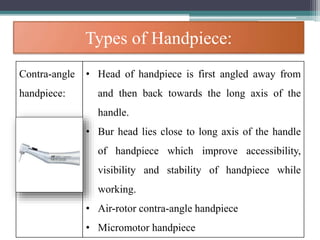
Contra-angle
handpiece:
• Head of handpiece is first angled away from
and then back towards the long axis of the
handle.
• Bur head lies close to long axis of the handle
of handpiece which improve accessibility,
visibility and stability of handpiece while
working.
• Air-rotor contra-angle handpiece
• Micromotor handpiece
Types of Handpiece:
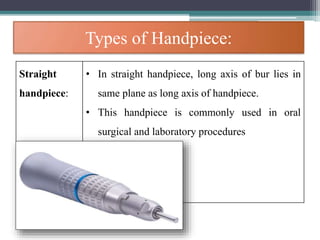
Straight
handpiece:
• In straight handpiece, long axis of bur lies in
same plane as long axis of handpiece.
• This handpiece is commonly used in oral
surgical and laboratory procedures
Dental Burs:
• “Bur is a rotary cutting instrument which has bladed
cutting head”.
• Before 1890s, silicon carbide disks and stones were
used to cut enamel since carbon steel burs were not
effective in cutting enamel.
Dental Burs:
1897 • William and Schroeder first made diamond dental bur
1932 • Modern diamond bur was introduced in 1932 by WH
Drendel by bonding diamond points to stainless steel
shanks.
• Diamond particles of < 25 μm size are recommended
for polishing procedures and > 100 μm are used for
cavity preparation.
Materials Used for Bur:
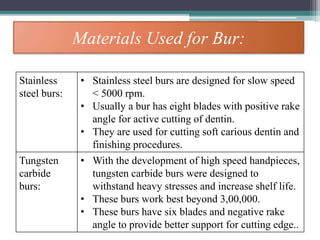
Stainless
steel burs:
• Stainless steel burs are designed for slow speed
< 5000 rpm.
• Usually a bur has eight blades with positive rake
angle for active cutting of dentin.
• They are used for cutting soft carious dentin and
finishing procedures.
Tungsten
carbide
burs:
• With the development of high speed handpieces,
tungsten carbide burs were designed to
withstand heavy stresses and increase shelf life.
• These burs work best beyond 3,00,000.
• These burs have six blades and negative rake
angle to provide better support for cutting edge..
Materials Used for Bur:
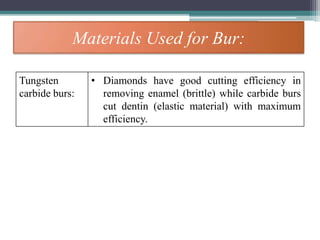
Tungsten
carbide burs:
• Diamonds have good cutting efficiency in
removing enamel (brittle) while carbide burs
cut dentin (elastic material) with maximum
efficiency.
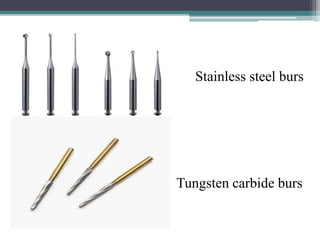
Tungsten carbide burs
Stainless steel burs
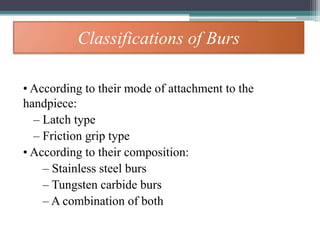
Classifications of Burs
• According to their mode of attachment to the
handpiece:
– Latch type
– Friction grip type
• According to their composition:
– Stainless steel burs
– Tungsten carbide burs
– A combination of both
Classifications of Burs
• According to their motion:
– Right bur: A right bur is one which cuts when it
revolves clockwise.
– Left bur: A left bur is one which cuts when
revolving anticlockwise.
• According to the length of their head:
– Long
– Short
– Regular
Classifications of Burs
• According to their use:
– Cutting burs
– Finishing burs
– Polishing burs
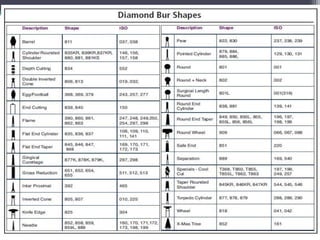
• According to their shapes:
– Round bur
– Inverted cone
– Pear-shaped
– Wheel shaped
– Tapering fissure
– Straight fissure
– End cutting bur
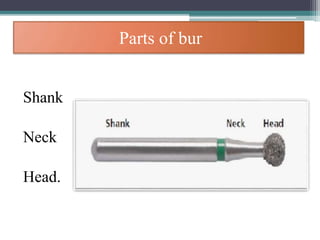
Parts of bur
Shank
Neck
Head.
Shank
• The shank is that part of the bur that fits into the handpiece,
accepts the rotary movement from the handpiece and controls
the alignment and concentricity of the instrument.
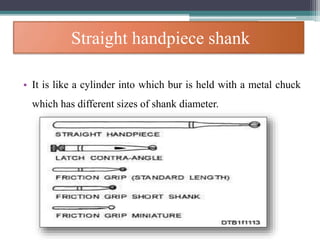
• The three commonly seen instrument shanks are:
– Straight handpiece shank
– Latch type handpiece shank
– Friction grip handpiece shank.
Straight handpiece shank
• It is like a cylinder into which bur is held with a metal chuck
which has different sizes of shank diameter.
Latch type angle handpiece shank:
• In this handpiece posterior portion of shank is made flat on
one side so that end of bur fits into D-shaped socket at bottom
of bur tube.
• In this, instrument is not retained in handpiece with chuck but
with a latch which fits into the grooves made in shank of bur.
• These instruments are commonly used in contra-angle
handpiece for finishing and polishing procedures.
Friction grip angle handpiece shank:
• This was introduced for high speed handpiece.
• Here the shank is simple cylinder which is held in the
handpiece by friction between shank and metal chuck.
• This design of shank is much smaller than latch type
instruments.
Neck
• The neck connects the shank to the hand.
• Main function of neck is to transmit rotational and
translational forces to the head.
Design of neck:
• Neck connects head and shank.
• It is tapered from shank to the head.
• For optical visibility and efficiency of bur, dimensions of neck
should be small but at the same time it should not compromise
the strength.
Head
• It is working part of the instrument.
• Based upon their head characteristics, the instruments can be
bladed or abrasive.
• These are available in different sizes and shapes.
Design of bur head
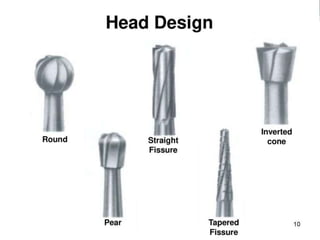
• Round bur: Spherical in shape, used for removal of caries,
extension of the preparation and for the placement of retentive
grooves.
• Inverted cone bur: It has flat base and sides tapered towards
shank. It is used for establishing wall angulations and
providing undercuts in tooth preparations.
Design of bur head
• Pear shaped bur: Here head is shaped like tapered cone with
small end of cone directed towards shank. It is used in class I
tooth preparation for gold foil. A long length pear bur is used
for tooth preparation for amalgam.
• Straight fissure bur: It is parallel sided cylindrical bur of
different lengths and is used for amalgam tooth preparations.
Design of bur head
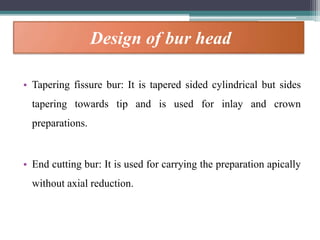
• Tapering fissure bur: It is tapered sided cylindrical but sides
tapering towards tip and is used for inlay and crown
preparations.
• End cutting bur: It is used for carrying the preparation apically
without axial reduction.
Modifications in Bur Design
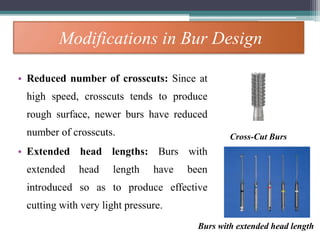
• Reduced number of crosscuts: Since at
high speed, crosscuts tends to produce
rough surface, newer burs have reduced
number of crosscuts.
• Extended head lengths: Burs with
extended head length have been
introduced so as to produce effective
cutting with very light pressure.
Cross-Cut Burs
Burs with extended head length
Modifications in Bur Design
• Rounding of sharp tip corners: Sharp tip corners of burs
produce sharp internal angles, resulting in stress concentration.
Burs with round tip corners produce rounded internal line
angles and thus lower stress in restored tooth.
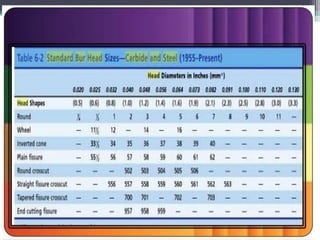
Bur Size
• Bur size represents the diameter of bur head.
• Different numbers have been assigned to burs which denote
bur size and head design.
• Earlier burs had a numbering system in which burs were
grouped by 9 shapes and 11 sizes.
• But later because of modifications in bur design this
numbering system was modified.
Bur Design
• Bur head consists of uniformly spaced blades with concave
areas in between them.
• These concave depressed areas are called chip or flute spaces.
• Normally, a bur has 6, 8, or 10 numbers of blades
Bur blade
Blade is a projection on the bur head which forms a cutting
edge.
Blade has two surfaces:
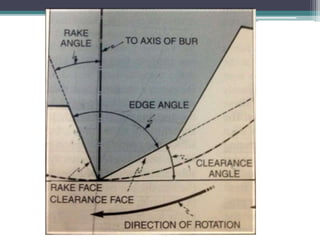
– Blade face/Rake face: It is the surface of bur blade on
the leading edge
– Clearance face: It is the surface of bur blade on the
trailing edge.
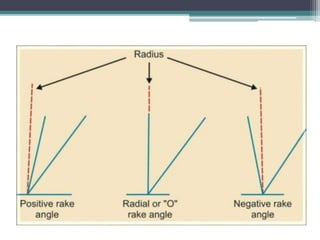
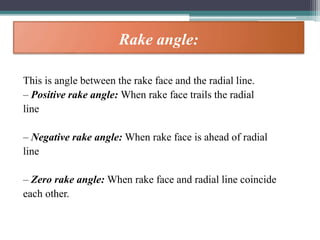
Rake angle:
This is angle between the rake face and the radial line.
– Positive rake angle: When rake face trails the radial
line
– Negative rake angle: When rake face is ahead of radial
line
– Zero rake angle: When rake face and radial line coincide
each other.
Radial line:
• It is the line connecting center of the bur and the blade
Land:
• It is the plane surface immediately following the cutting edge
Clearance angle:
• This is the angle between the clearance face and the work
• Significance: Clearance angle provides a stop to prevent the
bur edge from digging into the tooth and provides adequate
chip space for clearing debris.
Blade angle:
• It is the angle between the rake face and the clearance face.
• Significance: Among these, rake angle is one of the most
important feature of bur blade design.
• Negative rake angle increases the life of bur by reducing
fracture of cutting edges.
• Positive rake angle increases the cutting efficiency but since it
reduces the bulk of bur blade, it becomes prone to fracture.
• Positive rake angle also causes clogging of debris in the chip
space
Blade angle:
• The carbide burs have negative rake angles and 90° of blade
angle so as to reduce their chances of fracture.
• For better clearance of debris, the clearance faces of carbide
burs are made curved to provide adequate flute space.
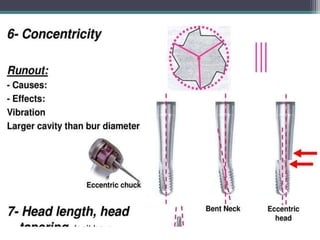
Concentricity:
• It is a direct measurement of symmetry of the bur head. In
other words, concentricity measures whether blades are of
equal length or not.
• It is done when the bur is static.
Run out:
• It measures the accuracy with which all the tip of blades pass
through a single point when bur is moving.
• It measures the maximum displacement of bur head from its
center of rotation.
• In case, there is trembling of bur during rotation, this effect of
run out is directly proportional to length of bur shank.
Smart Prep Burs
• Smart prep instrument is also known as polymer bur or smart
bur.
• This type of instrument is made from polymer that safely and
effectively removes decayed dentin without affecting the
healthy dentin.
• Smart prep bur has property of self-limiting, this means it will
not cut the healthy dentin. It cuts dentin only when large
amount of force is applied.
Availability
• Sizes 2, 4, 6.
• Used with slow speed handpiece (500–800 rpm).
• Single patient use.
Smart Prep Burs
Advantages of smart prep burs
• Used for deep caries removal in lieu of indirect capping
procedure
• Chances of iatrogenic pulp exposure are less
• Minimum removal of tooth structure.
Disadvantages of smart prep burs
• Technique sensitive
• This instrument leaves large amount of decayed portion
unexcavated
• Expensive
• Chances of damage of bur are more if it touches the enamel or
sound dentin during and after the procedure
ABRASIVE INSTRUMENTS
• The head of these instruments consists of small angular
particles of a hard substance held in a matrix of softer material
called as the binder.
• Different materials used for a binder are ceramic, metal,
rubber, shellac, etc.
• Abrasive instruments can be divided into:
• Diamond abrasives
• Other abrasives.
Diamond Abrasive Instruments
• They were introduced in 1942.
• They have greater resistance to abrasion, lower heat
generation and longer life to be preferred over tungsten
carbide
Diamond Abrasive Instruments
Diamond instruments consist of three parts:
1. A metal blank.
2. Powdered diamond abrasive: Abrasive diamond can be
natural or synthetic which is crushed to a powder of desired
particles.
3. The bonding agent: It serves the purpose of holding the
abrasive particles together and binding the particles to the metal
blank. Most commonly used binding agents for diamond
instruments are ceramic and metal.
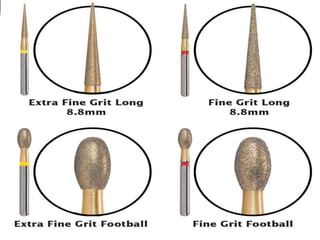
Diamond Abrasive Burs
Classification
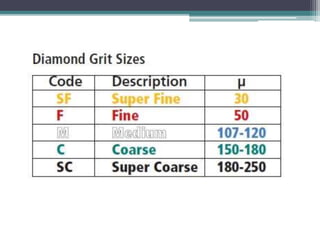
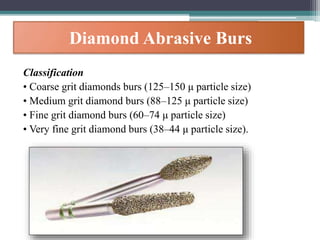
• Coarse grit diamonds burs (125–150 μ particle size)
• Medium grit diamond burs (88–125 μ particle size)
• Fine grit diamond burs (60–74 μ particle size)
• Very fine grit diamond burs (38–44 μ particle size).
Factors Influencing the Abrasive Effiiency
and Effectiveness
• Size of the abrasive particles: Abrasive nature is directly
proportional to size of abrasive particle. Rapid removal of
material occurs with coarse grit burs compared to medium or
fine grit burs
• Shape of the abrasive particles: The abrasive particles with
irregular shape show more efficiency because they present a
sharp edge
• Density of the abrasive particles: Coarse grit burs have a low
density compared to fine grit burs.
Factors Influencing the Abrasive Effiiency
and Effectiveness
• Hardness of the abrasive particle: The hardness of the
abrasive particles should be more than the hardness of the
surface on which it is to be used.
• Clogging of the abrasive surface: Clogging of the spaces
between the particles by grinding debris decreases efficiency.
• Pressure: Excessive pressure causes the loss of diamonds,
thus, decrease their cutting efficiency.
Finishing Burs
• Finishing burs are usually made of stainless steel or tungsten
carbide.
• Bur should be atleast 12 fluted
• The main function of finishing bur is to remove excess of
restorative material rather than cutting the surface.
• These burs also make the surface smoother.
• Burs are available in different shapes and sizes, i.e. tapered,
inverted cone, rounded and pear-shaped, etc.
Diamond Instruments and Pastes
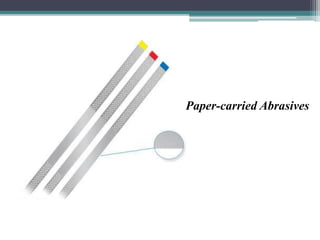
Paper-carried Abrasives
• These are usually abrasives, i.e. sand, garnet or boron carbide
attached to paper disks or strips
• These are preferably used in back and forth motion polishing
(similar to shoe polishing).
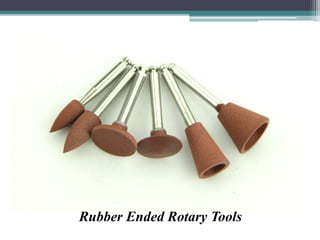
Rubber Ended Rotary Tools
• These type of instruments are available in variety of shapes,
i.e. cups, wheels, etc.
• These can be attached to handpiece with the help of mandrel
or with their own extension.
• These are used with other abrasive or polishing pastes.
Paper-carried Abrasives
Rubber Ended Rotary Tools
Questions:
• Short notes on:
a. Use of high speed in dentistry
b. Abrasives and burs used in operative dentistry.
c. Bur design.
• Classify burs. Explain in detail bur design
• Enumerate various factors affecting efficiency of bur cutting.

Dental burs

  • 1.
  • 2.
    • Rotary cuttinginstruments are those instruments which rotate on an axis to do the work of abrading and cutting on tooth structure.
  • 3.
    Types of RotaryCutting • Handpiece: It is a power device • Bur: It is a cutting tool.
  • 4.
    Handpiece 1728 Drill wasprovided by a socket fitting against the palm and the ring was adapted to the index or middle finger 1864 British dentist George fellows invented the “clockwork” drill. 1868 American dentist GF Green developed a pneumatic handpiece powered by pedal operated bellows. 1871 Dr James B Morrison. First “dental engine” to provide enough power to spin The bur with sufficient speed for tooth cutting 1957 The Borden, airotor was developed as the prototype for today’s modern air-turbine handpiece. It had speed up to 250,000 rpm. 1970 Electrically driven handpieces were introduced
  • 5.
    Classification according totheir driving mechanisms. Gear driven handpiece: Rotary power is transferred by a belt which runs from an electric engine. Power is transferred from the straight handpiece by a shaft and gears inside the angle section. Water driven handpiece: It was discovered in 1953. It operates at speed up to 100,000 rpm. In this handpiece, a small inner piece transports water under high pressure to rotate the turbine in the handpiece and the larger outer tube returns the water to the reservoir.
  • 6.
    Classification according totheir driving mechanisms. Belt driven handpiece: Belt driven angle handpiece was made available in 1955. It runs at speed of > 100,000 rpm. This handpieces has excellent performance and great versatility. Air driven handpiece: This handipiece became available in the later part of 1956. It runs at speed of approximately 300,000 rpm.
  • 7.
    Gear driven handpiece:Water driven handpiece: Belt driven handpiece: Air driven handpiece:
  • 8.
    Types of Handpiece: Contra-angle handpiece: •Head of handpiece is first angled away from and then back towards the long axis of the handle. • Bur head lies close to long axis of the handle of handpiece which improve accessibility, visibility and stability of handpiece while working. • Air-rotor contra-angle handpiece • Micromotor handpiece
  • 9.
    Types of Handpiece: Straight handpiece: •In straight handpiece, long axis of bur lies in same plane as long axis of handpiece. • This handpiece is commonly used in oral surgical and laboratory procedures
  • 10.
    Dental Burs: • “Buris a rotary cutting instrument which has bladed cutting head”. • Before 1890s, silicon carbide disks and stones were used to cut enamel since carbon steel burs were not effective in cutting enamel.
  • 11.
    Dental Burs: 1897 •William and Schroeder first made diamond dental bur 1932 • Modern diamond bur was introduced in 1932 by WH Drendel by bonding diamond points to stainless steel shanks. • Diamond particles of < 25 μm size are recommended for polishing procedures and > 100 μm are used for cavity preparation.
  • 12.
    Materials Used forBur: Stainless steel burs: • Stainless steel burs are designed for slow speed < 5000 rpm. • Usually a bur has eight blades with positive rake angle for active cutting of dentin. • They are used for cutting soft carious dentin and finishing procedures. Tungsten carbide burs: • With the development of high speed handpieces, tungsten carbide burs were designed to withstand heavy stresses and increase shelf life. • These burs work best beyond 3,00,000. • These burs have six blades and negative rake angle to provide better support for cutting edge..
  • 13.
    Materials Used forBur: Tungsten carbide burs: • Diamonds have good cutting efficiency in removing enamel (brittle) while carbide burs cut dentin (elastic material) with maximum efficiency.
  • 14.
  • 15.
    Classifications of Burs •According to their mode of attachment to the handpiece: – Latch type – Friction grip type • According to their composition: – Stainless steel burs – Tungsten carbide burs – A combination of both
  • 16.
    Classifications of Burs •According to their motion: – Right bur: A right bur is one which cuts when it revolves clockwise. – Left bur: A left bur is one which cuts when revolving anticlockwise. • According to the length of their head: – Long – Short – Regular
  • 17.
    Classifications of Burs •According to their use: – Cutting burs – Finishing burs – Polishing burs • According to their shapes: – Round bur – Inverted cone – Pear-shaped – Wheel shaped – Tapering fissure – Straight fissure – End cutting bur
  • 18.
  • 19.
    Shank • The shankis that part of the bur that fits into the handpiece, accepts the rotary movement from the handpiece and controls the alignment and concentricity of the instrument. • The three commonly seen instrument shanks are: – Straight handpiece shank – Latch type handpiece shank – Friction grip handpiece shank.
  • 20.
    Straight handpiece shank •It is like a cylinder into which bur is held with a metal chuck which has different sizes of shank diameter.
  • 21.
    Latch type anglehandpiece shank: • In this handpiece posterior portion of shank is made flat on one side so that end of bur fits into D-shaped socket at bottom of bur tube. • In this, instrument is not retained in handpiece with chuck but with a latch which fits into the grooves made in shank of bur. • These instruments are commonly used in contra-angle handpiece for finishing and polishing procedures.
  • 22.
    Friction grip anglehandpiece shank: • This was introduced for high speed handpiece. • Here the shank is simple cylinder which is held in the handpiece by friction between shank and metal chuck. • This design of shank is much smaller than latch type instruments.
  • 23.
    Neck • The neckconnects the shank to the hand. • Main function of neck is to transmit rotational and translational forces to the head.
  • 24.
    Design of neck: •Neck connects head and shank. • It is tapered from shank to the head. • For optical visibility and efficiency of bur, dimensions of neck should be small but at the same time it should not compromise the strength.
  • 25.
    Head • It isworking part of the instrument. • Based upon their head characteristics, the instruments can be bladed or abrasive. • These are available in different sizes and shapes.
  • 26.
    Design of burhead • Round bur: Spherical in shape, used for removal of caries, extension of the preparation and for the placement of retentive grooves. • Inverted cone bur: It has flat base and sides tapered towards shank. It is used for establishing wall angulations and providing undercuts in tooth preparations.
  • 27.
    Design of burhead • Pear shaped bur: Here head is shaped like tapered cone with small end of cone directed towards shank. It is used in class I tooth preparation for gold foil. A long length pear bur is used for tooth preparation for amalgam. • Straight fissure bur: It is parallel sided cylindrical bur of different lengths and is used for amalgam tooth preparations.
  • 28.
    Design of burhead • Tapering fissure bur: It is tapered sided cylindrical but sides tapering towards tip and is used for inlay and crown preparations. • End cutting bur: It is used for carrying the preparation apically without axial reduction.
  • 30.
    Modifications in BurDesign • Reduced number of crosscuts: Since at high speed, crosscuts tends to produce rough surface, newer burs have reduced number of crosscuts. • Extended head lengths: Burs with extended head length have been introduced so as to produce effective cutting with very light pressure. Cross-Cut Burs Burs with extended head length
  • 31.
    Modifications in BurDesign • Rounding of sharp tip corners: Sharp tip corners of burs produce sharp internal angles, resulting in stress concentration. Burs with round tip corners produce rounded internal line angles and thus lower stress in restored tooth.
  • 32.
    Bur Size • Bursize represents the diameter of bur head. • Different numbers have been assigned to burs which denote bur size and head design. • Earlier burs had a numbering system in which burs were grouped by 9 shapes and 11 sizes. • But later because of modifications in bur design this numbering system was modified.
  • 35.
    Bur Design • Burhead consists of uniformly spaced blades with concave areas in between them. • These concave depressed areas are called chip or flute spaces. • Normally, a bur has 6, 8, or 10 numbers of blades
  • 36.
    Bur blade Blade isa projection on the bur head which forms a cutting edge. Blade has two surfaces: – Blade face/Rake face: It is the surface of bur blade on the leading edge – Clearance face: It is the surface of bur blade on the trailing edge.
  • 38.
    Rake angle: This isangle between the rake face and the radial line. – Positive rake angle: When rake face trails the radial line – Negative rake angle: When rake face is ahead of radial line – Zero rake angle: When rake face and radial line coincide each other.
  • 40.
    Radial line: • Itis the line connecting center of the bur and the blade
  • 41.
    Land: • It isthe plane surface immediately following the cutting edge
  • 42.
    Clearance angle: • Thisis the angle between the clearance face and the work • Significance: Clearance angle provides a stop to prevent the bur edge from digging into the tooth and provides adequate chip space for clearing debris.
  • 43.
    Blade angle: • Itis the angle between the rake face and the clearance face. • Significance: Among these, rake angle is one of the most important feature of bur blade design. • Negative rake angle increases the life of bur by reducing fracture of cutting edges. • Positive rake angle increases the cutting efficiency but since it reduces the bulk of bur blade, it becomes prone to fracture. • Positive rake angle also causes clogging of debris in the chip space
  • 44.
    Blade angle: • Thecarbide burs have negative rake angles and 90° of blade angle so as to reduce their chances of fracture. • For better clearance of debris, the clearance faces of carbide burs are made curved to provide adequate flute space.
  • 45.
    Concentricity: • It isa direct measurement of symmetry of the bur head. In other words, concentricity measures whether blades are of equal length or not. • It is done when the bur is static.
  • 46.
    Run out: • Itmeasures the accuracy with which all the tip of blades pass through a single point when bur is moving. • It measures the maximum displacement of bur head from its center of rotation. • In case, there is trembling of bur during rotation, this effect of run out is directly proportional to length of bur shank.
  • 48.
    Smart Prep Burs •Smart prep instrument is also known as polymer bur or smart bur. • This type of instrument is made from polymer that safely and effectively removes decayed dentin without affecting the healthy dentin. • Smart prep bur has property of self-limiting, this means it will not cut the healthy dentin. It cuts dentin only when large amount of force is applied. Availability • Sizes 2, 4, 6. • Used with slow speed handpiece (500–800 rpm). • Single patient use.
  • 49.
    Smart Prep Burs Advantagesof smart prep burs • Used for deep caries removal in lieu of indirect capping procedure • Chances of iatrogenic pulp exposure are less • Minimum removal of tooth structure. Disadvantages of smart prep burs • Technique sensitive • This instrument leaves large amount of decayed portion unexcavated • Expensive • Chances of damage of bur are more if it touches the enamel or sound dentin during and after the procedure
  • 51.
    ABRASIVE INSTRUMENTS • Thehead of these instruments consists of small angular particles of a hard substance held in a matrix of softer material called as the binder. • Different materials used for a binder are ceramic, metal, rubber, shellac, etc. • Abrasive instruments can be divided into: • Diamond abrasives • Other abrasives.
  • 52.
    Diamond Abrasive Instruments •They were introduced in 1942. • They have greater resistance to abrasion, lower heat generation and longer life to be preferred over tungsten carbide
  • 53.
    Diamond Abrasive Instruments Diamondinstruments consist of three parts: 1. A metal blank. 2. Powdered diamond abrasive: Abrasive diamond can be natural or synthetic which is crushed to a powder of desired particles. 3. The bonding agent: It serves the purpose of holding the abrasive particles together and binding the particles to the metal blank. Most commonly used binding agents for diamond instruments are ceramic and metal.
  • 55.
    Diamond Abrasive Burs Classification •Coarse grit diamonds burs (125–150 μ particle size) • Medium grit diamond burs (88–125 μ particle size) • Fine grit diamond burs (60–74 μ particle size) • Very fine grit diamond burs (38–44 μ particle size).
  • 56.
    Factors Influencing theAbrasive Effiiency and Effectiveness • Size of the abrasive particles: Abrasive nature is directly proportional to size of abrasive particle. Rapid removal of material occurs with coarse grit burs compared to medium or fine grit burs • Shape of the abrasive particles: The abrasive particles with irregular shape show more efficiency because they present a sharp edge • Density of the abrasive particles: Coarse grit burs have a low density compared to fine grit burs.
  • 57.
    Factors Influencing theAbrasive Effiiency and Effectiveness • Hardness of the abrasive particle: The hardness of the abrasive particles should be more than the hardness of the surface on which it is to be used. • Clogging of the abrasive surface: Clogging of the spaces between the particles by grinding debris decreases efficiency. • Pressure: Excessive pressure causes the loss of diamonds, thus, decrease their cutting efficiency.
  • 58.
    Finishing Burs • Finishingburs are usually made of stainless steel or tungsten carbide. • Bur should be atleast 12 fluted • The main function of finishing bur is to remove excess of restorative material rather than cutting the surface. • These burs also make the surface smoother. • Burs are available in different shapes and sizes, i.e. tapered, inverted cone, rounded and pear-shaped, etc.
  • 60.
    Diamond Instruments andPastes Paper-carried Abrasives • These are usually abrasives, i.e. sand, garnet or boron carbide attached to paper disks or strips • These are preferably used in back and forth motion polishing (similar to shoe polishing). Rubber Ended Rotary Tools • These type of instruments are available in variety of shapes, i.e. cups, wheels, etc. • These can be attached to handpiece with the help of mandrel or with their own extension. • These are used with other abrasive or polishing pastes.
  • 61.
  • 62.
  • 63.
    Questions: • Short noteson: a. Use of high speed in dentistry b. Abrasives and burs used in operative dentistry. c. Bur design. • Classify burs. Explain in detail bur design • Enumerate various factors affecting efficiency of bur cutting.