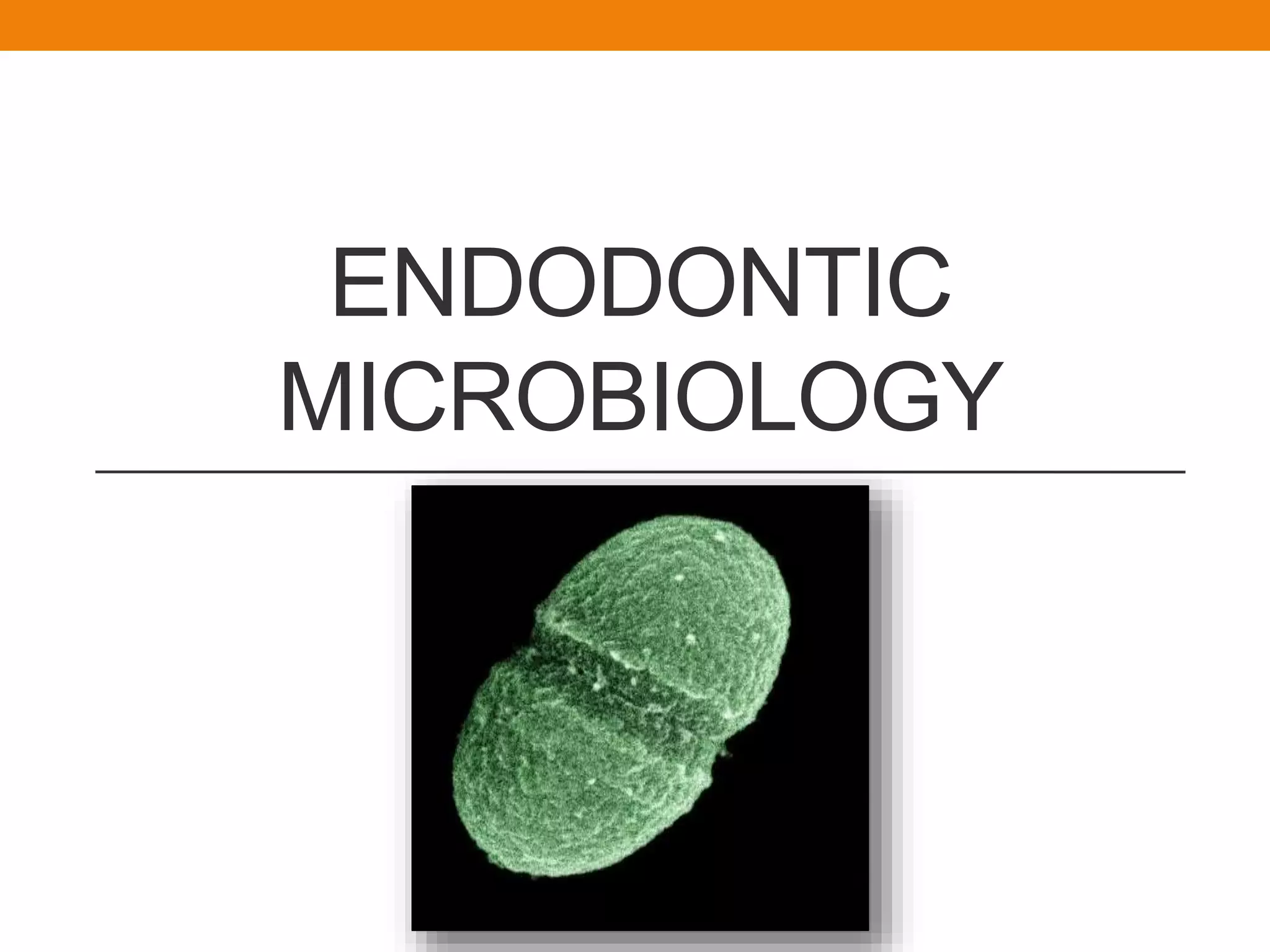

ENDODONTIC
MICROBIOLOGY
Why???
• Effective diagnosis
• Treatment of endodontic infection
• Knowledge of endodontic pathology
Who found co relation???
• W D MILLER
• FISH ZONE (1939)
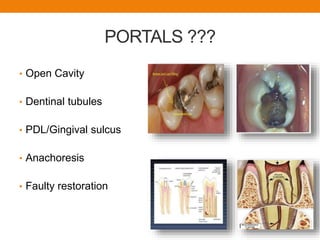
PORTALS ???
• Open Cavity
• Dentinal tubules
• PDL/Gingival sulcus
• Anachoresis
• Faulty restoration
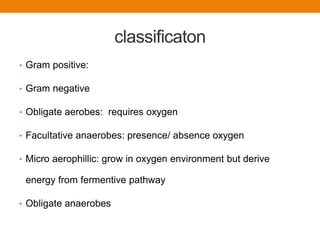
classificaton
• Gram positive:
• Gram negative
• Obligate aerobes: requires oxygen
• Facultative anaerobes: presence/ absence oxygen
• Micro aerophillic: grow in oxygen environment but derive
energy from fermentive pathway
• Obligate anaerobes
Pathogenicity ???
• Ability of micro organism to produce diseases.
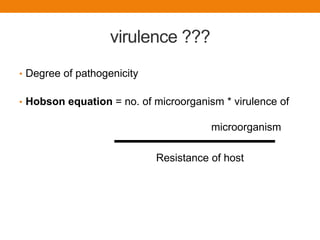
virulence ???
• Degree of pathogenicity
• Hobson equation = no. of microorganism * virulence of
microorganism
Resistance of host
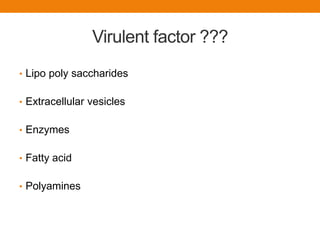
Virulent factor ???
• Lipo poly saccharides
• Extracellular vesicles
• Enzymes
• Fatty acid
• Polyamines
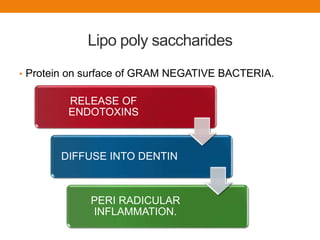
Lipo poly saccharides
• Protein on surface of GRAM NEGATIVE BACTERIA.
RELEASE OF
ENDOTOXINS
DIFFUSE INTO DENTIN
PERI RADICULAR
INFLAMMATION.
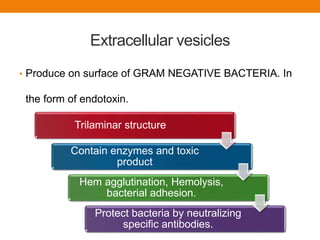
Extracellular vesicles
• Produce on surface of GRAM NEGATIVE BACTERIA. In
the form of endotoxin.
Trilaminar structure
Contain enzymes and toxic
product
Hem agglutination, Hemolysis,
bacterial adhesion.
Protect bacteria by neutralizing
specific antibodies.
Enzymes
• Produce on surface of BACTERIA.
Help in spread of infection and
neutralization of Ig & complement
component.
Release hydrolytic enzymes
Degenerate and lyse to form
purulent exudates and have
adverse effect on surrounding
tissues.
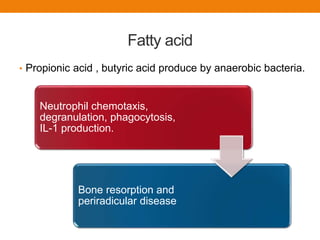
Fatty acid
• Propionic acid , butyric acid produce by anaerobic bacteria.
Neutrophil chemotaxis,
degranulation, phagocytosis,
IL-1 production.
Bone resorption and
periradicular disease
Polyamines
• Biologically active chemical found in infected canal.
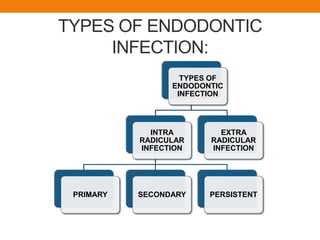
TYPES OF ENDODONTIC
INFECTION:
TYPES OF
ENDODONTIC
INFECTION
INTRA
RADICULAR
INFECTION
PRIMARY SECONDARY PERSISTENT
EXTRA
RADICULAR
INFECTION
INTRA RADICULAR INFECTION
Micro organism present within the Root Canal System
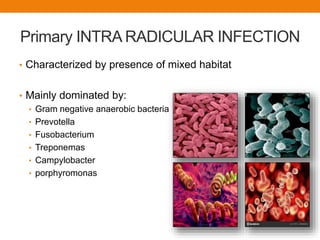
Primary INTRA RADICULAR INFECTION
• Characterized by presence of mixed habitat
• Mainly dominated by:
• Gram negative anaerobic bacteria
• Prevotella
• Fusobacterium
• Treponemas
• Campylobacter
• porphyromonas
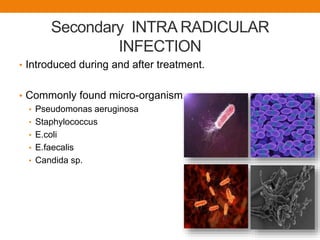
Secondary INTRA RADICULAR
INFECTION
• Introduced during and after treatment.
• Commonly found micro-organism:
• Pseudomonas aeruginosa
• Staphylococcus
• E.coli
• E.faecalis
• Candida sp.
persistent INTRA RADICULAR
INFECTION
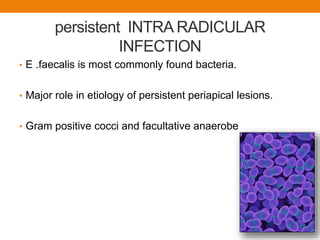
• E .faecalis is most commonly found bacteria.
• Major role in etiology of persistent periapical lesions.
• Gram positive cocci and facultative anaerobe
Reason why E .Faecalis survived
• Persist in poor nutritional environment of root canal
• Survive in presence of medicament.
• Stay alive in presence of irrigants
• Forms biofilm in medicated canal.
• Penetrate and utilize fluid from dentinal tubules
• Survive prolong period of starvation
• Survive in low pH and temperature.
• Acquire resistance to antibiotics
Extra radicular infection
• It can be dependent or independent of Intra radicular
infection.
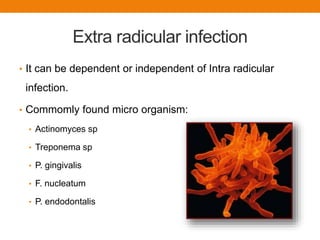
• Commomly found micro organism:
• Actinomyces sp
• Treponema sp
• P. gingivalis
• F. nucleatum
• P. endodontalis
biofilms
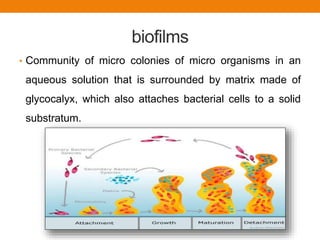
• Community of micro colonies of micro organisms in an
aqueous solution that is surrounded by matrix made of
glycocalyx, which also attaches bacterial cells to a solid
substratum.
biofilms
• According to Caldwell et al biofilm has the following
attributes:
• Autopoiesis: ability to self organize
• Homeostasis: ability to resist environmental disturbance.
• Synergy: effective in association with fellow micro
organism than isolation.
• Communality: responds to environmental challenges as
combined unit
biofilms
• Responsible for endodontic failures.
• Ability to protect the bacteria from environment as well as
help entrap nutrient for growth of microbial constituents.
• Offer safe environment for the exchange of genetic
material amongst bacteria.
• Inherent resistance to antimicrobial agent.
Classification of biofilms
• Intracanal microbial biofilm:
• Formed on radicular dentin in infected canal.
• E.faecalis responsible for most therapy resistant and
prevalent endodontic biofilm
Classification of biofilms
• Extra-canal microbial biofilm:
• Cemental surface around root apex of endodontically
infected tooth.
Classification of biofilms
• Periapical microbial biofilm:
• Isolated biofilm
• Independent of internal /external surface of root canal.
• Actinomyces and P. propionicum to form periapical
lesion resistant to endodontic therapy.
Identification of bacteria
• 1. Gram’s stain:
• Help to differentiate gram positive and negative
organism.
Identification of bacteria
2. Culture:
Principle:
to grow and isolate the microflora for
antibiotic sensitivity and resistance
determine the effectiveness of debridement
procedure before obturation
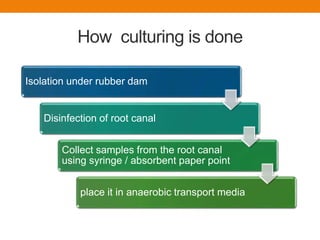
How culturing is done
Isolation under rubber dam
Disinfection of root canal
Collect samples from the root canal
using syringe / absorbent paper point
place it in anaerobic transport media
Molecular diagnostic methods
• Identify the microorganism using gene as target which is
unique for each species.
• DNA-DNA HYBRIDIZATION
• POLYMERASE CHAIN REACTION
DNA-DNA HYBRIDIZATION
• Uses the DNA probes which target genomic DNA
• Advantage:
• Can be used for epidemiological research
• Simultaneous detection of multiple species
Polymerase chain reaction
• In vitro replication of DNA
• “ GENETIC XEROXING”
• Advantage:
• Remarkable specificity and sensitivity
• Microbial diversity can be investigated.
Thank you !!!!

Endodontic microbiology

  • 1.
  • 2.
    Why??? • Effective diagnosis •Treatment of endodontic infection • Knowledge of endodontic pathology
  • 3.
    Who found corelation??? • W D MILLER • FISH ZONE (1939)
  • 4.
    PORTALS ??? • OpenCavity • Dentinal tubules • PDL/Gingival sulcus • Anachoresis • Faulty restoration
  • 5.
    classificaton • Gram positive: •Gram negative • Obligate aerobes: requires oxygen • Facultative anaerobes: presence/ absence oxygen • Micro aerophillic: grow in oxygen environment but derive energy from fermentive pathway • Obligate anaerobes
  • 6.
    Pathogenicity ??? • Abilityof micro organism to produce diseases.
  • 7.
    virulence ??? • Degreeof pathogenicity • Hobson equation = no. of microorganism * virulence of microorganism Resistance of host
  • 8.
    Virulent factor ??? •Lipo poly saccharides • Extracellular vesicles • Enzymes • Fatty acid • Polyamines
  • 9.
    Lipo poly saccharides •Protein on surface of GRAM NEGATIVE BACTERIA. RELEASE OF ENDOTOXINS DIFFUSE INTO DENTIN PERI RADICULAR INFLAMMATION.
  • 10.
    Extracellular vesicles • Produceon surface of GRAM NEGATIVE BACTERIA. In the form of endotoxin. Trilaminar structure Contain enzymes and toxic product Hem agglutination, Hemolysis, bacterial adhesion. Protect bacteria by neutralizing specific antibodies.
  • 11.
    Enzymes • Produce onsurface of BACTERIA. Help in spread of infection and neutralization of Ig & complement component. Release hydrolytic enzymes Degenerate and lyse to form purulent exudates and have adverse effect on surrounding tissues.
  • 12.
    Fatty acid • Propionicacid , butyric acid produce by anaerobic bacteria. Neutrophil chemotaxis, degranulation, phagocytosis, IL-1 production. Bone resorption and periradicular disease
  • 13.
    Polyamines • Biologically activechemical found in infected canal.
  • 14.
    TYPES OF ENDODONTIC INFECTION: TYPESOF ENDODONTIC INFECTION INTRA RADICULAR INFECTION PRIMARY SECONDARY PERSISTENT EXTRA RADICULAR INFECTION
  • 15.
    INTRA RADICULAR INFECTION Microorganism present within the Root Canal System
  • 16.
    Primary INTRA RADICULARINFECTION • Characterized by presence of mixed habitat • Mainly dominated by: • Gram negative anaerobic bacteria • Prevotella • Fusobacterium • Treponemas • Campylobacter • porphyromonas
  • 17.
    Secondary INTRA RADICULAR INFECTION •Introduced during and after treatment. • Commonly found micro-organism: • Pseudomonas aeruginosa • Staphylococcus • E.coli • E.faecalis • Candida sp.
  • 18.
    persistent INTRA RADICULAR INFECTION •E .faecalis is most commonly found bacteria. • Major role in etiology of persistent periapical lesions. • Gram positive cocci and facultative anaerobe
  • 19.
    Reason why E.Faecalis survived • Persist in poor nutritional environment of root canal • Survive in presence of medicament. • Stay alive in presence of irrigants • Forms biofilm in medicated canal. • Penetrate and utilize fluid from dentinal tubules • Survive prolong period of starvation • Survive in low pH and temperature. • Acquire resistance to antibiotics
  • 20.
    Extra radicular infection •It can be dependent or independent of Intra radicular infection. • Commomly found micro organism: • Actinomyces sp • Treponema sp • P. gingivalis • F. nucleatum • P. endodontalis
  • 21.
    biofilms • Community ofmicro colonies of micro organisms in an aqueous solution that is surrounded by matrix made of glycocalyx, which also attaches bacterial cells to a solid substratum.
  • 22.
    biofilms • According toCaldwell et al biofilm has the following attributes: • Autopoiesis: ability to self organize • Homeostasis: ability to resist environmental disturbance. • Synergy: effective in association with fellow micro organism than isolation. • Communality: responds to environmental challenges as combined unit
  • 23.
    biofilms • Responsible forendodontic failures. • Ability to protect the bacteria from environment as well as help entrap nutrient for growth of microbial constituents. • Offer safe environment for the exchange of genetic material amongst bacteria. • Inherent resistance to antimicrobial agent.
  • 24.
    Classification of biofilms •Intracanal microbial biofilm: • Formed on radicular dentin in infected canal. • E.faecalis responsible for most therapy resistant and prevalent endodontic biofilm
  • 25.
    Classification of biofilms •Extra-canal microbial biofilm: • Cemental surface around root apex of endodontically infected tooth.
  • 26.
    Classification of biofilms •Periapical microbial biofilm: • Isolated biofilm • Independent of internal /external surface of root canal. • Actinomyces and P. propionicum to form periapical lesion resistant to endodontic therapy.
  • 27.
    Identification of bacteria •1. Gram’s stain: • Help to differentiate gram positive and negative organism.
  • 28.
    Identification of bacteria 2.Culture: Principle: to grow and isolate the microflora for antibiotic sensitivity and resistance determine the effectiveness of debridement procedure before obturation
  • 29.
    How culturing isdone Isolation under rubber dam Disinfection of root canal Collect samples from the root canal using syringe / absorbent paper point place it in anaerobic transport media
  • 30.
    Molecular diagnostic methods •Identify the microorganism using gene as target which is unique for each species. • DNA-DNA HYBRIDIZATION • POLYMERASE CHAIN REACTION
  • 31.
    DNA-DNA HYBRIDIZATION • Usesthe DNA probes which target genomic DNA • Advantage: • Can be used for epidemiological research • Simultaneous detection of multiple species
  • 32.
    Polymerase chain reaction •In vitro replication of DNA • “ GENETIC XEROXING” • Advantage: • Remarkable specificity and sensitivity • Microbial diversity can be investigated.
  • 33.

Editor's Notes

  • #12 BREAK THE CHEMICAL BOND BETWEEN ATOMS IN PRESENCE OF WATER.