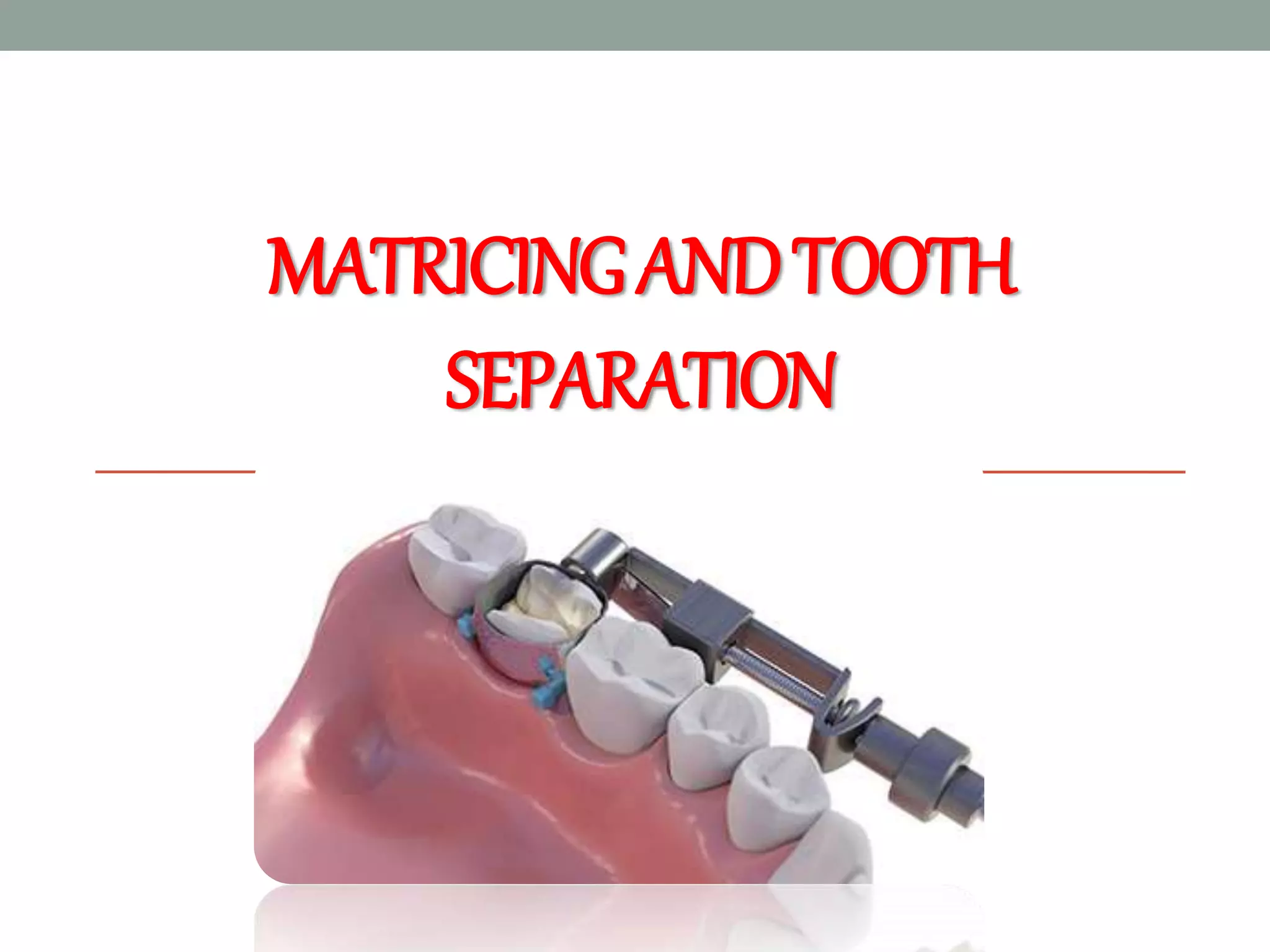
MATRICINGANDTOOTH
SEPARATION
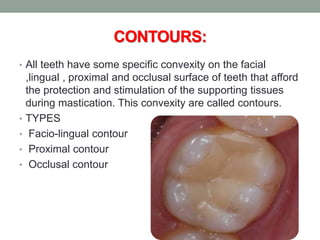
CONTOURS:
• All teeth have some specific convexity on the facial
,lingual , proximal and occlusal surface of teeth that afford
the protection and stimulation of the supporting tissues
during mastication. This convexity are called contours.
• TYPES
• Facio-lingual contour
• Proximal contour
• Occlusal contour
CONTOURS:
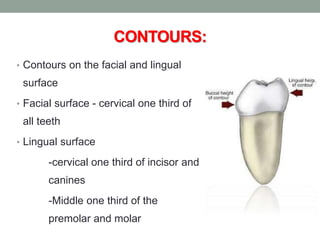
• Contours on the facial and lingual
surface
• Facial surface - cervical one third of
all teeth
• Lingual surface
-cervical one third of incisor and
canines
-Middle one third of the
premolar and molar
CONTOURS:
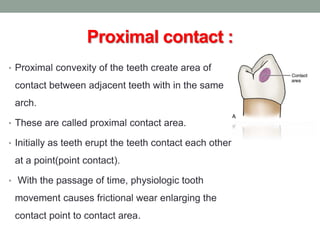
• Contours on the proximal surface
• Teeth show convexities on the distal and mesial surface.
• The area with maximum convexity on the proximal
surface is called the proximal height of contour.
• Proximal height of contour responsible for the creation of
the
a)Proximal contact
b)Embrasure space
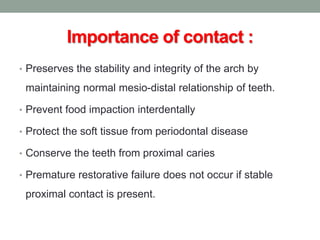
Proximal contact :
• Proximal convexity of the teeth create area of
contact between adjacent teeth with in the same
arch.
• These are called proximal contact area.
• Initially as teeth erupt the teeth contact each other
at a point(point contact).
• With the passage of time, physiologic tooth
movement causes frictional wear enlarging the
contact point to contact area.
Importance of contact :
• Preserves the stability and integrity of the arch by
maintaining normal mesio-distal relationship of teeth.
• Prevent food impaction interdentally
• Protect the soft tissue from periodontal disease
• Conserve the teeth from proximal caries
• Premature restorative failure does not occur if stable
proximal contact is present.
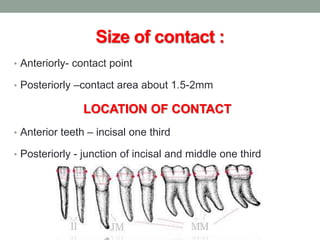
Size of contact :
• Anteriorly- contact point
• Posteriorly –contact area about 1.5-2mm
LOCATION OF CONTACT
• Anterior teeth – incisal one third
• Posteriorly - junction of incisal and middle one third
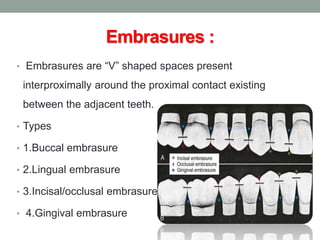
Embrasures :
• Embrasures are “V” shaped spaces present
interproximally around the proximal contact existing
between the adjacent teeth.
• Types
• 1.Buccal embrasure
• 2.Lingual embrasure
• 3.Incisal/occlusal embrasure
• 4.Gingival embrasure
Functions of Embrasures :
1)Serve as spillways for the escape of food during
mastication
2) Prevent trapping of food in to the contact area
3)Protect the underlying supporting tissue during
mastication
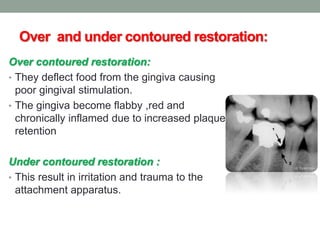
Over and under contoured restoration:
Over contoured restoration:
• They deflect food from the gingiva causing
poor gingival stimulation.
• The gingiva become flabby ,red and
chronically inflamed due to increased plaque
retention
Under contoured restoration :
• This result in irritation and trauma to the
attachment apparatus.
Too broad contact :
It will change the tooth anatomy
It will change the interdental ‘col’ by broadening it.
The delicate non keratinized epithelium may get damaged
increasing the chance of periodontal tissue.
With too broad contact the interdental area is difficult to
clean increase the risk of future decay
Too Narrow contact :
It will change the tooth anatomy
The embrasure size will increase leading to impaction of
food vertically and horizontally, thereby damaging
periodontal tissue.
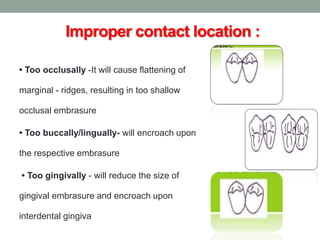
Improper contact location :
• Too occlusally -It will cause flattening of
marginal - ridges, resulting in too shallow
occlusal embrasure
• Too buccally/lingually- will encroach upon
the respective embrasure
• Too gingivally - will reduce the size of
gingival embrasure and encroach upon
interdental gingiva
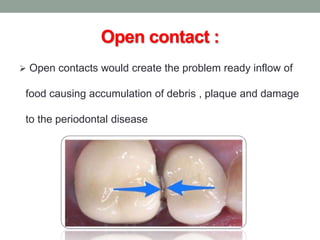
Open contact :
 Open contacts would create the problem ready inflow of
food causing accumulation of debris , plaque and damage
to the periodontal disease
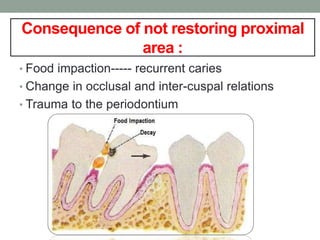
Consequence of not restoring proximal
area :
• Food impaction----- recurrent caries
• Change in occlusal and inter-cuspal relations
• Trauma to the periodontium
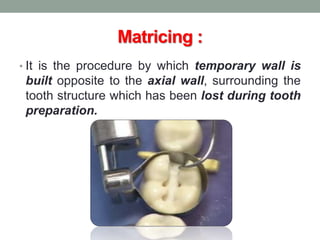
Matricing :
• It is the procedure by which temporary wall is
built opposite to the axial wall, surrounding the
tooth structure which has been lost during tooth
preparation.
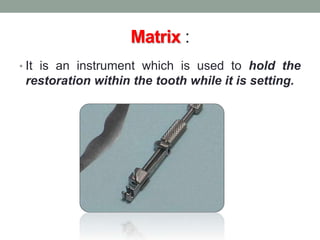
Matrix :
• It is an instrument which is used to hold the
restoration within the tooth while it is setting.
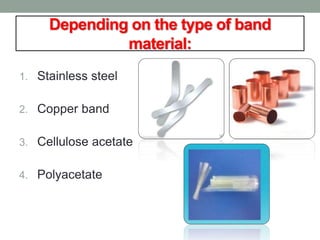
Depending on the type of band
material:
1. Stainless steel
2. Copper band
3. Cellulose acetate
4. Polyacetate
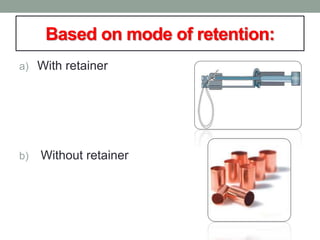
Based on mode of retention:
a) With retainer
b) Without retainer
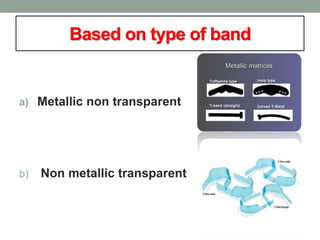
Based on type of band
a) Metallic non transparent
b) Non metallic transparent
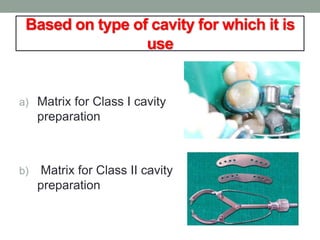
Based on type of cavity for which it is
use
a) Matrix for Class I cavity
preparation
b) Matrix for Class II cavity
preparation
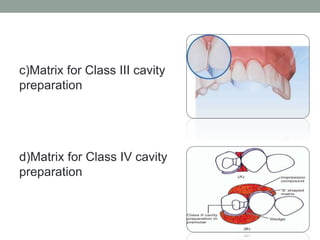
c)Matrix for Class III cavity
preparation
d)Matrix for Class IV cavity
preparation
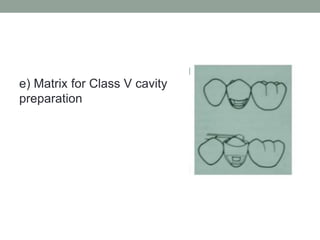
e) Matrix for Class V cavity
preparation
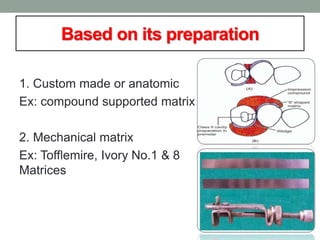
Based on its preparation
1. Custom made or anatomic
Ex: compound supported matrix
2. Mechanical matrix
Ex: Tofflemire, Ivory No.1 & 8
Matrices
Parts of matrix:
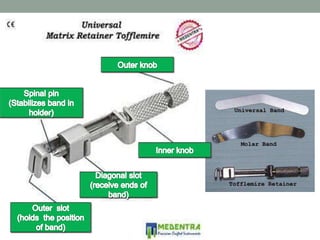
1. Retainer :
Holds the band in desired position and shape
2. Band :
piece of metal or polymeric material, intended to
give support and form to restoration during its insertion
and setting.
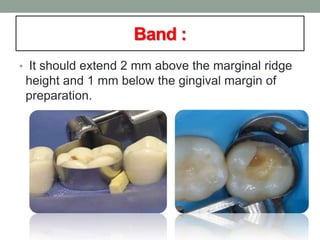
Band :
• It should extend 2 mm above the marginal ridge
height and 1 mm below the gingival margin of
preparation.
Width of matrix band :
• Permanent teeth- 6.35mm- 1/4th inch to 9.525 mm –
3/8th inch.
• Deciduous teeth- 3.175 mm- 1/8th inch to 7.9375 mm
– 5/16th inch
Thickness of matrix band :
0.0381mm (0.0015 inch) to 0.0508 mm (0.002 inch)
• Confine the restoration
while setting
• Provide proper proximal
contact and contour
• Provide optimal surface
texture for restoration
• Prevent gingival
overhang
Functions:
Ideal requirement of matrix band :
Rigidity
Adaptability
Easy to use
Non reactive
Height and contour
Application
Sterilization
Inexpensive
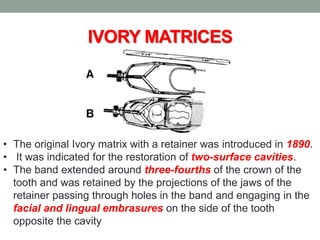
IVORY MATRICES
• The original Ivory matrix with a retainer was introduced in 1890.
• It was indicated for the restoration of two-surface cavities.
• The band extended around three-fourths of the crown of the
tooth and was retained by the projections of the jaws of the
retainer passing through holes in the band and engaging in the
facial and lingual embrasures on the side of the tooth
opposite the cavity
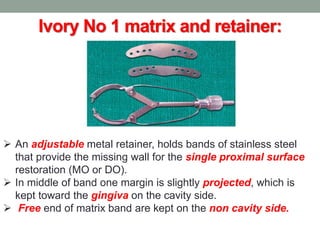
Ivory No 1 matrix and retainer:
 An adjustable metal retainer, holds bands of stainless steel
that provide the missing wall for the single proximal surface
restoration (MO or DO).
 In middle of band one margin is slightly projected, which is
kept toward the gingiva on the cavity side.
 Free end of matrix band are kept on the non cavity side.
Ivory No 2 matrix and retainer:
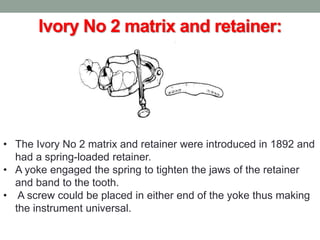
• The Ivory No 2 matrix and retainer were introduced in 1892 and
had a spring-loaded retainer.
• A yoke engaged the spring to tighten the jaws of the retainer
and band to the tooth.
• A screw could be placed in either end of the yoke thus making
the instrument universal.
Ivory No 3 matrix and retainer:
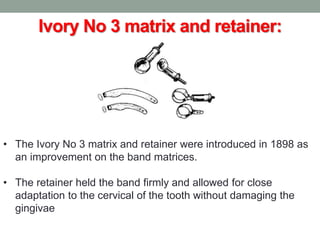
• The Ivory No 3 matrix and retainer were introduced in 1898 as
an improvement on the band matrices.
• The retainer held the band firmly and allowed for close
adaptation to the cervical of the tooth without damaging the
gingivae
Ivory No 4 matrix and retainer:
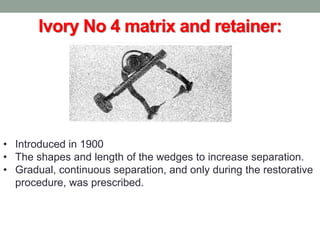
• Introduced in 1900
• The shapes and length of the wedges to increase separation.
• Gradual, continuous separation, and only during the restorative
procedure, was prescribed.
Ivory No 5 matrix and retainer:
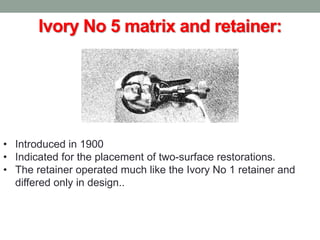
• Introduced in 1900
• Indicated for the placement of two-surface restorations.
• The retainer operated much like the Ivory No 1 retainer and
differed only in design..
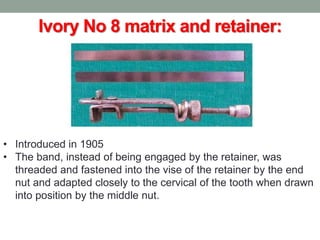
Ivory No 8 matrix and retainer:
• Introduced in 1905
• The band, instead of being engaged by the retainer, was
threaded and fastened into the vise of the retainer by the end
nut and adapted closely to the cervical of the tooth when drawn
into position by the middle nut.
Ivory No 8 matrix and retainer:
• INDICATION:
• Unilateral or bilateral Class II (MOD).
• Class II compound
ADVANTAGES:
• Economical
• Can be sterlized
Tofflemire matrix
• Designed by B R Tofflemire
• Indicated when two or three surfaces of posterior teeth has
been prepared.
ADVANTAGES:
• Ease of use.
• Good contact & contour
• Rigid & stable
DISADVANTAGES:
• Does not produce optimum contact & contour for posterior
composite
• Not useful for extensive class II
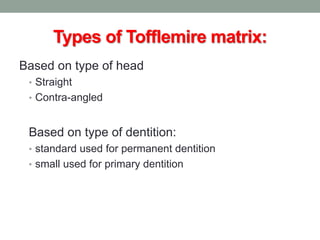
Types of Tofflemire matrix:
Based on type of head
• Straight
• Contra-angled
Based on type of dentition:
• standard used for permanent dentition
• small used for primary dentition
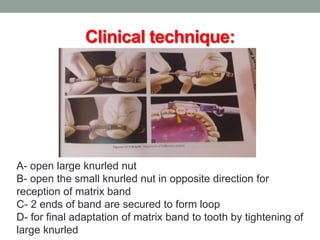
Clinical technique:
A- open large knurled nut
B- open the small knurled nut in opposite direction for
reception of matrix band
C- 2 ends of band are secured to form loop
D- for final adaptation of matrix band to tooth by tightening of
large knurled
Steele’s Siqueland Self Adjusting Matrix
Holder For Tapered Teeth:
• Used when there is significant difference between
diameters of cervical and occlusal one third of tooth.
• Advantages:
• Can adapt to tooth contour
Anatomical matrix band / Custom made
matrix compound supported matrix
• Described by Sweeney .
• Adapted over tooth with one healthy tooth on either
side.
• Wedges are placed
• Embrasure's are sealed with the help of self cure
acrylic/impression compound.
• Advantage:
• Provides better contact and contour
• Easy to remove
• Rigid and stable than other matrix system.
Retainerless Automatrix system
• Adjusted according to tooth shape & size.
• Auto matrix bands
• Automated II mechanical device
• Shielded nipper
Indicated : tilted and partially erupted teeth
complex amalgam restoration
Advantage: simple , convenient, better visibility
Precontoured Sectional matrix and contact
rings
• Consist of precontoured matrices (selected according to
tooth size)
• A flexible metal ring called as contact ring is placed to
stabilize the ends of matrix band against proximal box.
•
Tooth separation:
• The process of separating the involved teeth slightly
away from each other .
• REASON:
• Examination: proximal caries
• Preparation of teeth: Class II & III
• Polishing of restoration:
• Matrix placement
• Removal of foreign bodies
Slow or Delayed Tooth separation:
• Takes long time
• Methods of slow separation:
• Rubber ring
• Rubber dam sheet
• Ligature wire
• Gutta percha stick
• Oversized temporary crowns
• Fixed orthodontic appliance
Rapid tooth separation
• Traction principle:
• Uses mechanical devices which engages proximal area
of tooth with holding arms.
• Ferrier double bow separator
• Wedge principle:
Pointed wedge shaped mechanical device inserted beneath
contact area of teeth
• Elliot separator
• wedges

Matricing and tooth separation

  • 1.
  • 2.
    CONTOURS: • All teethhave some specific convexity on the facial ,lingual , proximal and occlusal surface of teeth that afford the protection and stimulation of the supporting tissues during mastication. This convexity are called contours. • TYPES • Facio-lingual contour • Proximal contour • Occlusal contour
  • 3.
    CONTOURS: • Contours onthe facial and lingual surface • Facial surface - cervical one third of all teeth • Lingual surface -cervical one third of incisor and canines -Middle one third of the premolar and molar
  • 4.
    CONTOURS: • Contours onthe proximal surface • Teeth show convexities on the distal and mesial surface. • The area with maximum convexity on the proximal surface is called the proximal height of contour. • Proximal height of contour responsible for the creation of the a)Proximal contact b)Embrasure space
  • 5.
    Proximal contact : •Proximal convexity of the teeth create area of contact between adjacent teeth with in the same arch. • These are called proximal contact area. • Initially as teeth erupt the teeth contact each other at a point(point contact). • With the passage of time, physiologic tooth movement causes frictional wear enlarging the contact point to contact area.
  • 6.
    Importance of contact: • Preserves the stability and integrity of the arch by maintaining normal mesio-distal relationship of teeth. • Prevent food impaction interdentally • Protect the soft tissue from periodontal disease • Conserve the teeth from proximal caries • Premature restorative failure does not occur if stable proximal contact is present.
  • 7.
    Size of contact: • Anteriorly- contact point • Posteriorly –contact area about 1.5-2mm LOCATION OF CONTACT • Anterior teeth – incisal one third • Posteriorly - junction of incisal and middle one third
  • 8.
    Embrasures : • Embrasuresare “V” shaped spaces present interproximally around the proximal contact existing between the adjacent teeth. • Types • 1.Buccal embrasure • 2.Lingual embrasure • 3.Incisal/occlusal embrasure • 4.Gingival embrasure
  • 9.
    Functions of Embrasures: 1)Serve as spillways for the escape of food during mastication 2) Prevent trapping of food in to the contact area 3)Protect the underlying supporting tissue during mastication
  • 10.
    Over and undercontoured restoration: Over contoured restoration: • They deflect food from the gingiva causing poor gingival stimulation. • The gingiva become flabby ,red and chronically inflamed due to increased plaque retention Under contoured restoration : • This result in irritation and trauma to the attachment apparatus.
  • 11.
    Too broad contact: It will change the tooth anatomy It will change the interdental ‘col’ by broadening it. The delicate non keratinized epithelium may get damaged increasing the chance of periodontal tissue. With too broad contact the interdental area is difficult to clean increase the risk of future decay
  • 12.
    Too Narrow contact: It will change the tooth anatomy The embrasure size will increase leading to impaction of food vertically and horizontally, thereby damaging periodontal tissue.
  • 13.
    Improper contact location: • Too occlusally -It will cause flattening of marginal - ridges, resulting in too shallow occlusal embrasure • Too buccally/lingually- will encroach upon the respective embrasure • Too gingivally - will reduce the size of gingival embrasure and encroach upon interdental gingiva
  • 14.
    Open contact : Open contacts would create the problem ready inflow of food causing accumulation of debris , plaque and damage to the periodontal disease
  • 15.
    Consequence of notrestoring proximal area : • Food impaction----- recurrent caries • Change in occlusal and inter-cuspal relations • Trauma to the periodontium
  • 16.
    Matricing : • Itis the procedure by which temporary wall is built opposite to the axial wall, surrounding the tooth structure which has been lost during tooth preparation.
  • 17.
    Matrix : • Itis an instrument which is used to hold the restoration within the tooth while it is setting.
  • 18.
    Depending on thetype of band material: 1. Stainless steel 2. Copper band 3. Cellulose acetate 4. Polyacetate
  • 19.
    Based on modeof retention: a) With retainer b) Without retainer
  • 20.
    Based on typeof band a) Metallic non transparent b) Non metallic transparent
  • 21.
    Based on typeof cavity for which it is use a) Matrix for Class I cavity preparation b) Matrix for Class II cavity preparation
  • 22.
    c)Matrix for ClassIII cavity preparation d)Matrix for Class IV cavity preparation
  • 23.
    e) Matrix forClass V cavity preparation
  • 24.
    Based on itspreparation 1. Custom made or anatomic Ex: compound supported matrix 2. Mechanical matrix Ex: Tofflemire, Ivory No.1 & 8 Matrices
  • 25.
    Parts of matrix: 1.Retainer : Holds the band in desired position and shape 2. Band : piece of metal or polymeric material, intended to give support and form to restoration during its insertion and setting.
  • 26.
    Band : • Itshould extend 2 mm above the marginal ridge height and 1 mm below the gingival margin of preparation.
  • 27.
    Width of matrixband : • Permanent teeth- 6.35mm- 1/4th inch to 9.525 mm – 3/8th inch. • Deciduous teeth- 3.175 mm- 1/8th inch to 7.9375 mm – 5/16th inch Thickness of matrix band : 0.0381mm (0.0015 inch) to 0.0508 mm (0.002 inch)
  • 28.
    • Confine therestoration while setting • Provide proper proximal contact and contour • Provide optimal surface texture for restoration • Prevent gingival overhang Functions:
  • 29.
    Ideal requirement ofmatrix band : Rigidity Adaptability Easy to use Non reactive Height and contour Application Sterilization Inexpensive
  • 30.
    IVORY MATRICES • Theoriginal Ivory matrix with a retainer was introduced in 1890. • It was indicated for the restoration of two-surface cavities. • The band extended around three-fourths of the crown of the tooth and was retained by the projections of the jaws of the retainer passing through holes in the band and engaging in the facial and lingual embrasures on the side of the tooth opposite the cavity
  • 31.
    Ivory No 1matrix and retainer:  An adjustable metal retainer, holds bands of stainless steel that provide the missing wall for the single proximal surface restoration (MO or DO).  In middle of band one margin is slightly projected, which is kept toward the gingiva on the cavity side.  Free end of matrix band are kept on the non cavity side.
  • 32.
    Ivory No 2matrix and retainer: • The Ivory No 2 matrix and retainer were introduced in 1892 and had a spring-loaded retainer. • A yoke engaged the spring to tighten the jaws of the retainer and band to the tooth. • A screw could be placed in either end of the yoke thus making the instrument universal.
  • 33.
    Ivory No 3matrix and retainer: • The Ivory No 3 matrix and retainer were introduced in 1898 as an improvement on the band matrices. • The retainer held the band firmly and allowed for close adaptation to the cervical of the tooth without damaging the gingivae
  • 34.
    Ivory No 4matrix and retainer: • Introduced in 1900 • The shapes and length of the wedges to increase separation. • Gradual, continuous separation, and only during the restorative procedure, was prescribed.
  • 35.
    Ivory No 5matrix and retainer: • Introduced in 1900 • Indicated for the placement of two-surface restorations. • The retainer operated much like the Ivory No 1 retainer and differed only in design..
  • 36.
    Ivory No 8matrix and retainer: • Introduced in 1905 • The band, instead of being engaged by the retainer, was threaded and fastened into the vise of the retainer by the end nut and adapted closely to the cervical of the tooth when drawn into position by the middle nut.
  • 37.
    Ivory No 8matrix and retainer: • INDICATION: • Unilateral or bilateral Class II (MOD). • Class II compound ADVANTAGES: • Economical • Can be sterlized
  • 38.
    Tofflemire matrix • Designedby B R Tofflemire • Indicated when two or three surfaces of posterior teeth has been prepared. ADVANTAGES: • Ease of use. • Good contact & contour • Rigid & stable DISADVANTAGES: • Does not produce optimum contact & contour for posterior composite • Not useful for extensive class II
  • 40.
    Types of Tofflemirematrix: Based on type of head • Straight • Contra-angled Based on type of dentition: • standard used for permanent dentition • small used for primary dentition
  • 41.
    Clinical technique: A- openlarge knurled nut B- open the small knurled nut in opposite direction for reception of matrix band C- 2 ends of band are secured to form loop D- for final adaptation of matrix band to tooth by tightening of large knurled
  • 42.
    Steele’s Siqueland SelfAdjusting Matrix Holder For Tapered Teeth: • Used when there is significant difference between diameters of cervical and occlusal one third of tooth. • Advantages: • Can adapt to tooth contour
  • 43.
    Anatomical matrix band/ Custom made matrix compound supported matrix • Described by Sweeney . • Adapted over tooth with one healthy tooth on either side. • Wedges are placed • Embrasure's are sealed with the help of self cure acrylic/impression compound. • Advantage: • Provides better contact and contour • Easy to remove • Rigid and stable than other matrix system.
  • 44.
    Retainerless Automatrix system •Adjusted according to tooth shape & size. • Auto matrix bands • Automated II mechanical device • Shielded nipper Indicated : tilted and partially erupted teeth complex amalgam restoration Advantage: simple , convenient, better visibility
  • 45.
    Precontoured Sectional matrixand contact rings • Consist of precontoured matrices (selected according to tooth size) • A flexible metal ring called as contact ring is placed to stabilize the ends of matrix band against proximal box. •
  • 46.
    Tooth separation: • Theprocess of separating the involved teeth slightly away from each other . • REASON: • Examination: proximal caries • Preparation of teeth: Class II & III • Polishing of restoration: • Matrix placement • Removal of foreign bodies
  • 47.
    Slow or DelayedTooth separation: • Takes long time • Methods of slow separation: • Rubber ring • Rubber dam sheet • Ligature wire • Gutta percha stick • Oversized temporary crowns • Fixed orthodontic appliance
  • 48.
    Rapid tooth separation •Traction principle: • Uses mechanical devices which engages proximal area of tooth with holding arms. • Ferrier double bow separator • Wedge principle: Pointed wedge shaped mechanical device inserted beneath contact area of teeth • Elliot separator • wedges