1 
Technical Communication: 
Process and Product 
6th Edition 
Steven M. Gerson 
Sharon J. Gerson 
Gerson: Technical Communication, 6e © 2009 Pearson Education, Upper Saddle River, NJ 07458. All Rights Reserved.
2 
Chapter 3: The Goals of Technical 
Communication 
This chapter discusses 
the following: 
• Clarity 
• Conciseness 
• Accuracy 
• Organization 
• Ethics 
Gerson: Technical Communication, 6e © 2009 Pearson Education, Upper Saddle River, NJ 07458. All Rights Reserved.
3 
Clarity 
To achieve clarity: 
• Provide Specific Detail 
• Answer the Reporters’ Questions 
• Use Easily Understandable Words 
• Use Verbs in the Active Voice Versus the 
Passive Voice 
Gerson: Technical Communication, 6e © 2009 Pearson Education, Upper Saddle River, NJ 07458. All Rights Reserved.
4 
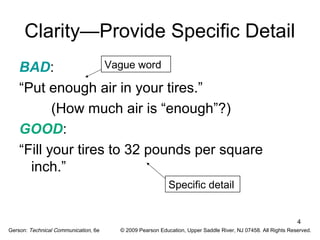
Clarity—Provide Specific Detail 
BAD: 
Vague word 
“Put enough air in your tires.” 
(How much air is “enough”?) 
GOOD: 
“Fill your tires to 32 pounds per square 
inch.” 
Specific detail 
Gerson: Technical Communication, 6e © 2009 Pearson Education, Upper Saddle River, NJ 07458. All Rights Reserved.
5 
Clarity—Answer Reporter’s 
Questions 
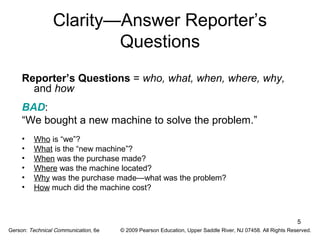
Reporter’s Questions = who, what, when, where, why, 
and how 
BAD: 
“We bought a new machine to solve the problem.” 
• Who is “we”? 
• What is the “new machine”? 
• When was the purchase made? 
• Where was the machine located? 
• Why was the purchase made—what was the problem? 
• How much did the machine cost? 
Gerson: Technical Communication, 6e © 2009 Pearson Education, Upper Saddle River, NJ 07458. All Rights Reserved.
6 
Clarity—Answer Reporter’s 
Questions (cont.) 
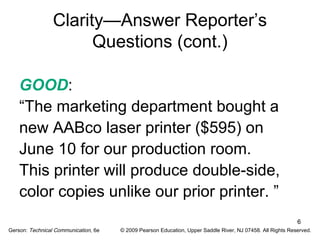
GOOD: 
“The marketing department bought a 
new AABco laser printer ($595) on 
June 10 for our production room. 
This printer will produce double-side, 
color copies unlike our prior printer. ” 
Gerson: Technical Communication, 6e © 2009 Pearson Education, Upper Saddle River, NJ 07458. All Rights Reserved.
7 
Clarity—Use Easily 
Understandable Words 
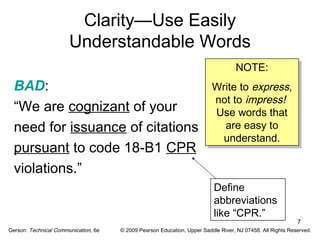
BAD: 
“We are cognizant of your 
need for issuance of citations 
pursuant to code 18-B1 CPR 
violations.” 
NOTE: 
NOTE: 
Write to express, 
not to impress! 
Use words that 
are easy to 
understand. 
Write to express, 
not to impress! 
Use words that 
are easy to 
understand. 
Define 
abbreviations 
like “CPR.” 
Gerson: Technical Communication, 6e © 2009 Pearson Education, Upper Saddle River, NJ 07458. All Rights Reserved.
8 
Clarity—Use Easily 
Understandable Words (cont.) 
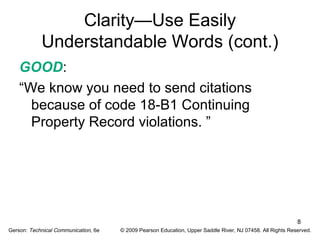
GOOD: 
“We know you need to send citations 
because of code 18-B1 Continuing 
Property Record violations. ” 
Gerson: Technical Communication, 6e © 2009 Pearson Education, Upper Saddle River, NJ 07458. All Rights Reserved.
9 
Clarity—Use Verbs in the Active 
Voice vs. the Passive Voice 
Avoid Passive Voice: 
“It has been determined 
that the machine was 
broken by John.” 
Use Active Voice: 
“John broke the 
machine. ” 
NOTE: 
Active voice 
sentences are 
less wordy and 
more direct than 
passive voice 
constructions. 
NOTE: 
Active voice 
sentences are 
less wordy and 
more direct than 
passive voice 
constructions. 
Gerson: Technical Communication, 6e © 2009 Pearson Education, Upper Saddle River, NJ 07458. All Rights Reserved.
10 
Practice 
• Use the end-of-chapter activities to 
practice writing clearly. 
Gerson: Technical Communication, 6e © 2009 Pearson Education, Upper Saddle River, NJ 07458. All Rights Reserved.
11 
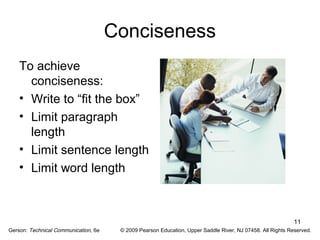
Conciseness 
To achieve 
conciseness: 
• Write to “fit the box” 
• Limit paragraph 
length 
• Limit sentence length 
• Limit word length 
Gerson: Technical Communication, 6e © 2009 Pearson Education, Upper Saddle River, NJ 07458. All Rights Reserved.
Conciseness—Write to “fit the box” 
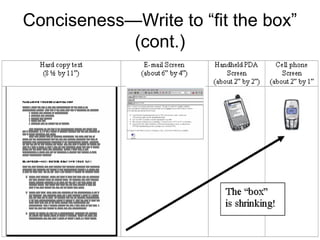
• Technical communication often “fits in a box.” 
12 
– An automobile’s user manual must fit in the glove 
compartment. 
– Instructions for baking brownies must fit on the 
back of the brownie box. 
• Due to technological advancements, the box 
is shrinking. Consider the monitor size of: 
– Cell phones 
– PDAs 
– E-mail screens 
– PowerPoint slides 
Gerson: Technical Communication, 6e © 2009 Pearson Education, Upper Saddle River, NJ 07458. All Rights Reserved.
Conciseness—Write to “fit the box” 
13 
(cont.) 
Gerson: Technical Communication, 6e © 2009 Pearson Education, Upper Saddle River, NJ 07458. All Rights Reserved.
Conciseness—Write to “fit the box” 
14 
(cont.) 
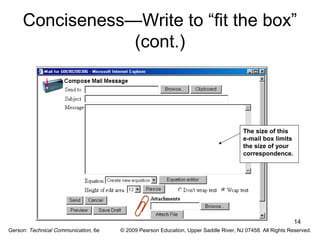
The size of this 
e-mail box limits 
the size of your 
correspondence. 
Gerson: Technical Communication, 6e © 2009 Pearson Education, Upper Saddle River, NJ 07458. All Rights Reserved.
Conciseness—Write to “fit the box” 
15 
(cont.) 
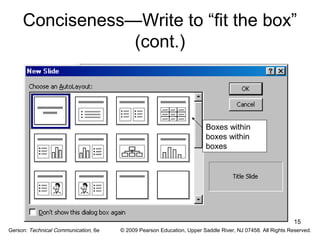
Boxes within 
boxes within 
boxes 
Gerson: Technical Communication, 6e © 2009 Pearson Education, Upper Saddle River, NJ 07458. All Rights Reserved.
16 
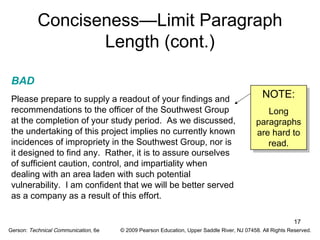
Conciseness—Limit Paragraph 
Length 
• To write concisely, limit paragraph 
length to approximately: 
– 4-6 lines of text 
– 50 words per paragraph 
Gerson: Technical Communication, 6e © 2009 Pearson Education, Upper Saddle River, NJ 07458. All Rights Reserved.
NOTE: 
Long 
paragraphs 
are hard to 
read. 
NOTE: 
Long 
paragraphs 
are hard to 
read. 
17 
Conciseness—Limit Paragraph 
Length (cont.) 
BAD 
Please prepare to supply a readout of your findings and 
recommendations to the officer of the Southwest Group 
at the completion of your study period. As we discussed, 
the undertaking of this project implies no currently known 
incidences of impropriety in the Southwest Group, nor is 
it designed to find any. Rather, it is to assure ourselves 
of sufficient caution, control, and impartiality when 
dealing with an area laden with such potential 
vulnerability. I am confident that we will be better served 
as a company as a result of this effort. 
Gerson: Technical Communication, 6e © 2009 Pearson Education, Upper Saddle River, NJ 07458. All Rights Reserved.
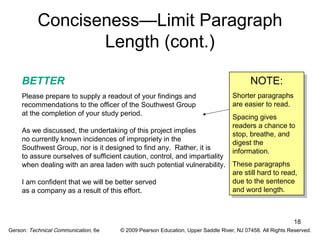
NOTE: 
Shorter paragraphs 
are easier to read. 
Spacing gives 
readers a chance to 
stop, breathe, and 
digest the 
information. 
These paragraphs 
are still hard to read, 
due to the sentence 
and word length. 
Shorter paragraphs 
are easier to read. 
Spacing gives 
readers a chance to 
stop, breathe, and 
digest the 
information. 
These paragraphs 
are still hard to read, 
due to the sentence 
and word length. 
18 
Conciseness—Limit Paragraph 
Length (cont.) 
BETTER 
Please prepare to supply a readout of your findings and 
recommendations to the officer of the Southwest Group 
at the completion of your study period. 
As we discussed, the undertaking of this project implies 
no currently known incidences of impropriety in the 
Southwest Group, nor is it designed to find any. Rather, it is 
to assure ourselves of sufficient caution, control, and impartiality 
when dealing with an area laden with such potential vulnerability. 
I am confident that we will be better served 
as a company as a result of this effort. 
NOTE: 
Gerson: Technical Communication, 6e © 2009 Pearson Education, Upper Saddle River, NJ 07458. All Rights Reserved.
19 
Conciseness—Limit Sentence 
Length 
• To write concisely, limit sentence length 
to: 
– 10-15 words (average) 
Gerson: Technical Communication, 6e © 2009 Pearson Education, Upper Saddle River, NJ 07458. All Rights Reserved.
20 
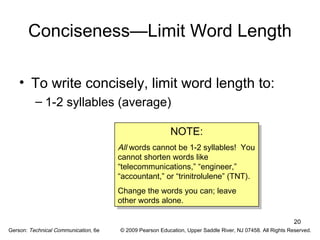
Conciseness—Limit Word Length 
• To write concisely, limit word length to: 
– 1-2 syllables (average) 
NOTE: 
NOTE: 
All words cannot be 1-2 syllables! You 
cannot shorten words like 
“telecommunications,” “engineer,” 
“accountant,” or “trinitrolulene” (TNT). 
Change the words you can; leave 
other words alone. 
All words cannot be 1-2 syllables! You 
cannot shorten words like 
“telecommunications,” “engineer,” 
“accountant,” or “trinitrolulene” (TNT). 
Change the words you can; leave 
other words alone. 
Gerson: Technical Communication, 6e © 2009 Pearson Education, Upper Saddle River, NJ 07458. All Rights Reserved.
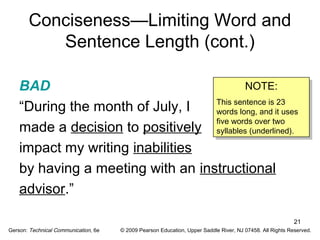
NOTE: 
This sentence is 23 
words long, and it uses 
five words over two 
syllables (underlined). 
This sentence is 23 
words long, and it uses 
five words over two 
syllables (underlined). 
21 
Conciseness—Limiting Word and 
Sentence Length (cont.) 
BAD 
“During the month of July, I 
made a decision to positively 
impact my writing inabilities 
by having a meeting with an instructional 
advisor.” 
NOTE: 
Gerson: Technical Communication, 6e © 2009 Pearson Education, Upper Saddle River, NJ 07458. All Rights Reserved.
22 
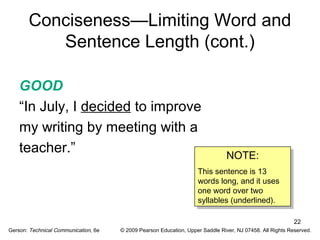
Conciseness—Limiting Word and 
Sentence Length (cont.) 
GOOD 
“In July, I decided to improve 
my writing by meeting with a 
teacher.” 
NOTE: 
NOTE: 
This sentence is 13 
words long, and it uses 
one word over two 
syllables (underlined). 
This sentence is 13 
words long, and it uses 
one word over two 
syllables (underlined). 
Gerson: Technical Communication, 6e © 2009 Pearson Education, Upper Saddle River, NJ 07458. All Rights Reserved.
23 
Practice 
• Use the end-of-chapter activities to 
practice writing concisely. 
Gerson: Technical Communication, 6e © 2009 Pearson Education, Upper Saddle River, NJ 07458. All Rights Reserved.
24 
Accuracy 
• Errors in your writing make you look 
unprofessional. 
• Proofread to catch and correct errors. 
Gerson: Technical Communication, 6e © 2009 Pearson Education, Upper Saddle River, NJ 07458. All Rights Reserved.
25 
Organization 
• Use appropriate organizational modes to help 
readers understand your content: 
– Spatial (good for technical specifications) 
– Chronological (good for instructions) 
– Importance (good for focusing your reader’s 
attention on the key ideas in any type of writing) 
– Comparison/Contrast (good for showing 
alternatives in any type of writing) 
– Problem/Solution (good for proposals) 
Gerson: Technical Communication, 6e © 2009 Pearson Education, Upper Saddle River, NJ 07458. All Rights Reserved.
26 
Practice 
• Use the end-of-chapter activities to 
practice different organizational modes. 
Gerson: Technical Communication, 6e © 2009 Pearson Education, Upper Saddle River, NJ 07458. All Rights Reserved.
27 
Ethics 
• Post Enron, IMclone, and Adelphia, 
ethics in communication have never 
been more important. 
• Effective technical communication must 
focus on: 
– Legalities 
– Practicalities 
– Ethicalities 
Gerson: Technical Communication, 6e © 2009 Pearson Education, Upper Saddle River, NJ 07458. All Rights Reserved.
28 
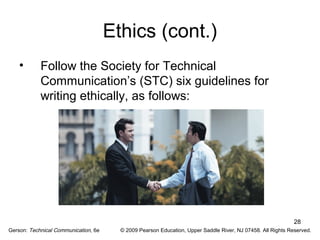
Ethics (cont.) 
• Follow the Society for Technical 
Communication’s (STC) six guidelines for 
writing ethically, as follows: 
Gerson: Technical Communication, 6e © 2009 Pearson Education, Upper Saddle River, NJ 07458. All Rights Reserved.
29 
Ethics (cont.) 
1. Use language and visuals with 
precision. (Clarity) 
2. Prefer simple, direct expressions of 
ideas. (Conciseness) 
3. Satisfy the audience’s need for 
information, not your own need for self 
expression. (Clarity and Conciseness) 
Gerson: Technical Communication, 6e © 2009 Pearson Education, Upper Saddle River, NJ 07458. All Rights Reserved.
30 
Ethics (cont.) 
4. Hold yourself responsible for how well the 
audience understands the message. 
(Clarity) 
5. Respect the work of colleagues. (Focusing 
on Confidentiality, Courtesy, and Copyright 
laws) 
6. Strive continually to improve your 
professional competence. Promote a 
climate that encourages the exercise of 
professional judgment. 
Gerson: Technical Communication, 6e © 2009 Pearson Education, Upper Saddle River, NJ 07458. All Rights Reserved.
31 
Practice 
• Use the end-of-chapter activities to 
practice ethical considerations. 
Gerson: Technical Communication, 6e © 2009 Pearson Education, Upper Saddle River, NJ 07458. All Rights Reserved.

Objectives or goals of technical communication

  • 1.
    1 Technical Communication: Process and Product 6th Edition Steven M. Gerson Sharon J. Gerson Gerson: Technical Communication, 6e © 2009 Pearson Education, Upper Saddle River, NJ 07458. All Rights Reserved.
  • 2.
    2 Chapter 3:The Goals of Technical Communication This chapter discusses the following: • Clarity • Conciseness • Accuracy • Organization • Ethics Gerson: Technical Communication, 6e © 2009 Pearson Education, Upper Saddle River, NJ 07458. All Rights Reserved.
  • 3.
    3 Clarity Toachieve clarity: • Provide Specific Detail • Answer the Reporters’ Questions • Use Easily Understandable Words • Use Verbs in the Active Voice Versus the Passive Voice Gerson: Technical Communication, 6e © 2009 Pearson Education, Upper Saddle River, NJ 07458. All Rights Reserved.
  • 4.
    4 Clarity—Provide SpecificDetail BAD: Vague word “Put enough air in your tires.” (How much air is “enough”?) GOOD: “Fill your tires to 32 pounds per square inch.” Specific detail Gerson: Technical Communication, 6e © 2009 Pearson Education, Upper Saddle River, NJ 07458. All Rights Reserved.
  • 5.
    5 Clarity—Answer Reporter’s Questions Reporter’s Questions = who, what, when, where, why, and how BAD: “We bought a new machine to solve the problem.” • Who is “we”? • What is the “new machine”? • When was the purchase made? • Where was the machine located? • Why was the purchase made—what was the problem? • How much did the machine cost? Gerson: Technical Communication, 6e © 2009 Pearson Education, Upper Saddle River, NJ 07458. All Rights Reserved.
  • 6.
    6 Clarity—Answer Reporter’s Questions (cont.) GOOD: “The marketing department bought a new AABco laser printer ($595) on June 10 for our production room. This printer will produce double-side, color copies unlike our prior printer. ” Gerson: Technical Communication, 6e © 2009 Pearson Education, Upper Saddle River, NJ 07458. All Rights Reserved.
  • 7.
    7 Clarity—Use Easily Understandable Words BAD: “We are cognizant of your need for issuance of citations pursuant to code 18-B1 CPR violations.” NOTE: NOTE: Write to express, not to impress! Use words that are easy to understand. Write to express, not to impress! Use words that are easy to understand. Define abbreviations like “CPR.” Gerson: Technical Communication, 6e © 2009 Pearson Education, Upper Saddle River, NJ 07458. All Rights Reserved.
  • 8.
    8 Clarity—Use Easily Understandable Words (cont.) GOOD: “We know you need to send citations because of code 18-B1 Continuing Property Record violations. ” Gerson: Technical Communication, 6e © 2009 Pearson Education, Upper Saddle River, NJ 07458. All Rights Reserved.
  • 9.
    9 Clarity—Use Verbsin the Active Voice vs. the Passive Voice Avoid Passive Voice: “It has been determined that the machine was broken by John.” Use Active Voice: “John broke the machine. ” NOTE: Active voice sentences are less wordy and more direct than passive voice constructions. NOTE: Active voice sentences are less wordy and more direct than passive voice constructions. Gerson: Technical Communication, 6e © 2009 Pearson Education, Upper Saddle River, NJ 07458. All Rights Reserved.
  • 10.
    10 Practice •Use the end-of-chapter activities to practice writing clearly. Gerson: Technical Communication, 6e © 2009 Pearson Education, Upper Saddle River, NJ 07458. All Rights Reserved.
  • 11.
    11 Conciseness Toachieve conciseness: • Write to “fit the box” • Limit paragraph length • Limit sentence length • Limit word length Gerson: Technical Communication, 6e © 2009 Pearson Education, Upper Saddle River, NJ 07458. All Rights Reserved.
  • 12.
    Conciseness—Write to “fitthe box” • Technical communication often “fits in a box.” 12 – An automobile’s user manual must fit in the glove compartment. – Instructions for baking brownies must fit on the back of the brownie box. • Due to technological advancements, the box is shrinking. Consider the monitor size of: – Cell phones – PDAs – E-mail screens – PowerPoint slides Gerson: Technical Communication, 6e © 2009 Pearson Education, Upper Saddle River, NJ 07458. All Rights Reserved.
  • 13.
    Conciseness—Write to “fitthe box” 13 (cont.) Gerson: Technical Communication, 6e © 2009 Pearson Education, Upper Saddle River, NJ 07458. All Rights Reserved.
  • 14.
    Conciseness—Write to “fitthe box” 14 (cont.) The size of this e-mail box limits the size of your correspondence. Gerson: Technical Communication, 6e © 2009 Pearson Education, Upper Saddle River, NJ 07458. All Rights Reserved.
  • 15.
    Conciseness—Write to “fitthe box” 15 (cont.) Boxes within boxes within boxes Gerson: Technical Communication, 6e © 2009 Pearson Education, Upper Saddle River, NJ 07458. All Rights Reserved.
  • 16.
    16 Conciseness—Limit Paragraph Length • To write concisely, limit paragraph length to approximately: – 4-6 lines of text – 50 words per paragraph Gerson: Technical Communication, 6e © 2009 Pearson Education, Upper Saddle River, NJ 07458. All Rights Reserved.
  • 17.
    NOTE: Long paragraphs are hard to read. NOTE: Long paragraphs are hard to read. 17 Conciseness—Limit Paragraph Length (cont.) BAD Please prepare to supply a readout of your findings and recommendations to the officer of the Southwest Group at the completion of your study period. As we discussed, the undertaking of this project implies no currently known incidences of impropriety in the Southwest Group, nor is it designed to find any. Rather, it is to assure ourselves of sufficient caution, control, and impartiality when dealing with an area laden with such potential vulnerability. I am confident that we will be better served as a company as a result of this effort. Gerson: Technical Communication, 6e © 2009 Pearson Education, Upper Saddle River, NJ 07458. All Rights Reserved.
  • 18.
    NOTE: Shorter paragraphs are easier to read. Spacing gives readers a chance to stop, breathe, and digest the information. These paragraphs are still hard to read, due to the sentence and word length. Shorter paragraphs are easier to read. Spacing gives readers a chance to stop, breathe, and digest the information. These paragraphs are still hard to read, due to the sentence and word length. 18 Conciseness—Limit Paragraph Length (cont.) BETTER Please prepare to supply a readout of your findings and recommendations to the officer of the Southwest Group at the completion of your study period. As we discussed, the undertaking of this project implies no currently known incidences of impropriety in the Southwest Group, nor is it designed to find any. Rather, it is to assure ourselves of sufficient caution, control, and impartiality when dealing with an area laden with such potential vulnerability. I am confident that we will be better served as a company as a result of this effort. NOTE: Gerson: Technical Communication, 6e © 2009 Pearson Education, Upper Saddle River, NJ 07458. All Rights Reserved.
  • 19.
    19 Conciseness—Limit Sentence Length • To write concisely, limit sentence length to: – 10-15 words (average) Gerson: Technical Communication, 6e © 2009 Pearson Education, Upper Saddle River, NJ 07458. All Rights Reserved.
  • 20.
    20 Conciseness—Limit WordLength • To write concisely, limit word length to: – 1-2 syllables (average) NOTE: NOTE: All words cannot be 1-2 syllables! You cannot shorten words like “telecommunications,” “engineer,” “accountant,” or “trinitrolulene” (TNT). Change the words you can; leave other words alone. All words cannot be 1-2 syllables! You cannot shorten words like “telecommunications,” “engineer,” “accountant,” or “trinitrolulene” (TNT). Change the words you can; leave other words alone. Gerson: Technical Communication, 6e © 2009 Pearson Education, Upper Saddle River, NJ 07458. All Rights Reserved.
  • 21.
    NOTE: This sentenceis 23 words long, and it uses five words over two syllables (underlined). This sentence is 23 words long, and it uses five words over two syllables (underlined). 21 Conciseness—Limiting Word and Sentence Length (cont.) BAD “During the month of July, I made a decision to positively impact my writing inabilities by having a meeting with an instructional advisor.” NOTE: Gerson: Technical Communication, 6e © 2009 Pearson Education, Upper Saddle River, NJ 07458. All Rights Reserved.
  • 22.
    22 Conciseness—Limiting Wordand Sentence Length (cont.) GOOD “In July, I decided to improve my writing by meeting with a teacher.” NOTE: NOTE: This sentence is 13 words long, and it uses one word over two syllables (underlined). This sentence is 13 words long, and it uses one word over two syllables (underlined). Gerson: Technical Communication, 6e © 2009 Pearson Education, Upper Saddle River, NJ 07458. All Rights Reserved.
  • 23.
    23 Practice •Use the end-of-chapter activities to practice writing concisely. Gerson: Technical Communication, 6e © 2009 Pearson Education, Upper Saddle River, NJ 07458. All Rights Reserved.
  • 24.
    24 Accuracy •Errors in your writing make you look unprofessional. • Proofread to catch and correct errors. Gerson: Technical Communication, 6e © 2009 Pearson Education, Upper Saddle River, NJ 07458. All Rights Reserved.
  • 25.
    25 Organization •Use appropriate organizational modes to help readers understand your content: – Spatial (good for technical specifications) – Chronological (good for instructions) – Importance (good for focusing your reader’s attention on the key ideas in any type of writing) – Comparison/Contrast (good for showing alternatives in any type of writing) – Problem/Solution (good for proposals) Gerson: Technical Communication, 6e © 2009 Pearson Education, Upper Saddle River, NJ 07458. All Rights Reserved.
  • 26.
    26 Practice •Use the end-of-chapter activities to practice different organizational modes. Gerson: Technical Communication, 6e © 2009 Pearson Education, Upper Saddle River, NJ 07458. All Rights Reserved.
  • 27.
    27 Ethics •Post Enron, IMclone, and Adelphia, ethics in communication have never been more important. • Effective technical communication must focus on: – Legalities – Practicalities – Ethicalities Gerson: Technical Communication, 6e © 2009 Pearson Education, Upper Saddle River, NJ 07458. All Rights Reserved.
  • 28.
    28 Ethics (cont.) • Follow the Society for Technical Communication’s (STC) six guidelines for writing ethically, as follows: Gerson: Technical Communication, 6e © 2009 Pearson Education, Upper Saddle River, NJ 07458. All Rights Reserved.
  • 29.
    29 Ethics (cont.) 1. Use language and visuals with precision. (Clarity) 2. Prefer simple, direct expressions of ideas. (Conciseness) 3. Satisfy the audience’s need for information, not your own need for self expression. (Clarity and Conciseness) Gerson: Technical Communication, 6e © 2009 Pearson Education, Upper Saddle River, NJ 07458. All Rights Reserved.
  • 30.
    30 Ethics (cont.) 4. Hold yourself responsible for how well the audience understands the message. (Clarity) 5. Respect the work of colleagues. (Focusing on Confidentiality, Courtesy, and Copyright laws) 6. Strive continually to improve your professional competence. Promote a climate that encourages the exercise of professional judgment. Gerson: Technical Communication, 6e © 2009 Pearson Education, Upper Saddle River, NJ 07458. All Rights Reserved.
  • 31.
    31 Practice •Use the end-of-chapter activities to practice ethical considerations. Gerson: Technical Communication, 6e © 2009 Pearson Education, Upper Saddle River, NJ 07458. All Rights Reserved.