Using Rules of Inference to Build 
Arguments 
Lecturer: Amil Dar
Rules of Inference 
• By an argument, we mean a sequence of statements that end with a 
conclusion. By valid, we mean that the conclusion, or final statement of 
the argument, must follow from the truth of the preceding statements, or 
premises, of the argument.
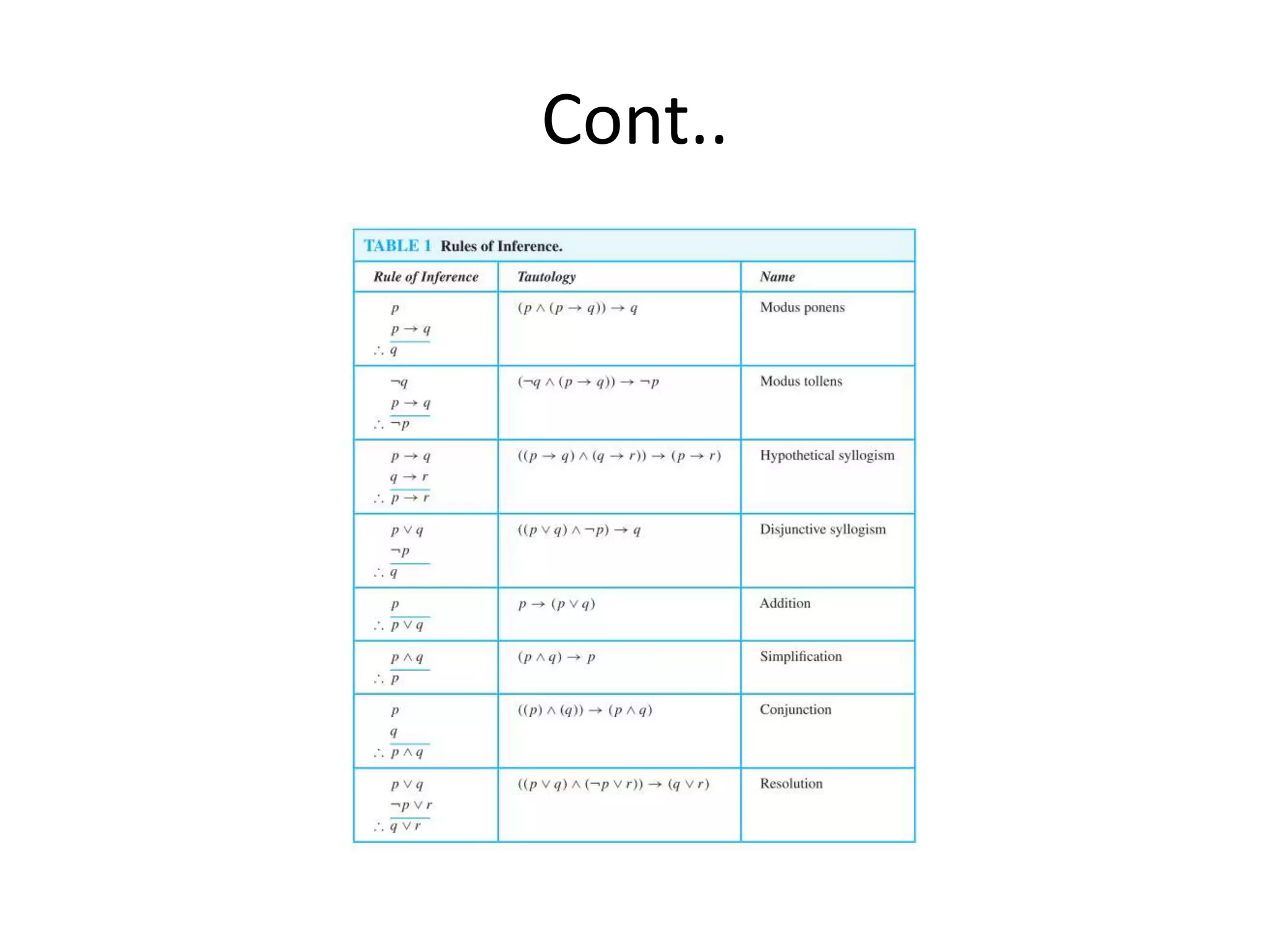
Cont..
Valid Arguments in Propositional Logic 
• Consider the following argument involving propositions (which, by 
dentition, is a sequence of propositions): “If you have a current password, 
then you can log onto the network.” “You have a current password.” 
• Therefore, “You can log onto the network.” 
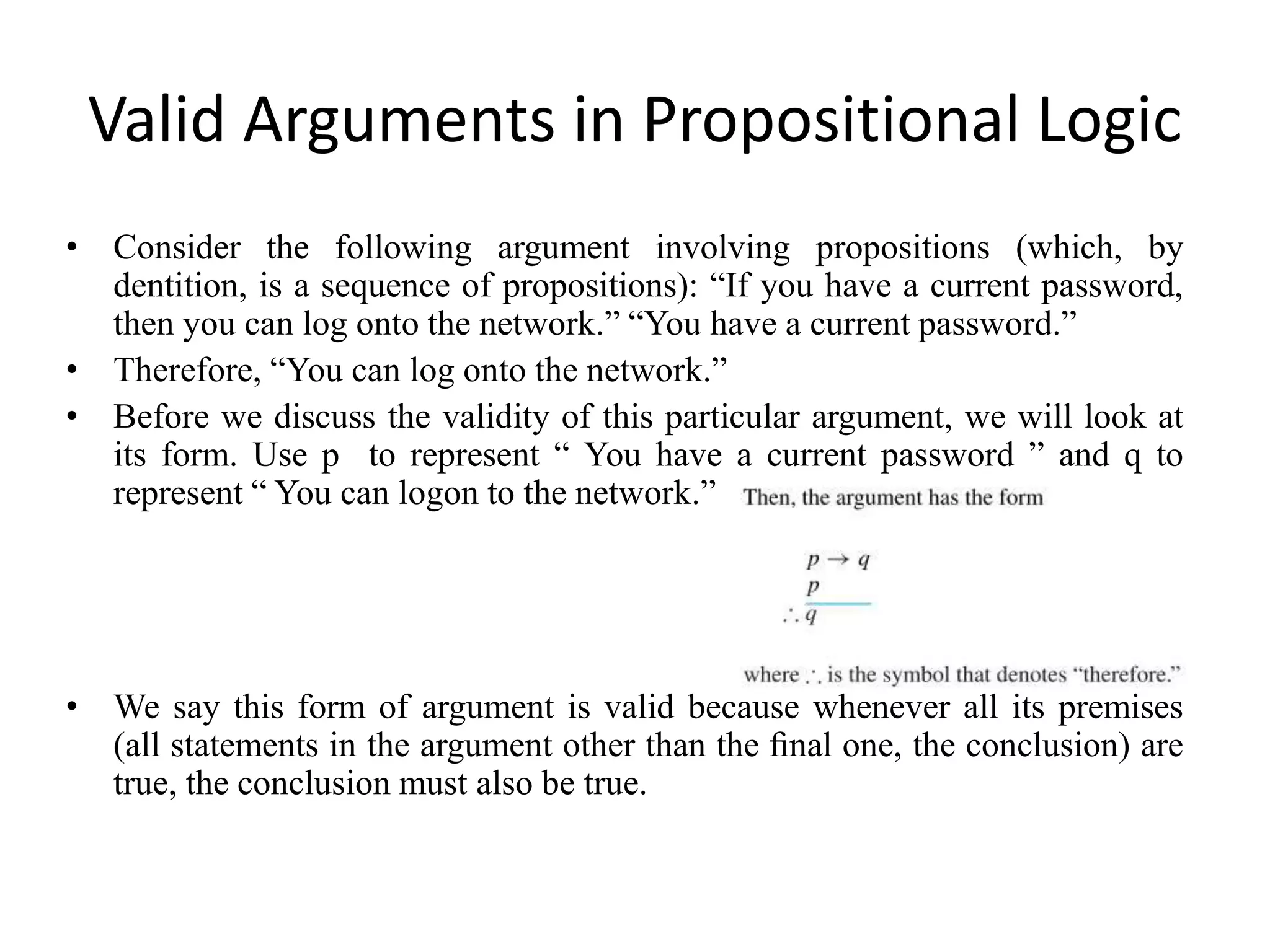
• Before we discuss the validity of this particular argument, we will look at 
its form. Use p to represent “ You have a current password ” and q to 
represent “ You can logon to the network.” 
• We say this form of argument is valid because whenever all its premises 
(all statements in the argument other than the final one, the conclusion) are 
true, the conclusion must also be true.
Using Rules of Inference to Build 
Arguments 
• When there are many premises, several rules of inference are 
often needed to show that an argument is valid.
EXAMPLE 1 
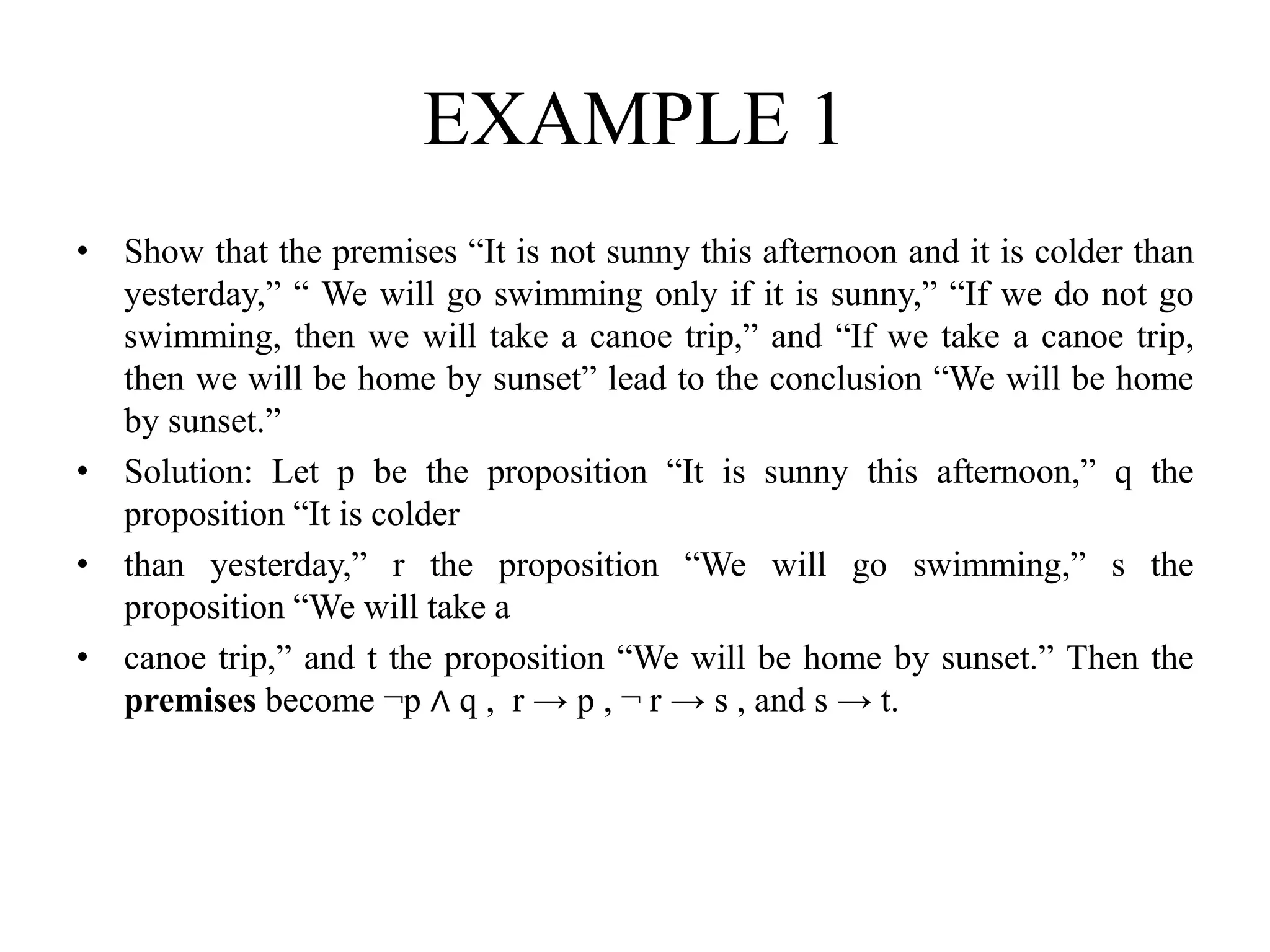
• Show that the premises “It is not sunny this afternoon and it is colder than 
yesterday,” “ We will go swimming only if it is sunny,” “If we do not go 
swimming, then we will take a canoe trip,” and “If we take a canoe trip, 
then we will be home by sunset” lead to the conclusion “We will be home 
by sunset.” 
• Solution: Let p be the proposition “It is sunny this afternoon,” q the 
proposition “It is colder 
• than yesterday,” r the proposition “We will go swimming,” s the 
proposition “We will take a 
• canoe trip,” and t the proposition “We will be home by sunset.” Then the 
premises become ¬p ∧ q , r → p , ¬ r → s , and s → t.
Cont.. 
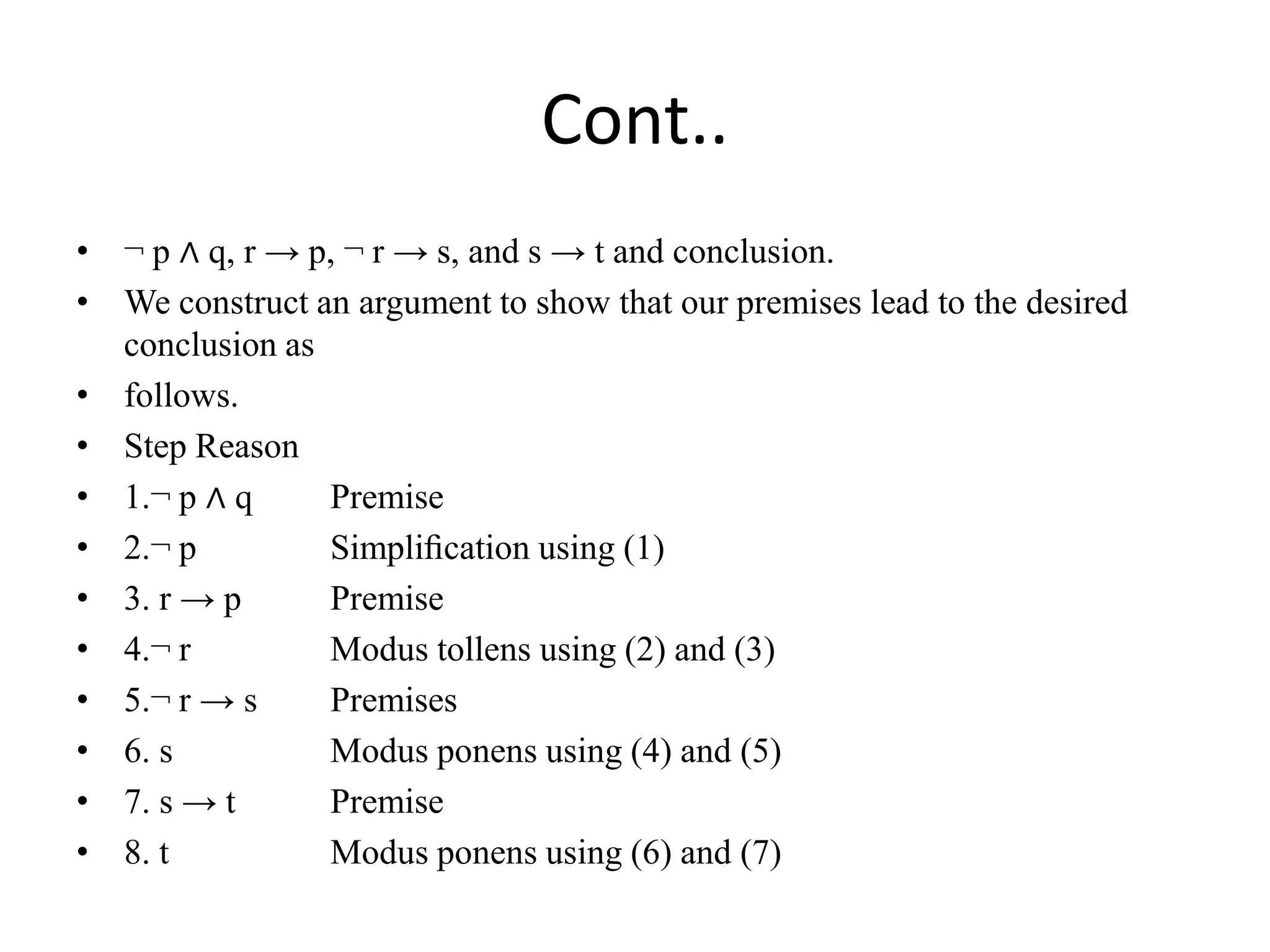
• ¬ p ∧ q, r → p, ¬ r → s, and s → t and conclusion. 
• We construct an argument to show that our premises lead to the desired 
conclusion as 
• follows. 
• Step Reason 
• 1.¬ p ∧ q Premise 
• 2.¬ p Simplification using (1) 
• 3. r → p Premise 
• 4.¬ r Modus tollens using (2) and (3) 
• 5.¬ r → s Premises 
• 6. s Modus ponens using (4) and (5) 
• 7. s → t Premise 
• 8. t Modus ponens using (6) and (7)
EXAMPLE 2 
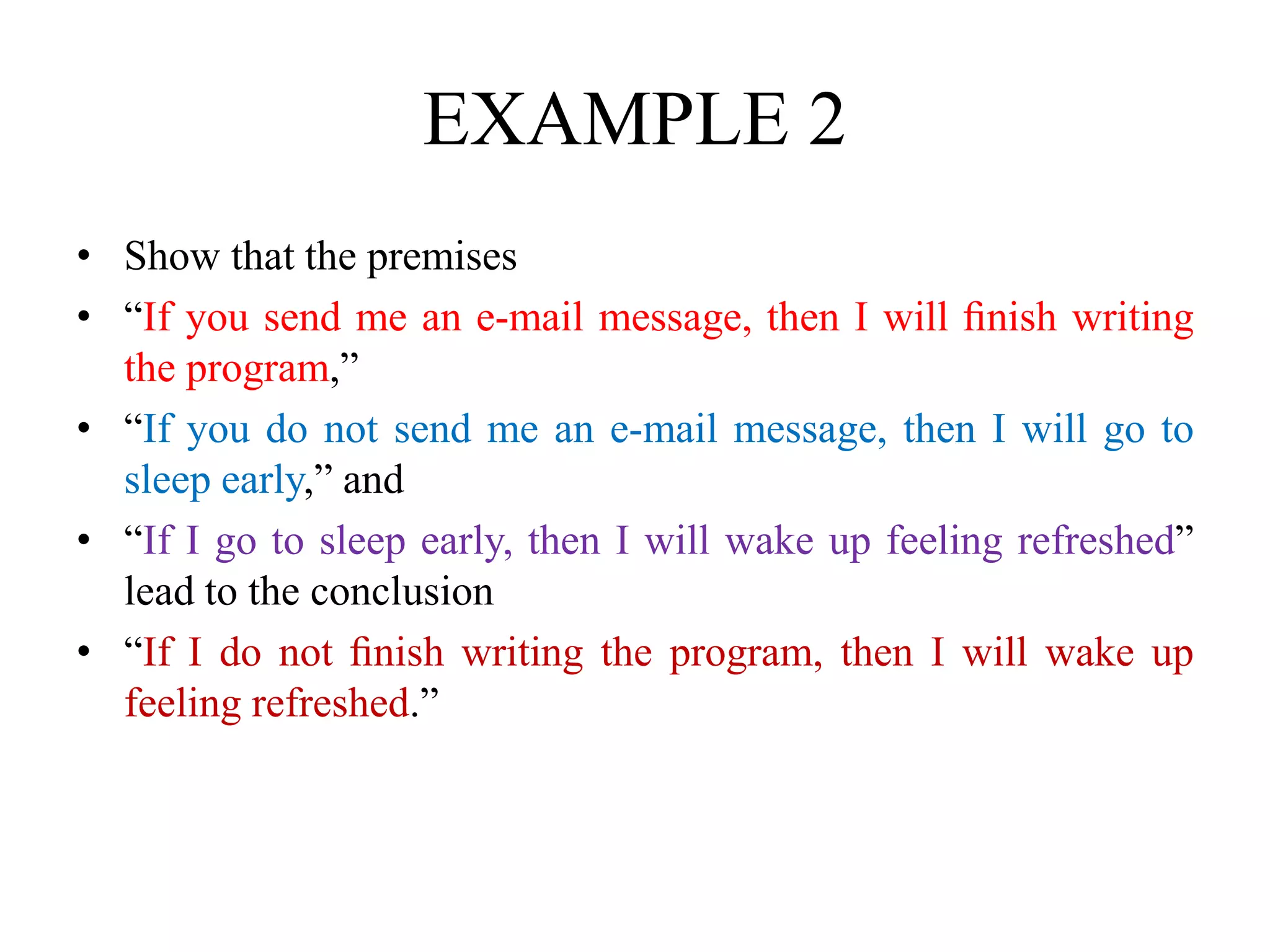
• Show that the premises 
• “If you send me an e-mail message, then I will finish writing 
the program,” 
• “If you do not send me an e-mail message, then I will go to 
sleep early,” and 
• “If I go to sleep early, then I will wake up feeling refreshed” 
lead to the conclusion 
• “If I do not finish writing the program, then I will wake up 
feeling refreshed.”
Solution 
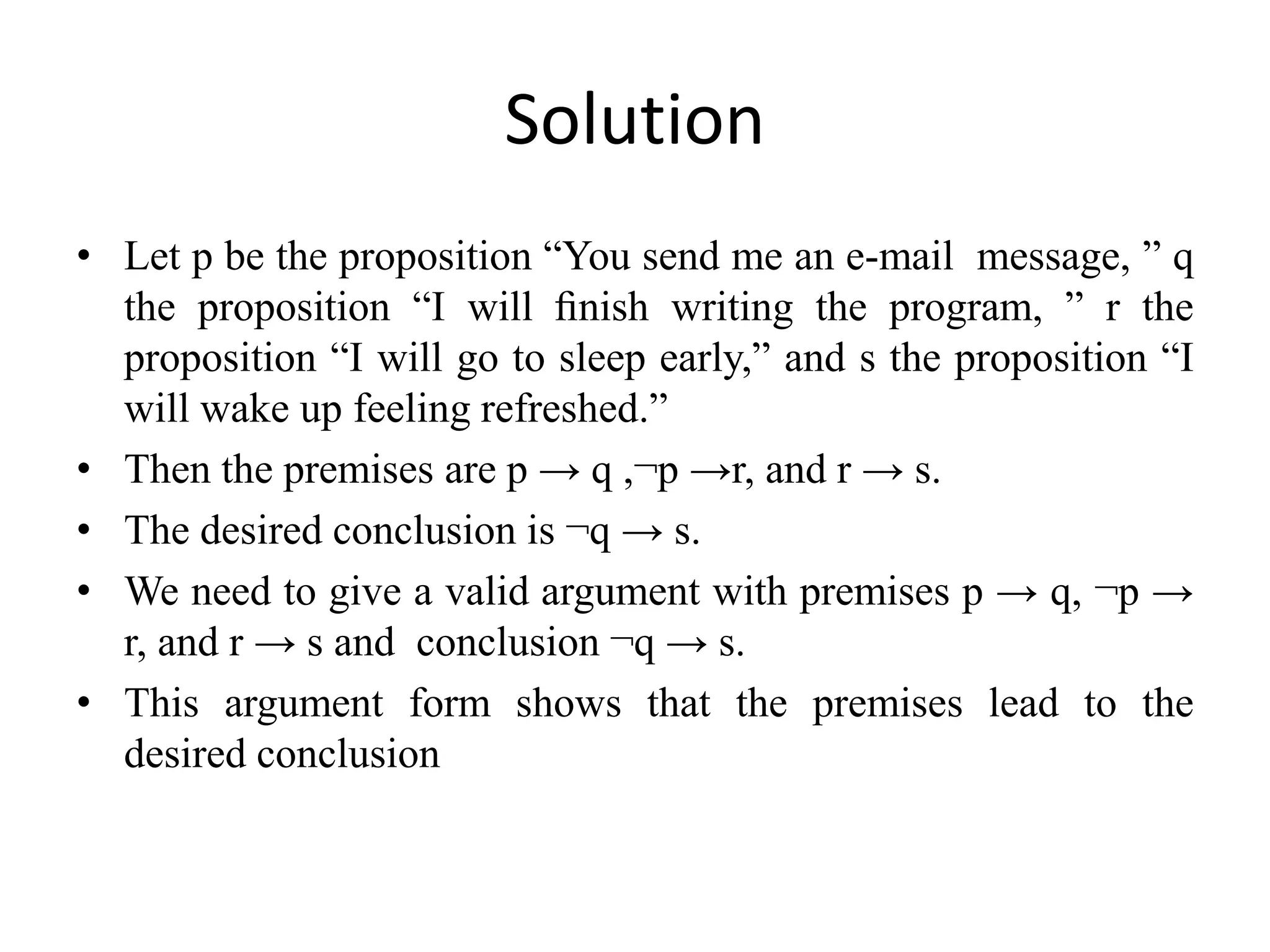
• Let p be the proposition “You send me an e-mail message, ” q 
the proposition “I will finish writing the program, ” r the 
proposition “I will go to sleep early,” and s the proposition “I 
will wake up feeling refreshed.” 
• Then the premises are p → q ,¬p →r, and r → s. 
• The desired conclusion is ¬q → s. 
• We need to give a valid argument with premises p → q, ¬p → 
r, and r → s and conclusion ¬q → s. 
• This argument form shows that the premises lead to the 
desired conclusion
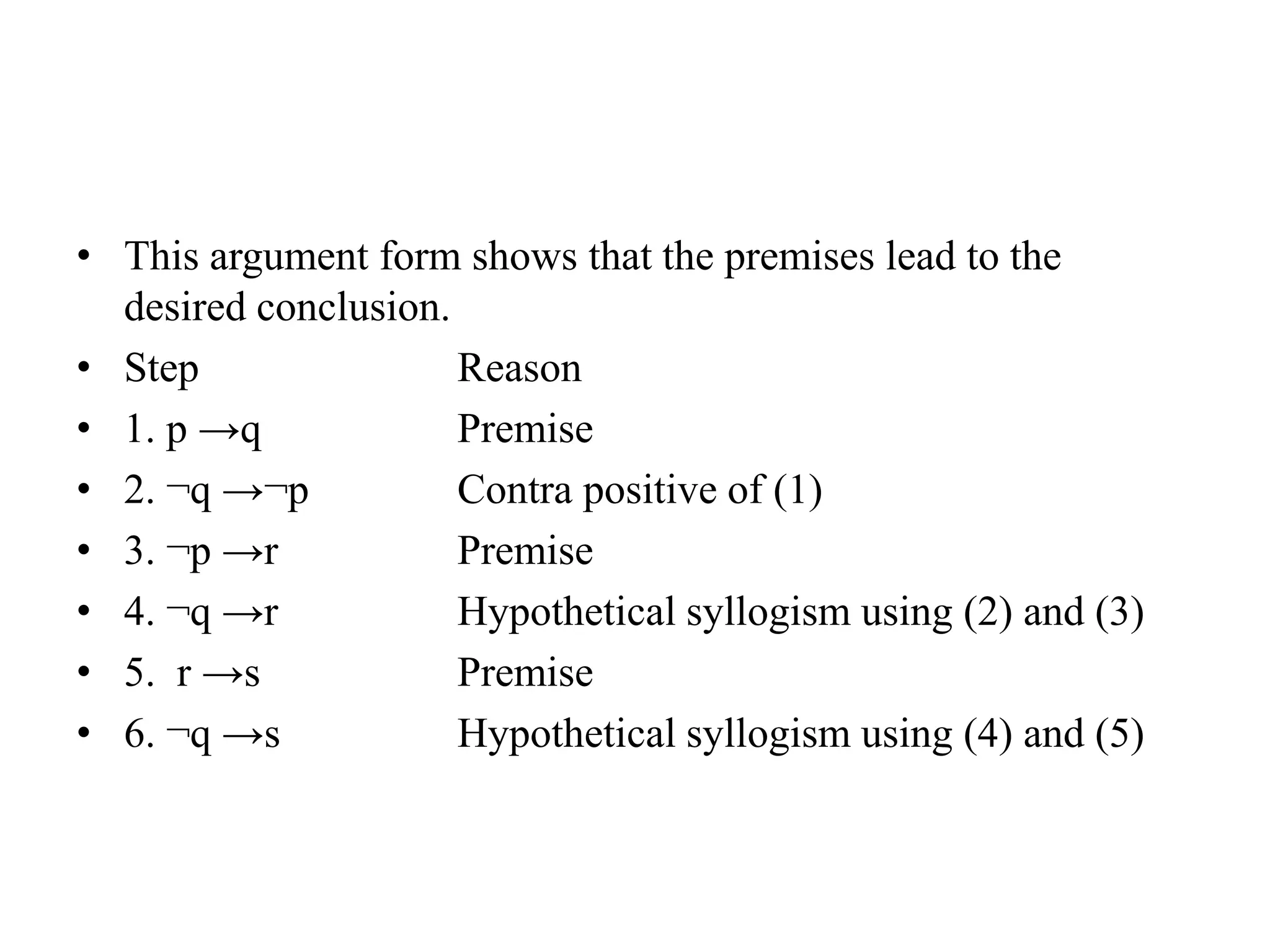
• This argument form shows that the premises lead to the 
desired conclusion. 
• Step Reason 
• 1. p →q Premise 
• 2. ¬q →¬p Contra positive of (1) 
• 3. ¬p →r Premise 
• 4. ¬q →r Hypothetical syllogism using (2) and (3) 
• 5. r →s Premise 
• 6. ¬q →s Hypothetical syllogism using (4) and (5)

17 using rules of inference to build arguments

  • 1.
    Using Rules ofInference to Build Arguments Lecturer: Amil Dar
  • 2.
    Rules of Inference • By an argument, we mean a sequence of statements that end with a conclusion. By valid, we mean that the conclusion, or final statement of the argument, must follow from the truth of the preceding statements, or premises, of the argument.
  • 3.
  • 4.
    Valid Arguments inPropositional Logic • Consider the following argument involving propositions (which, by dentition, is a sequence of propositions): “If you have a current password, then you can log onto the network.” “You have a current password.” • Therefore, “You can log onto the network.” • Before we discuss the validity of this particular argument, we will look at its form. Use p to represent “ You have a current password ” and q to represent “ You can logon to the network.” • We say this form of argument is valid because whenever all its premises (all statements in the argument other than the final one, the conclusion) are true, the conclusion must also be true.
  • 5.
    Using Rules ofInference to Build Arguments • When there are many premises, several rules of inference are often needed to show that an argument is valid.
  • 6.
    EXAMPLE 1 •Show that the premises “It is not sunny this afternoon and it is colder than yesterday,” “ We will go swimming only if it is sunny,” “If we do not go swimming, then we will take a canoe trip,” and “If we take a canoe trip, then we will be home by sunset” lead to the conclusion “We will be home by sunset.” • Solution: Let p be the proposition “It is sunny this afternoon,” q the proposition “It is colder • than yesterday,” r the proposition “We will go swimming,” s the proposition “We will take a • canoe trip,” and t the proposition “We will be home by sunset.” Then the premises become ¬p ∧ q , r → p , ¬ r → s , and s → t.
  • 7.
    Cont.. • ¬p ∧ q, r → p, ¬ r → s, and s → t and conclusion. • We construct an argument to show that our premises lead to the desired conclusion as • follows. • Step Reason • 1.¬ p ∧ q Premise • 2.¬ p Simplification using (1) • 3. r → p Premise • 4.¬ r Modus tollens using (2) and (3) • 5.¬ r → s Premises • 6. s Modus ponens using (4) and (5) • 7. s → t Premise • 8. t Modus ponens using (6) and (7)
  • 8.
    EXAMPLE 2 •Show that the premises • “If you send me an e-mail message, then I will finish writing the program,” • “If you do not send me an e-mail message, then I will go to sleep early,” and • “If I go to sleep early, then I will wake up feeling refreshed” lead to the conclusion • “If I do not finish writing the program, then I will wake up feeling refreshed.”
  • 9.
    Solution • Letp be the proposition “You send me an e-mail message, ” q the proposition “I will finish writing the program, ” r the proposition “I will go to sleep early,” and s the proposition “I will wake up feeling refreshed.” • Then the premises are p → q ,¬p →r, and r → s. • The desired conclusion is ¬q → s. • We need to give a valid argument with premises p → q, ¬p → r, and r → s and conclusion ¬q → s. • This argument form shows that the premises lead to the desired conclusion
  • 10.
    • This argumentform shows that the premises lead to the desired conclusion. • Step Reason • 1. p →q Premise • 2. ¬q →¬p Contra positive of (1) • 3. ¬p →r Premise • 4. ¬q →r Hypothetical syllogism using (2) and (3) • 5. r →s Premise • 6. ¬q →s Hypothetical syllogism using (4) and (5)