Proofreading
By: Mr.Jack
 Proofreading is the last and
ultimate step of any editing
process.
 Proofreading focuses on external
errors, such as spelling mistakes,
grammar and punctuation
errors, etc.
What is proofread?
What is proofreading for?
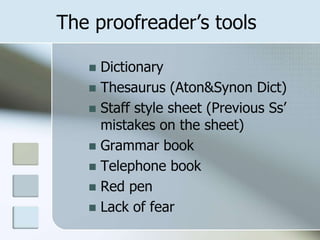
The proofreader’s tools
 Dictionary
 Thesaurus (Aton&Synon Dict)
 Staff style sheet (Previous Ss’
mistakes on the sheet)
 Grammar book
 Telephone book
 Red pen
 Lack of fear
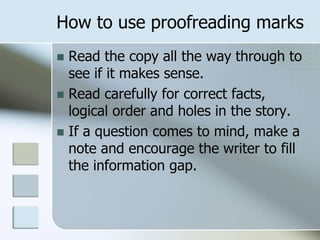
How to use proofreading marks
 Read the copy all the way through to
see if it makes sense.
 Read carefully for correct facts,
logical order and holes in the story.
 If a question comes to mind, make a
note and encourage the writer to fill
the information gap.
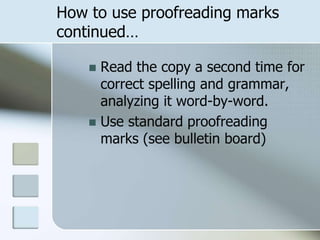
How to use proofreading marks
continued…
 Read the copy a second time for
correct spelling and grammar,
analyzing it word-by-word.
 Use standard proofreading
marks (see bulletin board)
Proofreading Tips
 double check for errors you typically make
 read out loud, read slowly, read one word
at a time to determine if it makes sense
 look for formatting and alignment errors
 read what is actually on the page and not
what you think
 proof before printing
Errors missed by
Spell/Grammar Check
 names and addresses
not in computer’s
dictionary
 homonyms that are
not misspelled but
misused (i.e.,
they’re/their/there)
 numbers only verified
by checking original
copy
 repeated words and
omitted words
 formatting errors
punctuation or
capitalization errors
 such as incorrect
paragraph indentions
or spacing between
lines and words
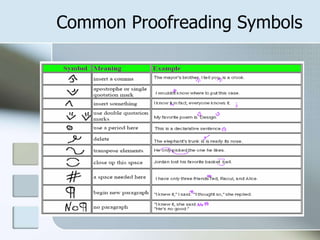
Common Proofreading Symbols
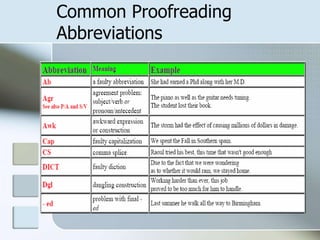
Common Proofreading
Abbreviations
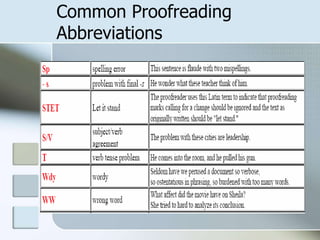
Common Proofreading
Abbreviations
Common Proofreading
Abbreviations
Additional Resources
 LR Communication
Systems, Inc—
Proofreading and
Editing Tips
Daily Writing Tips—8
Proofreading Tips
and Techniques
1. unit 5, proofreading

1. unit 5, proofreading

  • 1.
  • 2.
     Proofreading isthe last and ultimate step of any editing process.  Proofreading focuses on external errors, such as spelling mistakes, grammar and punctuation errors, etc. What is proofread?
  • 3.
  • 5.
    The proofreader’s tools Dictionary  Thesaurus (Aton&Synon Dict)  Staff style sheet (Previous Ss’ mistakes on the sheet)  Grammar book  Telephone book  Red pen  Lack of fear
  • 6.
    How to useproofreading marks  Read the copy all the way through to see if it makes sense.  Read carefully for correct facts, logical order and holes in the story.  If a question comes to mind, make a note and encourage the writer to fill the information gap.
  • 7.
    How to useproofreading marks continued…  Read the copy a second time for correct spelling and grammar, analyzing it word-by-word.  Use standard proofreading marks (see bulletin board)
  • 8.
    Proofreading Tips  doublecheck for errors you typically make  read out loud, read slowly, read one word at a time to determine if it makes sense  look for formatting and alignment errors  read what is actually on the page and not what you think  proof before printing
  • 9.
    Errors missed by Spell/GrammarCheck  names and addresses not in computer’s dictionary  homonyms that are not misspelled but misused (i.e., they’re/their/there)  numbers only verified by checking original copy  repeated words and omitted words  formatting errors punctuation or capitalization errors  such as incorrect paragraph indentions or spacing between lines and words
  • 10.
  • 11.
  • 12.
  • 13.
  • 14.
    Additional Resources  LRCommunication Systems, Inc— Proofreading and Editing Tips Daily Writing Tips—8 Proofreading Tips and Techniques