
Technical
Communication
KAMAL SUBEDI
BOSTON INTERNATIONAL COLLEGE
1
Page 2
What is Communication?
 Communication is “the transmission of information
and meaning from one individual or group to
another.”
 The crucial element in this definition is meaning.
 Communication has as its central objective the
transmission of meaning.
2
Page 3
Natures of Communication
 Communication is related to human activity
 Communication involves two or more parties
 Communication could be one-way or maybe two-way
process
 Success of communication depends on a proper
understanding of the parties involved
 Conversation in organization flows in a variety of
styles
 Communication is media or channel based
3
Page 4
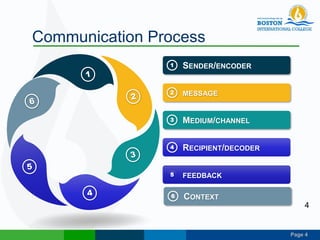
Communication Process
4
SENDER/ENCODER1
MESSAGE2
MEDIUM/CHANNEL3
RECIPIENT/DECODER4
FEEDBACK5
CONTEXT6
Page 5
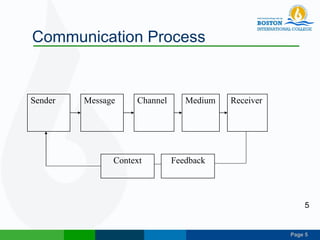
Communication Process
5
Sender Message Channel Medium Receiver
Context Feedback
Page 6
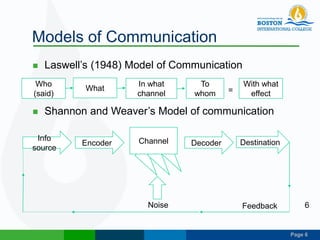
Models of Communication
 Laswell’s (1948) Model of Communication
 Shannon and Weaver’s Model of communication
6
Who
(said)
What
In what
channel
With what
effect
To
whom =
Info
source
Encoder Decoder DestinationChannel
Noise Feedback
Page 7
Contd.
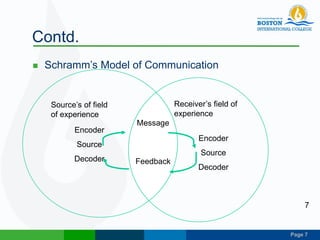
 Schramm’s Model of Communication
7
Message
Feedback
Encoder
Source
Decoder
Encoder
Source
Decoder
Source’s of field
of experience
Receiver’s field of
experience
Page 8
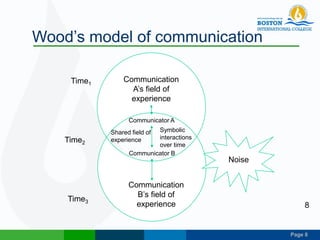
Wood’s model of communication
8
Communication
A’s field of
experience
Communication
B’s field of
experience
Time1
Time2
Time3
Noise
Communicator A
Communicator B
Shared field of
experience
Symbolic
interactions
over time
Page 9
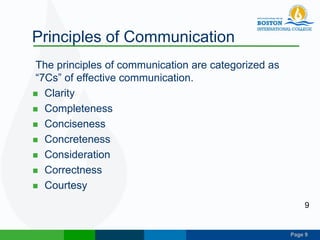
Principles of Communication
The principles of communication are categorized as
“7Cs” of effective communication.
 Clarity
 Completeness
 Conciseness
 Concreteness
 Consideration
 Correctness
 Courtesy
9
Page 10
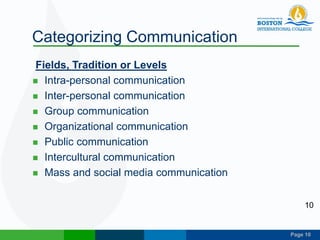
Categorizing Communication
Fields, Tradition or Levels
 Intra-personal communication
 Inter-personal communication
 Group communication
 Organizational communication
 Public communication
 Intercultural communication
 Mass and social media communication
10
Page 11
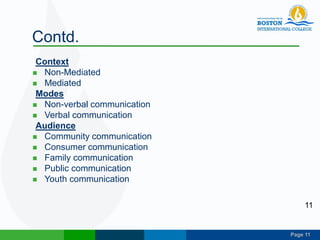
Contd.
Context
 Non-Mediated
 Mediated
Modes
 Non-verbal communication
 Verbal communication
Audience
 Community communication
 Consumer communication
 Family communication
 Public communication
 Youth communication
11
Page 12
Contd.
Specialty Areas
 Business Communication
 Development Communication
 Health Communication
 Management Communication
 Popular communication
 Professional communication
 Science communication
12
13
Thank You 

Technical communication

  • 1.
  • 2.
    Page 2 What isCommunication?  Communication is “the transmission of information and meaning from one individual or group to another.”  The crucial element in this definition is meaning.  Communication has as its central objective the transmission of meaning. 2
  • 3.
    Page 3 Natures ofCommunication  Communication is related to human activity  Communication involves two or more parties  Communication could be one-way or maybe two-way process  Success of communication depends on a proper understanding of the parties involved  Conversation in organization flows in a variety of styles  Communication is media or channel based 3
  • 4.
  • 5.
    Page 5 Communication Process 5 SenderMessage Channel Medium Receiver Context Feedback
  • 6.
    Page 6 Models ofCommunication  Laswell’s (1948) Model of Communication  Shannon and Weaver’s Model of communication 6 Who (said) What In what channel With what effect To whom = Info source Encoder Decoder DestinationChannel Noise Feedback
  • 7.
    Page 7 Contd.  Schramm’sModel of Communication 7 Message Feedback Encoder Source Decoder Encoder Source Decoder Source’s of field of experience Receiver’s field of experience
  • 8.
    Page 8 Wood’s modelof communication 8 Communication A’s field of experience Communication B’s field of experience Time1 Time2 Time3 Noise Communicator A Communicator B Shared field of experience Symbolic interactions over time
  • 9.
    Page 9 Principles ofCommunication The principles of communication are categorized as “7Cs” of effective communication.  Clarity  Completeness  Conciseness  Concreteness  Consideration  Correctness  Courtesy 9
  • 10.
    Page 10 Categorizing Communication Fields,Tradition or Levels  Intra-personal communication  Inter-personal communication  Group communication  Organizational communication  Public communication  Intercultural communication  Mass and social media communication 10
  • 11.
    Page 11 Contd. Context  Non-Mediated Mediated Modes  Non-verbal communication  Verbal communication Audience  Community communication  Consumer communication  Family communication  Public communication  Youth communication 11
  • 12.
    Page 12 Contd. Specialty Areas Business Communication  Development Communication  Health Communication  Management Communication  Popular communication  Professional communication  Science communication 12
  • 13.