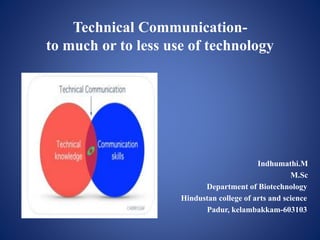
Technical Communication-
to much or to less use of technology
Indhumathi.M
M.Sc
Department of Biotechnology
Hindustan college of arts and science
Padur, kelambakkam-603103
Technical Communication Reaches a Global
Audience
• Electronically linked, our global community
shares social, political, and financial interests.
• To connect with all readers, technical documents
need to reflect global and intercultural diversity.
• Cultures differ over which behaviours seem
appropriate for social interaction, business
relationships, contract negotiation, and
communication practices.
Technical Communication Is Part of Most
Careers
• Whatever your job description, expect to be
evaluated, at least in part, on your communication
skills.
• Most professionals serve as part-time technical
communicators.
• Full-time technical communicators serve many
roles.
Main Features of Technical Communication
• Technical communication is:
• reader-centered
• accessible and efficient
• often produced by teams
• delivered in paper and digital versions
Purposes of Technical Communication
Technical communication serves three purposes
that sometimes overlap:
• to inform: Anticipate and answer your
readers’ questions
• to instruct: Enable your readers to perform
certain tasks
• to persuade: Motivate your readers
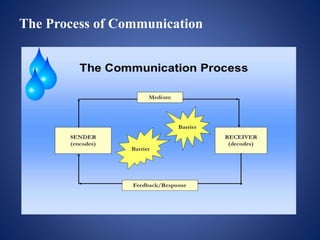
The Process of Communication
Components of technical communication
• Verbal Communication
a. oral form
b. written form
• Vocal communication
• Non-verbal communication
Forms of technical communication
Oral form:
• Face-to-face communication
• Telephone Talk
• Meetings
• Seminars
• Conferences
• Dictation
• Instructions
• Presentations
• Group discussions
• Interviews (employment/press)
• Video conferences
• Voice conferences
(Continued…)
Written forms:
• Memos
• Letters
• E-mails
• Faxes
• Notices
• Circulars
• Newsletters
• Reports
• Proposals
• Research papers
• Bulletins
• Brochures
• Manuals
• In-house journals
(Continued…)
1. Reading -Like listening and speaking, reading is also
important for effective communication. You need
effective reading skills as you may be required to
read several kinds of reading material for different
general, academic and professional purposes. It includes
general- newspaper, magazines, stories.
academic- textbook, research book, classroom notes.
professional- business reports, proposals, email messages.
(Continued…)
2. Listening- Listening skills are probably one of the most
important language skills that you need in order to be successful in
your academic and professional pursuits. And various types of
listening skills under three categories,
general- formal conversation, public speeches, social interaction.
academic- lecture, academic discussion, seminar and workshops.
professional- meeting, conferences, interviews.
(Continued…)
• Speaking- Speaking skills are also important for a person’s
professional survival and growth. A person requires effective oral
communication skills in several formal communicative situations.
• Oral communication not only makes professional interaction
possible, it develops information and understanding essential for
decision making in meetings, conferences and other similar oral
communicative skills.
• As oral communication is a tool of professional and business
interactions, one should be able to use it fluently, effectively and
confidently.
general- public speeches, small talks on local topics.
academic- viva voce, oral interaction, academic discussion.
professional- teleconferencing, videoconferencing.
(Continued…)
4. writing- The significance of writing cannot be overemphasised
because writing is so important for students of all kinds and
professionals in all fields. Both professionals and students need
excellent writing skills to survive and excel in their pursuits.
general- notes comments, general articles.
academic- examination answers, project reports, lab report.
professional- job application, resume, technical reports.
Non verbal communication
• Keep appropriate distance
• Touch only when appropriate
• Take care of your appearance
• Be aware - people may give false cues
• Maintain eye contact
• Smile genuinely
• body language
• Gusture
• Posture
Barriers of technical communication
• Noise
• Inappropriate medium
• Assumptions/Misconceptions
• Emotions
• Language differences
• Cultural differences
• Poor listening skills
• Use of jargon
• Distractions
Benefits of technical communication
•Quicker problem solving
•Better decision making
• Steady work flow
• Strong business relations
• Better professional image
To improve communication
Success for YOU…
…in the new global and divers workplace
requires
excellent communication skills!
Thank you

Technical communication

  • 1.
    Technical Communication- to muchor to less use of technology Indhumathi.M M.Sc Department of Biotechnology Hindustan college of arts and science Padur, kelambakkam-603103
  • 3.
    Technical Communication Reachesa Global Audience • Electronically linked, our global community shares social, political, and financial interests. • To connect with all readers, technical documents need to reflect global and intercultural diversity. • Cultures differ over which behaviours seem appropriate for social interaction, business relationships, contract negotiation, and communication practices.
  • 4.
    Technical Communication IsPart of Most Careers • Whatever your job description, expect to be evaluated, at least in part, on your communication skills. • Most professionals serve as part-time technical communicators. • Full-time technical communicators serve many roles.
  • 5.
    Main Features ofTechnical Communication • Technical communication is: • reader-centered • accessible and efficient • often produced by teams • delivered in paper and digital versions
  • 6.
    Purposes of TechnicalCommunication Technical communication serves three purposes that sometimes overlap: • to inform: Anticipate and answer your readers’ questions • to instruct: Enable your readers to perform certain tasks • to persuade: Motivate your readers
  • 7.
    The Process ofCommunication
  • 8.
    Components of technicalcommunication • Verbal Communication a. oral form b. written form • Vocal communication • Non-verbal communication
  • 9.
    Forms of technicalcommunication Oral form: • Face-to-face communication • Telephone Talk • Meetings • Seminars • Conferences • Dictation • Instructions • Presentations • Group discussions • Interviews (employment/press) • Video conferences • Voice conferences
  • 10.
    (Continued…) Written forms: • Memos •Letters • E-mails • Faxes • Notices • Circulars • Newsletters • Reports • Proposals • Research papers • Bulletins • Brochures • Manuals • In-house journals
  • 11.
    (Continued…) 1. Reading -Likelistening and speaking, reading is also important for effective communication. You need effective reading skills as you may be required to read several kinds of reading material for different general, academic and professional purposes. It includes general- newspaper, magazines, stories. academic- textbook, research book, classroom notes. professional- business reports, proposals, email messages.
  • 12.
    (Continued…) 2. Listening- Listeningskills are probably one of the most important language skills that you need in order to be successful in your academic and professional pursuits. And various types of listening skills under three categories, general- formal conversation, public speeches, social interaction. academic- lecture, academic discussion, seminar and workshops. professional- meeting, conferences, interviews.
  • 13.
    (Continued…) • Speaking- Speakingskills are also important for a person’s professional survival and growth. A person requires effective oral communication skills in several formal communicative situations. • Oral communication not only makes professional interaction possible, it develops information and understanding essential for decision making in meetings, conferences and other similar oral communicative skills. • As oral communication is a tool of professional and business interactions, one should be able to use it fluently, effectively and confidently. general- public speeches, small talks on local topics. academic- viva voce, oral interaction, academic discussion. professional- teleconferencing, videoconferencing.
  • 14.
    (Continued…) 4. writing- Thesignificance of writing cannot be overemphasised because writing is so important for students of all kinds and professionals in all fields. Both professionals and students need excellent writing skills to survive and excel in their pursuits. general- notes comments, general articles. academic- examination answers, project reports, lab report. professional- job application, resume, technical reports.
  • 15.
    Non verbal communication •Keep appropriate distance • Touch only when appropriate • Take care of your appearance • Be aware - people may give false cues • Maintain eye contact • Smile genuinely • body language • Gusture • Posture
  • 16.
    Barriers of technicalcommunication • Noise • Inappropriate medium • Assumptions/Misconceptions • Emotions • Language differences • Cultural differences • Poor listening skills • Use of jargon • Distractions
  • 17.
    Benefits of technicalcommunication •Quicker problem solving •Better decision making • Steady work flow • Strong business relations • Better professional image
  • 18.
  • 19.
    Success for YOU… …inthe new global and divers workplace requires excellent communication skills!
  • 21.