English for Technical
Communication
Master the language of industry. In engineering, brilliant ideas
are useless without clear, precise, professional communication.
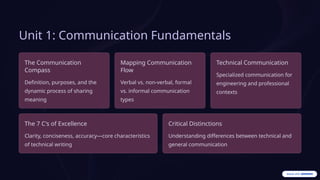
Unit 1: Communication Fundamentals
The Communication
Compass
Definition, purposes, and the
dynamic process of sharing
meaning
Mapping Communication
Flow
Verbal vs. non-verbal, formal
vs. informal communication
types
Technical Communication
Specialized communication for
engineering and professional
contexts
The 7 C's of Excellence
Clarity, conciseness, accuracy—core characteristics
of technical writing
Critical Distinctions
Understanding differences between technical and
general communication
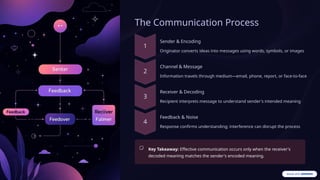
The Communication Process
Sender & Encoding
Originator converts ideas into messages using words, symbols, or images
Channel & Message
Information travels through medium—email, phone, report, or face-to-face
Receiver & Decoding
Recipient interprets message to understand sender's intended meaning
Feedback & Noise
Response confirms understanding; interference can disrupt the process
Key Takeaway: Effective communication occurs only when the receiver's
decoded meaning matches the sender's encoded meaning.
The 7 C's of Technical Excellence
1
Clarity
Unmistakable meaning using simple, precise language
2
Conciseness
Direct communication without unnecessary words
3
Completeness
All necessary information for audience's purpose
4
Correctness
Free from grammar, fact, and calculation errors
1
Coherence
Logically connected ideas with smooth transitions
2
Concreteness
Specific facts and figures, not vague statements
3
Consideration
Focused on receiver's needs and background
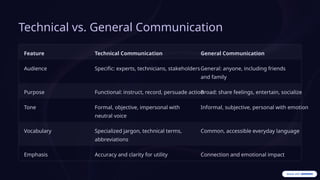
Technical vs. General Communication
Feature Technical Communication General Communication
Audience Specific: experts, technicians, stakeholdersGeneral: anyone, including friends
and family
Purpose Functional: instruct, record, persuade action
Broad: share feelings, entertain, socialize
Tone Formal, objective, impersonal with
neutral voice
Informal, subjective, personal with emotion
Vocabulary Specialized jargon, technical terms,
abbreviations
Common, accessible everyday language
Emphasis Accuracy and clarity for utility Connection and emotional impact
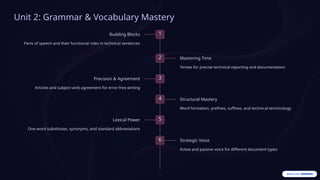
Unit 2: Grammar & Vocabulary Mastery
1
Building Blocks
Parts of speech and their functional roles in technical sentences
2 Mastering Time
Tenses for precise technical reporting and documentation
3
Precision & Agreement
Articles and subject-verb agreement for error-free writing
4 Structural Mastery
Word formation, prefixes, suffixes, and technical terminology
5
Lexical Power
One-word substitutes, synonyms, and standard abbreviations
6 Strategic Voice
Active and passive voice for different document types
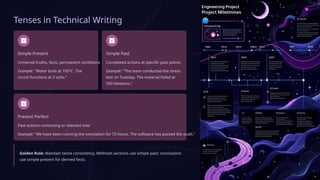
Tenses in Technical Writing
Simple Present
Universal truths, facts, permanent conditions
Example: "Water boils at 100°C. The
circuit functions at 5 volts."
Simple Past
Completed actions at specific past points
Example: "The team conducted the stress
test on Tuesday. The material failed at
500 Newtons."
Present Perfect
Past actions continuing or relevant now
Example: "We have been running the simulation for 72 hours. The software has passed the audit."
Golden Rule: Maintain tense consistency. Methods sections use simple past; conclusions
use simple present for derived facts.
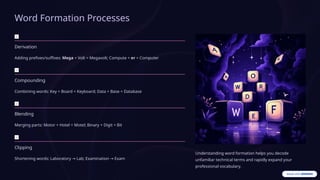
Word Formation Processes
Derivation
Adding prefixes/suffixes: Mega + Volt = Megavolt; Compute + er = Computer
Compounding
Combining words: Key + Board = Keyboard; Data + Base = Database
Blending
Merging parts: Motor + Hotel = Motel; Binary + Digit = Bit
Clipping
Shortening words: Laboratory Lab; Examination Exam
→ →
Understanding word formation helps you decode
unfamiliar technical terms and rapidly expand your
professional vocabulary.
Active vs. Passive Voice Strategy
Active Voice: Clarity & Action
Structure: Subject Verb Object
→ →
Example: "The engineer calibrated the sensor."
Use for: Clear attribution, instructions, procedures, conciseness
Best in: User manuals, project reports, instructions
Passive Voice: Focus on Result
Structure: Object be + past participle by Subject
→ →
Example: "The sensor was calibrated by the engineer."
Use for: Emphasizing action/result, unknown actor, objective tone
Best in: Research papers, formal reports, scientific documentation
Your Path to Communication
Excellence
5
Lectures
Comprehensive
coverage of Unit 1
communication
fundamentals
6
Grammar Topics
Essential grammar and
vocabulary for
professional writing
7
C's of Excellence
Core characteristics
defining technical
communication quality
Master these principles to transform from student to professional
communicator. Your ability to convey complex technical information clearly
and precisely will define your engineering career success.
Remember: The most brilliant engineering idea is useless if you
can't communicate it effectively. Excellence in technical
communication is non-negotiable.


English-for-Technical-Communication.pptx

  • 1.
    English for Technical Communication Masterthe language of industry. In engineering, brilliant ideas are useless without clear, precise, professional communication.
  • 2.
    Unit 1: CommunicationFundamentals The Communication Compass Definition, purposes, and the dynamic process of sharing meaning Mapping Communication Flow Verbal vs. non-verbal, formal vs. informal communication types Technical Communication Specialized communication for engineering and professional contexts The 7 C's of Excellence Clarity, conciseness, accuracy—core characteristics of technical writing Critical Distinctions Understanding differences between technical and general communication
  • 3.
    The Communication Process Sender& Encoding Originator converts ideas into messages using words, symbols, or images Channel & Message Information travels through medium—email, phone, report, or face-to-face Receiver & Decoding Recipient interprets message to understand sender's intended meaning Feedback & Noise Response confirms understanding; interference can disrupt the process Key Takeaway: Effective communication occurs only when the receiver's decoded meaning matches the sender's encoded meaning.
  • 4.
    The 7 C'sof Technical Excellence 1 Clarity Unmistakable meaning using simple, precise language 2 Conciseness Direct communication without unnecessary words 3 Completeness All necessary information for audience's purpose 4 Correctness Free from grammar, fact, and calculation errors 1 Coherence Logically connected ideas with smooth transitions 2 Concreteness Specific facts and figures, not vague statements 3 Consideration Focused on receiver's needs and background
  • 5.
    Technical vs. GeneralCommunication Feature Technical Communication General Communication Audience Specific: experts, technicians, stakeholdersGeneral: anyone, including friends and family Purpose Functional: instruct, record, persuade action Broad: share feelings, entertain, socialize Tone Formal, objective, impersonal with neutral voice Informal, subjective, personal with emotion Vocabulary Specialized jargon, technical terms, abbreviations Common, accessible everyday language Emphasis Accuracy and clarity for utility Connection and emotional impact
  • 6.
    Unit 2: Grammar& Vocabulary Mastery 1 Building Blocks Parts of speech and their functional roles in technical sentences 2 Mastering Time Tenses for precise technical reporting and documentation 3 Precision & Agreement Articles and subject-verb agreement for error-free writing 4 Structural Mastery Word formation, prefixes, suffixes, and technical terminology 5 Lexical Power One-word substitutes, synonyms, and standard abbreviations 6 Strategic Voice Active and passive voice for different document types
  • 7.
    Tenses in TechnicalWriting Simple Present Universal truths, facts, permanent conditions Example: "Water boils at 100°C. The circuit functions at 5 volts." Simple Past Completed actions at specific past points Example: "The team conducted the stress test on Tuesday. The material failed at 500 Newtons." Present Perfect Past actions continuing or relevant now Example: "We have been running the simulation for 72 hours. The software has passed the audit." Golden Rule: Maintain tense consistency. Methods sections use simple past; conclusions use simple present for derived facts.
  • 8.
    Word Formation Processes Derivation Addingprefixes/suffixes: Mega + Volt = Megavolt; Compute + er = Computer Compounding Combining words: Key + Board = Keyboard; Data + Base = Database Blending Merging parts: Motor + Hotel = Motel; Binary + Digit = Bit Clipping Shortening words: Laboratory Lab; Examination Exam → → Understanding word formation helps you decode unfamiliar technical terms and rapidly expand your professional vocabulary.
  • 9.
    Active vs. PassiveVoice Strategy Active Voice: Clarity & Action Structure: Subject Verb Object → → Example: "The engineer calibrated the sensor." Use for: Clear attribution, instructions, procedures, conciseness Best in: User manuals, project reports, instructions Passive Voice: Focus on Result Structure: Object be + past participle by Subject → → Example: "The sensor was calibrated by the engineer." Use for: Emphasizing action/result, unknown actor, objective tone Best in: Research papers, formal reports, scientific documentation
  • 10.
    Your Path toCommunication Excellence 5 Lectures Comprehensive coverage of Unit 1 communication fundamentals 6 Grammar Topics Essential grammar and vocabulary for professional writing 7 C's of Excellence Core characteristics defining technical communication quality Master these principles to transform from student to professional communicator. Your ability to convey complex technical information clearly and precisely will define your engineering career success. Remember: The most brilliant engineering idea is useless if you can't communicate it effectively. Excellence in technical communication is non-negotiable.