Year & Sem – 2nd
Year, 3rd
Sem
Subject – Technical Communication
Unit – 03
Presented by – SAROJ PARIHAR (English & Humanities)
J A I P U R E N G I N E E R I N G C O L L E G E
A N D R E S E A R C H C E N T R E
VISION AND MISSION OF INSTITUTE
To become a renowned centre of outcome
based learning, and work towards academic,
professional, cultural and social enrichment of
the lives of individuals and communities.
VISION AND MISSION OF DEPARTMENT
 Focus on evaluation of learning outcomes and motivate students to
inculcate
 research aptitude by project based learning.
 Identify, based on informed perception of Indian, regional and global
needs, the
 areas of focus and provide platform to gain knowledge and solutions.
 Offer opportunities for interaction between academia and industry.
 Develop human potential to its fullest extent so that intellectually
capable and
 imaginatively gifted leaders may emerge.
Course Objective
CO1: able to express themselves better in technical writing by
understanding the concept, style and methodology used in Technical
communication.
CO2: able to pursue higher studies by working on all aspects of English
Language and also develop a better understanding of process and
design of technical texts.
CO3: able to get an in depth knowledge of technical communication
used in professional life by getting to know all the forms and aspects of
Technical Communication.
UNIT -3 Technical Writing, Grammar
and Editing-
Technical writing process, forms of
technical discourse, Writing, drafts and
revising
6
What is Technical writing? „
Writing that focuses on instrumental discourse
(discourse that aims to do something) ‰
e.g. computer manuals (print and help screens) ‰
Assembly instructions for toys, appliances, games
Purpose of all these documents: To inform To be
„ „
“instruments” or tools for people to use to get
things done. The documents you will write in this
course all share this sense of purpose.
7
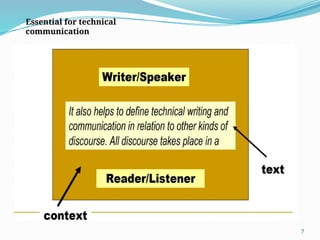
Essential for technical
communication
8
08/06/2024 9
 Next Factor is Audience
 The audience are the important factor that is to
be considered at the top most in technical
writing , you are supposed to write a highly
technical subject but in such a way that a
beginner can understand it.
 Following things have to be noted before
designing :-
 Accumulating information:-
a) Style of writing
b) Type of document.
c) Type of Audience
d) Resources to be used
e) Subject matter that is to be written.
08/06/2024 10
Designing Document
Sorting of information.
Preparing a draft of the outline.
Sequencing the information as per importance.
Arranging as per format.
Essential details and examples with supporting
documents.
Provides information about the type of
document.
08/06/2024 11
 Creating Document
a). Development of the design
b). Writing style should be simple
c).Avoid jargons
d).User friendly language
 Reviewing document
a)Self review
b).Client review
c).Technical review
Publishing Document
a). Soft copy /CD /DVD
b). Print or bind
12
 There are mainly two types of discourse Written
and Oral
 The difference between speech and writing is
referred to as channel or medium as both of the
discourses needs some processes .
 Difference between the two is spoken has to
understood at the spot whereas written can be
referred several times. Spoken is fast as
compared to written.
13
Difference between Spoken and Written discourse.
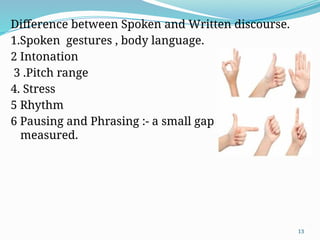
1.Spoken gestures , body language.
2 Intonation
3 .Pitch range
4. Stress
5 Rhythm
6 Pausing and Phrasing :- a small gap difficult to be
measured.
14
 INTERRELATION BETWEEN THE TWO
 Oral informal letters, poetry .
 Written Focus on writer/speaker: expressive ‰
Journals, diaries, manifestoes „
 Focus on reader/listener: persuasive ‰
Advertising, editorials in newspapers „
 Focus on reality: technical & scientific
 Textbooks, reports, manuals Focus on text:
‰ „
literary Poetry, plays, fiction, non-fiction
‰
15
16
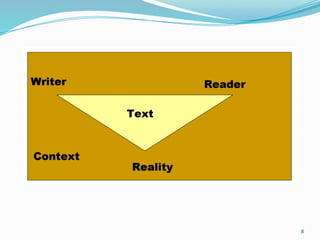
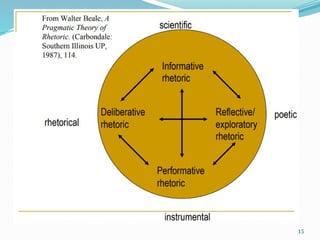
The Diagram highlights the dual aims of discourse
 A piece of writing can both persuade and
„
inform (e.g. newspaper report on school lunches)
„
 Any piece of writing has at least two aims E.g
„
Your resume Informative and persuasive
‰
Audience and Purpose „
 Understand your audience for a piece of writing „
Understand your purpose for a piece of writing „
The better you understand your audience and
purpose, the better your document you will
accomplish your goals .
17
 Revising, Editing, and Proofreading of Drafts
 Revision involves analyzing the global level and paragraph
level organization of the document, and making changes to
your draft on a global, paragraph, and sentence level to
ensure that:
 The document addresses its purpose
 The document supports any claims its makes (main claims
and secondary claims)
 The structure of the document is logical and supports the
purpose and main claims
 Editing involves looking at each sentence carefully, and
making sure that it’s well designed and serves its purpose.
 Proofreading involves checking for grammatical and
punctuation errors, spelling mistakes, etc. Proofing is the
final stage of the writing process
i
08/06/2024 18
 What is Technical writing ?
 It is art of presenting technical information to the audience in such away that they can
understand and use the information. Today technical writing encompasses all
documentation of complex technical processes. It includes reports, executive summary
statements, briefs. Any time technical information is conveyed in writing at work, it is, by
definition, technical writing.
 This can include high-tech manufacturing, engineering, biotech, energy, aerospace, finance,
IT, and global supply chain.
 The format is no longer bound to lengthy user manuals. Technical information must be
distilled and presented unambiguously. This can come in the form of technical reports,
emails, policy, briefs, and press releases.
In easy words it follows through formal channels , formal communication can be in
different forms like vertical communication, horizontal, upward and others.
Technical writing process
08/06/2024 19
 There are various forms of technical
communication the very first we will discuss is
Business letter
 A business letter is a document which is written
by authorised person of an organisation , it is a
document which is not only within the premises
of the organisation but also outside the
organisation , this can be sent in other
organisations, credit departments,
suppliers ,customers and employees etc .
Forms of communication
Business letter
08/06/2024 20
 Helps in maintaining business relationship.
 Important media for complex information.
 Valuable source of information for future.
 It helps to serve a large number of people.
 It is economic as compared to other means of
communication.
Importance of the Business letter
08/06/2024 21
 To create and sustain new business relations ,
different organisations will have different purpose
of writing it .
 To send greetings .
 To inform about new product or offers and
services.
 To request dues and collect dues . (Airtel ,
Vodafone bill warning, insurance policies ).
 Reminders for different products , services
available dates .
 To apply for a job and internship. (Job application)
Functions of business letter.
08/06/2024 22
 Heading
 Date
 Subject
 Inside address
 Salutation
 Message
 Complimentary message
 Signature
Layout of a business letter
08/06/2024 23
 Email is the most common form of business
communication so it is important to make them clear,
concise and actionable.
 Important contents :-
 Subject Line Subject line is the first thing a recipient
reads. Subject should be short and to the point and it
should highlight the main message of the email. The
ideal subject gives the reader all they need to know or
informs them they need to make a decision.
 Greeting :- Begin with a greeting Always open your

email with a greeting. The greeting should be concise
and formal. You may or may not choose to address a
person specifically by name, depending on the context
of the message. Some examples of greetings are:
Email writing
08/06/2024 24
  Good afternoon
  Hi Manish
  Dear Dr.Ranjan
 If you don’t know the name of the person you are
writing to, use: “To whom it may concern” or “Dear
Sir/Madam”. Thank the recipient If you are replying

to a client’s inquiry, you should begin with a line of
thanks. For example, if someone has a question about
your company, you can say, “Thank you for contacting
ABC Company”. If someone has replied to one of your
emails, be sure to say, “Thank you for your prompt
reply” or “Thanks for getting back to me”. Thanking the
reader puts him or her at ease, and it will make you
appear more polite
08/06/2024 25
  State your purpose
 If you are starting the email communication, it is not
possible to include a line of thanks then begin by
stating your purpose.
 For example, “I am writing to enquire about …” or “I
am writing in reference to …” Make your purpose
clear early on in the email, and then move into the
main text of your email. Remember, people want to
read emails quickly, so keep your sentences short and
clear. You’ll also need to pay careful attention to
grammar, spelling and punctuation so that you present
a professional image of yourself and your company.
  Attachments Include URLs or attachments if that
will help the recipient proce
08/06/2024 26
Never force the recipient to hunt for a URL or
attachment in another email.
  End with a closing
 The last step is to include an appropriate closing
with your name.
 Some potential closings:
  I look forward to your response,
  I hope to hear from you soon,
  Thank you for your time,
  Thank you for your attention to this matter,
08/06/2024 27
 Sign your name
 It is appropriate to write your name and title in a
work at the end of an email.
 Choose the most suitable phrase before typing
your name.
  Yours sincerely, (when you know the name of
the recipient, (Formal)
  Best regards, or Kind regards, (Formal, Most
common) .
08/06/2024 28
 EXAMPLE :-
 As a former student, write an email to your professor, Mr. Sinha,
thanking him for teaching and guidance that contributed to your
overall development. Sign the email as Anant.
 Dear Mr. Sinha,
 I am very happy to tell you that I got successful in the recently
conducted campus placement drive at my college. I am placed with
TCS. I am extremely grateful for your help regarding my preparation.
More over your advice regarding personality development helped me
a lot. In addition to that, your style of teaching inculcates not only
those skills related to professional success but also for developing
values which I believe help for shaping my career. Once again I would
like to thank for your sincere and professional help.
 With Regards
 Name ,designation
 Sign and date
08/06/2024 29
Minutes of meeting
 What are meeting minutes for?
 Meeting minutes are the notes that capture what happened at a
meeting! Different than a meeting agenda, it records the decisions
made and actions requested by the group. Despite the team, they are
not a minute-by-minute record but include the key details that the
team will want to know. It's important in meeting minutes to capture
information such as:
 decisions made
 next steps
 action items and who is responsible
 Minutes are the record of who was there and what happened. They
are an important source of information for people who were unable
to attend or looking back to reflect on what happened. They're also an
incredibly effective tool to notify or remind people of tasks assigned to
them or timelines to keep everyone on track.
08/06/2024 30
 What should go into meeting minutes?
 Here are some of the details that you should into
the meeting minutes.
 Date and time of meeting
 Names of the participants
 Agenda items and topics discussed
 Action items
08/06/2024 31
 Informal team meeting minutes template
 Date: Today's date
 Attendees
 List of attendees
 Agenda
 Item 1 including key discussions, decisions made, next
steps
 Item 2
 Item 3
 Next steps
 List goes here in format: action item, responsible person,
date
 Example: Brian to follow up to this group with a list of
target companies by
32
Bibliography
 https://ecp.engineering.utoronto.ca/resources/onl
ine-handbook/the-writing-process/revising-editin
g-and-proofreading/
 https://sites.uai need to copy these slides in new
ppt lberta.ca/~graves1/engineering.pdf

design and algorithm analysis unit -3.pptx

  • 1.
    Year & Sem– 2nd Year, 3rd Sem Subject – Technical Communication Unit – 03 Presented by – SAROJ PARIHAR (English & Humanities) J A I P U R E N G I N E E R I N G C O L L E G E A N D R E S E A R C H C E N T R E
  • 2.
    VISION AND MISSIONOF INSTITUTE To become a renowned centre of outcome based learning, and work towards academic, professional, cultural and social enrichment of the lives of individuals and communities.
  • 3.
    VISION AND MISSIONOF DEPARTMENT  Focus on evaluation of learning outcomes and motivate students to inculcate  research aptitude by project based learning.  Identify, based on informed perception of Indian, regional and global needs, the  areas of focus and provide platform to gain knowledge and solutions.  Offer opportunities for interaction between academia and industry.  Develop human potential to its fullest extent so that intellectually capable and  imaginatively gifted leaders may emerge.
  • 4.
    Course Objective CO1: ableto express themselves better in technical writing by understanding the concept, style and methodology used in Technical communication. CO2: able to pursue higher studies by working on all aspects of English Language and also develop a better understanding of process and design of technical texts. CO3: able to get an in depth knowledge of technical communication used in professional life by getting to know all the forms and aspects of Technical Communication.
  • 5.
    UNIT -3 TechnicalWriting, Grammar and Editing- Technical writing process, forms of technical discourse, Writing, drafts and revising
  • 6.
    6 What is Technicalwriting? „ Writing that focuses on instrumental discourse (discourse that aims to do something) ‰ e.g. computer manuals (print and help screens) ‰ Assembly instructions for toys, appliances, games Purpose of all these documents: To inform To be „ „ “instruments” or tools for people to use to get things done. The documents you will write in this course all share this sense of purpose.
  • 7.
  • 8.
  • 9.
    08/06/2024 9  NextFactor is Audience  The audience are the important factor that is to be considered at the top most in technical writing , you are supposed to write a highly technical subject but in such a way that a beginner can understand it.  Following things have to be noted before designing :-  Accumulating information:- a) Style of writing b) Type of document. c) Type of Audience d) Resources to be used e) Subject matter that is to be written.
  • 10.
    08/06/2024 10 Designing Document Sortingof information. Preparing a draft of the outline. Sequencing the information as per importance. Arranging as per format. Essential details and examples with supporting documents. Provides information about the type of document.
  • 11.
    08/06/2024 11  CreatingDocument a). Development of the design b). Writing style should be simple c).Avoid jargons d).User friendly language  Reviewing document a)Self review b).Client review c).Technical review Publishing Document a). Soft copy /CD /DVD b). Print or bind
  • 12.
    12  There aremainly two types of discourse Written and Oral  The difference between speech and writing is referred to as channel or medium as both of the discourses needs some processes .  Difference between the two is spoken has to understood at the spot whereas written can be referred several times. Spoken is fast as compared to written.
  • 13.
    13 Difference between Spokenand Written discourse. 1.Spoken gestures , body language. 2 Intonation 3 .Pitch range 4. Stress 5 Rhythm 6 Pausing and Phrasing :- a small gap difficult to be measured.
  • 14.
    14  INTERRELATION BETWEENTHE TWO  Oral informal letters, poetry .  Written Focus on writer/speaker: expressive ‰ Journals, diaries, manifestoes „  Focus on reader/listener: persuasive ‰ Advertising, editorials in newspapers „  Focus on reality: technical & scientific  Textbooks, reports, manuals Focus on text: ‰ „ literary Poetry, plays, fiction, non-fiction ‰
  • 15.
  • 16.
    16 The Diagram highlightsthe dual aims of discourse  A piece of writing can both persuade and „ inform (e.g. newspaper report on school lunches) „  Any piece of writing has at least two aims E.g „ Your resume Informative and persuasive ‰ Audience and Purpose „  Understand your audience for a piece of writing „ Understand your purpose for a piece of writing „ The better you understand your audience and purpose, the better your document you will accomplish your goals .
  • 17.
    17  Revising, Editing,and Proofreading of Drafts  Revision involves analyzing the global level and paragraph level organization of the document, and making changes to your draft on a global, paragraph, and sentence level to ensure that:  The document addresses its purpose  The document supports any claims its makes (main claims and secondary claims)  The structure of the document is logical and supports the purpose and main claims  Editing involves looking at each sentence carefully, and making sure that it’s well designed and serves its purpose.  Proofreading involves checking for grammatical and punctuation errors, spelling mistakes, etc. Proofing is the final stage of the writing process i
  • 18.
    08/06/2024 18  Whatis Technical writing ?  It is art of presenting technical information to the audience in such away that they can understand and use the information. Today technical writing encompasses all documentation of complex technical processes. It includes reports, executive summary statements, briefs. Any time technical information is conveyed in writing at work, it is, by definition, technical writing.  This can include high-tech manufacturing, engineering, biotech, energy, aerospace, finance, IT, and global supply chain.  The format is no longer bound to lengthy user manuals. Technical information must be distilled and presented unambiguously. This can come in the form of technical reports, emails, policy, briefs, and press releases. In easy words it follows through formal channels , formal communication can be in different forms like vertical communication, horizontal, upward and others. Technical writing process
  • 19.
    08/06/2024 19  Thereare various forms of technical communication the very first we will discuss is Business letter  A business letter is a document which is written by authorised person of an organisation , it is a document which is not only within the premises of the organisation but also outside the organisation , this can be sent in other organisations, credit departments, suppliers ,customers and employees etc . Forms of communication Business letter
  • 20.
    08/06/2024 20  Helpsin maintaining business relationship.  Important media for complex information.  Valuable source of information for future.  It helps to serve a large number of people.  It is economic as compared to other means of communication. Importance of the Business letter
  • 21.
    08/06/2024 21  Tocreate and sustain new business relations , different organisations will have different purpose of writing it .  To send greetings .  To inform about new product or offers and services.  To request dues and collect dues . (Airtel , Vodafone bill warning, insurance policies ).  Reminders for different products , services available dates .  To apply for a job and internship. (Job application) Functions of business letter.
  • 22.
    08/06/2024 22  Heading Date  Subject  Inside address  Salutation  Message  Complimentary message  Signature Layout of a business letter
  • 23.
    08/06/2024 23  Emailis the most common form of business communication so it is important to make them clear, concise and actionable.  Important contents :-  Subject Line Subject line is the first thing a recipient reads. Subject should be short and to the point and it should highlight the main message of the email. The ideal subject gives the reader all they need to know or informs them they need to make a decision.  Greeting :- Begin with a greeting Always open your  email with a greeting. The greeting should be concise and formal. You may or may not choose to address a person specifically by name, depending on the context of the message. Some examples of greetings are: Email writing
  • 24.
    08/06/2024 24  Good afternoon   Hi Manish   Dear Dr.Ranjan  If you don’t know the name of the person you are writing to, use: “To whom it may concern” or “Dear Sir/Madam”. Thank the recipient If you are replying  to a client’s inquiry, you should begin with a line of thanks. For example, if someone has a question about your company, you can say, “Thank you for contacting ABC Company”. If someone has replied to one of your emails, be sure to say, “Thank you for your prompt reply” or “Thanks for getting back to me”. Thanking the reader puts him or her at ease, and it will make you appear more polite
  • 25.
    08/06/2024 25  State your purpose  If you are starting the email communication, it is not possible to include a line of thanks then begin by stating your purpose.  For example, “I am writing to enquire about …” or “I am writing in reference to …” Make your purpose clear early on in the email, and then move into the main text of your email. Remember, people want to read emails quickly, so keep your sentences short and clear. You’ll also need to pay careful attention to grammar, spelling and punctuation so that you present a professional image of yourself and your company.   Attachments Include URLs or attachments if that will help the recipient proce
  • 26.
    08/06/2024 26 Never forcethe recipient to hunt for a URL or attachment in another email.   End with a closing  The last step is to include an appropriate closing with your name.  Some potential closings:   I look forward to your response,   I hope to hear from you soon,   Thank you for your time,   Thank you for your attention to this matter,
  • 27.
    08/06/2024 27  Signyour name  It is appropriate to write your name and title in a work at the end of an email.  Choose the most suitable phrase before typing your name.   Yours sincerely, (when you know the name of the recipient, (Formal)   Best regards, or Kind regards, (Formal, Most common) .
  • 28.
    08/06/2024 28  EXAMPLE:-  As a former student, write an email to your professor, Mr. Sinha, thanking him for teaching and guidance that contributed to your overall development. Sign the email as Anant.  Dear Mr. Sinha,  I am very happy to tell you that I got successful in the recently conducted campus placement drive at my college. I am placed with TCS. I am extremely grateful for your help regarding my preparation. More over your advice regarding personality development helped me a lot. In addition to that, your style of teaching inculcates not only those skills related to professional success but also for developing values which I believe help for shaping my career. Once again I would like to thank for your sincere and professional help.  With Regards  Name ,designation  Sign and date
  • 29.
    08/06/2024 29 Minutes ofmeeting  What are meeting minutes for?  Meeting minutes are the notes that capture what happened at a meeting! Different than a meeting agenda, it records the decisions made and actions requested by the group. Despite the team, they are not a minute-by-minute record but include the key details that the team will want to know. It's important in meeting minutes to capture information such as:  decisions made  next steps  action items and who is responsible  Minutes are the record of who was there and what happened. They are an important source of information for people who were unable to attend or looking back to reflect on what happened. They're also an incredibly effective tool to notify or remind people of tasks assigned to them or timelines to keep everyone on track.
  • 30.
    08/06/2024 30  Whatshould go into meeting minutes?  Here are some of the details that you should into the meeting minutes.  Date and time of meeting  Names of the participants  Agenda items and topics discussed  Action items
  • 31.
    08/06/2024 31  Informalteam meeting minutes template  Date: Today's date  Attendees  List of attendees  Agenda  Item 1 including key discussions, decisions made, next steps  Item 2  Item 3  Next steps  List goes here in format: action item, responsible person, date  Example: Brian to follow up to this group with a list of target companies by
  • 32.