Communication skills
for engineering project teams


                     Steve Dyson
                 www.sdc-language.com
Steve Dyson

     Technical communicator
     and translator
     to French high-technology companies:
         space (CNES, Alcatel, etc.)
         satellite-based imagery and remote sensing (Spot
          Image, CNES, Istar, etc.)
         naval defence (DCN, Thales, Armaris, etc.).


2
 Consultant on major technical documentation
      and translation projects for:
         French space agency CNES
         French naval prime contractor DCN.


3
Outline

    1. Communication in engineering projects
          Communications-critical phases
    2. Technical communication: Basic concepts
          Sender/receiver model
          Audience-centred communication
          Tips (writing, PowerPoint, etc.)
    2. Communication failures + responses
    3. Localization & catalogues

4
Communication in
engineering projects
Communications challenges faced
    by engineering teams

    Two main types of comms challenges:
         Presentations to team members and others with
          engineering backgrounds.
         Presentations to non-engineers.
    Engineer/presenter typically aims to:
         "Sell" the project or key concepts.
         Provide engineering input for high-level
          presentations by senior project managers
          to clients, investors, authorities, etc.

6
First critical steps

    • Assess the importance of each presentation or
        writing task
    •   Tailor response to the challenge:
        –   The more critical the task,
            the more effective the document or presentation
            should be,
            and the bigger the communication effort.
        A major effort will involve applying the
        lessons learned today and more …

7
Technical communication:
     Basic concepts
Technical communication:

    Basic concepts:
     Sender/receiver model
     Audience-centred communication


9
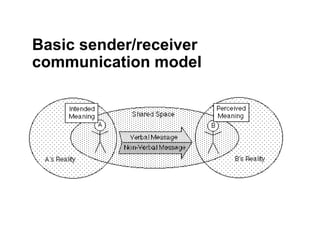
Basic sender/receiver
communication model
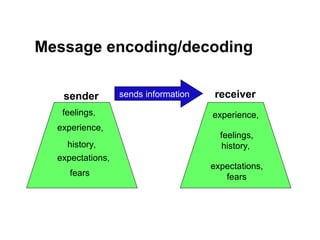
Message encoding/decoding

   sender         sends information    receiver
   feelings,                          experience,
  experience,
                                        feelings,
    history,                             history,
  expectations,
                                      expectations,
     fears                               fears
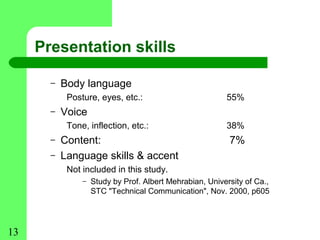
Presentation skills

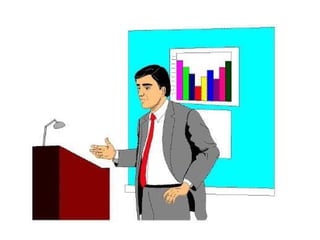
       –   Body language
            Posture, eyes, etc.:                          55%
       –   Voice
            Tone, inflection, etc.:                       38%
       –   Content:                                        7%
       –   Language skills & accent
            Not included in this study.
                –   Study by Prof. Albert Mehrabian, University of Ca.,
                    STC "Technical Communication", Nov. 2000, p605


13
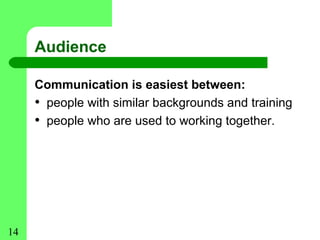
Audience

     Communication is easiest between:
     • people with similar backgrounds and training
     • people who are used to working together.


14
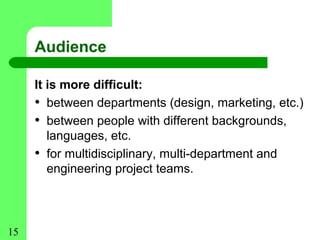
Audience

     It is more difficult:
     • between departments (design, marketing, etc.)
     • between people with different backgrounds,
        languages, etc.
     • for multidisciplinary, multi-department and
        engineering project teams.


15
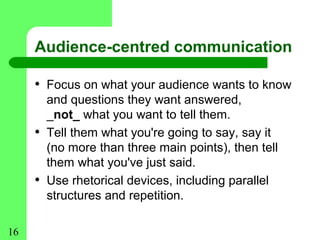
Audience-centred communication

     • Focus on what your audience wants to know
         and questions they want answered,
         _not_ what you want to tell them.
     •   Tell them what you're going to say, say it
         (no more than three main points), then tell
         them what you've just said.
     •   Use rhetorical devices, including parallel
         structures and repetition.

16
Reader-centred writing

     • Focus on what readers want to know
         and questions they want answered,
         _not_ what you want to tell them.
     •   Provide navigation devices.
     •   Consider "Information Mapping":
         –   courses now available in Portugal.


17
Focus on:
       –   Readers’ information needs
       –   Readers’ technical knowledge
       –   Readers’ language skills
       –   Readers’ attitudes
       –   The time they are likely to spend reading your
           document.


18
Unlearning …

     Unlearning … things you thought you knew
       and others you learnt at school/university.
     Reader-centred writing is radically different from:
     • explaining to teachers, who already know
     • writing at least X pages
     • showing that you know how to use
       sophisticated language
     • avoiding (at all cost) repetition of words.
19
Answer readers’ likely questions

     • Start by playing devil’s advocate:
       –   Why should I read this?
       –   Where does this information come from?
       –   Which are the most important parts?
       –   What am I expected to do next?
       –   What does the competition have to say?
     • What details or facts are your readers hoping
       to learn?

20
Drafting tips
Making lists

     Lists are:
        –   shorter than running text
        –   easier to write and understand,
            especially if you use parallel structure.
     Use parallel structure, i.e., begin with:
        –   verb (infinitive or conjugated; imperative, other)
        –   gerund
        –   noun (less powerful).
     (See also : saywhatyoumean.com/html/readingroom21.html)

22
Keep It Short and Simple (KISS)

     • Aim for an average sentence length of 17-21
       words
       But vary the pattern:
          medium, long, short, short, medium,
          short, long, medium, short, medium


     • Maximum: 30 words, except in lists


23
KISS

     • Remove unnecessary prepositions
       –   in the region of --> about
       –   as a means to --> to
     • Remove other unnecessary words
       –   complete monopoly
       –   rectangular in shape
       –   . . . the dusting problem . . .
       –   these instruments have a marked tendency to drift

24
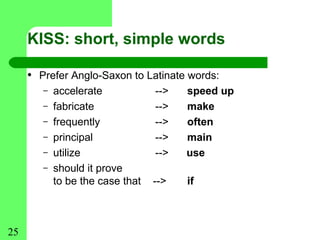
KISS: short, simple words

     • Prefer Anglo-Saxon to Latinate words:
        –   accelerate            -->   speed up
        –   fabricate             -->   make
        –   frequently            -->   often
        –   principal             -->   main
        –   utilize               -->   use
        –   should it prove
            to be the case that   -->   if


25
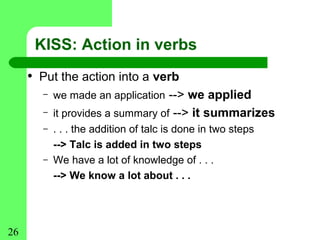
KISS: Action in verbs
     • Put the action into a verb
       –   we made an application --> we applied
       –   it provides a summary of --> it summarizes
       –   . . . the addition of talc is done in two steps
           --> Talc is added in two steps
       –   We have a lot of knowledge of . . .
           --> We know a lot about . . .


26
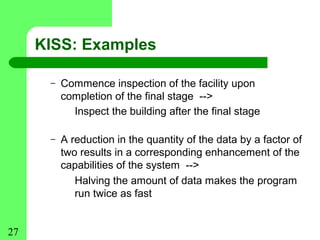
KISS: Examples

      –   Commence inspection of the facility upon
          completion of the final stage -->
            Inspect the building after the final stage

      –   A reduction in the quantity of the data by a factor of
          two results in a corresponding enhancement of the
          capabilities of the system -->
             Halving the amount of data makes the program
             run twice as fast


27
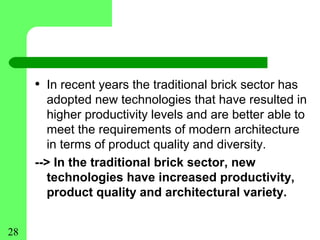
• In recent years the traditional brick sector has
        adopted new technologies that have resulted in
        higher productivity levels and are better able to
        meet the requirements of modern architecture
        in terms of product quality and diversity.
     --> In the traditional brick sector, new
        technologies have increased productivity,
        product quality and architectural variety.


28
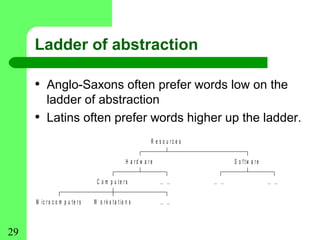
Ladder of abstraction

     • Anglo-Saxons often prefer words low on the
          ladder of abstraction
     •    Latins often prefer words higher up the ladder.
                                                             R e s o u rc e s

                                                 H a rd w a re                        S o ftw a re

                                 C o m p u te rs                 … …            … …                  … …

     M ic r o c o m p u te rs   W o r k s ta tio n s             … …


29
Writing PowerPoint slides
Steps and tips

     1. Select a plain, easy-to-read template
     2. Go to Options/Edit:
          Deselect "Auto-fit text to text placeholders"
     3.   Consider using Word in Outline mode,
          then importing Word Outline into PPT
     4.   Follow advice of Office Assistant
     5.   Apply 6x6 rule: 6 lines, 6 words each
     6.   Use bulleted points with parallel construction.

31
PowerPoint: Limitations

      Be aware, however, that PowerPoint also has
      severe limitations.
        As Edward Tufte says:
        "The problem with bullet points is that they can only
        represent the simplest relationships between things.
        They're good for making laundry lists or describing
        step-by-step procedures. The problem is that
        information is usually much more complex."
        More at: saywhatyoumean.com/html/readingroom25.html


32
Communications failures
   and responses
Communications failures

     • Who's responsible?
       –   Sender:
            Virtually every time
       –   Receiver:
            Hardly ever!!
             ... and even if he/she is responsible,
             what point would there be to saying so?


34
Responses to failure:

     Review presentation with:
     • carefully selected member of audience
     • someone from outside your organization
     • someone unfamiliar with the subject.


35
Review resources and strategies:
     • Choose a different presenter
     • Call in an outside specialist
     • Learn how to speak better in public


36
Repeated challenges

       Team facing repeated communication
       challenges should consider:
     • developing standard procedures
       possibly even standard forms, templates, etc.
     • studying how others handle these challenges:
       –   internet searches
       –   external consultants


37
Is the problem cross-cultural?

     Did communication failure involve:
     • more than one nationality?
     • different cultural or sociocultural groups?
     • several corporate cultures?
       If so, research cross-cultural communication
       issues or call in a specialist.
         Jody Jakob (jody.jakob@netcabo.pt) is one such
         specialist based in Portugal.

38
Cultural differences
Culture: What is it?

     • “The collective programming of the mind which
       distinguishes the members of one group or
       category from those of another.”
       –   Geert Hofstede
     • “A learned, shared, compelling, interrelated set
       of symbols whose meanings provide a set of
       orientations for members of society.”
       –   Terpstra & David


40
Characteristics:
     What all have in common

     All cultural traits are:
      Prescriptive, i.e. they define what a particular
       group considers to be acceptable
      Learned, not genetic
      Dynamic: Interactive relationship between
       behaviour and culture
      Subjective: Meanings vary by culture


41
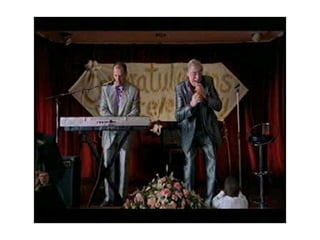
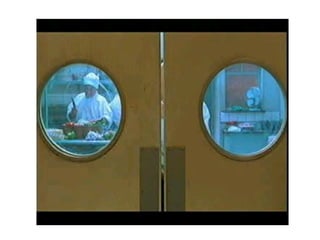
Cultural differences _do_ exist!

      Cultural studies and their impact on good
      business are also increasingly popular,
      witness these TV advertisements by anglo-
      Asian banking group HSBC.


42
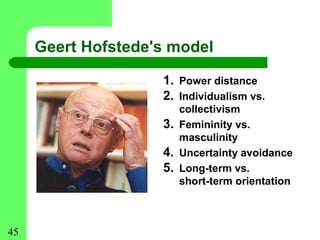
Geert Hofstede's model

                    1. Power distance
                    2. Individualism vs.
                         collectivism
                    3.   Femininity vs.
                         masculinity
                    4.   Uncertainty avoidance
                    5.   Long-term vs.
                         short-term orientation


45
Power distance


      The extent to which the less powerful members
      of an organization (in a given culture) expect
      and accept that power is distributed unequally.


46
Individualism vs. collectivism

     Individualism = degree to which individuals are
       integrated into groups.
     • An individualistic society has loose ties
       between individuals, i.e. everyone is expected
       to look after him/herself and his/her family.
     • Collectivistic society has in-groups (with
       strong, cohesive ties between individuals from
       birth) which protect their members in exchange
       for unquestioning loyalty.
47
Masculinity vs. femininity

     • Masculinity = assertiveness
     • Femininity = caring
       –   Masculinity/femininity refers to the distribution of
           roles between the genders, a fundamental issue for
           any society.
            • Women in 'feminine' countries have about the same
              modest, caring values as the men.
            • Women in 'masculine' countries are somewhat assertive
              and competitive, but not as much as the men (hence a gap
              between men's values and women's values).


48
Uncertainty avoidance


      Uncertainty avoidance deals with a society's
      tolerance for uncertainty and ambiguity; it
      ultimately refers to man's search for Truth.


49
Long- vs. short-term orientation

     • Deals with Virtue regardless of Truth.
     • Values associated with long-term orientation
         are thrift and perseverance
     •   Values associated with short-term orientation
         are respect for tradition, fulfilling social
         obligations, and protecting one's 'face'.


50
Low- vs. high-context cultures

         Individualism/collectivism is related to
         Edward T. Hall’s idea of
         low- and high-context cultures:
        Individualist cultures tend to be low-context
        Collectivist cultures tend to be high-context.


51
• Low-context communication:
      the mass of information is explicit.


     • High-context communication:
      little has to be said or written because most of
      the information is in the physical environment
      or within the person.


52
Examples of impact on writing


      More formal style expected in high power
         distance cultures
        More explicit information expected in low-
         context, individualist cultures
        Inductive + deductive mix often suitable in low
         power distance, individualist cultures.

53
"Localization" problem
(Internet catalogues, etc.)


         Terminology for web sites
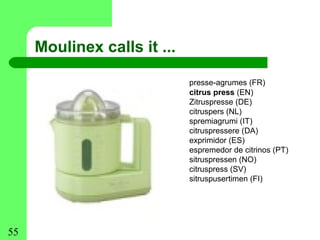
Moulinex calls it ...

                             presse-agrumes (FR)
                             citrus press (EN)
                             Zitruspresse (DE)
                             citruspers (NL)
                             spremiagrumi (IT)
                             citruspressere (DA)
                             exprimidor (ES)
                             espremedor de citrinos (PT)
                             sitruspressen (NO)
                             citruspress (SV)
                             sitruspusertimen (FI)


55
Search statistics (English)

     AltaVista normal mode (10/04/01):
     • lemon squeezer:                     987
     • orange juicer:                      193
     • citrus press:                       151
     • orange squeezer:                     94
     AltaVista advanced mode (10/04/01):
     • "orange squeezer" + Moulinex:         0


56
Search results (English)

     AltaVista "image search" (10/04/01):
     • citrus press:               3
     • lemon squeezer:             2
     • orange squeezer:            2
     • orange juicer:              2


57
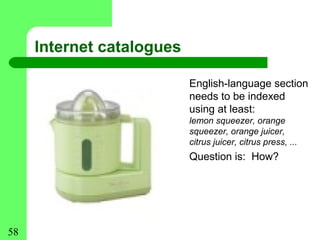
Internet catalogues

                           English-language section
                           needs to be indexed
                           using at least:
                           lemon squeezer, orange
                           squeezer, orange juicer,
                           citrus juicer, citrus press, ...
                           Question is: How?


58
META tags

      How can one add synonyms, variants, etc. to
      Internet catalogues, etc.?
      Solution: HTML META tags ... containing
      invisible keywords, that are recognized and
      indexed by certain search engines.
        Same applies to typos.
        (Think about spelling of destinations offered by a
        travel agency.)


59
Information Mapping®


                What is it?
Information Mapping

     • Information Mapping® is a methodology for
       analysing, organizing, and presenting
       information based on the audience's needs and
       the purpose of the information.
     • All information is presented in specially
       formatted "maps" comprising "chunks".


61
Information Mapping

      –   Information Mapping
          (in Portuguese) by Formedia
           http://www.formedia.pt/
      –   Information Mapping in Europe
           http://www.imap.dk/


62
On-line resources: General

     • Online writing course (in English):
        http://www.me.vt.edu/writing/
     • Online diploma course in technical writing (in
       English):
        http://www.cpit.ac.nz/splashpages/techwrit/
     • STC (Society for Technical Communication)
        http://www.stc.org/


63
On-line resources: writing, etc.

     • Writing resources for engineers, etc.:
           http://www.ecf.toronto.edu/~writing/resources.htm
     • On-line English grammar:
           www.edunet.com/english/grammar/
     • Writing mission statements:
       –   "The Mission Primer, Four Steps to an Effective
           Mission Statement"
           www.erols.com/rdoh/4steps.html


64
On-line resources

     On-line learning:
       –   On-line technical writing courses:
              http://www.online-learning.com/
       –   On-line writing tips:
              http://saywhatyoumean.com/


65
On-line resources

     Tips on presentation skills:
       –   http://lorien.ncl.ac.uk/ming/Dept/Tips/present/present.htm
     Tips on using PowerPoint:
       –   http://www.communicateusingtechnology.com/pptworkscd.htm


66
On-line resources

     PowerPoint Is Evil
       or Power corrupts.
          PowerPoint corrupts absolutely.
          at http://www.wired.com/wired/archive/11.09/ppt2.html
       An alternative view by Edward Tufte,
        Professor Emeritus of Political Science, Computer
        Science and Statistics, and Graphic Design at Yale,
        and author of "The Cognitive Style of PowerPoint".
          See http://www.edwardtufte.com


67
Roundup

     1. Communication in engineering projects
          Communications-critical phases
     2. Technical communication: Basic concepts
          Sender/receiver model
          Audience-centred communication
          Tips (writing, PowerPoint, etc.)
     2. Communications failures + responses
     3. Localization & catalogues

68

1

  • 1.
    Communication skills for engineeringproject teams Steve Dyson www.sdc-language.com
  • 2.
    Steve Dyson  Technical communicator and translator to French high-technology companies:  space (CNES, Alcatel, etc.)  satellite-based imagery and remote sensing (Spot Image, CNES, Istar, etc.)  naval defence (DCN, Thales, Armaris, etc.). 2
  • 3.
     Consultant onmajor technical documentation and translation projects for:  French space agency CNES  French naval prime contractor DCN. 3
  • 4.
    Outline 1. Communication in engineering projects  Communications-critical phases 2. Technical communication: Basic concepts  Sender/receiver model  Audience-centred communication  Tips (writing, PowerPoint, etc.) 2. Communication failures + responses 3. Localization & catalogues 4
  • 5.
  • 6.
    Communications challenges faced by engineering teams Two main types of comms challenges:  Presentations to team members and others with engineering backgrounds.  Presentations to non-engineers. Engineer/presenter typically aims to:  "Sell" the project or key concepts.  Provide engineering input for high-level presentations by senior project managers to clients, investors, authorities, etc. 6
  • 7.
    First critical steps • Assess the importance of each presentation or writing task • Tailor response to the challenge: – The more critical the task, the more effective the document or presentation should be, and the bigger the communication effort. A major effort will involve applying the lessons learned today and more … 7
  • 8.
  • 9.
    Technical communication: Basic concepts:  Sender/receiver model  Audience-centred communication 9
  • 10.
  • 11.
    Message encoding/decoding sender sends information receiver feelings, experience, experience, feelings, history, history, expectations, expectations, fears fears
  • 13.
    Presentation skills – Body language Posture, eyes, etc.: 55% – Voice Tone, inflection, etc.: 38% – Content: 7% – Language skills & accent Not included in this study. – Study by Prof. Albert Mehrabian, University of Ca., STC "Technical Communication", Nov. 2000, p605 13
  • 14.
    Audience Communication is easiest between: • people with similar backgrounds and training • people who are used to working together. 14
  • 15.
    Audience It is more difficult: • between departments (design, marketing, etc.) • between people with different backgrounds, languages, etc. • for multidisciplinary, multi-department and engineering project teams. 15
  • 16.
    Audience-centred communication • Focus on what your audience wants to know and questions they want answered, _not_ what you want to tell them. • Tell them what you're going to say, say it (no more than three main points), then tell them what you've just said. • Use rhetorical devices, including parallel structures and repetition. 16
  • 17.
    Reader-centred writing • Focus on what readers want to know and questions they want answered, _not_ what you want to tell them. • Provide navigation devices. • Consider "Information Mapping": – courses now available in Portugal. 17
  • 18.
    Focus on: – Readers’ information needs – Readers’ technical knowledge – Readers’ language skills – Readers’ attitudes – The time they are likely to spend reading your document. 18
  • 19.
    Unlearning … Unlearning … things you thought you knew and others you learnt at school/university. Reader-centred writing is radically different from: • explaining to teachers, who already know • writing at least X pages • showing that you know how to use sophisticated language • avoiding (at all cost) repetition of words. 19
  • 20.
    Answer readers’ likelyquestions • Start by playing devil’s advocate: – Why should I read this? – Where does this information come from? – Which are the most important parts? – What am I expected to do next? – What does the competition have to say? • What details or facts are your readers hoping to learn? 20
  • 21.
  • 22.
    Making lists Lists are: – shorter than running text – easier to write and understand, especially if you use parallel structure. Use parallel structure, i.e., begin with: – verb (infinitive or conjugated; imperative, other) – gerund – noun (less powerful). (See also : saywhatyoumean.com/html/readingroom21.html) 22
  • 23.
    Keep It Shortand Simple (KISS) • Aim for an average sentence length of 17-21 words But vary the pattern: medium, long, short, short, medium, short, long, medium, short, medium • Maximum: 30 words, except in lists 23
  • 24.
    KISS • Remove unnecessary prepositions – in the region of --> about – as a means to --> to • Remove other unnecessary words – complete monopoly – rectangular in shape – . . . the dusting problem . . . – these instruments have a marked tendency to drift 24
  • 25.
    KISS: short, simplewords • Prefer Anglo-Saxon to Latinate words: – accelerate --> speed up – fabricate --> make – frequently --> often – principal --> main – utilize --> use – should it prove to be the case that --> if 25
  • 26.
    KISS: Action inverbs • Put the action into a verb – we made an application --> we applied – it provides a summary of --> it summarizes – . . . the addition of talc is done in two steps --> Talc is added in two steps – We have a lot of knowledge of . . . --> We know a lot about . . . 26
  • 27.
    KISS: Examples – Commence inspection of the facility upon completion of the final stage --> Inspect the building after the final stage – A reduction in the quantity of the data by a factor of two results in a corresponding enhancement of the capabilities of the system --> Halving the amount of data makes the program run twice as fast 27
  • 28.
    • In recentyears the traditional brick sector has adopted new technologies that have resulted in higher productivity levels and are better able to meet the requirements of modern architecture in terms of product quality and diversity. --> In the traditional brick sector, new technologies have increased productivity, product quality and architectural variety. 28
  • 29.
    Ladder of abstraction • Anglo-Saxons often prefer words low on the ladder of abstraction • Latins often prefer words higher up the ladder. R e s o u rc e s H a rd w a re S o ftw a re C o m p u te rs … … … … … … M ic r o c o m p u te rs W o r k s ta tio n s … … 29
  • 30.
  • 31.
    Steps and tips 1. Select a plain, easy-to-read template 2. Go to Options/Edit: Deselect "Auto-fit text to text placeholders" 3. Consider using Word in Outline mode, then importing Word Outline into PPT 4. Follow advice of Office Assistant 5. Apply 6x6 rule: 6 lines, 6 words each 6. Use bulleted points with parallel construction. 31
  • 32.
    PowerPoint: Limitations Be aware, however, that PowerPoint also has severe limitations. As Edward Tufte says: "The problem with bullet points is that they can only represent the simplest relationships between things. They're good for making laundry lists or describing step-by-step procedures. The problem is that information is usually much more complex." More at: saywhatyoumean.com/html/readingroom25.html 32
  • 33.
  • 34.
    Communications failures • Who's responsible? – Sender: Virtually every time – Receiver: Hardly ever!! ... and even if he/she is responsible, what point would there be to saying so? 34
  • 35.
    Responses to failure: Review presentation with: • carefully selected member of audience • someone from outside your organization • someone unfamiliar with the subject. 35
  • 36.
    Review resources andstrategies: • Choose a different presenter • Call in an outside specialist • Learn how to speak better in public 36
  • 37.
    Repeated challenges Team facing repeated communication challenges should consider: • developing standard procedures possibly even standard forms, templates, etc. • studying how others handle these challenges: – internet searches – external consultants 37
  • 38.
    Is the problemcross-cultural? Did communication failure involve: • more than one nationality? • different cultural or sociocultural groups? • several corporate cultures? If so, research cross-cultural communication issues or call in a specialist. Jody Jakob (jody.jakob@netcabo.pt) is one such specialist based in Portugal. 38
  • 39.
  • 40.
    Culture: What isit? • “The collective programming of the mind which distinguishes the members of one group or category from those of another.” – Geert Hofstede • “A learned, shared, compelling, interrelated set of symbols whose meanings provide a set of orientations for members of society.” – Terpstra & David 40
  • 41.
    Characteristics: What all have in common All cultural traits are:  Prescriptive, i.e. they define what a particular group considers to be acceptable  Learned, not genetic  Dynamic: Interactive relationship between behaviour and culture  Subjective: Meanings vary by culture 41
  • 42.
    Cultural differences _do_exist! Cultural studies and their impact on good business are also increasingly popular, witness these TV advertisements by anglo- Asian banking group HSBC. 42
  • 45.
    Geert Hofstede's model 1. Power distance 2. Individualism vs. collectivism 3. Femininity vs. masculinity 4. Uncertainty avoidance 5. Long-term vs. short-term orientation 45
  • 46.
    Power distance The extent to which the less powerful members of an organization (in a given culture) expect and accept that power is distributed unequally. 46
  • 47.
    Individualism vs. collectivism Individualism = degree to which individuals are integrated into groups. • An individualistic society has loose ties between individuals, i.e. everyone is expected to look after him/herself and his/her family. • Collectivistic society has in-groups (with strong, cohesive ties between individuals from birth) which protect their members in exchange for unquestioning loyalty. 47
  • 48.
    Masculinity vs. femininity • Masculinity = assertiveness • Femininity = caring – Masculinity/femininity refers to the distribution of roles between the genders, a fundamental issue for any society. • Women in 'feminine' countries have about the same modest, caring values as the men. • Women in 'masculine' countries are somewhat assertive and competitive, but not as much as the men (hence a gap between men's values and women's values). 48
  • 49.
    Uncertainty avoidance Uncertainty avoidance deals with a society's tolerance for uncertainty and ambiguity; it ultimately refers to man's search for Truth. 49
  • 50.
    Long- vs. short-termorientation • Deals with Virtue regardless of Truth. • Values associated with long-term orientation are thrift and perseverance • Values associated with short-term orientation are respect for tradition, fulfilling social obligations, and protecting one's 'face'. 50
  • 51.
    Low- vs. high-contextcultures Individualism/collectivism is related to Edward T. Hall’s idea of low- and high-context cultures:  Individualist cultures tend to be low-context  Collectivist cultures tend to be high-context. 51
  • 52.
    • Low-context communication: the mass of information is explicit. • High-context communication: little has to be said or written because most of the information is in the physical environment or within the person. 52
  • 53.
    Examples of impacton writing  More formal style expected in high power distance cultures  More explicit information expected in low- context, individualist cultures  Inductive + deductive mix often suitable in low power distance, individualist cultures. 53
  • 54.
    "Localization" problem (Internet catalogues,etc.) Terminology for web sites
  • 55.
    Moulinex calls it... presse-agrumes (FR) citrus press (EN) Zitruspresse (DE) citruspers (NL) spremiagrumi (IT) citruspressere (DA) exprimidor (ES) espremedor de citrinos (PT) sitruspressen (NO) citruspress (SV) sitruspusertimen (FI) 55
  • 56.
    Search statistics (English) AltaVista normal mode (10/04/01): • lemon squeezer: 987 • orange juicer: 193 • citrus press: 151 • orange squeezer: 94 AltaVista advanced mode (10/04/01): • "orange squeezer" + Moulinex: 0 56
  • 57.
    Search results (English) AltaVista "image search" (10/04/01): • citrus press: 3 • lemon squeezer: 2 • orange squeezer: 2 • orange juicer: 2 57
  • 58.
    Internet catalogues English-language section needs to be indexed using at least: lemon squeezer, orange squeezer, orange juicer, citrus juicer, citrus press, ... Question is: How? 58
  • 59.
    META tags How can one add synonyms, variants, etc. to Internet catalogues, etc.? Solution: HTML META tags ... containing invisible keywords, that are recognized and indexed by certain search engines. Same applies to typos. (Think about spelling of destinations offered by a travel agency.) 59
  • 60.
  • 61.
    Information Mapping • Information Mapping® is a methodology for analysing, organizing, and presenting information based on the audience's needs and the purpose of the information. • All information is presented in specially formatted "maps" comprising "chunks". 61
  • 62.
    Information Mapping – Information Mapping (in Portuguese) by Formedia http://www.formedia.pt/ – Information Mapping in Europe http://www.imap.dk/ 62
  • 63.
    On-line resources: General • Online writing course (in English): http://www.me.vt.edu/writing/ • Online diploma course in technical writing (in English): http://www.cpit.ac.nz/splashpages/techwrit/ • STC (Society for Technical Communication) http://www.stc.org/ 63
  • 64.
    On-line resources: writing,etc. • Writing resources for engineers, etc.: http://www.ecf.toronto.edu/~writing/resources.htm • On-line English grammar: www.edunet.com/english/grammar/ • Writing mission statements: – "The Mission Primer, Four Steps to an Effective Mission Statement" www.erols.com/rdoh/4steps.html 64
  • 65.
    On-line resources On-line learning: – On-line technical writing courses: http://www.online-learning.com/ – On-line writing tips: http://saywhatyoumean.com/ 65
  • 66.
    On-line resources Tips on presentation skills: – http://lorien.ncl.ac.uk/ming/Dept/Tips/present/present.htm Tips on using PowerPoint: – http://www.communicateusingtechnology.com/pptworkscd.htm 66
  • 67.
    On-line resources PowerPoint Is Evil or Power corrupts. PowerPoint corrupts absolutely. at http://www.wired.com/wired/archive/11.09/ppt2.html An alternative view by Edward Tufte, Professor Emeritus of Political Science, Computer Science and Statistics, and Graphic Design at Yale, and author of "The Cognitive Style of PowerPoint". See http://www.edwardtufte.com 67
  • 68.
    Roundup 1. Communication in engineering projects  Communications-critical phases 2. Technical communication: Basic concepts  Sender/receiver model  Audience-centred communication  Tips (writing, PowerPoint, etc.) 2. Communications failures + responses 3. Localization & catalogues 68

Editor's Notes

  • #12 Example: Portugal now has many migrants from Eastern Europe, particularly Ukraine. Migrants from former Soviet Block countries have radically different perceptions, attitudes, beliefs, values, etc. from the Portuguese. Thus, Ukrainian workers may pose a communications challenge for Portuguese engineers and managers wishing to increase motivation, improve quality awareness, etc.
  • #13 Maybe he's considering telling a joke before moving on to discuss the graphs. That may work with some audiences, but not all. Many Asians think Anglo-Saxon style joke telling during presentations is most inappropriate! Joke about the Australian-Chinese interpreter who coerced audience into gales of laughter ...
  • #17 All Latins, including the Portuguese, love speaking. Most presentations I hear by Portuguese speakers contain too much information, too many points. This talk also attempts to make too many points, but then I am assuming that I have a very smart audience! Make fewer points and repeat your main points two or three times to ensure people come away remembering some of the content in addition to an overall impression.
  • #40 I will not say much about culture and cultural differences because it is not really my subject. You should, however, be aware of two things: a) We sometimes fail to communicate successfully because of unidentified cultural differences between the message sender and receiver, between the presenter and his/her audience, and so forth. b) If you or one of your team suspects that this may be the reason for a communication failure, be aware that much useful information is available on the internet and, if necessary, you can attend a course or hire a consultant to help you overcome your problem. Below I would simply like to introduce the concept of culture, give some definitions, mentions some names, and very, very briefly introduce some of the concepts developed by Geert Hofstede.
  • #44 In England, presents are given to the bride and groom to set them up in their new life … whereas, in Malta, guests can expect a present as a momento of the day.
  • #45 The English believe it's a slur on your host's food if you don't clear your plate … whereas the Chinese feel that you are questioning their generosity if you do …
  • #46 These ideas were first based on a large research project into national cultures across IBM subsidiaries in 64 countries. The original research was conducted in the 1970s (TBC). Subsequent studies by others covered: students in 23 countries, elites in 19 countries, commercial airline pilots in 23 countries, up-market consumers in 15 countries, and civil service managers in 14 countries. These studies together identified and validated five independent dimensions of national culture differences: Power distance Individualism vs. collectivism Femininity vs. masculinity Uncertainty avoidance Long-term vs. short-term orientation
  • #47 The extent to which the less powerful members of organizations (like the family) accept and expect that power is distributed unequally . This represents inequality (more vs. less), but defined from below, not from above. It suggests that a society's level of inequality is endorsed by the followers as much as by the leaders. Power and inequality, of course, are extremely fundamental facts of any society and anybody with some international experience will be aware that 'all societies are unequal, but some are more unequal than others'.
  • #49 The IBM studies revealed that (a) women's values differ less among societies than men's values; (b) men's values from one country to another contain a dimension from very assertive and competitive and maximally different from women's values on the one side, to modest and caring and similar to women's values on the other.
  • #50 UA indicates to what extent a culture programs its members to feel either uncomfortable or comfortable in unstructured situations. Unstructured situations are novel, unknown, surprising, different from usual. Uncertainty avoiding cultures try to minimize the possibility of such situations by strict laws and rules, safety and security measures, and on the philosophical and religious level by a belief in absolute Truth; 'there can only be one Truth and we have it'. People in uncertainty avoiding countries are also more emotional, and motivated by inner nervous energy. The opposite type, uncertainty accepting cultures, are more tolerant of opinions different from what they are used to; they try to have as few rules as possible, and on the philosophical and religious level they are relativist and allow many currents to flow side by side. People within these cultures are more phlegmatic and contemplative, and not expected by their environment to express emotions.
  • #51 Long-term vs. short-term orientation: this fifth dimension was found in a study among students in 23 countries around the world, using a questionnaire designed by Chinese scholars. Both the positively and the negatively rated values of this dimension are found in the teachings of Confucius, the most influential Chinese philosopher who lived around 500 B.C.; however, the dimension also applies to countries without a Confucian heritage.