Year & Sem– 2nd
Year, 3rd
Sem
Subject – Technical Communication
Unit – 01
Presented by – Javed Ul Islam
J A I P U R E N G I N E E R I N G C O L L E G E
A N D R E S E A R C H C E N T R E
2.
VISION AND MISSIONOF INSTITUTE
To become a renowned centre of outcome
based learning, and work towards academic,
professional, cultural and social enrichment of
the lives of individuals and communities.
3.
VISION AND MISSIONOF DEPARTMENT
Focus on evaluation of learning outcomes and motivate students to inculcate
research aptitude by project based learning.
Identify, based on informed perception of Indian, regional and global needs, the
areas of focus and provide platform to gain knowledge and solutions.
Offer opportunities for interaction between academia and industry.
Develop human potential to its fullest extent so that intellectually capable and
imaginatively gifted leaders may emerge.
4.
Course Objective
CO1: ableto express themselves better in technical writing by understanding
the concept, style and methodology used in Technical communication.
CO2: able to pursue higher studies by working on all aspects of English
Language and also develop a better understanding of process and design of
technical texts.
CO3: able to get an in depth knowledge of technical communication used in
professional life by getting to know all the forms and aspects of Technical
Communication.
UNIT -1
Contents :-
Introductionto Technical Communication-
Definition of technical communication,
Aspects of technical communication, forms
of technical communication, importance of
technical communication.
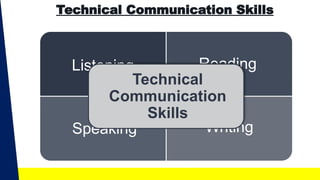
Technical communication skills (Listening,
speaking, writing, reading writing),
linguistic ability, style in technical
communication.
Introduction
Technical Communication isa process of communication
that help users to accomplish a defined goal or task . The main
purpose is to give a specific information related to some particular
task. Technical communication can be either written or verbal
communication that can help users to communicate on their
specialized topics to accomplish a defined goal or task. It is
helpful to assist users who need specific information on
completing tasks, using products, operating equipment, and so on.
What’s the differencebetween technical communication and General
Communication
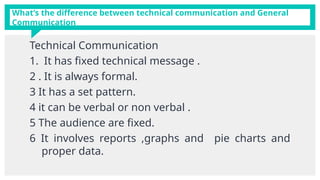
Technical Communication
1. It has fixed technical message .
2 . It is always formal.
3 It has a set pattern.
4 it can be verbal or non verbal .
5 The audience are fixed.
6 It involves reports ,graphs and pie charts and
proper data.
11.
What’s the differencebetween technical communication and General
Communication
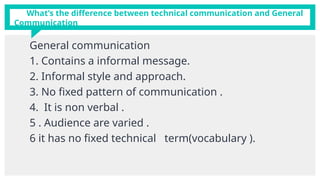
General communication
1. Contains a informal message.
2. Informal style and approach.
3. No fixed pattern of communication .
4. It is non verbal .
5 . Audience are varied .
6 it has no fixed technical term(vocabulary ).
12.
Characteristics of Technicalcommunication.
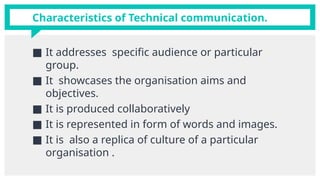
■ It addresses specific audience or particular
group.
■ It showcases the organisation aims and
objectives.
■ It is produced collaboratively
■ It is represented in form of words and images.
■ It is also a replica of culture of a particular
organisation .
13.
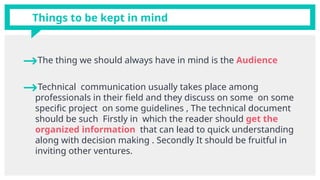
→The thing weshould always have in mind is the Audience
→Technical communication usually takes place among
professionals in their field and they discuss on some on some
specific project on some guidelines , The technical document
should be such Firstly in which the reader should get the
organized information that can lead to quick understanding
along with decision making . Secondly It should be fruitful in
inviting other ventures.
Things to be kept in mind
14.
Note
→How familiar arereaders
with the terms used by the
writer .
→In what best way the terms
used can be explained?
We will onlysee how technical communication works in a
organization and what are the forms of technical
communication .
Memos, Graphics, Letters, Fliers, Reports, Newsletters,
Presentations, Web pages, Brochures, Proposals, Instructions,
Reviews, Press Releases, Catalogs, Advertisements, Handbooks,
Business plans, Policies and procedures, specifications,
instructions, style guides, agendas and so forth.
More or frequently used :-
■ It includes all types of notices , minutes of meeting , circulars
quarterly and annually reports and manuals.
■ Emails , ,Web pages, and even social media.
Types of Technical Documents :-
17.
“
Engineers and goodprofessionals should have the
following skills if they have the below skills then only they
can make their communication effective…
↓
↓
↓
18.
“
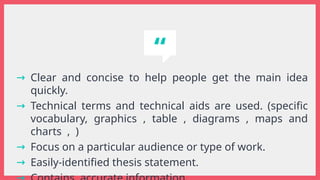
→ Clear andconcise to help people get the main idea
quickly.
→ Technical terms and technical aids are used. (specific
vocabulary, graphics , table , diagrams , maps and
charts , )
→ Focus on a particular audience or type of work.
→ Easily-identified thesis statement.
Importance
→It is theheart and soul of the organization as it s
helpful in recruiting , functioning , decision-making
and coordinating whether it is business enterprise,
administrative ,academic organization, or medical
firm or IT industry.
→Good qualitative information will always help a
company to grow.
→Technical communication is a field that makes our life
easier and more productive
LISTENING
Listening skills areprobably one of the most important language skills that
you need in order to be successful in your academic and professional
pursuits.
25.
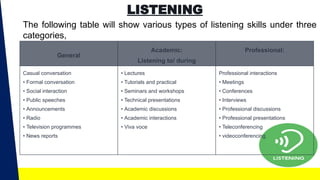
LISTENING
The following tablewill show various types of listening skills under three
categories,
General
Academic:
Listening to/ during
Professional:
Casual conversation
• Formal conversation
• Social interaction
• Public speeches
• Announcements
• Radio
• Television programmes
• News reports
• Lectures
• Tutorials and practical
• Seminars and workshops
• Technical presentations
• Academic discussions
• Academic interactions
• Viva voce
Professional interactions
• Meetings
• Conferences
• Interviews
• Professional discussions
• Professional presentations
• Teleconferencing
• videoconferencing
26.
SPEAKING
Speaking skills arealso important for a person’s professional survival and
growth. A person requires effective oral communication skills in several
formal communicative situations.
Oral communication not only makes professional interaction possible, it
develops information and understanding essential for decision making
in meetings, conferences and other similar oral communicative skills.
As oral communication is a tool of professional and business
interactions, one should be able to use it fluently, effectively and
confidently.
27.
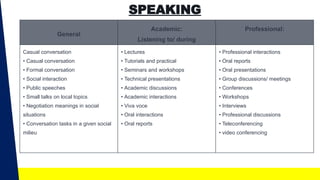
SPEAKING
General
Academic:
Listening to/ during
Professional:
Casualconversation
• Casual conversation
• Formal conversation
• Social interaction
• Public speeches
• Small talks on local topics
• Negotiation meanings in social
situations
• Conversation tasks in a given social
milieu
• Lectures
• Tutorials and practical
• Seminars and workshops
• Technical presentations
• Academic discussions
• Academic interactions
• Viva voce
• Oral interactions
• Oral reports
• Professional interactions
• Oral reports
• Oral presentations
• Group discussions/ meetings
• Conferences
• Workshops
• Interviews
• Professional discussions
• Teleconferencing
• video conferencing
28.
READING
Like listening andspeaking, reading is also important for effective
communication. You need effective reading skills as you may be required
to read several kinds of reading material for different general, academic
and professional purposes.
29.
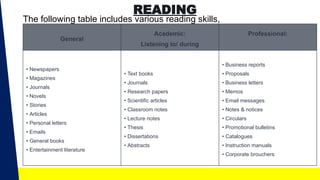
READING
General
Academic:
Listening to/ during
Professional:
•Newspapers
• Magazines
• Journals
• Novels
• Stories
• Articles
• Personal letters
• Emails
• General books
• Entertainment literature
• Text books
• Journals
• Research papers
• Scientific articles
• Classroom notes
• Lecture notes
• Thesis
• Dissertations
• Abstracts
• Business reports
• Proposals
• Business letters
• Memos
• Email messages
• Notes & notices
• Circulars
• Promotional bulletins
• Catalogues
• Instruction manuals
• Corporate brouchers
The following table includes various reading skills,
30.
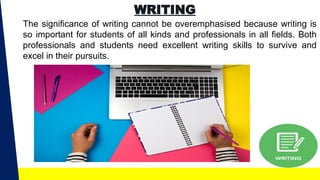
WRITING
The significance ofwriting cannot be overemphasised because writing is
so important for students of all kinds and professionals in all fields. Both
professionals and students need excellent writing skills to survive and
excel in their pursuits.
31.
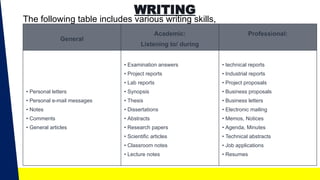
WRITING
General
Academic:
Listening to/ during
Professional:
•Personal letters
• Personal e-mail messages
• Notes
• Comments
• General articles
• Examination answers
• Project reports
• Lab reports
• Synopsis
• Thesis
• Dissertations
• Abstracts
• Research papers
• Scientific articles
• Classroom notes
• Lecture notes
• technical reports
• Industrial reports
• Project proposals
• Business proposals
• Business letters
• Electronic mailing
• Memos, Notices
• Agenda, Minutes
• Technical abstracts
• Job applications
• Resumes
The following table includes various writing skills,
32.
WRITING
SKILLS
Writing is away to express human emotions, knowledge. Every
writer has his/her own style of writing, which reflects his personality.
However, each piece of writing requires different style and tone
which can decide on the basis of the content of the writing. No
matter what you write it is very important for you to stay focus on
your purpose of writing. There are mainly four categories in which
all different type of writing fall, which are narrative writing,
descriptive writing, expository writing, and persuasive writing.
34.
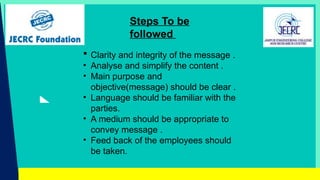
Steps To be
followed
Clarity and integrity of the message .
• Analyse and simplify the content .
• Main purpose and
objective(message) should be clear .
• Language should be familiar with the
parties.
• A medium should be appropriate to
convey message .
• Feed back of the employees should
be taken.
35.
35
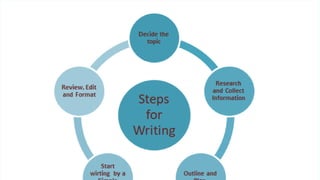
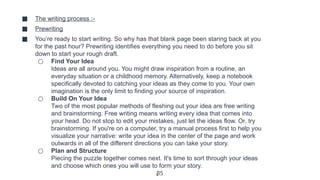
■ The writingprocess :-
■ Prewriting
■ You’re ready to start writing. So why has that blank page been staring back at you
for the past hour? Prewriting identifies everything you need to do before you sit
down to start your rough draft.
○ Find Your Idea
Ideas are all around you. You might draw inspiration from a routine, an
everyday situation or a childhood memory. Alternatively, keep a notebook
specifically devoted to catching your ideas as they come to you. Your own
imagination is the only limit to finding your source of inspiration.
○ Build On Your Idea
Two of the most popular methods of fleshing out your idea are free writing
and brainstorming. Free writing means writing every idea that comes into
your head. Do not stop to edit your mistakes, just let the ideas flow. Or, try
brainstorming. If you're on a computer, try a manual process first to help you
visualize your narrative: write your idea in the center of the page and work
outwards in all of the different directions you can take your story.
○ Plan and Structure
Piecing the puzzle together comes next. It's time to sort through your ideas
and choose which ones you will use to form your story.
i
36.
36
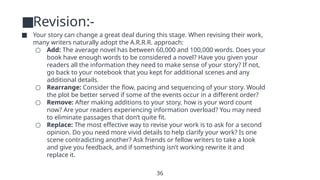
■Revision:-
■ Your storycan change a great deal during this stage. When revising their work,
many writers naturally adopt the A.R.R.R. approach:
○ Add: The average novel has between 60,000 and 100,000 words. Does your
book have enough words to be considered a novel? Have you given your
readers all the information they need to make sense of your story? If not,
go back to your notebook that you kept for additional scenes and any
additional details.
○ Rearrange: Consider the flow, pacing and sequencing of your story. Would
the plot be better served if some of the events occur in a different order?
○ Remove: After making additions to your story, how is your word count
now? Are your readers experiencing information overload? You may need
to eliminate passages that don’t quite fit.
○ Replace: The most effective way to revise your work is to ask for a second
opinion. Do you need more vivid details to help clarify your work? Is one
scene contradicting another? Ask friends or fellow writers to take a look
and give you feedback, and if something isn’t working rewrite it and
replace it.
37.
37
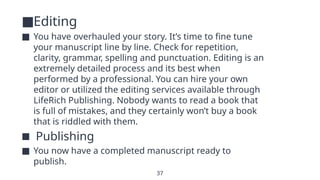
■Editing
■ You haveoverhauled your story. It’s time to fine tune
your manuscript line by line. Check for repetition,
clarity, grammar, spelling and punctuation. Editing is an
extremely detailed process and its best when
performed by a professional. You can hire your own
editor or utilized the editing services available through
LifeRich Publishing. Nobody wants to read a book that
is full of mistakes, and they certainly won’t buy a book
that is riddled with them.
■ Publishing
■ You now have a completed manuscript ready to
publish.
38.
38
■Types of writing
■Narrative writing :-
■ In narrative writing, the writer develops a lot of fictional
character and tell what happened to them in the form of a
story. Mostly, stories are narrated from the point of view of
one character, which is called first-person narration. All novels,
poetry, short stories, biographies, and autobiographies fall
under this category. A whole narrative writing is an answer to
the simple and small question “what happened then?”.
Narrative writing always has a person who tells a story or an
event from his / her point of view. It has characters who carry
the story. It has a dialogue.
39.
39
■Expository writing :(Information writing )
■ This type of writing styles is commonly found in textbooks. This types
of writing is used to explain things, people, place, relationship or an
idea. Expository writing is used to provide information about various
things, therefore, it is sometimes also referred to as information writing.
In this types of writing, the author provides factual information about a
certain subject rather than voicing his / her own opinion.
■ This types of writing is built on facts, statics, reasons, laws and principle,
cause, effects, and examples. As this information written in this types of
writing is factual, therefore, it is written without emotions and from the
point of view of a third person. Self-reference can be used in expository
writing but to give an external description and explanation and not to
explain personal feelings and opinions.
40.
40
■Persuasive writing
■ Themain purpose of this type of writing is to persuade its audience
about something. It includes opinion and a personal point of view
of the author. The author should have known about the other side
of the topic so that he can present the strongest information to
counter it. He/she should be able to develop a well-defined and
debatable topic.
■ Sometimes the author writes about the other side of the opposing
point and refute them and give a strong explanation for why
he/she does it. Even though persuasive writing includes a personal
opinion of the author, it is still written objectively. Persuasive
writing usually uses emotional appeal to win the heart and
confidence of readers.
41.
41
■Descriptive writing
■ Itis describing things such as characters, places, events etc. in details.
It is like painting a picture in the minds of readers. Descriptive writing
is an art of showing something through words. A writer describes
everything with respect to all senses. Through words, he tells you how
it looks like, feels like, smells like and sounds like. Descriptive writing
does the job of connecting the outer world with the inner world.
■ A writer uses various adjectives and adverbs to make the picture vivid
for the reader. Descriptive writing usually written with the point of view
of the first person and the context of the writing is emotional and
personal. Haruki Murakami, a Japanese writer is famous for his
descriptive writing. His books like Kafka on the shore and Norwegian
woods are the best samples of his descriptive writing.
42.
42
■ REVIEW WRITING:-
■ Reviewing things has become a trend these
days. People review everything like
restaurants, food, cosmetic products, books,
movies, and even mobile phones and laptops.
Tech savvy people read the review of things
online before making any purchase.
Therefore, it has become so important that
many companies pay people to review their
products. Review writing is art.
■ It requires both persuasive writing skills as
well as descriptive writing skills.