Objective Structured Practical Examination (OSPE)
By Dalal Alanazi

Culture Media:
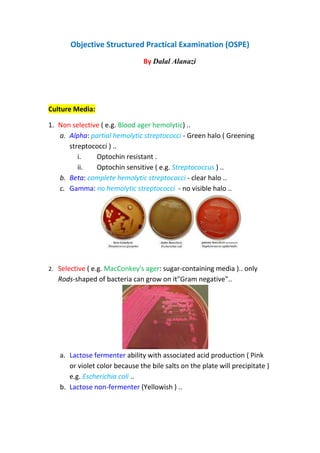
1. Non selective ( e.g. Blood ager hemolytic) ..
a. Alpha: partial hemolytic streptococci - Green halo ( Greening
streptococci ) ..
i.
Optochin resistant .
ii.
Optochin sensitive ( e.g. Streptococcus ) ..
b. Beta: complete hemolytic streptococci - clear halo ..
c. Gamma: no hemolytic streptococci - no visible halo ..

2. Selective ( e.g. MacConkey's ager: sugar-containing media ).. only

Rods-shaped of bacteria can grow on it"Gram negative"..

a. Lactose fermenter ability with associated acid production ( Pink
or violet color because the bile salts on the plate will precipitate )
e.g. Escherichia coli ..
b. Lactose non-fermenter (Yellowish ) ..
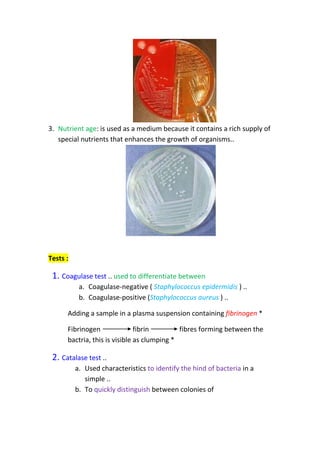
3. Nutrient age: is used as a medium because it contains a rich supply of
special nutrients that enhances the growth of organisms..

Tests :

1. Coagulase test .. used to differentiate between
a. Coagulase-negative ( Staphylococcus epidermidis ) ..
b. Coagulase-positive (Staphylococcus aureus ) ..
Adding a sample in a plasma suspension containing fibrinogen *
Fibrinogen
fibrin
fibres forming between the
bactria, this is visible as clumping *

2. Catalase test ..
a. Used characteristics to identify the hind of bacteria in a
simple ..
b. To quickly distinguish between colonies of
i. Catalase-negative ( Streptocci ) – microorganism will not
produce gas bubble ..
ii. Catalase-positive ( Staphylococci ) – microorganism will
split the Hydrogen peroxide, which can be observed as
O2 bubbles forming in the droplet ..
Hydrogen peroxide is product of oxidative carbohydrate
metabolism, it helps to identified on a slide ..
2H2O2 Catalase 2H2O + O2 ( gas bubble ) ..

3. Oxidase test ..
a. Negative ( e.g. Enterobacteriaceae ) ..
b. Positive which is indigo "Blue-purple" in color .. ( e.g. NonEnterobacteriaceae & Neisseria species ) ..
c. Cytochrome c-oxidase: is an enzyme that plays an important
role in electron transport in the respiratory chain of aerobic
bactria ..
d. cytochrome c oxidase depends on the oxidation of
Teramethyl-P-phenylenediamine to stain bacteria the violetcoloured ..
Shapes of Bacteria
& Gram Stain
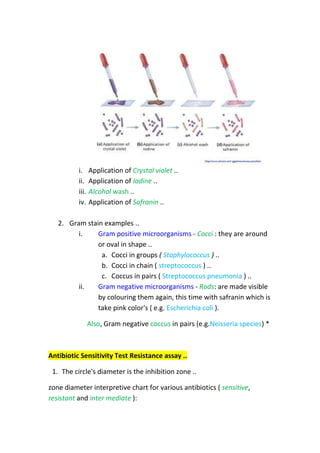
1. Gram stain ..
i.
ii.
iii.
iv.

Application of Crystal violet ..
Application of Iodine ..
Alcohol wash ..
Application of Safranin ..

2. Gram stain examples ..
i.
Gram positive microorganisms - Cocci : they are around
or oval in shape ..
a. Cocci in groups ( Staphylococcus ) ..
b. Cocci in chain ( streptococcus ) ..
c. Coccus in pairs ( Streptococcus pneumonia ) ..
ii.
Gram negative microorganisms - Rods: are made visible
by colouring them again, this time with safranin which is
take pink color's ( e.g. Escherichia coli ).
Also, Gram negative coccus in pairs (e.g.Neisseria species) *

Antibiotic Sensitivity Test Resistance assay ..
1. The circle's diameter is the inhibition zone ..
zone diameter interpretive chart for various antibiotics ( sensitive,
resistant and inter mediate ):
Abbreviation &
Concentration per disc
Zone > : S
Zone < : R

P AML AMC CAZ IMP CN VA CIP CT SXT
10 10
30
30
10 10 30
5
10 25
21 26
26
28
28
28 15 24 18 28
21 22
22
23
23
23 10 20 15 23

2. The antibiotic in the dispenser ..
Antibiotic
1. Penicillin.
2. Amoxicillin.
3. Amoxicillin + Clavulanic.
4. Ceftazidime.
5. Imipenem.
6. Vancomycin.
7. Colistin ( polymyxin E ).
8. Gentamycin.
9. Ciprofloxacin2.
10.Trimethoprim +
sulfamethoxazole3

Abbreviation
( Code )
P
AML
AMC
CAZ
IMP
VA
CT
CN
CIP
SXT

Molecular Dignosis ..
1. PCR .. polymerase chain reaction .. Name's of the machine is Thermo
cycler
a. A major advantage ..
i.
Is that much of it can be automated ..
ii.
Isolation of nucleic acid and the detection of the
amplified DNA ..
b. Disadvantage ..
i.
It is still relatively expensive ..
ii.
Require certain the various PCR steps are carried out in
separate rooms to prevent false positive.
c. Control ..
i.

ii.

iii.

Positive control : This consists of a sample containing the
DNA to be detected, always the test positive .." known
amount of target DNA "
Negative control : This consists of sample that does not
target DNA .. " to check that no contamination has
occurred during the isolation of nucleic acid "
Internal control : this check is done with the patient
sample prier to nucleic acid isolation. A much-used
internal control is a particular type of phocid herpesvirus
that not reside in human ..
"A negative PCR can't be interpreted reliably" *

2. Gel electrophoresis ..
Serological Testing
1. Used to determine whether a patient has come into contact with a
particular microorganism ..
2. Used to determine whether a person has been recently infected
by a particular pathogen ..
3. Used to detect antibodies and antigen in blood ..
Diagnosis of recent infection ..
1. IgM ( Primary infection) ..
2. Seroconversion ..
3. 4 fold IgG titre increase( old infection ): paired serum samples ..
- Atitre is the reciprocal value of the highest dilution of the
serum that still produces a positive test ..
(lowest concentration = highest dilution ) *

Enzyme-linked Immunosorbent Assay ( ELISA ) ..
1. Indirect: to determine the number of antibody in serum ..
2. Direct: to determine antigen in serum ..
Enzyme is horseradish peroxidase *

Objective structured practical examination (ospe)

  • 1.
    Objective Structured PracticalExamination (OSPE) By Dalal Alanazi Culture Media: 1. Non selective ( e.g. Blood ager hemolytic) .. a. Alpha: partial hemolytic streptococci - Green halo ( Greening streptococci ) .. i. Optochin resistant . ii. Optochin sensitive ( e.g. Streptococcus ) .. b. Beta: complete hemolytic streptococci - clear halo .. c. Gamma: no hemolytic streptococci - no visible halo .. 2. Selective ( e.g. MacConkey's ager: sugar-containing media ).. only Rods-shaped of bacteria can grow on it"Gram negative".. a. Lactose fermenter ability with associated acid production ( Pink or violet color because the bile salts on the plate will precipitate ) e.g. Escherichia coli .. b. Lactose non-fermenter (Yellowish ) ..
  • 2.
    3. Nutrient age:is used as a medium because it contains a rich supply of special nutrients that enhances the growth of organisms.. Tests : 1. Coagulase test .. used to differentiate between a. Coagulase-negative ( Staphylococcus epidermidis ) .. b. Coagulase-positive (Staphylococcus aureus ) .. Adding a sample in a plasma suspension containing fibrinogen * Fibrinogen fibrin fibres forming between the bactria, this is visible as clumping * 2. Catalase test .. a. Used characteristics to identify the hind of bacteria in a simple .. b. To quickly distinguish between colonies of
  • 3.
    i. Catalase-negative (Streptocci ) – microorganism will not produce gas bubble .. ii. Catalase-positive ( Staphylococci ) – microorganism will split the Hydrogen peroxide, which can be observed as O2 bubbles forming in the droplet .. Hydrogen peroxide is product of oxidative carbohydrate metabolism, it helps to identified on a slide .. 2H2O2 Catalase 2H2O + O2 ( gas bubble ) .. 3. Oxidase test .. a. Negative ( e.g. Enterobacteriaceae ) .. b. Positive which is indigo "Blue-purple" in color .. ( e.g. NonEnterobacteriaceae & Neisseria species ) .. c. Cytochrome c-oxidase: is an enzyme that plays an important role in electron transport in the respiratory chain of aerobic bactria .. d. cytochrome c oxidase depends on the oxidation of Teramethyl-P-phenylenediamine to stain bacteria the violetcoloured .. Shapes of Bacteria & Gram Stain 1. Gram stain ..
  • 4.
    i. ii. iii. iv. Application of Crystalviolet .. Application of Iodine .. Alcohol wash .. Application of Safranin .. 2. Gram stain examples .. i. Gram positive microorganisms - Cocci : they are around or oval in shape .. a. Cocci in groups ( Staphylococcus ) .. b. Cocci in chain ( streptococcus ) .. c. Coccus in pairs ( Streptococcus pneumonia ) .. ii. Gram negative microorganisms - Rods: are made visible by colouring them again, this time with safranin which is take pink color's ( e.g. Escherichia coli ). Also, Gram negative coccus in pairs (e.g.Neisseria species) * Antibiotic Sensitivity Test Resistance assay .. 1. The circle's diameter is the inhibition zone .. zone diameter interpretive chart for various antibiotics ( sensitive, resistant and inter mediate ):
  • 5.
    Abbreviation & Concentration perdisc Zone > : S Zone < : R P AML AMC CAZ IMP CN VA CIP CT SXT 10 10 30 30 10 10 30 5 10 25 21 26 26 28 28 28 15 24 18 28 21 22 22 23 23 23 10 20 15 23 2. The antibiotic in the dispenser .. Antibiotic 1. Penicillin. 2. Amoxicillin. 3. Amoxicillin + Clavulanic. 4. Ceftazidime. 5. Imipenem. 6. Vancomycin. 7. Colistin ( polymyxin E ). 8. Gentamycin. 9. Ciprofloxacin2. 10.Trimethoprim + sulfamethoxazole3 Abbreviation ( Code ) P AML AMC CAZ IMP VA CT CN CIP SXT Molecular Dignosis .. 1. PCR .. polymerase chain reaction .. Name's of the machine is Thermo cycler a. A major advantage .. i. Is that much of it can be automated .. ii. Isolation of nucleic acid and the detection of the amplified DNA .. b. Disadvantage .. i. It is still relatively expensive .. ii. Require certain the various PCR steps are carried out in separate rooms to prevent false positive. c. Control ..
  • 6.
    i. ii. iii. Positive control :This consists of a sample containing the DNA to be detected, always the test positive .." known amount of target DNA " Negative control : This consists of sample that does not target DNA .. " to check that no contamination has occurred during the isolation of nucleic acid " Internal control : this check is done with the patient sample prier to nucleic acid isolation. A much-used internal control is a particular type of phocid herpesvirus that not reside in human .. "A negative PCR can't be interpreted reliably" * 2. Gel electrophoresis ..
  • 8.
    Serological Testing 1. Usedto determine whether a patient has come into contact with a particular microorganism .. 2. Used to determine whether a person has been recently infected by a particular pathogen .. 3. Used to detect antibodies and antigen in blood .. Diagnosis of recent infection .. 1. IgM ( Primary infection) .. 2. Seroconversion .. 3. 4 fold IgG titre increase( old infection ): paired serum samples .. - Atitre is the reciprocal value of the highest dilution of the serum that still produces a positive test .. (lowest concentration = highest dilution ) * Enzyme-linked Immunosorbent Assay ( ELISA ) .. 1. Indirect: to determine the number of antibody in serum .. 2. Direct: to determine antigen in serum ..
  • 9.