STOOL CONCENTRATION
METHODS
Dr.P.B.PRAVEENKUMAR
FIRST YEAR POST GRADUATE
DEPARTMENT OF MICROBIOLOGY
THANJAVUR MEDICAL COLLEGE
When will we go for concentration of
the stool specimen????
• If the parasite output is low.
• Whenever epidemiological analysis is needed.
• To assess prognosis.
NOTE: Eggs, cysts and larvae can be seen.
Trophozoites get destroyed.
TYPES OF CONCENTRATION METHODS
• Sedimentation
• Floatation
SEDIMENTATION METHODS
• Eggs and cysts settle down at the bottom
following centrifugation.
TYPES:
• Simple sedimentation technique
• Formalin-ether concentration technique
• Formalin-ethyl acetate concentration technique
• Formalin-acetone sedimentation technique
• Formalin-hemo-de sedimentation technique
PRINCIPLE
• Concentration of stool specimen by
centrifugation
• Concentrated at the bottom of the tube since
they have greater density than the suspending
medium
SIMPLE SEDIMENTATION
• Significant amount of faeces is thoroughly
mixed with 10-20 times of tap water and
shaken several times.
• Then allow that diluted faeces sample to
settle it in a conical flask for 1 to 2 hours.
• Repeat several times till the time supernatant
fluid is clear.
PROCEDURE
(Modified Ritchief’s method by Ridley and Hagwood, 1956)
1) 1 gram of feces is emulsified in 7 ml of 10%
formol-saline and kept for 10 minutes for
fixation.
2) Then the mixture is transferred into a conical
centrifuge tube through two layered gauze.
3) The filtrate is collected in a centrifuge tube.
4) 3 ml of ether is added in centrifuge tube and
close the tube using stopper, mix vigorously
for 1 minute.
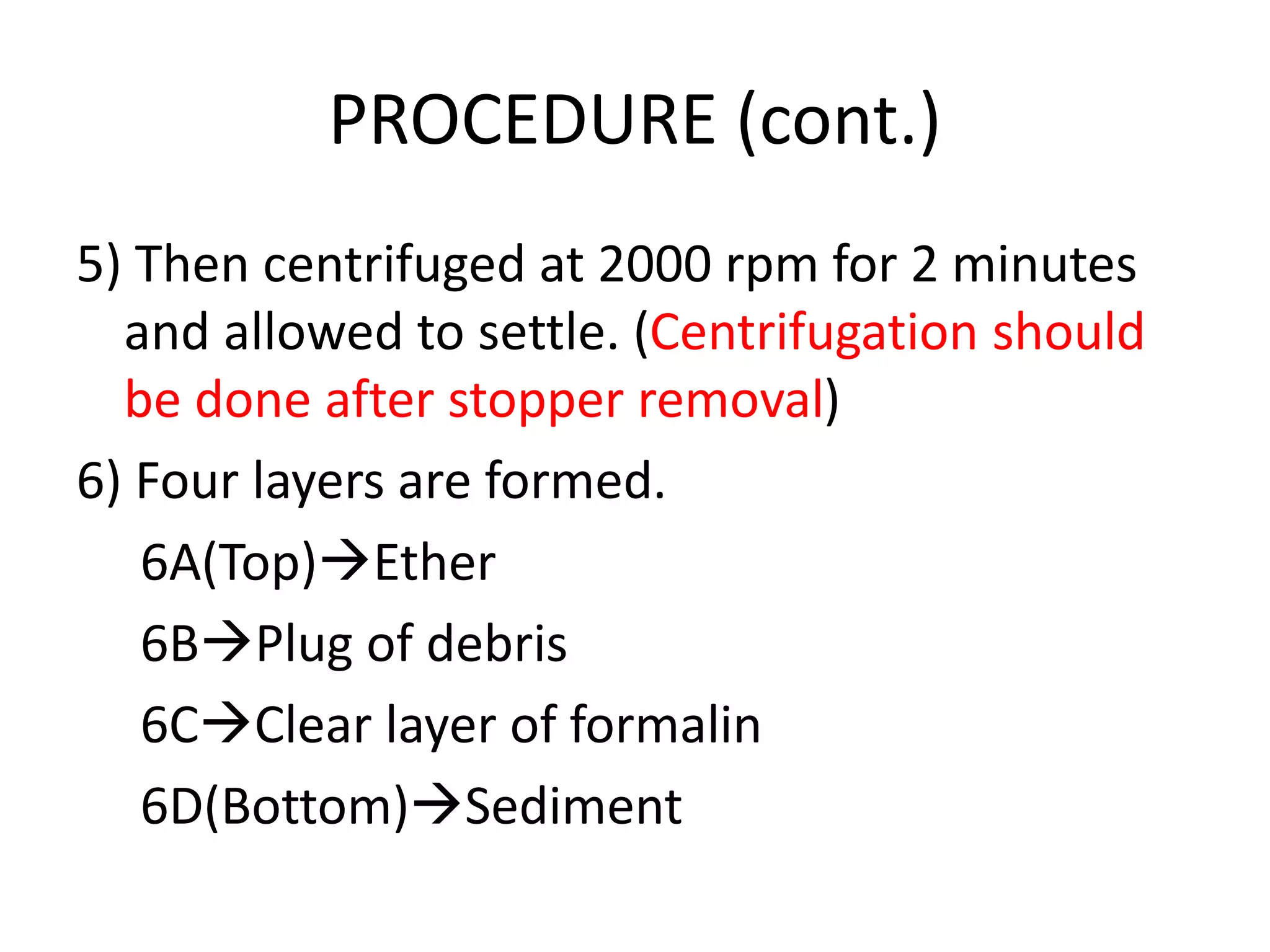
PROCEDURE (cont.)
5) Then centrifuged at 2000 rpm for 2 minutes
and allowed to settle. (Centrifugation should
be done after stopper removal)
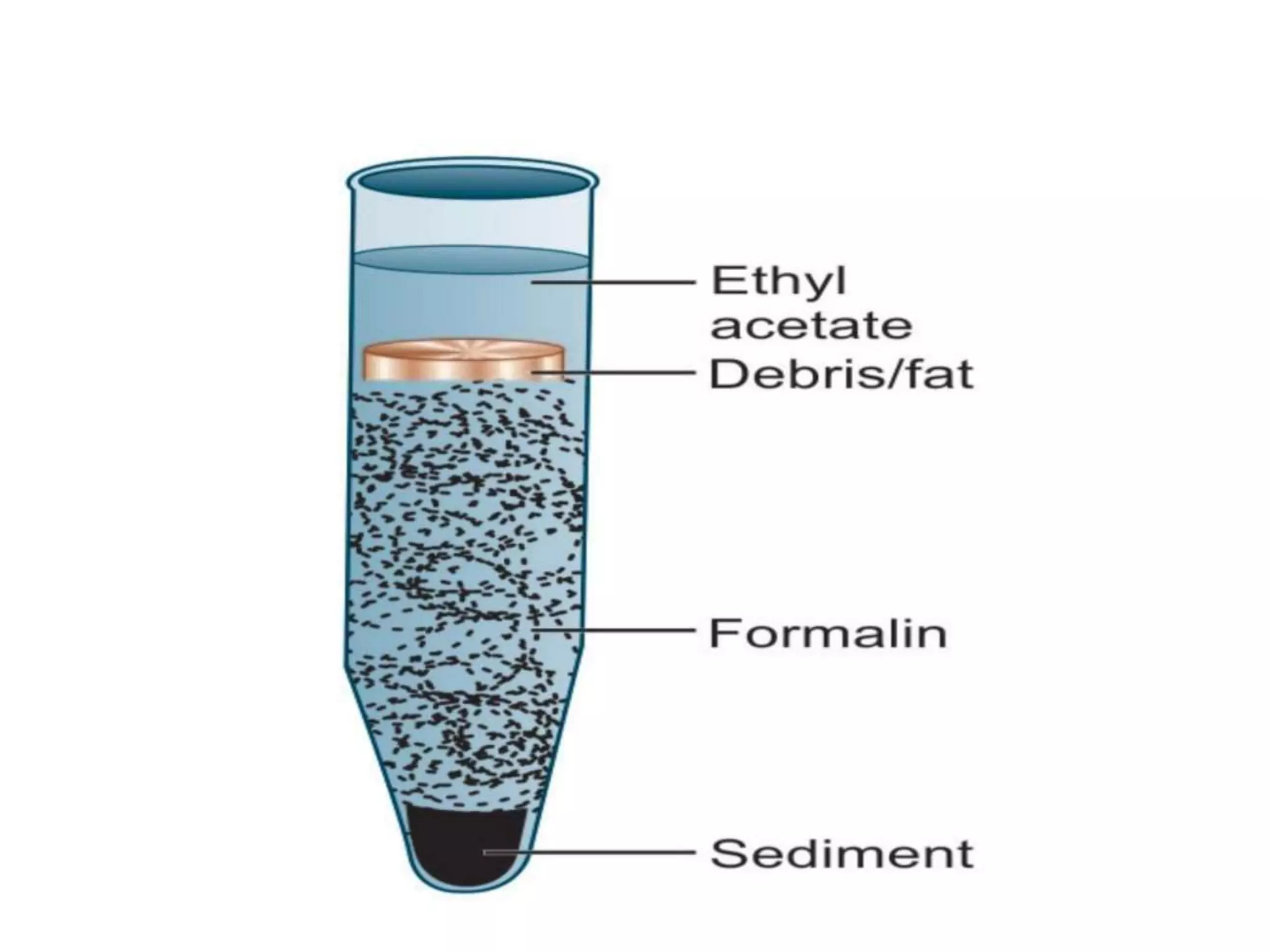
6) Four layers are formed.
6A(Top)Ether
6BPlug of debris
6CClear layer of formalin
6D(Bottom)Sediment
PROCEDURE (cont.)
7) The debris is loosened using a glass rod and
cleared.
8) Supernatant fluid is decanted.
9) The deposit is poured after shaking in a glass
slide to look for saline or iodine mount.
ADVANTAGES
• Increased sensitivity to detection of ova and
cysts since formalin fixes the ova and cysts.
• Size and shape of parasite is maintained.
• Inexpensive and easy to perform.
• Faecal odour is removed using formalin.
• Ether dissolves faecal fats.
• Even formalin kills faecal parasites, so no
laboratory acquired infection.
DISADVANTAGES
TROPHOZOITES CANNOT BE DETECTED
Since ether is explosive, what are all
other alternatives???
• Ethyl acetate
• Acetone
• Hemo-de (Clearing agent)
If we are going to do this sedimentation
technique for formalin preserved stool..THEN???
SKIP STEP 1
(STEP:1 - 1 gram of feces is emulsified in 7 ml of
10% formol-saline and kept for 10 minutes for
fixation)
If the stool contains lot of mucus, then
anything to do????
SKIP STEP 2
(STEP – 2 - Then the mixture is transferred into a
conical centrifuge tube through two layered
gauze)
If the stool is PVA preserved, then....
MODIFICATION OF STEP 1
(STEP:1 - 1 gram of feces is emulsified in 7 ml of
10% formol-saline) No need to wait for 10
minutes, immediately go for STEP 2
BAERMANN CONCENTRATION
METHOD
• Used to see the fecal specimen containing
small number of strongyloides larva.
• PRINCIPLE: Strongyloides larva migrates from
cooler to warmer area.
PROCEDURE
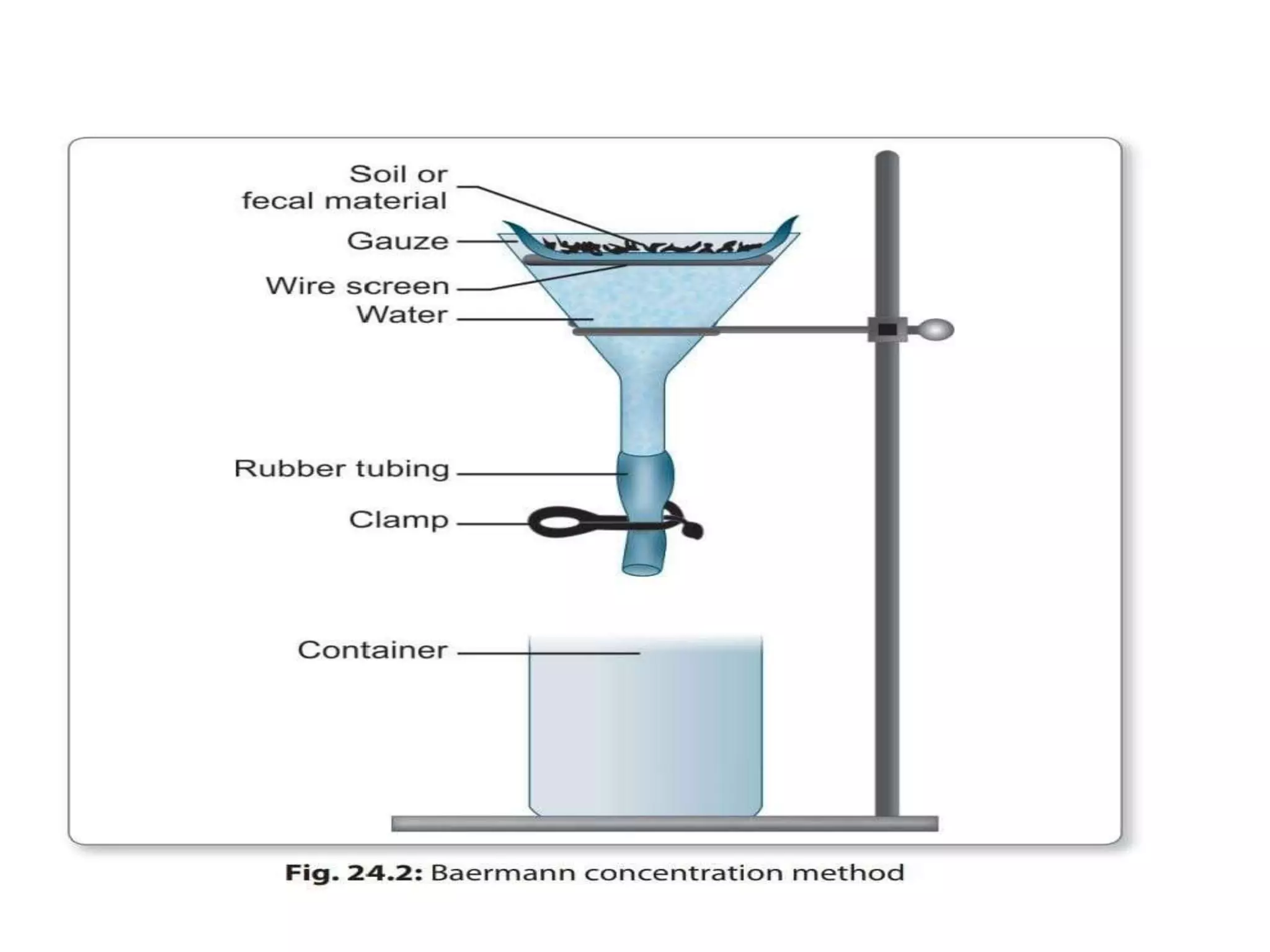
• 5 Grams of feces is placed on the gauze.
• Funnel is filled with warm water and left 1-2
hours to give time for strongyloides larva to
come out from feces.
• After 1-2 hours, clamp of funnel is opened, 7-8
ml of water is collected in beaker.
• Larva migrate downards bottom of the fluid.
• After centrifugation, sediment should be
examined microscopically.
MODIFICATION OF BAERMANN
TECHNIQUE
• Instead of funnel here we are using test tube with
rubber stopper.
• Perforation of rubber stopper to allow insertion
of plastic pipette tip to take out supernatant fluid.
• The tube containing faecal suspension is inverted
over another tube containing 6 ml of saline and
incubated at 37 degrees celsius for 2 hours.
• After centrifuge, saline solution is screened for
larvae.
FLOATATION TECHNIQUE
• Faecal material dissolved in solution of higher
density than that of eggs.
• In this method, eggs will float in superficial
part of the fluid.
• All eggs will float in solution except
(i) Unfertilized eggs of Ascaris lumbricoides
(ii) Eggs of Taenia saginata and Taenia solium
(iii)Eggs of all intestinal flukes.
TYPES OF FLOATATION TECHNIQUE
• Simple / Saturated salt floatation technique
• Direct Centrifugation Floatation / D.C.F
technique
• Zinc sulphate centrifugal floatation technique
SIMPLE SATURATED SALT FLOATATION
TECHNIQUE
Materials required:
• Glass (or) metal container of 15-20 ml capacity
• Glass slide of size 3*2 >> 3*1
• Saturated salt solution of specific gravity of
1.200
• A sheet of glass on which the glass container is
placed.
PROCEDURE
• 1 ml of faeces is taken in container along with
few drops of salt solution.
• Mix it with glass rod or stick to prevent
uneven emulsion.
• Now, add 15 to 20 ml salt solution along with
mixing using glass rod.
• Any coarse matter floats up means, remove it
without any fear (EGGS WILL TAKE MORE
TIME TO FLOAT)
PROCEDURE (cont.)
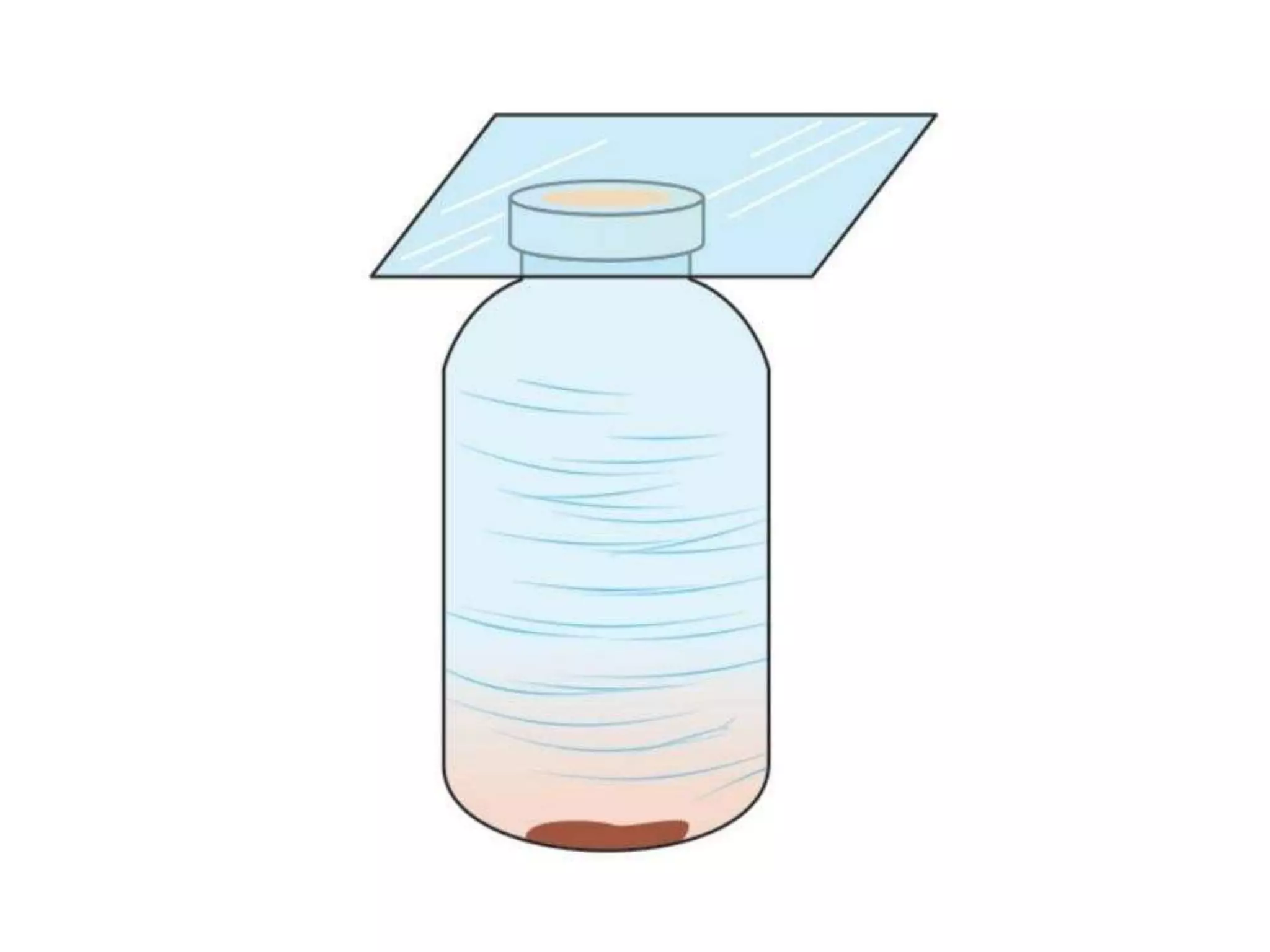
• At this stage, container is placed at clean glass
sheet (EVENFUL surface)
• The final filling of container should be done by
dropper till the time a convex meniscus is
formed.
• A glass slide is carefully laid on the top of the
container so that centre of the slide is in
contact with the fluid.
PROCEDURE (cont.)
• The preparation is allowed to stand for 20 – 30
minutes.
• After which, glass slide is quickly lifted, turned
over smoothly so as to avoid spillage.
• Examined under microscope after putting
coverslip.
LANE’S DIRECT CENTRIFUGAL
FLOATATION TECHNIQUE (D.C.F)
Materials required:
• Special bucket (For containing the centrifugal
tube) with flat bottom and special guard to
keep cover slip in position.
• Special cover slip having 19mm square by 0.5
mm thickness.
• Lane’s centrifugal machine.
PROCEDURE
• 1 (or) 2 gram of faeces mixed with water in a Clayton
Lane’s centrifugal tube.
• Centrifuge the mixture for 2 minutes at 1000 rpm.
• Then supernatant fluid is poured off.
• Add saturated salt solution with specific gravity of
1.200 till the level of brim and then thick cover slip is
put on.
• Centrifuge at 1000 rpm for 2 minutes again.
• Cover slip is quickly lifted off and examine that one
drop undersurface by means of hanging drop method.
FAUST ZINC SULPHATE CENTRIFUGAL
FLOATATION TECHNIQUE
1) 1 gram of faeces is emulsified in 10 ml of
distilled water and kept for 10 minutes for
fixation.
2) Then the mixture is transferred into a conical
centrifuge tube through two layered gauze.
3) The filtrate is collected in a centrifuge tube.
4) Centrifuge the tube at 2500 rpm for 1 minute
repeatedly till the time that supernatant fluid
is clear.
PROCEDURE (cont.)
5) Add 3-4 ml of a 33% zinc sulphate solution having
specific gravity 1.800 along with stirring till top
of the tube. (For formalin preserved stool, zinc
sulphate of specific gravity 1.200 is used)
6) Again centrifuge at 2500 rpm for 1 minute.
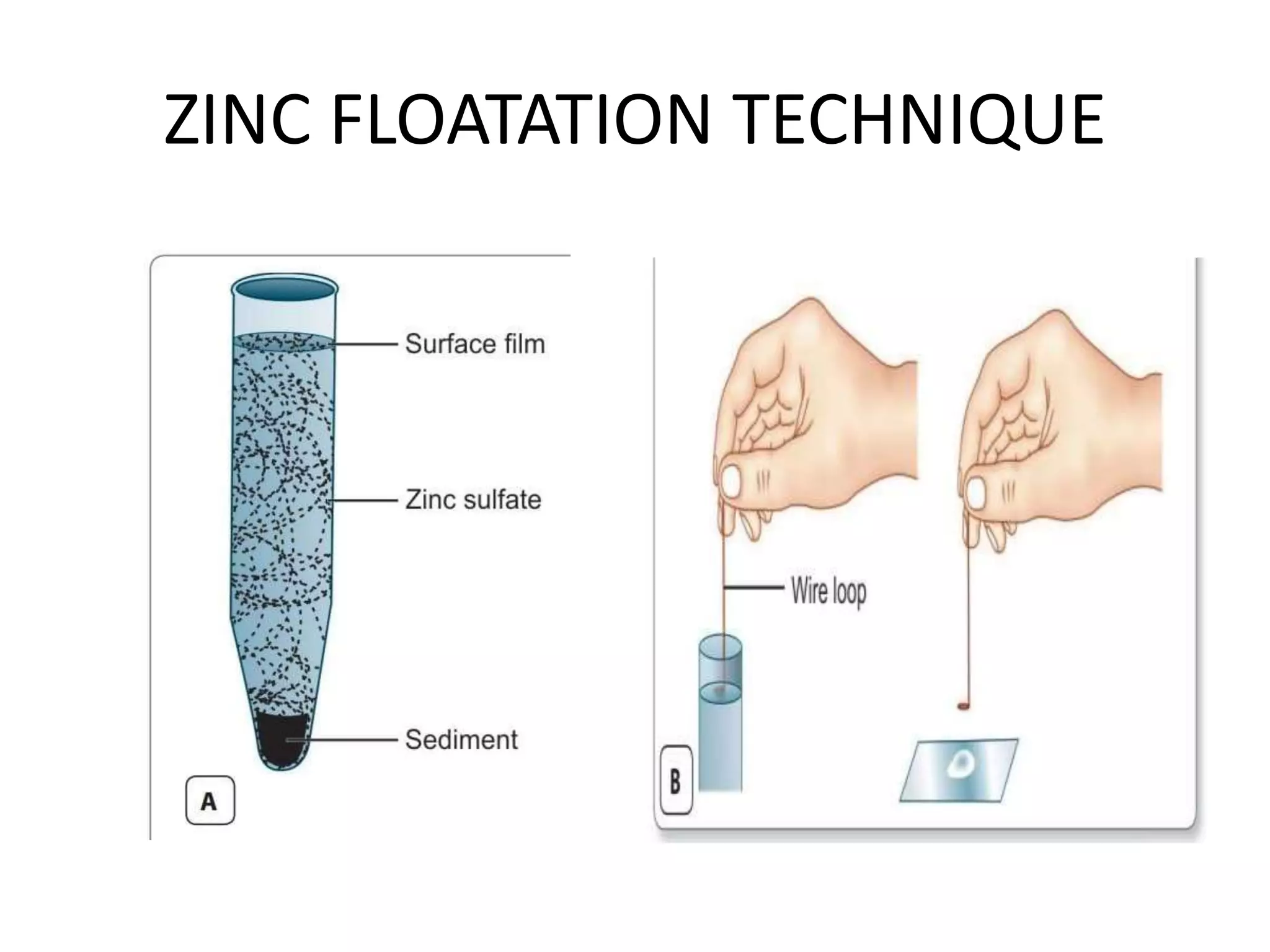
7) The surface film is removed by platinum loop of
5 mm, place it on clean glass slide and then
focus it in microscope after placing cover slip.
The sediment also mounted and examined.
ZINC FLOATATION TECHNIQUE
SHEATHER’S SUGAR FLOATATION
TECHNIQUE
• Used for detection of Cryptosporidia infection.
THANK YOU

STOOL CONCENTRATION METHODS

  • 1.
    STOOL CONCENTRATION METHODS Dr.P.B.PRAVEENKUMAR FIRST YEARPOST GRADUATE DEPARTMENT OF MICROBIOLOGY THANJAVUR MEDICAL COLLEGE
  • 2.
    When will wego for concentration of the stool specimen???? • If the parasite output is low. • Whenever epidemiological analysis is needed. • To assess prognosis. NOTE: Eggs, cysts and larvae can be seen. Trophozoites get destroyed.
  • 3.
    TYPES OF CONCENTRATIONMETHODS • Sedimentation • Floatation
  • 4.
    SEDIMENTATION METHODS • Eggsand cysts settle down at the bottom following centrifugation. TYPES: • Simple sedimentation technique • Formalin-ether concentration technique • Formalin-ethyl acetate concentration technique • Formalin-acetone sedimentation technique • Formalin-hemo-de sedimentation technique
  • 5.
    PRINCIPLE • Concentration ofstool specimen by centrifugation • Concentrated at the bottom of the tube since they have greater density than the suspending medium
  • 6.
    SIMPLE SEDIMENTATION • Significantamount of faeces is thoroughly mixed with 10-20 times of tap water and shaken several times. • Then allow that diluted faeces sample to settle it in a conical flask for 1 to 2 hours. • Repeat several times till the time supernatant fluid is clear.
  • 7.
    PROCEDURE (Modified Ritchief’s methodby Ridley and Hagwood, 1956) 1) 1 gram of feces is emulsified in 7 ml of 10% formol-saline and kept for 10 minutes for fixation. 2) Then the mixture is transferred into a conical centrifuge tube through two layered gauze. 3) The filtrate is collected in a centrifuge tube. 4) 3 ml of ether is added in centrifuge tube and close the tube using stopper, mix vigorously for 1 minute.
  • 8.
    PROCEDURE (cont.) 5) Thencentrifuged at 2000 rpm for 2 minutes and allowed to settle. (Centrifugation should be done after stopper removal) 6) Four layers are formed. 6A(Top)Ether 6BPlug of debris 6CClear layer of formalin 6D(Bottom)Sediment
  • 10.
    PROCEDURE (cont.) 7) Thedebris is loosened using a glass rod and cleared. 8) Supernatant fluid is decanted. 9) The deposit is poured after shaking in a glass slide to look for saline or iodine mount.
  • 11.
    ADVANTAGES • Increased sensitivityto detection of ova and cysts since formalin fixes the ova and cysts. • Size and shape of parasite is maintained. • Inexpensive and easy to perform. • Faecal odour is removed using formalin. • Ether dissolves faecal fats. • Even formalin kills faecal parasites, so no laboratory acquired infection.
  • 12.
  • 13.
    Since ether isexplosive, what are all other alternatives??? • Ethyl acetate • Acetone • Hemo-de (Clearing agent)
  • 14.
    If we aregoing to do this sedimentation technique for formalin preserved stool..THEN??? SKIP STEP 1 (STEP:1 - 1 gram of feces is emulsified in 7 ml of 10% formol-saline and kept for 10 minutes for fixation)
  • 15.
    If the stoolcontains lot of mucus, then anything to do???? SKIP STEP 2 (STEP – 2 - Then the mixture is transferred into a conical centrifuge tube through two layered gauze)
  • 16.
    If the stoolis PVA preserved, then.... MODIFICATION OF STEP 1 (STEP:1 - 1 gram of feces is emulsified in 7 ml of 10% formol-saline) No need to wait for 10 minutes, immediately go for STEP 2
  • 17.
    BAERMANN CONCENTRATION METHOD • Usedto see the fecal specimen containing small number of strongyloides larva. • PRINCIPLE: Strongyloides larva migrates from cooler to warmer area.
  • 19.
    PROCEDURE • 5 Gramsof feces is placed on the gauze. • Funnel is filled with warm water and left 1-2 hours to give time for strongyloides larva to come out from feces. • After 1-2 hours, clamp of funnel is opened, 7-8 ml of water is collected in beaker. • Larva migrate downards bottom of the fluid. • After centrifugation, sediment should be examined microscopically.
  • 20.
    MODIFICATION OF BAERMANN TECHNIQUE •Instead of funnel here we are using test tube with rubber stopper. • Perforation of rubber stopper to allow insertion of plastic pipette tip to take out supernatant fluid. • The tube containing faecal suspension is inverted over another tube containing 6 ml of saline and incubated at 37 degrees celsius for 2 hours. • After centrifuge, saline solution is screened for larvae.
  • 21.
    FLOATATION TECHNIQUE • Faecalmaterial dissolved in solution of higher density than that of eggs. • In this method, eggs will float in superficial part of the fluid. • All eggs will float in solution except (i) Unfertilized eggs of Ascaris lumbricoides (ii) Eggs of Taenia saginata and Taenia solium (iii)Eggs of all intestinal flukes.
  • 23.
    TYPES OF FLOATATIONTECHNIQUE • Simple / Saturated salt floatation technique • Direct Centrifugation Floatation / D.C.F technique • Zinc sulphate centrifugal floatation technique
  • 24.
    SIMPLE SATURATED SALTFLOATATION TECHNIQUE Materials required: • Glass (or) metal container of 15-20 ml capacity • Glass slide of size 3*2 >> 3*1 • Saturated salt solution of specific gravity of 1.200 • A sheet of glass on which the glass container is placed.
  • 25.
    PROCEDURE • 1 mlof faeces is taken in container along with few drops of salt solution. • Mix it with glass rod or stick to prevent uneven emulsion. • Now, add 15 to 20 ml salt solution along with mixing using glass rod. • Any coarse matter floats up means, remove it without any fear (EGGS WILL TAKE MORE TIME TO FLOAT)
  • 26.
    PROCEDURE (cont.) • Atthis stage, container is placed at clean glass sheet (EVENFUL surface) • The final filling of container should be done by dropper till the time a convex meniscus is formed. • A glass slide is carefully laid on the top of the container so that centre of the slide is in contact with the fluid.
  • 27.
    PROCEDURE (cont.) • Thepreparation is allowed to stand for 20 – 30 minutes. • After which, glass slide is quickly lifted, turned over smoothly so as to avoid spillage. • Examined under microscope after putting coverslip.
  • 28.
    LANE’S DIRECT CENTRIFUGAL FLOATATIONTECHNIQUE (D.C.F) Materials required: • Special bucket (For containing the centrifugal tube) with flat bottom and special guard to keep cover slip in position. • Special cover slip having 19mm square by 0.5 mm thickness. • Lane’s centrifugal machine.
  • 29.
    PROCEDURE • 1 (or)2 gram of faeces mixed with water in a Clayton Lane’s centrifugal tube. • Centrifuge the mixture for 2 minutes at 1000 rpm. • Then supernatant fluid is poured off. • Add saturated salt solution with specific gravity of 1.200 till the level of brim and then thick cover slip is put on. • Centrifuge at 1000 rpm for 2 minutes again. • Cover slip is quickly lifted off and examine that one drop undersurface by means of hanging drop method.
  • 30.
    FAUST ZINC SULPHATECENTRIFUGAL FLOATATION TECHNIQUE 1) 1 gram of faeces is emulsified in 10 ml of distilled water and kept for 10 minutes for fixation. 2) Then the mixture is transferred into a conical centrifuge tube through two layered gauze. 3) The filtrate is collected in a centrifuge tube. 4) Centrifuge the tube at 2500 rpm for 1 minute repeatedly till the time that supernatant fluid is clear.
  • 31.
    PROCEDURE (cont.) 5) Add3-4 ml of a 33% zinc sulphate solution having specific gravity 1.800 along with stirring till top of the tube. (For formalin preserved stool, zinc sulphate of specific gravity 1.200 is used) 6) Again centrifuge at 2500 rpm for 1 minute. 7) The surface film is removed by platinum loop of 5 mm, place it on clean glass slide and then focus it in microscope after placing cover slip. The sediment also mounted and examined.
  • 32.
  • 33.
    SHEATHER’S SUGAR FLOATATION TECHNIQUE •Used for detection of Cryptosporidia infection.
  • 34.