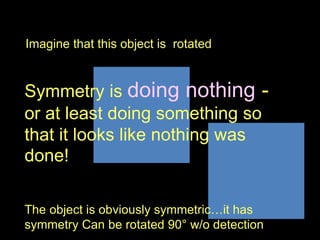
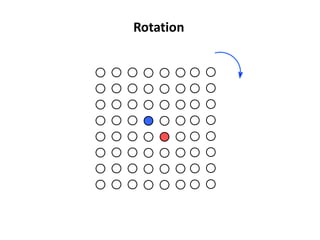
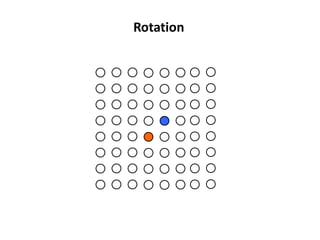
Imagine that this object is rotated
The object is obviously symmetric…it has
symmetry Can be rotated 90° w/o detection
Symmetry is doing nothing -
or at least doing something so
that it looks like nothing was
done!
Repetition = Symmetry
Translation
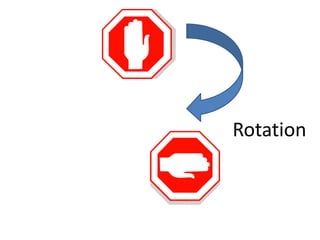
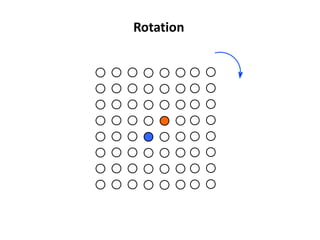
Rotation
Reflection
Inversion
and
Combination of these……………….
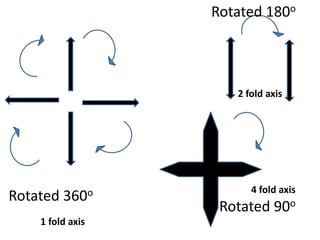
Rotated 360o
Rotated 180o
Rotated 90o
1 fold axis
2 fold axis
4 fold axis
n-fold Rotation
1-Fold Rotation Axis - An object that requires
rotation of a full 360o in order to restore it to
its original appearance . Since it repeats itself
1 time every 360o it is said to have a 1-fold axis
of rotational symmetry.
2-fold Rotation Axis - If an object appears
identical after a rotation of 180o, that is twice
in a 360o rotation, then it is said to have a 2-
fold rotation axis (360/2= 180).
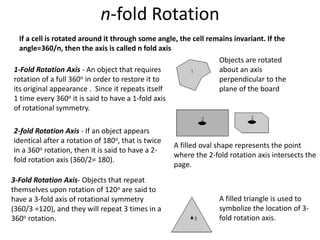
Objects are rotated
about an axis
perpendicular to the
plane of the board
A filled oval shape represents the point
where the 2-fold rotation axis intersects the
page.
3-Fold Rotation Axis- Objects that repeat
themselves upon rotation of 120o are said to
have a 3-fold axis of rotational symmetry
(360/3 =120), and they will repeat 3 times in a
360o rotation.
If a cell is rotated around it through some angle, the cell remains invariant. If the
angle=360/n, then the axis is called n fold axis
A filled triangle is used to
symbolize the location of 3-
fold rotation axis.
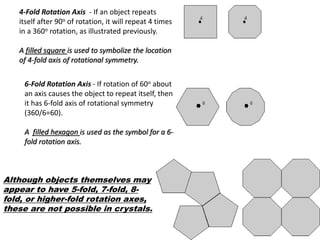
4-Fold Rotation Axis - If an object repeats
itself after 90o of rotation, it will repeat 4 times
in a 360o rotation, as illustrated previously.
A filled square is used to symbolize the location
of 4-fold axis of rotational symmetry.
6-Fold Rotation Axis - If rotation of 60o about
an axis causes the object to repeat itself, then
it has 6-fold axis of rotational symmetry
(360/6=60).
A filled hexagon is used as the symbol for a 6-
fold rotation axis.
Although objects themselves may
appear to have 5-fold, 7-fold, 8-
fold, or higher-fold rotation axes,
these are not possible in crystals.
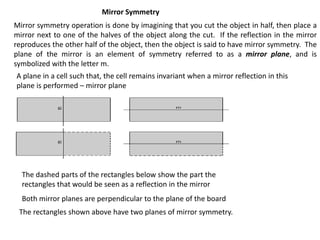
Mirror Symmetry
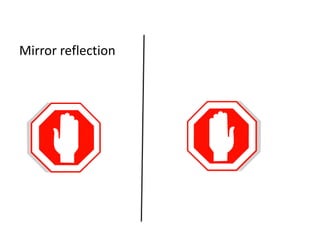
Mirror symmetry operation is done by imagining that you cut the object in half, then place a
mirror next to one of the halves of the object along the cut. If the reflection in the mirror
reproduces the other half of the object, then the object is said to have mirror symmetry. The
plane of the mirror is an element of symmetry referred to as a mirror plane, and is
symbolized with the letter m.
The dashed parts of the rectangles below show the part the
rectangles that would be seen as a reflection in the mirror
The rectangles shown above have two planes of mirror symmetry.
Both mirror planes are perpendicular to the plane of the board
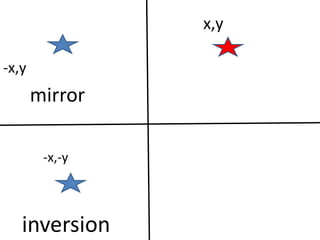
A plane in a cell such that, the cell remains invariant when a mirror reflection in this
plane is performed – mirror plane
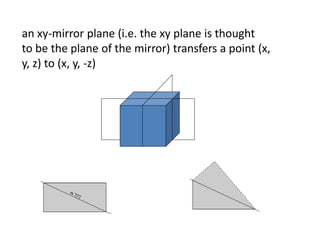
an xy-mirror plane (i.e. the xy plane is thought
to be the plane of the mirror) transfers a point (x,
y, z) to (x, y, -z)
Rotation
Mirror reflection
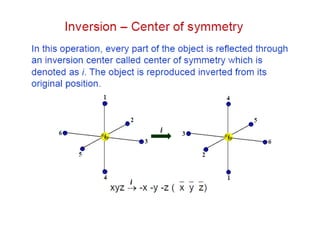
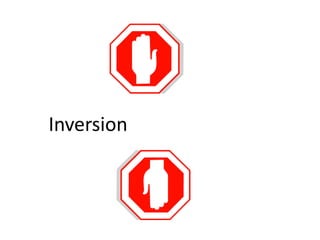
Inversion
x,y
-x,y
-x,-y
mirror
inversion
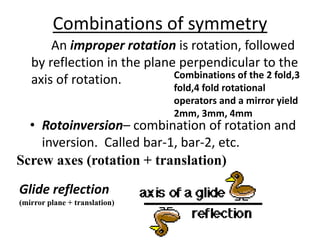
An improper rotation is rotation, followed
by reflection in the plane perpendicular to the
axis of rotation.
Combinations of symmetry
Combinations of the 2 fold,3
fold,4 fold rotational
operators and a mirror yield
2mm, 3mm, 4mm
• Rotoinversion– combination of rotation and
inversion. Called bar-1, bar-2, etc.
Glide reflection
(mirror plane + translation)
Screw axes (rotation + translation)
Translation
Translation
Translation
Rotation
Rotation
Rotation
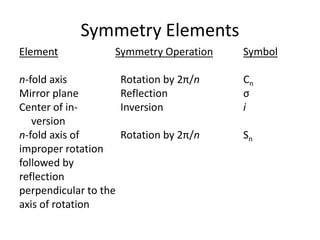
Symmetry is defined in terms of elements and
operations.
Element – an axis, a plane, a point.
Operation – rotation, reflection, inversion.
An operation is symmetric if the resulting object
is identical to the original one.
Symmetry Elements
Symmetry Elements
Element Symmetry Operation Symbol
n-fold axis Rotation by 2π/n Cn
Mirror plane Reflection σ
Center of in- Inversion i
version
n-fold axis of Rotation by 2π/n Sn
improper rotation
followed by
reflection
perpendicular to the
axis of rotation

symmetry in solid state physics rotation

  • 1.
    Imagine that thisobject is rotated The object is obviously symmetric…it has symmetry Can be rotated 90° w/o detection Symmetry is doing nothing - or at least doing something so that it looks like nothing was done!
  • 2.
  • 3.
    Rotated 360o Rotated 180o Rotated90o 1 fold axis 2 fold axis 4 fold axis
  • 4.
    n-fold Rotation 1-Fold RotationAxis - An object that requires rotation of a full 360o in order to restore it to its original appearance . Since it repeats itself 1 time every 360o it is said to have a 1-fold axis of rotational symmetry. 2-fold Rotation Axis - If an object appears identical after a rotation of 180o, that is twice in a 360o rotation, then it is said to have a 2- fold rotation axis (360/2= 180). Objects are rotated about an axis perpendicular to the plane of the board A filled oval shape represents the point where the 2-fold rotation axis intersects the page. 3-Fold Rotation Axis- Objects that repeat themselves upon rotation of 120o are said to have a 3-fold axis of rotational symmetry (360/3 =120), and they will repeat 3 times in a 360o rotation. If a cell is rotated around it through some angle, the cell remains invariant. If the angle=360/n, then the axis is called n fold axis A filled triangle is used to symbolize the location of 3- fold rotation axis.
  • 5.
    4-Fold Rotation Axis- If an object repeats itself after 90o of rotation, it will repeat 4 times in a 360o rotation, as illustrated previously. A filled square is used to symbolize the location of 4-fold axis of rotational symmetry. 6-Fold Rotation Axis - If rotation of 60o about an axis causes the object to repeat itself, then it has 6-fold axis of rotational symmetry (360/6=60). A filled hexagon is used as the symbol for a 6- fold rotation axis. Although objects themselves may appear to have 5-fold, 7-fold, 8- fold, or higher-fold rotation axes, these are not possible in crystals.
  • 6.
    Mirror Symmetry Mirror symmetryoperation is done by imagining that you cut the object in half, then place a mirror next to one of the halves of the object along the cut. If the reflection in the mirror reproduces the other half of the object, then the object is said to have mirror symmetry. The plane of the mirror is an element of symmetry referred to as a mirror plane, and is symbolized with the letter m. The dashed parts of the rectangles below show the part the rectangles that would be seen as a reflection in the mirror The rectangles shown above have two planes of mirror symmetry. Both mirror planes are perpendicular to the plane of the board A plane in a cell such that, the cell remains invariant when a mirror reflection in this plane is performed – mirror plane
  • 7.
    an xy-mirror plane(i.e. the xy plane is thought to be the plane of the mirror) transfers a point (x, y, z) to (x, y, -z)
  • 8.
  • 9.
  • 10.
  • 11.
  • 13.
    An improper rotationis rotation, followed by reflection in the plane perpendicular to the axis of rotation. Combinations of symmetry Combinations of the 2 fold,3 fold,4 fold rotational operators and a mirror yield 2mm, 3mm, 4mm • Rotoinversion– combination of rotation and inversion. Called bar-1, bar-2, etc. Glide reflection (mirror plane + translation) Screw axes (rotation + translation)
  • 14.
  • 15.
  • 16.
  • 17.
  • 18.
  • 19.
  • 20.
    Symmetry is definedin terms of elements and operations. Element – an axis, a plane, a point. Operation – rotation, reflection, inversion. An operation is symmetric if the resulting object is identical to the original one. Symmetry Elements
  • 22.
    Symmetry Elements Element SymmetryOperation Symbol n-fold axis Rotation by 2π/n Cn Mirror plane Reflection σ Center of in- Inversion i version n-fold axis of Rotation by 2π/n Sn improper rotation followed by reflection perpendicular to the axis of rotation