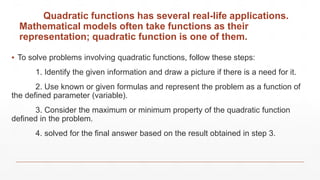
Quadratic functions has several real-life applications.
Mathematical models often take functions as their
representation; quadratic function is one of them.
▪ To solve problems involving quadratic functions, follow these steps:
1. Identify the given information and draw a picture if there is a need for it.
2. Use known or given formulas and represent the problem as a function of
the defined parameter (variable).
3. Consider the maximum or minimum property of the quadratic function
defined in the problem.
4. solved for the final answer based on the result obtained in step 3.
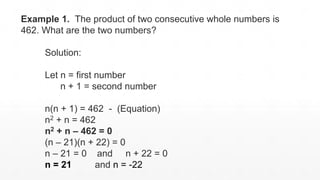
Example 1. The product of two consecutive whole numbers is
462. What are the two numbers?
Solution:
Let n = first number
n + 1 = second number
n(n + 1) = 462 - (Equation)
n2 + n = 462
n2 + n – 462 = 0
(n – 21)(n + 22) = 0
n – 21 = 0 and n + 22 = 0
n = 21 and n = -22
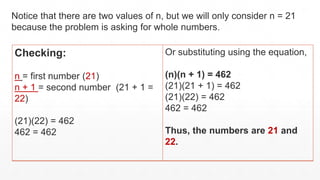
Checking:
n = first number (21)
n + 1 = second number (21 + 1 =
22)
(21)(22) = 462
462 = 462
Or substituting using the equation,
(n)(n + 1) = 462
(21)(21 + 1) = 462
(21)(22) = 462
462 = 462
Thus, the numbers are 21 and
22.
Notice that there are two values of n, but we will only consider n = 21
because the problem is asking for whole numbers.
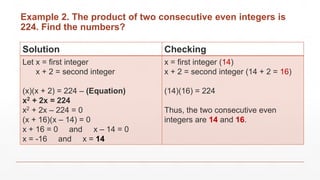
Example 2. The product of two consecutive even integers is
224. Find the numbers?
Solution Checking
Let x = first integer
x + 2 = second integer
(x)(x + 2) = 224 – (Equation)
x2 + 2x = 224
x2 + 2x – 224 = 0
(x + 16)(x – 14) = 0
x + 16 = 0 and x – 14 = 0
x = -16 and x = 14
x = first integer (14)
x + 2 = second integer (14 + 2 = 16)
(14)(16) = 224
Thus, the two consecutive even
integers are 14 and 16.
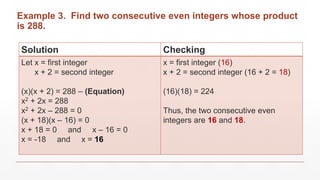
Example 3. Find two consecutive even integers whose product
is 288.
Solution Checking
Let x = first integer
x + 2 = second integer
(x)(x + 2) = 288 – (Equation)
x2 + 2x = 288
x2 + 2x – 288 = 0
(x + 18)(x – 16) = 0
x + 18 = 0 and x – 16 = 0
x = -18 and x = 16
x = first integer (16)
x + 2 = second integer (16 + 2 = 18)
(16)(18) = 224
Thus, the two consecutive even
integers are 16 and 18.
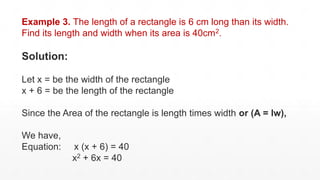
Example 3. The length of a rectangle is 6 cm long than its width.
Find its length and width when its area is 40cm2.
Solution:
Let x = be the width of the rectangle
x + 6 = be the length of the rectangle
Since the Area of the rectangle is length times width or (A = lw),
We have,
Equation: x (x + 6) = 40
x2 + 6x = 40
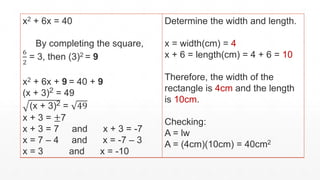
x2 + 6x = 40
By completing the square,
6
2
= 3, then (3)2 = 9
x2 + 6x + 9 = 40 + 9
(x + 3)2 = 49
(x + 3)2 = 49
x + 3 = ±7
x + 3 = 7 and x + 3 = -7
x = 7 – 4 and x = -7 – 3
x = 3 and x = -10
Determine the width and length.
x = width(cm) = 4
x + 6 = length(cm) = 4 + 6 = 10
Therefore, the width of the
rectangle is 4cm and the length
is 10cm.
Checking:
A = lw
A = (4cm)(10cm) = 40cm2
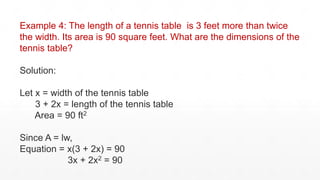
Example 4: The length of a tennis table is 3 feet more than twice
the width. Its area is 90 square feet. What are the dimensions of the
tennis table?
Solution:
Let x = width of the tennis table
3 + 2x = length of the tennis table
Area = 90 ft2
Since A = lw,
Equation = x(3 + 2x) = 90
3x + 2x2 = 90
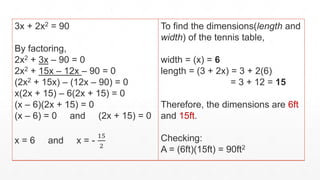
3x + 2x2 = 90
By factoring,
2x2 + 3x – 90 = 0
2x2 + 15x – 12x – 90 = 0
(2x2 + 15x) – (12x – 90) = 0
x(2x + 15) – 6(2x + 15) = 0
(x – 6)(2x + 15) = 0
(x – 6) = 0 and (2x + 15) = 0
x = 6 and x = -
15
2
To find the dimensions(length and
width) of the tennis table,
width = (x) = 6
length = (3 + 2x) = 3 + 2(6)
= 3 + 12 = 15
Therefore, the dimensions are 6ft
and 15ft.
Checking:
A = (6ft)(15ft) = 90ft2
Quadratic functions and their application

Quadratic functions and their application

  • 2.
    Quadratic functions hasseveral real-life applications. Mathematical models often take functions as their representation; quadratic function is one of them. ▪ To solve problems involving quadratic functions, follow these steps: 1. Identify the given information and draw a picture if there is a need for it. 2. Use known or given formulas and represent the problem as a function of the defined parameter (variable). 3. Consider the maximum or minimum property of the quadratic function defined in the problem. 4. solved for the final answer based on the result obtained in step 3.
  • 3.
    Example 1. Theproduct of two consecutive whole numbers is 462. What are the two numbers? Solution: Let n = first number n + 1 = second number n(n + 1) = 462 - (Equation) n2 + n = 462 n2 + n – 462 = 0 (n – 21)(n + 22) = 0 n – 21 = 0 and n + 22 = 0 n = 21 and n = -22
  • 4.
    Checking: n = firstnumber (21) n + 1 = second number (21 + 1 = 22) (21)(22) = 462 462 = 462 Or substituting using the equation, (n)(n + 1) = 462 (21)(21 + 1) = 462 (21)(22) = 462 462 = 462 Thus, the numbers are 21 and 22. Notice that there are two values of n, but we will only consider n = 21 because the problem is asking for whole numbers.
  • 5.
    Example 2. Theproduct of two consecutive even integers is 224. Find the numbers? Solution Checking Let x = first integer x + 2 = second integer (x)(x + 2) = 224 – (Equation) x2 + 2x = 224 x2 + 2x – 224 = 0 (x + 16)(x – 14) = 0 x + 16 = 0 and x – 14 = 0 x = -16 and x = 14 x = first integer (14) x + 2 = second integer (14 + 2 = 16) (14)(16) = 224 Thus, the two consecutive even integers are 14 and 16.
  • 6.
    Example 3. Findtwo consecutive even integers whose product is 288. Solution Checking Let x = first integer x + 2 = second integer (x)(x + 2) = 288 – (Equation) x2 + 2x = 288 x2 + 2x – 288 = 0 (x + 18)(x – 16) = 0 x + 18 = 0 and x – 16 = 0 x = -18 and x = 16 x = first integer (16) x + 2 = second integer (16 + 2 = 18) (16)(18) = 224 Thus, the two consecutive even integers are 16 and 18.
  • 7.
    Example 3. Thelength of a rectangle is 6 cm long than its width. Find its length and width when its area is 40cm2. Solution: Let x = be the width of the rectangle x + 6 = be the length of the rectangle Since the Area of the rectangle is length times width or (A = lw), We have, Equation: x (x + 6) = 40 x2 + 6x = 40
  • 8.
    x2 + 6x= 40 By completing the square, 6 2 = 3, then (3)2 = 9 x2 + 6x + 9 = 40 + 9 (x + 3)2 = 49 (x + 3)2 = 49 x + 3 = ±7 x + 3 = 7 and x + 3 = -7 x = 7 – 4 and x = -7 – 3 x = 3 and x = -10 Determine the width and length. x = width(cm) = 4 x + 6 = length(cm) = 4 + 6 = 10 Therefore, the width of the rectangle is 4cm and the length is 10cm. Checking: A = lw A = (4cm)(10cm) = 40cm2
  • 9.
    Example 4: Thelength of a tennis table is 3 feet more than twice the width. Its area is 90 square feet. What are the dimensions of the tennis table? Solution: Let x = width of the tennis table 3 + 2x = length of the tennis table Area = 90 ft2 Since A = lw, Equation = x(3 + 2x) = 90 3x + 2x2 = 90
  • 10.
    3x + 2x2= 90 By factoring, 2x2 + 3x – 90 = 0 2x2 + 15x – 12x – 90 = 0 (2x2 + 15x) – (12x – 90) = 0 x(2x + 15) – 6(2x + 15) = 0 (x – 6)(2x + 15) = 0 (x – 6) = 0 and (2x + 15) = 0 x = 6 and x = - 15 2 To find the dimensions(length and width) of the tennis table, width = (x) = 6 length = (3 + 2x) = 3 + 2(6) = 3 + 12 = 15 Therefore, the dimensions are 6ft and 15ft. Checking: A = (6ft)(15ft) = 90ft2