

NUTRITIONAL CLASSIFICATION OF MICROBES
Lecture by:
Dr. Aswartha Harinath Reddy M.Sc, Ph.D
Department of Life Sciences
Srikrishnadevaraya University
Anantapur –A.P. India
10
The microbial cell composition shows that over 95% of cell dry
weight is made up carbon, oxygen, hydrogen, nitrogen, sulfur,
phosphorus (C, O, H, N, S, P), potassium, calcium, magnesium,
and iron (K, Ca, Mg, and Fe).
These are called macroelements or macronutrients because
they are required by microorganisms in relatively large
amounts.
The first six (C, O, H, N, S, and P) are components of
carbohydrates, lipids, proteins, and nucleic acids.
The remaining four macroelements exist in the cell as cations and
play a variety of roles.
For example, potassium (K+) is required for activity by a number of
enzymes (Co-factor enzymes).
Ex: Aminoacyl tRNA synthetase, Pyruvate kinase.
Calcium (Ca2+), contributes to the heat resistance of bacterial
endospores.
Magnesium (Mg2+) serves as a cofactor for many enzymes, like
ATPase, Kinases and stabilizes ribosomes and cell membranes.
 Iron (Fe2+ and Fe3+) is a part of cytochromes and a cofactor for
enzymes like catalase, peroxidase and electron-carrying proteins.
All organisms, including microorganisms, require several
micronutrients or trace elements besides macroelements.
The micronutrients manganese, zinc, cobalt, nickel, molybdenum, and
copper are needed by most cells.
 For example, zinc (Zn2+) is a co-factor for DNA Polymerase and
Alcoholic dehydrogenase.
Manganese (Mn2+) is a co-factor for Superoxide dismutase (SOD).
Molybdenum (Mo2+) is required for nitrogen fixation and cofactor
Nitrogenase and Nitrate reductase.
Cobalt (Co2+) is a major component of vitamin B12.
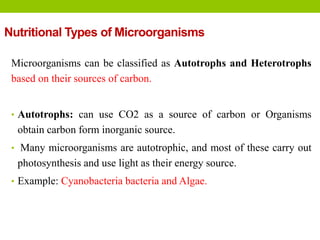
Nutritional Types of Microorganisms
Microorganisms can be classified as Autotrophs and Heterotrophs
based on their sources of carbon.
• Autotrophs: can use CO2 as a source of carbon or Organisms
obtain carbon form inorganic source.
• Many microorganisms are autotrophic, and most of these carry out
photosynthesis and use light as their energy source.
• Example: Cyanobacteria bacteria and Algae.
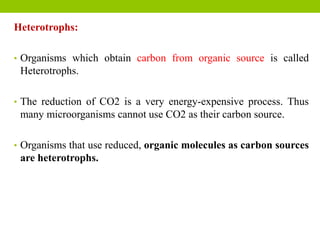
Heterotrophs:
• Organisms which obtain carbon from organic source is called
Heterotrophs.
• The reduction of CO2 is a very energy-expensive process. Thus
many microorganisms cannot use CO2 as their carbon source.
• Organisms that use reduced, organic molecules as carbon sources
are heterotrophs.
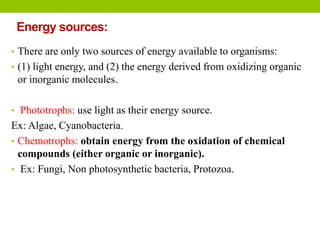
Energy sources:
• There are only two sources of energy available to organisms:
• (1) light energy, and (2) the energy derived from oxidizing organic
or inorganic molecules.
• Phototrophs: use light as their energy source.
Ex: Algae, Cyanobacteria.
• Chemotrophs: obtain energy from the oxidation of chemical
compounds (either organic or inorganic).
• Ex: Fungi, Non photosynthetic bacteria, Protozoa.
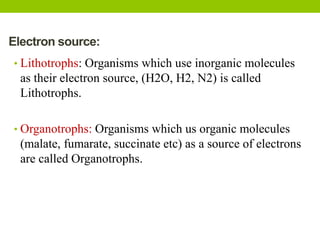
Electron source:
• Lithotrophs: Organisms which use inorganic molecules
as their electron source, (H2O, H2, N2) is called
Lithotrophs.
• Organotrophs: Organisms which us organic molecules
(malate, fumarate, succinate etc) as a source of electrons
are called Organotrophs.
Based on energy, carbon and electron source
1. Photolithoautotrophs
2. Photoorganoheterotrophs
3. Chemolithoautotrophs
4. Chemoorganoheterotrophs
Photolithoautotrophs
Organisms obtain energy form sun light and carbon,
electrons form inorganic source are called
Photolithoautotrophs.
Example: Purple and green sulfur bacteria, cyanobacteria
and algae.
Photoorganoheterotrophs:
• Also know as photoorganotrophs or photoheterotrophs.
• Organisms which obtain energy form sun light and carbon,
electrons form organic molecules.
Ex: Purple nonsulfur bacteria and Green nonsulfur bacteria.
Chemolithoautotrophs:
• Also know as chemoautotrophs or chemolithotrophs.
• Organisms which use inorganic substance as source of
energy, carbon and electrons are called
Chemolithotrophs.
Example: Sulfur-oxidizing bacteria, Nitrifying bacteria and
Iron-oxidizing bacteria.
Chemoorganoheterotrophs
• Also known as Chemoorganotrophs or Chemoheterotrophs.
• Organisms which obtain energy, carbon and electrons form
organic sources are called Chemoorganoheterotrophs.
Examples are: E. coli, Salmonella, Fungi, Protozoa.
The dominant group of organisms present in nature are
Chemoheterotrophs.
Mixotrophs:
• Organisms which survive both as Autotrophs and
heterotrophs.
• These microorganisms use both organic and inorganic
substances as a source of carbon.
• Examples are: Bacillus licheniformis
Methylotrophs:
• Methylotrophs are a diverse group of microorganisms that
can use reduced one-carbon compounds, such as methanol
or methane, as the carbon source for their growth.
• Some methylotrophs can degrade the greenhouse gas
methane, and in this case they are called Methanotrophs.
• Examples are: Metylococcus, Methylomonas.
• Auxotroph: Organisms which cannot synthesize essential
components form raw material available in the medium is
called Auxotrophs.
• Medium with out growth factors is called Minimal medium.
• Prototroph: An organism or cell capable of synthesizing all
its metabolites from inorganic material, requiring no organic
nutrients.
Halophiles:
• Halophiles have adapted so completely to hypertonic, saline
conditions.
• That they require high levels of sodium chloride to grow,
concentrations between about 2.8 M for Halophiles and about
6.2 M for extreme halophilic bacteria.
• Example: Halobacterium salinarum and Halomonas
titanicae.
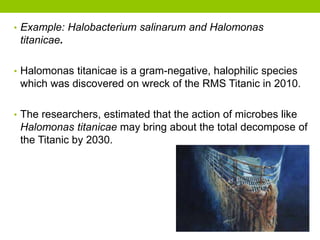
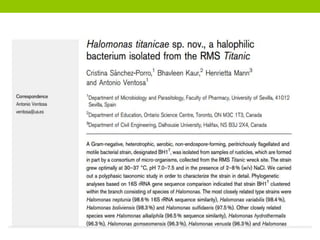
• Halomonas titanicae is a gram-negative, halophilic species
which was discovered on wreck of the RMS Titanic in 2010.
• The researchers, estimated that the action of microbes like
Halomonas titanicae may bring about the total decompose of
the Titanic by 2030.
Growth Factors:
Microorganisms often grow and reproduce when minerals and
sources of energy, carbon, nitrogen, phosphorus, and sulfur are
supplied. These organisms have the enzymes and pathways
necessary to synthesize all cell components.
Organic compounds required because they are essential cell
components such components and cannot be synthesized by the
organism are called growth factors.
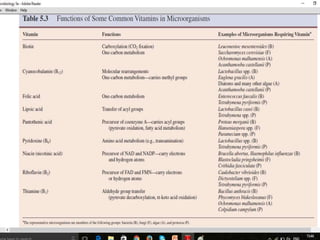
There are three major classes of growth factors: (1) amino acids,
(2) purines and pyrimidines, and (3) vitamins.
Amino acids are needed for protein synthesis, purines and
pyrimidines for nucleic acid synthesis. Vitamins are small organic
molecules that usually make up all or part of enzyme cofactors.
Some microorganisms require many vitamins; for example,
Enterococcus faecalis needs eight different vitamins for growth.
• Many microorganisms can synthesize large quantities of
vitamins has led to their use in industry.
• Good examples of such vitamins and the microorganisms that
synthesize them are riboflavin (Clostridium, Candida,),
coenzyme A (Brevibacterium), vitamin B12 (Streptomyces,
Propionibacterium Pseudomonas), vitamin C (Gluconobacter,
Corynebacterium), and vitamin D (Saccharomyces).
Nutritional classification of microbes

Nutritional classification of microbes

  • 1.
    NUTRITIONAL CLASSIFICATION OFMICROBES Lecture by: Dr. Aswartha Harinath Reddy M.Sc, Ph.D Department of Life Sciences Srikrishnadevaraya University Anantapur –A.P. India 10
  • 2.
    The microbial cellcomposition shows that over 95% of cell dry weight is made up carbon, oxygen, hydrogen, nitrogen, sulfur, phosphorus (C, O, H, N, S, P), potassium, calcium, magnesium, and iron (K, Ca, Mg, and Fe). These are called macroelements or macronutrients because they are required by microorganisms in relatively large amounts. The first six (C, O, H, N, S, and P) are components of carbohydrates, lipids, proteins, and nucleic acids.
  • 3.
    The remaining fourmacroelements exist in the cell as cations and play a variety of roles. For example, potassium (K+) is required for activity by a number of enzymes (Co-factor enzymes). Ex: Aminoacyl tRNA synthetase, Pyruvate kinase. Calcium (Ca2+), contributes to the heat resistance of bacterial endospores. Magnesium (Mg2+) serves as a cofactor for many enzymes, like ATPase, Kinases and stabilizes ribosomes and cell membranes.  Iron (Fe2+ and Fe3+) is a part of cytochromes and a cofactor for enzymes like catalase, peroxidase and electron-carrying proteins.
  • 4.
    All organisms, includingmicroorganisms, require several micronutrients or trace elements besides macroelements. The micronutrients manganese, zinc, cobalt, nickel, molybdenum, and copper are needed by most cells.  For example, zinc (Zn2+) is a co-factor for DNA Polymerase and Alcoholic dehydrogenase. Manganese (Mn2+) is a co-factor for Superoxide dismutase (SOD). Molybdenum (Mo2+) is required for nitrogen fixation and cofactor Nitrogenase and Nitrate reductase. Cobalt (Co2+) is a major component of vitamin B12.
  • 5.
    Nutritional Types ofMicroorganisms Microorganisms can be classified as Autotrophs and Heterotrophs based on their sources of carbon. • Autotrophs: can use CO2 as a source of carbon or Organisms obtain carbon form inorganic source. • Many microorganisms are autotrophic, and most of these carry out photosynthesis and use light as their energy source. • Example: Cyanobacteria bacteria and Algae.
  • 6.
    Heterotrophs: • Organisms whichobtain carbon from organic source is called Heterotrophs. • The reduction of CO2 is a very energy-expensive process. Thus many microorganisms cannot use CO2 as their carbon source. • Organisms that use reduced, organic molecules as carbon sources are heterotrophs.
  • 7.
    Energy sources: • Thereare only two sources of energy available to organisms: • (1) light energy, and (2) the energy derived from oxidizing organic or inorganic molecules. • Phototrophs: use light as their energy source. Ex: Algae, Cyanobacteria. • Chemotrophs: obtain energy from the oxidation of chemical compounds (either organic or inorganic). • Ex: Fungi, Non photosynthetic bacteria, Protozoa.
  • 8.
    Electron source: • Lithotrophs:Organisms which use inorganic molecules as their electron source, (H2O, H2, N2) is called Lithotrophs. • Organotrophs: Organisms which us organic molecules (malate, fumarate, succinate etc) as a source of electrons are called Organotrophs.
  • 9.
    Based on energy,carbon and electron source 1. Photolithoautotrophs 2. Photoorganoheterotrophs 3. Chemolithoautotrophs 4. Chemoorganoheterotrophs
  • 10.
    Photolithoautotrophs Organisms obtain energyform sun light and carbon, electrons form inorganic source are called Photolithoautotrophs. Example: Purple and green sulfur bacteria, cyanobacteria and algae.
  • 11.
    Photoorganoheterotrophs: • Also knowas photoorganotrophs or photoheterotrophs. • Organisms which obtain energy form sun light and carbon, electrons form organic molecules. Ex: Purple nonsulfur bacteria and Green nonsulfur bacteria.
  • 12.
    Chemolithoautotrophs: • Also knowas chemoautotrophs or chemolithotrophs. • Organisms which use inorganic substance as source of energy, carbon and electrons are called Chemolithotrophs. Example: Sulfur-oxidizing bacteria, Nitrifying bacteria and Iron-oxidizing bacteria.
  • 13.
    Chemoorganoheterotrophs • Also knownas Chemoorganotrophs or Chemoheterotrophs. • Organisms which obtain energy, carbon and electrons form organic sources are called Chemoorganoheterotrophs. Examples are: E. coli, Salmonella, Fungi, Protozoa. The dominant group of organisms present in nature are Chemoheterotrophs.
  • 14.
    Mixotrophs: • Organisms whichsurvive both as Autotrophs and heterotrophs. • These microorganisms use both organic and inorganic substances as a source of carbon. • Examples are: Bacillus licheniformis
  • 15.
    Methylotrophs: • Methylotrophs area diverse group of microorganisms that can use reduced one-carbon compounds, such as methanol or methane, as the carbon source for their growth. • Some methylotrophs can degrade the greenhouse gas methane, and in this case they are called Methanotrophs. • Examples are: Metylococcus, Methylomonas.
  • 16.
    • Auxotroph: Organismswhich cannot synthesize essential components form raw material available in the medium is called Auxotrophs. • Medium with out growth factors is called Minimal medium. • Prototroph: An organism or cell capable of synthesizing all its metabolites from inorganic material, requiring no organic nutrients.
  • 17.
    Halophiles: • Halophiles haveadapted so completely to hypertonic, saline conditions. • That they require high levels of sodium chloride to grow, concentrations between about 2.8 M for Halophiles and about 6.2 M for extreme halophilic bacteria.
  • 18.
    • Example: Halobacteriumsalinarum and Halomonas titanicae. • Halomonas titanicae is a gram-negative, halophilic species which was discovered on wreck of the RMS Titanic in 2010. • The researchers, estimated that the action of microbes like Halomonas titanicae may bring about the total decompose of the Titanic by 2030.
  • 21.
    Growth Factors: Microorganisms oftengrow and reproduce when minerals and sources of energy, carbon, nitrogen, phosphorus, and sulfur are supplied. These organisms have the enzymes and pathways necessary to synthesize all cell components. Organic compounds required because they are essential cell components such components and cannot be synthesized by the organism are called growth factors. There are three major classes of growth factors: (1) amino acids, (2) purines and pyrimidines, and (3) vitamins. Amino acids are needed for protein synthesis, purines and pyrimidines for nucleic acid synthesis. Vitamins are small organic molecules that usually make up all or part of enzyme cofactors. Some microorganisms require many vitamins; for example, Enterococcus faecalis needs eight different vitamins for growth.
  • 22.
    • Many microorganismscan synthesize large quantities of vitamins has led to their use in industry. • Good examples of such vitamins and the microorganisms that synthesize them are riboflavin (Clostridium, Candida,), coenzyme A (Brevibacterium), vitamin B12 (Streptomyces, Propionibacterium Pseudomonas), vitamin C (Gluconobacter, Corynebacterium), and vitamin D (Saccharomyces).