Getting to Know Plants
SACHIT
AGGARWAL
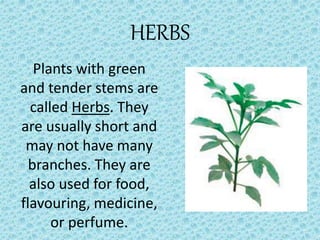
HERBS
Plants with green
and tender stems are
called Herbs. They
are usually short and
may not have many
branches. They are
also used for food,
flavouring, medicine,
or perfume.
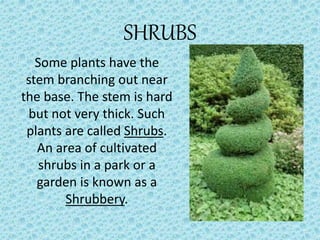
SHRUBS
Some plants have the
stem branching out near
the base. The stem is hard
but not very thick. Such
plants are called Shrubs.
An area of cultivated
shrubs in a park or a
garden is known as a
Shrubbery.
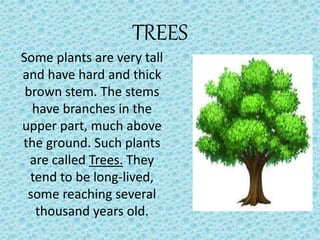
TREES
Some plants are very tall
and have hard and thick
brown stem. The stems
have branches in the
upper part, much above
the ground. Such plants
are called Trees. They
tend to be long-lived,
some reaching several
thousand years old.
CLIMBERS & CREEPERS
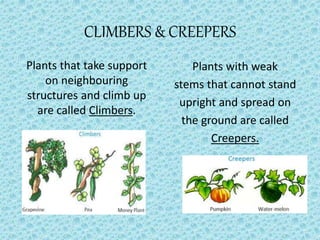
Plants that take support
on neighbouring
structures and climb up
are called Climbers.
Plants with weak
stems that cannot stand
upright and spread on
the ground are called
Creepers.
STEMS
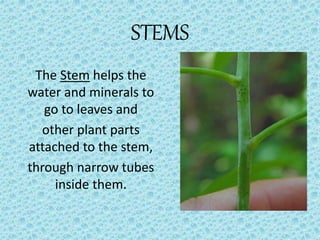
The Stem helps the
water and minerals to
go to leaves and
other plant parts
attached to the stem,
through narrow tubes
inside them.
LEAVES
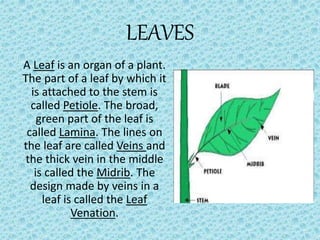
A Leaf is an organ of a plant.
The part of a leaf by which it
is attached to the stem is
called Petiole. The broad,
green part of the leaf is
called Lamina. The lines on
the leaf are called Veins and
the thick vein in the middle
is called the Midrib. The
design made by veins in a
leaf is called the Leaf
Venation.
LEAF VENATION
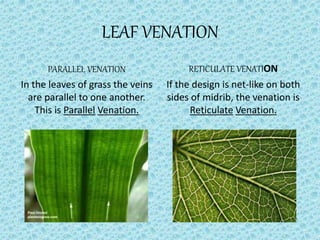
PARALLEL VENATION
In the leaves of grass the veins
are parallel to one another.
This is Parallel Venation.
RETICULATE VENATION
If the design is net-like on both
sides of midrib, the venation is
Reticulate Venation.
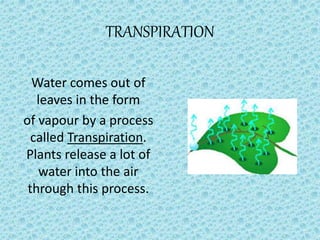
TRANSPIRATION
Water comes out of
leaves in the form
of vapour by a process
called Transpiration.
Plants release a lot of
water into the air
through this process.
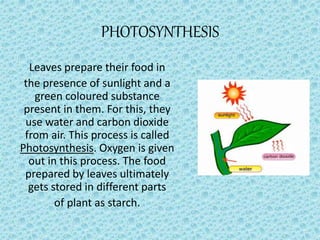
PHOTOSYNTHESIS
Leaves prepare their food in
the presence of sunlight and a
green coloured substance
present in them. For this, they
use water and carbon dioxide
from air. This process is called
Photosynthesis. Oxygen is given
out in this process. The food
prepared by leaves ultimately
gets stored in different parts
of plant as starch.
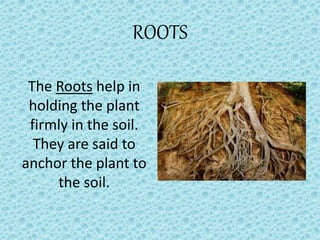
ROOTS
The Roots help in
holding the plant
firmly in the soil.
They are said to
anchor the plant to
the soil.
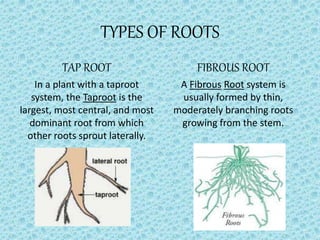
TYPES OF ROOTS
TAP ROOT
In a plant with a taproot
system, the Taproot is the
largest, most central, and most
dominant root from which
other roots sprout laterally.
FIBROUS ROOT
A Fibrous Root system is
usually formed by thin,
moderately branching roots
growing from the stem.
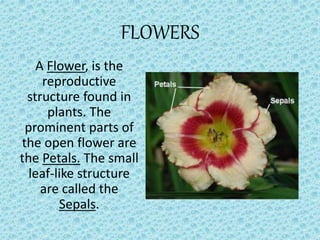
FLOWERS
A Flower, is the
reproductive
structure found in
plants. The
prominent parts of
the open flower are
the Petals. The small
leaf-like structure
are called the
Sepals.
PARTS OF A FLOWER
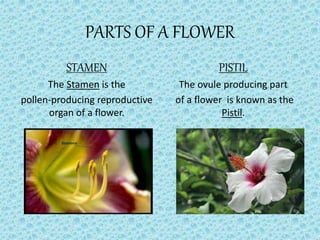
STAMEN
The Stamen is the
pollen-producing reproductive
organ of a flower.
PISTIL
The ovule producing part
of a flower is known as the
Pistil.
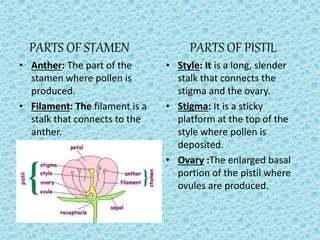
PARTS OF STAMEN
• Anther: The part of the
stamen where pollen is
produced.
• Filament: The filament is a
stalk that connects to the
anther.
PARTS OF PISTIL
• Style: It is a long, slender
stalk that connects the
stigma and the ovary.
• Stigma: It is a sticky
platform at the top of the
style where pollen is
deposited.
• Ovary :The enlarged basal
portion of the pistil where
ovules are produced.
THANK YOU

Getting to know plants

  • 1.
    Getting to KnowPlants SACHIT AGGARWAL
  • 2.
    HERBS Plants with green andtender stems are called Herbs. They are usually short and may not have many branches. They are also used for food, flavouring, medicine, or perfume.
  • 3.
    SHRUBS Some plants havethe stem branching out near the base. The stem is hard but not very thick. Such plants are called Shrubs. An area of cultivated shrubs in a park or a garden is known as a Shrubbery.
  • 4.
    TREES Some plants arevery tall and have hard and thick brown stem. The stems have branches in the upper part, much above the ground. Such plants are called Trees. They tend to be long-lived, some reaching several thousand years old.
  • 5.
    CLIMBERS & CREEPERS Plantsthat take support on neighbouring structures and climb up are called Climbers. Plants with weak stems that cannot stand upright and spread on the ground are called Creepers.
  • 6.
    STEMS The Stem helpsthe water and minerals to go to leaves and other plant parts attached to the stem, through narrow tubes inside them.
  • 7.
    LEAVES A Leaf isan organ of a plant. The part of a leaf by which it is attached to the stem is called Petiole. The broad, green part of the leaf is called Lamina. The lines on the leaf are called Veins and the thick vein in the middle is called the Midrib. The design made by veins in a leaf is called the Leaf Venation.
  • 8.
    LEAF VENATION PARALLEL VENATION Inthe leaves of grass the veins are parallel to one another. This is Parallel Venation. RETICULATE VENATION If the design is net-like on both sides of midrib, the venation is Reticulate Venation.
  • 9.
    TRANSPIRATION Water comes outof leaves in the form of vapour by a process called Transpiration. Plants release a lot of water into the air through this process.
  • 10.
    PHOTOSYNTHESIS Leaves prepare theirfood in the presence of sunlight and a green coloured substance present in them. For this, they use water and carbon dioxide from air. This process is called Photosynthesis. Oxygen is given out in this process. The food prepared by leaves ultimately gets stored in different parts of plant as starch.
  • 11.
    ROOTS The Roots helpin holding the plant firmly in the soil. They are said to anchor the plant to the soil.
  • 12.
    TYPES OF ROOTS TAPROOT In a plant with a taproot system, the Taproot is the largest, most central, and most dominant root from which other roots sprout laterally. FIBROUS ROOT A Fibrous Root system is usually formed by thin, moderately branching roots growing from the stem.
  • 13.
    FLOWERS A Flower, isthe reproductive structure found in plants. The prominent parts of the open flower are the Petals. The small leaf-like structure are called the Sepals.
  • 14.
    PARTS OF AFLOWER STAMEN The Stamen is the pollen-producing reproductive organ of a flower. PISTIL The ovule producing part of a flower is known as the Pistil.
  • 15.
    PARTS OF STAMEN •Anther: The part of the stamen where pollen is produced. • Filament: The filament is a stalk that connects to the anther. PARTS OF PISTIL • Style: It is a long, slender stalk that connects the stigma and the ovary. • Stigma: It is a sticky platform at the top of the style where pollen is deposited. • Ovary :The enlarged basal portion of the pistil where ovules are produced.
  • 16.