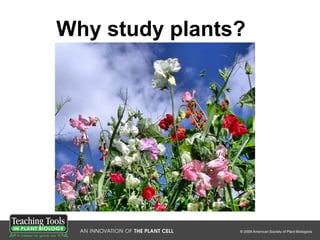
Why study plants?
Plants, like most animals, are
multicellular eukaryotes
Bacteria
Archaea Animals
Plants
Fungi
Common ancestors
Photo credits: Public Health Image Library; NASA; © Dave
Powell, USDA Forest Service; tom donald
Plants are diverse
Green algae
Liverworts
Mosses
Vascular Plants
Club mosses
Ferns
Seed Plants
Flowering
Plants
Cone-
bearing
plants
Grasses
Broad-
leafed
plants
Land
Plants
Plants have evolved
the ability to thrive in
diverse land habitats.
Images courtesy tom donald
Plants make us happy
Dravigne, A, et al., (2008) HortScience 43: 183-187 ; Photo credit: tom donald
People at work
who can see
plants report
significantly
greater job
satisfaction than
those who can’t.
Plants are amazing
living organisms
Largest flower (~ 1m)
Longest living (~ 5000 years)
Largest organism (> 100m)
Photo credits: ma_suska; Bradluke22; Stan Shebs
We could not live without plants
•Plants produce most of the
oxygen we breathe.
•Plants produce most of the
chemically stored energy we
consume as food and burn for
fuel.
•Plants produce an amazing
assortment of useful
chemicals.
We can’t live without oxygen!
X
X
NO oxygen
Joseph Priestley
recognized that an
animal’s breathing
“injured” air. An animal
kept in a sealed
container would
eventually pass out.
We can’t live without oxygen!
Oxygen
produced
Priestley also recognized
that plants have the ability to
“restore” the air. We now
know that they produce
oxygen as a by-product of
photosynthesis.
Plants fix carbon dioxide into
energy- rich molecules we animals
can use as food
CO2
Plants convert CO2
gas into sugars
through the process
of photosynthesis.
Plants can produce an amazing
assortment of chemicals
vitamin A
vitamin Cvanillin
caffeine
morphine
CO2
Why study plants?
To help conserve
endangered plants and
threatened environments
To learn more about the
natural world
To better harness the
abilities of plants to provide
us with food, medicines,
and energy
Photo credit: tom donald
Studying about plants informs us
about our world
Drawing of cork by Robert Hooke, discover of
“cells”
Cells were first observed in plants.
Photograph of cork cells
Photo credit: ©David B. Fankhauser, Ph.D
Viruses were first purified from
plants
Tobacco Mosaic Virus
Viruses infect humans as well
as plants, causing many
diseases including AIDS,
hepatitis, SARS, swine flu,
cervical cancer, chicken pox,
and polio.
Image Copyright 1994 Rothamsted Research.
Mendel’s studies of peas revealed
the laws of inheritance
Mendel’s studies of peas revealed
the laws of inheritance
...which help us understand
human diseases such as sickle
cell anemia...
Mendel’s studies of peas revealed
the laws of inheritance
...and hemophilia, as well
as countless other human
diseases that have a
genetic contribution.
Pedigree of family carrying hemophilia allele
Mendel’s studies of peas revealed
the laws of inheritance
Mendel’s work laid the foundation
for the sciences of plant genetics
and plant breeding.
Distinguished
plant breeder
Norman Borlaug
1914-2009
WHY STUDY PLANTS?
The world population grows and
grows ...
The world
population is
expected to triple
between 1950 (2.5
billion) and 2020
(7.5 billion)
The world population grows and
grows ...
A major objective of
plant science is to
increase food
production; current
estimates indicate that
we need to increase
production by 70% in the
next 40 years.
Malnutrition and hunger
disproportionately kill children
In 2004, 60 million people worldwide died.
(Source:  World Health Organization, 2008) 
10,000,000 of them were
children under 5 years of age,
of which 99% lived in low- or
middle-income countries
(Source: The State of the World's Children, UNICEF, 2007)
Malnutrition and hunger
disproportionately kill children
5 million children under the age of 5 die
each year due to undernutrition and
related causes.
That’s one preschool-aged child
dying a preventable death every six
seconds.
Malnutrition and hunger
disproportionately kill children
A lack of adequate vitamin A kills
one million children a year.
(Source: Vitamin and Mineral Deficiency, A Global Progress Report, UNICEF)
Malnutrition and hunger
disproportionately kill children
How would the world respond to a
disease that affected the population
of the USA, Canada, and the
European Union?
Globally, more than one billion people
per year are chronically hungry
That’s more than the total population of the USA, Canada and the EU.
(Source: FAO news release, 19 June 2009)
More than two billion people per
year are chronically anemic due to
iron deficiency
That’s about the total population of the USA, Canada, the EU, and
China.
(Source:  World Health Organization, WHO Global Database on Anaemia)
WHAT CAN SCIENTISTS
DO ABOUT THIS?
By developing plants that
 are drought or stress tolerant
 require less fertilizer or water
 are resistant to pathogens
 are more nutritious
Plant scientists can contribute
to the alleviation of hunger
Plant growth is often limited by
drought stress
Image source: IWMI
Drought stress is compounded by
increased global temperatures
In warm regions, crop
yields can drop ~3 – 5%
with every 1°C increase
in temperature.
© European Communities, 1995-2009. Image Source: The PESETA Project
Temperature change forecast 2071-2100
period, relative to the 1961-1990 period.
Even mild drought stress reduces
yields
Mild drought stress reduces the rate of
photosynthesis and growth, whereas
extreme drought stress is lethal.
We need plants that grow well even
under stressful conditions
Heat and drought stunt
plants and reduce their
yields
We need plants that grow well even
under stressful conditions
Heat and drought stunt
plants and reduce their
yields
More land must be cleared
to grow more crops
We need plants that grow well even
under stressful conditions
Heat and drought stunt
plants and reduce their
yields
More land must be cleared
to grow more crops
Removing trees to make
way for crops puts more
CO2 into the atmosphere
Altering a single gene can increase
plants’ drought tolerance
Yu, H., et al. Plant Cell 2008;20:1134-
1151
After re-wateringWell-watered 10 days drought 20 days drought
Drought-resistant
Wild-type
A larger root system contributes to
drought tolerance
Seedlings Mature plants
Wild-type Wild-type
Drought
tolerant
Drought
tolerant
Breeding plants
for larger root
systems can
help them grow
in drought-prone
regions.
Yu, H., et al. Plant Cell 2008;20:1134-
1151
Fertilizer is an energy-demanding
limiting resource
•Crops need fertilizer – potassium,
phosphate, nitrogen, and other
nutrients
•Potassium and phosphate are
non-renewable, mined resources
•Synthesis of nitrogen fertilizers
requires huge amounts of energy
Photo credits: Mining Top News; Library of Congress, Prints & Photographs Division, FSA-OWI Collection, LC-USW361-374
Agricultural fertilizer use is a
considerable source of
environmental pollution
Photo courtesy of NASA/Goddard Space Flight Center Scientific Visualization Studio)
Fertilizer run-off
causes dead zones,
algal blooms that then
decay, reducing
oxygen levels in the
water and making
animal life impossible
Yuan, L., et al. (2007) Plant Cell;19:2636-2652
More efficient transport systems in
the root can reduce fertilizer needs.
Plant nutrient uptake can be
improved
Scientists are crossing
crop plants with
perennial plants to
reduce crop plants’
dependency on fertilizers
and water
Wes Jackson of the Land Institute
holding a perennial wheat relative
Thinopyrum intermedium
Perennial plants uptake water and
nutrients better than most crop plants
Photo credit: Jodi Torpey, westerngardeners.com
Right now, two serious diseases
threaten the world’s food supply
Phytophthora infestans, cause
of potato late blight, has re-
emerged as a threat.
Puccinia graminis tritici, the
wheat stem rust fungus, has
developed into a highly
aggressive form.
Photo credits: www.news.cornell.edu; www.fao.org
Late blight destroys potato plants
Potato late blight disease is
caused by Phytophthera
infestans. Outbreaks in the
1840s ruined crops and
contributed to more than a
million deaths in Europe.
. (Photo credits: USDA; Scott Bauer)
Infected Treated
Identification of resistance genes
Resistant
Inoculated with fungus Not
inoculated
Susceptible
The plant on the left carries the
resistance gene and is free from
disease symptoms.
Song, J. et al.,(2003) PNAS 100: 9128-9133; Copyright (2003) National Academy of Sciences, U.S.A.
Geneticists have identified
the gene conferring
resistance and are
introducing it into edible
varieties.
Wheat stem rust is an
emerging threat
•A new, highly pathogenic
strain emerged in Uganda
in 1999 – it is called Ug99.
•Most wheat has no
resistance to this strain.
Infected wheat plant
Photo credit: ARS USDA
Ug99 threatens wheat everywhere
This is a global
problem that needs
global attention. Ug99
spores do not stop at
national borders...
– United Nations
Food and Agriculture
Organization (FAO)
Photo credit: ARS USDA
The fungus is carried by wind
Ug99 is found in Uganda,
Kenya, Ethiopia, Sudan,
Yemen, and Iran, and
threatens regions of the
near east, eastern Africa,
and central and southern
Asia.
Wind currents carrying
spores are shown in red.
Photo credit: www.wheatrust.cornell.edu
The fungus is carried by wind
Wheat is the major
food crop in many
of these
threatened
regions, especially
for the poorest
inhabitants.
Probable Ug99 trajectories
Photo credit: www.wheatrust.cornell.edu
International teams of
scientists are cooperating
to monitor the spread of
Ug99 and develop wheat
strains that resist it.
At this time, no one
knows if resistant strains
will be developed in time
to avoid a major famine...
Photo credits: Bluemoose; FAO
Plant biologists study ways to keep
plants fresh after harvesting
After harvesting,
fruits soften, ripen,
and eventually rot.
These processes make the fruit less
appealing and affect the nutritional
qualities.
Photo credits: Cornell University ; ARC
Greening along with solanine
production can occur in
improperly stored potatoes.
Solanine is harmful and can
be toxic in large quantities.
Photo credits: Dr. C.M. Christensen, Univ. of Minnesota.; WSU; Pavalista, A.D. 2001
Aspergillus mold growing on corn kernels.
Post-harvest losses
can ruin 50% or more
of a grain harvest.
Plant biologists study ways to keep
plants fresh after harvesting
Vitamin A deficiency
Hunger
Subsistence level diets are usually
nutrient-poor. Our bodies need
vitamins and minerals as well as
calories. Malnutrition is primarily a
disease of poverty.
Anemia (young children)
Improved nutrient content in plants
can help alleviate malnutrition
Image sources: Petaholmes based on WHO data; WHO
The practice of fortifying foods with vitamins (such as
folate and vitamin A) and micronutrients (such as iron,
zinc, and iodine) has dramatically reduced
malnutrition in much of the world.
Photo credit: © UNICEF/NYHQ1998-0891/Giacomo Pirozzi
Genetically biofortified foods
()
Iron-enriched rice
Wild-type (top) and
antioxidant-enriched
tomatoes
Photo credits: Golden Rice Humanitarian Board © 2007; Credit: ETH Zurich / Christof Sautter; Reprinted by permission
from Macmillan Publishers, Ltd: Butelli, E., et al., Nature Biotechnology 26, 1301 - 1308 copyright (2008).
Vitamin A–enriched rice
Plants
provide us
with more
than food
Plants:
• are sources of novel therapeutic drugs
• provide better fibers for paper or fabric
• are sources of biorenewable products
• provide renewable energy sources
Photo credit: tom donald
Plants produce hundreds of compounds
we use as medicines or drugs
•Willow (Salix) bark as a source of aspirin (acetylsalicylic
acid)
•Foxglove (Digitalis purpurea) as a source of digitalis
(treatment for cardiac problems)
•Pacific yew (Taxus brevifolia) as a source of taxol
(treatment for cancer)
•Coffee (Coffea arabica) and tea (Camellia sinensis) as
sources of caffeine (stimulant)
Malaria kills millions of people
The regions of the world with highest risk for malaria.
Hay, S.I., et al., (2009) PLoS Med 6(3): e1000048. doi:10.1371/ journal.pmed.1000048
The protozoan Plasmodium
causes malaria
Plasmodium
inside a
mouse cell
Image by Ute Frevert; false color by Margaret Shear.
Plasmodium is transferred into
humans by infected mosquitoes
Photo credit: CDC
Cinchona tree bark contains a
compound, quinine, that kills
Plasmodium
But Plasmodium are developing
resistances to quinine, so other
sources of anti-malarial compounds
must be found.
Image credits: Köhler; CDC
Gin and quinine?
(Crown copyright; Photograph courtesy of the Imperial War Museum, London - Q 32160)
British soldiers in
tropical regions were
given quinine pills to
prevent malaria. To
disguise its bitter
flavor, quinine was
mixed with sweet,
carbonated water
(“tonic”) and
frequently also with
gin – the origin of the
“gin and tonic.”
Artemisia annua is a plant with novel
antimalarial activities
Photo credit: www.anamed.net
Artemisinin
Artemisia has been used by Chinese herbalists for
thousands of years. In 1972 the active ingredient,
artemisinin, was purified.
Plant scientists are developing
higher-producing Artemisia
Photo credit: www.york.ac.uk/org/cnap/artemisiaproject/
Plant cell walls provide important
durable materials
Wood is
primarily
composed of
plant cell
walls.
Photo credit: tom donald
Cell walls
Photo credit: www.wpclipart.com/plants; Zhong, R., et al., (2008) Plant Cell 20:2763-2782 .
Primary plant cell walls are composed mainly of
carbohydrates and proteins.
Some cells produce a rigid
secondary wall that incorporates
lignin, an insoluble cross-linking
compound.
Wood and fibers are everywhere
Rembrandt van Rijn
(1631)
Clothing made
from plant fibers
(cotton, linen)
Plant fibers are used
for making paper,
and before that
papyrus.
Wood is used for
buildings and
furniture.
Painting canvas
is made from
flax or hemp
fibers.
Plants provide fibers for
paper and fabric
Cotton is being bred for increased pest
resistance and better fiber production.
Photo credits: Chen Lab; IFPC
The genome sequence of poplar, a
source of fiber for paper, was
recently completed
This information is being used to improve
the efficiency of paper production.
Photo credit: ChmlTech.com
Plants can replace petroleum for
many products and purposes
creativecartoons.org.
Unfortunately, it takes
millions and millions of
years to convert dead
organic material into
petroleum...and we are
running out of it.
Petroleum is
NOT a
renewable
resource
Plants can replace petroleum for
many products and purposes
Unfortunately, it takes
millions and millions of
years to convert dead
organic material into
petroleum.... And we are
running out of it.
Petroleum is
NOT a
renewable
resource
When I grow
up I want to be
a fossil fuel
creativecartoons.org.
Plants can be a source of biofuels
Energy
from
sunlight
Image source: Genome Management Information System, Oak Ridge National Laboratory
Sugars, starches and
cellulose can be
fermented into ethanol
Plants can be a source of biodiesel
Image sources: Tilo Hauke, University of Minnesota, Iowa State University Extension.
Biodiesel produced from rape, algae and
soybeans are replacing petroleum-
derived diesel.
Bioenergy crops should not affect
food production or prices
Miscanthus giganteus
is a fast growing
perennial bioenergy
crop that grows on land
unsuitable for food
production.
Photo Illustration courtesy S. Long Lab, University of Illinois, 2006
Ethanol isolated from cell wall cellulose
is an important energy source
Cell walls
from corn
stalks and
other
agricultural
residue
Ethanol
Image source: Genome Management Information System, Oak Ridge National Laboratory
Plants can be sources of biorenewable
and biodegradable resources
Energy
from
sunlight
Produce plastics
from renewable
plant material
Photo Illustration courtesy S. Long Lab, University of Illinois, 2006
Energy
from
sunlight
Biodegradation
Plants can be sources of biorenewable
and biodegradable resources
Scientists are investigating
cost-effective ways to
convert plants into plastics.
Photo Illustration courtesy S. Long Lab, University of Illinois, 2006
Why study plants?
Studying plants increases our knowledge about life
in general and helps us to work with them to keep
us fed, healthy, sheltered, clothed, and happy.

Ttpb1 whystudyplants

  • 1.
  • 2.
    Plants, like mostanimals, are multicellular eukaryotes Bacteria Archaea Animals Plants Fungi Common ancestors Photo credits: Public Health Image Library; NASA; © Dave Powell, USDA Forest Service; tom donald
  • 3.
    Plants are diverse Greenalgae Liverworts Mosses Vascular Plants Club mosses Ferns Seed Plants Flowering Plants Cone- bearing plants Grasses Broad- leafed plants Land Plants Plants have evolved the ability to thrive in diverse land habitats. Images courtesy tom donald
  • 4.
    Plants make ushappy Dravigne, A, et al., (2008) HortScience 43: 183-187 ; Photo credit: tom donald People at work who can see plants report significantly greater job satisfaction than those who can’t.
  • 5.
    Plants are amazing livingorganisms Largest flower (~ 1m) Longest living (~ 5000 years) Largest organism (> 100m) Photo credits: ma_suska; Bradluke22; Stan Shebs
  • 6.
    We could notlive without plants •Plants produce most of the oxygen we breathe. •Plants produce most of the chemically stored energy we consume as food and burn for fuel. •Plants produce an amazing assortment of useful chemicals.
  • 7.
    We can’t livewithout oxygen! X X NO oxygen Joseph Priestley recognized that an animal’s breathing “injured” air. An animal kept in a sealed container would eventually pass out.
  • 8.
    We can’t livewithout oxygen! Oxygen produced Priestley also recognized that plants have the ability to “restore” the air. We now know that they produce oxygen as a by-product of photosynthesis.
  • 9.
    Plants fix carbondioxide into energy- rich molecules we animals can use as food CO2 Plants convert CO2 gas into sugars through the process of photosynthesis.
  • 10.
    Plants can producean amazing assortment of chemicals vitamin A vitamin Cvanillin caffeine morphine CO2
  • 11.
    Why study plants? Tohelp conserve endangered plants and threatened environments To learn more about the natural world To better harness the abilities of plants to provide us with food, medicines, and energy Photo credit: tom donald
  • 12.
    Studying about plantsinforms us about our world Drawing of cork by Robert Hooke, discover of “cells” Cells were first observed in plants. Photograph of cork cells Photo credit: ©David B. Fankhauser, Ph.D
  • 13.
    Viruses were firstpurified from plants Tobacco Mosaic Virus Viruses infect humans as well as plants, causing many diseases including AIDS, hepatitis, SARS, swine flu, cervical cancer, chicken pox, and polio. Image Copyright 1994 Rothamsted Research.
  • 14.
    Mendel’s studies ofpeas revealed the laws of inheritance
  • 15.
    Mendel’s studies ofpeas revealed the laws of inheritance ...which help us understand human diseases such as sickle cell anemia...
  • 16.
    Mendel’s studies ofpeas revealed the laws of inheritance ...and hemophilia, as well as countless other human diseases that have a genetic contribution. Pedigree of family carrying hemophilia allele
  • 17.
    Mendel’s studies ofpeas revealed the laws of inheritance Mendel’s work laid the foundation for the sciences of plant genetics and plant breeding. Distinguished plant breeder Norman Borlaug 1914-2009
  • 18.
  • 19.
    The world populationgrows and grows ... The world population is expected to triple between 1950 (2.5 billion) and 2020 (7.5 billion)
  • 20.
    The world populationgrows and grows ... A major objective of plant science is to increase food production; current estimates indicate that we need to increase production by 70% in the next 40 years.
  • 21.
    Malnutrition and hunger disproportionatelykill children In 2004, 60 million people worldwide died. (Source:  World Health Organization, 2008) 
  • 22.
    10,000,000 of themwere children under 5 years of age, of which 99% lived in low- or middle-income countries (Source: The State of the World's Children, UNICEF, 2007) Malnutrition and hunger disproportionately kill children
  • 23.
    5 million childrenunder the age of 5 die each year due to undernutrition and related causes. That’s one preschool-aged child dying a preventable death every six seconds. Malnutrition and hunger disproportionately kill children
  • 24.
    A lack ofadequate vitamin A kills one million children a year. (Source: Vitamin and Mineral Deficiency, A Global Progress Report, UNICEF) Malnutrition and hunger disproportionately kill children
  • 25.
    How would theworld respond to a disease that affected the population of the USA, Canada, and the European Union?
  • 26.
    Globally, more thanone billion people per year are chronically hungry That’s more than the total population of the USA, Canada and the EU. (Source: FAO news release, 19 June 2009)
  • 27.
    More than twobillion people per year are chronically anemic due to iron deficiency That’s about the total population of the USA, Canada, the EU, and China. (Source:  World Health Organization, WHO Global Database on Anaemia)
  • 28.
  • 29.
    By developing plantsthat  are drought or stress tolerant  require less fertilizer or water  are resistant to pathogens  are more nutritious Plant scientists can contribute to the alleviation of hunger
  • 30.
    Plant growth isoften limited by drought stress Image source: IWMI
  • 31.
    Drought stress iscompounded by increased global temperatures In warm regions, crop yields can drop ~3 – 5% with every 1°C increase in temperature. © European Communities, 1995-2009. Image Source: The PESETA Project Temperature change forecast 2071-2100 period, relative to the 1961-1990 period.
  • 32.
    Even mild droughtstress reduces yields Mild drought stress reduces the rate of photosynthesis and growth, whereas extreme drought stress is lethal.
  • 33.
    We need plantsthat grow well even under stressful conditions Heat and drought stunt plants and reduce their yields
  • 34.
    We need plantsthat grow well even under stressful conditions Heat and drought stunt plants and reduce their yields More land must be cleared to grow more crops
  • 35.
    We need plantsthat grow well even under stressful conditions Heat and drought stunt plants and reduce their yields More land must be cleared to grow more crops Removing trees to make way for crops puts more CO2 into the atmosphere
  • 36.
    Altering a singlegene can increase plants’ drought tolerance Yu, H., et al. Plant Cell 2008;20:1134- 1151 After re-wateringWell-watered 10 days drought 20 days drought Drought-resistant Wild-type
  • 37.
    A larger rootsystem contributes to drought tolerance Seedlings Mature plants Wild-type Wild-type Drought tolerant Drought tolerant Breeding plants for larger root systems can help them grow in drought-prone regions. Yu, H., et al. Plant Cell 2008;20:1134- 1151
  • 38.
    Fertilizer is anenergy-demanding limiting resource •Crops need fertilizer – potassium, phosphate, nitrogen, and other nutrients •Potassium and phosphate are non-renewable, mined resources •Synthesis of nitrogen fertilizers requires huge amounts of energy Photo credits: Mining Top News; Library of Congress, Prints & Photographs Division, FSA-OWI Collection, LC-USW361-374
  • 39.
    Agricultural fertilizer useis a considerable source of environmental pollution Photo courtesy of NASA/Goddard Space Flight Center Scientific Visualization Studio) Fertilizer run-off causes dead zones, algal blooms that then decay, reducing oxygen levels in the water and making animal life impossible
  • 40.
    Yuan, L., etal. (2007) Plant Cell;19:2636-2652 More efficient transport systems in the root can reduce fertilizer needs. Plant nutrient uptake can be improved
  • 41.
    Scientists are crossing cropplants with perennial plants to reduce crop plants’ dependency on fertilizers and water Wes Jackson of the Land Institute holding a perennial wheat relative Thinopyrum intermedium Perennial plants uptake water and nutrients better than most crop plants Photo credit: Jodi Torpey, westerngardeners.com
  • 42.
    Right now, twoserious diseases threaten the world’s food supply Phytophthora infestans, cause of potato late blight, has re- emerged as a threat. Puccinia graminis tritici, the wheat stem rust fungus, has developed into a highly aggressive form. Photo credits: www.news.cornell.edu; www.fao.org
  • 43.
    Late blight destroyspotato plants Potato late blight disease is caused by Phytophthera infestans. Outbreaks in the 1840s ruined crops and contributed to more than a million deaths in Europe. . (Photo credits: USDA; Scott Bauer) Infected Treated
  • 44.
    Identification of resistancegenes Resistant Inoculated with fungus Not inoculated Susceptible The plant on the left carries the resistance gene and is free from disease symptoms. Song, J. et al.,(2003) PNAS 100: 9128-9133; Copyright (2003) National Academy of Sciences, U.S.A. Geneticists have identified the gene conferring resistance and are introducing it into edible varieties.
  • 45.
    Wheat stem rustis an emerging threat •A new, highly pathogenic strain emerged in Uganda in 1999 – it is called Ug99. •Most wheat has no resistance to this strain. Infected wheat plant Photo credit: ARS USDA
  • 46.
    Ug99 threatens wheateverywhere This is a global problem that needs global attention. Ug99 spores do not stop at national borders... – United Nations Food and Agriculture Organization (FAO) Photo credit: ARS USDA
  • 47.
    The fungus iscarried by wind Ug99 is found in Uganda, Kenya, Ethiopia, Sudan, Yemen, and Iran, and threatens regions of the near east, eastern Africa, and central and southern Asia. Wind currents carrying spores are shown in red. Photo credit: www.wheatrust.cornell.edu
  • 48.
    The fungus iscarried by wind Wheat is the major food crop in many of these threatened regions, especially for the poorest inhabitants. Probable Ug99 trajectories Photo credit: www.wheatrust.cornell.edu
  • 49.
    International teams of scientistsare cooperating to monitor the spread of Ug99 and develop wheat strains that resist it. At this time, no one knows if resistant strains will be developed in time to avoid a major famine... Photo credits: Bluemoose; FAO
  • 50.
    Plant biologists studyways to keep plants fresh after harvesting After harvesting, fruits soften, ripen, and eventually rot. These processes make the fruit less appealing and affect the nutritional qualities. Photo credits: Cornell University ; ARC
  • 51.
    Greening along withsolanine production can occur in improperly stored potatoes. Solanine is harmful and can be toxic in large quantities. Photo credits: Dr. C.M. Christensen, Univ. of Minnesota.; WSU; Pavalista, A.D. 2001 Aspergillus mold growing on corn kernels. Post-harvest losses can ruin 50% or more of a grain harvest. Plant biologists study ways to keep plants fresh after harvesting
  • 52.
    Vitamin A deficiency Hunger Subsistencelevel diets are usually nutrient-poor. Our bodies need vitamins and minerals as well as calories. Malnutrition is primarily a disease of poverty. Anemia (young children) Improved nutrient content in plants can help alleviate malnutrition Image sources: Petaholmes based on WHO data; WHO
  • 53.
    The practice offortifying foods with vitamins (such as folate and vitamin A) and micronutrients (such as iron, zinc, and iodine) has dramatically reduced malnutrition in much of the world. Photo credit: © UNICEF/NYHQ1998-0891/Giacomo Pirozzi
  • 54.
    Genetically biofortified foods () Iron-enrichedrice Wild-type (top) and antioxidant-enriched tomatoes Photo credits: Golden Rice Humanitarian Board © 2007; Credit: ETH Zurich / Christof Sautter; Reprinted by permission from Macmillan Publishers, Ltd: Butelli, E., et al., Nature Biotechnology 26, 1301 - 1308 copyright (2008). Vitamin A–enriched rice
  • 55.
    Plants provide us with more thanfood Plants: • are sources of novel therapeutic drugs • provide better fibers for paper or fabric • are sources of biorenewable products • provide renewable energy sources Photo credit: tom donald
  • 56.
    Plants produce hundredsof compounds we use as medicines or drugs •Willow (Salix) bark as a source of aspirin (acetylsalicylic acid) •Foxglove (Digitalis purpurea) as a source of digitalis (treatment for cardiac problems) •Pacific yew (Taxus brevifolia) as a source of taxol (treatment for cancer) •Coffee (Coffea arabica) and tea (Camellia sinensis) as sources of caffeine (stimulant)
  • 57.
    Malaria kills millionsof people The regions of the world with highest risk for malaria. Hay, S.I., et al., (2009) PLoS Med 6(3): e1000048. doi:10.1371/ journal.pmed.1000048
  • 58.
    The protozoan Plasmodium causesmalaria Plasmodium inside a mouse cell Image by Ute Frevert; false color by Margaret Shear.
  • 59.
    Plasmodium is transferredinto humans by infected mosquitoes Photo credit: CDC
  • 60.
    Cinchona tree barkcontains a compound, quinine, that kills Plasmodium But Plasmodium are developing resistances to quinine, so other sources of anti-malarial compounds must be found. Image credits: Köhler; CDC
  • 61.
    Gin and quinine? (Crowncopyright; Photograph courtesy of the Imperial War Museum, London - Q 32160) British soldiers in tropical regions were given quinine pills to prevent malaria. To disguise its bitter flavor, quinine was mixed with sweet, carbonated water (“tonic”) and frequently also with gin – the origin of the “gin and tonic.”
  • 62.
    Artemisia annua isa plant with novel antimalarial activities Photo credit: www.anamed.net Artemisinin Artemisia has been used by Chinese herbalists for thousands of years. In 1972 the active ingredient, artemisinin, was purified.
  • 63.
    Plant scientists aredeveloping higher-producing Artemisia Photo credit: www.york.ac.uk/org/cnap/artemisiaproject/
  • 64.
    Plant cell wallsprovide important durable materials Wood is primarily composed of plant cell walls. Photo credit: tom donald
  • 65.
    Cell walls Photo credit:www.wpclipart.com/plants; Zhong, R., et al., (2008) Plant Cell 20:2763-2782 . Primary plant cell walls are composed mainly of carbohydrates and proteins. Some cells produce a rigid secondary wall that incorporates lignin, an insoluble cross-linking compound.
  • 66.
    Wood and fibersare everywhere Rembrandt van Rijn (1631) Clothing made from plant fibers (cotton, linen) Plant fibers are used for making paper, and before that papyrus. Wood is used for buildings and furniture. Painting canvas is made from flax or hemp fibers.
  • 67.
    Plants provide fibersfor paper and fabric Cotton is being bred for increased pest resistance and better fiber production. Photo credits: Chen Lab; IFPC
  • 68.
    The genome sequenceof poplar, a source of fiber for paper, was recently completed This information is being used to improve the efficiency of paper production. Photo credit: ChmlTech.com
  • 69.
    Plants can replacepetroleum for many products and purposes creativecartoons.org. Unfortunately, it takes millions and millions of years to convert dead organic material into petroleum...and we are running out of it. Petroleum is NOT a renewable resource
  • 70.
    Plants can replacepetroleum for many products and purposes Unfortunately, it takes millions and millions of years to convert dead organic material into petroleum.... And we are running out of it. Petroleum is NOT a renewable resource When I grow up I want to be a fossil fuel creativecartoons.org.
  • 71.
    Plants can bea source of biofuels Energy from sunlight Image source: Genome Management Information System, Oak Ridge National Laboratory Sugars, starches and cellulose can be fermented into ethanol
  • 72.
    Plants can bea source of biodiesel Image sources: Tilo Hauke, University of Minnesota, Iowa State University Extension. Biodiesel produced from rape, algae and soybeans are replacing petroleum- derived diesel.
  • 73.
    Bioenergy crops shouldnot affect food production or prices Miscanthus giganteus is a fast growing perennial bioenergy crop that grows on land unsuitable for food production. Photo Illustration courtesy S. Long Lab, University of Illinois, 2006
  • 74.
    Ethanol isolated fromcell wall cellulose is an important energy source Cell walls from corn stalks and other agricultural residue Ethanol Image source: Genome Management Information System, Oak Ridge National Laboratory
  • 75.
    Plants can besources of biorenewable and biodegradable resources Energy from sunlight Produce plastics from renewable plant material Photo Illustration courtesy S. Long Lab, University of Illinois, 2006
  • 76.
    Energy from sunlight Biodegradation Plants can besources of biorenewable and biodegradable resources Scientists are investigating cost-effective ways to convert plants into plastics. Photo Illustration courtesy S. Long Lab, University of Illinois, 2006
  • 77.
    Why study plants? Studyingplants increases our knowledge about life in general and helps us to work with them to keep us fed, healthy, sheltered, clothed, and happy.

Editor's Notes

  • #3 Plants, animals and fungi share many cellular functions. Studying plants informs us about animals, and vice versa, because of their shared eukaryotic ancestry. Images – bacteria - Pseudomonas aeruginosa Archaea - Halobacterium sp. Fungi - Coprinus comatus Animal - Sciurus carolinensis Plant - Lathyrus odoratus
  • #6 The largest tree, General Sherman, is much larger than the largest animal, the blue whale. For more botanical record breakers see http://waynesword.palomar.edu/ww0601.htm#oldseed Rafflesia arnoldii Photo by ma_suska Pinus longaeva – bristle cone pine Sequoiadendron giganteum - giant sequoia
  • #8 In a celebrated experiment from 1772, Joseph Priestley kept a mouse in a jar of air until it collapse because of a lack of oxygen. He found that a mouse kept with a plant would survive.
  • #9 In a celebrated experiment from 1772, Joseph Priestley kept a mouse in a jar of air until it collapse because of a lack of oxygen. He found that a mouse kept with a plant would survive.
  • #13 biology.clc.uc.edu/Fankhauser/Labs/Cell_Biology/Cells_Lab/CELLS.htm
  • #14 (Copyright) 1994 Rothamsted Research. www.rothamsted.bbsrc.ac.uk
  • #40 http://www.sciencedaily.com/releases/2009/06/090618124956.htm
  • #42 The enormous root system of a perennial wheat relative Thinopyrum intermedium, is held by its developer Wes Jackson. http://www.westerngardeners.com/foodshed-challenges-require-new-thinking.html
  • #50 www.fao.org/agriculture/crops/core-themes/theme/pests/wrdgp/ug99intconf/en/
  • #51 http://hort.cals.cornell.edu/cals/hort/research/images/postharvest.jpg http://www.arc.agric.za/institutes/infruit/main/divisions/postharvestprocessing/fruitquality.htm
  • #53 For permissions permissions@who.int
  • #58 Citation: Hay SI, Guerra CA, Gething PW, Patil AP, Tatem AJ, et al. (2009) A world malaria map: Plasmodium falciparum endemicity in 2007. PLoS Med 6(3): e1000048. doi:10.1371/ journal.pmed.1000048
  • #59 Image by Ute Frevert; false color by Margaret Shear. Frevert U, Engelmann S, Zougbédé S, Stange J, Ng B, et al. (2005) Intravital Observation of Plasmodium berghei Sporozoite Infection of the Liver. PLoS Biol 3(6): e192.
  • #61 Plasmodia are developing resistances to quinine, so other sources of antimalerial compounds must be found (Cinchona calisaya Wedd., quinine) from Köhler's Medizinal-Pflanzen in naturgetreuen Abbildungen mit kurz erläuterndem Texte : Atlas zur Pharmacopoea germanica Franz Eugen Köhler Plate from "Quinologie", Paris, 1854, showing bark of Quinquina calisaya (www.cdc.gov/malaria)
  • #68 http://cottongenomics.biosci.utexas.edu http://www.cottonpromotion.org/features/bremen/
  • #72 http://genomicsgtl.energy.gov/biofuels/placemat.shtml
  • #77 http://i76.photobucket.com/albums/j14/biopact/biodegradable_bags.jpg