General Science
(Biology)
CLASS VIII
Subject Teacher:
CHAPTER 04
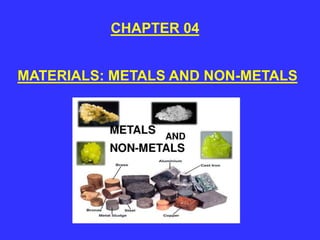
MATERIALS: METALS AND NON-METALS
INTRODUCTION
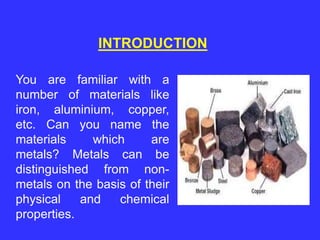
You are familiar with a
number of materials like
iron, aluminium, copper,
etc. Can you name the
materials which are
metals? Metals can be
distinguished from non-
metals on the basis of their
physical and chemical
properties.
PHYSICAL PROPERTIES OF METALS
AND NON-METALS
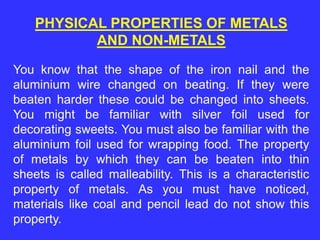
You know that the shape of the iron nail and the
aluminium wire changed on beating. If they were
beaten harder these could be changed into sheets.
You might be familiar with silver foil used for
decorating sweets. You must also be familiar with the
aluminium foil used for wrapping food. The property
of metals by which they can be beaten into thin
sheets is called malleability. This is a characteristic
property of metals. As you must have noticed,
materials like coal and pencil lead do not show this
property.
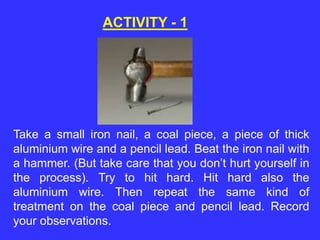
ACTIVITY - 1
Take a small iron nail, a coal piece, a piece of thick
aluminium wire and a pencil lead. Beat the iron nail with
a hammer. (But take care that you don’t hurt yourself in
the process). Try to hit hard. Hit hard also the
aluminium wire. Then repeat the same kind of
treatment on the coal piece and pencil lead. Record
your observations.
You saw that the shape of the iron nail and the
aluminium wire changed on beating. If they were
beaten harder these could be changed into sheets. You
might be familiar with silver foil used for decorating
sweets. You must also be familiar with the aluminium
foil used for wrapping food. The property of metals by
which they can be beaten into thin sheets is called
malleability. This is a characteristic property of metals.
As you must have noticed, materials like coal and
pencil lead do not show this property.
OBSERVATION
Can you hold a hot metallic pan which is without a
plastic or a wooden handle and not get hurt?
Perhaps not! Why? Try to list some other
experiences in which a wooden or plastic handle
protects you from being hurt while handling hot
things. On the basis of these experiences what can
you say about the conduction of heat by wood and
plastic? You must have seen an electrician using his
screw driver. What kind of handle does it have?
Why? Let us find out.
CONDUCTIVITY
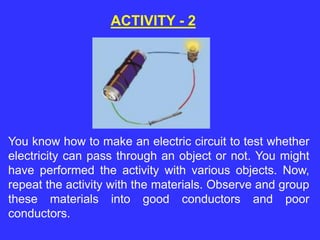
You know how to make an electric circuit to test whether
electricity can pass through an object or not. You might
have performed the activity with various objects. Now,
repeat the activity with the materials. Observe and group
these materials into good conductors and poor
conductors.
ACTIVITY - 2
OBSERVATION
You observe that iron rod, nail and copper wire are
good conductors while rolled sulphur piece and coal
piece are poor conductors. Through this, we can
come to know that which of the metals are poor
conductors and which are good conductors.
DUCTILITY
Where do you find the use of aluminium and copper
wires? Have you seen wires of coal? Definitely not!
The property of metal by which it can be drawn into
wires is called ductility.
SONOROUSNESS
The things made of metals produce ringing sound
when struck hard. Since metals produce ringing
sounds, they are said to be sonorous. Have you seen
wooden bells in temples? Can you give reason?
After performing the above activities, we can say
that some materials are hard, lustrous, malleable,
ductile, sonorous and good conductors of heat and
electricity. The materials which generally posses
these properties are called metals. The examples of
metals are iron, copper, aluminium, calcium,
magnesium, etc. In contrast, materials like coal and
sulphur are soft and dull in appearance. They break
down into powdery mass on tapping with hammer.
They are not sonorous and are poor conductors of
heat and electricity. These materials are called non-
metals. The examples of non-metals are sulphur,
carbon, oxygen, phosphorus, etc.
OBSERVATION AFTER ACTIVITIES
CHEMICAL PROPERTIES OF METALS AND
NON-METALS
You are familiar with the phenomenon of rusting of
iron. You had learnt that in both the processes oxide
formation takes place.
A. REACTION WITH OXYGEN
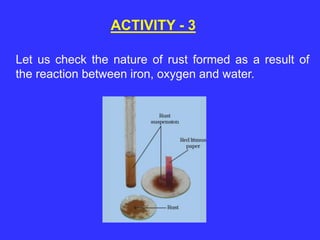
ACTIVITY - 3
Let us check the nature of rust formed as a result of
the reaction between iron, oxygen and water.
ACTIVITY - 3
Collect a spoonful of rust and dissolve it in a very little
amount of water. You will find that the rust remains
suspended in water. Shake the suspension well. Test
the solution with red and blue litmus paper. What do
you observe? Is the solution acidic or basic?
OBSERVATION
You must have observed that the red litmus turns
blue. So, oxide of magnesium is also basic in nature.
In general, metallic oxides are basic in nature.
(To be demonstrated by the teacher in the class)
ACTIVITY - 4
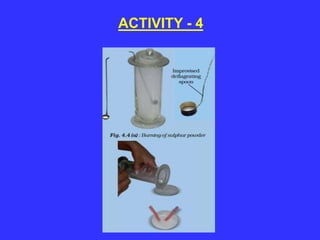
Take a small amount of powdered sulphur in a
deflagrating spoon and heat it. If deflagrating spoon is
not available, you may take a metallic cap of any bottle
and wrap a metallic wire around it.
Precautions to be taken:
As soon as sulphur starts burning, introduce the
spoon into a gas jar/ glass tumbler. Cover the
tumbler with a lid to ensure that the gas produced
does not escape. Remove the spoon after some
time. Add a small quantity of water into the tumbler
and quickly replace the lid. Shake the tumbler well.
Check the solution with red and blue litmus papers.
ACTIVITY - 4
ACTIVITY - 4
OBSERVATION
The name of the product formed in the reaction of
sulphur and oxygen is sulphur dioxide gas. When
sulphur dioxide is dissolved in water sulphurous acid
is formed. The reaction can be given as follows:
Sulphur dioxide (SO2) + Water (H2O) → Sulphurous
acid (H2SO3) The sulphurous acid turns blue litmus
paper red. Generally, oxides of non-metals are acidic
in nature
B. REACTION WITH WATER
Let us see how metals and non-metals react with
water.
Sodium metal is very reactive. It reacts vigorously
with oxygen and water. A lot of heat is generated in
the reaction. It is, therefore, stored in kerosene.
NOTE:
ACTIVITY - 5
To be demonstrated by the teacher. During
demonstration special care should be taken
that the size of the sodium metal piece is
roughly the size of a wheat grain. It should
be held with a pair of tongs. During
observation keep away from the beaker
Precautions to be taken:

ACTIVITY - 5
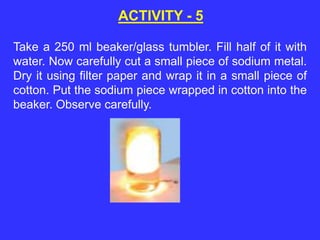
Take a 250 ml beaker/glass tumbler. Fill half of it with
water. Now carefully cut a small piece of sodium metal.
Dry it using filter paper and wrap it in a small piece of
cotton. Put the sodium piece wrapped in cotton into the
beaker. Observe carefully.
ACTIVITY - 5
When reaction stops touch the beaker. What do you
feel? Has the beaker become hot? Test the solution
with red and blue litmus papers. Is the solution acidic
or basic?
You observed that sodium reacts vigorously with water.
Some other metals do not do so. For example, iron
reacts with water slowly. Generally, non-metals do not
react with water though they may be very reactive in
air. Such non-metals are stored in water. For example,
phosphorus is a very reactive non-metal. It catches fire
if exposed to air. To prevent the contact of phosphorus
with atmospheric oxygen, it is stored in water.
OBSERVATION
C. REACTIONS WITH ACIDS
ACTIVITY - 6
Warning : Keep the mouth of the test tube away from
your face. Use test tube holder to hold the test tube.
PRECAUTIONS TO BE TAKEN:
Take samples of metals and non-metals in separate
test tubes and label them as A, B, C, D, E, and F.
With the help of a dropper add 5 ml of dilute
hydrochloric acid to each test tube one by one.
Observe the reactions carefully. If no reaction occurs
in a cold solution, warm the test tube gently. Bring a
burning matchstick near the mouth of each test tube.
Repeat the same activity using dilute sulphuric acid
instead of the dilute hydrocholoric acid. Record your
observations.
ACTIVITY - 6
Is there a difference in the way metals and non-
metals react with acids? What could the ‘pop’ sound
in some cases be due to when a burning match stick
is brought near the mouth of the test tubes?
ACTIVITY - 6
OBSERVATION
You must have found that non-metals generally do not
react with acids but metals react with acids and
produce hydrogen gas that burns with a ‘pop’ sound.
You must have noticed that copper does not react with
dilute hydrochloric acid even on heating but it reacts
with sulphuric acid.
ACTIVITY - 7
To be demonstrated by the teacher. During the
preparation of sodium hydroxide solution, care should
be taken that pellets of sodium hydroxide are handled
with a plastic spatula.
PRECAUTIONS TO BE TAKEN:
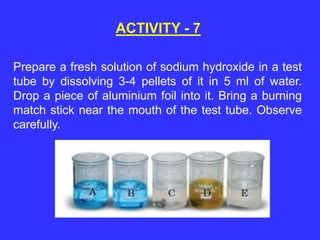
Prepare a fresh solution of sodium hydroxide in a test
tube by dissolving 3-4 pellets of it in 5 ml of water.
Drop a piece of aluminium foil into it. Bring a burning
match stick near the mouth of the test tube. Observe
carefully.
ACTIVITY - 7
ACTIVITY - 7
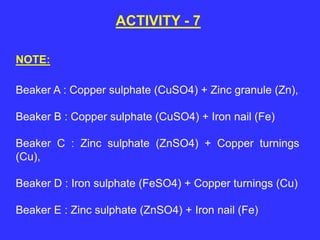
Beaker A : Copper sulphate (CuSO4) + Zinc granule (Zn),
Beaker B : Copper sulphate (CuSO4) + Iron nail (Fe)
Beaker C : Zinc sulphate (ZnSO4) + Copper turnings
(Cu),
Beaker D : Iron sulphate (FeSO4) + Copper turnings (Cu)
Beaker E : Zinc sulphate (ZnSO4) + Iron nail (Fe)
NOTE:
OBSERVATION
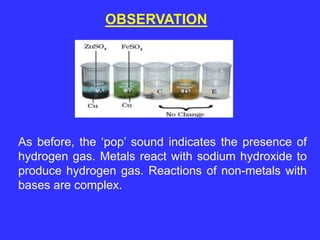
As before, the ‘pop’ sound indicates the presence of
hydrogen gas. Metals react with sodium hydroxide to
produce hydrogen gas. Reactions of non-metals with
bases are complex.
ACTIVITY - 8
E. DISPLACEMENT REACTIONS
Take five 100 ml beakers and label them A, B, C, D
and E. Take about 50 ml of water in each beaker.
Dissolve in each beaker a teaspoonful of each
substance
OBSERVATION
You have read that one metal displaces another metal
from its compound in aqueous solution. In beaker ‘A’ zinc
(Zn) replaces copper (Cu) from copper sulphate
(CuSO4). That is why the blue colour of copper sulphate
disappears and a powdery red mass of copper is
deposited at the bottom of the beaker. The reaction can
be represented as follows:
Copper Sulphate (CuSO4) + Zinc (Zn)
(Blue) → Zinc Sulphate (ZnSO4) + Copper (Cu)
(Colourless) (Red). You can write down the reaction
taking place in beaker ‘B’ in a similar manner.
OBSERVATION
There could have been displacement of zinc by
copper in beaker ‘C’ and by iron in beaker ‘E’.
Similarly iron could be displaced by copper in beaker
‘D’. Since we do not see any change in beaker C, we
can infer that copper is not able to replace zinc from
zinc sulphate. But why? When zinc can replace
copper in beaker ‘A’ why cannot copper replace zinc
in beaker ‘C’? Remember that science is not
arbitrary. It follows definite rules based on facts.
OBSERVATION
And the rule here is that zinc is more reactive than
copper and iron. A more reactive metal can replace a
less reactive metal, but a less reactive one cannot
replace a more reactive metal. Now you can
understand why there are no displacement reactions in
beakers D and E also.
USES OF METALS AND NON-METALS
You should be able to guess why metals are used in
making machinery, automobiles, aeroplanes, trains,
satellites, industrial gadgets, cooking utensils, water
boilers, etc. You are also familiar with the uses of
some non-metals.
USES OF METALS AND NON-METALS
Here are some interesting ones. We are sure that you
will guess them right:
•Non-metal essential for our life which all living beings
inhale during breathing.
•Non-metals used in fertilisers to enhance the growth of
plants,
•Non-metal used in water purification process.
•Non-metal used in the purple coloured solution which
is applied on wounds as an antiseptic.
•Non-metals used in crackers.
You may add some more uses of metals and non-metals
from your experiences.
ELEMENTS
You have learnt that in a chemical reaction, new
substances are formed. These substances are
different from those which underwent the reaction.
Now, if a substance cannot be broken down further by
chemical reactions, by cooling, heating, or by
electrolysis, it is called ‘element’. Sulphur is an
element. So is iron. Carbon, too, is an element. The
smallest unit of an element is atom. A sample of an
element contains only one kind of atoms. The atom of
an element remains unaffected by physical changes in
the element.
ELEMENTS
For example, an atom of liquid sulphur would be
exactly the same as the atom of solid or vapour
sulphur.
Although we have an infinite variety of substances in
the universe, the number of elements forming these
substances is limited. There are no more than 92
naturally occurring elements. An important
classification of elements is in terms of metals and
non-metals. Most of the elements are metals. Less
than 20 are non-metals. A few are metalloids which
possess characters of both metals and non-metals.
1. Atom
2. Conductor
3. Displacement Reaction
4. Ductility
5. Elements
6. Hardness
7. Malleability
8. Metals
9. Metalloids
10.Non – metals
11.Sonorous
KEYWORDS
Any Questions Please…
Prepared By
IT CLUB, Sainik School Amaravathinagar
Post: Amaravathinagar
Dist: Tiruppur, Tamilnadu
Club I/c
Praveen M Jigajinni
DCSc & Engg,PGDCA,ADCA,MCA,MSc(IT),MTech(IT), M.Phil (Comp Sci)
For Any Queries Please feel free to contact:
Email Id : praveenkumarjigajinni@gmail.com
Cell No: 9431453730
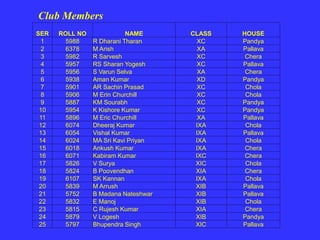
SER ROLL NO NAME CLASS HOUSE
1 5988 R Dharani Tharan XC Pandya
2 6378 M Arish XA Pallava
3 5982 R Sarvesh XC Chera
4 5957 RS Sharan Yogesh XC Pallava
5 5956 S Varun Selva XA Chera
6 5938 Aman Kumar XD Pandya
7 5901 AR Sachin Prasad XC Chola
8 5906 M Erin Churchill XC Chola
9 5887 KM Sourabh XC Pandya
10 5954 K Kishore Kumar XC Pandya
11 5896 M Eric Churchill XA Pallava
12 6074 Dheeraj Kumar IXA Chola
13 6054 Vishal Kumar IXA Pallava
14 6024 MA Sri Kavi Priyan IXA Chola
15 6018 Ankush Kumar IXA Chera
16 6071 Kabiram Kumar IXC Chera
17 5826 V Surya XIC Chola
18 5824 B Poovendhan XIA Chera
19 6107 SK Kannan IXA Chola
20 5839 M Arrush XIB Pallava
21 5752 B Madana Nateshwar XIB Pallava
22 5832 E Manoj XIB Chola
23 5815 C Rujesh Kumar XIA Chera
24 5879 V Logesh XIB Pandya
25 5797 Bhupendra Singh XIC Pallava
Club Members
THANK YOU

Chapter 04 materials metals & non-metal

  • 1.
  • 2.
  • 3.
    INTRODUCTION You are familiarwith a number of materials like iron, aluminium, copper, etc. Can you name the materials which are metals? Metals can be distinguished from non- metals on the basis of their physical and chemical properties.
  • 4.
    PHYSICAL PROPERTIES OFMETALS AND NON-METALS You know that the shape of the iron nail and the aluminium wire changed on beating. If they were beaten harder these could be changed into sheets. You might be familiar with silver foil used for decorating sweets. You must also be familiar with the aluminium foil used for wrapping food. The property of metals by which they can be beaten into thin sheets is called malleability. This is a characteristic property of metals. As you must have noticed, materials like coal and pencil lead do not show this property.
  • 5.
    ACTIVITY - 1 Takea small iron nail, a coal piece, a piece of thick aluminium wire and a pencil lead. Beat the iron nail with a hammer. (But take care that you don’t hurt yourself in the process). Try to hit hard. Hit hard also the aluminium wire. Then repeat the same kind of treatment on the coal piece and pencil lead. Record your observations.
  • 6.
    You saw thatthe shape of the iron nail and the aluminium wire changed on beating. If they were beaten harder these could be changed into sheets. You might be familiar with silver foil used for decorating sweets. You must also be familiar with the aluminium foil used for wrapping food. The property of metals by which they can be beaten into thin sheets is called malleability. This is a characteristic property of metals. As you must have noticed, materials like coal and pencil lead do not show this property. OBSERVATION
  • 7.
    Can you holda hot metallic pan which is without a plastic or a wooden handle and not get hurt? Perhaps not! Why? Try to list some other experiences in which a wooden or plastic handle protects you from being hurt while handling hot things. On the basis of these experiences what can you say about the conduction of heat by wood and plastic? You must have seen an electrician using his screw driver. What kind of handle does it have? Why? Let us find out. CONDUCTIVITY
  • 8.
    You know howto make an electric circuit to test whether electricity can pass through an object or not. You might have performed the activity with various objects. Now, repeat the activity with the materials. Observe and group these materials into good conductors and poor conductors. ACTIVITY - 2
  • 9.
    OBSERVATION You observe thatiron rod, nail and copper wire are good conductors while rolled sulphur piece and coal piece are poor conductors. Through this, we can come to know that which of the metals are poor conductors and which are good conductors.
  • 10.
    DUCTILITY Where do youfind the use of aluminium and copper wires? Have you seen wires of coal? Definitely not! The property of metal by which it can be drawn into wires is called ductility. SONOROUSNESS The things made of metals produce ringing sound when struck hard. Since metals produce ringing sounds, they are said to be sonorous. Have you seen wooden bells in temples? Can you give reason?
  • 11.
    After performing theabove activities, we can say that some materials are hard, lustrous, malleable, ductile, sonorous and good conductors of heat and electricity. The materials which generally posses these properties are called metals. The examples of metals are iron, copper, aluminium, calcium, magnesium, etc. In contrast, materials like coal and sulphur are soft and dull in appearance. They break down into powdery mass on tapping with hammer. They are not sonorous and are poor conductors of heat and electricity. These materials are called non- metals. The examples of non-metals are sulphur, carbon, oxygen, phosphorus, etc. OBSERVATION AFTER ACTIVITIES
  • 12.
    CHEMICAL PROPERTIES OFMETALS AND NON-METALS You are familiar with the phenomenon of rusting of iron. You had learnt that in both the processes oxide formation takes place. A. REACTION WITH OXYGEN
  • 13.
    ACTIVITY - 3 Letus check the nature of rust formed as a result of the reaction between iron, oxygen and water.
  • 14.
    ACTIVITY - 3 Collecta spoonful of rust and dissolve it in a very little amount of water. You will find that the rust remains suspended in water. Shake the suspension well. Test the solution with red and blue litmus paper. What do you observe? Is the solution acidic or basic?
  • 15.
    OBSERVATION You must haveobserved that the red litmus turns blue. So, oxide of magnesium is also basic in nature. In general, metallic oxides are basic in nature.
  • 16.
    (To be demonstratedby the teacher in the class) ACTIVITY - 4 Take a small amount of powdered sulphur in a deflagrating spoon and heat it. If deflagrating spoon is not available, you may take a metallic cap of any bottle and wrap a metallic wire around it. Precautions to be taken:
  • 17.
    As soon assulphur starts burning, introduce the spoon into a gas jar/ glass tumbler. Cover the tumbler with a lid to ensure that the gas produced does not escape. Remove the spoon after some time. Add a small quantity of water into the tumbler and quickly replace the lid. Shake the tumbler well. Check the solution with red and blue litmus papers. ACTIVITY - 4
  • 18.
  • 19.
    OBSERVATION The name ofthe product formed in the reaction of sulphur and oxygen is sulphur dioxide gas. When sulphur dioxide is dissolved in water sulphurous acid is formed. The reaction can be given as follows: Sulphur dioxide (SO2) + Water (H2O) → Sulphurous acid (H2SO3) The sulphurous acid turns blue litmus paper red. Generally, oxides of non-metals are acidic in nature
  • 20.
    B. REACTION WITHWATER Let us see how metals and non-metals react with water. Sodium metal is very reactive. It reacts vigorously with oxygen and water. A lot of heat is generated in the reaction. It is, therefore, stored in kerosene. NOTE:
  • 21.
    ACTIVITY - 5 Tobe demonstrated by the teacher. During demonstration special care should be taken that the size of the sodium metal piece is roughly the size of a wheat grain. It should be held with a pair of tongs. During observation keep away from the beaker Precautions to be taken: 
  • 22.
    ACTIVITY - 5 Takea 250 ml beaker/glass tumbler. Fill half of it with water. Now carefully cut a small piece of sodium metal. Dry it using filter paper and wrap it in a small piece of cotton. Put the sodium piece wrapped in cotton into the beaker. Observe carefully.
  • 23.
    ACTIVITY - 5 Whenreaction stops touch the beaker. What do you feel? Has the beaker become hot? Test the solution with red and blue litmus papers. Is the solution acidic or basic?
  • 24.
    You observed thatsodium reacts vigorously with water. Some other metals do not do so. For example, iron reacts with water slowly. Generally, non-metals do not react with water though they may be very reactive in air. Such non-metals are stored in water. For example, phosphorus is a very reactive non-metal. It catches fire if exposed to air. To prevent the contact of phosphorus with atmospheric oxygen, it is stored in water. OBSERVATION
  • 25.
    C. REACTIONS WITHACIDS ACTIVITY - 6 Warning : Keep the mouth of the test tube away from your face. Use test tube holder to hold the test tube. PRECAUTIONS TO BE TAKEN:
  • 26.
    Take samples ofmetals and non-metals in separate test tubes and label them as A, B, C, D, E, and F. With the help of a dropper add 5 ml of dilute hydrochloric acid to each test tube one by one. Observe the reactions carefully. If no reaction occurs in a cold solution, warm the test tube gently. Bring a burning matchstick near the mouth of each test tube. Repeat the same activity using dilute sulphuric acid instead of the dilute hydrocholoric acid. Record your observations. ACTIVITY - 6
  • 27.
    Is there adifference in the way metals and non- metals react with acids? What could the ‘pop’ sound in some cases be due to when a burning match stick is brought near the mouth of the test tubes? ACTIVITY - 6
  • 28.
    OBSERVATION You must havefound that non-metals generally do not react with acids but metals react with acids and produce hydrogen gas that burns with a ‘pop’ sound. You must have noticed that copper does not react with dilute hydrochloric acid even on heating but it reacts with sulphuric acid.
  • 29.
    ACTIVITY - 7 Tobe demonstrated by the teacher. During the preparation of sodium hydroxide solution, care should be taken that pellets of sodium hydroxide are handled with a plastic spatula. PRECAUTIONS TO BE TAKEN:
  • 30.
    Prepare a freshsolution of sodium hydroxide in a test tube by dissolving 3-4 pellets of it in 5 ml of water. Drop a piece of aluminium foil into it. Bring a burning match stick near the mouth of the test tube. Observe carefully. ACTIVITY - 7
  • 31.
    ACTIVITY - 7 BeakerA : Copper sulphate (CuSO4) + Zinc granule (Zn), Beaker B : Copper sulphate (CuSO4) + Iron nail (Fe) Beaker C : Zinc sulphate (ZnSO4) + Copper turnings (Cu), Beaker D : Iron sulphate (FeSO4) + Copper turnings (Cu) Beaker E : Zinc sulphate (ZnSO4) + Iron nail (Fe) NOTE:
  • 32.
    OBSERVATION As before, the‘pop’ sound indicates the presence of hydrogen gas. Metals react with sodium hydroxide to produce hydrogen gas. Reactions of non-metals with bases are complex.
  • 33.
    ACTIVITY - 8 E.DISPLACEMENT REACTIONS Take five 100 ml beakers and label them A, B, C, D and E. Take about 50 ml of water in each beaker. Dissolve in each beaker a teaspoonful of each substance
  • 34.
    OBSERVATION You have readthat one metal displaces another metal from its compound in aqueous solution. In beaker ‘A’ zinc (Zn) replaces copper (Cu) from copper sulphate (CuSO4). That is why the blue colour of copper sulphate disappears and a powdery red mass of copper is deposited at the bottom of the beaker. The reaction can be represented as follows: Copper Sulphate (CuSO4) + Zinc (Zn) (Blue) → Zinc Sulphate (ZnSO4) + Copper (Cu) (Colourless) (Red). You can write down the reaction taking place in beaker ‘B’ in a similar manner.
  • 35.
    OBSERVATION There could havebeen displacement of zinc by copper in beaker ‘C’ and by iron in beaker ‘E’. Similarly iron could be displaced by copper in beaker ‘D’. Since we do not see any change in beaker C, we can infer that copper is not able to replace zinc from zinc sulphate. But why? When zinc can replace copper in beaker ‘A’ why cannot copper replace zinc in beaker ‘C’? Remember that science is not arbitrary. It follows definite rules based on facts.
  • 36.
    OBSERVATION And the rulehere is that zinc is more reactive than copper and iron. A more reactive metal can replace a less reactive metal, but a less reactive one cannot replace a more reactive metal. Now you can understand why there are no displacement reactions in beakers D and E also.
  • 37.
    USES OF METALSAND NON-METALS You should be able to guess why metals are used in making machinery, automobiles, aeroplanes, trains, satellites, industrial gadgets, cooking utensils, water boilers, etc. You are also familiar with the uses of some non-metals.
  • 38.
    USES OF METALSAND NON-METALS Here are some interesting ones. We are sure that you will guess them right: •Non-metal essential for our life which all living beings inhale during breathing. •Non-metals used in fertilisers to enhance the growth of plants, •Non-metal used in water purification process. •Non-metal used in the purple coloured solution which is applied on wounds as an antiseptic. •Non-metals used in crackers. You may add some more uses of metals and non-metals from your experiences.
  • 39.
    ELEMENTS You have learntthat in a chemical reaction, new substances are formed. These substances are different from those which underwent the reaction. Now, if a substance cannot be broken down further by chemical reactions, by cooling, heating, or by electrolysis, it is called ‘element’. Sulphur is an element. So is iron. Carbon, too, is an element. The smallest unit of an element is atom. A sample of an element contains only one kind of atoms. The atom of an element remains unaffected by physical changes in the element.
  • 40.
    ELEMENTS For example, anatom of liquid sulphur would be exactly the same as the atom of solid or vapour sulphur. Although we have an infinite variety of substances in the universe, the number of elements forming these substances is limited. There are no more than 92 naturally occurring elements. An important classification of elements is in terms of metals and non-metals. Most of the elements are metals. Less than 20 are non-metals. A few are metalloids which possess characters of both metals and non-metals.
  • 41.
    1. Atom 2. Conductor 3.Displacement Reaction 4. Ductility 5. Elements 6. Hardness 7. Malleability 8. Metals 9. Metalloids 10.Non – metals 11.Sonorous KEYWORDS
  • 42.
  • 43.
    Prepared By IT CLUB,Sainik School Amaravathinagar Post: Amaravathinagar Dist: Tiruppur, Tamilnadu Club I/c Praveen M Jigajinni DCSc & Engg,PGDCA,ADCA,MCA,MSc(IT),MTech(IT), M.Phil (Comp Sci) For Any Queries Please feel free to contact: Email Id : praveenkumarjigajinni@gmail.com Cell No: 9431453730
  • 44.
    SER ROLL NONAME CLASS HOUSE 1 5988 R Dharani Tharan XC Pandya 2 6378 M Arish XA Pallava 3 5982 R Sarvesh XC Chera 4 5957 RS Sharan Yogesh XC Pallava 5 5956 S Varun Selva XA Chera 6 5938 Aman Kumar XD Pandya 7 5901 AR Sachin Prasad XC Chola 8 5906 M Erin Churchill XC Chola 9 5887 KM Sourabh XC Pandya 10 5954 K Kishore Kumar XC Pandya 11 5896 M Eric Churchill XA Pallava 12 6074 Dheeraj Kumar IXA Chola 13 6054 Vishal Kumar IXA Pallava 14 6024 MA Sri Kavi Priyan IXA Chola 15 6018 Ankush Kumar IXA Chera 16 6071 Kabiram Kumar IXC Chera 17 5826 V Surya XIC Chola 18 5824 B Poovendhan XIA Chera 19 6107 SK Kannan IXA Chola 20 5839 M Arrush XIB Pallava 21 5752 B Madana Nateshwar XIB Pallava 22 5832 E Manoj XIB Chola 23 5815 C Rujesh Kumar XIA Chera 24 5879 V Logesh XIB Pandya 25 5797 Bhupendra Singh XIC Pallava Club Members
  • 45.

Editor's Notes

  • #12 Note: Metals like sodium and potassium are soft and can be cut with a knife. Mercury is the only metal which is found in liquid state at room temperature. These are exceptions