By – Sarita CHOURASIA
Content
1. Definition
2.Types of reproduction
3. Comparison between asexual
and sexual reproduction
4. Stages of reproduction in man
5. Metamorphosis in frog
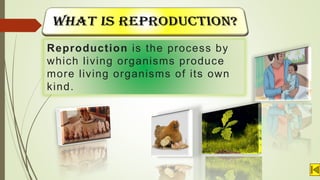
Reproduction is the process by
which living organisms produce
more living organisms of its own
kind.
What are the types of reproduction?
There are two main types of reproduction;
sexual and asexual.
Both share the commonality that more
organisms are produced which share some or all
of parental DNA (which translates into the
physical traits we can observe), but they are
accomplished in different ways.
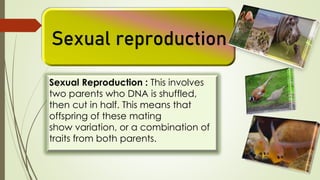
Sexual reproduction
Sexual Reproduction : This involves
two parents who DNA is shuffled,
then cut in half. This means that
offspring of these mating
show variation, or a combination of
traits from both parents.
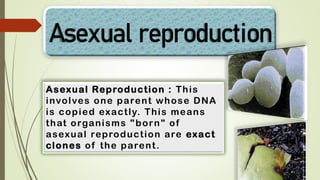
Asexual reproduction
Asexual Reproduction : This
involves one parent whose DNA
is copied exactly. This means
that organisms "born" of
asexual reproduction are exact
clones of the parent.
Comparison between Asexual and Sexual
reproduction
A s e x u a l
 Require one parent organism.
 The single organism makes a copy of
itself and divides.
 The offspring are generally genetically
identical to the parent.
 Used by yeast, sponges, and bacteria.
 Pros-- extremely efficient .
 Cons -- If the parent has genetic
defects or deficiencies, all of its
offspring will also be weak.
S e x u a l
 Require two parents organism.
 Sperm and egg fertilize, one another
to form zygote.
 The offspring are genetically unique
from the parents, but contain a
random combination of parental
genes.
 Used by humans, other animals and
plants.
 Pros-- Produces genetically
different babies, increasing the
survival rate of the population.
 Cons-- Requires a lot of time and
effort.
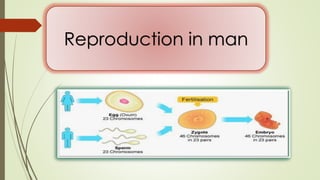
Reproduction in man
Stages of sexual reproduction
Stage 1: Fertilization
Stage 2: Development of zygote
Stage 3: Child birth
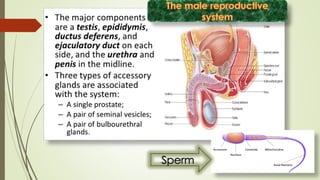
Sperm
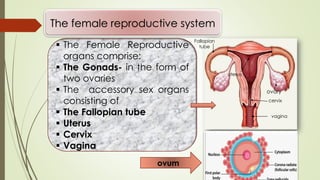
The female reproductive system
▪ The Female Reproductive
organs comprise:
▪ The Gonads- in the form of
two ovaries
▪ The accessory sex organs
consisting of
▪ The Fallopian tube
▪ Uterus
▪ Cervix
▪ Vagina
ovum
Fallopian
tube
ovary
uterus
cervix
vagina
Stage 1: Fertilization
• The fusion of the genetic material
contained in the gametes to form
a zygote is known as fertilization.
• Zygote is the fertilized egg or
ovum. It is single cell, thus we
begin our life as a single cell.
sperm
ovum
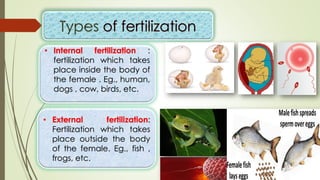
• Internal fertilization :
fertilization which takes
place inside the body of
the female . Eg., human,
dogs , cow, birds, etc.
• External fertilization:
Fertilization which takes
place outside the body
of the female. Eg., fish ,
frogs, etc.
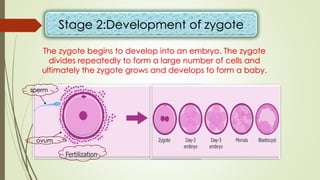
Stage 2:Development of zygote
The zygote begins to develop into an embryo. The zygote
divides repeatedly to form a large number of cells and
ultimately the zygote grows and develops to form a baby.
sperm
ovum
Stage 3: Birth of young ones
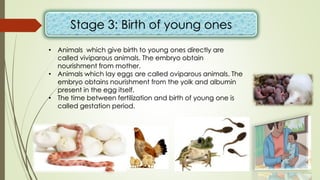
• Animals which give birth to young ones directly are
called viviparous animals. The embryo obtain
nourishment from mother.
• Animals which lay eggs are called oviparous animals. The
embryo obtains nourishment from the yolk and albumin
present in the egg itself.
• The time between fertilization and birth of young one is
called gestation period.
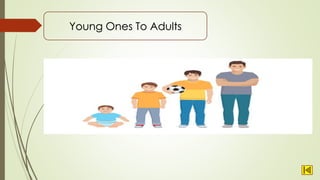
Young Ones To Adults
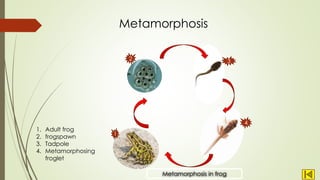
Metamorphosis
Metamorphosis in frog
1
4
3
2
1. Adult frog
2. frogspawn
3. Tadpole
4. Metamorphosing
froglet
Thanks
for
watching
sarita