NUTRITION
The study of food, its composition, the
amounts needed by the body and its
effects on the body
© PDST Home Economics
DEFINITIONS
 Food: any substance, solid or liquid, that contains
nutrients.
 Nutrients: substances that can be digested and used by
the body.
Elements: All nutrients are made up of elements. They are
simple substances that cannot be broken down into
anything simpler.
 Diet: the selection of food each person eats
 Balanced diet: contains all the nutrients in the correct
amount for the needs of the body.
 RDA: Recommended dietary allowance
 GDA: Guideline daily amount
Nutrients
There are 6 nutrients
 Proteins
 Fats / Lipids
 Carbohydrates
 Mineral elements
 Vitamins
 Water
Nutrients
 Macronutrients: needed in large amounts by the
body i.e. protein, fat and carbohydrate.
 Micronutrients: Needed in small amounts by the
body i.e. vitamins, minerals
Nutrients
 Composition: the elements that make up the
nutrients.
 Classification: dividing things into groups or
classes.
 Sources: foods that supply a large amount of a
nutrient.
 Functions: Uses of nutrients in the body
Protein - Composition
Made up of the elements:
 Carbon
 Hydrogen
 Oxygen
 Nitrogen
 Protein is the only nutrient with nitrogen which
is needed for growth
 The elements join to form Amino Acids
 The amino acids link together in long chains
called Proteins
Protein - Composition
Protein - Classification
There are 2 classes of protein
 1. HBV protein (High Biological Value)/ First
class protein / Animal protein.
 2. LBV protein (Low Biological Value ) / Second
class protein / Plant protein.
 Both classes of protein are needed in the diet
Protein - Sources
 Animal protein: meat, poultry, fish, eggs, cheese,
yoghurt, milk.
 Plant protein: Lentils, Beans, Peas, nuts, cereals
Plant protein foods contain:
 Less saturated fat
 More fibre
 Cheaper to produce
Protein - Sources
Protein - Functions
 The growth of all body cells
 For repair of worn or damaged cells
 To make hormones, enzymes and antibodies in
the body
Protein - functions
Protein – RDA and Energy value
 RDA for protein is 1g per day per Kg of body
weight.
 1 gram of protein can release 4 kilocalories or 17
kilojoules of energy
Test on Protein
1. Atoms of which elements make up protein?
2. What’s special about Nitrogen?
3. Name the small units that form proteins
4. Name the 2 classes of protein
5. List 5 food sources for each class
6. Give 2 functions for protein
7. What are the effects of protein deficiency
8. Are proteins micro or macro nutrients?
9. How much protein do we need per day?
10. What is the energy value of 1 gram of protein?
Lipids (fats & oils)- Composition
 Lipids are called fats when solid at room temperature
and oils when they are liquid at room temperature.
 Made of 3 elements:
 Carbon
 Hydrogen
 Oxygen
 The elements make units called glycerol and fatty acids
 Each glycerol joins to 3 fatty acids to form a lipid
Lipids - structure
Lipids - Classification
There are 2 classes of lipids
 1. Saturated lipids: animal fats, solid at room
temperature.
 2.Unsaturated lipids: plant and fish oils, liquid at
room temperature
Lipids - Sources
 1. Saturated fats are found in: butter, suet, lard,
meat, cheese, eggs, milk, yoghurt.
 2. Unsaturated fats are found in: fish, nuts,
seeds, cereals, soya beans, olives, avocado pears,
some margarines, cooking oils.
Saturated fat
sources
Unsaturated fat sources
Lipids - Function
 Releases heat and energy for the body
 Insulates the body
 Protects delicate organs e.g. kidneys
 Source of fat soluble vitamins A, D, E, K
 Delays hunger
 Adds flavour to foods
Functions of
fat
Overeating Lipids
 Overweight or obesity
 Saturated fats raise blood cholesterol. This
causes high blood pressure, strokes and heart
disease
Benefits of saturated lipids
 Help reduce cholesterol
 Omega 3 and omega 6 fatty acids reduce risk of
heart disease and improve brain function. They
are found in oily fish, seeds and nuts
Carbohydrates - Composition
 Made of 3 elements:
 Carbon
 Hydrogen
 Oxygen
 The elements form single sugar units e.g. glucose
 The sugar units link up to form other
carbohydrates
Carbohydrates-Classification
 There are 3 classes of carbohydrates
 Sugars
 Starches
 Cellulose (fibre, roughage)
Carbohydrates - Sources
 1. Sugars are found in: fruit, honey, table sugar,
cakes, biscuits, sweets, fizzy drinks, jam
 2. Starches are found in: bread, potato, pasta,
rice
 3. Cellulose is found in: Fruit, vegetables, whole-
cereals, seeds, nuts, beans, brown bread, brown
rice, high fibre breakfast cereals
Carbohydrate -
sources
Carbohydrate - functions
 To supply the body with energy
 Extra carbohydrate is changed to body fat and
stored
 Cellulose is needed to keep the digestive system
healthy and lower cholesterol
Cellulose
 Not digested, just passes through our digestive
system unchanged
 Helps to push food through the intestine and
prevent constipation, diverticulosis and cancer of
the colon
 We need to eat 30g of fibre a day to be healthy
most people only eat 15g
Sugar
 Sugar is a food we need to eat less of
 Too much sugar is causing obesity, tooth decay
and diabetes
 A lot of sugar is hidden in foods that don’t really
taste sweet especially convenience foods e.g.
spaghetti hoops, check label for ingredients
Reducing Sugar in your Diet.
 Replace sugary snacks with healthy fruit , nuts,
yoghurt etc.
 Drink water instead of fizzy drinks
 Sweeten breakfast cereals with fresh or dried
fruit e.g. raisins, banana
 Check sugar content on food labels and choose
low sugar foods
Vitamins – (micronutrients)
 Essential for good health
 Each vitamin has its own job to do in the body
 If a vitamin is missing from the diet a deficiency
disease can occur
Vitamins - Classification
 1. Fat –Soluble (dissolve in fat) Vitamins: A,D,E,K.
 2. Water – Soluble (dissolve in water) Vitamins:B, C
 If more of the fat soluble vitamins is eaten than the
body needs it is stored in the liver.
 If an overdose of these vitamins is eaten it causes
hypervitaminosis which is harmful to the body.
 Water soluble vitamins are not stored in the body, if too
much is eaten they are removed in the urine.
 It is therefore important to eat water soluble vitamins
every day
Fat soluble vitamins
Vitamin Sources Functions Deficiency
A
Carotene
(changed to vitamin A
in the body)
Oily fish, cod liver oils
liver/kidney
eggs, margarine
e.g. cabbage, spinach
Eyesight
Growth
Membranes/linings
of the body
Retarded growth
Night blindness
Unhealthy membranes /linings
D
Sunlight oily fish, cod liver oil, tinned salmon/sardines,
margarine, butter eggs,
Healthy bones and teeth
Rickets
Tooth decay
Osteoporosis
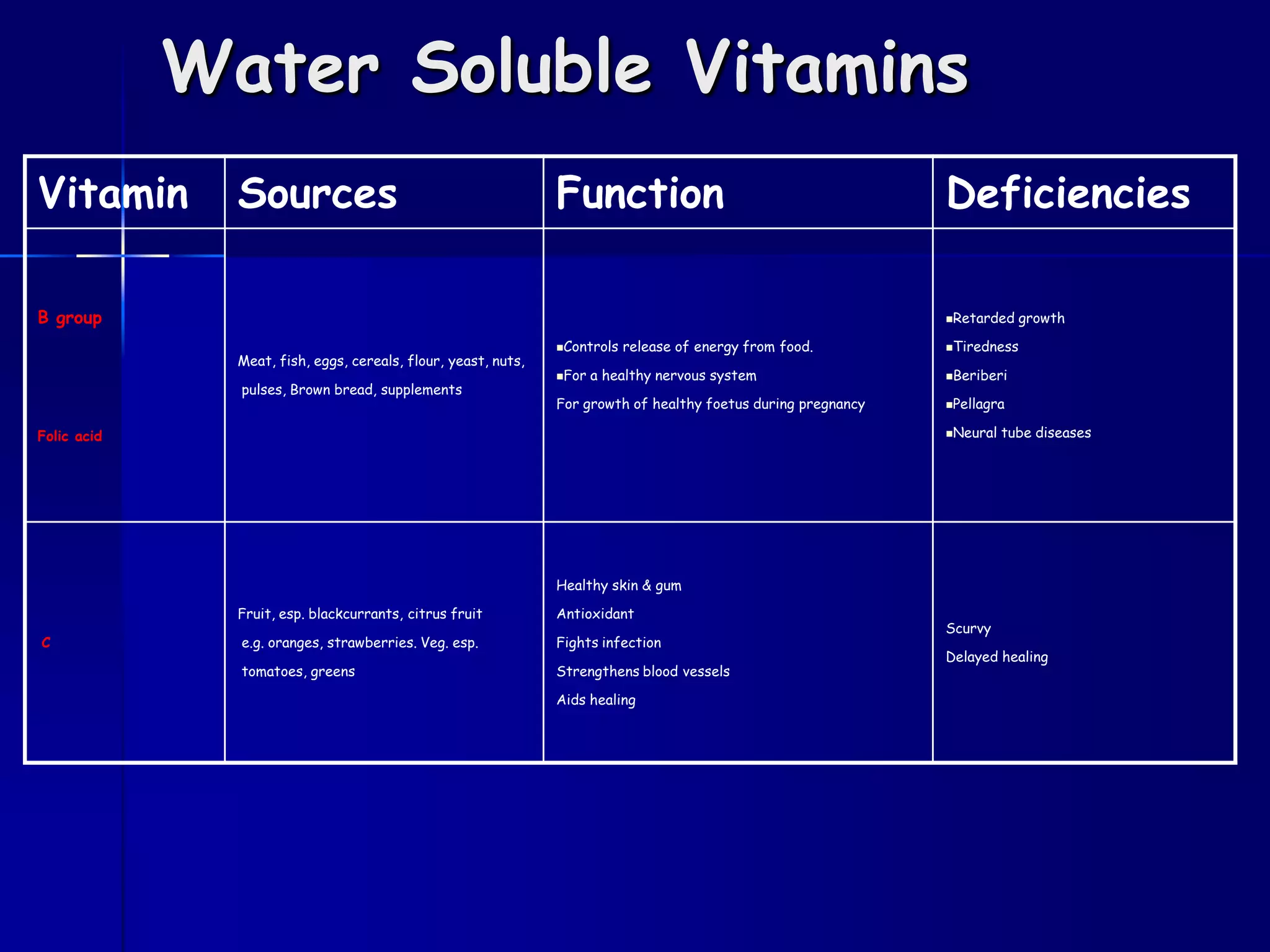
Water Soluble Vitamins
Vitamin Sources Function Deficiencies
B group
Folic acid
Meat, fish, eggs, cereals, flour, yeast, nuts,
pulses, Brown bread, supplements
Controls release of energy from food.
For a healthy nervous system
For growth of healthy foetus during pregnancy
Retarded growth
Tiredness
Beriberi
Pellagra
Neural tube diseases
C
Fruit, esp. blackcurrants, citrus fruit
e.g. oranges, strawberries. Veg. esp.
tomatoes, greens
Healthy skin & gum
Antioxidant
Fights infection
Strengthens blood vessels
Aids healing
Scurvy
Delayed healing
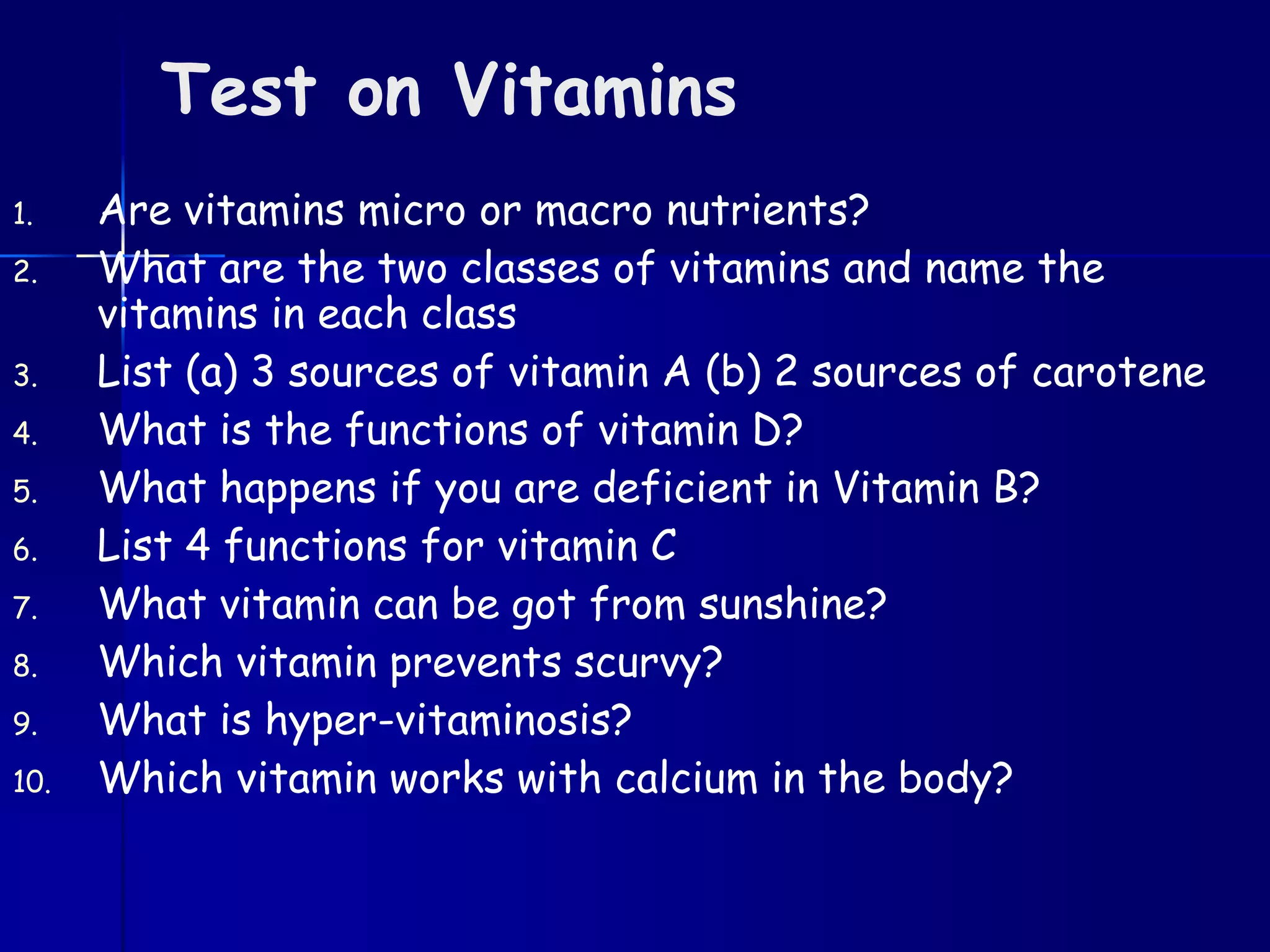
Test on Vitamins
1. Are vitamins micro or macro nutrients?
2. What are the two classes of vitamins and name the
vitamins in each class
3. List (a) 3 sources of vitamin A (b) 2 sources of carotene
4. What is the functions of vitamin D?
5. What happens if you are deficient in Vitamin B?
6. List 4 functions for vitamin C
7. What vitamin can be got from sunshine?
8. Which vitamin prevents scurvy?
9. What is hyper-vitaminosis?
10. Which vitamin works with calcium in the body?

Nutrition

  • 1.
    NUTRITION The study offood, its composition, the amounts needed by the body and its effects on the body © PDST Home Economics
  • 2.
    DEFINITIONS  Food: anysubstance, solid or liquid, that contains nutrients.  Nutrients: substances that can be digested and used by the body. Elements: All nutrients are made up of elements. They are simple substances that cannot be broken down into anything simpler.  Diet: the selection of food each person eats  Balanced diet: contains all the nutrients in the correct amount for the needs of the body.  RDA: Recommended dietary allowance  GDA: Guideline daily amount
  • 3.
    Nutrients There are 6nutrients  Proteins  Fats / Lipids  Carbohydrates  Mineral elements  Vitamins  Water
  • 4.
    Nutrients  Macronutrients: neededin large amounts by the body i.e. protein, fat and carbohydrate.  Micronutrients: Needed in small amounts by the body i.e. vitamins, minerals
  • 5.
    Nutrients  Composition: theelements that make up the nutrients.  Classification: dividing things into groups or classes.  Sources: foods that supply a large amount of a nutrient.  Functions: Uses of nutrients in the body
  • 6.
    Protein - Composition Madeup of the elements:  Carbon  Hydrogen  Oxygen  Nitrogen  Protein is the only nutrient with nitrogen which is needed for growth  The elements join to form Amino Acids  The amino acids link together in long chains called Proteins
  • 7.
  • 8.
    Protein - Classification Thereare 2 classes of protein  1. HBV protein (High Biological Value)/ First class protein / Animal protein.  2. LBV protein (Low Biological Value ) / Second class protein / Plant protein.  Both classes of protein are needed in the diet
  • 9.
    Protein - Sources Animal protein: meat, poultry, fish, eggs, cheese, yoghurt, milk.  Plant protein: Lentils, Beans, Peas, nuts, cereals Plant protein foods contain:  Less saturated fat  More fibre  Cheaper to produce
  • 10.
  • 11.
    Protein - Functions The growth of all body cells  For repair of worn or damaged cells  To make hormones, enzymes and antibodies in the body
  • 12.
  • 13.
    Protein – RDAand Energy value  RDA for protein is 1g per day per Kg of body weight.  1 gram of protein can release 4 kilocalories or 17 kilojoules of energy
  • 14.
    Test on Protein 1.Atoms of which elements make up protein? 2. What’s special about Nitrogen? 3. Name the small units that form proteins 4. Name the 2 classes of protein 5. List 5 food sources for each class 6. Give 2 functions for protein 7. What are the effects of protein deficiency 8. Are proteins micro or macro nutrients? 9. How much protein do we need per day? 10. What is the energy value of 1 gram of protein?
  • 15.
    Lipids (fats &oils)- Composition  Lipids are called fats when solid at room temperature and oils when they are liquid at room temperature.  Made of 3 elements:  Carbon  Hydrogen  Oxygen  The elements make units called glycerol and fatty acids  Each glycerol joins to 3 fatty acids to form a lipid
  • 16.
  • 17.
    Lipids - Classification Thereare 2 classes of lipids  1. Saturated lipids: animal fats, solid at room temperature.  2.Unsaturated lipids: plant and fish oils, liquid at room temperature
  • 18.
    Lipids - Sources 1. Saturated fats are found in: butter, suet, lard, meat, cheese, eggs, milk, yoghurt.  2. Unsaturated fats are found in: fish, nuts, seeds, cereals, soya beans, olives, avocado pears, some margarines, cooking oils.
  • 19.
  • 20.
  • 21.
    Lipids - Function Releases heat and energy for the body  Insulates the body  Protects delicate organs e.g. kidneys  Source of fat soluble vitamins A, D, E, K  Delays hunger  Adds flavour to foods
  • 22.
  • 23.
    Overeating Lipids  Overweightor obesity  Saturated fats raise blood cholesterol. This causes high blood pressure, strokes and heart disease
  • 24.
    Benefits of saturatedlipids  Help reduce cholesterol  Omega 3 and omega 6 fatty acids reduce risk of heart disease and improve brain function. They are found in oily fish, seeds and nuts
  • 25.
    Carbohydrates - Composition Made of 3 elements:  Carbon  Hydrogen  Oxygen  The elements form single sugar units e.g. glucose  The sugar units link up to form other carbohydrates
  • 26.
    Carbohydrates-Classification  There are3 classes of carbohydrates  Sugars  Starches  Cellulose (fibre, roughage)
  • 27.
    Carbohydrates - Sources 1. Sugars are found in: fruit, honey, table sugar, cakes, biscuits, sweets, fizzy drinks, jam  2. Starches are found in: bread, potato, pasta, rice  3. Cellulose is found in: Fruit, vegetables, whole- cereals, seeds, nuts, beans, brown bread, brown rice, high fibre breakfast cereals
  • 28.
  • 29.
    Carbohydrate - functions To supply the body with energy  Extra carbohydrate is changed to body fat and stored  Cellulose is needed to keep the digestive system healthy and lower cholesterol
  • 30.
    Cellulose  Not digested,just passes through our digestive system unchanged  Helps to push food through the intestine and prevent constipation, diverticulosis and cancer of the colon  We need to eat 30g of fibre a day to be healthy most people only eat 15g
  • 31.
    Sugar  Sugar isa food we need to eat less of  Too much sugar is causing obesity, tooth decay and diabetes  A lot of sugar is hidden in foods that don’t really taste sweet especially convenience foods e.g. spaghetti hoops, check label for ingredients
  • 32.
    Reducing Sugar inyour Diet.  Replace sugary snacks with healthy fruit , nuts, yoghurt etc.  Drink water instead of fizzy drinks  Sweeten breakfast cereals with fresh or dried fruit e.g. raisins, banana  Check sugar content on food labels and choose low sugar foods
  • 33.
    Vitamins – (micronutrients) Essential for good health  Each vitamin has its own job to do in the body  If a vitamin is missing from the diet a deficiency disease can occur
  • 34.
    Vitamins - Classification 1. Fat –Soluble (dissolve in fat) Vitamins: A,D,E,K.  2. Water – Soluble (dissolve in water) Vitamins:B, C  If more of the fat soluble vitamins is eaten than the body needs it is stored in the liver.  If an overdose of these vitamins is eaten it causes hypervitaminosis which is harmful to the body.  Water soluble vitamins are not stored in the body, if too much is eaten they are removed in the urine.  It is therefore important to eat water soluble vitamins every day
  • 35.
    Fat soluble vitamins VitaminSources Functions Deficiency A Carotene (changed to vitamin A in the body) Oily fish, cod liver oils liver/kidney eggs, margarine e.g. cabbage, spinach Eyesight Growth Membranes/linings of the body Retarded growth Night blindness Unhealthy membranes /linings D Sunlight oily fish, cod liver oil, tinned salmon/sardines, margarine, butter eggs, Healthy bones and teeth Rickets Tooth decay Osteoporosis
  • 36.
    Water Soluble Vitamins VitaminSources Function Deficiencies B group Folic acid Meat, fish, eggs, cereals, flour, yeast, nuts, pulses, Brown bread, supplements Controls release of energy from food. For a healthy nervous system For growth of healthy foetus during pregnancy Retarded growth Tiredness Beriberi Pellagra Neural tube diseases C Fruit, esp. blackcurrants, citrus fruit e.g. oranges, strawberries. Veg. esp. tomatoes, greens Healthy skin & gum Antioxidant Fights infection Strengthens blood vessels Aids healing Scurvy Delayed healing
  • 37.
    Test on Vitamins 1.Are vitamins micro or macro nutrients? 2. What are the two classes of vitamins and name the vitamins in each class 3. List (a) 3 sources of vitamin A (b) 2 sources of carotene 4. What is the functions of vitamin D? 5. What happens if you are deficient in Vitamin B? 6. List 4 functions for vitamin C 7. What vitamin can be got from sunshine? 8. Which vitamin prevents scurvy? 9. What is hyper-vitaminosis? 10. Which vitamin works with calcium in the body?