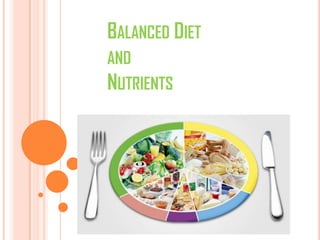
BALANCED DIET
AND
NUTRIENTS
WHAT IS BALANCED DIET???
 A balanced diet means getting the right types and
amounts of foods and drinks to supply nutrition and
energy for maintaining body cells, tissues, and
organs, and for supporting normal growth and
development.
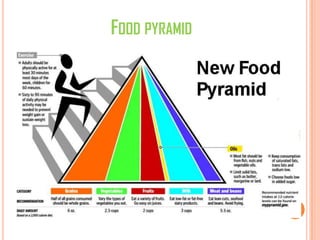
FOOD PYRAMID
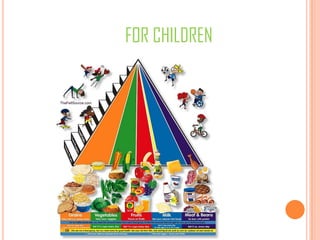
FOR CHILDREN
NUTRIENTS
 2 types of nutirents-
 1. Major- protein,carbohydrate,fats
 2. Micro- minerals-
calcium,magnesium,phosphorus,zinc,selenium
 Vitamins- a,d,e,k,c,b group
 Water
PROTEINS
 1. Helps in tissue and muscle building
 2. Boost up immunity
 3. Helps to maintain fluid balance
 4. Healing
 Deficiency- muscle wasting, weight gain, poor
immunity and low hb.
 Sources- milk and milk products, soya
bean,beans,dals,egg,chicken,fish.
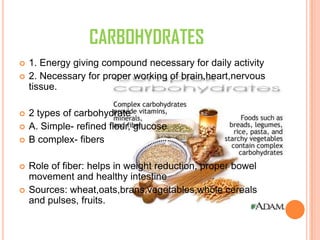
CARBOHYDRATES
 1. Energy giving compound necessary for daily activity
 2. Necessary for proper working of brain,heart,nervous
tissue.
 2 types of carbohydrate
 A. Simple- refined flour, glucose
 B complex- fibers
 Role of fiber: helps in weight reduction, proper bowel
movement and healthy intestine
 Sources: wheat,oats,brans,vegetables,whole cereals
and pulses, fruits.
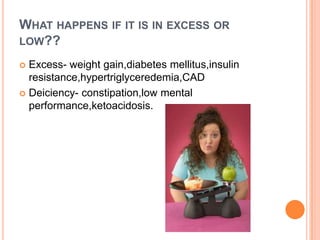
WHAT HAPPENS IF IT IS IN EXCESS OR
LOW??
 Excess- weight gain,diabetes mellitus,insulin
resistance,hypertriglyceredemia,CAD
 Deiciency- constipation,low mental
performance,ketoacidosis.
FATS
 The main function is to give energy
 Important for transport of vitamins a,d,e,k
 Covers organs acts as insulators to our vital organs like
heart,kidney,liver.
 Types of fats: saturated and unsaturated.
 Saturated- solid at room temperature ghee,butter,coconut oil.. This is
bad for our health..
 Unsaturated-liquid at room temperature, omega 3 fatty acid omega 6
fatty acid… good for our health
 Sources: olive oil,rice bran oil, soyabean oil,groundnut oil,mustard oil
 Good source of omega 3 fatty acid- almonds,fish,walnuts.
 Deficency- vitamin deficiency,dry skin,nervous disorders
 Excess- weight gain,elevated blood lipid levels,CAD
RDA FOR MAJOR NURTRIENTS
 Carbohyrates- 65% of total diet
 Proteins- 1g/kg of body weight
 Fats – 3-4 tsp oil and 1 tsp ghee..aprrox 0.5-1
L/person in a family.
WHAT IF OUR DAILY DIET LACK ALL THESE
NUTRIENTS???
 It leads to a condition called Protein energy
malnutrition simply called as malnutrition.
 In Madhya Pradesh alone, about 53% children are
malnourished it include upper middle class children
also..
 Cases of cancers has increased two fold.
Reason??? Lack of fiber in diet
 So what's the remedy???? Inclusion of Protein
supplements in our diet. Inclusion of high fiber
supplements and food in diet.
MINERALS:
 Inorganic elements found in food that are essential
to life processes
 About 25 are essential
 Classified as major or trace minerals
 RDA’s have only been determined for 7 minerals-
calcium,phosphorus,sodium,pottasium,magnesium,i
ron,zinc
CALCIUM
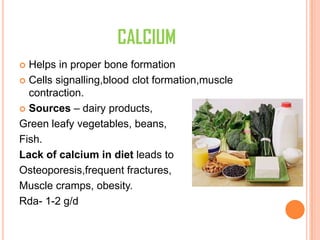
 Helps in proper bone formation
 Cells signalling,blood clot formation,muscle
contraction.
 Sources – dairy products,
Green leafy vegetables, beans,
Fish.
Lack of calcium in diet leads to
Osteoporesis,frequent fractures,
Muscle cramps, obesity.
Rda- 1-2 g/d
IRON AND FOLIC ACID
 Most important for proper haemoglobin levels in our
body.
 Its deficiency causes anemia..
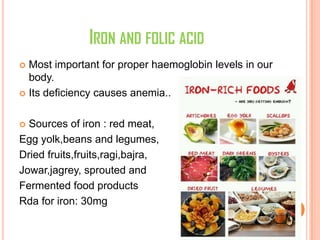
 Sources of iron : red meat,
Egg yolk,beans and legumes,
Dried fruits,fruits,ragi,bajra,
Jowar,jagrey, sprouted and
Fermented food products
Rda for iron: 30mg
SODIUM
 A mineral that regulates body fluid volume,
concentration and acid-base
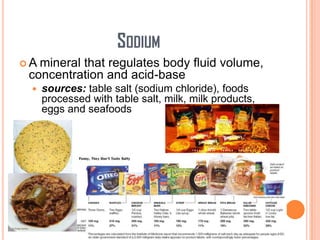
 sources: table salt (sodium chloride), foods
processed with table salt, milk, milk products,
eggs and seafoods
OTHERS
• Magnesium: A mineral found mainly inside muscles, soft
tissues and bone. It functions in many enzyme processes.
• Zinc: A mineral involved in wound healing, taste sensation,
growth and sexual maturation and part of many enzymes
regulating metabolism
sources: meat, liver, eggs and seafood (oysters).
• Iodine: Iodine is needed for the normal metabolism of cells.
Metabolism is the process of converting food into energy.
Humans need iodine for normal thyroid function, and for the
production of thyroid hormones.
Sources -Iodized salt is table salt with iodine added. It is the
main food source of iodine.Seafood is naturally rich in iodine.
Cod, sea bass, haddock, and perch are good sources.
Deficiency – Hypothyroidism
VITAMINS
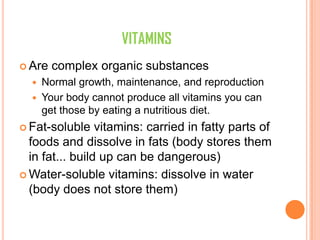
 Are complex organic substances
 Normal growth, maintenance, and reproduction
 Your body cannot produce all vitamins you can
get those by eating a nutritious diet.
 Fat-soluble vitamins: carried in fatty parts of
foods and dissolve in fats (body stores them
in fat... build up can be dangerous)
 Water-soluble vitamins: dissolve in water
(body does not store them)
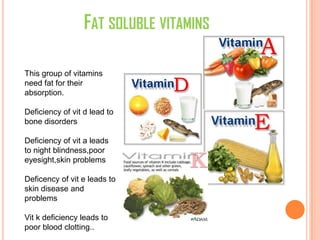
FAT SOLUBLE VITAMINS
This group of vitamins
need fat for their
absorption.
Deficiency of vit d lead to
bone disorders
Deficiency of vit a leads
to night blindness,poor
eyesight,skin problems
Deficency of vit e leads to
skin disease and
problems
Vit k deficiency leads to
poor blood clotting..
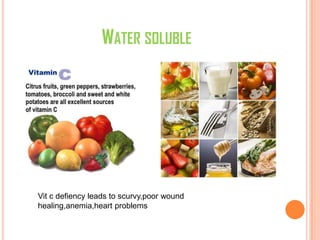
WATER SOLUBLE
Vit c defiency leads to scurvy,poor wound
healing,anemia,heart problems
DEFICIENCY AND SUPPLEMENTS
 The normal rda for mineral and vitamins are
 Calcium-1-2g/d
 Iron-28-30mg.d
 Vit A-2400-3000 I U/d
 Vit E-10-15 mg.d
 Vit D-400-500 I U / d
 Vit K-50-80ug/d
 Vit C-40mg/d
 B12-3-2mcg/d
 Sodium-2-3g/d
WHAT IF ALL THESE NUTRIENT ARE LACKING IN
OUR DIET???
 Although all the mentioned vitamins are present in
our daily diet but some how or the other their
absorption is not proper.
Reason??????
 Lack of vit c might leads to poor absorption of iron.
Lack of vit d leads to calcium deficiecy.
 Heavy bleeding during mestrual cylcle leads to
anemia
 So one cannot depend completely upoon the food
to meet RDA
 Here supplement play important role.
 It provides all the necessary amount of nutrients to
our body.
DIETARY SUPPLEMENTS -BENEFITS
 Enhance immune system
 Antioxidants
 Reduce risk of CAD, stroke
 Decrease risk of Cancers
 Decrease risk of Cataracts,Arthrits,Macular
degeneration,Alzeimers
 Improvements other chronic diseases
WATER
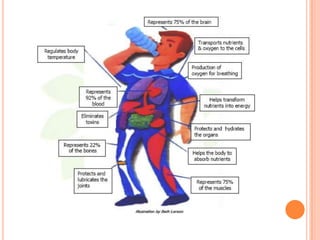
 Water is your body's most important nutrient, is
involved in every bodily function, and makes up 70-
75% of your total body weight. Water helps you to
maintain body temperature, metabolize body fat,
aids in digestion, lubricates and cushions organs,
transports nutrients, and flushes toxins from your
body.
 Daily minimum 10-12 glasses of water should be
taken..
PHYSICAL EXERCISE
 Daily 30-45 mins of physical exercise should be
done or 3-4 hrs per week..
 Physical exercise can be of any type-
walking,jogging,swimming,aerobics,yoga,cycling.
TIPS FOR HEALTHY DIET
 A well balanced diet including food from all nutrients
in correct form
 Engage in regular physical exercise atleast 30 mins
 Positive attitude
 Keep smiling always.
balanced diet

balanced diet

  • 1.
  • 2.
    WHAT IS BALANCEDDIET???  A balanced diet means getting the right types and amounts of foods and drinks to supply nutrition and energy for maintaining body cells, tissues, and organs, and for supporting normal growth and development.
  • 3.
  • 4.
  • 5.
    NUTRIENTS  2 typesof nutirents-  1. Major- protein,carbohydrate,fats  2. Micro- minerals- calcium,magnesium,phosphorus,zinc,selenium  Vitamins- a,d,e,k,c,b group  Water
  • 6.
    PROTEINS  1. Helpsin tissue and muscle building  2. Boost up immunity  3. Helps to maintain fluid balance  4. Healing  Deficiency- muscle wasting, weight gain, poor immunity and low hb.  Sources- milk and milk products, soya bean,beans,dals,egg,chicken,fish.
  • 7.
    CARBOHYDRATES  1. Energygiving compound necessary for daily activity  2. Necessary for proper working of brain,heart,nervous tissue.  2 types of carbohydrate  A. Simple- refined flour, glucose  B complex- fibers  Role of fiber: helps in weight reduction, proper bowel movement and healthy intestine  Sources: wheat,oats,brans,vegetables,whole cereals and pulses, fruits.
  • 8.
    WHAT HAPPENS IFIT IS IN EXCESS OR LOW??  Excess- weight gain,diabetes mellitus,insulin resistance,hypertriglyceredemia,CAD  Deiciency- constipation,low mental performance,ketoacidosis.
  • 9.
    FATS  The mainfunction is to give energy  Important for transport of vitamins a,d,e,k  Covers organs acts as insulators to our vital organs like heart,kidney,liver.  Types of fats: saturated and unsaturated.  Saturated- solid at room temperature ghee,butter,coconut oil.. This is bad for our health..  Unsaturated-liquid at room temperature, omega 3 fatty acid omega 6 fatty acid… good for our health  Sources: olive oil,rice bran oil, soyabean oil,groundnut oil,mustard oil  Good source of omega 3 fatty acid- almonds,fish,walnuts.  Deficency- vitamin deficiency,dry skin,nervous disorders  Excess- weight gain,elevated blood lipid levels,CAD
  • 10.
    RDA FOR MAJORNURTRIENTS  Carbohyrates- 65% of total diet  Proteins- 1g/kg of body weight  Fats – 3-4 tsp oil and 1 tsp ghee..aprrox 0.5-1 L/person in a family.
  • 11.
    WHAT IF OURDAILY DIET LACK ALL THESE NUTRIENTS???  It leads to a condition called Protein energy malnutrition simply called as malnutrition.  In Madhya Pradesh alone, about 53% children are malnourished it include upper middle class children also..  Cases of cancers has increased two fold. Reason??? Lack of fiber in diet  So what's the remedy???? Inclusion of Protein supplements in our diet. Inclusion of high fiber supplements and food in diet.
  • 12.
    MINERALS:  Inorganic elementsfound in food that are essential to life processes  About 25 are essential  Classified as major or trace minerals  RDA’s have only been determined for 7 minerals- calcium,phosphorus,sodium,pottasium,magnesium,i ron,zinc
  • 13.
    CALCIUM  Helps inproper bone formation  Cells signalling,blood clot formation,muscle contraction.  Sources – dairy products, Green leafy vegetables, beans, Fish. Lack of calcium in diet leads to Osteoporesis,frequent fractures, Muscle cramps, obesity. Rda- 1-2 g/d
  • 14.
    IRON AND FOLICACID  Most important for proper haemoglobin levels in our body.  Its deficiency causes anemia..  Sources of iron : red meat, Egg yolk,beans and legumes, Dried fruits,fruits,ragi,bajra, Jowar,jagrey, sprouted and Fermented food products Rda for iron: 30mg
  • 15.
    SODIUM  A mineralthat regulates body fluid volume, concentration and acid-base  sources: table salt (sodium chloride), foods processed with table salt, milk, milk products, eggs and seafoods
  • 16.
    OTHERS • Magnesium: Amineral found mainly inside muscles, soft tissues and bone. It functions in many enzyme processes. • Zinc: A mineral involved in wound healing, taste sensation, growth and sexual maturation and part of many enzymes regulating metabolism sources: meat, liver, eggs and seafood (oysters). • Iodine: Iodine is needed for the normal metabolism of cells. Metabolism is the process of converting food into energy. Humans need iodine for normal thyroid function, and for the production of thyroid hormones. Sources -Iodized salt is table salt with iodine added. It is the main food source of iodine.Seafood is naturally rich in iodine. Cod, sea bass, haddock, and perch are good sources. Deficiency – Hypothyroidism
  • 17.
    VITAMINS  Are complexorganic substances  Normal growth, maintenance, and reproduction  Your body cannot produce all vitamins you can get those by eating a nutritious diet.  Fat-soluble vitamins: carried in fatty parts of foods and dissolve in fats (body stores them in fat... build up can be dangerous)  Water-soluble vitamins: dissolve in water (body does not store them)
  • 18.
    FAT SOLUBLE VITAMINS Thisgroup of vitamins need fat for their absorption. Deficiency of vit d lead to bone disorders Deficiency of vit a leads to night blindness,poor eyesight,skin problems Deficency of vit e leads to skin disease and problems Vit k deficiency leads to poor blood clotting..
  • 19.
    WATER SOLUBLE Vit cdefiency leads to scurvy,poor wound healing,anemia,heart problems
  • 20.
    DEFICIENCY AND SUPPLEMENTS The normal rda for mineral and vitamins are  Calcium-1-2g/d  Iron-28-30mg.d  Vit A-2400-3000 I U/d  Vit E-10-15 mg.d  Vit D-400-500 I U / d  Vit K-50-80ug/d  Vit C-40mg/d  B12-3-2mcg/d  Sodium-2-3g/d
  • 21.
    WHAT IF ALLTHESE NUTRIENT ARE LACKING IN OUR DIET???  Although all the mentioned vitamins are present in our daily diet but some how or the other their absorption is not proper. Reason??????  Lack of vit c might leads to poor absorption of iron. Lack of vit d leads to calcium deficiecy.  Heavy bleeding during mestrual cylcle leads to anemia  So one cannot depend completely upoon the food to meet RDA  Here supplement play important role.  It provides all the necessary amount of nutrients to our body.
  • 22.
    DIETARY SUPPLEMENTS -BENEFITS Enhance immune system  Antioxidants  Reduce risk of CAD, stroke  Decrease risk of Cancers  Decrease risk of Cataracts,Arthrits,Macular degeneration,Alzeimers  Improvements other chronic diseases
  • 23.
    WATER  Water isyour body's most important nutrient, is involved in every bodily function, and makes up 70- 75% of your total body weight. Water helps you to maintain body temperature, metabolize body fat, aids in digestion, lubricates and cushions organs, transports nutrients, and flushes toxins from your body.  Daily minimum 10-12 glasses of water should be taken..
  • 25.
    PHYSICAL EXERCISE  Daily30-45 mins of physical exercise should be done or 3-4 hrs per week..  Physical exercise can be of any type- walking,jogging,swimming,aerobics,yoga,cycling.
  • 26.
    TIPS FOR HEALTHYDIET  A well balanced diet including food from all nutrients in correct form  Engage in regular physical exercise atleast 30 mins  Positive attitude  Keep smiling always.