Why the knowledge of food & nutrition is
important?
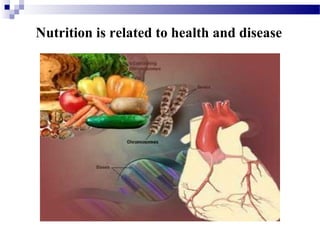
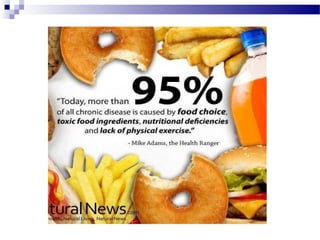
Nutrition is related to health and disease
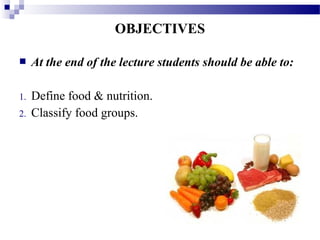
 At the end of the lecture students should be able to:
1. Define food & nutrition.
2. Classify food groups.
OBJECTIVES
 Define:
i. Food
ii. Nutrition
iii. Nutrients
iv. Diet
v. Healthy diet
DEFINITIONS
INTRODUCTION
 Food isis a substance that living beings eat to satite their
hunger.
 Diet is the kinds of food that a person, animal, or
community habitually eats.
 Dietics is “Dietics is “the practical application of the principles ofthe practical application of the principles of
nutrition”nutrition”; It includes the planning of meals for well and; It includes the planning of meals for well and
sick.sick.
 Community nutrition isCommunity nutrition is the “practical application of the“practical application of the
nutritional knowledge to promote health and wellbeing of
individuals, groups or community”.
1. Fulfills energy needs (macronutrients)
2. Provides sufficient amounts of essential nutrients
(micronutrients)
3. Reduces risk of disease
4. Is safe to consume (low contaminants or potentially harmful
added substances)
What is Healthy Diet?
 Nutrition is defined asNutrition is defined as “the science of food and its“the science of food and its
relationship to health”.relationship to health”.
 The science of human nutrition deals with all the
effects on people, of any component, found in food.
NUTRITION
 The science of nutrition include:
1. The physiological and biochemical processes
involved in nourishment—how substances in food
provide energy or are converted into body tissues,
2. The diseases that result from insufficiency or excess
of essential nutrients (malnutrition).
3. Nutrition is also about why people choose to eat the
foods they do, even if they have been advised that
doing so may be unhealthy.
NUTRITION
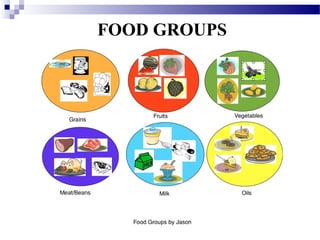
FOOD GROUPS
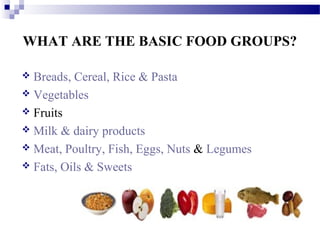
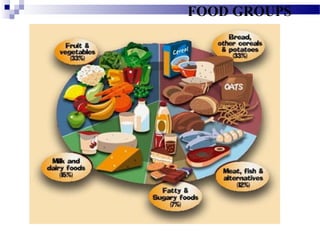
WHAT ARE THE BASIC FOOD GROUPS?
 Breads, Cereal, Rice & Pasta
 Vegetables
 Fruits
 Milk & dairy products
 Meat, Poultry, Fish, Eggs, Nuts & Legumes
 Fats, Oils & Sweets
FOOD GROUPS
CEREALS & GRAINS
 Cereals are grasses cultivated for the edible
components of their grain; composed of the endosperm,
germ, and bran.
 Cereal grains are grown in greater quantities and
provide more food energy worldwide than any other
type of crop; they are therefore “staple crops”.
TYPES OF GRAINS
1. Whole Grains refer to grains that have all of the parts
of the grain seed, (bran, germ & endosperm).
 Examples: Brown bread & rice, maize, oat, barley,
millet
1. "Refined Grain” is processed grain when some of the
dietary fiber and other important nutrients are
removed.
 Examples: Refined grains (white bread & rice, pasta,
noodles)
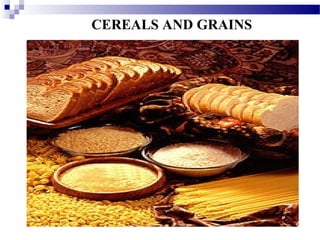
CEREALS AND GRAINS
TYPES OF GRAINS
 Whole grains are a rich source of carbohydrates,
protein, fiber, fats & oils and a wide range of
vitamins and minerals including folate, thiamin,
riboflavin, niacin and iron.
 However, when refined by the removal of the bran
and germ, the remaining endosperm is mostly
carbohydrate and lacks the majority of the other
nutrients.
VEGETABLES
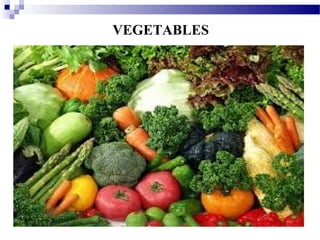
 Vegetables comprise any plant part, other than fruit
which is used as food. They include;
i. Roots and tubers (potatoes, turnips, carrots)
ii. Bulbs s(onions)
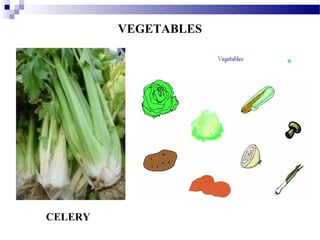
iii. Stems (Celery)
iv. Leaves (Lettuce and cabbage)
v. Flowers (broccoli and cauliflower)
vi. Peas and beans are legumes but when immature and
green are treated as vegetables.
CELERY
VEGETABLES
VEGETABLES
FRUITS
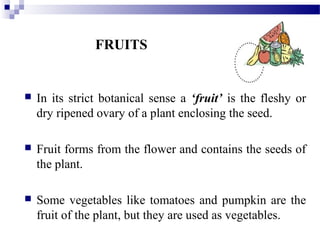
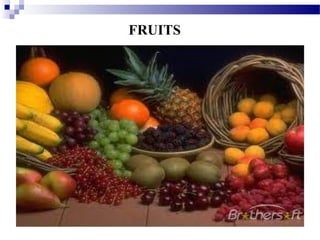
 In its strict botanical sense a ‘fruit’ is the fleshy or
dry ripened ovary of a plant enclosing the seed.
 Fruit forms from the flower and contains the seeds of
the plant.
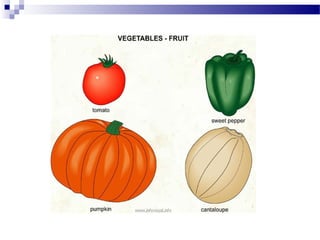
 Some vegetables like tomatoes and pumpkin are the
fruit of the plant, but they are used as vegetables.
FRUITS
 Fruit is a good source of vitamins, including vitamin
C and folate, carotenoids as well as useful amount of
potassium.
 It also provides carbohydrates, in particular natural
sugars and fibre, especially in the edible skins.
 The sugar that makes them sweet provides energy.
FRUITS
MILK AND MILK PRODUCTS
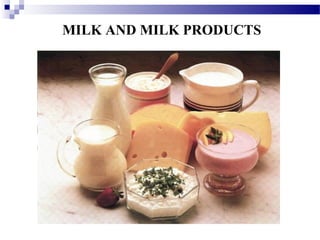
 Milk, yoghurt and firm cheeses are the three
important foods in this group.
 The foods in this group are an excellent source of
calcium.
 Milk carries B group vitamins, particularly riboflavin
& vitamin B12, and the fat soluble vitamins A & D.
MILK AND MILK PRODUCTS
 These foods are also a good source of fats and
protein, but is low in iron.
 Lactose is the principal sugar in milk, and milk is
the only source of lactose in nature.
 The lactose enhances the absorption of calcium and
phosphorus from the intestine.
MILK AND MILK PRODUCTS
MEAT, FISH, POULTRY, EGGS
NUTS & LEGUMES
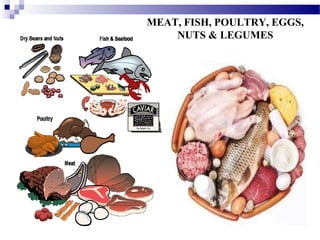
 There is a wide variety of foods in this group.
 It consists of all kinds of meat, poultry, fish, eggs,
nuts and nut pastes such as peanut butter, legumes,
and some seeds such as sunflower and sesame seeds.
 The foods in this group are a good source of protein,
iron, niacin and vitamin B12.
MEAT, FISH, POULTRY, EGGS,
NUTS & LEGUMES
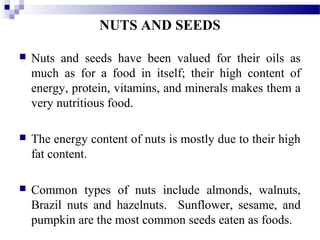
NUTS AND SEEDS
 Nuts and seeds have been valued for their oils as
much as for a food in itself; their high content of
energy, protein, vitamins, and minerals makes them a
very nutritious food.
 The energy content of nuts is mostly due to their high
fat content.
 Common types of nuts include almonds, walnuts,
Brazil nuts and hazelnuts. Sunflower, sesame, and
pumpkin are the most common seeds eaten as foods.
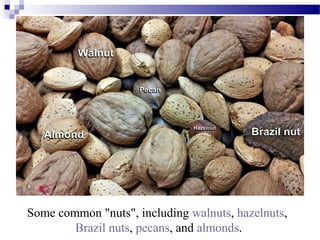
Some common "nuts", including walnuts, hazelnuts,
Brazil nuts, pecans, and almonds.
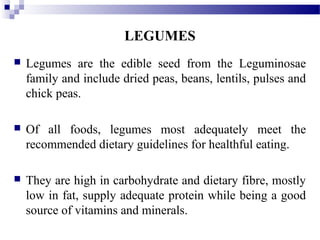
LEGUMES
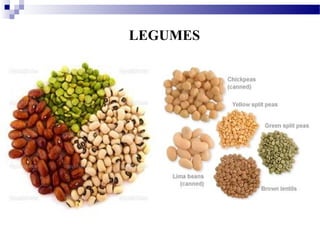
 Legumes are the edible seed from the Leguminosae
family and include dried peas, beans, lentils, pulses and
chick peas.
 Of all foods, legumes most adequately meet the
recommended dietary guidelines for healthful eating.
 They are high in carbohydrate and dietary fibre, mostly
low in fat, supply adequate protein while being a good
source of vitamins and minerals.
LEGUMES
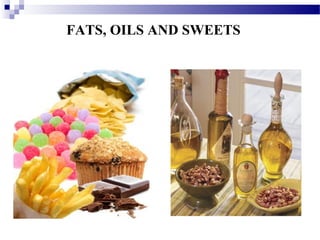
FATS, OILS AND SWEETS
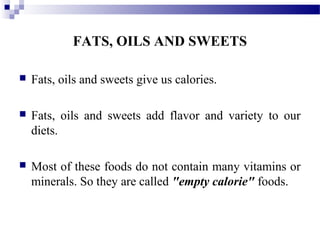
 Fats, oils and sweets give us calories.
 Fats, oils and sweets add flavor and variety to our
diets.
 Most of these foods do not contain many vitamins or
minerals. So they are called "empty calorie" foods.
FATS, OILS AND SWEETS
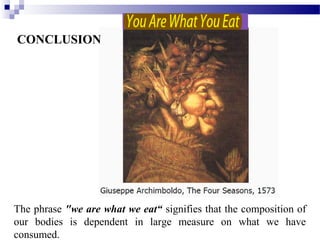
The phrase "we are what we eat“ signifies that the composition of
our bodies is dependent in large measure on what we have
consumed.
CONCLUSION
THANK YOU

Food groups

  • 2.
    Why the knowledgeof food & nutrition is important?
  • 3.
    Nutrition is relatedto health and disease
  • 5.
     At theend of the lecture students should be able to: 1. Define food & nutrition. 2. Classify food groups. OBJECTIVES
  • 6.
     Define: i. Food ii.Nutrition iii. Nutrients iv. Diet v. Healthy diet DEFINITIONS
  • 7.
    INTRODUCTION  Food isisa substance that living beings eat to satite their hunger.  Diet is the kinds of food that a person, animal, or community habitually eats.  Dietics is “Dietics is “the practical application of the principles ofthe practical application of the principles of nutrition”nutrition”; It includes the planning of meals for well and; It includes the planning of meals for well and sick.sick.  Community nutrition isCommunity nutrition is the “practical application of the“practical application of the nutritional knowledge to promote health and wellbeing of individuals, groups or community”.
  • 8.
    1. Fulfills energyneeds (macronutrients) 2. Provides sufficient amounts of essential nutrients (micronutrients) 3. Reduces risk of disease 4. Is safe to consume (low contaminants or potentially harmful added substances) What is Healthy Diet?
  • 9.
     Nutrition isdefined asNutrition is defined as “the science of food and its“the science of food and its relationship to health”.relationship to health”.  The science of human nutrition deals with all the effects on people, of any component, found in food. NUTRITION
  • 10.
     The scienceof nutrition include: 1. The physiological and biochemical processes involved in nourishment—how substances in food provide energy or are converted into body tissues, 2. The diseases that result from insufficiency or excess of essential nutrients (malnutrition). 3. Nutrition is also about why people choose to eat the foods they do, even if they have been advised that doing so may be unhealthy. NUTRITION
  • 11.
  • 12.
    WHAT ARE THEBASIC FOOD GROUPS?  Breads, Cereal, Rice & Pasta  Vegetables  Fruits  Milk & dairy products  Meat, Poultry, Fish, Eggs, Nuts & Legumes  Fats, Oils & Sweets
  • 13.
  • 14.
    CEREALS & GRAINS Cereals are grasses cultivated for the edible components of their grain; composed of the endosperm, germ, and bran.  Cereal grains are grown in greater quantities and provide more food energy worldwide than any other type of crop; they are therefore “staple crops”.
  • 15.
    TYPES OF GRAINS 1.Whole Grains refer to grains that have all of the parts of the grain seed, (bran, germ & endosperm).  Examples: Brown bread & rice, maize, oat, barley, millet 1. "Refined Grain” is processed grain when some of the dietary fiber and other important nutrients are removed.  Examples: Refined grains (white bread & rice, pasta, noodles)
  • 16.
  • 17.
    TYPES OF GRAINS Whole grains are a rich source of carbohydrates, protein, fiber, fats & oils and a wide range of vitamins and minerals including folate, thiamin, riboflavin, niacin and iron.  However, when refined by the removal of the bran and germ, the remaining endosperm is mostly carbohydrate and lacks the majority of the other nutrients.
  • 18.
    VEGETABLES  Vegetables compriseany plant part, other than fruit which is used as food. They include; i. Roots and tubers (potatoes, turnips, carrots) ii. Bulbs s(onions) iii. Stems (Celery) iv. Leaves (Lettuce and cabbage) v. Flowers (broccoli and cauliflower) vi. Peas and beans are legumes but when immature and green are treated as vegetables.
  • 19.
  • 20.
  • 21.
    FRUITS  In itsstrict botanical sense a ‘fruit’ is the fleshy or dry ripened ovary of a plant enclosing the seed.  Fruit forms from the flower and contains the seeds of the plant.  Some vegetables like tomatoes and pumpkin are the fruit of the plant, but they are used as vegetables.
  • 23.
    FRUITS  Fruit isa good source of vitamins, including vitamin C and folate, carotenoids as well as useful amount of potassium.  It also provides carbohydrates, in particular natural sugars and fibre, especially in the edible skins.  The sugar that makes them sweet provides energy.
  • 24.
  • 25.
    MILK AND MILKPRODUCTS  Milk, yoghurt and firm cheeses are the three important foods in this group.  The foods in this group are an excellent source of calcium.  Milk carries B group vitamins, particularly riboflavin & vitamin B12, and the fat soluble vitamins A & D.
  • 26.
    MILK AND MILKPRODUCTS  These foods are also a good source of fats and protein, but is low in iron.  Lactose is the principal sugar in milk, and milk is the only source of lactose in nature.  The lactose enhances the absorption of calcium and phosphorus from the intestine.
  • 27.
    MILK AND MILKPRODUCTS
  • 28.
    MEAT, FISH, POULTRY,EGGS NUTS & LEGUMES  There is a wide variety of foods in this group.  It consists of all kinds of meat, poultry, fish, eggs, nuts and nut pastes such as peanut butter, legumes, and some seeds such as sunflower and sesame seeds.  The foods in this group are a good source of protein, iron, niacin and vitamin B12.
  • 29.
    MEAT, FISH, POULTRY,EGGS, NUTS & LEGUMES
  • 30.
    NUTS AND SEEDS Nuts and seeds have been valued for their oils as much as for a food in itself; their high content of energy, protein, vitamins, and minerals makes them a very nutritious food.  The energy content of nuts is mostly due to their high fat content.  Common types of nuts include almonds, walnuts, Brazil nuts and hazelnuts. Sunflower, sesame, and pumpkin are the most common seeds eaten as foods.
  • 31.
    Some common "nuts",including walnuts, hazelnuts, Brazil nuts, pecans, and almonds.
  • 32.
    LEGUMES  Legumes arethe edible seed from the Leguminosae family and include dried peas, beans, lentils, pulses and chick peas.  Of all foods, legumes most adequately meet the recommended dietary guidelines for healthful eating.  They are high in carbohydrate and dietary fibre, mostly low in fat, supply adequate protein while being a good source of vitamins and minerals.
  • 33.
  • 34.
    FATS, OILS ANDSWEETS  Fats, oils and sweets give us calories.  Fats, oils and sweets add flavor and variety to our diets.  Most of these foods do not contain many vitamins or minerals. So they are called "empty calorie" foods.
  • 35.
  • 36.
    The phrase "weare what we eat“ signifies that the composition of our bodies is dependent in large measure on what we have consumed. CONCLUSION
  • 37.