MILKMILK
TheThe
CompleteComplete
FoodFood
© PDST Home Economics
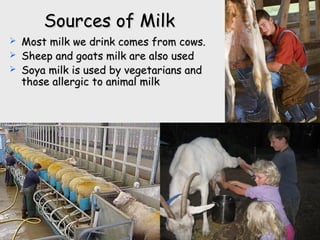
Sources of MilkSources of Milk
 Most milk we drink comes from cows.Most milk we drink comes from cows.
 Sheep and goats milk are also usedSheep and goats milk are also used
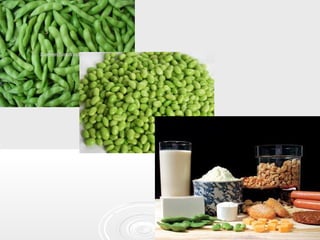
 Soya milk is used by vegetarians andSoya milk is used by vegetarians and
those allergic to animal milkthose allergic to animal milk
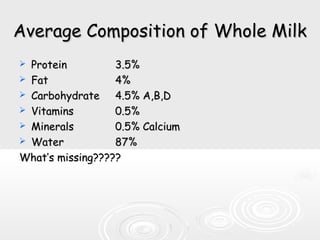
Average Composition of Whole MilkAverage Composition of Whole Milk
 ProteinProtein 3.5%3.5%
 FatFat 4%4%
 CarbohydrateCarbohydrate 4.5% A,B,D4.5% A,B,D
 VitaminsVitamins 0.5%0.5%
 MineralsMinerals 0.5% Calcium0.5% Calcium
 WaterWater 87%87%
What’s missing?????What’s missing?????
Nutritive ValueNutritive Value
 Protein, HBV, growth and repair of cells.Protein, HBV, growth and repair of cells.
 Fat, saturated, for energy, easily digested.Fat, saturated, for energy, easily digested.
 Carbohydrates, sugar (lactose), energy.Carbohydrates, sugar (lactose), energy.
 Minerals, calcium and phosphorus, bones and teeth.Minerals, calcium and phosphorus, bones and teeth.
 Vitamins, A (eyes, growth, skin, membranes), BVitamins, A (eyes, growth, skin, membranes), B
(nerves and energy), D (bones and teeth).(nerves and energy), D (bones and teeth).
 Water, very high amount.Water, very high amount.
Value of milk in the dietValue of milk in the diet
 Important for protein and calcium (for growing andImportant for protein and calcium (for growing and
repairing cells and bones)repairing cells and bones)
 Lots of different uses.Lots of different uses.
 InexpensiveInexpensive
 Easily digested (elderly, small children, invalids).Easily digested (elderly, small children, invalids).
Uses of milkUses of milk
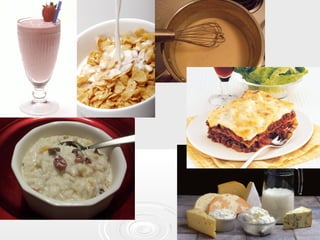
 As a drinkAs a drink
 On breakfast cerealsOn breakfast cereals
 Desserts e.g. milk Pudding.Desserts e.g. milk Pudding.
 Sauces e.g. cheese sauceSauces e.g. cheese sauce
 In soupIn soup
 For bakingFor baking
 Savoury dishes e.g. LasagneSavoury dishes e.g. Lasagne
 As a milk product e.g. yoghurt, cheese, butterAs a milk product e.g. yoghurt, cheese, butter
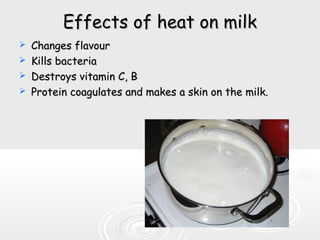
Effects of heat on milkEffects of heat on milk
 Changes flavourChanges flavour
 Kills bacteriaKills bacteria
 Destroys vitamin C, BDestroys vitamin C, B
 Protein coagulates and makes a skin on the milk.Protein coagulates and makes a skin on the milk.
Storing MilkStoring Milk
Milk is easily infected by bacteria so….Milk is easily infected by bacteria so….
 Check date stampCheck date stamp
 Keep out of sunlightKeep out of sunlight
 CoverCover
 Keep away from strong smelling food.Keep away from strong smelling food.
 Store in a refrigeratorStore in a refrigerator
 Use a clean jugUse a clean jug
……..clean cool covered..clean cool covered
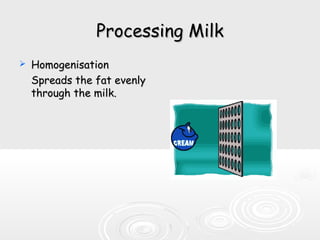
Processing MilkProcessing Milk
 HomogenisationHomogenisation
Spreads the fat evenlySpreads the fat evenly
through the milk.through the milk.
Heat TreatmentsHeat Treatments
(a) Makes milk safe to drink(a) Makes milk safe to drink
(b) Helps milk stay fresh for longer(b) Helps milk stay fresh for longer
Examples:Examples:
PasteurisationPasteurisation
Ultra Heat Treated (UHT)Ultra Heat Treated (UHT)
PasteurisationPasteurisation
 Milk is heated to 72Milk is heated to 72ºC for 25 secondsºC for 25 seconds
 Then cooled to 10 ºCThen cooled to 10 ºC
 Sealed in sterile containersSealed in sterile containers
Effects on milk:Effects on milk:
Flavour changeFlavour change
Vit. C destroyedVit. C destroyed
Disease causing bacteria destroyedDisease causing bacteria destroyed
SomeSome souring bacteria destroyed so milk keeps longersouring bacteria destroyed so milk keeps longer
Ultra Heat TreatedUltra Heat Treated
 Heated to 132Heated to 132 ºCºC
 Cooled quicklyCooled quickly
 Sealed in sterile containersSealed in sterile containers
Effects on milk:Effects on milk:
Flavour changeFlavour change
All bacteria killedAll bacteria killed
Sealed cartons don’t need refrigeration and keep forSealed cartons don’t need refrigeration and keep for
monthsmonths
Vitamin C and some B destroyedVitamin C and some B destroyed
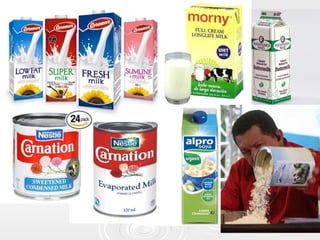
Types of milkTypes of milk
 Whole milkWhole milk: nothing added or taken away, just: nothing added or taken away, just
homogenised and pasteurised – children.homogenised and pasteurised – children.
 Low fat milkLow fat milk: some fat removed – adults: some fat removed – adults
 Skimmed milkSkimmed milk: almost all fat removed – low calorie and low: almost all fat removed – low calorie and low
fat diets.fat diets.
 Fortified milkFortified milk (super) extra vitamins and minerals added.(super) extra vitamins and minerals added.
 Long life milkLong life milk: ultra heat treated, camping, warm: ultra heat treated, camping, warm
countriescountries
Types of milkTypes of milk
 ButtermilkButtermilk: liquid left over after butter is made,: liquid left over after butter is made,
acidic, used in baking.acidic, used in baking.
 Dried milkDried milk: all moisture removed keeps for long time: all moisture removed keeps for long time
inin sealedsealed container, camping, emergencies.container, camping, emergencies.
 Evaporated milkEvaporated milk: some water removed, sterilised and: some water removed, sterilised and
sealed in a can, keeps over a year, used in cooking -sealed in a can, keeps over a year, used in cooking -
dessertdessert
 Condensed milk:Condensed milk: some water removed, sugar added,some water removed, sugar added,
sterilised and sealed in a can, keeps well, used insterilised and sealed in a can, keeps well, used in
cooking – dessertcooking – dessert
 Soya milk:Soya milk: made from soya beans, used by vegans andmade from soya beans, used by vegans and
people allergic to cows milk.people allergic to cows milk.
TESTTEST
1. List 2 sources of milk1. List 2 sources of milk
2. % composition of milk?2. % composition of milk?
3. What nutrients are missing from milk?3. What nutrients are missing from milk?
4. Why is milk good for teenagers?4. Why is milk good for teenagers?
5. 4 uses of milk5. 4 uses of milk
6. 2 points on storing milk6. 2 points on storing milk
7. 2 effects of heat on milk7. 2 effects of heat on milk
8. What is homogenisation, what effect has it?8. What is homogenisation, what effect has it?
9. What is pasteurisation, what effect has it?9. What is pasteurisation, what effect has it?
10. Name 4 types of milk and give one use for each.10. Name 4 types of milk and give one use for each.
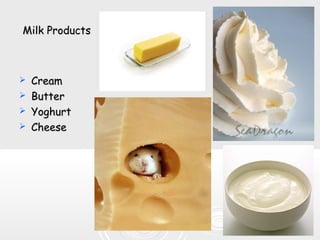
Milk ProductsMilk Products
 CreamCream
 ButterButter
 YoghurtYoghurt
 CheeseCheese
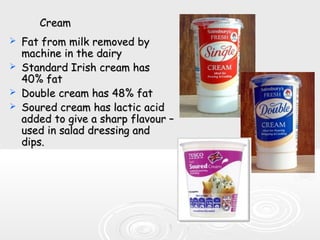
CreamCream
 Fat from milk removed byFat from milk removed by
machine in the dairymachine in the dairy
 Standard Irish cream hasStandard Irish cream has
4040% fat% fat
 Double cream has 48% fatDouble cream has 48% fat
 Soured cream has lactic acidSoured cream has lactic acid
added to give a sharp flavour –added to give a sharp flavour –
used in salad dressing andused in salad dressing and
dips.dips.
ButterButter
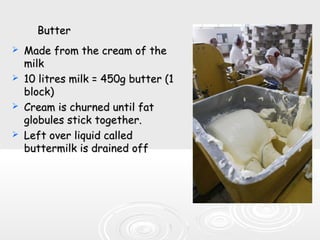
 Made from the cream of theMade from the cream of the
milkmilk
 10 litres milk = 450g butter (110 litres milk = 450g butter (1
block)block)
 Cream is churned until fatCream is churned until fat
globules stick together.globules stick together.
 Left over liquid calledLeft over liquid called
buttermilk is drained offbuttermilk is drained off
YoghurtYoghurt
 Special harmless bacteria added to warm milk.Special harmless bacteria added to warm milk.
 Bacteria turn milk sugar to acid which flavours andBacteria turn milk sugar to acid which flavours and
thickens the milk – naturalthickens the milk – natural
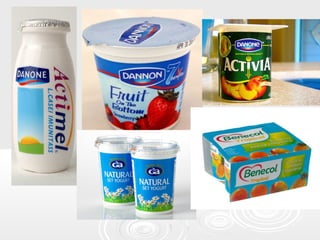
 Flavoured with sugar, fruit, chocolate, vanilla etcFlavoured with sugar, fruit, chocolate, vanilla etc
 Made from whole, low fat or skimmed milk.Made from whole, low fat or skimmed milk.
 Can be drinking, stirred, set or frozen.Can be drinking, stirred, set or frozen.
 Some yoghurts help immunity or digestion others helpSome yoghurts help immunity or digestion others help
reduce cholesterolreduce cholesterol
Uses of yoghurtUses of yoghurt
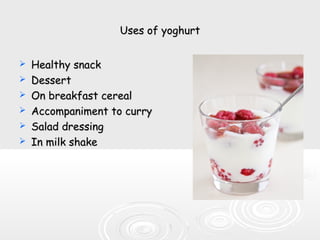
 Healthy snackHealthy snack
 DessertDessert
 On breakfast cerealOn breakfast cereal
 Accompaniment to curryAccompaniment to curry
 Salad dressingSalad dressing
 In milk shakeIn milk shake

Milk the complete food

  • 1.
  • 2.
    Sources of MilkSourcesof Milk  Most milk we drink comes from cows.Most milk we drink comes from cows.  Sheep and goats milk are also usedSheep and goats milk are also used  Soya milk is used by vegetarians andSoya milk is used by vegetarians and those allergic to animal milkthose allergic to animal milk
  • 4.
    Average Composition ofWhole MilkAverage Composition of Whole Milk  ProteinProtein 3.5%3.5%  FatFat 4%4%  CarbohydrateCarbohydrate 4.5% A,B,D4.5% A,B,D  VitaminsVitamins 0.5%0.5%  MineralsMinerals 0.5% Calcium0.5% Calcium  WaterWater 87%87% What’s missing?????What’s missing?????
  • 5.
    Nutritive ValueNutritive Value Protein, HBV, growth and repair of cells.Protein, HBV, growth and repair of cells.  Fat, saturated, for energy, easily digested.Fat, saturated, for energy, easily digested.  Carbohydrates, sugar (lactose), energy.Carbohydrates, sugar (lactose), energy.  Minerals, calcium and phosphorus, bones and teeth.Minerals, calcium and phosphorus, bones and teeth.  Vitamins, A (eyes, growth, skin, membranes), BVitamins, A (eyes, growth, skin, membranes), B (nerves and energy), D (bones and teeth).(nerves and energy), D (bones and teeth).  Water, very high amount.Water, very high amount.
  • 6.
    Value of milkin the dietValue of milk in the diet  Important for protein and calcium (for growing andImportant for protein and calcium (for growing and repairing cells and bones)repairing cells and bones)  Lots of different uses.Lots of different uses.  InexpensiveInexpensive  Easily digested (elderly, small children, invalids).Easily digested (elderly, small children, invalids).
  • 7.
    Uses of milkUsesof milk  As a drinkAs a drink  On breakfast cerealsOn breakfast cereals  Desserts e.g. milk Pudding.Desserts e.g. milk Pudding.  Sauces e.g. cheese sauceSauces e.g. cheese sauce  In soupIn soup  For bakingFor baking  Savoury dishes e.g. LasagneSavoury dishes e.g. Lasagne  As a milk product e.g. yoghurt, cheese, butterAs a milk product e.g. yoghurt, cheese, butter
  • 9.
    Effects of heaton milkEffects of heat on milk  Changes flavourChanges flavour  Kills bacteriaKills bacteria  Destroys vitamin C, BDestroys vitamin C, B  Protein coagulates and makes a skin on the milk.Protein coagulates and makes a skin on the milk.
  • 10.
    Storing MilkStoring Milk Milkis easily infected by bacteria so….Milk is easily infected by bacteria so….  Check date stampCheck date stamp  Keep out of sunlightKeep out of sunlight  CoverCover  Keep away from strong smelling food.Keep away from strong smelling food.  Store in a refrigeratorStore in a refrigerator  Use a clean jugUse a clean jug ……..clean cool covered..clean cool covered
  • 11.
    Processing MilkProcessing Milk HomogenisationHomogenisation Spreads the fat evenlySpreads the fat evenly through the milk.through the milk.
  • 12.
    Heat TreatmentsHeat Treatments (a)Makes milk safe to drink(a) Makes milk safe to drink (b) Helps milk stay fresh for longer(b) Helps milk stay fresh for longer Examples:Examples: PasteurisationPasteurisation Ultra Heat Treated (UHT)Ultra Heat Treated (UHT)
  • 13.
    PasteurisationPasteurisation  Milk isheated to 72Milk is heated to 72ºC for 25 secondsºC for 25 seconds  Then cooled to 10 ºCThen cooled to 10 ºC  Sealed in sterile containersSealed in sterile containers Effects on milk:Effects on milk: Flavour changeFlavour change Vit. C destroyedVit. C destroyed Disease causing bacteria destroyedDisease causing bacteria destroyed SomeSome souring bacteria destroyed so milk keeps longersouring bacteria destroyed so milk keeps longer
  • 14.
    Ultra Heat TreatedUltraHeat Treated  Heated to 132Heated to 132 ºCºC  Cooled quicklyCooled quickly  Sealed in sterile containersSealed in sterile containers Effects on milk:Effects on milk: Flavour changeFlavour change All bacteria killedAll bacteria killed Sealed cartons don’t need refrigeration and keep forSealed cartons don’t need refrigeration and keep for monthsmonths Vitamin C and some B destroyedVitamin C and some B destroyed
  • 15.
    Types of milkTypesof milk  Whole milkWhole milk: nothing added or taken away, just: nothing added or taken away, just homogenised and pasteurised – children.homogenised and pasteurised – children.  Low fat milkLow fat milk: some fat removed – adults: some fat removed – adults  Skimmed milkSkimmed milk: almost all fat removed – low calorie and low: almost all fat removed – low calorie and low fat diets.fat diets.  Fortified milkFortified milk (super) extra vitamins and minerals added.(super) extra vitamins and minerals added.  Long life milkLong life milk: ultra heat treated, camping, warm: ultra heat treated, camping, warm countriescountries
  • 16.
    Types of milkTypesof milk  ButtermilkButtermilk: liquid left over after butter is made,: liquid left over after butter is made, acidic, used in baking.acidic, used in baking.  Dried milkDried milk: all moisture removed keeps for long time: all moisture removed keeps for long time inin sealedsealed container, camping, emergencies.container, camping, emergencies.  Evaporated milkEvaporated milk: some water removed, sterilised and: some water removed, sterilised and sealed in a can, keeps over a year, used in cooking -sealed in a can, keeps over a year, used in cooking - dessertdessert  Condensed milk:Condensed milk: some water removed, sugar added,some water removed, sugar added, sterilised and sealed in a can, keeps well, used insterilised and sealed in a can, keeps well, used in cooking – dessertcooking – dessert  Soya milk:Soya milk: made from soya beans, used by vegans andmade from soya beans, used by vegans and people allergic to cows milk.people allergic to cows milk.
  • 18.
    TESTTEST 1. List 2sources of milk1. List 2 sources of milk 2. % composition of milk?2. % composition of milk? 3. What nutrients are missing from milk?3. What nutrients are missing from milk? 4. Why is milk good for teenagers?4. Why is milk good for teenagers? 5. 4 uses of milk5. 4 uses of milk 6. 2 points on storing milk6. 2 points on storing milk 7. 2 effects of heat on milk7. 2 effects of heat on milk 8. What is homogenisation, what effect has it?8. What is homogenisation, what effect has it? 9. What is pasteurisation, what effect has it?9. What is pasteurisation, what effect has it? 10. Name 4 types of milk and give one use for each.10. Name 4 types of milk and give one use for each.
  • 19.
    Milk ProductsMilk Products CreamCream  ButterButter  YoghurtYoghurt  CheeseCheese
  • 20.
    CreamCream  Fat frommilk removed byFat from milk removed by machine in the dairymachine in the dairy  Standard Irish cream hasStandard Irish cream has 4040% fat% fat  Double cream has 48% fatDouble cream has 48% fat  Soured cream has lactic acidSoured cream has lactic acid added to give a sharp flavour –added to give a sharp flavour – used in salad dressing andused in salad dressing and dips.dips.
  • 21.
    ButterButter  Made fromthe cream of theMade from the cream of the milkmilk  10 litres milk = 450g butter (110 litres milk = 450g butter (1 block)block)  Cream is churned until fatCream is churned until fat globules stick together.globules stick together.  Left over liquid calledLeft over liquid called buttermilk is drained offbuttermilk is drained off
  • 22.
    YoghurtYoghurt  Special harmlessbacteria added to warm milk.Special harmless bacteria added to warm milk.  Bacteria turn milk sugar to acid which flavours andBacteria turn milk sugar to acid which flavours and thickens the milk – naturalthickens the milk – natural  Flavoured with sugar, fruit, chocolate, vanilla etcFlavoured with sugar, fruit, chocolate, vanilla etc  Made from whole, low fat or skimmed milk.Made from whole, low fat or skimmed milk.  Can be drinking, stirred, set or frozen.Can be drinking, stirred, set or frozen.  Some yoghurts help immunity or digestion others helpSome yoghurts help immunity or digestion others help reduce cholesterolreduce cholesterol
  • 24.
    Uses of yoghurtUsesof yoghurt  Healthy snackHealthy snack  DessertDessert  On breakfast cerealOn breakfast cereal  Accompaniment to curryAccompaniment to curry  Salad dressingSalad dressing  In milk shakeIn milk shake