WEL-COME
WELCOME
SUBMITTED BY:
Mr. SHIVAJI RAVASAHEB SURYAVANSHI
M.Sc. (AGRONOMY),
RCSM COLLEGE OF AGRICULTURE, KOLHAPUR
MAHATMA PHULE KRISHI VIDYAPEETH, RAHURI.
Spray of Anti-transpirant
and their effects on crops
Anti-transpirants:
Antitranspirants are the materials/chemicals which applied
to the transpiring plant surfaces with aim to reducing water loss
from the plant.
Approximately 99% of the water taken up by plant roots is
transpired to the atmosphere through stomatal pores in the
leaves.
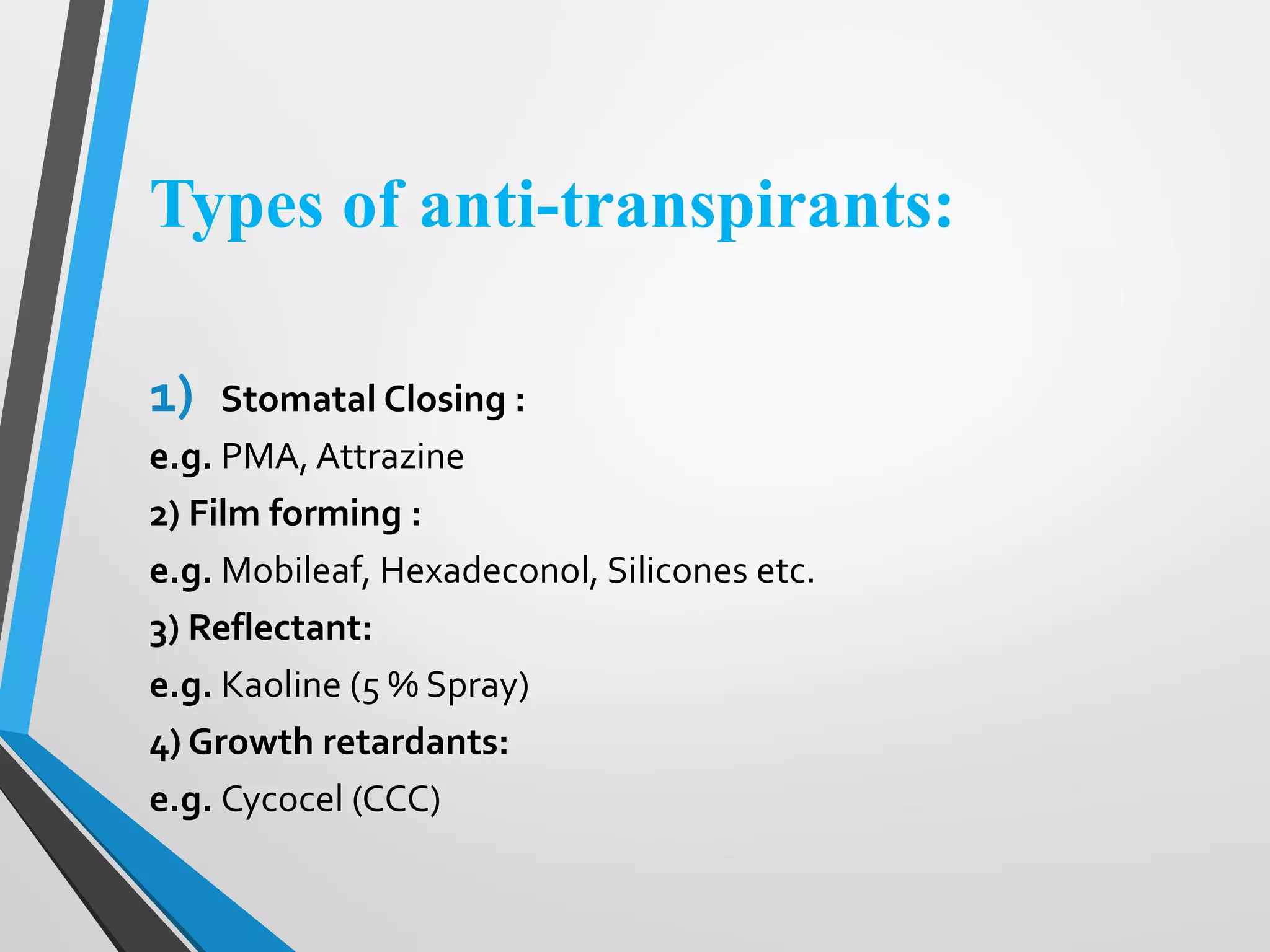
Types of anti-transpirants:
1) Stomatal Closing :
e.g. PMA, Attrazine
2) Film forming :
e.g. Mobileaf, Hexadeconol, Silicones etc.
3) Reflectant:
e.g. Kaoline (5 % Spray)
4) Growth retardants:
e.g. Cycocel (CCC)
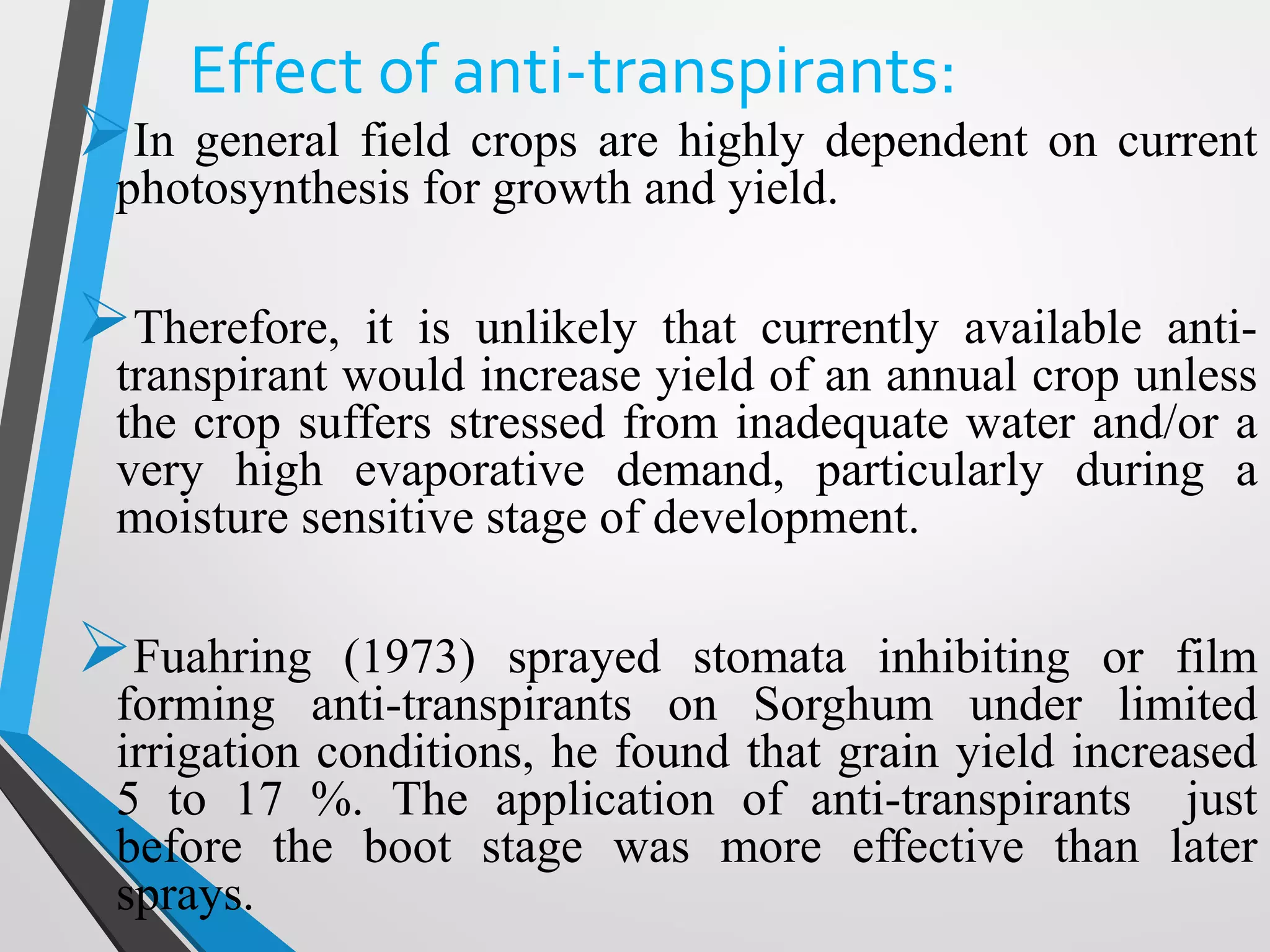
Effect of anti-transpirants:
In general field crops are highly dependent on current
photosynthesis for growth and yield.
Therefore, it is unlikely that currently available anti-
transpirant would increase yield of an annual crop unless
the crop suffers stressed from inadequate water and/or a
very high evaporative demand, particularly during a
moisture sensitive stage of development.
Fuahring (1973) sprayed stomata inhibiting or film
forming anti-transpirants on Sorghum under limited
irrigation conditions, he found that grain yield increased
5 to 17 %. The application of anti-transpirants just
before the boot stage was more effective than later
sprays.
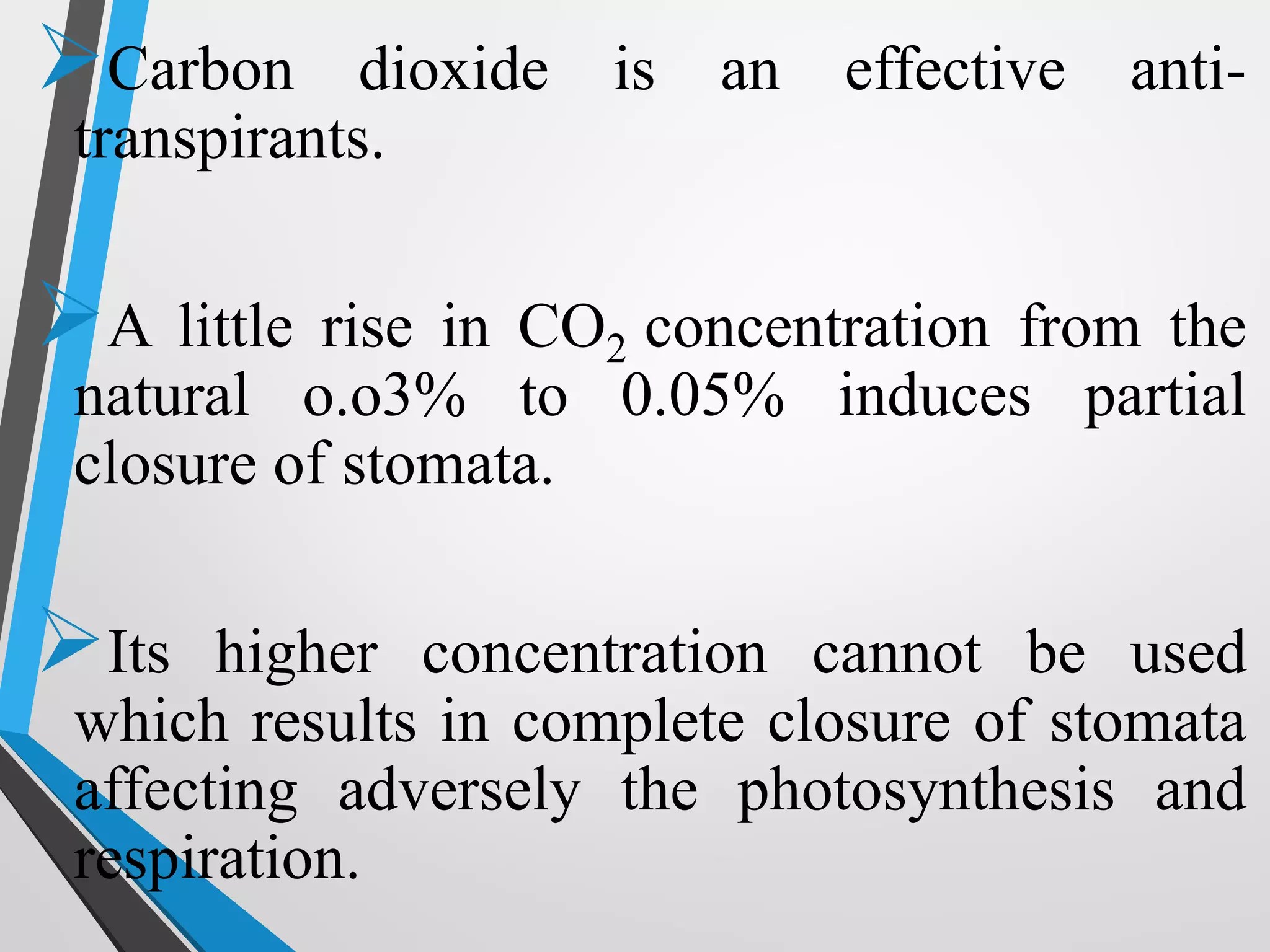
Carbon dioxide is an effective anti-
transpirants.
A little rise in CO2 concentration from the
natural o.o3% to 0.05% induces partial
closure of stomata.
Its higher concentration cannot be used
which results in complete closure of stomata
affecting adversely the photosynthesis and
respiration.
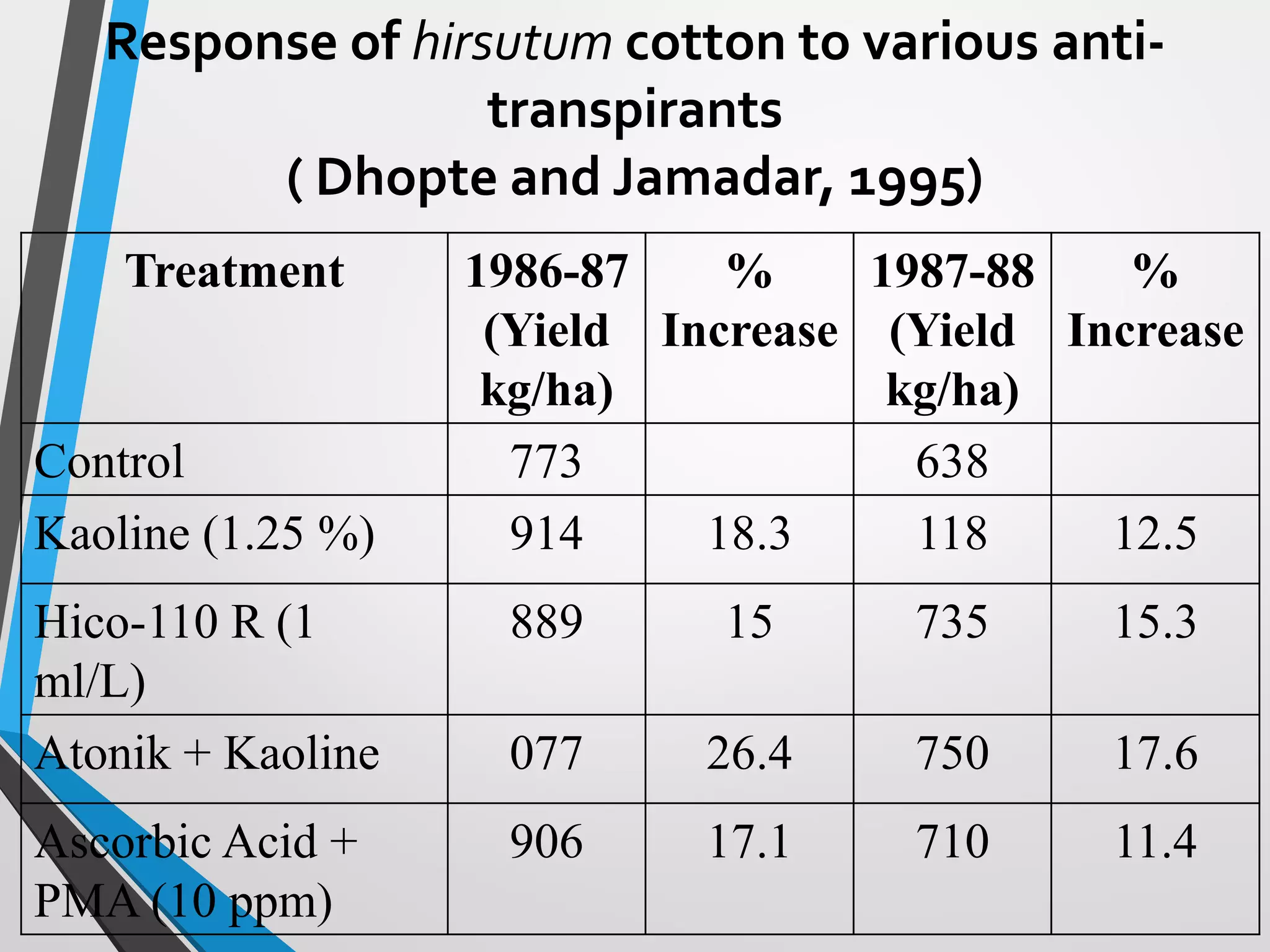
Treatment 1986-87
(Yield
kg/ha)
%
Increase
1987-88
(Yield
kg/ha)
%
Increase
Control 773 638
Kaoline (1.25 %) 914 18.3 118 12.5
Hico-110 R (1
ml/L)
889 15 735 15.3
Atonik + Kaoline 077 26.4 750 17.6
Ascorbic Acid +
PMA (10 ppm)
906 17.1 710 11.4
Response of hirsutum cotton to various anti-
transpirants
( Dhopte and Jamadar, 1995)
Preparation of
appropriate crop plans
for dry land areas
Cropping system:
Cropping system may be defined as the order in which the
crops are cultivated on a piece of land over a fixed period.
In short it is pattern of crops for a given piece of land.
Cropping pattern :
The yearly sequence and spatial arrangement of crops and
fallow in an area.
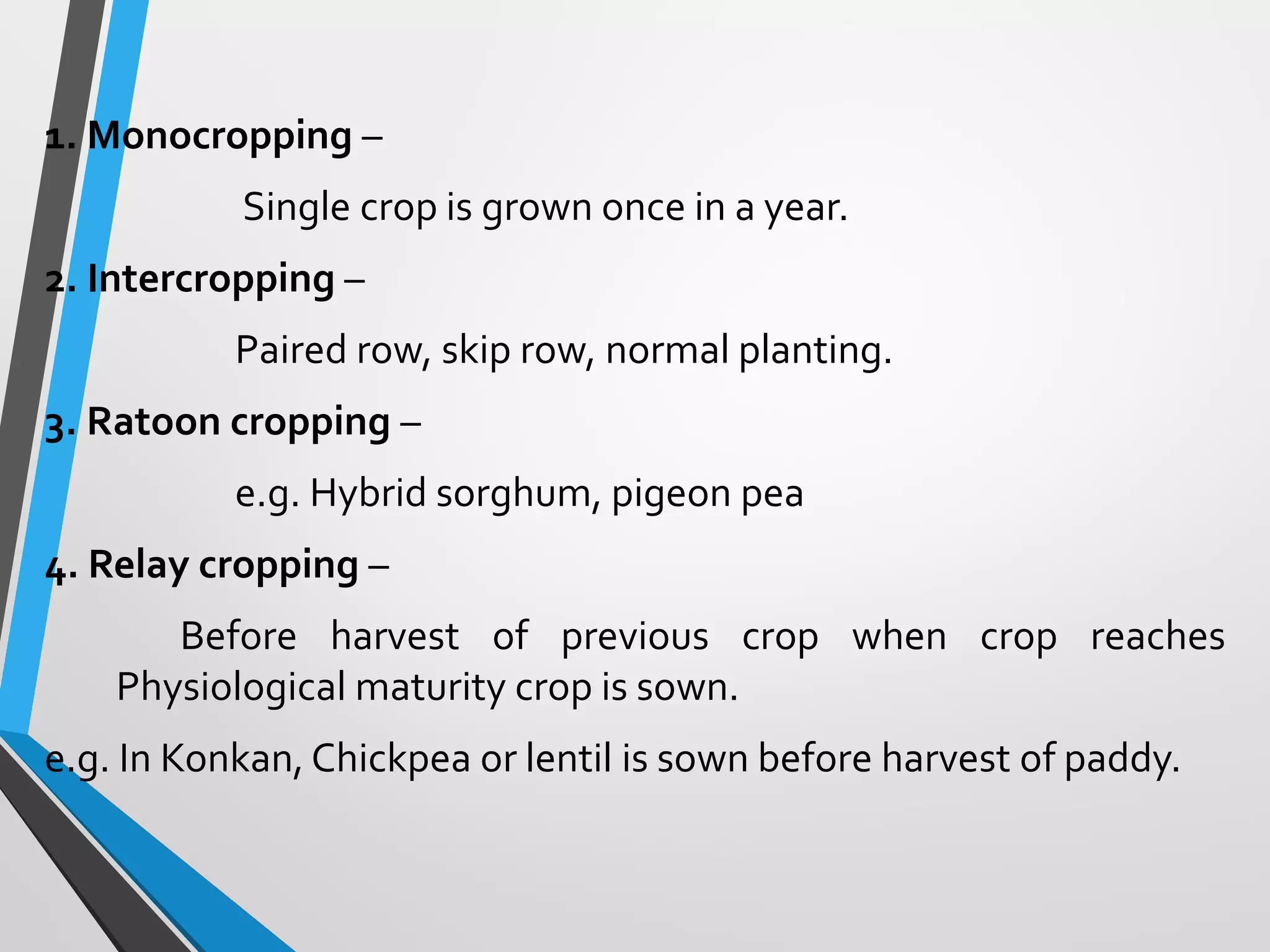
1. Monocropping –
Single crop is grown once in a year.
2. Intercropping –
Paired row, skip row, normal planting.
3. Ratoon cropping –
e.g. Hybrid sorghum, pigeon pea
4. Relay cropping –
Before harvest of previous crop when crop reaches
Physiological maturity crop is sown.
e.g. In Konkan, Chickpea or lentil is sown before harvest of paddy.
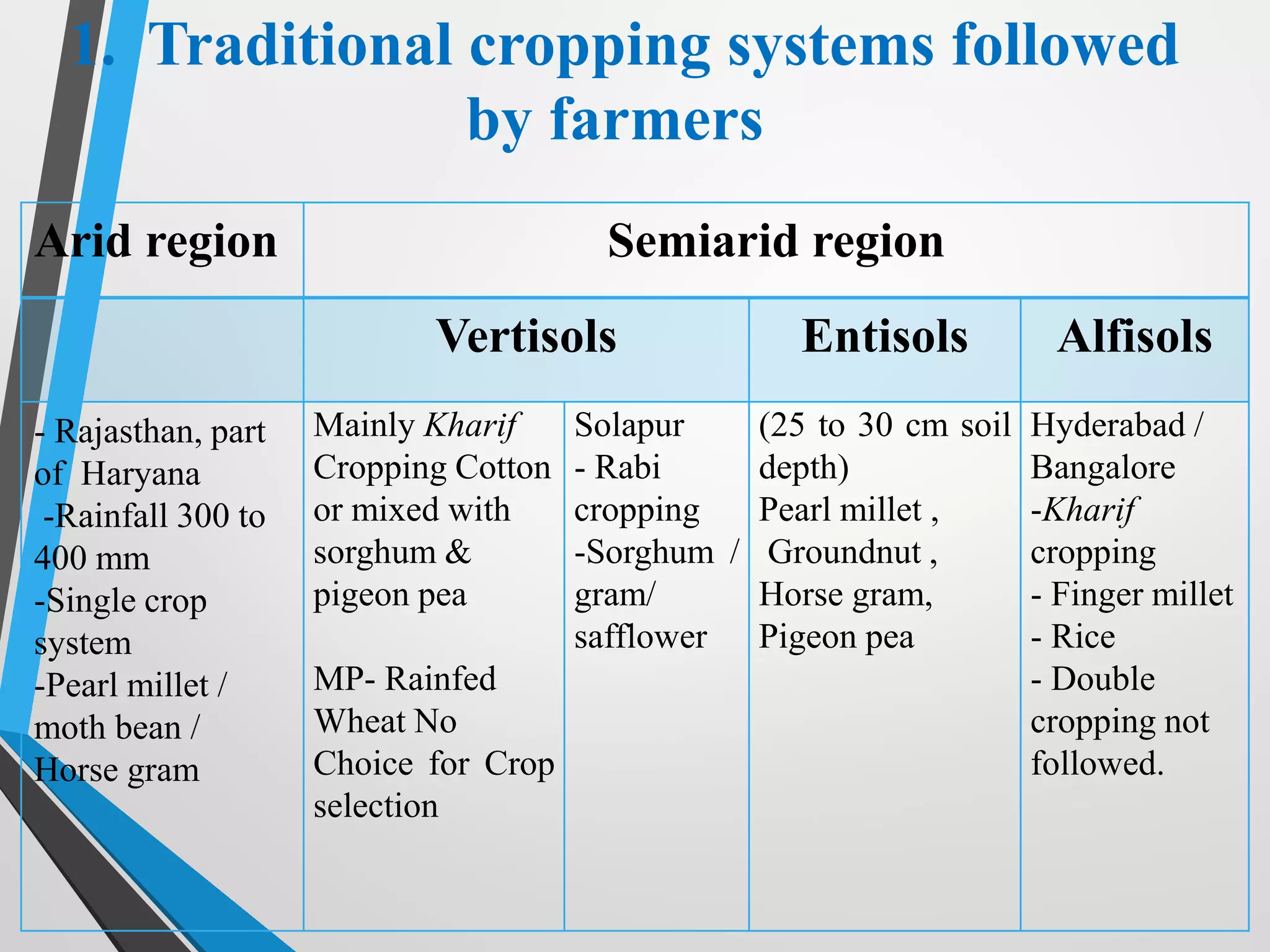
1. Traditional cropping systems followed
by farmers
Arid region Semiarid region
Vertisols Entisols Alfisols
- Rajasthan, part
of Haryana
-Rainfall 300 to
400 mm
-Single crop
system
-Pearl millet /
moth bean /
Horse gram
Mainly Kharif
Cropping Cotton
or mixed with
sorghum &
pigeon pea
MP- Rainfed
Wheat No
Choice for Crop
selection
Solapur
- Rabi
cropping
-Sorghum /
gram/
safflower
(25 to 30 cm soil
depth)
Pearl millet ,
Groundnut ,
Horse gram,
Pigeon pea
Hyderabad /
Bangalore
-Kharif
cropping
- Finger millet
- Rice
- Double
cropping not
followed.
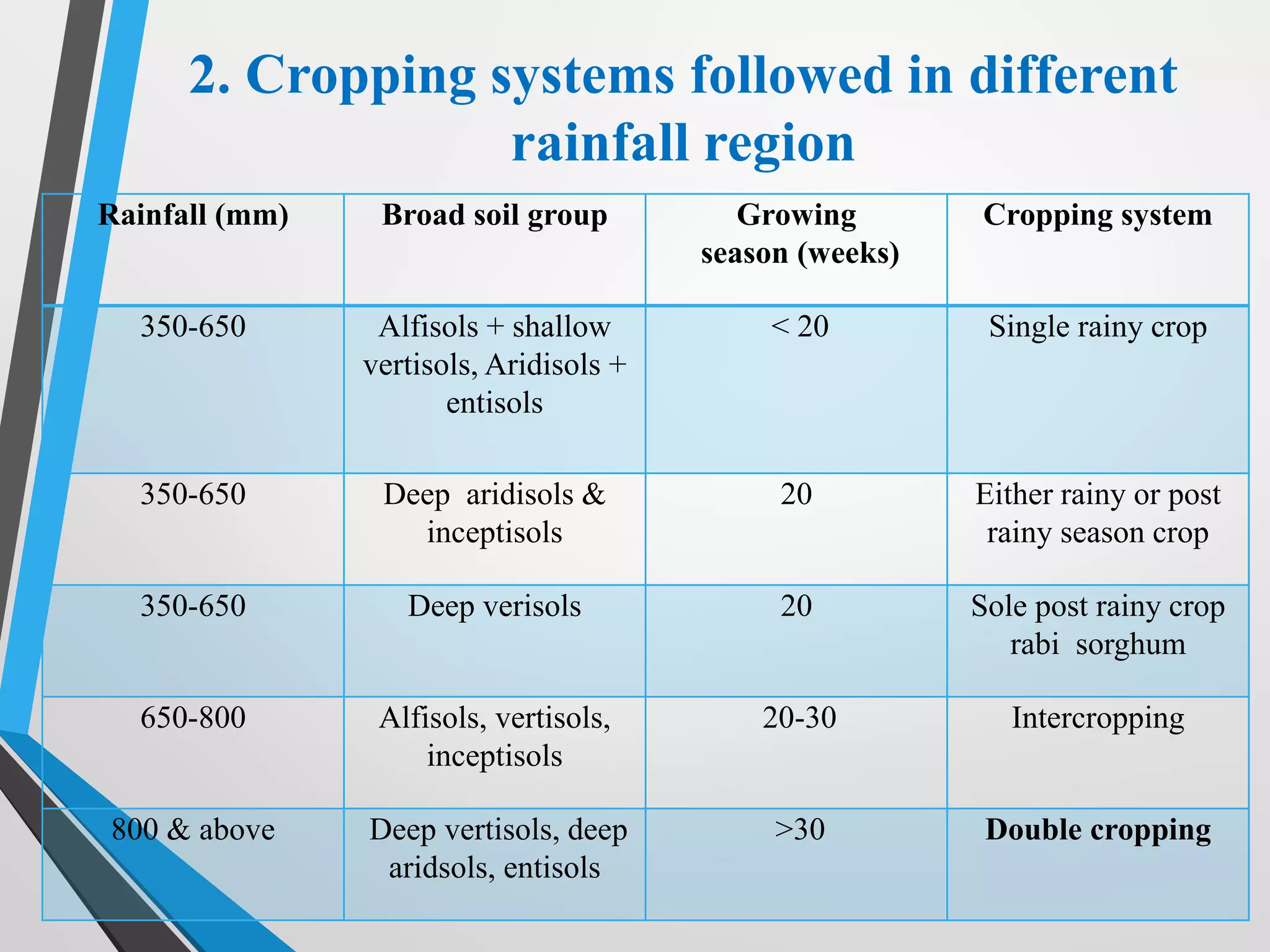
2. Cropping systems followed in different
rainfall region
Rainfall (mm) Broad soil group Growing
season (weeks)
Cropping system
350-650 Alfisols + shallow
vertisols, Aridisols +
entisols
< 20 Single rainy crop
350-650 Deep aridisols &
inceptisols
20 Either rainy or post
rainy season crop
350-650 Deep verisols 20 Sole post rainy crop
rabi sorghum
650-800 Alfisols, vertisols,
inceptisols
20-30 Intercropping
800 & above Deep vertisols, deep
aridsols, entisols
>30 Double cropping
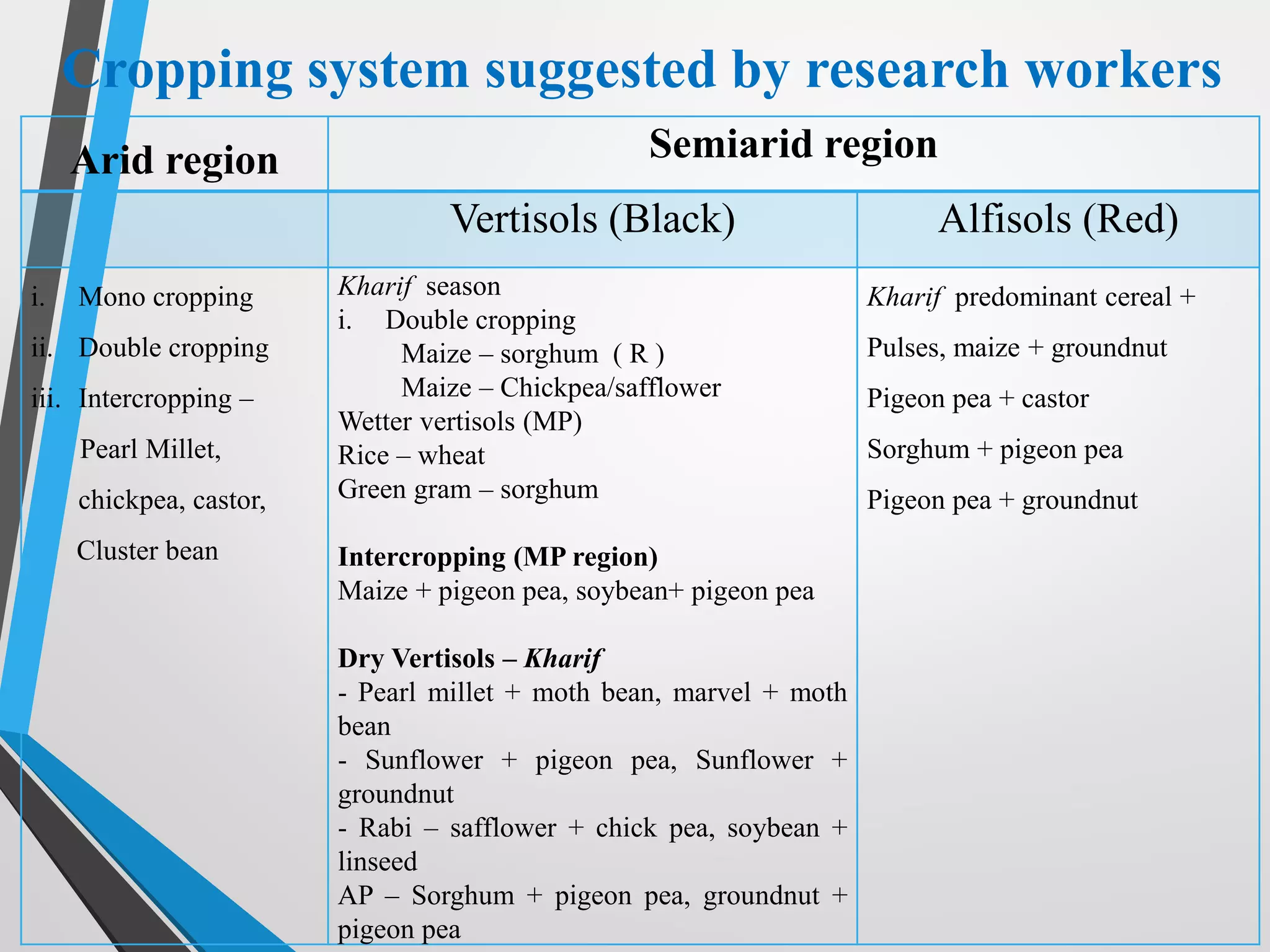
Cropping system suggested by research workers
Arid region Semiarid region
Vertisols (Black) Alfisols (Red)
i. Mono cropping
ii. Double cropping
iii. Intercropping –
Pearl Millet,
chickpea, castor,
Cluster bean
Kharif season
i. Double cropping
Maize – sorghum ( R )
Maize – Chickpea/safflower
Wetter vertisols (MP)
Rice – wheat
Green gram – sorghum
Intercropping (MP region)
Maize + pigeon pea, soybean+ pigeon pea
Dry Vertisols – Kharif
- Pearl millet + moth bean, marvel + moth
bean
- Sunflower + pigeon pea, Sunflower +
groundnut
- Rabi – safflower + chick pea, soybean +
linseed
AP – Sorghum + pigeon pea, groundnut +
pigeon pea
Kharif predominant cereal +
Pulses, maize + groundnut
Pigeon pea + castor
Sorghum + pigeon pea
Pigeon pea + groundnut
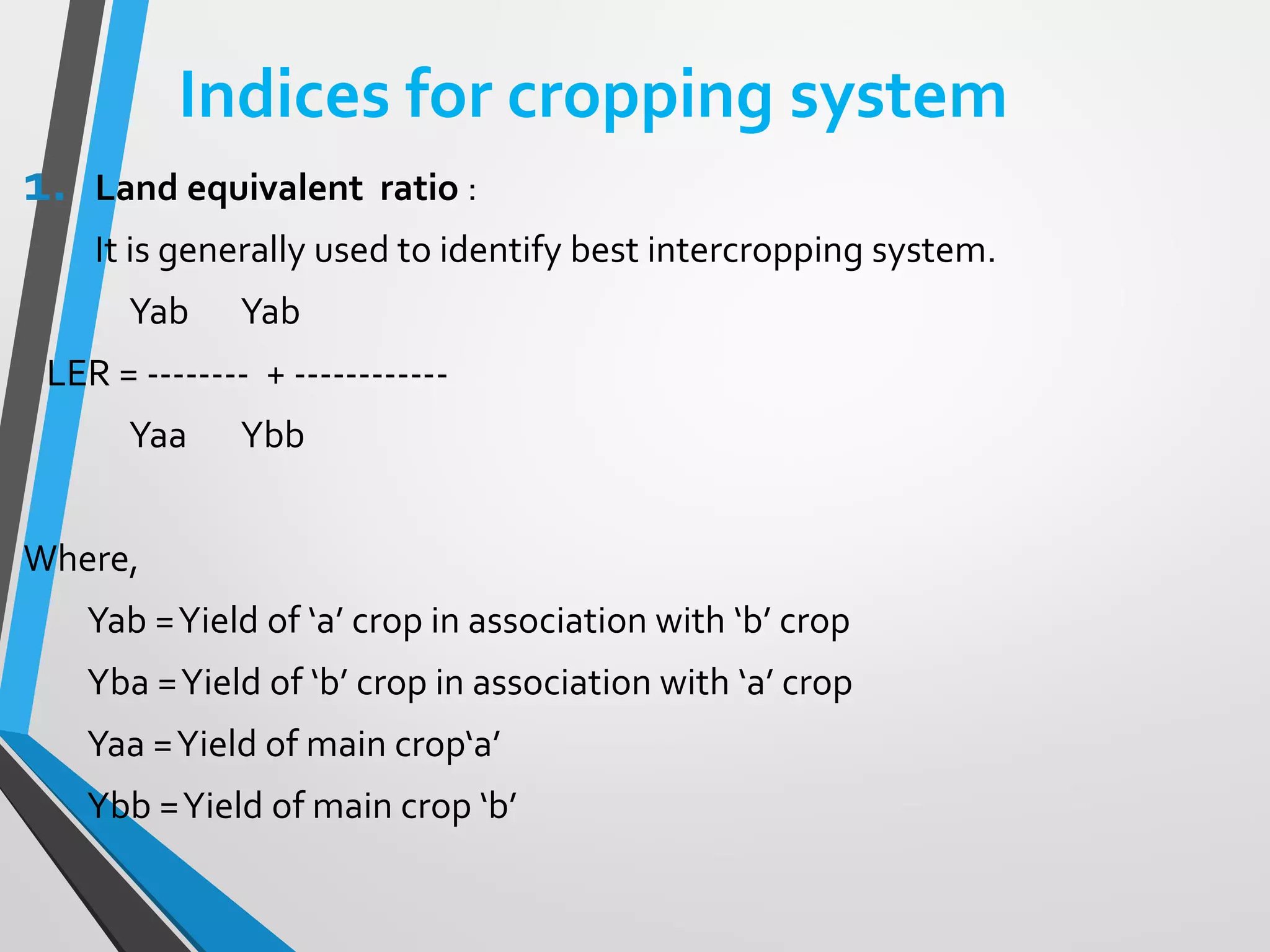
Indices for cropping system
1. Land equivalent ratio :
It is generally used to identify best intercropping system.
Yab Yab
LER = -------- + ------------
Yaa Ybb
Where,
Yab =Yield of ‘a’ crop in association with ‘b’ crop
Yba =Yield of ‘b’ crop in association with ‘a’ crop
Yaa =Yield of main crop‘a’
Ybb =Yield of main crop ‘b’
Sustainable yield index (SYI) :
It is defined as the practice which gives maximum yield.
At least 5-6 years data must be available for calculating SYI.
¯Y - δ
SYI = ----------------
Y maximum
Where,
δ = Estimated standard deviation
¯Y = Estimated average yield of a practice over the years
Y= maximum=Maximum observed yield in the experiment
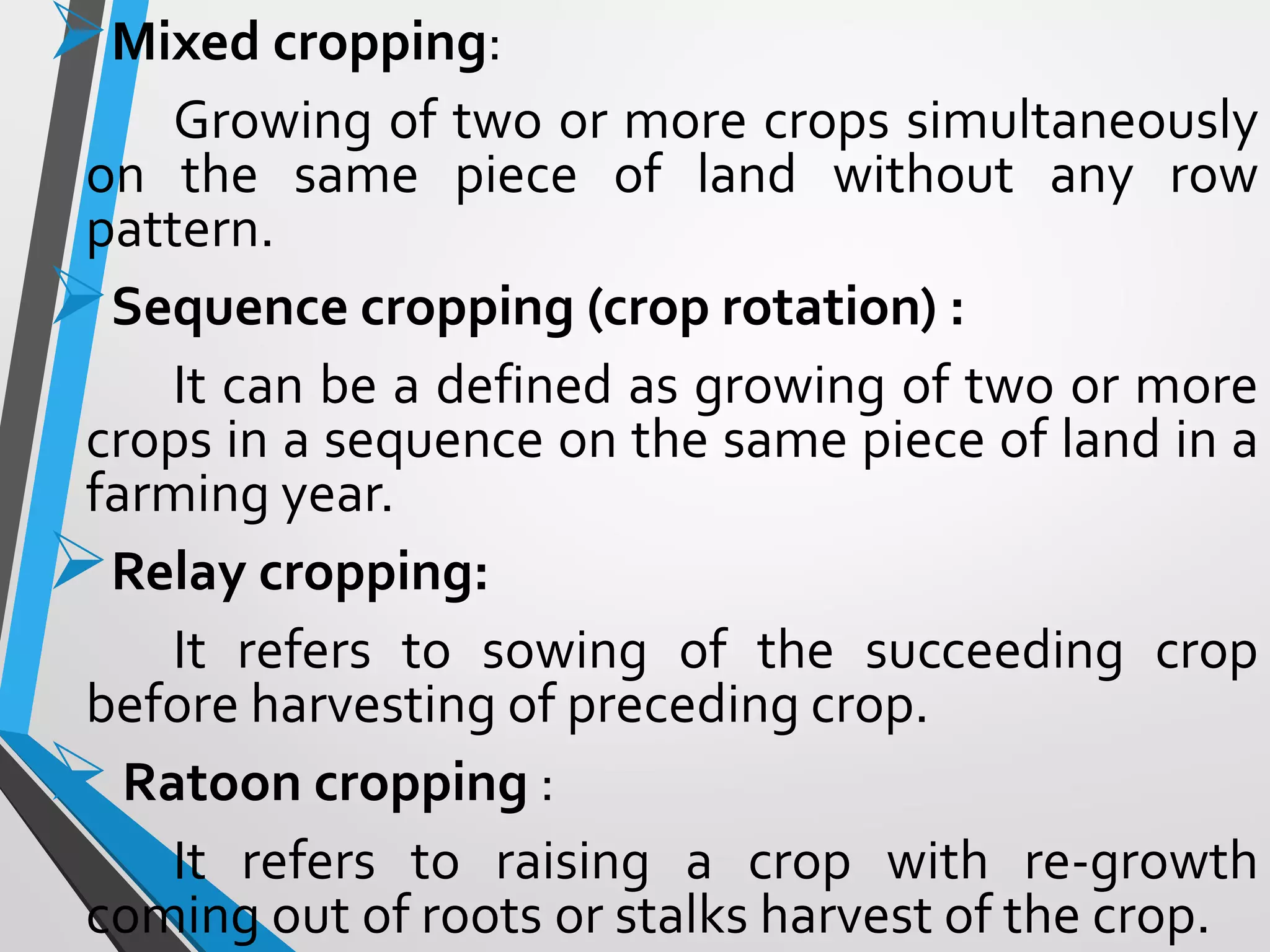
Mixed cropping:
Growing of two or more crops simultaneously
on the same piece of land without any row
pattern.
Sequence cropping (crop rotation) :
It can be a defined as growing of two or more
crops in a sequence on the same piece of land in a
farming year.
Relay cropping:
It refers to sowing of the succeeding crop
before harvesting of preceding crop.
Ratoon cropping :
It refers to raising a crop with re-growth
coming out of roots or stalks harvest of the crop.
Crop planning as per the soil depth
S.N. Soil type Depth (cm) Suggested cropping
1 Very
shallow
soils
7.5 a) Fruit crops – Ber , Aonla, Pomegranate, Tamarind
b) Improved grasses–Madras anjan, Marvel–8, stylo
2 Shallow soil 7.5 to 22.5 Field crops – horse gram, moth bean, castor
Pearl millet + pigeon pea intercropping
3. Medium
deep soil
a) 22.5 to 45
b) 45 to 60
c) 60 to 90
Sunflower + pigeon pea intercropping
Pearl millet+ pigeon pea intercropping
Sunflower, groundnut, castor, setaria – kharif Pearl
millet + pigeon pea intercropping, sole cropping of
pearl millet, sunflower, green gram, groundnut in
kharif
Sole crop of sorghum, safflower, chickpea
Double cropping green gram – sorghum
Double cropping pearl millet – chickpea
sole crop of sorghum, safflower, chickpea and
sunflower
4 Deep soil More than
90
Green gram – sorghum, sunflower – chickpea sole
crop of sorghum, safflower, chickpea and sunflower
ThankYou…

Use of Antitranspirants

  • 1.
  • 2.
    SUBMITTED BY: Mr. SHIVAJIRAVASAHEB SURYAVANSHI M.Sc. (AGRONOMY), RCSM COLLEGE OF AGRICULTURE, KOLHAPUR MAHATMA PHULE KRISHI VIDYAPEETH, RAHURI. Spray of Anti-transpirant and their effects on crops
  • 3.
    Anti-transpirants: Antitranspirants are thematerials/chemicals which applied to the transpiring plant surfaces with aim to reducing water loss from the plant. Approximately 99% of the water taken up by plant roots is transpired to the atmosphere through stomatal pores in the leaves.
  • 5.
    Types of anti-transpirants: 1)Stomatal Closing : e.g. PMA, Attrazine 2) Film forming : e.g. Mobileaf, Hexadeconol, Silicones etc. 3) Reflectant: e.g. Kaoline (5 % Spray) 4) Growth retardants: e.g. Cycocel (CCC)
  • 6.
    Effect of anti-transpirants: Ingeneral field crops are highly dependent on current photosynthesis for growth and yield. Therefore, it is unlikely that currently available anti- transpirant would increase yield of an annual crop unless the crop suffers stressed from inadequate water and/or a very high evaporative demand, particularly during a moisture sensitive stage of development. Fuahring (1973) sprayed stomata inhibiting or film forming anti-transpirants on Sorghum under limited irrigation conditions, he found that grain yield increased 5 to 17 %. The application of anti-transpirants just before the boot stage was more effective than later sprays.
  • 7.
    Carbon dioxide isan effective anti- transpirants. A little rise in CO2 concentration from the natural o.o3% to 0.05% induces partial closure of stomata. Its higher concentration cannot be used which results in complete closure of stomata affecting adversely the photosynthesis and respiration.
  • 8.
    Treatment 1986-87 (Yield kg/ha) % Increase 1987-88 (Yield kg/ha) % Increase Control 773638 Kaoline (1.25 %) 914 18.3 118 12.5 Hico-110 R (1 ml/L) 889 15 735 15.3 Atonik + Kaoline 077 26.4 750 17.6 Ascorbic Acid + PMA (10 ppm) 906 17.1 710 11.4 Response of hirsutum cotton to various anti- transpirants ( Dhopte and Jamadar, 1995)
  • 9.
    Preparation of appropriate cropplans for dry land areas
  • 10.
    Cropping system: Cropping systemmay be defined as the order in which the crops are cultivated on a piece of land over a fixed period. In short it is pattern of crops for a given piece of land. Cropping pattern : The yearly sequence and spatial arrangement of crops and fallow in an area.
  • 11.
    1. Monocropping – Singlecrop is grown once in a year. 2. Intercropping – Paired row, skip row, normal planting. 3. Ratoon cropping – e.g. Hybrid sorghum, pigeon pea 4. Relay cropping – Before harvest of previous crop when crop reaches Physiological maturity crop is sown. e.g. In Konkan, Chickpea or lentil is sown before harvest of paddy.
  • 12.
    1. Traditional croppingsystems followed by farmers Arid region Semiarid region Vertisols Entisols Alfisols - Rajasthan, part of Haryana -Rainfall 300 to 400 mm -Single crop system -Pearl millet / moth bean / Horse gram Mainly Kharif Cropping Cotton or mixed with sorghum & pigeon pea MP- Rainfed Wheat No Choice for Crop selection Solapur - Rabi cropping -Sorghum / gram/ safflower (25 to 30 cm soil depth) Pearl millet , Groundnut , Horse gram, Pigeon pea Hyderabad / Bangalore -Kharif cropping - Finger millet - Rice - Double cropping not followed.
  • 13.
    2. Cropping systemsfollowed in different rainfall region Rainfall (mm) Broad soil group Growing season (weeks) Cropping system 350-650 Alfisols + shallow vertisols, Aridisols + entisols < 20 Single rainy crop 350-650 Deep aridisols & inceptisols 20 Either rainy or post rainy season crop 350-650 Deep verisols 20 Sole post rainy crop rabi sorghum 650-800 Alfisols, vertisols, inceptisols 20-30 Intercropping 800 & above Deep vertisols, deep aridsols, entisols >30 Double cropping
  • 14.
    Cropping system suggestedby research workers Arid region Semiarid region Vertisols (Black) Alfisols (Red) i. Mono cropping ii. Double cropping iii. Intercropping – Pearl Millet, chickpea, castor, Cluster bean Kharif season i. Double cropping Maize – sorghum ( R ) Maize – Chickpea/safflower Wetter vertisols (MP) Rice – wheat Green gram – sorghum Intercropping (MP region) Maize + pigeon pea, soybean+ pigeon pea Dry Vertisols – Kharif - Pearl millet + moth bean, marvel + moth bean - Sunflower + pigeon pea, Sunflower + groundnut - Rabi – safflower + chick pea, soybean + linseed AP – Sorghum + pigeon pea, groundnut + pigeon pea Kharif predominant cereal + Pulses, maize + groundnut Pigeon pea + castor Sorghum + pigeon pea Pigeon pea + groundnut
  • 15.
    Indices for croppingsystem 1. Land equivalent ratio : It is generally used to identify best intercropping system. Yab Yab LER = -------- + ------------ Yaa Ybb Where, Yab =Yield of ‘a’ crop in association with ‘b’ crop Yba =Yield of ‘b’ crop in association with ‘a’ crop Yaa =Yield of main crop‘a’ Ybb =Yield of main crop ‘b’
  • 16.
    Sustainable yield index(SYI) : It is defined as the practice which gives maximum yield. At least 5-6 years data must be available for calculating SYI. ¯Y - δ SYI = ---------------- Y maximum Where, δ = Estimated standard deviation ¯Y = Estimated average yield of a practice over the years Y= maximum=Maximum observed yield in the experiment
  • 17.
    Mixed cropping: Growing oftwo or more crops simultaneously on the same piece of land without any row pattern. Sequence cropping (crop rotation) : It can be a defined as growing of two or more crops in a sequence on the same piece of land in a farming year. Relay cropping: It refers to sowing of the succeeding crop before harvesting of preceding crop. Ratoon cropping : It refers to raising a crop with re-growth coming out of roots or stalks harvest of the crop.
  • 18.
    Crop planning asper the soil depth S.N. Soil type Depth (cm) Suggested cropping 1 Very shallow soils 7.5 a) Fruit crops – Ber , Aonla, Pomegranate, Tamarind b) Improved grasses–Madras anjan, Marvel–8, stylo 2 Shallow soil 7.5 to 22.5 Field crops – horse gram, moth bean, castor Pearl millet + pigeon pea intercropping 3. Medium deep soil a) 22.5 to 45 b) 45 to 60 c) 60 to 90 Sunflower + pigeon pea intercropping Pearl millet+ pigeon pea intercropping Sunflower, groundnut, castor, setaria – kharif Pearl millet + pigeon pea intercropping, sole cropping of pearl millet, sunflower, green gram, groundnut in kharif Sole crop of sorghum, safflower, chickpea Double cropping green gram – sorghum Double cropping pearl millet – chickpea sole crop of sorghum, safflower, chickpea and sunflower 4 Deep soil More than 90 Green gram – sorghum, sunflower – chickpea sole crop of sorghum, safflower, chickpea and sunflower
  • 19.