NURSING PROCESS -
PLANNING
   PREPARED AND PRESENTED BY

MRS.S.ANUKRISHNAN,

VICE PRINCIPAL CUM HOD OBG NURSING,

P.D.BHARATESH COLLEGE OF NURSING,

HALAGA, BELGAUM.
Introduction
   Planning is a deliberative, systematic phase of the
    nursing process

   Involves decision making and problem solving.

   Refer to the client’s assessment data and diagnostic
    statements for direction in formulating client goals
    and designing the nursing interventions required to
    prevent reduce or eliminate the client’s health
    problems.
Types of Planning
   1] Initial planning

   2] Ongoing Planning

   3] Discharge planning
1] Initial planning
   Admission assessment based on the initial care.

   As nurse obtain new information and evaluate the
    clients responses to care, they can individualize the
    initial care plan further.
2] Ongoing Planning
   Done by all nurses who work with the client.

   Ongoing planning also occurs at the beginning of a
    shift as the nurse plans the care.
3] Discharge planning
   Is the process of anticipating and planning for needs
    after discharge,

   Is a crucial part of comprehensive health care and
    should be addressed in each client’s care plan to be
    given that day.
Purposes of ongoing planning


1] To determine any changes in client’s health status.

2] To set priorities for the client’s care

3] To decide which problems to focus on during the
  shift

4] To Co-ordinate the nurse’s activities so that more
  than one problem can be addressed at each client
  contact.
Developing nursing care plans
   An informal nursing care plan

   A formal nursing care plan

   A Standardized care plan

   An individualized care plan
An informal nursing care plan
   Is a strategy for action that exists in the nurses
    mind.
A formal nursing care plan
   Is a written or computerized guide that organizes
    information about the client’s care.

   It provides continuity of care.
A Standardized care plan
   Is a formal plan that specifies the nursing care for
    groups of clients with common needs. (All clients
    with myocardial infarction)
An individualized care plan
   Is tailored to meet the unique needs of a specific
    client needs that are not addressed by standardized
    plan.
Guidelines for writing Nursing Care plans
1] Date and sign the plan

2]Use category headings assessment/ nursing diagnoses/
  planning /Implementation /Evaluation.

3] Use standardized Medical or English symbols and key
  words rather than complete sentences to communicate
  your ideas.

Eg. Clean wound with H2O2 b.i.d rather than “clean the
  client’s wound morning & evening with Hydrogen
  peroxide twice a day.
Guidelines for writing Nursing Care plans
4] Be specific. Because Nurses are now working shifts
 of different lengths, some working 12 hrs. & some
 working 8 hour shifts it is even more to be specific
 about expected timing of an intervention. If the order
 reads “change incision dressing q shift”

5] Refer to procedure books or other sources of
 information rather than including all the steps on a
 written plan.
Guidelines for writing Nursing Care plans
6] Tailor the plan to the unique characteristics of the
 client by ensuring that the client’s choices, such as
 preferences about the times of care & the methods
 used are included.

7] Ensure that the nursing plan incorporates preventive
 and   health   maintenance    aspects   as   well   as
 restorative ones.
Guidelines for writing Nursing Care plans
8] Ensure that the plan contains interventions for
 ongoing assessment of the client (eg. Inspect
 incision q8h)

9] Include collaborative and co-ordination activities in
 the plan.

10] Include plans for the client’s discharge and home
 care needs.
The planning process
   Setting priorities

   Establishing client goals/ desired outcomes.

   Selecting nursing interventions

   Writing nursing orders.
Assessing
a. Collect data
b. Organize data
c. Validate data
d. Document data
                      Diagnosing
                      a.   Analyze data
                      b.   Identify health
                           problems, risks and
                           strength,
                      c.   Formulating
                           nursing diagnosis


                   Planning
          a. Setting priorities
          b. Establishing client
             goals, desired
             outcomes
          c. Selecting nursing
             interventions
          d. Writing nursing
             orders
1) Setting priorities

   It is the process of establishing a preferential
    sequence for addressing nursing diagnoses &
    interventions.

   The client & nurse decides which nursing diagnosis
    requires attention Primarily, which secondary and so
    on.

   Instead of rank ordering diagnoses, nurses can
    group then as having high, Medium, or Low priority
    requires minimal nursing support.
   High: Life threatening problems such as loss of respiratory or
    cardiac function
   Medium:        Health     threatening   problems   like   acute   illness,
    decreased coping.
   Use Maslow’s hierarchy
   The nurse must consider some factors when assigning priorities,
    it includes.
       Client’s health values and beliefs
       Client’s priorities
       Resources available to the nurse & client.
       Urgency of health problem
       Medical treatment plan.
2) Establishing client goals & Desired
                      outcomes
   After establishing priorities, the nurse & client set
    goals for each nursing diagnosis.

   Goal-(Broad)      –improved     nutritional   status,
    desired outcome (specific) - Gain ½ kg by 2
    weeks.
       Short term goals: - than 6 weeks of period.
       Long term goals: - Goal achieved by 6 weeks &
        more
3) Selecting Nursing interventions &
                     activities
   Nursing interventions & activities are the action not a nurse performs to
    achieve client goals.

   Types of nursing interventions

1] Independent Interventions: - activities that are nurses are licensed to
    initiate.   Eg. Physical care, ongoing assessment, counseling, Emotional
    support, environmental Management.

2] Dependent Interventions: - activities carried out under physicians order.
    Eg. Medications, diagnostic tests, diet Activity.

3] Collaborative Interventions: - Nurse carries out in collaboration with other
    health team members - Such as physiotherapies social workers, dietitians,
    physicians, Eg. Crutch walking.
4) Writing Nursing orders

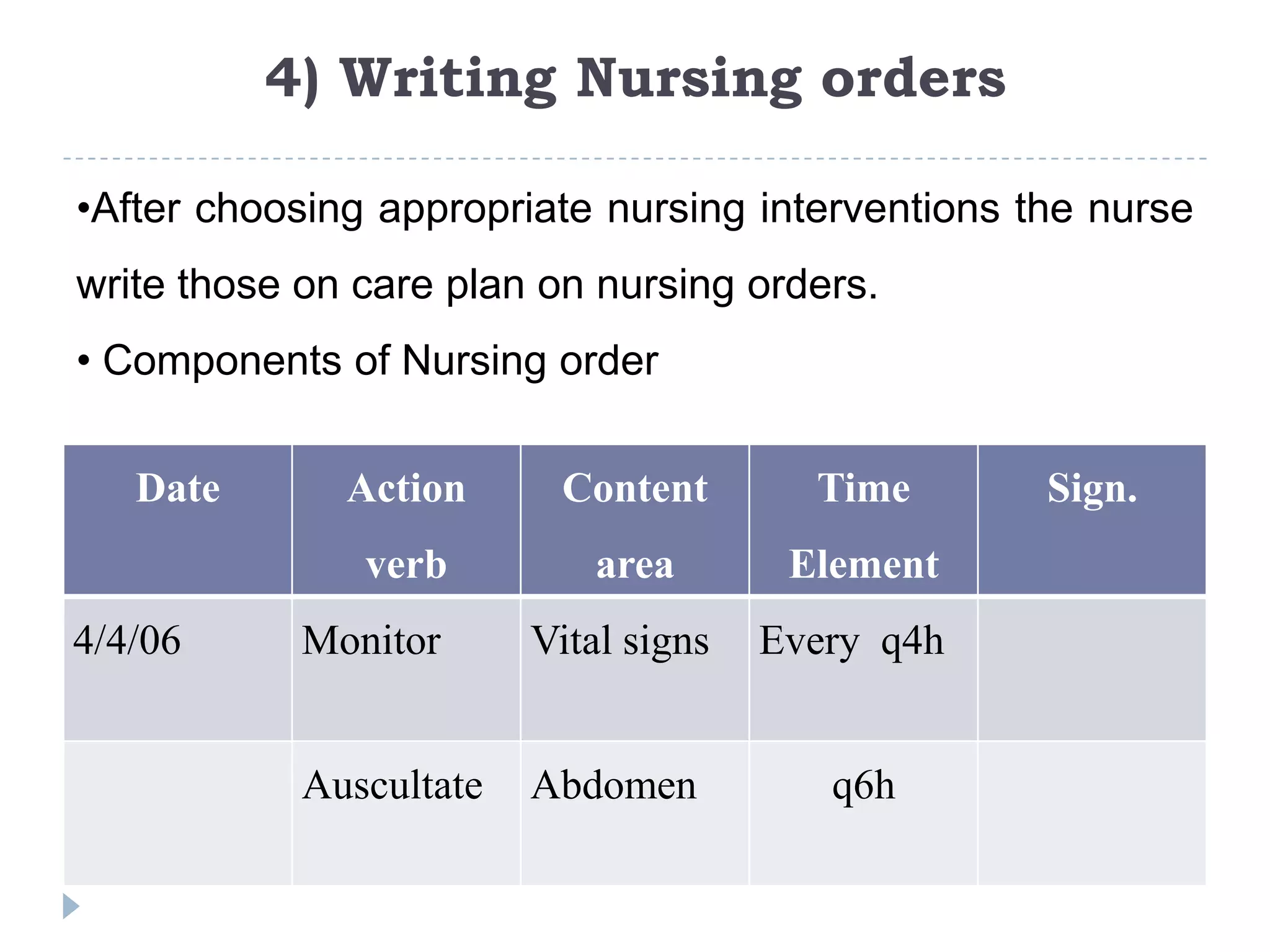
•After choosing appropriate nursing interventions the nurse
write those on care plan on nursing orders.
• Components of Nursing order


   Date       Action      Content        Time      Sign.
               verb          area       Element
4/4/06      Monitor      Vital signs   Every q4h


            Auscultate   Abdomen          q6h

Nursing process planning

  • 1.
    NURSING PROCESS - PLANNING  PREPARED AND PRESENTED BY MRS.S.ANUKRISHNAN, VICE PRINCIPAL CUM HOD OBG NURSING, P.D.BHARATESH COLLEGE OF NURSING, HALAGA, BELGAUM.
  • 2.
    Introduction  Planning is a deliberative, systematic phase of the nursing process  Involves decision making and problem solving.  Refer to the client’s assessment data and diagnostic statements for direction in formulating client goals and designing the nursing interventions required to prevent reduce or eliminate the client’s health problems.
  • 3.
    Types of Planning  1] Initial planning  2] Ongoing Planning  3] Discharge planning
  • 4.
    1] Initial planning  Admission assessment based on the initial care.  As nurse obtain new information and evaluate the clients responses to care, they can individualize the initial care plan further.
  • 5.
    2] Ongoing Planning  Done by all nurses who work with the client.  Ongoing planning also occurs at the beginning of a shift as the nurse plans the care.
  • 6.
    3] Discharge planning  Is the process of anticipating and planning for needs after discharge,  Is a crucial part of comprehensive health care and should be addressed in each client’s care plan to be given that day.
  • 7.
    Purposes of ongoingplanning 1] To determine any changes in client’s health status. 2] To set priorities for the client’s care 3] To decide which problems to focus on during the shift 4] To Co-ordinate the nurse’s activities so that more than one problem can be addressed at each client contact.
  • 8.
    Developing nursing careplans  An informal nursing care plan  A formal nursing care plan  A Standardized care plan  An individualized care plan
  • 9.
    An informal nursingcare plan  Is a strategy for action that exists in the nurses mind.
  • 10.
    A formal nursingcare plan  Is a written or computerized guide that organizes information about the client’s care.  It provides continuity of care.
  • 11.
    A Standardized careplan  Is a formal plan that specifies the nursing care for groups of clients with common needs. (All clients with myocardial infarction)
  • 12.
    An individualized careplan  Is tailored to meet the unique needs of a specific client needs that are not addressed by standardized plan.
  • 13.
    Guidelines for writingNursing Care plans 1] Date and sign the plan 2]Use category headings assessment/ nursing diagnoses/ planning /Implementation /Evaluation. 3] Use standardized Medical or English symbols and key words rather than complete sentences to communicate your ideas. Eg. Clean wound with H2O2 b.i.d rather than “clean the client’s wound morning & evening with Hydrogen peroxide twice a day.
  • 14.
    Guidelines for writingNursing Care plans 4] Be specific. Because Nurses are now working shifts of different lengths, some working 12 hrs. & some working 8 hour shifts it is even more to be specific about expected timing of an intervention. If the order reads “change incision dressing q shift” 5] Refer to procedure books or other sources of information rather than including all the steps on a written plan.
  • 15.
    Guidelines for writingNursing Care plans 6] Tailor the plan to the unique characteristics of the client by ensuring that the client’s choices, such as preferences about the times of care & the methods used are included. 7] Ensure that the nursing plan incorporates preventive and health maintenance aspects as well as restorative ones.
  • 16.
    Guidelines for writingNursing Care plans 8] Ensure that the plan contains interventions for ongoing assessment of the client (eg. Inspect incision q8h) 9] Include collaborative and co-ordination activities in the plan. 10] Include plans for the client’s discharge and home care needs.
  • 17.
    The planning process  Setting priorities  Establishing client goals/ desired outcomes.  Selecting nursing interventions  Writing nursing orders.
  • 18.
    Assessing a. Collect data b.Organize data c. Validate data d. Document data Diagnosing a. Analyze data b. Identify health problems, risks and strength, c. Formulating nursing diagnosis Planning a. Setting priorities b. Establishing client goals, desired outcomes c. Selecting nursing interventions d. Writing nursing orders
  • 19.
    1) Setting priorities  It is the process of establishing a preferential sequence for addressing nursing diagnoses & interventions.  The client & nurse decides which nursing diagnosis requires attention Primarily, which secondary and so on.  Instead of rank ordering diagnoses, nurses can group then as having high, Medium, or Low priority requires minimal nursing support.
  • 20.
    High: Life threatening problems such as loss of respiratory or cardiac function  Medium: Health threatening problems like acute illness, decreased coping.  Use Maslow’s hierarchy  The nurse must consider some factors when assigning priorities, it includes.  Client’s health values and beliefs  Client’s priorities  Resources available to the nurse & client.  Urgency of health problem  Medical treatment plan.
  • 21.
    2) Establishing clientgoals & Desired outcomes  After establishing priorities, the nurse & client set goals for each nursing diagnosis.  Goal-(Broad) –improved nutritional status, desired outcome (specific) - Gain ½ kg by 2 weeks.  Short term goals: - than 6 weeks of period.  Long term goals: - Goal achieved by 6 weeks & more
  • 22.
    3) Selecting Nursinginterventions & activities  Nursing interventions & activities are the action not a nurse performs to achieve client goals.  Types of nursing interventions 1] Independent Interventions: - activities that are nurses are licensed to initiate. Eg. Physical care, ongoing assessment, counseling, Emotional support, environmental Management. 2] Dependent Interventions: - activities carried out under physicians order. Eg. Medications, diagnostic tests, diet Activity. 3] Collaborative Interventions: - Nurse carries out in collaboration with other health team members - Such as physiotherapies social workers, dietitians, physicians, Eg. Crutch walking.
  • 23.
    4) Writing Nursingorders •After choosing appropriate nursing interventions the nurse write those on care plan on nursing orders. • Components of Nursing order Date Action Content Time Sign. verb area Element 4/4/06 Monitor Vital signs Every q4h Auscultate Abdomen q6h