
Focus Charting
Focus charting describes the patient’s
perspective and focuses on documenting
 the patient’s current status, progress
     towards goals and response to
             interventions.
 Purpose

    Focus charting brings the focus of care
    back to the patient and the patients’
    concerns. Instead of a problem list or list
    of nursing and medical diagnosis, a focus
    column is used that incorporates many
    aspects of patient and patient care.
   The focus might be patient
    strength, problem, or need. Topics that
    may appear in the focus column include
    patients’ concerns and behaviors;
    therapies and responses; significant
    events such as
    teaching, consultation, monitoring, manag
    ement of activities of daily living or
    assessment of functional health patterns.
   The narrative portion of focus charting
    includes Data, Action and Response (D
    A R). The principal advantage of focus
    charting is in the holistic emphasis on the
    patient and his/her priorities including
    ease in charting.
 Objectives
    To easily identify critical patient issues/
    concerns in the progress notes.
    To facilitate communication among all
    disciplines.
    To improve time efficiency with
    documentation.
    To improve concise entries that would not
    duplicate patient information already provided
    on flowsheet/ checklist.
 General Guidelines

    Focus charting must be Evident at least once
    every shift.
    Focus charting must be patient- oriented not
    nursing task- oriented.
    Indicate the date and time of entry on the first
    column.
    Separate the topic words from the body of
    notes:
       ° Focus note written on the second column.
       ° Data, Action and Response on the third
    column.
    Sign name (e.g. M. Aquino, RN) for
    every time entry.
    Document only patient’s concern and /
    or plan of care e.g. health per
    shift, hence, general notes are allowed.
    Document patient’s status on
    admission, for every transfer to/from
    another unit or discharge.
    Follow the do’s of documentation.
    For eight hours shift, use blue or black
    ink for morning and afternoon shift, red
    ink for night shift.
    For twelve hours shift, use blue or black
    ink for morning and red ink for night shift.
 Specific Guidelines
    Begin with comprehensive assessment of
    the patient using
    inspection, palpation, percussion, and
    auscultation (IPPA.)
    Include in the assessment, collection of
    information from the
    patient, family, existing health records
    (such as checklist/flow sheets, laboratory
    results and other health care providers.
    Establish a focus of care, to be
    addressed in the Progress Notes.
    Document the four elements of focus
    charting, as necessary, wherein:
       ° Focus identifies the content or purpose of
        the narrative entry and is separated from the
        body of the notes in order to promote easy
        data retrieval and communication.
   ° Data is the subjective and/or objective
    information supporting the stated focus or
    describing the observation at the time of a
    significant event.
   ° Action describes the nursing interventions
    (independent, basic and perspective)
    past, present or future.
   ° Response describes the patient
    outcome/response to interventions or
    describes how the care plan goals have been
    attained.
Focus note is necessary
      ° To describe a patient’s problem/
    focus/ concern from the care plan - when
    the purpose of the notes is to evaluate
    progress toward the defined patient
    outcome from the plan of care.
   Examples: Self care
                Skin integrity
                Activity tolerance
   ° To identify an exception to the expected
    outcome - when the significant finding or an
    outcome is not expected (the exception).

   Examples: Wheezes left base
              Nausea
   ° To document a new finding - when the
    purpose of the note is to document a new
    sign or symptom or a new behavior which is
    the current focus of care. (These may be
    “temporary foci” which do not need to be
    incorporated on the plan of care because they
    can quickly be resolved. Even if you are
    uncertain whether the sign or symptom is
    important, it is valuable to communicate the
    information to the health care team.)
   ° To document an acute change in patient’s
    condition - when there has been an event of
    new patient condition.

   Examples: Respiratory distress
              Seizure
              Code blue
   ° To document a significant event or unusual episode in
    patient care - when (a) responsibility for patient care
    changes from one department to another (b) a
    significant treatment. Intervention took place.
   Examples:         Admission
                      Pre-(specify procedure) assessment
                      Post-(specify procedure) assessment

                     Pre-transfer assessment
                     Discharge planning
                     Discharge status
                     Transfusion RBC
                     Begin thrombolytic therapy
                     PRN medication required
   ° To document an activity or treatment that
    was not carried out - when treatment or
    activity in the flow sheet was not provided to
    the patient or was different from the standard
    of care.

   ° To describe all specific patient/ family
    teaching - this is in compliance with a
    standard of care.
   ° To identify the discipline making the entry
    as well as the topic of the note - when all
    members of the patient care team use on
    patient programs record.


   Examples: Social service/ financial
    assistance
             Dietitian. Instruct low fat diet
             Physical therapy/
crutchwalking
   ° To best describe patient’s condition in
    relation to medical diagnosis - when the
    patient’s focus is the pathophysiology rather
    than pataient’s response to the problem. This
    happens most frequently in highly technical
    areas such as critical care.
    Data statements contain objective
    and/or subjective information.
    Action statement contains only nursing
    interventions
    (basic, perspective, independent)
    past, present or future.
    Patient outcome are evident in the
    response statements.
    Data, Action, Response only contain
    information related to the focus, none of
    the information is extraneous (e.g.:
    asleep, watching TV, visited by family).
    Response statements are documented
    after PRN medications are administered.
    Information from all these categories
    (Data, Action, and Response) should be
    used only as they are relevant or
    available. However all appropriate
    information should be included to ensure
    complete documentation.
       ° DATA and ACTION are responded at one
        hour and RESPONSE is not added until
        later, when the patient outcome is evident.
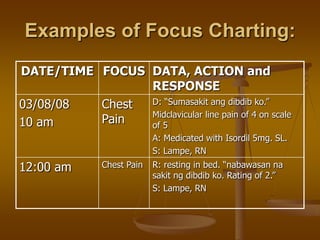
Examples of Focus Charting:
DATE/TIME FOCUS DATA, ACTION and
                RESPONSE
03/08/08  Chest D: “Sumasakit ang dibdib ko.”
                Midclavicular line pain of 4 on scale
10 am     Pain  of 5
                             A: Medicated with Isordil 5mg. SL.
                             S: Lampe, RN
12:00 am        Chest Pain   R: resting in bed. “nabawasan na
                             sakit ng dibdib ko. Rating of 2.”
                             S: Lampe, RN
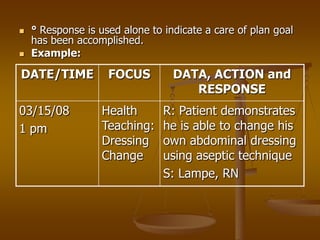
   ° Response is used alone to indicate a care of plan goal
    has been accomplished.
   Example:

DATE/TIME           FOCUS         DATA, ACTION and
                                     RESPONSE
03/15/08           Health       R: Patient demonstrates
1 pm               Teaching:    he is able to change his
                   Dressing     own abdominal dressing
                   Change       using aseptic technique
                                S: Lampe, RN
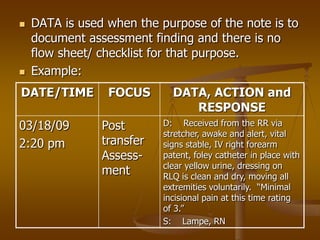
   DATA is used when the purpose of the note is to
    document assessment finding and there is no
    flow sheet/ checklist for that purpose.
   Example:
DATE/TIME        FOCUS       DATA, ACTION and
                                RESPONSE
03/18/09        Post       D: Received from the RR via
                           stretcher, awake and alert, vital
2:20 pm         transfer   signs stable, IV right forearm
                Assess-    patent, foley catheter in place with
                           clear yellow urine, dressing on
                ment       RLQ is clean and dry, moving all
                           extremities voluntarily. “Minimal
                           incisional pain at this time rating
                           of 3.”
                           S: Lampe, RN
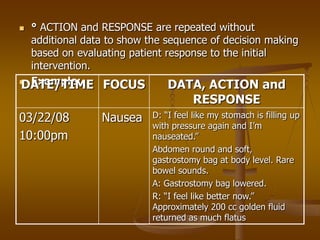
 ° ACTION and RESPONSE are repeated without
  additional data to show the sequence of decision making
  based on evaluating patient response to the initial
  intervention.
 Example:
DATE/TIME FOCUS                DATA, ACTION and
                                     RESPONSE
03/22/08        Nausea     D: “I feel like my stomach is filling up
                           with pressure again and I’m
10:00pm                    nauseated.”
                           Abdomen round and soft,
                           gastrostomy bag at body level. Rare
                           bowel sounds.
                           A: Gastrostomy bag lowered.
                           R: “I feel like better now.”
                           Approximately 200 cc golden fluid
                           returned as much flatus
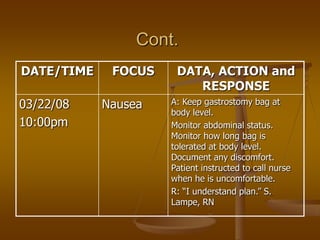
Cont.
DATE/TIME    FOCUS    DATA, ACTION and
                         RESPONSE
03/22/08    Nausea   A: Keep gastrostomy bag at
                     body level.
10:00pm              Monitor abdominal status.
                     Monitor how long bag is
                     tolerated at body level.
                     Document any discomfort.
                     Patient instructed to call nurse
                     when he is uncomfortable.
                     R: “I understand plan.” S.
                     Lampe, RN
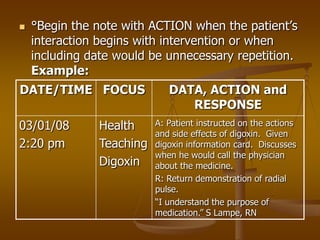
   °Begin the note with ACTION when the patient’s
    interaction begins with intervention or when
    including date would be unnecessary repetition.
    Example:
DATE/TIME FOCUS               DATA, ACTION and
                                 RESPONSE
03/01/08        Health     A: Patient instructed on the actions
                           and side effects of digoxin. Given
2:20 pm         Teaching   digoxin information card. Discusses
                           when he would call the physician
                Digoxin    about the medicine.
                           R: Return demonstration of radial
                           pulse.
                           “I understand the purpose of
                           medication.” S Lampe, RN
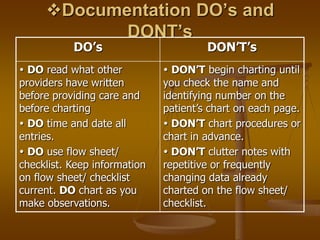
Documentation DO’s and
            DONT’s
           DO’s                        DON’T’s
 DO read what other           DON’T begin charting until
providers have written        you check the name and
before providing care and     identifying number on the
before charting               patient’s chart on each page.
 DO time and date all         DON’T chart procedures or
entries.                      chart in advance.
 DO use flow sheet/           DON’T clutter notes with
checklist. Keep information   repetitive or frequently
on flow sheet/ checklist      changing data already
current. DO chart as you      charted on the flow sheet/
make observations.            checklist.
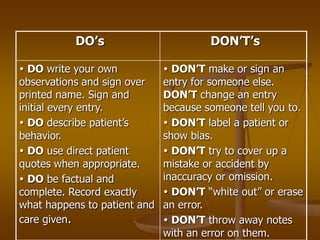
DO’s                        DON’T’s

 DO write your own            DON’T make or sign an
observations and sign over    entry for someone else.
printed name. Sign and        DON’T change an entry
initial every entry.          because someone tell you to.
 DO describe patient’s        DON’T label a patient or
behavior.                     show bias.
 DO use direct patient        DON’T try to cover up a
quotes when appropriate.      mistake or accident by
 DO be factual and           inaccuracy or omission.
complete. Record exactly       DON’T “white out” or erase
what happens to patient and   an error.
care given.                    DON’T throw away notes
                              with an error on them.
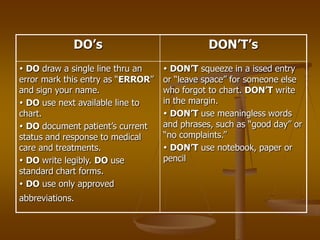
DO’s                             DON’T’s
 DO draw a single line thru an     DON’T squeeze in a issed entry
error mark this entry as “ERROR”   or “leave space” for someone else
and sign your name.                who forgot to chart. DON’T write
 DO use next available line to    in the margin.
chart.                              DON’T use meaningless words
 DO document patient’s current    and phrases, such as “good day” or
status and response to medical     “no complaints.”
care and treatments.                DON’T use notebook, paper or
 DO write legibly. DO use         pencil
standard chart forms.
 DO use only approved
abbreviations.
Focus Charting (FDAR)

Focus Charting (FDAR)

  • 1.
  • 2.
    Focus charting describesthe patient’s perspective and focuses on documenting the patient’s current status, progress towards goals and response to interventions.
  • 3.
     Purpose   Focus charting brings the focus of care back to the patient and the patients’ concerns. Instead of a problem list or list of nursing and medical diagnosis, a focus column is used that incorporates many aspects of patient and patient care.
  • 4.
    The focus might be patient strength, problem, or need. Topics that may appear in the focus column include patients’ concerns and behaviors; therapies and responses; significant events such as teaching, consultation, monitoring, manag ement of activities of daily living or assessment of functional health patterns.
  • 5.
    The narrative portion of focus charting includes Data, Action and Response (D A R). The principal advantage of focus charting is in the holistic emphasis on the patient and his/her priorities including ease in charting.
  • 6.
     Objectives   To easily identify critical patient issues/ concerns in the progress notes.   To facilitate communication among all disciplines.   To improve time efficiency with documentation.   To improve concise entries that would not duplicate patient information already provided on flowsheet/ checklist.
  • 7.
     General Guidelines   Focus charting must be Evident at least once every shift.   Focus charting must be patient- oriented not nursing task- oriented.   Indicate the date and time of entry on the first column.   Separate the topic words from the body of notes:  ° Focus note written on the second column.  ° Data, Action and Response on the third column.
  • 8.
     Sign name (e.g. M. Aquino, RN) for every time entry.   Document only patient’s concern and / or plan of care e.g. health per shift, hence, general notes are allowed.   Document patient’s status on admission, for every transfer to/from another unit or discharge.
  • 9.
     Follow the do’s of documentation.   For eight hours shift, use blue or black ink for morning and afternoon shift, red ink for night shift.   For twelve hours shift, use blue or black ink for morning and red ink for night shift.
  • 10.
     Specific Guidelines   Begin with comprehensive assessment of the patient using inspection, palpation, percussion, and auscultation (IPPA.)   Include in the assessment, collection of information from the patient, family, existing health records (such as checklist/flow sheets, laboratory results and other health care providers.
  • 11.
     Establish a focus of care, to be addressed in the Progress Notes.   Document the four elements of focus charting, as necessary, wherein:  ° Focus identifies the content or purpose of the narrative entry and is separated from the body of the notes in order to promote easy data retrieval and communication.
  • 12.
    ° Data is the subjective and/or objective information supporting the stated focus or describing the observation at the time of a significant event.  ° Action describes the nursing interventions (independent, basic and perspective) past, present or future.  ° Response describes the patient outcome/response to interventions or describes how the care plan goals have been attained.
  • 13.
    Focus note isnecessary  ° To describe a patient’s problem/ focus/ concern from the care plan - when the purpose of the notes is to evaluate progress toward the defined patient outcome from the plan of care.  Examples: Self care  Skin integrity  Activity tolerance
  • 14.
    ° To identify an exception to the expected outcome - when the significant finding or an outcome is not expected (the exception).  Examples: Wheezes left base Nausea
  • 15.
    ° To document a new finding - when the purpose of the note is to document a new sign or symptom or a new behavior which is the current focus of care. (These may be “temporary foci” which do not need to be incorporated on the plan of care because they can quickly be resolved. Even if you are uncertain whether the sign or symptom is important, it is valuable to communicate the information to the health care team.)
  • 16.
    ° To document an acute change in patient’s condition - when there has been an event of new patient condition.  Examples: Respiratory distress Seizure Code blue
  • 17.
    ° To document a significant event or unusual episode in patient care - when (a) responsibility for patient care changes from one department to another (b) a significant treatment. Intervention took place.  Examples: Admission Pre-(specify procedure) assessment Post-(specify procedure) assessment Pre-transfer assessment Discharge planning Discharge status Transfusion RBC Begin thrombolytic therapy PRN medication required
  • 18.
    ° To document an activity or treatment that was not carried out - when treatment or activity in the flow sheet was not provided to the patient or was different from the standard of care.  ° To describe all specific patient/ family teaching - this is in compliance with a standard of care.
  • 19.
    ° To identify the discipline making the entry as well as the topic of the note - when all members of the patient care team use on patient programs record.  Examples: Social service/ financial assistance Dietitian. Instruct low fat diet Physical therapy/ crutchwalking
  • 20.
    ° To best describe patient’s condition in relation to medical diagnosis - when the patient’s focus is the pathophysiology rather than pataient’s response to the problem. This happens most frequently in highly technical areas such as critical care.
  • 21.
     Data statements contain objective and/or subjective information.   Action statement contains only nursing interventions (basic, perspective, independent) past, present or future.   Patient outcome are evident in the response statements.
  • 22.
     Data, Action, Response only contain information related to the focus, none of the information is extraneous (e.g.: asleep, watching TV, visited by family).   Response statements are documented after PRN medications are administered.
  • 23.
     Information from all these categories (Data, Action, and Response) should be used only as they are relevant or available. However all appropriate information should be included to ensure complete documentation.  ° DATA and ACTION are responded at one hour and RESPONSE is not added until later, when the patient outcome is evident.
  • 24.
    Examples of FocusCharting: DATE/TIME FOCUS DATA, ACTION and RESPONSE 03/08/08 Chest D: “Sumasakit ang dibdib ko.” Midclavicular line pain of 4 on scale 10 am Pain of 5 A: Medicated with Isordil 5mg. SL. S: Lampe, RN 12:00 am Chest Pain R: resting in bed. “nabawasan na sakit ng dibdib ko. Rating of 2.” S: Lampe, RN
  • 25.
    ° Response is used alone to indicate a care of plan goal has been accomplished.  Example: DATE/TIME FOCUS DATA, ACTION and RESPONSE 03/15/08 Health R: Patient demonstrates 1 pm Teaching: he is able to change his Dressing own abdominal dressing Change using aseptic technique S: Lampe, RN
  • 26.
    DATA is used when the purpose of the note is to document assessment finding and there is no flow sheet/ checklist for that purpose.  Example: DATE/TIME FOCUS DATA, ACTION and RESPONSE 03/18/09 Post D: Received from the RR via stretcher, awake and alert, vital 2:20 pm transfer signs stable, IV right forearm Assess- patent, foley catheter in place with clear yellow urine, dressing on ment RLQ is clean and dry, moving all extremities voluntarily. “Minimal incisional pain at this time rating of 3.” S: Lampe, RN
  • 27.
     ° ACTIONand RESPONSE are repeated without additional data to show the sequence of decision making based on evaluating patient response to the initial intervention.  Example: DATE/TIME FOCUS DATA, ACTION and RESPONSE 03/22/08 Nausea D: “I feel like my stomach is filling up with pressure again and I’m 10:00pm nauseated.” Abdomen round and soft, gastrostomy bag at body level. Rare bowel sounds. A: Gastrostomy bag lowered. R: “I feel like better now.” Approximately 200 cc golden fluid returned as much flatus
  • 28.
    Cont. DATE/TIME FOCUS DATA, ACTION and RESPONSE 03/22/08 Nausea A: Keep gastrostomy bag at body level. 10:00pm Monitor abdominal status. Monitor how long bag is tolerated at body level. Document any discomfort. Patient instructed to call nurse when he is uncomfortable. R: “I understand plan.” S. Lampe, RN
  • 29.
    °Begin the note with ACTION when the patient’s interaction begins with intervention or when including date would be unnecessary repetition. Example: DATE/TIME FOCUS DATA, ACTION and RESPONSE 03/01/08 Health A: Patient instructed on the actions and side effects of digoxin. Given 2:20 pm Teaching digoxin information card. Discusses when he would call the physician Digoxin about the medicine. R: Return demonstration of radial pulse. “I understand the purpose of medication.” S Lampe, RN
  • 30.
    Documentation DO’s and DONT’s DO’s DON’T’s  DO read what other  DON’T begin charting until providers have written you check the name and before providing care and identifying number on the before charting patient’s chart on each page.  DO time and date all  DON’T chart procedures or entries. chart in advance.  DO use flow sheet/  DON’T clutter notes with checklist. Keep information repetitive or frequently on flow sheet/ checklist changing data already current. DO chart as you charted on the flow sheet/ make observations. checklist.
  • 31.
    DO’s DON’T’s  DO write your own  DON’T make or sign an observations and sign over entry for someone else. printed name. Sign and DON’T change an entry initial every entry. because someone tell you to.  DO describe patient’s  DON’T label a patient or behavior. show bias.  DO use direct patient  DON’T try to cover up a quotes when appropriate. mistake or accident by  DO be factual and inaccuracy or omission. complete. Record exactly  DON’T “white out” or erase what happens to patient and an error. care given.  DON’T throw away notes with an error on them.
  • 32.
    DO’s DON’T’s  DO draw a single line thru an  DON’T squeeze in a issed entry error mark this entry as “ERROR” or “leave space” for someone else and sign your name. who forgot to chart. DON’T write  DO use next available line to in the margin. chart.  DON’T use meaningless words  DO document patient’s current and phrases, such as “good day” or status and response to medical “no complaints.” care and treatments.  DON’T use notebook, paper or  DO write legibly. DO use pencil standard chart forms.  DO use only approved abbreviations.