Caring in Nursing
CARING
Introduction
• Caring is central to nursing practice.
• Today’s health care environment – Never
been more important.
CARING - INTRODUCTION
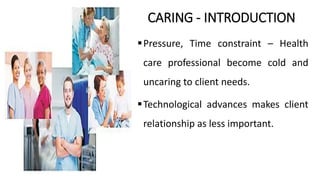
Pressure, Time constraint – Health
care professional become cold and
uncaring to client needs.
Technological advances makes client
relationship as less important.
CARING - INTRODUCTION
• HAVE YOU EVER BEEN ILL?
OR
• EXPERIENCED A PROBLEM REQUIRING
HEALTH CARE INTERVENTION?
Scenario - 1
A nurse enters a client’s room greets the client warmly while
touching the client lightly on her shoulder, makes eye contact,
spend some minutes and asks about the client’s thoughts and
concerns, listens to the client’s story, looks at the IV solution
hanging in the room, briefly examines the client, and then checks
the vital signs and summary on the bedside computer screen before
departing the room.
Scenario - 2
•A second nurse enters a client’s room,
looks at the IV solution hanging in the
room, checks the vital signs and summary
on the bedside computer screen before
departing the room.
Interpretation
• Which scenario presents the nurse
in specific acts of caring?
Interpretation
• Scenario 1: Nurse’s calm presence, parallel eye contact,
attention to the client’s concerns, and physical closeness
- Conveys a person-centered, comforting approach
• Scenario 2: Conveys sense of uncaring and uninterested,
only interested in the tasks of nursing care.
Interpretation
• During sickness, when a person seeks the professional nurses -
The guidance of a nurse - Caring is essential in reaching
positive outcomes.
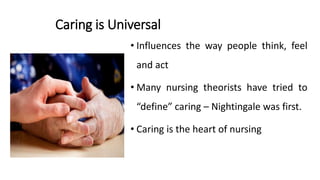
Caring is Universal
• Influences the way people think, feel
and act
• Many nursing theorists have tried to
“define” caring – Nightingale was first.
• Caring is the heart of nursing
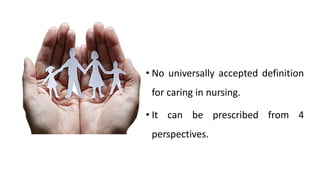
• No universally accepted definition
for caring in nursing.
• It can be prescribed from 4
perspectives.
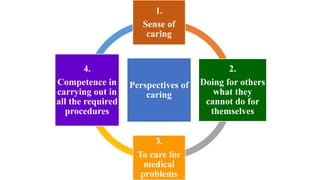
Perspectives of
caring
1.
Sense of
caring
2.
Doing for others
what they
cannot do for
themselves
3.
To care for
medical
problems
4.
Competence in
carrying out in
all the required
procedures
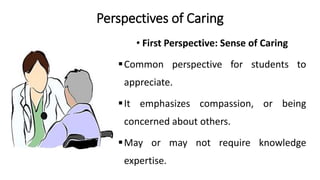
Perspectives of Caring
• First Perspective: Sense of Caring
Common perspective for students to
appreciate.
It emphasizes compassion, or being
concerned about others.
May or may not require knowledge
expertise.
Perspectives of Caring
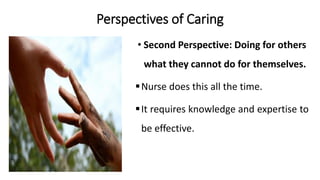
• Second Perspective: Doing for others
what they cannot do for themselves.
Nurse does this all the time.
It requires knowledge and expertise to
be effective.
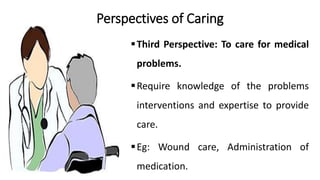
Perspectives of Caring
Third Perspective: To care for medical
problems.
Require knowledge of the problems
interventions and expertise to provide
care.
Eg: Wound care, Administration of
medication.
Perspectives of Caring
Fourth Perspective: “Competence in
carrying out all the required
procedures, personal and technical,
with true concern for providing the
proper care at the proper time in the
proper way.
• Not all four types of caring aspects must be
used at one time to be described as caring.
Patient’s View - Caring
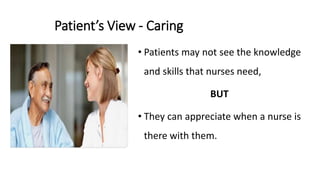
• Patients may not see the knowledge
and skills that nurses need,
BUT
• They can appreciate when a nurse is
there with them.
Patient’s View - Caring
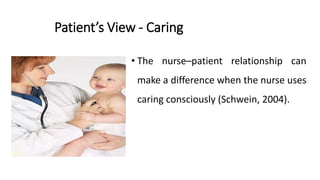
• The nurse–patient relationship can
make a difference when the nurse uses
caring consciously (Schwein, 2004).
Characteristics of Nurse - Patient Relationship
Being physically present with the patient
Having a dialogue with the patient
Showing a willingness to share and hear - to use active listening
Avoiding assumptions
Maintaining confidentiality
Showing awareness and flexibility
Believing in confidence
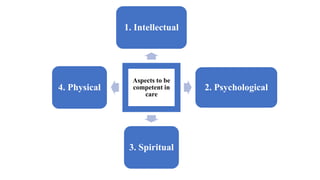
Aspects to be
competent in
care
1. Intellectual
2. Psychological
3. Spiritual
4. Physical
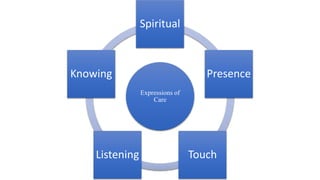
Expressions of
Care
Spiritual
Presence
Touch
Listening
Knowing
Expressions of Care
oSpiritual
Being aware of & honoring patient’s beliefs
oPresence
 Being there
 Physically present
 Demonstrating understanding
 Being with
 Sharing oneself
Expressions of Care
• Touch
Skin-to-skin
Eye contact (nonverbal)
Protective – to prevent injury
• Listening
Taking in patient information
Interpreting what has been taken in
•Knowing
Understanding the client
Understanding the planned interventions
Avoid making assumptions
Focuses on client

Caring in Nursing.pptx

  • 1.
  • 2.
    CARING Introduction • Caring iscentral to nursing practice. • Today’s health care environment – Never been more important.
  • 3.
    CARING - INTRODUCTION Pressure,Time constraint – Health care professional become cold and uncaring to client needs. Technological advances makes client relationship as less important.
  • 4.
    CARING - INTRODUCTION •HAVE YOU EVER BEEN ILL? OR • EXPERIENCED A PROBLEM REQUIRING HEALTH CARE INTERVENTION?
  • 5.
    Scenario - 1 Anurse enters a client’s room greets the client warmly while touching the client lightly on her shoulder, makes eye contact, spend some minutes and asks about the client’s thoughts and concerns, listens to the client’s story, looks at the IV solution hanging in the room, briefly examines the client, and then checks the vital signs and summary on the bedside computer screen before departing the room.
  • 6.
    Scenario - 2 •Asecond nurse enters a client’s room, looks at the IV solution hanging in the room, checks the vital signs and summary on the bedside computer screen before departing the room.
  • 7.
    Interpretation • Which scenariopresents the nurse in specific acts of caring?
  • 8.
    Interpretation • Scenario 1:Nurse’s calm presence, parallel eye contact, attention to the client’s concerns, and physical closeness - Conveys a person-centered, comforting approach • Scenario 2: Conveys sense of uncaring and uninterested, only interested in the tasks of nursing care.
  • 9.
    Interpretation • During sickness,when a person seeks the professional nurses - The guidance of a nurse - Caring is essential in reaching positive outcomes.
  • 10.
    Caring is Universal •Influences the way people think, feel and act • Many nursing theorists have tried to “define” caring – Nightingale was first. • Caring is the heart of nursing
  • 11.
    • No universallyaccepted definition for caring in nursing. • It can be prescribed from 4 perspectives.
  • 12.
    Perspectives of caring 1. Sense of caring 2. Doingfor others what they cannot do for themselves 3. To care for medical problems 4. Competence in carrying out in all the required procedures
  • 13.
    Perspectives of Caring •First Perspective: Sense of Caring Common perspective for students to appreciate. It emphasizes compassion, or being concerned about others. May or may not require knowledge expertise.
  • 14.
    Perspectives of Caring •Second Perspective: Doing for others what they cannot do for themselves. Nurse does this all the time. It requires knowledge and expertise to be effective.
  • 15.
    Perspectives of Caring ThirdPerspective: To care for medical problems. Require knowledge of the problems interventions and expertise to provide care. Eg: Wound care, Administration of medication.
  • 16.
    Perspectives of Caring FourthPerspective: “Competence in carrying out all the required procedures, personal and technical, with true concern for providing the proper care at the proper time in the proper way.
  • 17.
    • Not allfour types of caring aspects must be used at one time to be described as caring.
  • 18.
    Patient’s View -Caring • Patients may not see the knowledge and skills that nurses need, BUT • They can appreciate when a nurse is there with them.
  • 19.
    Patient’s View -Caring • The nurse–patient relationship can make a difference when the nurse uses caring consciously (Schwein, 2004).
  • 20.
    Characteristics of Nurse- Patient Relationship Being physically present with the patient Having a dialogue with the patient Showing a willingness to share and hear - to use active listening Avoiding assumptions Maintaining confidentiality Showing awareness and flexibility Believing in confidence
  • 21.
    Aspects to be competentin care 1. Intellectual 2. Psychological 3. Spiritual 4. Physical
  • 22.
  • 23.
    Expressions of Care oSpiritual Beingaware of & honoring patient’s beliefs oPresence  Being there  Physically present  Demonstrating understanding  Being with  Sharing oneself
  • 24.
    Expressions of Care •Touch Skin-to-skin Eye contact (nonverbal) Protective – to prevent injury • Listening Taking in patient information Interpreting what has been taken in
  • 25.
    •Knowing Understanding the client Understandingthe planned interventions Avoid making assumptions Focuses on client