STEPS OF NURSING
PROCESS
NURSING DIAGNOS
Introduction
• 2nd phase of nursing process
• Pivotal step in nursing process
• North American Nursing Diagnosis
Association (NANDA) 1982
Critical
thinking
North American Nursing Diagnosis
Association (NANDA)
• The purpose of NANDA is to define refine and
promote a taxonomy of nursing diagnostic
terminology.
• Taxonomy : A taxonomy is a classification
system or set of categories arranged based on a
single principles.
• In 2000, taxonomy 1 revised to taxonomy 2
• Currently, approved,13 domains and 47
classes, 247 nursing diagnosis.
NANDA NURSING DIAGNOSIS
Definitions
• Diagnosis : diagnosis is a statement or
conclusion regarding the nature of
phenomenon.
• Diagnostic label: the standardized NANDA
names for the diagnoses are diagnostic label.
• In 1990 ,NANDA adopted on official working
definition of nursing diagnosis,
Nursing diagnosis
“A clinical judgment about individual family, or
community responses to actual or potential
health problems / life process”.
A nursing diagnosis provides the basis for
selection of nursing interventions to achieve
outcome for which the nurse’s accountable
 Professional nurses are responsible for making
nursing diagnosis
13 domains …………
• Health promotion
• Nutrition
• Elimination exchange
• Activity /rest
• Perception or cognition
• Self perception
• Role relationships
• Sexuality
• Coping or stress
tolerance
• Life principle
• Safety /protection
• Comfort
• Growth and
development
Characteristics of nursing
diagnosis…
• It states clear and concise health problem
• It derived from existing evidences about the
client
• It is potentially amenable to nursing therapy
• It is the basis for planning and carrying
out nursing care
Types of nursing diagnosis …….
Actual nursing diagnosis
Risk nursing diagnosis
Health promotion nursing diagnosis
Possible nursing diagnosis
Syndrome nursing diagnosis
Actual nursing diagnosis…….
“A clinical judgment about human
experience/responses to health conditions /life
processes that exist in an individual ,family or
community.”
 Actual client problem present at the time of
assessment.
 It is based on the presence of signs and symptoms
 Eg :
 Ineffective breathing pattern
 Disturbed sleep pattern
Risk nursing diagnosis…..
• It is a clinical judgment that a problem doesn't
exist but the presence of risk factors indicates
that a problem is likely to develop unless
nurses intervene.
• No subjective or objective cues
• Eg : A client with DM or compromised
immune system is at high risk than others
Risk for infection
Risk for injury
Health promotion nursing diagnosis…
• Describes human responses to level of wellness in an
individual, family or community that have a readiness
for enhancement.
• Clinical judgment about a person’s ,families or
communities motivation and desire to increase well
being
• Eg :
 Readiness for enhanced family coping
 Readiness for enhanced self esteem
Possible nursing diagnosis……….
• A possible nursing diagnosis is one in which evidence
about a health problem is incomplete or unclear.
• A possible diagnosis requires more data either to
support or to refuse it
• Eg :
– Possible social isolation related to unknown etiology
potential risk of constipation as a result of enforced bed
rest
Syndrome nursing
diagnosis………..
• A clinical judgment describing a specific cluster of
nursing diagnoses that occurs together and are best
addressed together and through similar
interventions.
• Eg:
– Rape trauma syndrome
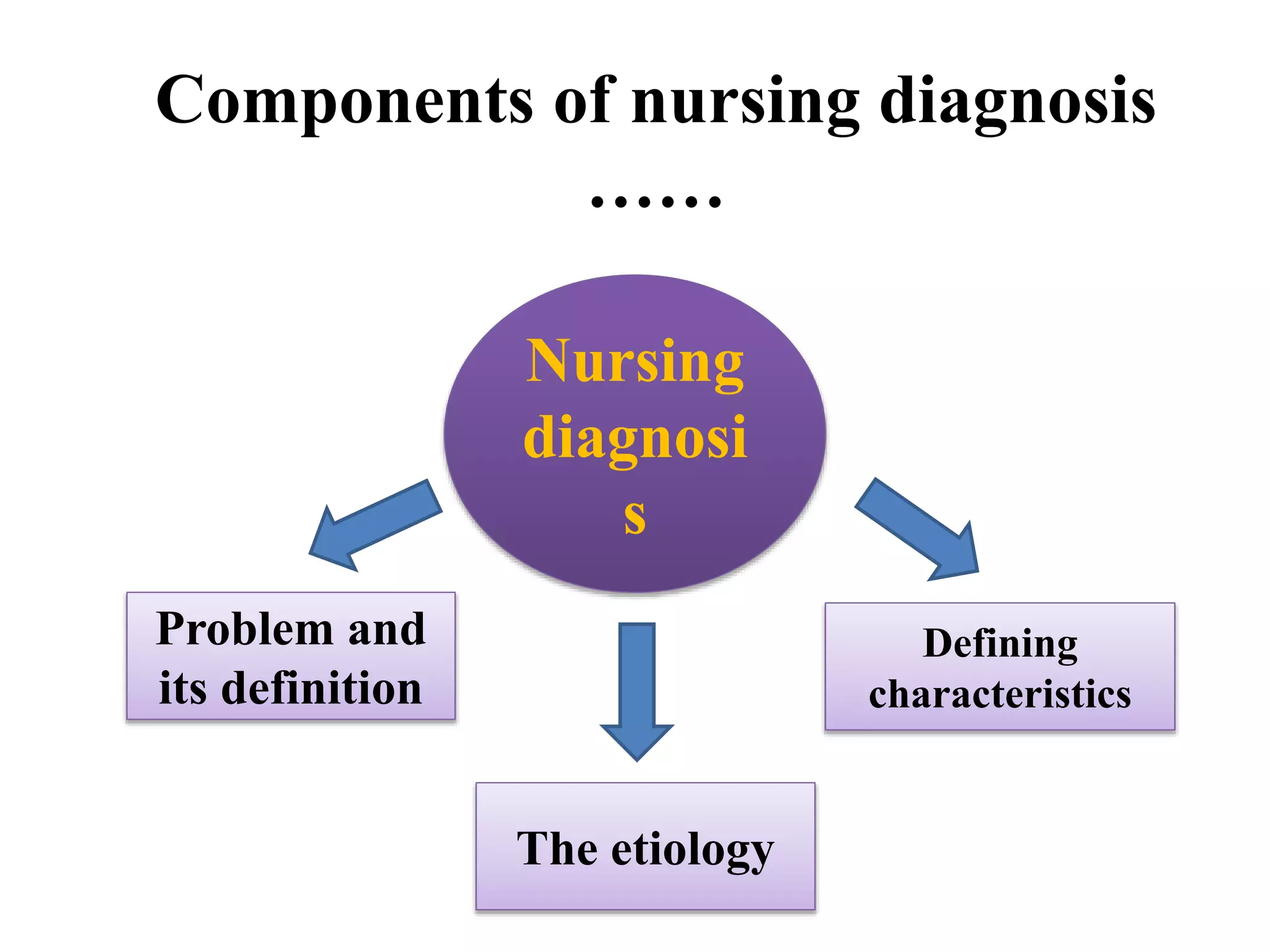
Components of nursing diagnosis
……
Nursing
diagnosi
s
Problem and
its definition
The etiology
Defining
characteristics
1. Problem (diagnostic
label)/definition
The problem statement describes the client health
problem or response for which nursing therapy is given
• The diagnostic label should be specific
• Each diagnostic label approved by NANDA carries a
definition that clarifies its meaning
• Qualifiers ; Are words that have been added to some
NANDA labels to give additional meaning to the diagnostic
statement
Deficient
Impaired
Ineffective
Decreased
Acute
Chronic
Imbalanced
Interrupted
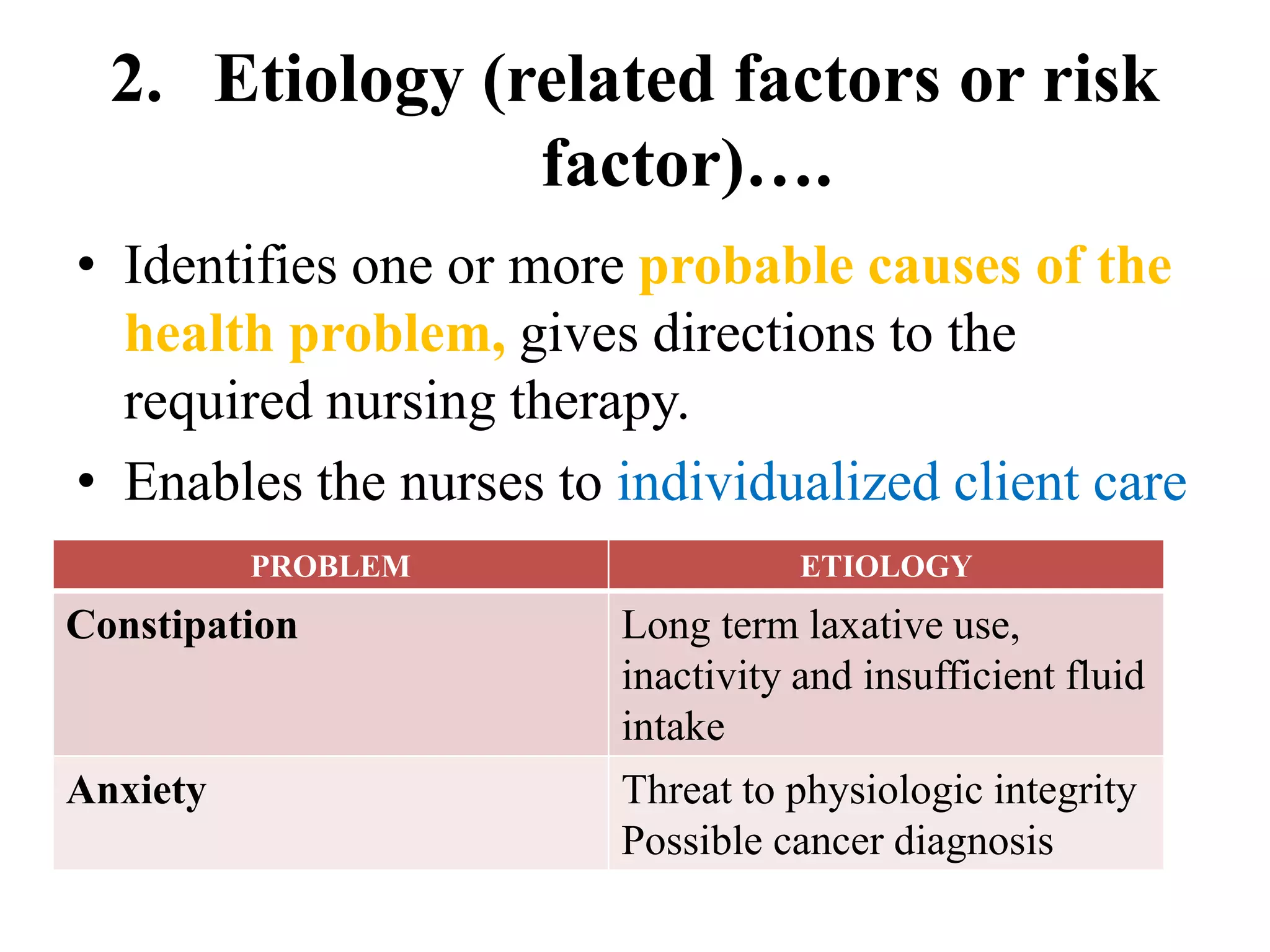
2. Etiology (related factors or risk
factor)….
• Identifies one or more probable causes of the
health problem, gives directions to the
required nursing therapy.
• Enables the nurses to individualized client care
PROBLEM ETIOLOGY
Constipation Long term laxative use,
inactivity and insufficient fluid
intake
Anxiety Threat to physiologic integrity
Possible cancer diagnosis
3. Defining characteristics.........
The cluster of signs and symptoms that
indicate the presence of a particular diagnostic
label .
Actual diagnosis: client signs and symptoms
Risk diagnosis : no subjective signs are present
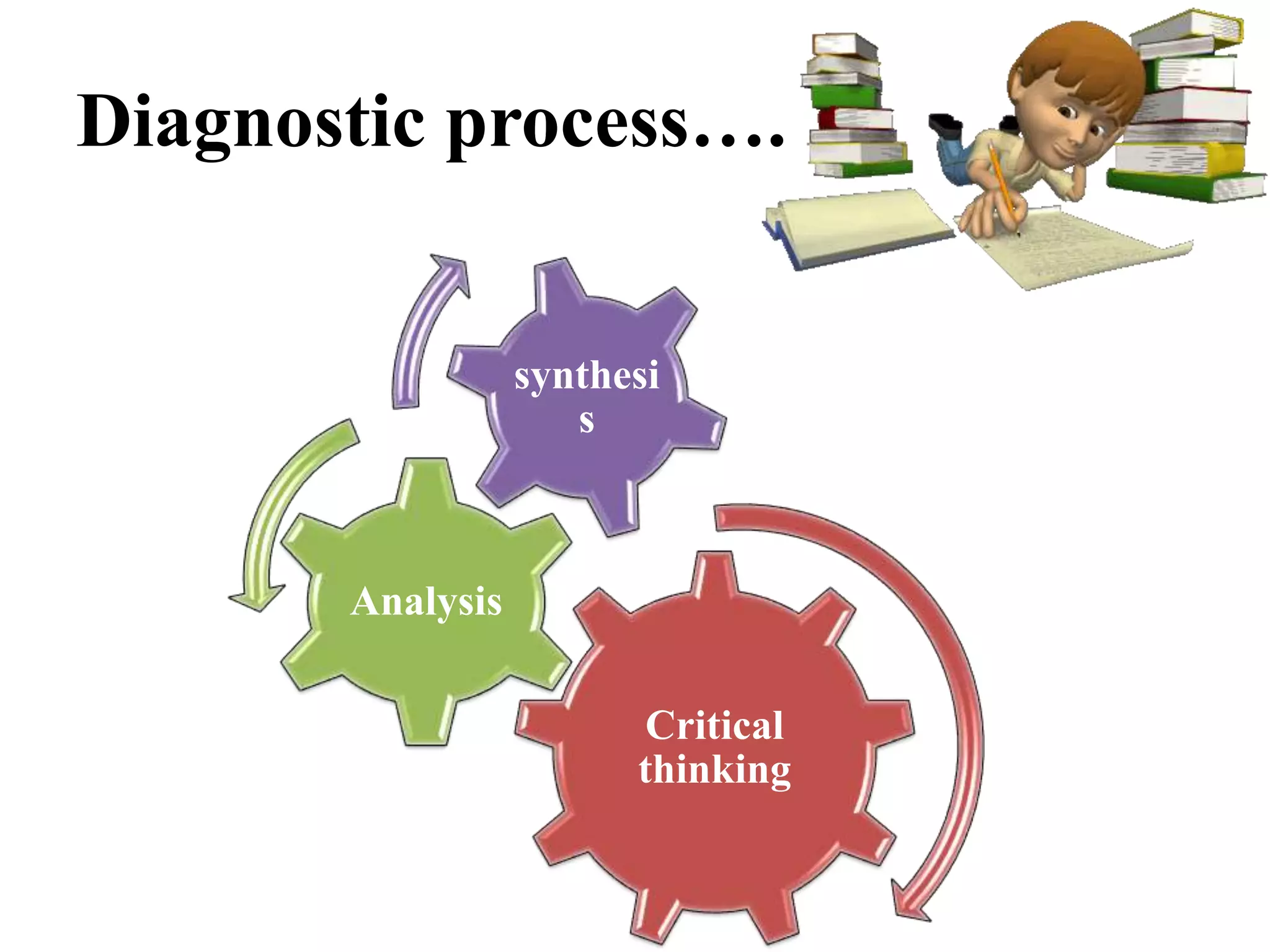
THE DIAGNOSTIC PROCESS
Diagnostic process….
Critical
thinking
Analysis
synthesi
s
Steps of diagnostic process…..
1. Analyzing data
2. Identifying
health problems
risks and strengths
3. Formulate
diagnostic
statement
1. Analyzing data………
Compare data against the standard
Cluster cues
Identifies gaps and inconsistencies
2. Identifying health problems…
• The nurse and client can together identify
strengths and problems
• Primarily decision making process
• Medical diagnosis
• Nursing diagnosis
• Collaborative problem
Determine problems
• Resources
• Ability to cope up
Determine strengths
Nursing
diagnosis
One part
statement
Two part
statement
Three
part
statement
Formulating diagnostic
statement……
Basic two parts………..
1. Problem :statement of the client responses
2. Etiology :factors contributing to or probable
causes of the responses
 “related to” phrase implies a relation ship
 Eg :
 Constipation related to insufficient fluid intake
 Acute pain related to presence of surgical
incision
 Insomnia related to hospitalization
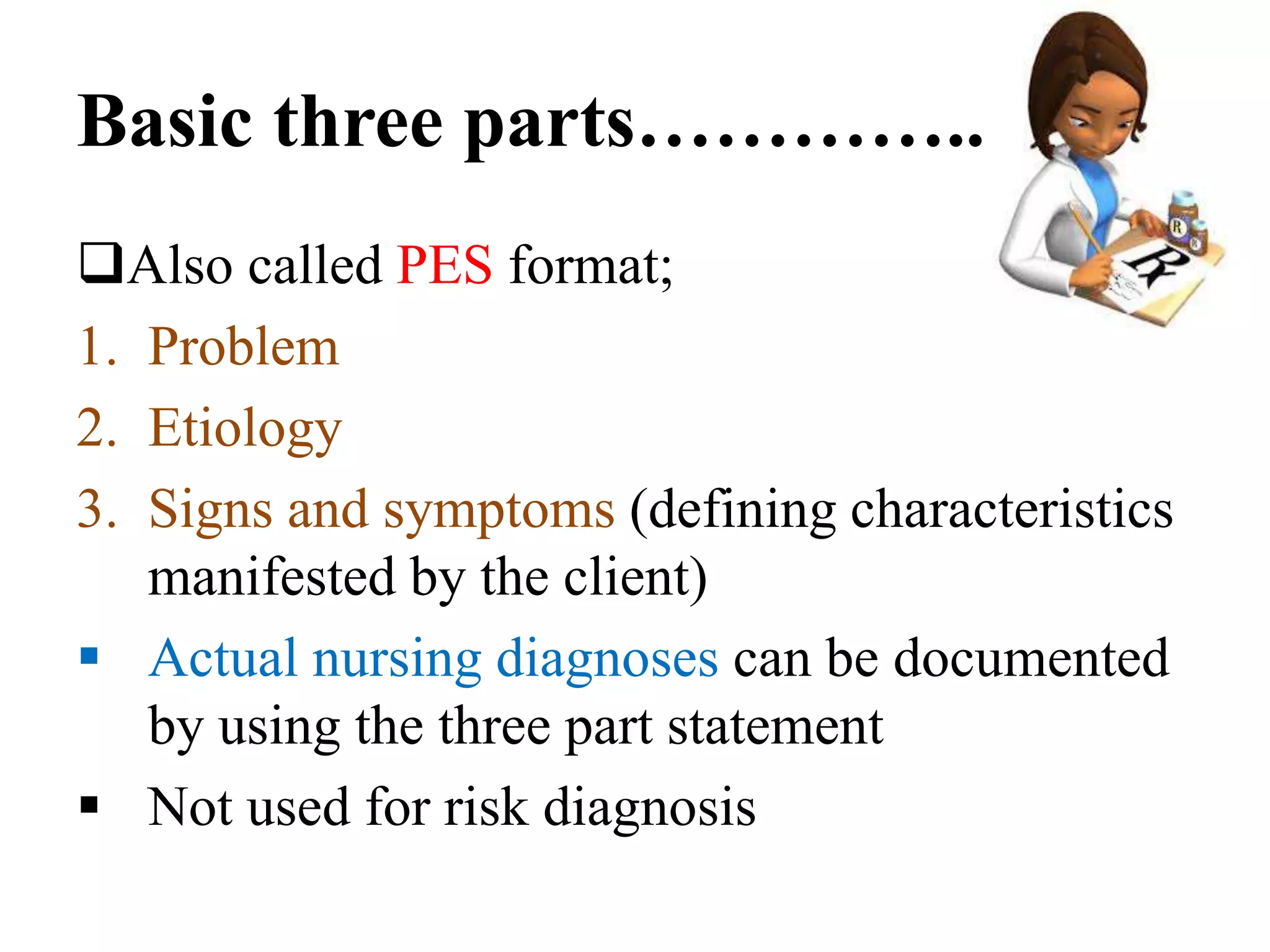
Basic three parts…………..
Also called PES format;
1. Problem
2. Etiology
3. Signs and symptoms (defining characteristics
manifested by the client)
 Actual nursing diagnoses can be documented
by using the three part statement
 Not used for risk diagnosis
Basic three parts…………..
• Eg :
– Acute pain r/t surgical incision as evidenced by
verbalization
– Ineffective airway clearance r/t accumulation of
pulmonary secretions as evidenced by crackles
on auscultation
– Hyperthermia r/t underlying infectious process
as evidenced by temperature 100 F
Basic one part…………
The diagnostic label are defined and
tend to become more specific ,the
interventions can be derived from the label
itself …… etiology may not be needed.
 Syndrome and wellness diagnosis consist
Nanda label only
 Eg :
 Rape trauma syndrome
 Spiritual well being
Variations of basic formats……..
• Writing unknown etiology
– Noncompliance (medication regimen) related to unknown etiology
• Using the phrase complex factors
– Chronic low self esteem r/t complex factors
• Using the word possible to describe either problem or etiology
– Possible low self-esteem r/t loss of job and rejection by family
– Altered thought processes possibly r/t unfamiliar surroundings
• Using secondary to divide the etiology into two parts
– Risk for impaired skin integrity r/t decreased peripheral circulation
secondary to diabetes
• Adding second part to the general response or NANDA label to make it
more precise
– Impaired skin integrity (left lateral ankle) r/t decreased peripheral
circulation.
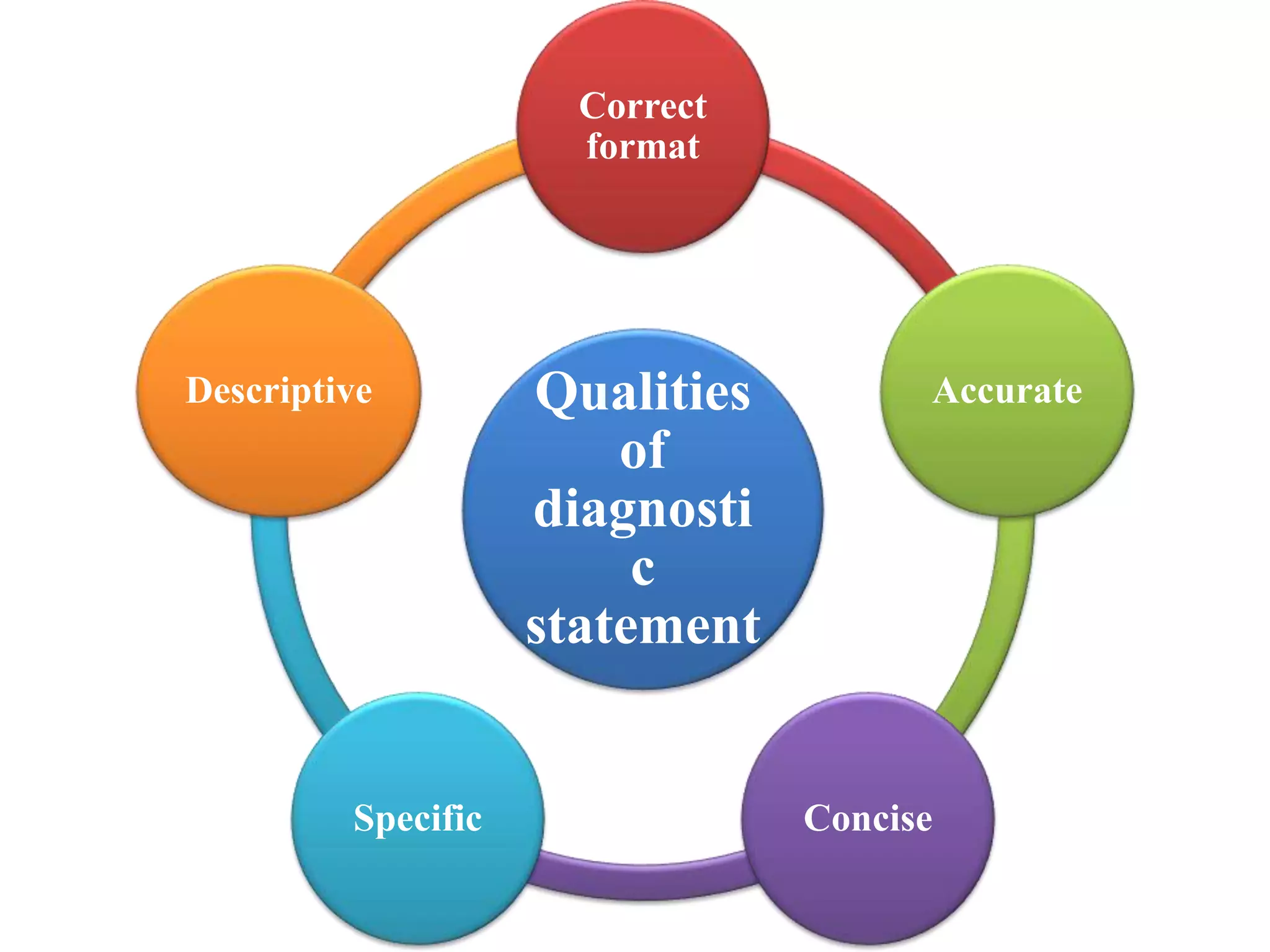
Qualities
of
diagnosti
c
statement
Correct
format
Accurate
ConciseSpecific
Descriptive
What all are the errors
can be
Errors in diagnostic
reasoning…..,……….
• Verify
• Build a very good knowledge base
and acquire clinical experience
• Have a working knowledge of what is normal
• Consult resources
• Base diagnosis on pattern that is , on behavior
over time –rather than on an isolated
incident
• Improving critical thinking skills
Nursing diagnosis v/s medical diagnosis
Nursing diagnosis Medical diagnosis
Care focused Etiology focused
Identifies risk and problems of the
patient
Identifies as nearly possible the
specific clinical entity that is
causing illness
Focused on the signs and
symptoms on the patient and his
/her care givers
The medical diagnosis specify the
pathology
Focused on the person and their
physiological / psychologic all
responses to illness
Focuses on illness
Eg : Ineffective denial related to
difficulty coping with new
diagnosis of “heart attack”
Eg : Myocardial infarction
THANK YOU
AreYouReadyToPlanCare? ……………………….

Nursing diagnosis

  • 1.
  • 2.
  • 3.
    Introduction • 2nd phaseof nursing process • Pivotal step in nursing process • North American Nursing Diagnosis Association (NANDA) 1982 Critical thinking
  • 4.
    North American NursingDiagnosis Association (NANDA) • The purpose of NANDA is to define refine and promote a taxonomy of nursing diagnostic terminology. • Taxonomy : A taxonomy is a classification system or set of categories arranged based on a single principles. • In 2000, taxonomy 1 revised to taxonomy 2 • Currently, approved,13 domains and 47 classes, 247 nursing diagnosis.
  • 5.
    NANDA NURSING DIAGNOSIS Definitions •Diagnosis : diagnosis is a statement or conclusion regarding the nature of phenomenon. • Diagnostic label: the standardized NANDA names for the diagnoses are diagnostic label. • In 1990 ,NANDA adopted on official working definition of nursing diagnosis,
  • 6.
    Nursing diagnosis “A clinicaljudgment about individual family, or community responses to actual or potential health problems / life process”. A nursing diagnosis provides the basis for selection of nursing interventions to achieve outcome for which the nurse’s accountable  Professional nurses are responsible for making nursing diagnosis
  • 7.
    13 domains ………… •Health promotion • Nutrition • Elimination exchange • Activity /rest • Perception or cognition • Self perception • Role relationships • Sexuality • Coping or stress tolerance • Life principle • Safety /protection • Comfort • Growth and development
  • 8.
    Characteristics of nursing diagnosis… •It states clear and concise health problem • It derived from existing evidences about the client • It is potentially amenable to nursing therapy • It is the basis for planning and carrying out nursing care
  • 9.
    Types of nursingdiagnosis ……. Actual nursing diagnosis Risk nursing diagnosis Health promotion nursing diagnosis Possible nursing diagnosis Syndrome nursing diagnosis
  • 10.
    Actual nursing diagnosis……. “Aclinical judgment about human experience/responses to health conditions /life processes that exist in an individual ,family or community.”  Actual client problem present at the time of assessment.  It is based on the presence of signs and symptoms  Eg :  Ineffective breathing pattern  Disturbed sleep pattern
  • 11.
    Risk nursing diagnosis….. •It is a clinical judgment that a problem doesn't exist but the presence of risk factors indicates that a problem is likely to develop unless nurses intervene. • No subjective or objective cues • Eg : A client with DM or compromised immune system is at high risk than others Risk for infection Risk for injury
  • 12.
    Health promotion nursingdiagnosis… • Describes human responses to level of wellness in an individual, family or community that have a readiness for enhancement. • Clinical judgment about a person’s ,families or communities motivation and desire to increase well being • Eg :  Readiness for enhanced family coping  Readiness for enhanced self esteem
  • 13.
    Possible nursing diagnosis………. •A possible nursing diagnosis is one in which evidence about a health problem is incomplete or unclear. • A possible diagnosis requires more data either to support or to refuse it • Eg : – Possible social isolation related to unknown etiology potential risk of constipation as a result of enforced bed rest
  • 14.
    Syndrome nursing diagnosis……….. • Aclinical judgment describing a specific cluster of nursing diagnoses that occurs together and are best addressed together and through similar interventions. • Eg: – Rape trauma syndrome
  • 15.
    Components of nursingdiagnosis …… Nursing diagnosi s Problem and its definition The etiology Defining characteristics
  • 16.
    1. Problem (diagnostic label)/definition Theproblem statement describes the client health problem or response for which nursing therapy is given • The diagnostic label should be specific • Each diagnostic label approved by NANDA carries a definition that clarifies its meaning • Qualifiers ; Are words that have been added to some NANDA labels to give additional meaning to the diagnostic statement Deficient Impaired Ineffective Decreased Acute Chronic Imbalanced Interrupted
  • 17.
    2. Etiology (relatedfactors or risk factor)…. • Identifies one or more probable causes of the health problem, gives directions to the required nursing therapy. • Enables the nurses to individualized client care PROBLEM ETIOLOGY Constipation Long term laxative use, inactivity and insufficient fluid intake Anxiety Threat to physiologic integrity Possible cancer diagnosis
  • 18.
    3. Defining characteristics......... Thecluster of signs and symptoms that indicate the presence of a particular diagnostic label . Actual diagnosis: client signs and symptoms Risk diagnosis : no subjective signs are present
  • 19.
  • 20.
  • 21.
    Steps of diagnosticprocess….. 1. Analyzing data 2. Identifying health problems risks and strengths 3. Formulate diagnostic statement
  • 22.
    1. Analyzing data……… Comparedata against the standard Cluster cues Identifies gaps and inconsistencies
  • 23.
    2. Identifying healthproblems… • The nurse and client can together identify strengths and problems • Primarily decision making process • Medical diagnosis • Nursing diagnosis • Collaborative problem Determine problems • Resources • Ability to cope up Determine strengths
  • 24.
  • 25.
    Basic two parts……….. 1.Problem :statement of the client responses 2. Etiology :factors contributing to or probable causes of the responses  “related to” phrase implies a relation ship  Eg :  Constipation related to insufficient fluid intake  Acute pain related to presence of surgical incision  Insomnia related to hospitalization
  • 26.
    Basic three parts………….. Alsocalled PES format; 1. Problem 2. Etiology 3. Signs and symptoms (defining characteristics manifested by the client)  Actual nursing diagnoses can be documented by using the three part statement  Not used for risk diagnosis
  • 27.
    Basic three parts………….. •Eg : – Acute pain r/t surgical incision as evidenced by verbalization – Ineffective airway clearance r/t accumulation of pulmonary secretions as evidenced by crackles on auscultation – Hyperthermia r/t underlying infectious process as evidenced by temperature 100 F
  • 28.
    Basic one part………… Thediagnostic label are defined and tend to become more specific ,the interventions can be derived from the label itself …… etiology may not be needed.  Syndrome and wellness diagnosis consist Nanda label only  Eg :  Rape trauma syndrome  Spiritual well being
  • 29.
    Variations of basicformats…….. • Writing unknown etiology – Noncompliance (medication regimen) related to unknown etiology • Using the phrase complex factors – Chronic low self esteem r/t complex factors • Using the word possible to describe either problem or etiology – Possible low self-esteem r/t loss of job and rejection by family – Altered thought processes possibly r/t unfamiliar surroundings • Using secondary to divide the etiology into two parts – Risk for impaired skin integrity r/t decreased peripheral circulation secondary to diabetes • Adding second part to the general response or NANDA label to make it more precise – Impaired skin integrity (left lateral ankle) r/t decreased peripheral circulation.
  • 30.
  • 31.
    What all arethe errors can be
  • 32.
    Errors in diagnostic reasoning…..,………. •Verify • Build a very good knowledge base and acquire clinical experience • Have a working knowledge of what is normal • Consult resources • Base diagnosis on pattern that is , on behavior over time –rather than on an isolated incident • Improving critical thinking skills
  • 33.
    Nursing diagnosis v/smedical diagnosis Nursing diagnosis Medical diagnosis Care focused Etiology focused Identifies risk and problems of the patient Identifies as nearly possible the specific clinical entity that is causing illness Focused on the signs and symptoms on the patient and his /her care givers The medical diagnosis specify the pathology Focused on the person and their physiological / psychologic all responses to illness Focuses on illness Eg : Ineffective denial related to difficulty coping with new diagnosis of “heart attack” Eg : Myocardial infarction
  • 34.