THE NURSING PROCESS
Objectives: At the end of 3 hours, the student should be able to: Define nursing process State importance of nursing process in nursing profession State and define interrelated phases of nursing process Be able to identify subjective and objective data gathered Be able to formulate nursing diagnosis according to NANDA using the nursing process
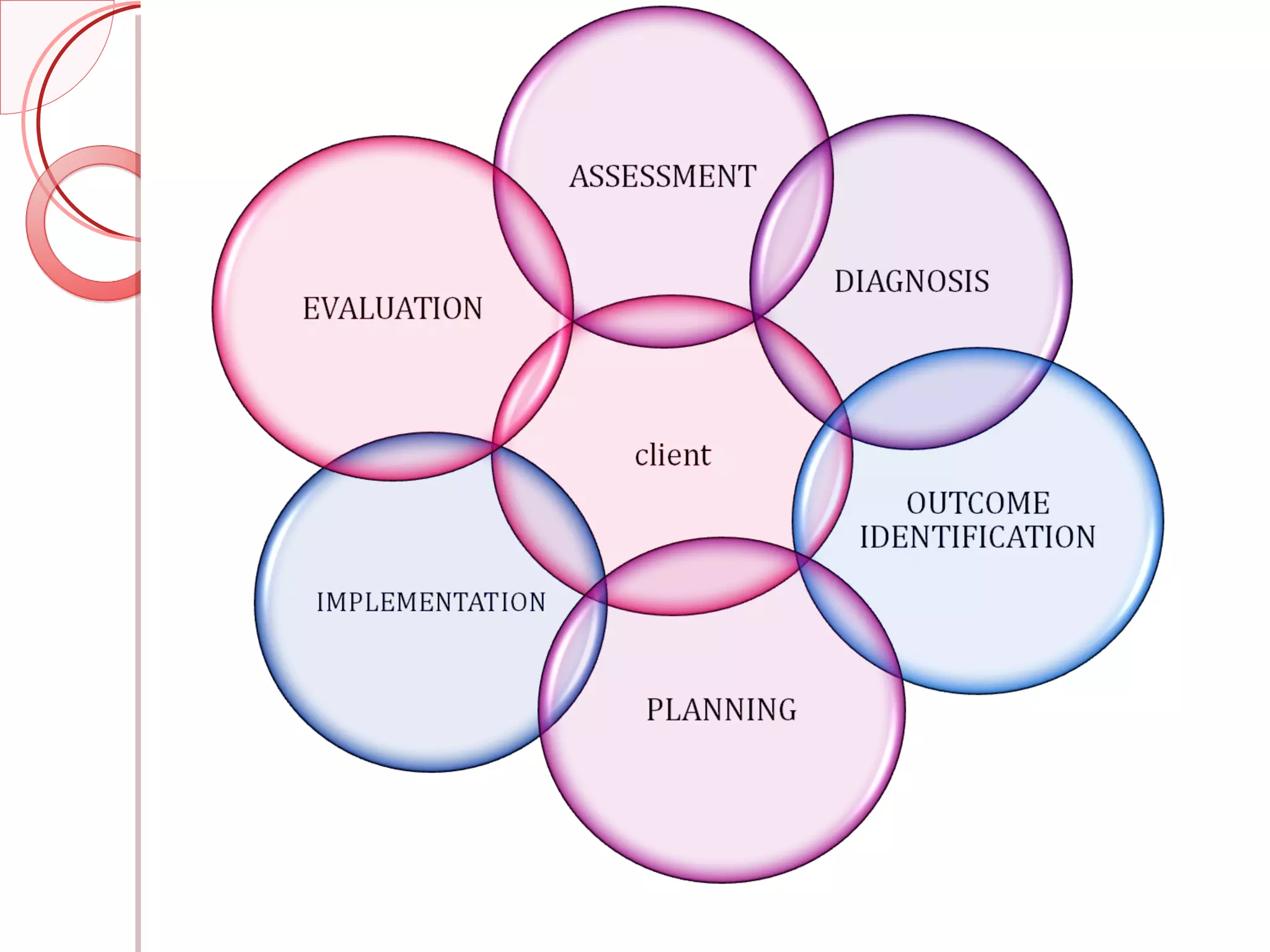
NURSING PROCESS The cornerstone of the nursing profession Includes: ADOPIE – Assessment, Diagnosis, Outcome identification, Planning, Implementation and Evaluation
NURSING PROCESS IS: ORGANIZED & SYSTEMATIC 6 sequential and interrelated steps HUMANISTIC  The plan of care is developed and implemented with great consideration to the unique needs and concerns of the individual client It is individualized It involves aspect of human dignity
EFFICIENT Relevant to the needs of the client Promotes client satisfaction and progress EFFECTIVE Utilizes resources wisely in terms of human, time, cost resources
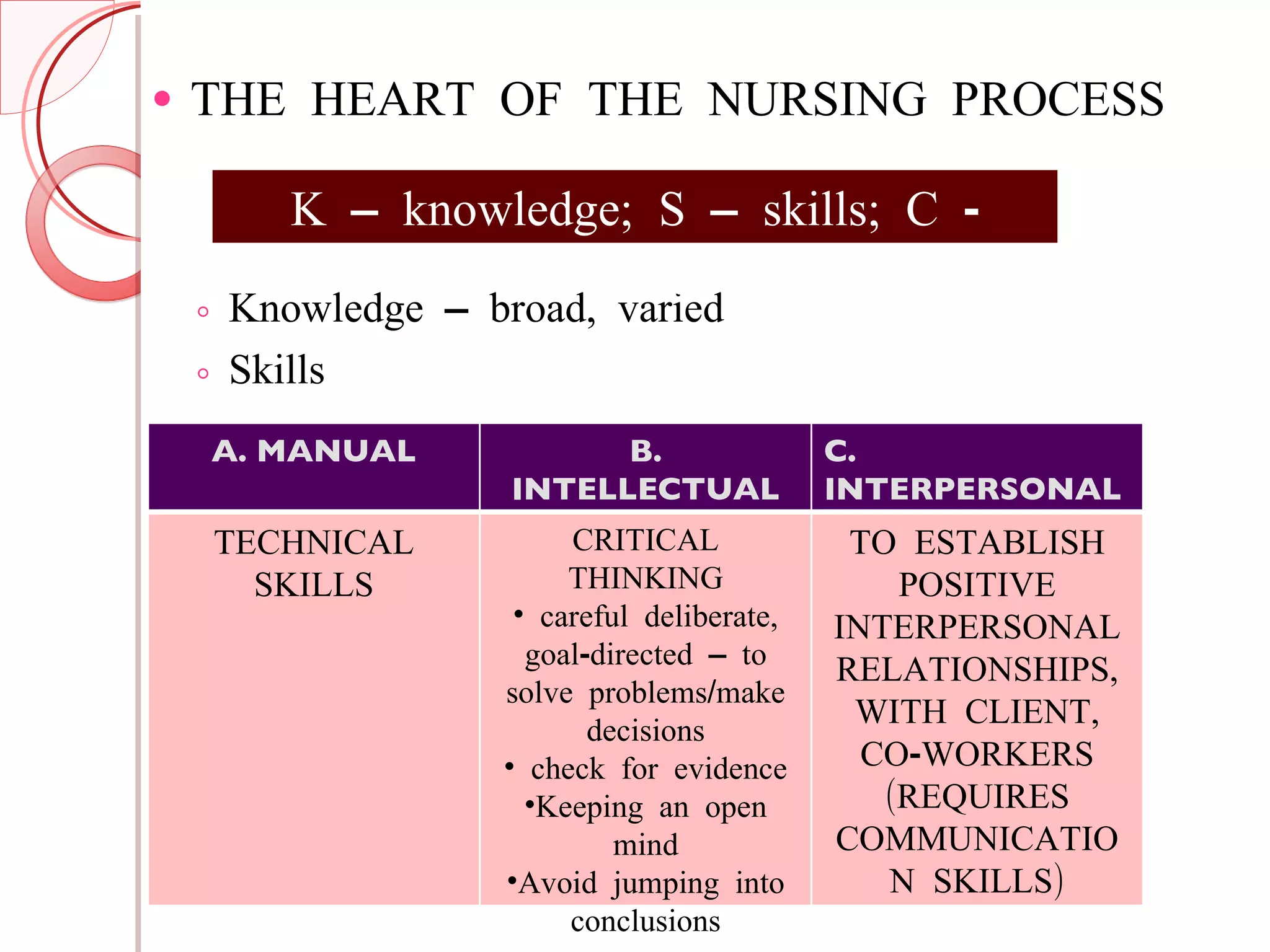
THE HEART OF THE NURSING PROCESS Knowledge – broad, varied Skills K – knowledge; S – skills; C - caring A. MANUAL B. INTELLECTUAL C. INTERPERSONAL TECHNICAL SKILLS CRITICAL THINKING careful deliberate, goal-directed – to solve problems/make decisions check for evidence Keeping an open mind Avoid jumping into conclusions TO ESTABLISH POSITIVE INTERPERSONAL RELATIONSHIPS, WITH CLIENT, CO-WORKERS (REQUIRES COMMUNICATION SKILLS)
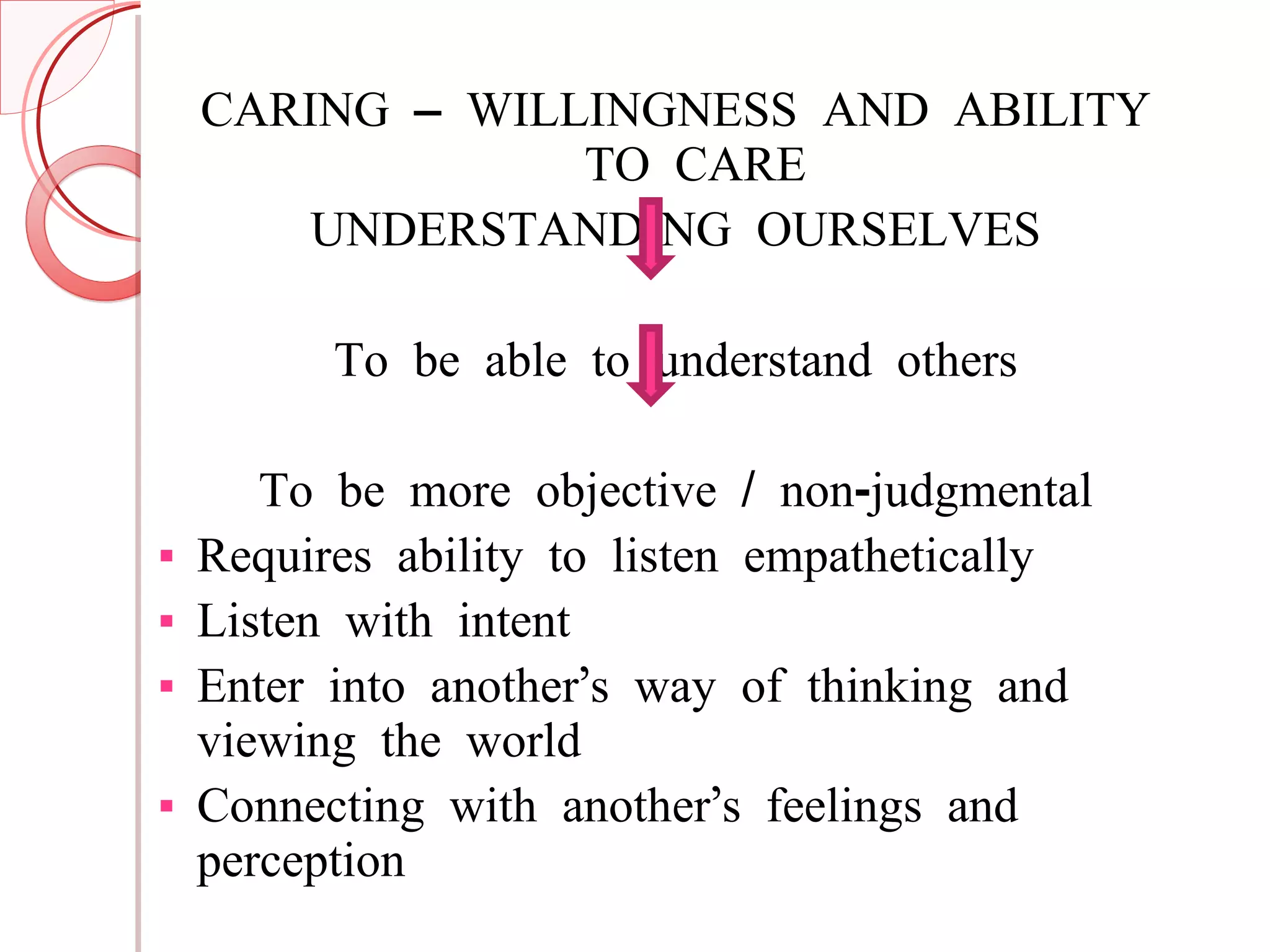
CARING – WILLINGNESS AND ABILITY TO CARE UNDERSTANDING OURSELVES To be able to understand others To be more objective / non-judgmental Requires ability to listen empathetically Listen with intent Enter into another’s way of thinking and viewing the world Connecting with another’s feelings and perception
Identify with another’s struggles, frustrations and desires Being able to detach from feelings and returning to our own frame of reference WILLINGNESS TO CARE Keep the focus on what is best for the patient Respect beliefs / values of others Stay involved Maintain a healthy lifestyle
CARING BEHAVIORS Inspiring someone / instilling hope and faith Demonstrating patience, compassion and willingness to persevere Offering companionship Helping someone stay in touch with positive aspect of the life Demonstrating thoughtfulness Bending the rules when it really counts Doing the little things Keeping someone informed Showing your human side by sharing “stories”
 
ASSESSMENT Collecting, validating, organizing and recording data about the client’s health status (individual, family, community) PURPOSE: To establish a data base ACTIVITIES: COLLECTING DATA: Gathering information. Include the physical, psychological, emotional, socio-cultural, and spiritual factors
TYPES OF DATA: SUBJECTIVE DATA (SYMPTOMS) - experienced by the client - EX. Pain, dizziness,  OBJECTIVE DATA (SIGNS) - those that can be observed and measured - EX. Pallor, diaphoresis, blood pressure, reddish urine, body temp. METHODS OF COLLECTING DATA: INTERVIEW. Planned purposeful conversation OBSERVATION. (use of senses, lab results interpretation, physical examination)
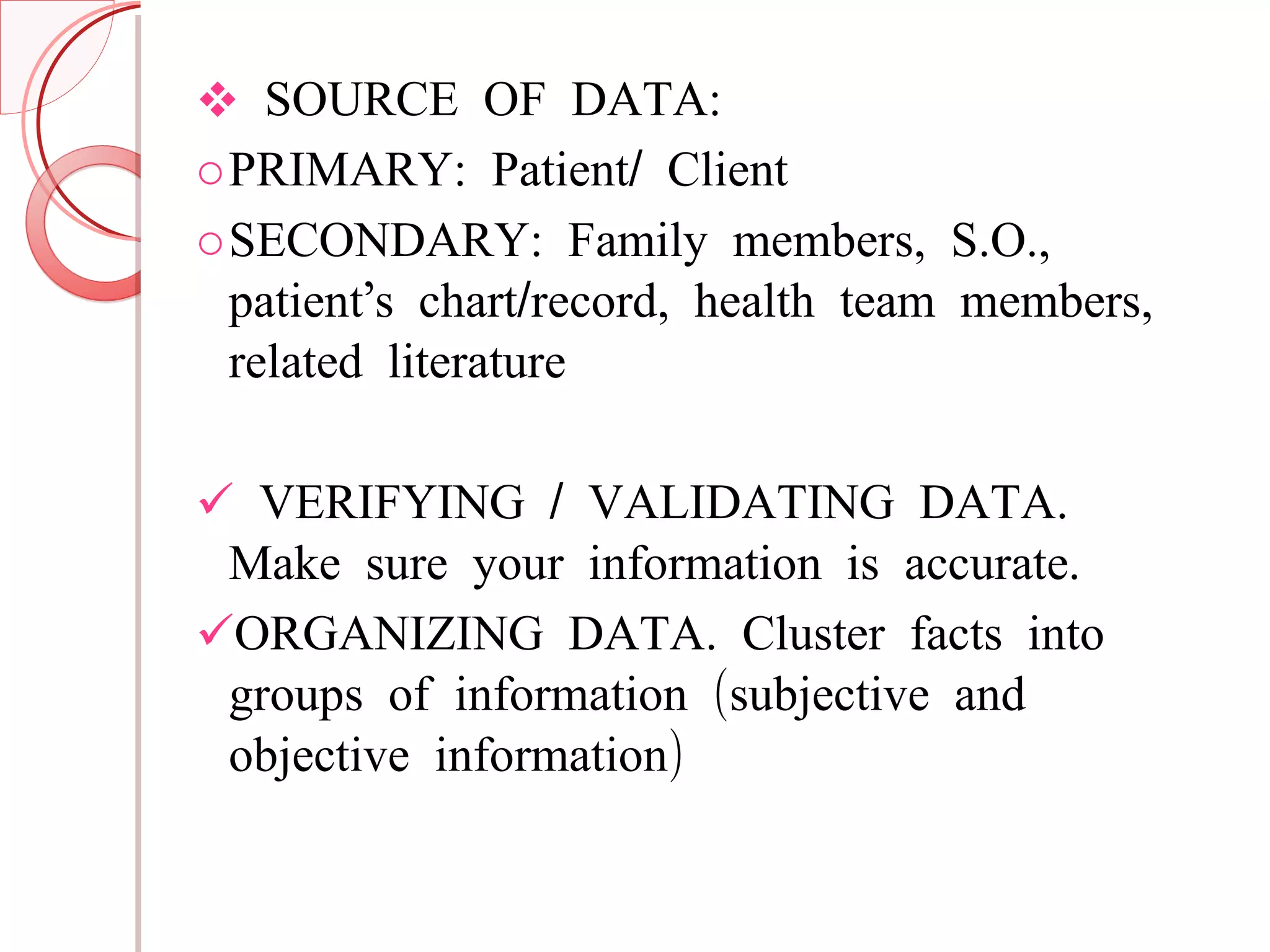
SOURCE OF DATA: PRIMARY: Patient/ Client SECONDARY: Family members, S.O., patient’s chart/record, health team members, related literature VERIFYING / VALIDATING DATA. Make sure your information is accurate. ORGANIZING DATA. Cluster facts into groups of information (subjective and objective information)
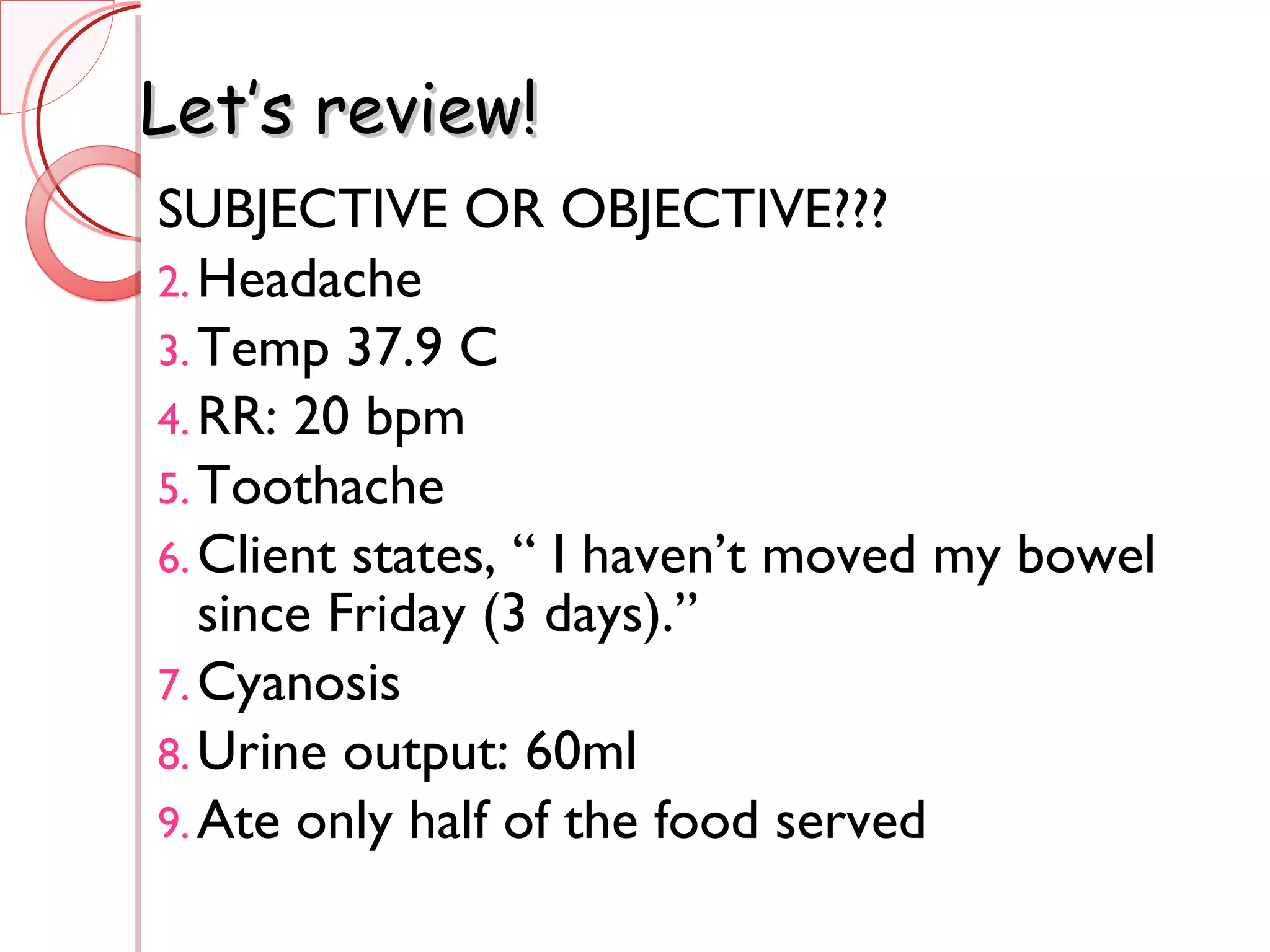
Let’s review! SUBJECTIVE OR OBJECTIVE??? Headache Temp 37.9 C RR: 20 bpm Toothache Client states, “ I haven’t moved my bowel since Friday (3 days).” Cyanosis Urine output: 60ml Ate only half of the food served
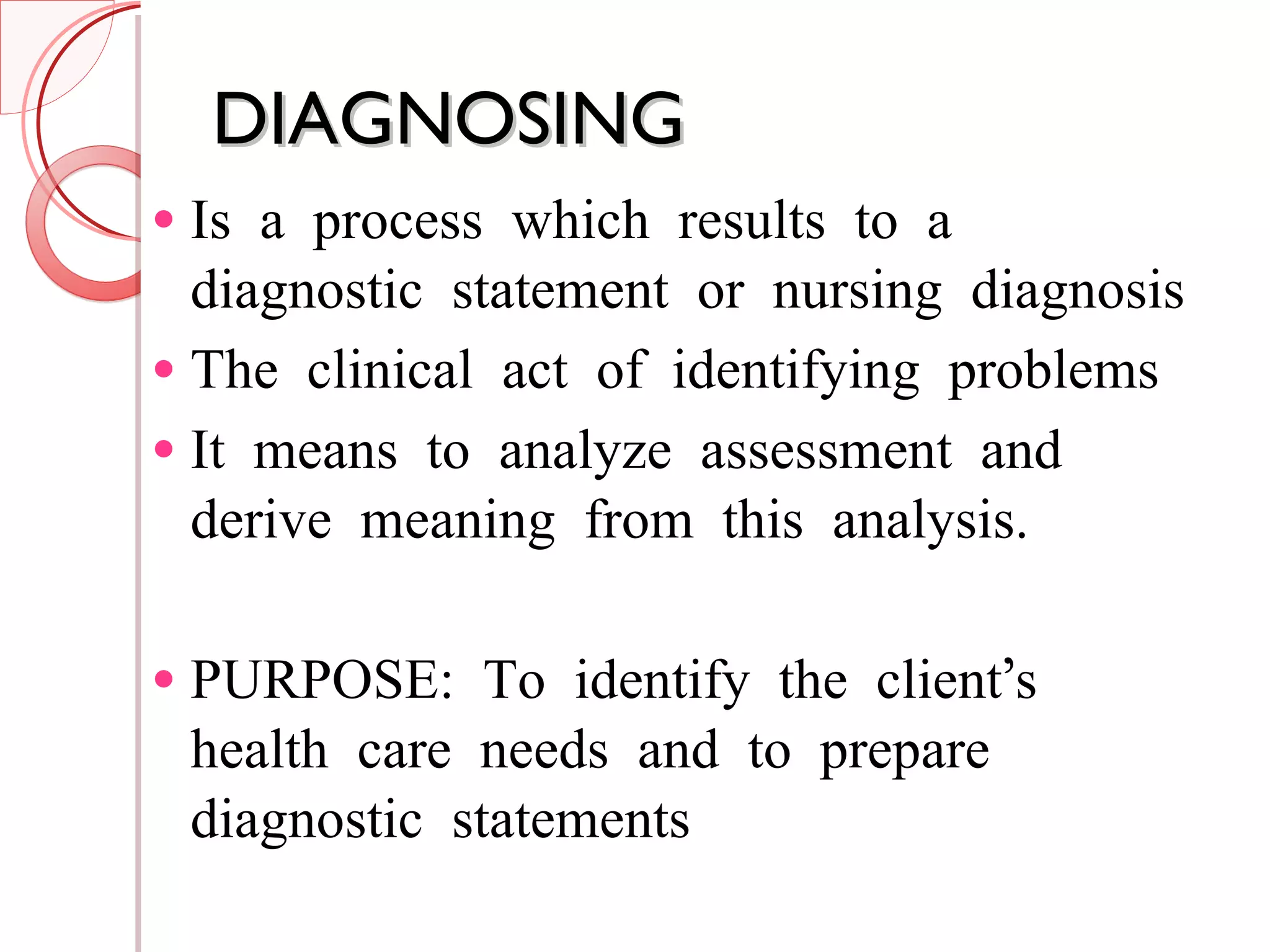
DIAGNOSING Is a process which results to a diagnostic statement or nursing diagnosis The clinical act of identifying problems It means to analyze assessment and derive meaning from this analysis. PURPOSE: To identify the client’s health care needs and to prepare diagnostic statements
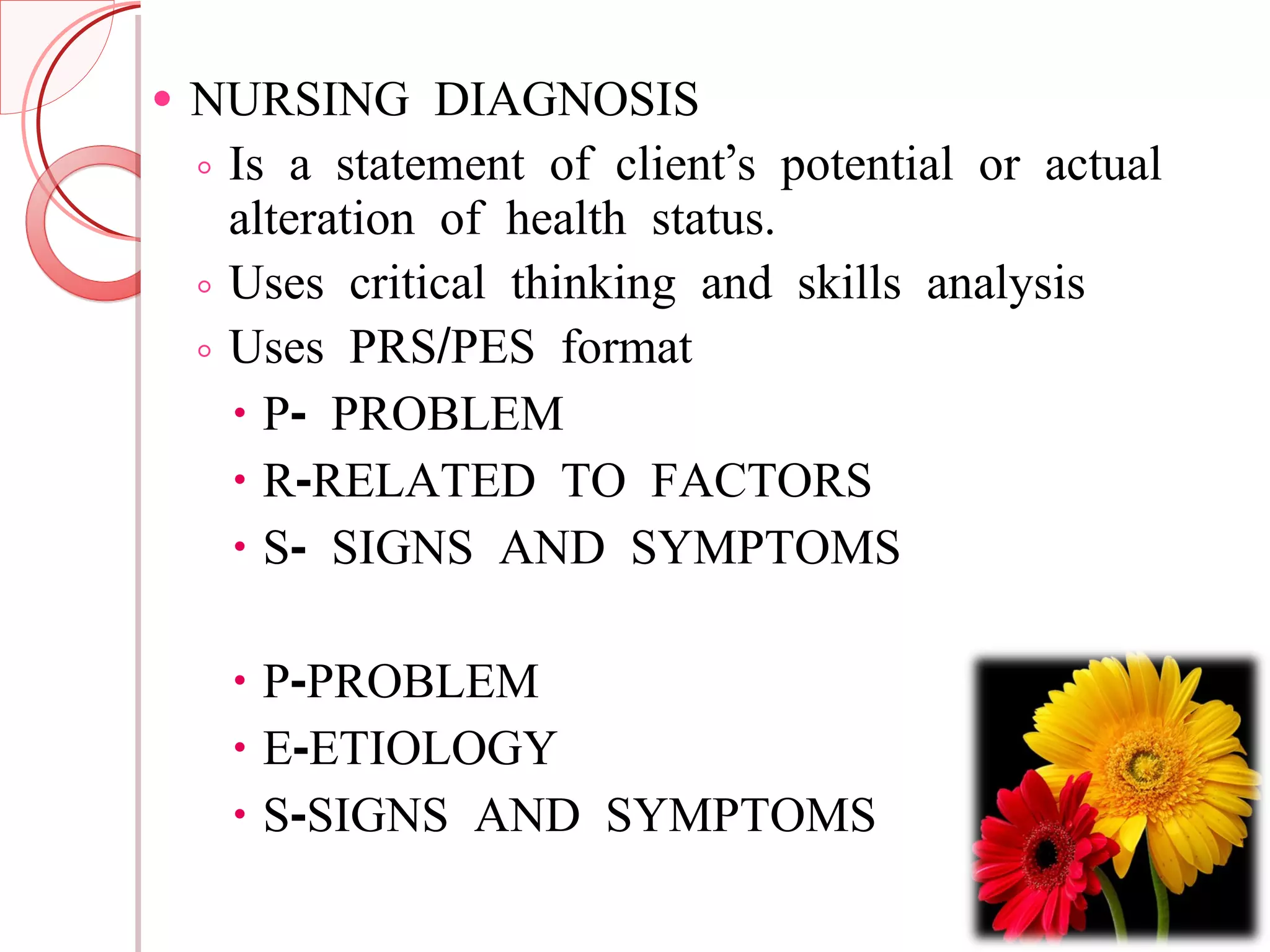
NURSING DIAGNOSIS Is a statement of client’s potential or actual alteration of health status. Uses critical thinking and skills analysis Uses PRS/PES format P- PROBLEM R-RELATED TO FACTORS S- SIGNS AND SYMPTOMS P-PROBLEM E-ETIOLOGY S-SIGNS AND SYMPTOMS
ACTIVITIES DURING DIAGNOSING: Organize cluster or group data. Ex. Pallor, dyspnea, weakness, fatigue – pertain to problems with oxygenation Compare data against standards (accepted norms). Ex. Amber, clear urine VS cloudy urine or tea colored urine. Analyze data after comparing with standards Identify gaps and inconsistencies in data Determine the client’s health problems, health risks, strengths Formulate Nursing Diagnosis statements
Examples of Nursing Diagnoses: Anxiety related to insufficient knowledge regarding surgical experience Ineffective airway clearance related to tracheobronchial infection as manifested by weak cough, adventitious breath sounds, and copious green sputum production.
Types of Nsg. Diagnoses: ACTUAL NURSING DIAGNOSIS A judgment about the client’s response to a health problem that is present at the time of nursing assessment Based on the presence of signs and symptoms Ex. - ALTERED COMFORT: PAIN  - PAIN: SEVERE HEADACHE RELATED TO FEAR OF ADDICTION TO NARCOTICS
RISK NURSING DIAGNOSIS A clinical judgment that a problem does  not exist, but the presence of risk factors indicates that a problem is likely to develop Ex. RISK FOR INFECTION RISK FOR CONSTIPATION
POSSIBLE NURSING DIAGNOSIS Is one in which evidence about a health problem is unclear or the causative factors are unknown. Requires more data either to support or to refute it. Ex. Possible Social Isolation related to unknown etiology
COMPONENTS of a NANDA NURSING DIAGNOSIS PROBLEM (diagnostic label) and DEFINITION Describes the client’s health status clearly and concisely in a few words Qualifiers: Deficient – inadequate in amount, quality, or degree; not sufficient Impaired – made worse, weakened, damaged
Ineffective – not producing the desired effect ETIOLOGY (related factors & risk factors) Identifies one or more probable causes of health problem Gives direction to what health needs to attend to.
DEFINING CHARACTERISTICS A cluster of signs and symptoms that indicate the presence of a particular diagnostic label ACTUAL DX: signs and symptoms HIGH RISK/ RISK: factors that cause the client to be more vulnerable to the problem
Ex. ACTIVITY INTOLERANCE RELATED TO IMMOBILITY  as manifested by verbal reports of fatigue or weakness during leg exercises Formulating statements:  Problem – Etiology format Problem – etiology – signs and symptoms format
OUTCOME IDENTIFICATION Refers to formulating and documenting measurable, realistic, client – focused goals. Provides the basis for evaluating nursing diagnosis and interventions.
ACTIVITIES INCLUDE: ESTABLISH PRIORITIES. Life-threatening should be given highest priority  ABC’s (airway, breathing, circulation) Maslow’s hierarchy of needs (physiologic needs over psychosocial) Unstable clients vs. clients with stable conditions Actual problems vs. potential concerns
ESTABLISH GOALS & OUTCOME CRITERIA GOALS: broad statements SHORT-TERM GOAL (STG) LONG-TERM GOAL (LTG) OUTCOME CRITERIA: specific, measurable, realistic statements of goal attainment S – M – A – R – T Specific, measurable, attainable, time-framed
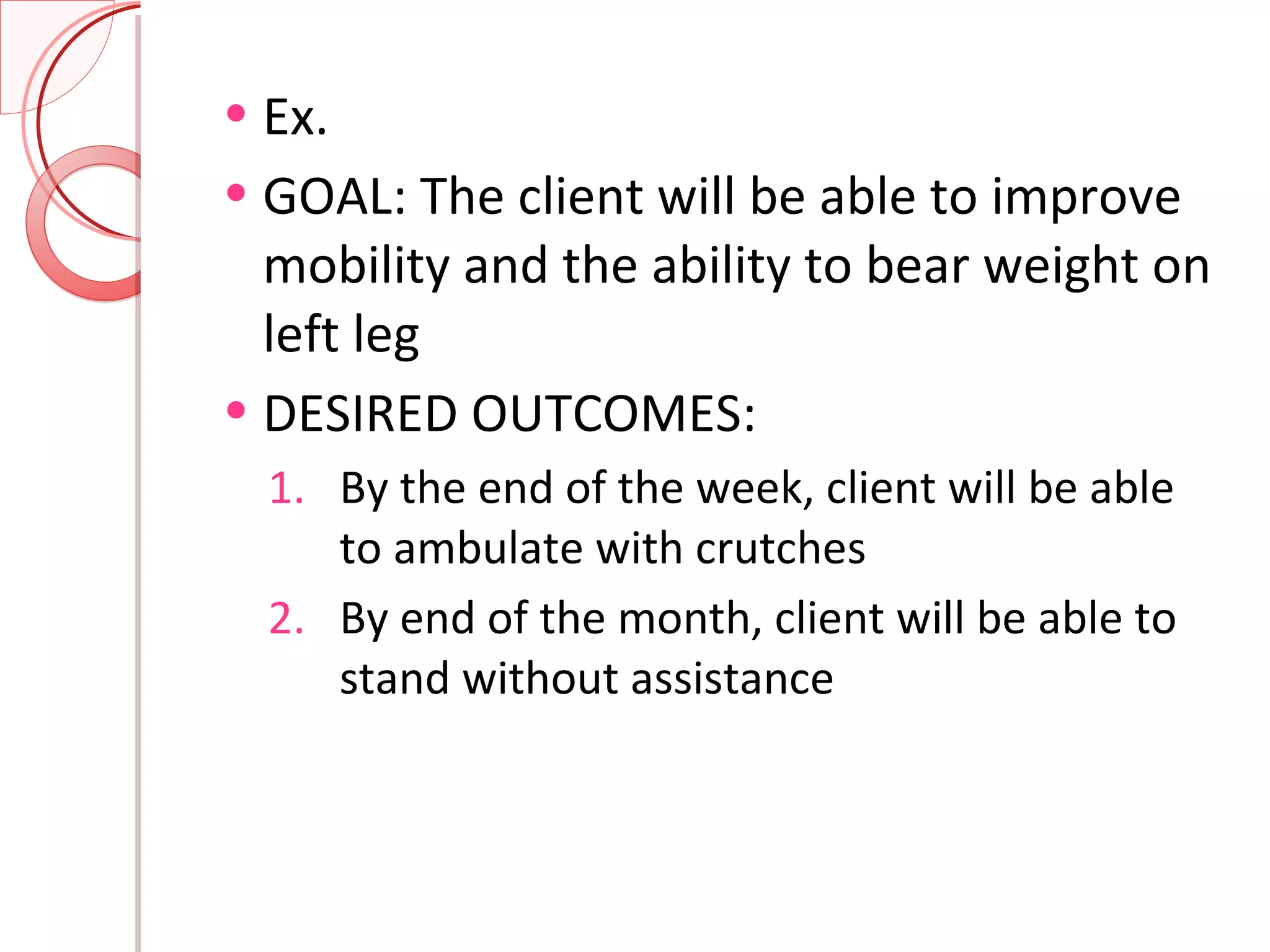
Ex.  GOAL: The client will be able to improve mobility and the ability to bear weight on left leg DESIRED OUTCOMES: By the end of the week, client will be able to ambulate with crutches By end of the month, client will be able to stand without assistance
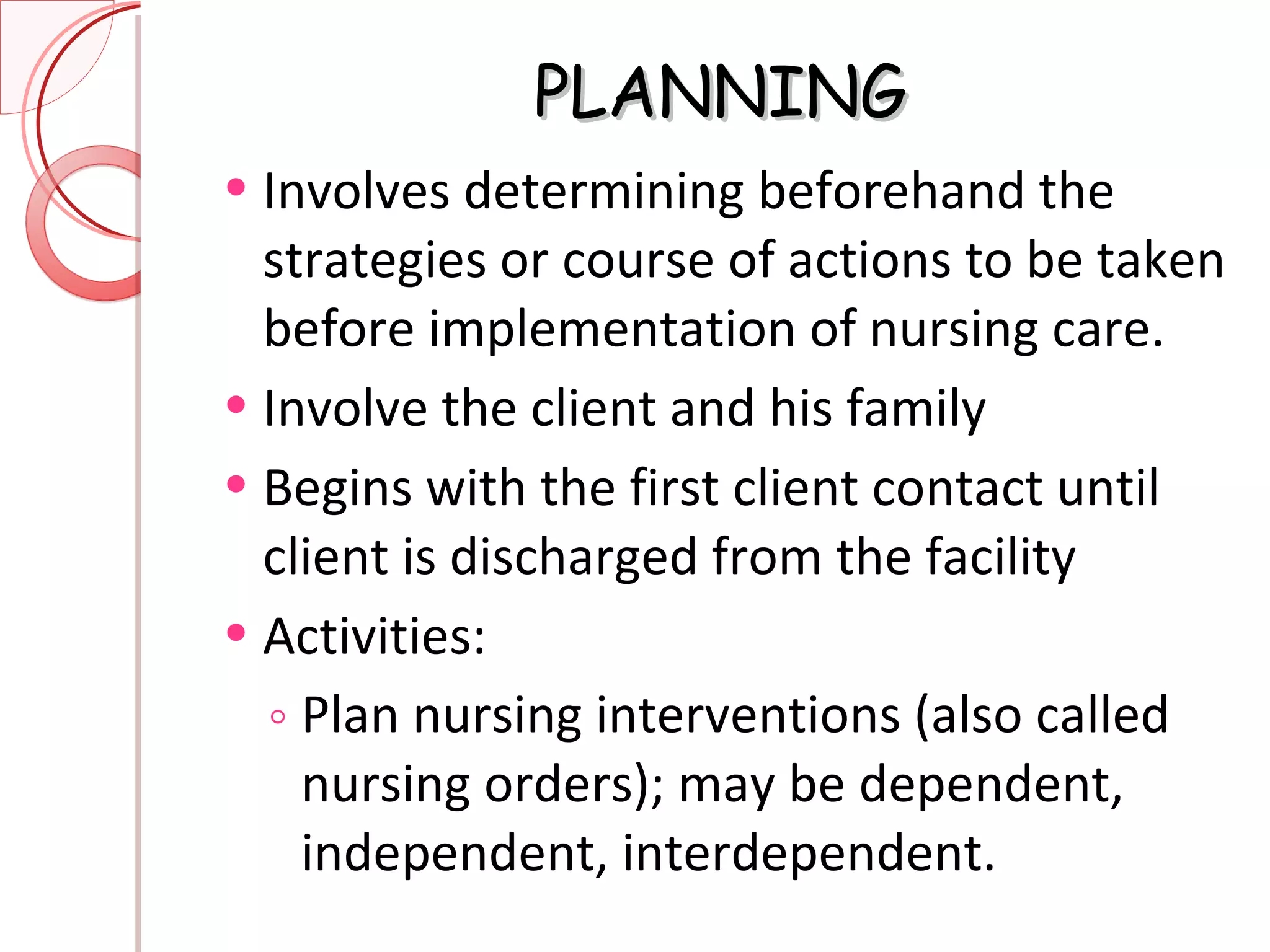
PLANNING Involves determining beforehand the strategies or course of actions to be taken before implementation of nursing care. Involve the client and his family Begins with the first client contact until client is discharged from the facility Activities: Plan nursing interventions (also called nursing orders); may be dependent, independent, interdependent.
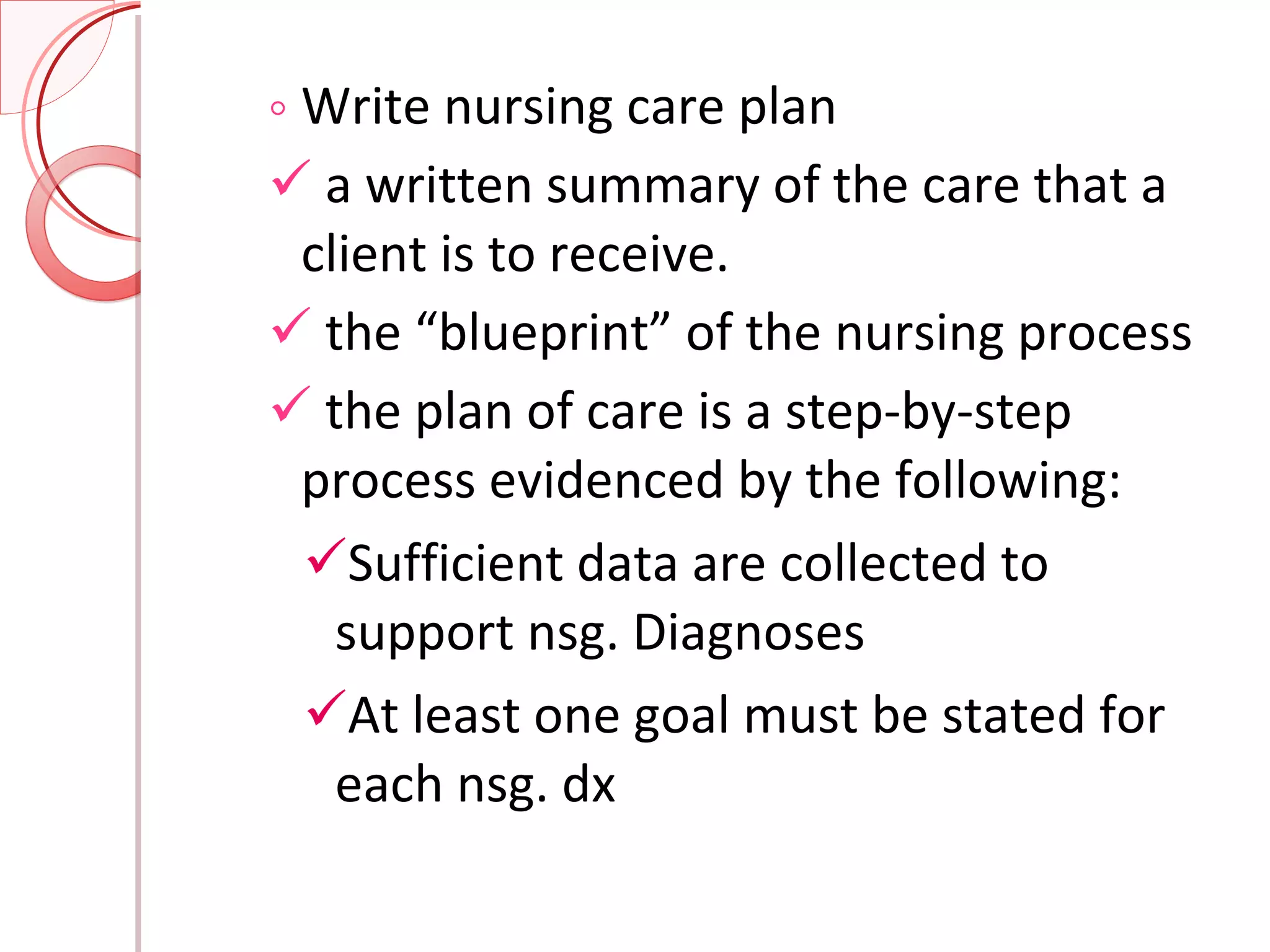
Write nursing care plan a written summary of the care that a client is to receive. the “blueprint” of the nursing process the plan of care is a step-by-step process evidenced by the following: Sufficient data are collected to support nsg. Diagnoses At least one goal must be stated for each nsg. dx
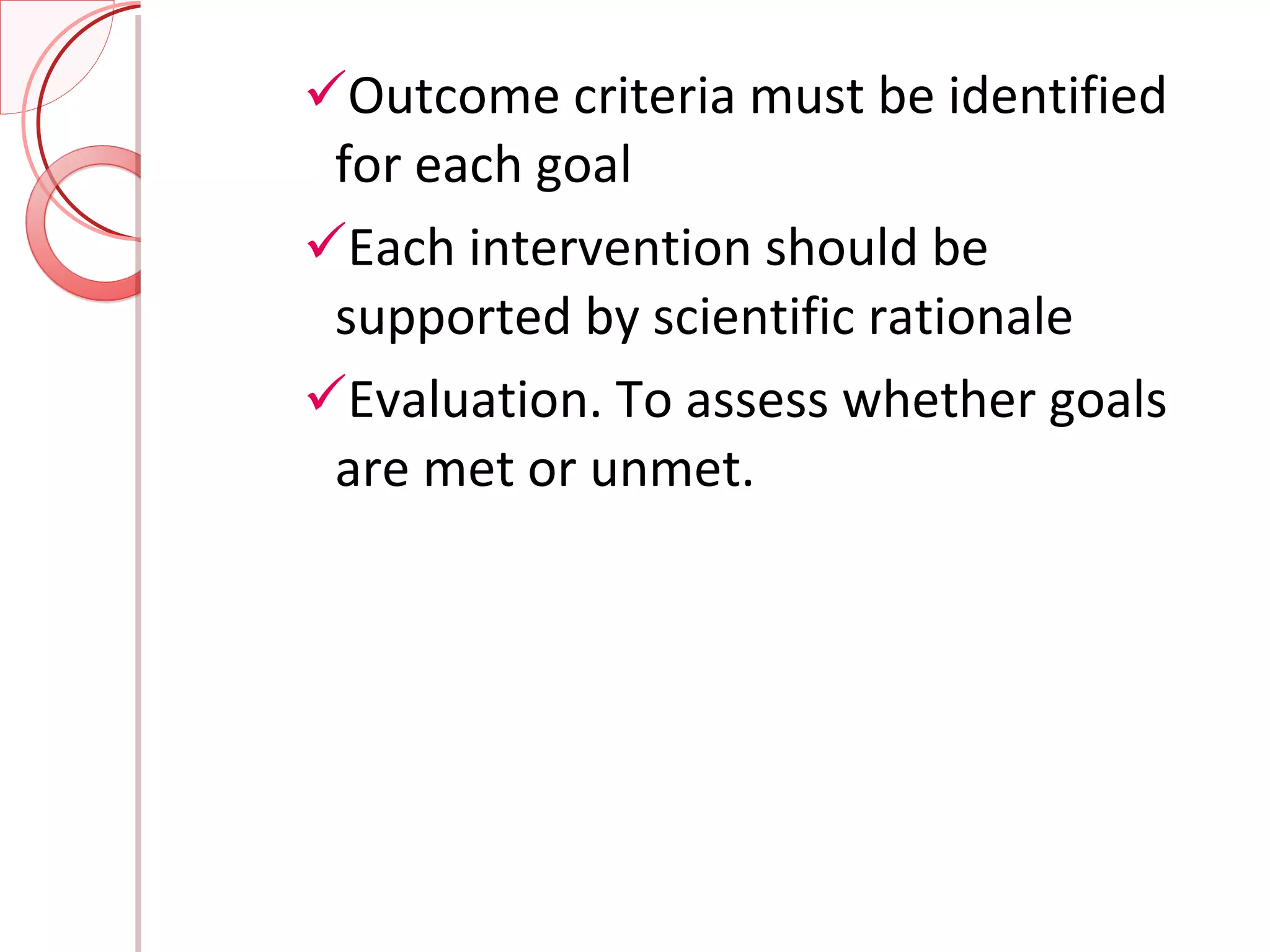
Outcome criteria must be identified for each goal Each intervention should be supported by scientific rationale Evaluation. To assess whether goals are met or unmet.
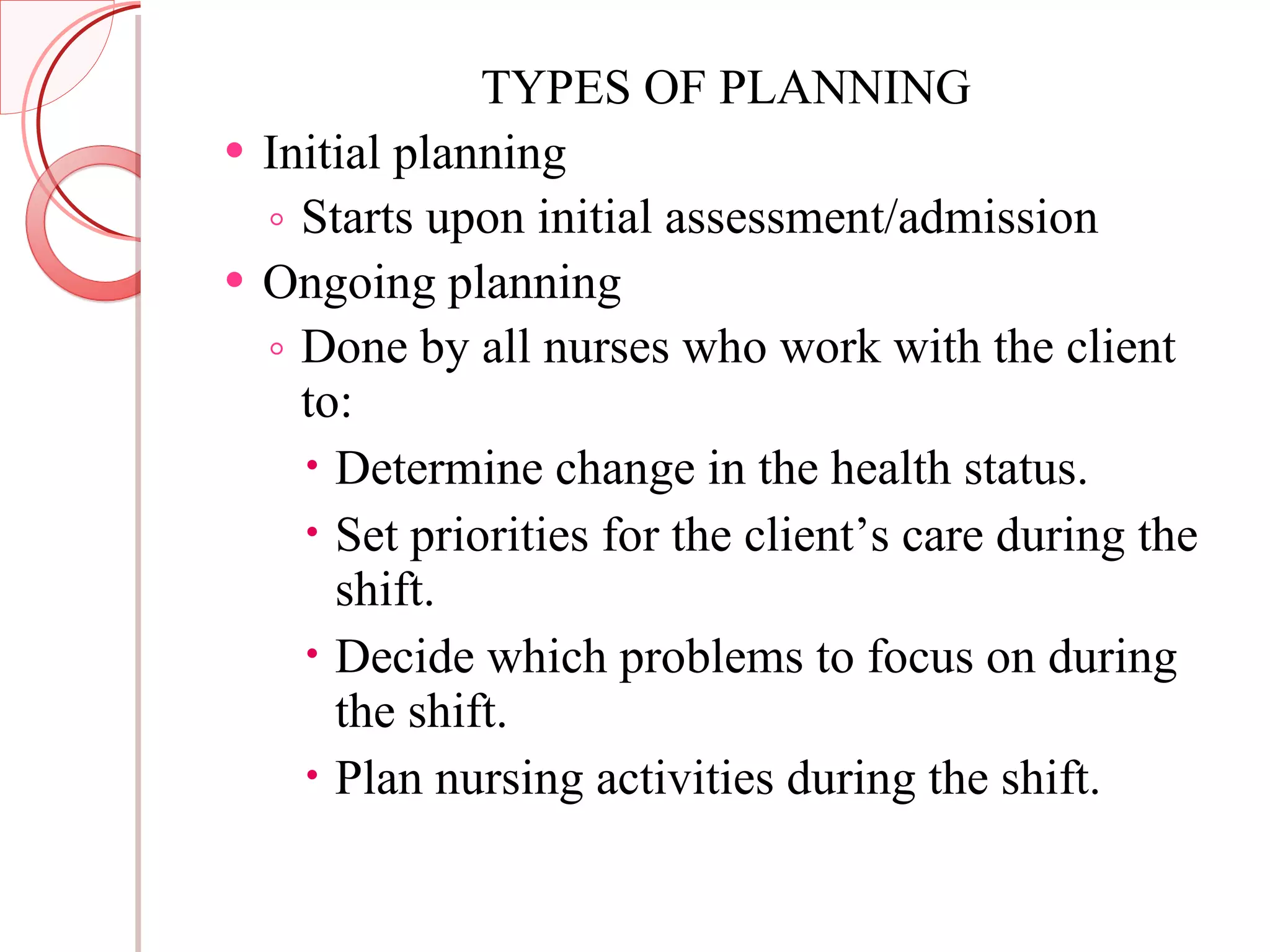
TYPES OF PLANNING Initial planning Starts upon initial assessment/admission Ongoing planning Done by all nurses who work with the client to: Determine change in the health status. Set priorities for the client’s care during the shift. Decide which problems to focus on during the shift. Plan nursing activities during the shift.
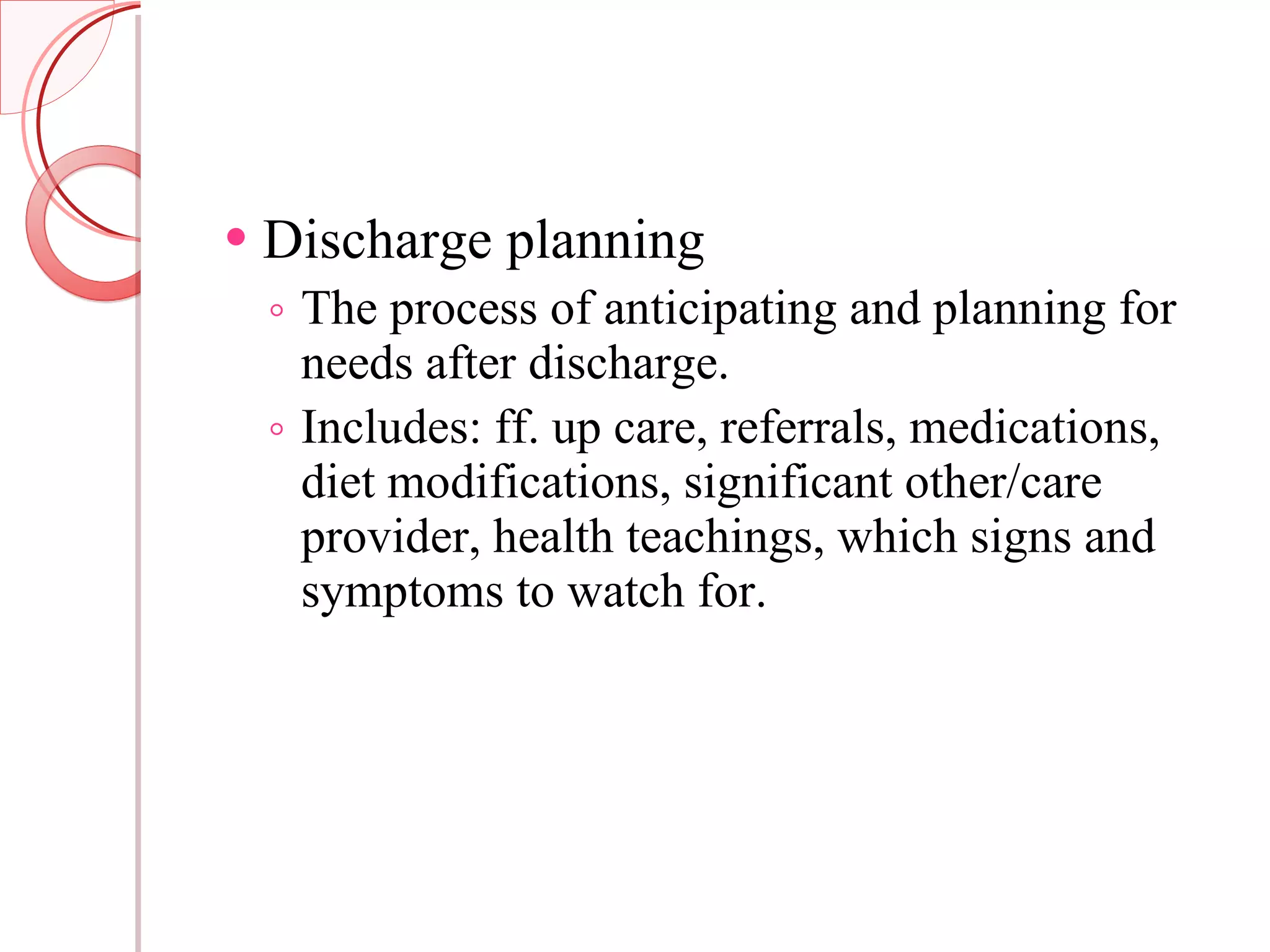
Discharge planning The process of anticipating and planning for needs after discharge. Includes: ff. up care, referrals, medications, diet modifications, significant other/care provider, health teachings, which signs and symptoms to watch for.
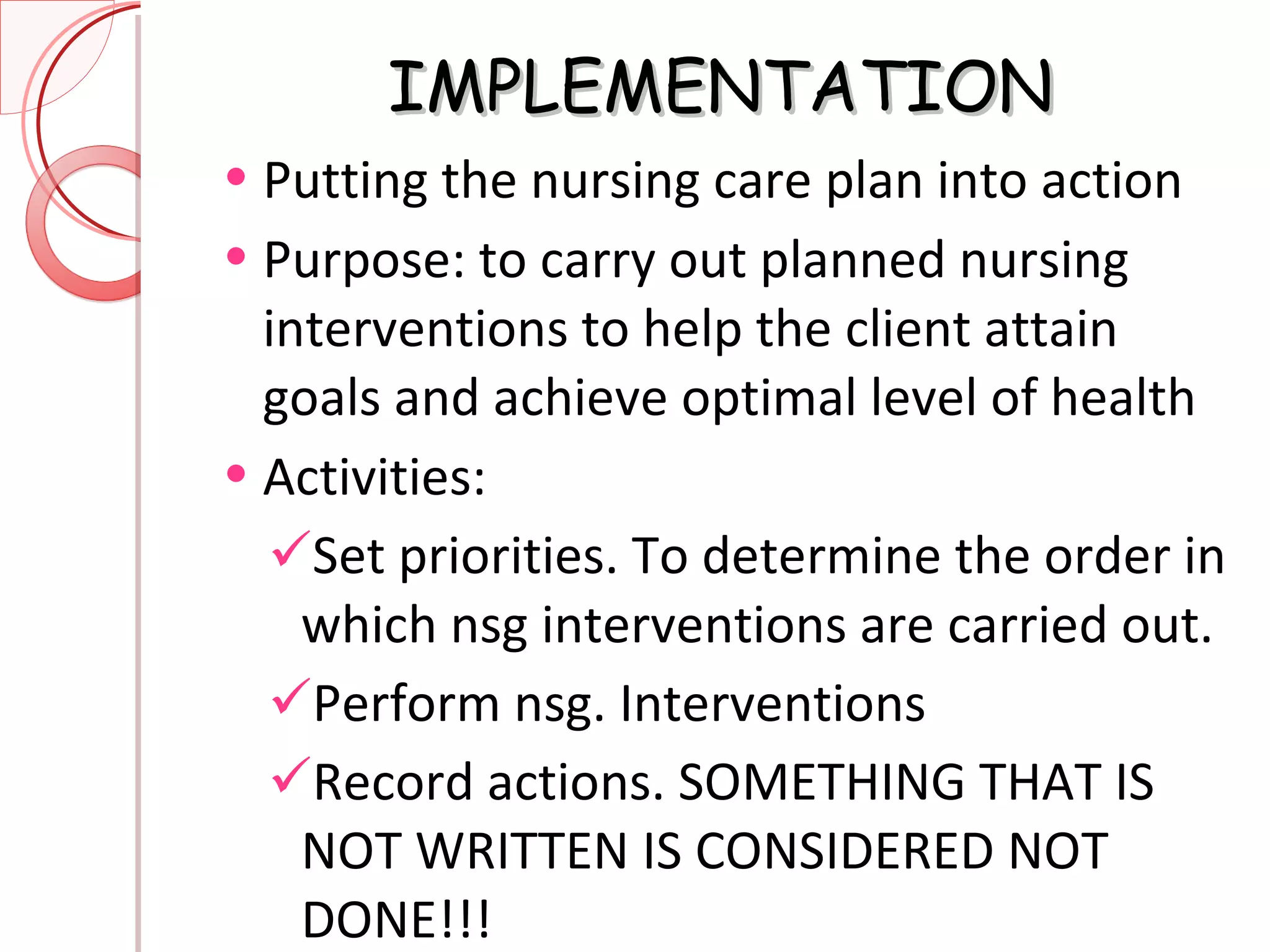
IMPLEMENTATION Putting the nursing care plan into action Purpose: to carry out planned nursing interventions to help the client attain goals and achieve optimal level of health Activities:  Set priorities. To determine the order in which nsg interventions are carried out. Perform nsg. Interventions Record actions. SOMETHING THAT IS NOT WRITTEN IS CONSIDERED NOT DONE!!!
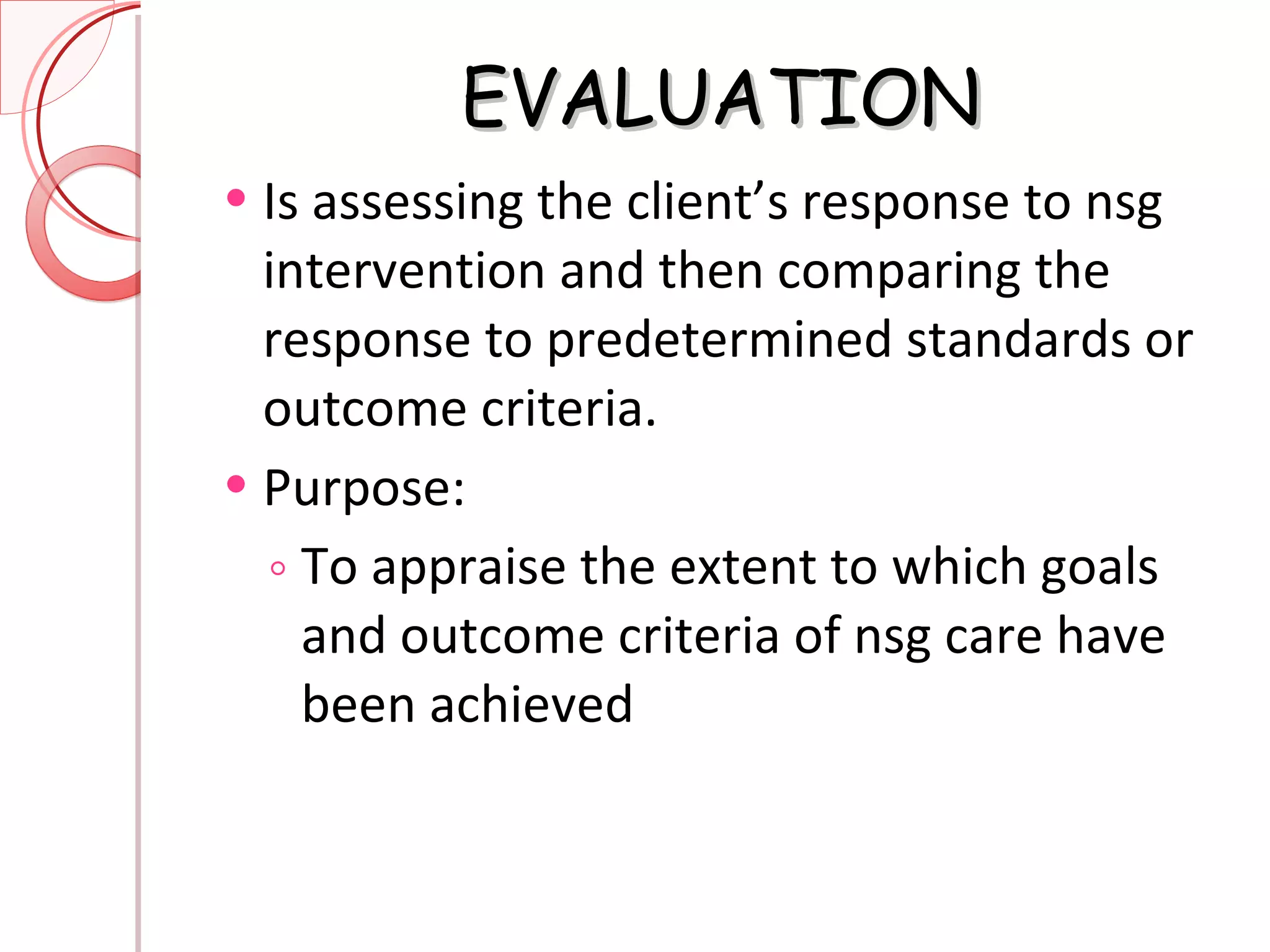
EVALUATION Is assessing the client’s response to nsg intervention and then comparing the response to predetermined standards or outcome criteria. Purpose: To appraise the extent to which goals and outcome criteria of nsg care have been achieved
Activities: Collect data about the client’s response Compare response to goals and outcome criteria Assess whether goals are met (partially/completely) or unmet Analyze reasons for outcomes Modify care plan as needed
BENEFITS OF THE NURSING PROCESS FOR THE CLIENT Quality client care. It meets standards of care. Continuity of care. Participation by the clients in their health care.
BENEFITS OF THE NURSING PROCESS FOR THE NURSE Consistent and systematic nursing education Job satisfaction Professional growth Avoidance of legal action Meeting professional nsg standards Meeting standards of accredited hospitals

The Nursing Process

  • 1.
  • 2.
    Objectives: At theend of 3 hours, the student should be able to: Define nursing process State importance of nursing process in nursing profession State and define interrelated phases of nursing process Be able to identify subjective and objective data gathered Be able to formulate nursing diagnosis according to NANDA using the nursing process
  • 3.
    NURSING PROCESS Thecornerstone of the nursing profession Includes: ADOPIE – Assessment, Diagnosis, Outcome identification, Planning, Implementation and Evaluation
  • 4.
    NURSING PROCESS IS:ORGANIZED & SYSTEMATIC 6 sequential and interrelated steps HUMANISTIC The plan of care is developed and implemented with great consideration to the unique needs and concerns of the individual client It is individualized It involves aspect of human dignity
  • 5.
    EFFICIENT Relevant tothe needs of the client Promotes client satisfaction and progress EFFECTIVE Utilizes resources wisely in terms of human, time, cost resources
  • 6.
    THE HEART OFTHE NURSING PROCESS Knowledge – broad, varied Skills K – knowledge; S – skills; C - caring A. MANUAL B. INTELLECTUAL C. INTERPERSONAL TECHNICAL SKILLS CRITICAL THINKING careful deliberate, goal-directed – to solve problems/make decisions check for evidence Keeping an open mind Avoid jumping into conclusions TO ESTABLISH POSITIVE INTERPERSONAL RELATIONSHIPS, WITH CLIENT, CO-WORKERS (REQUIRES COMMUNICATION SKILLS)
  • 7.
    CARING – WILLINGNESSAND ABILITY TO CARE UNDERSTANDING OURSELVES To be able to understand others To be more objective / non-judgmental Requires ability to listen empathetically Listen with intent Enter into another’s way of thinking and viewing the world Connecting with another’s feelings and perception
  • 8.
    Identify with another’sstruggles, frustrations and desires Being able to detach from feelings and returning to our own frame of reference WILLINGNESS TO CARE Keep the focus on what is best for the patient Respect beliefs / values of others Stay involved Maintain a healthy lifestyle
  • 9.
    CARING BEHAVIORS Inspiringsomeone / instilling hope and faith Demonstrating patience, compassion and willingness to persevere Offering companionship Helping someone stay in touch with positive aspect of the life Demonstrating thoughtfulness Bending the rules when it really counts Doing the little things Keeping someone informed Showing your human side by sharing “stories”
  • 10.
  • 11.
    ASSESSMENT Collecting, validating,organizing and recording data about the client’s health status (individual, family, community) PURPOSE: To establish a data base ACTIVITIES: COLLECTING DATA: Gathering information. Include the physical, psychological, emotional, socio-cultural, and spiritual factors
  • 12.
    TYPES OF DATA:SUBJECTIVE DATA (SYMPTOMS) - experienced by the client - EX. Pain, dizziness, OBJECTIVE DATA (SIGNS) - those that can be observed and measured - EX. Pallor, diaphoresis, blood pressure, reddish urine, body temp. METHODS OF COLLECTING DATA: INTERVIEW. Planned purposeful conversation OBSERVATION. (use of senses, lab results interpretation, physical examination)
  • 13.
    SOURCE OF DATA:PRIMARY: Patient/ Client SECONDARY: Family members, S.O., patient’s chart/record, health team members, related literature VERIFYING / VALIDATING DATA. Make sure your information is accurate. ORGANIZING DATA. Cluster facts into groups of information (subjective and objective information)
  • 14.
    Let’s review! SUBJECTIVEOR OBJECTIVE??? Headache Temp 37.9 C RR: 20 bpm Toothache Client states, “ I haven’t moved my bowel since Friday (3 days).” Cyanosis Urine output: 60ml Ate only half of the food served
  • 15.
    DIAGNOSING Is aprocess which results to a diagnostic statement or nursing diagnosis The clinical act of identifying problems It means to analyze assessment and derive meaning from this analysis. PURPOSE: To identify the client’s health care needs and to prepare diagnostic statements
  • 16.
    NURSING DIAGNOSIS Isa statement of client’s potential or actual alteration of health status. Uses critical thinking and skills analysis Uses PRS/PES format P- PROBLEM R-RELATED TO FACTORS S- SIGNS AND SYMPTOMS P-PROBLEM E-ETIOLOGY S-SIGNS AND SYMPTOMS
  • 17.
    ACTIVITIES DURING DIAGNOSING:Organize cluster or group data. Ex. Pallor, dyspnea, weakness, fatigue – pertain to problems with oxygenation Compare data against standards (accepted norms). Ex. Amber, clear urine VS cloudy urine or tea colored urine. Analyze data after comparing with standards Identify gaps and inconsistencies in data Determine the client’s health problems, health risks, strengths Formulate Nursing Diagnosis statements
  • 18.
    Examples of NursingDiagnoses: Anxiety related to insufficient knowledge regarding surgical experience Ineffective airway clearance related to tracheobronchial infection as manifested by weak cough, adventitious breath sounds, and copious green sputum production.
  • 19.
    Types of Nsg.Diagnoses: ACTUAL NURSING DIAGNOSIS A judgment about the client’s response to a health problem that is present at the time of nursing assessment Based on the presence of signs and symptoms Ex. - ALTERED COMFORT: PAIN - PAIN: SEVERE HEADACHE RELATED TO FEAR OF ADDICTION TO NARCOTICS
  • 20.
    RISK NURSING DIAGNOSISA clinical judgment that a problem does not exist, but the presence of risk factors indicates that a problem is likely to develop Ex. RISK FOR INFECTION RISK FOR CONSTIPATION
  • 21.
    POSSIBLE NURSING DIAGNOSISIs one in which evidence about a health problem is unclear or the causative factors are unknown. Requires more data either to support or to refute it. Ex. Possible Social Isolation related to unknown etiology
  • 22.
    COMPONENTS of aNANDA NURSING DIAGNOSIS PROBLEM (diagnostic label) and DEFINITION Describes the client’s health status clearly and concisely in a few words Qualifiers: Deficient – inadequate in amount, quality, or degree; not sufficient Impaired – made worse, weakened, damaged
  • 23.
    Ineffective – notproducing the desired effect ETIOLOGY (related factors & risk factors) Identifies one or more probable causes of health problem Gives direction to what health needs to attend to.
  • 24.
    DEFINING CHARACTERISTICS Acluster of signs and symptoms that indicate the presence of a particular diagnostic label ACTUAL DX: signs and symptoms HIGH RISK/ RISK: factors that cause the client to be more vulnerable to the problem
  • 25.
    Ex. ACTIVITY INTOLERANCERELATED TO IMMOBILITY as manifested by verbal reports of fatigue or weakness during leg exercises Formulating statements: Problem – Etiology format Problem – etiology – signs and symptoms format
  • 26.
    OUTCOME IDENTIFICATION Refersto formulating and documenting measurable, realistic, client – focused goals. Provides the basis for evaluating nursing diagnosis and interventions.
  • 27.
    ACTIVITIES INCLUDE: ESTABLISHPRIORITIES. Life-threatening should be given highest priority ABC’s (airway, breathing, circulation) Maslow’s hierarchy of needs (physiologic needs over psychosocial) Unstable clients vs. clients with stable conditions Actual problems vs. potential concerns
  • 28.
    ESTABLISH GOALS &OUTCOME CRITERIA GOALS: broad statements SHORT-TERM GOAL (STG) LONG-TERM GOAL (LTG) OUTCOME CRITERIA: specific, measurable, realistic statements of goal attainment S – M – A – R – T Specific, measurable, attainable, time-framed
  • 29.
    Ex. GOAL:The client will be able to improve mobility and the ability to bear weight on left leg DESIRED OUTCOMES: By the end of the week, client will be able to ambulate with crutches By end of the month, client will be able to stand without assistance
  • 30.
    PLANNING Involves determiningbeforehand the strategies or course of actions to be taken before implementation of nursing care. Involve the client and his family Begins with the first client contact until client is discharged from the facility Activities: Plan nursing interventions (also called nursing orders); may be dependent, independent, interdependent.
  • 31.
    Write nursing careplan a written summary of the care that a client is to receive. the “blueprint” of the nursing process the plan of care is a step-by-step process evidenced by the following: Sufficient data are collected to support nsg. Diagnoses At least one goal must be stated for each nsg. dx
  • 32.
    Outcome criteria mustbe identified for each goal Each intervention should be supported by scientific rationale Evaluation. To assess whether goals are met or unmet.
  • 33.
    TYPES OF PLANNINGInitial planning Starts upon initial assessment/admission Ongoing planning Done by all nurses who work with the client to: Determine change in the health status. Set priorities for the client’s care during the shift. Decide which problems to focus on during the shift. Plan nursing activities during the shift.
  • 34.
    Discharge planning Theprocess of anticipating and planning for needs after discharge. Includes: ff. up care, referrals, medications, diet modifications, significant other/care provider, health teachings, which signs and symptoms to watch for.
  • 35.
    IMPLEMENTATION Putting thenursing care plan into action Purpose: to carry out planned nursing interventions to help the client attain goals and achieve optimal level of health Activities: Set priorities. To determine the order in which nsg interventions are carried out. Perform nsg. Interventions Record actions. SOMETHING THAT IS NOT WRITTEN IS CONSIDERED NOT DONE!!!
  • 36.
    EVALUATION Is assessingthe client’s response to nsg intervention and then comparing the response to predetermined standards or outcome criteria. Purpose: To appraise the extent to which goals and outcome criteria of nsg care have been achieved
  • 37.
    Activities: Collect dataabout the client’s response Compare response to goals and outcome criteria Assess whether goals are met (partially/completely) or unmet Analyze reasons for outcomes Modify care plan as needed
  • 38.
    BENEFITS OF THENURSING PROCESS FOR THE CLIENT Quality client care. It meets standards of care. Continuity of care. Participation by the clients in their health care.
  • 39.
    BENEFITS OF THENURSING PROCESS FOR THE NURSE Consistent and systematic nursing education Job satisfaction Professional growth Avoidance of legal action Meeting professional nsg standards Meeting standards of accredited hospitals