Mrs. Puvaneswari Ramesh
Associate Professor
NHCON , Bangalore
Steps in Nursing Process
Introduction
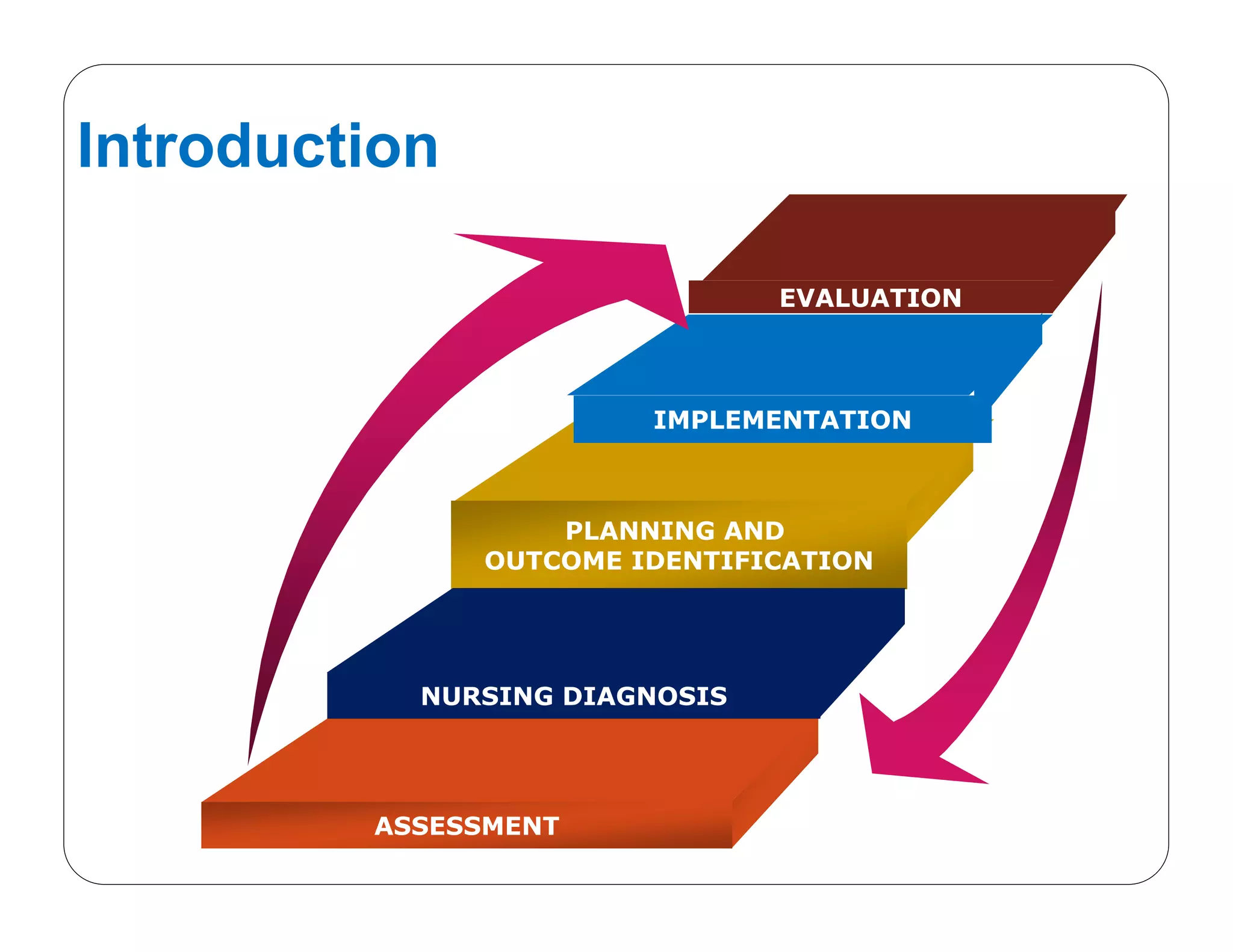
IMPLEMENTATION
PLANNING AND
OUTCOME IDENTIFICATION
NURSING DIAGNOSIS
ASSESSMENT
EVALUATION
Nursing Assessment
It is the deliberate and  systematic 
collection of information about a patient to determine 
his or her current and past health and functional status 
and  his or her present and past coping patterns.
(Carpenito – Moyet‐ 2009)
Purposes of Assessment
To establish a database 
To identify health‐promoting behaviors 
To identify actual and/or potential health problems.
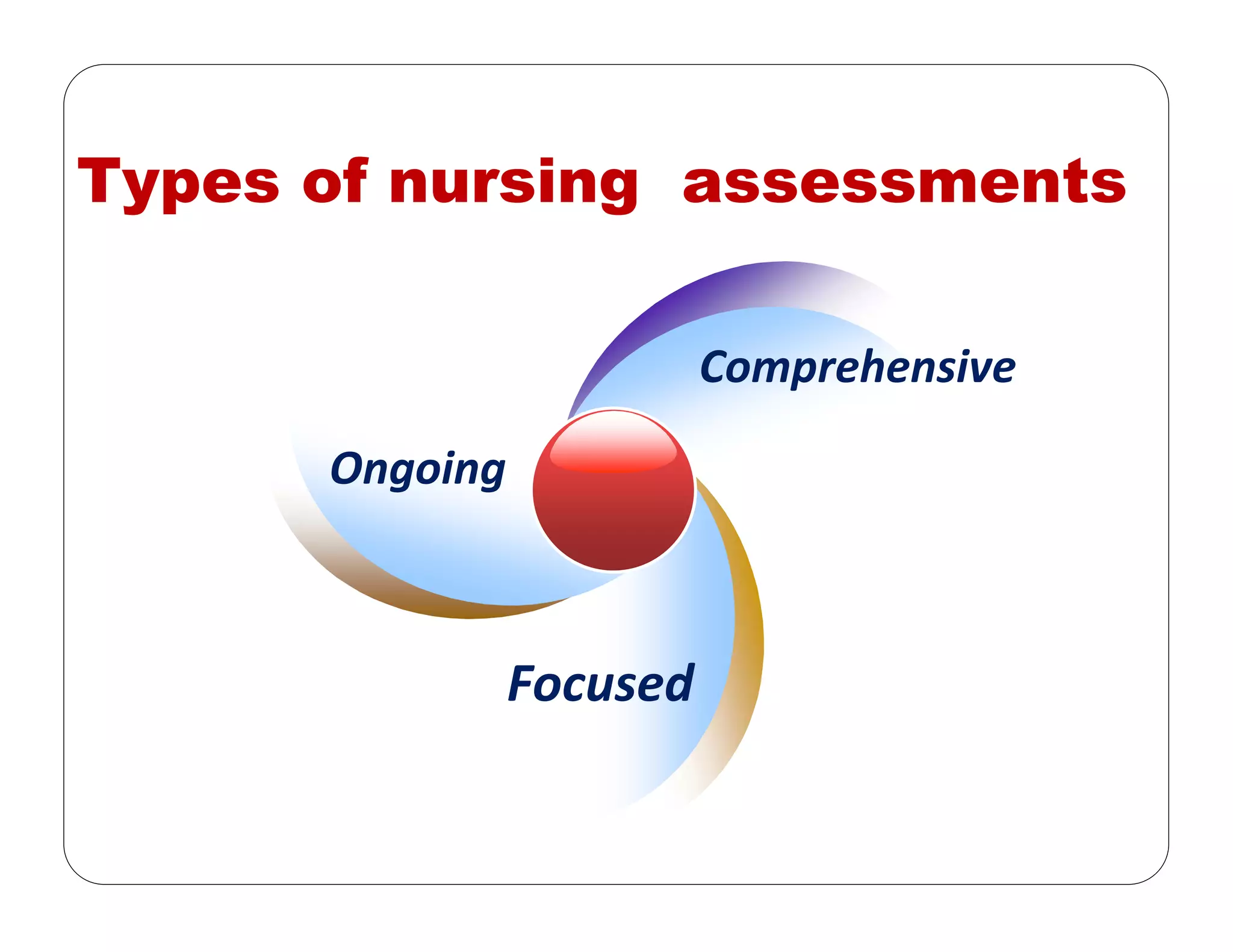
Types of nursing assessments
Ongoing
Comprehensive
Focused
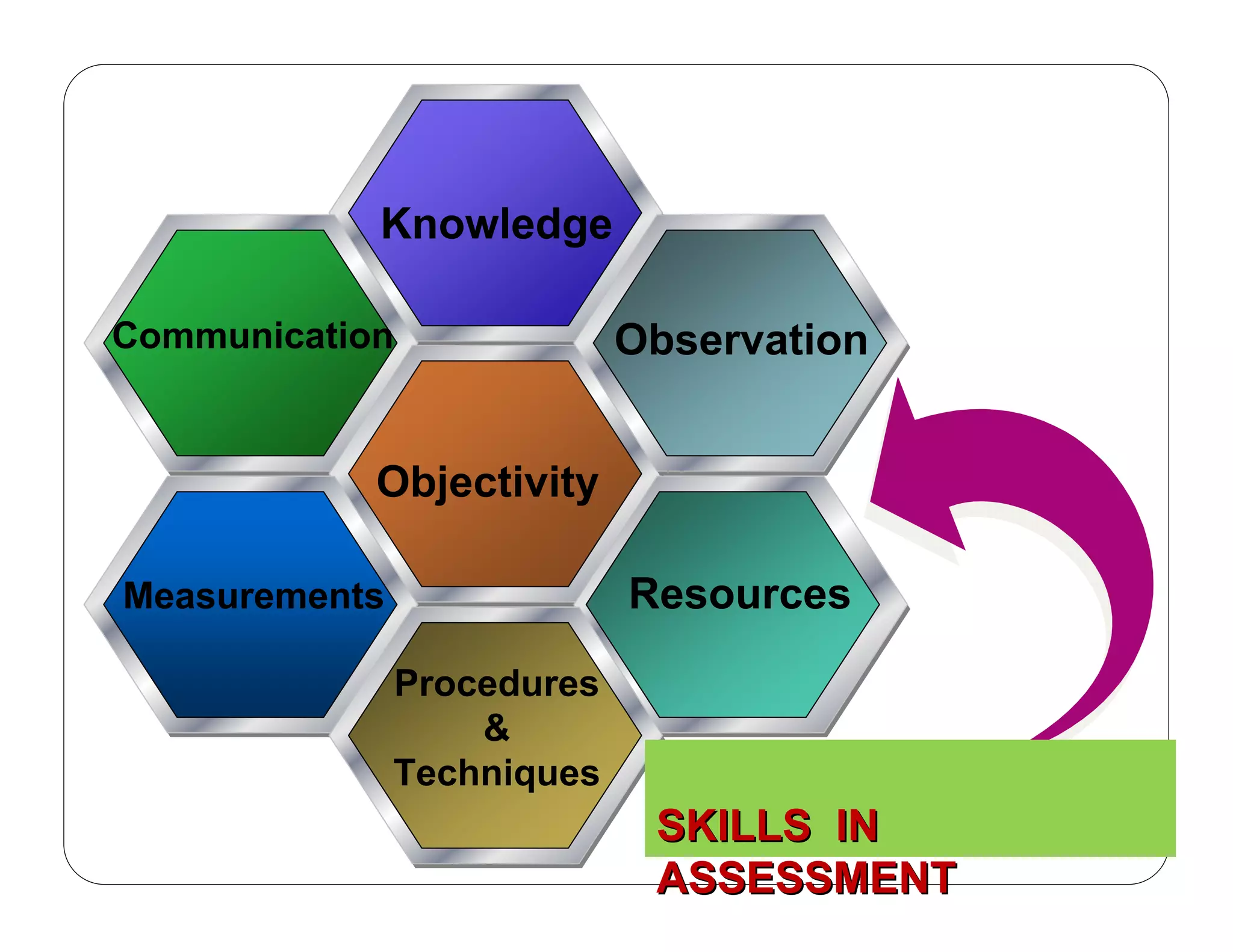
Knowledge
Communication
Objectivity
Observation
ResourcesMeasurements
Procedures
&
Techniques
SKILLS INSKILLS IN
ASSESSMENTASSESSMENT
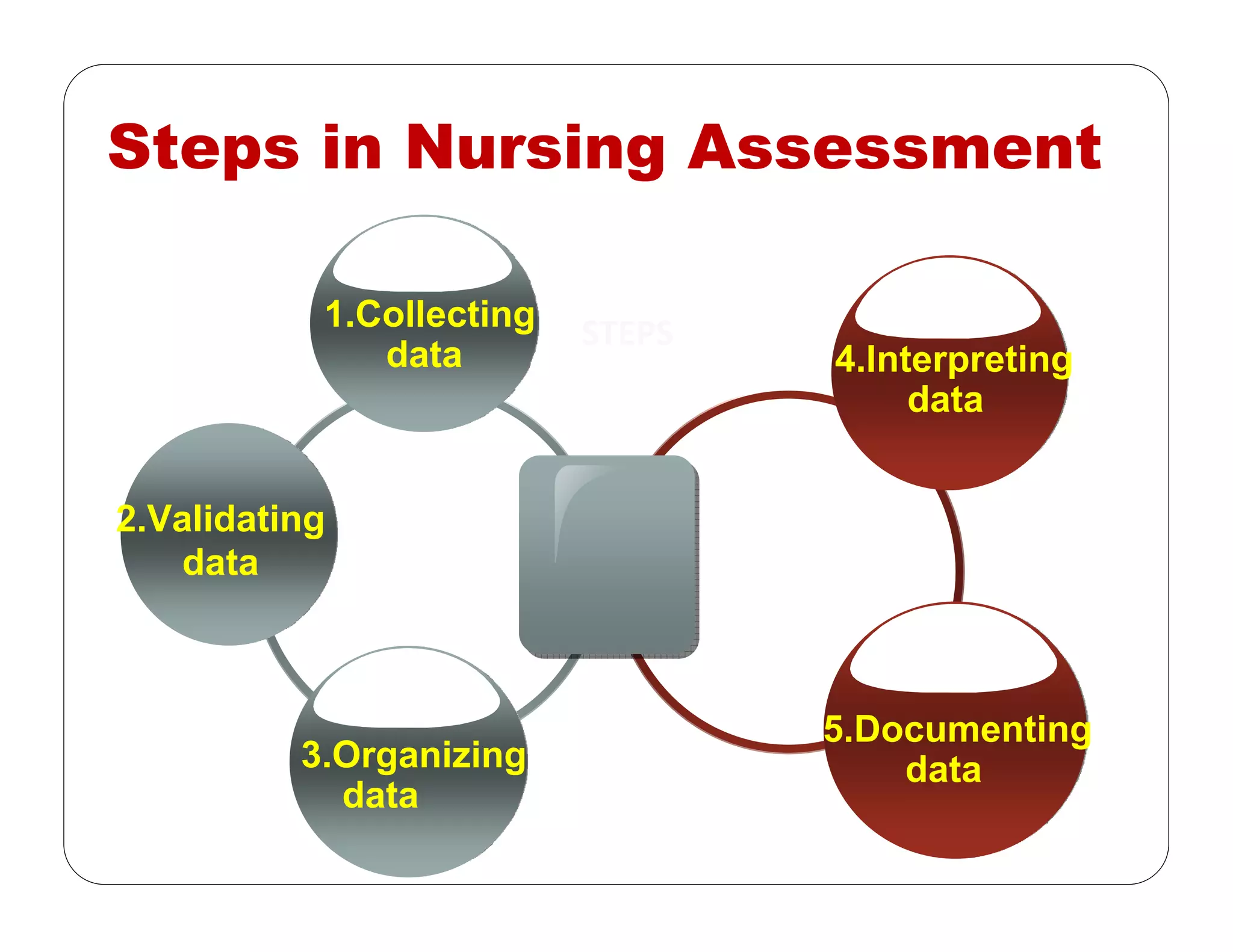
Steps in Nursing Assessment
STEPS 1.Collecting
data
2.Validating
data
3.Organizing
data
4.Interpreting
data
5.Documenting
data
Collecting Data
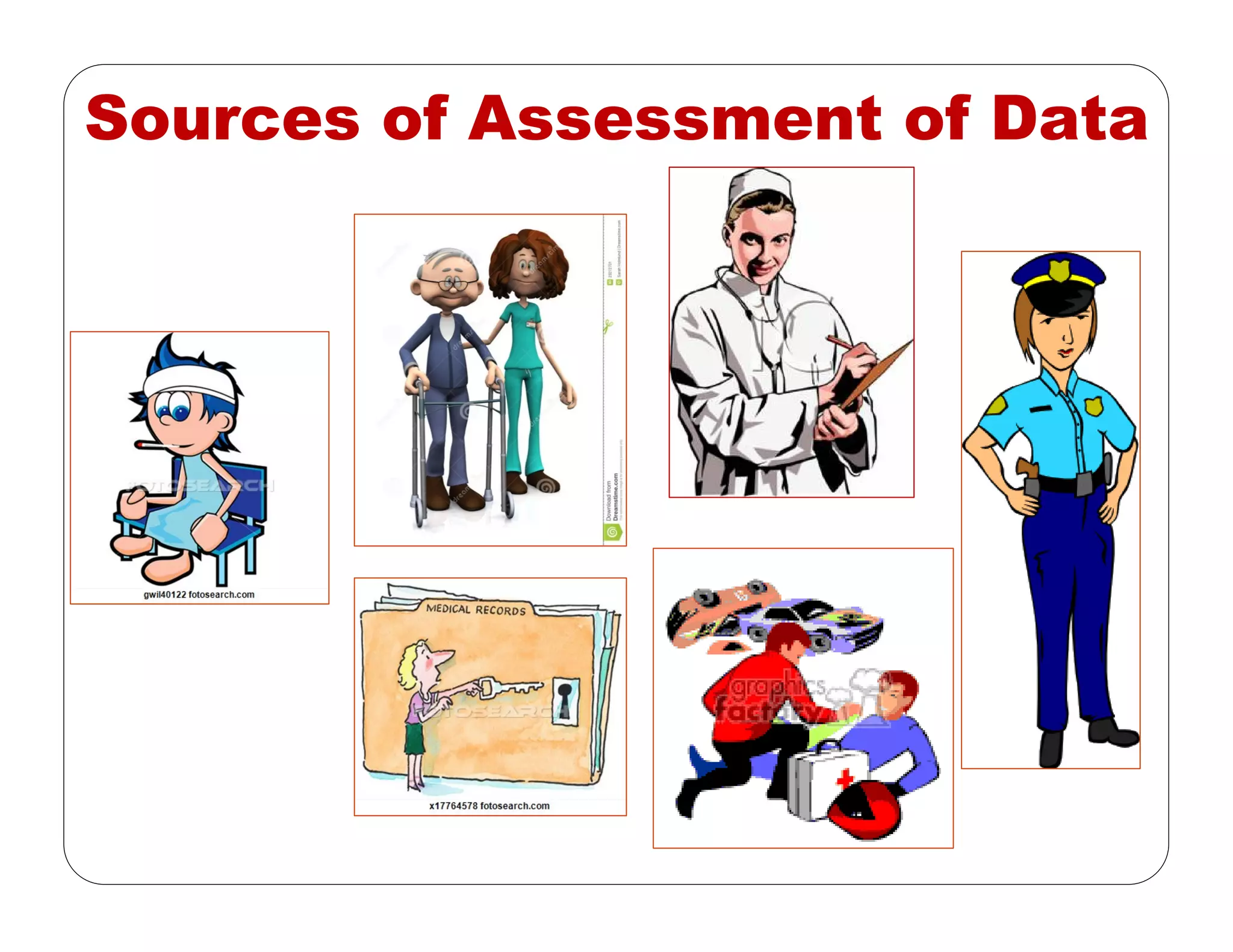
Sources of Assessment of Data
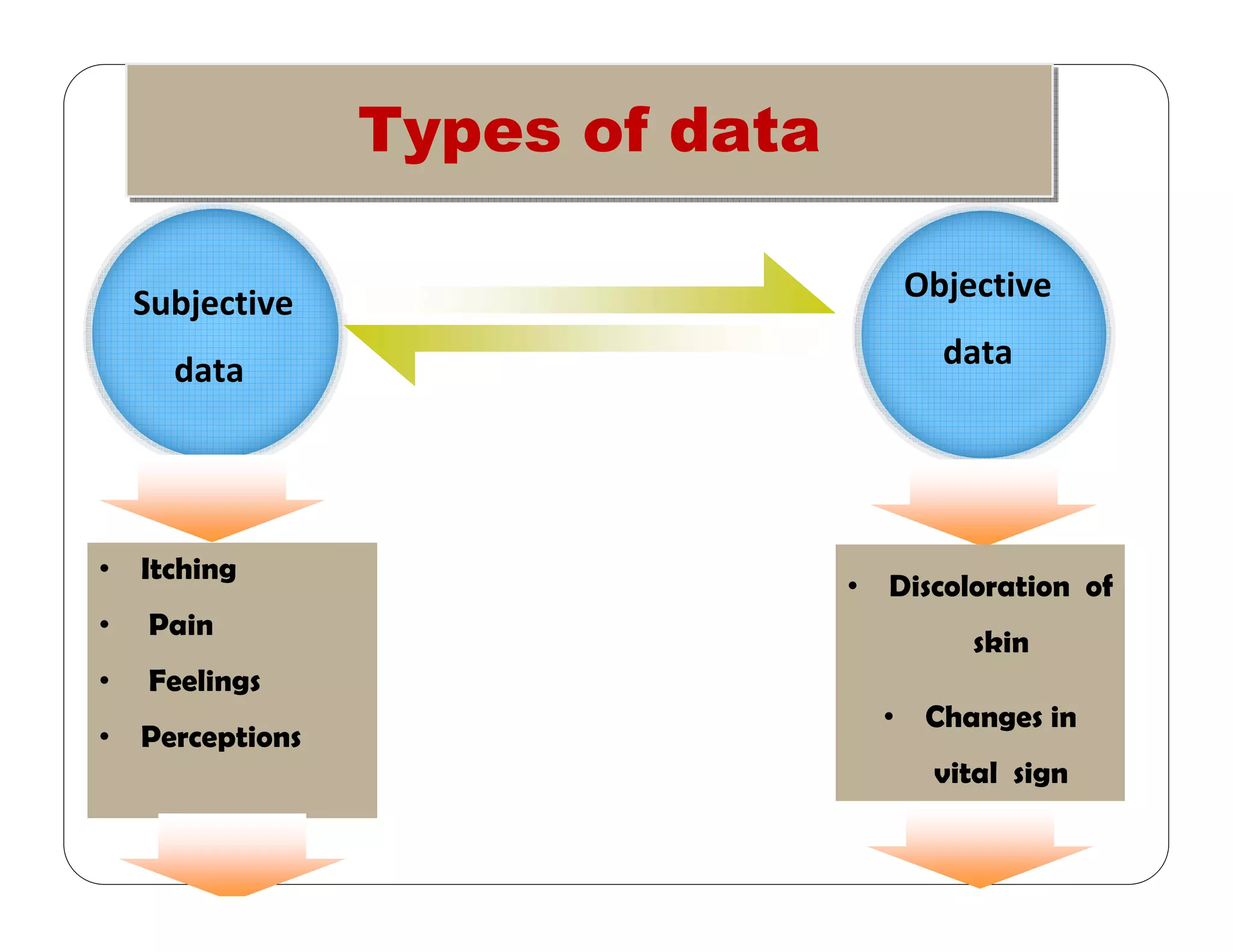
Subjective
data
• Itching
• Pain
• Feelings
• Perceptions
Types of dataTypes of data
Objective
data
• Discoloration of
skin
• Changes in
vital sign
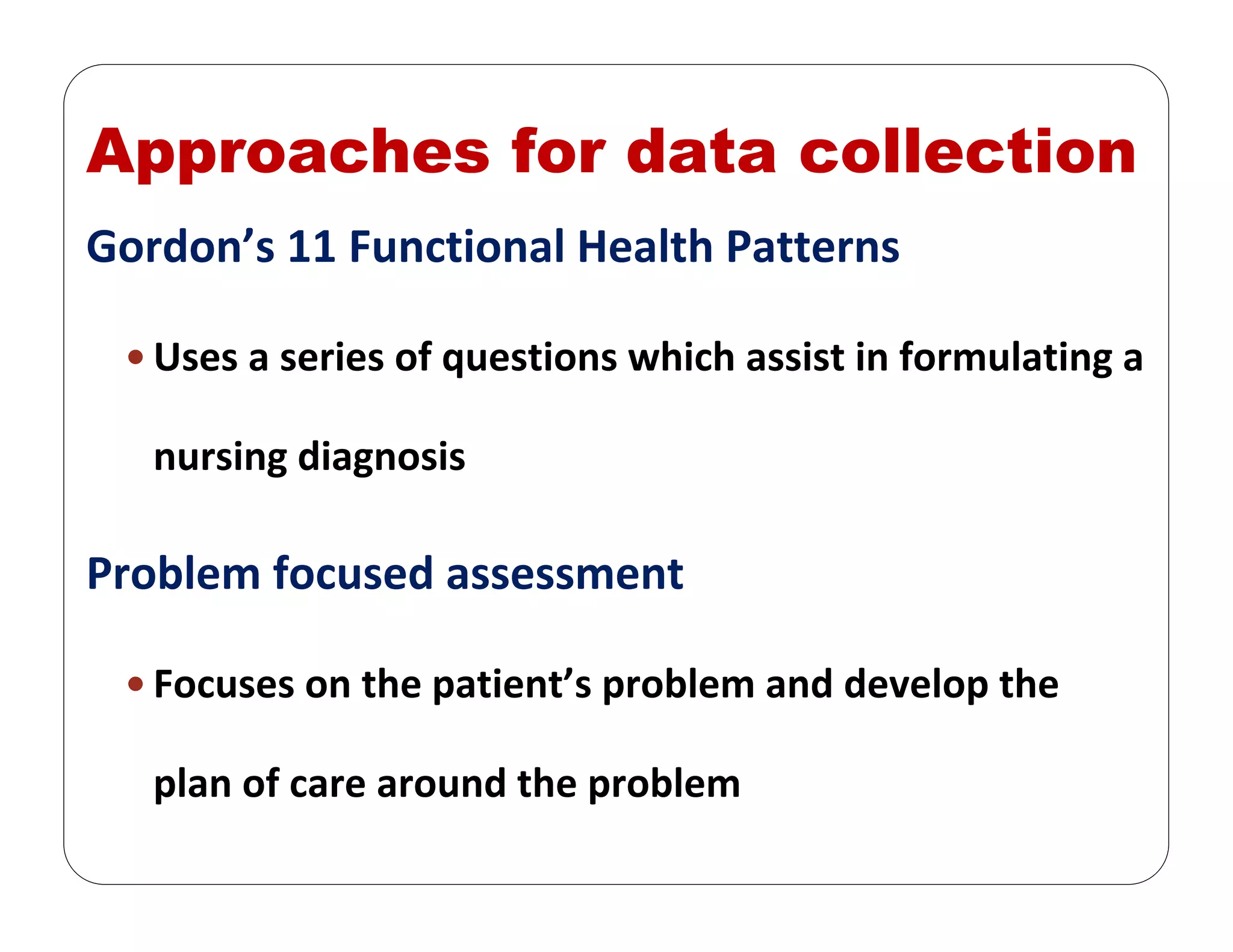
Approaches for data collection
Gordon’s 11 Functional Health Patterns
Uses a series of questions which assist in formulating a 
nursing diagnosis
Problem focused assessment
Focuses on the patient’s problem and develop the 
plan of care around the problem
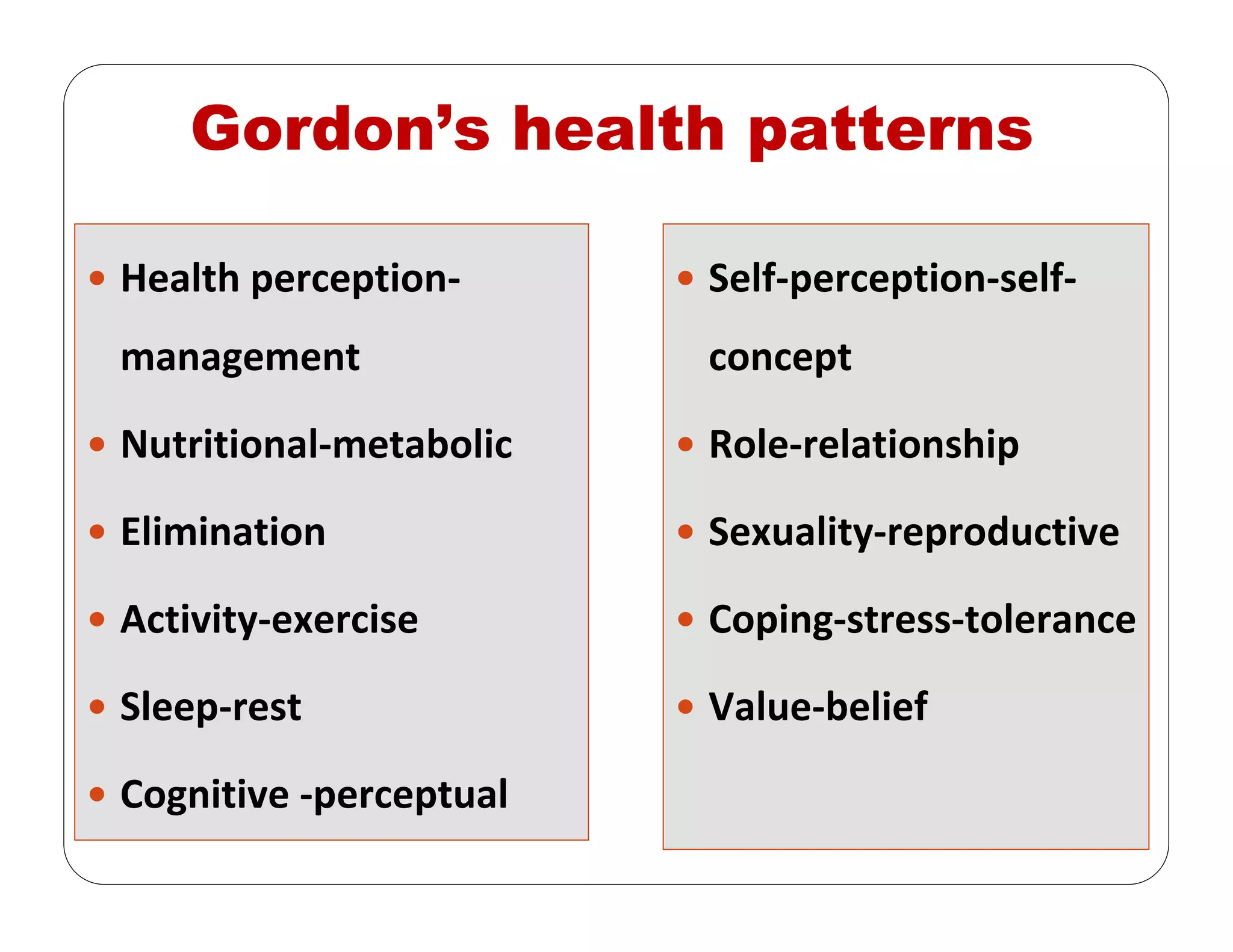
Gordon’s health patterns
Health perception‐
management
Nutritional‐metabolic
Elimination
Activity‐exercise
Sleep‐rest
Cognitive ‐perceptual
Self‐perception‐self‐
concept
Role‐relationship
Sexuality‐reproductive
Coping‐stress‐tolerance
Value‐belief
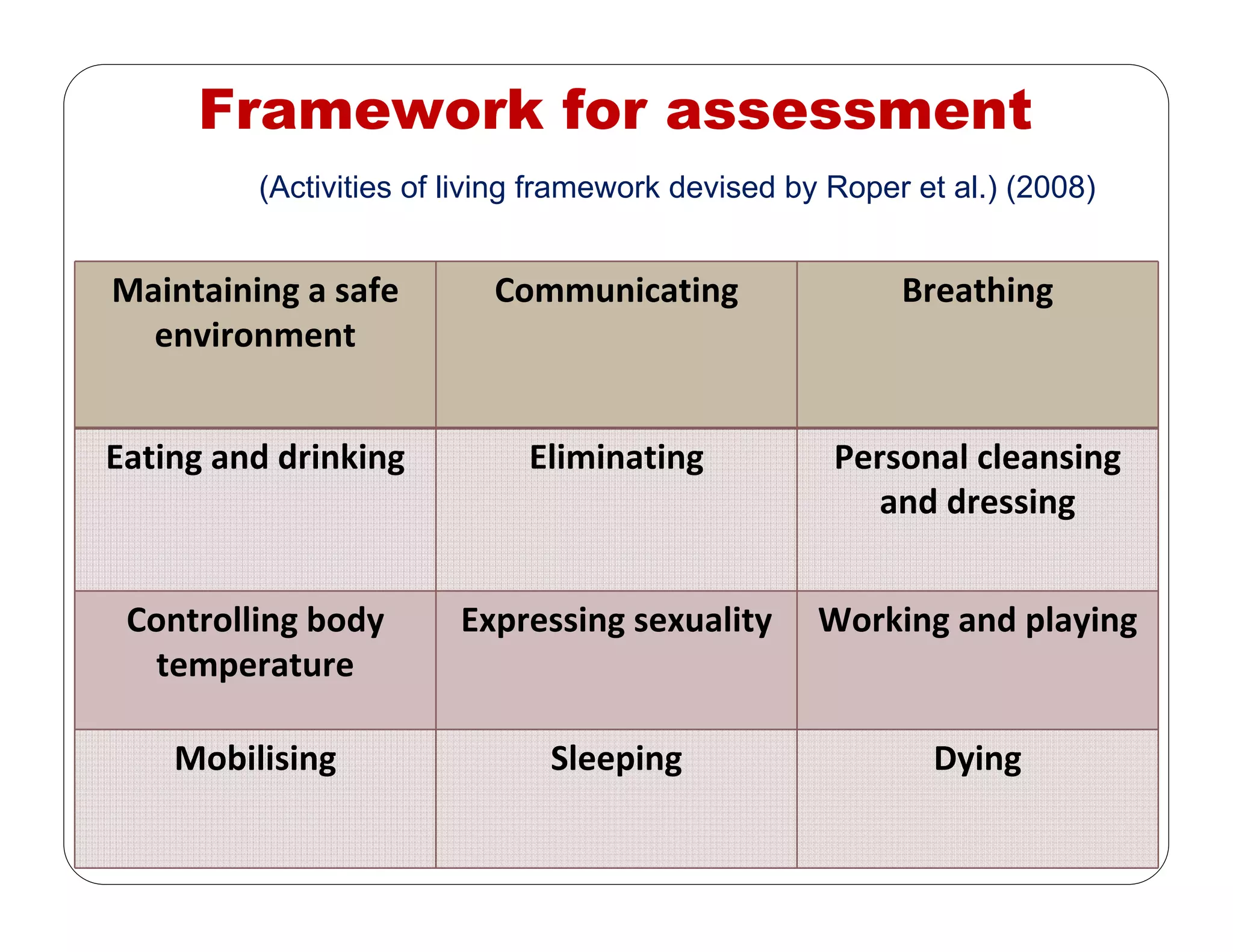
Framework for assessment
(Activities of living framework devised by Roper et al.) (2008)
Maintaining a safe 
environment 
Communicating Breathing
Eating and drinking Eliminating Personal cleansing 
and dressing
Controlling body 
temperature 
Expressing sexuality Working and playing 
Mobilising Sleeping Dying
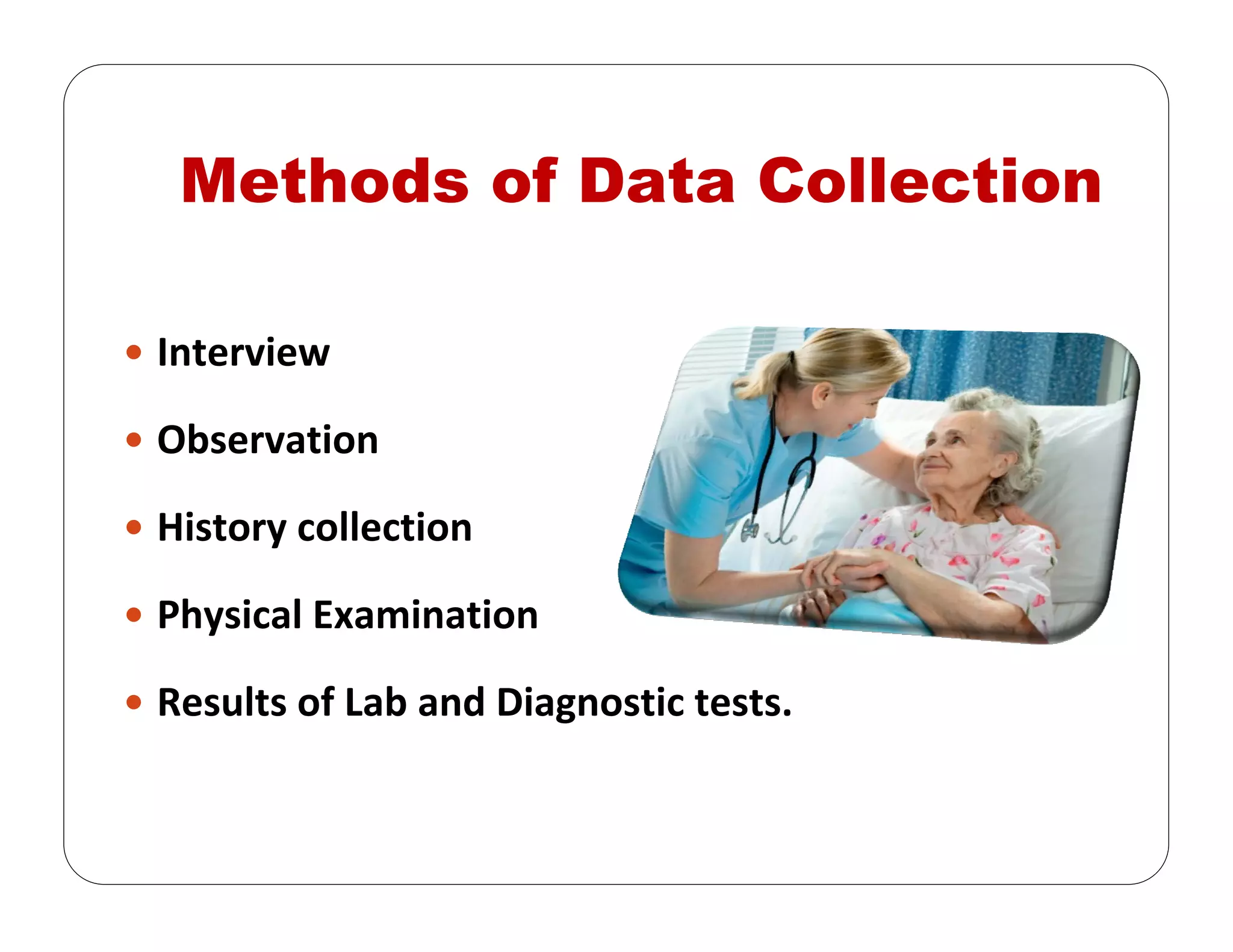
Methods of Data Collection
Interview
Observation
History collection
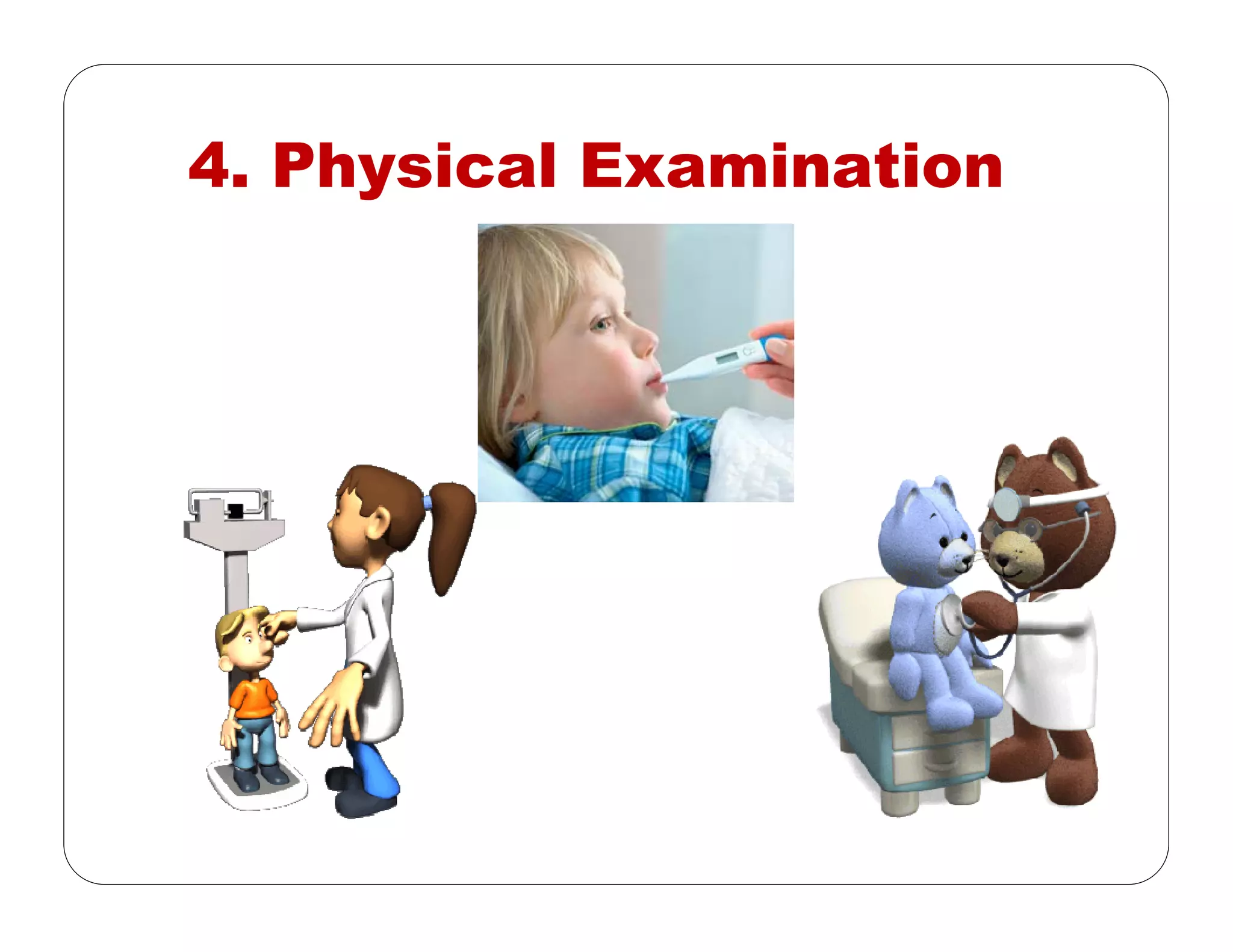
Physical Examination
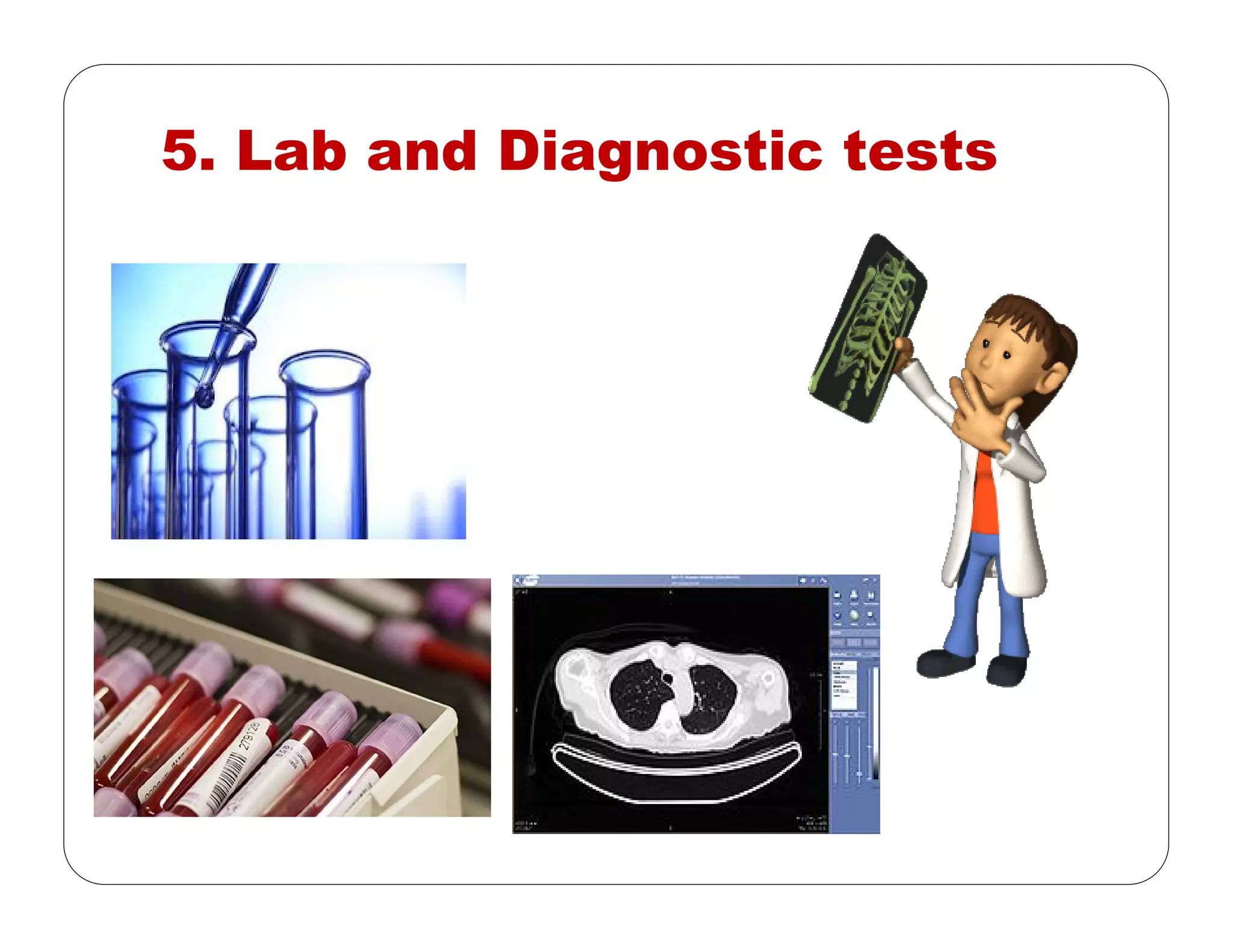
Results of Lab and Diagnostic tests.
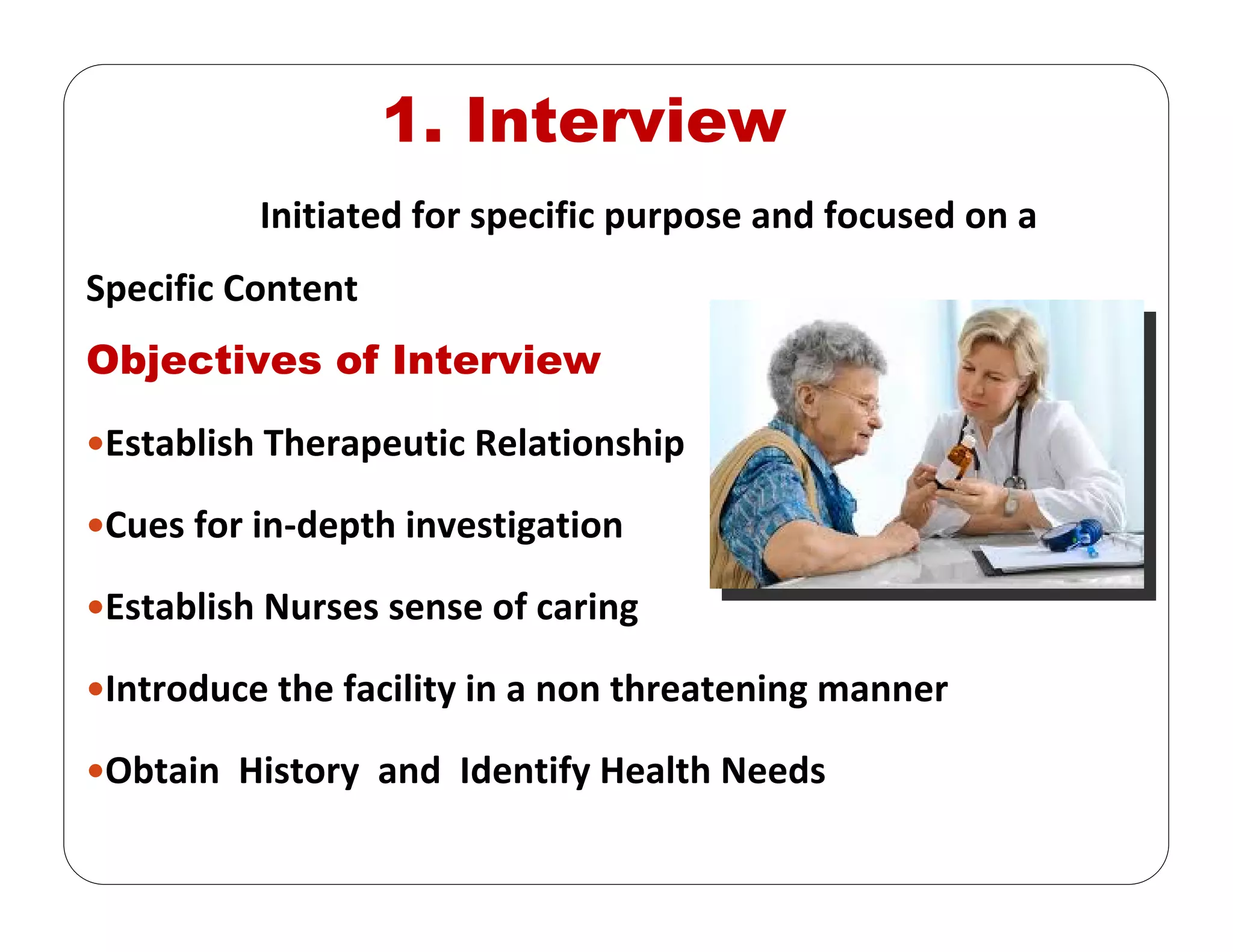
Initiated for specific purpose and focused on a 
Specific Content
Objectives of Interview
Establish Therapeutic Relationship
Cues for in‐depth investigation 
Establish Nurses sense of caring 
Introduce the facility in a non threatening manner
Obtain  History  and  Identify Health Needs 
1. Interview
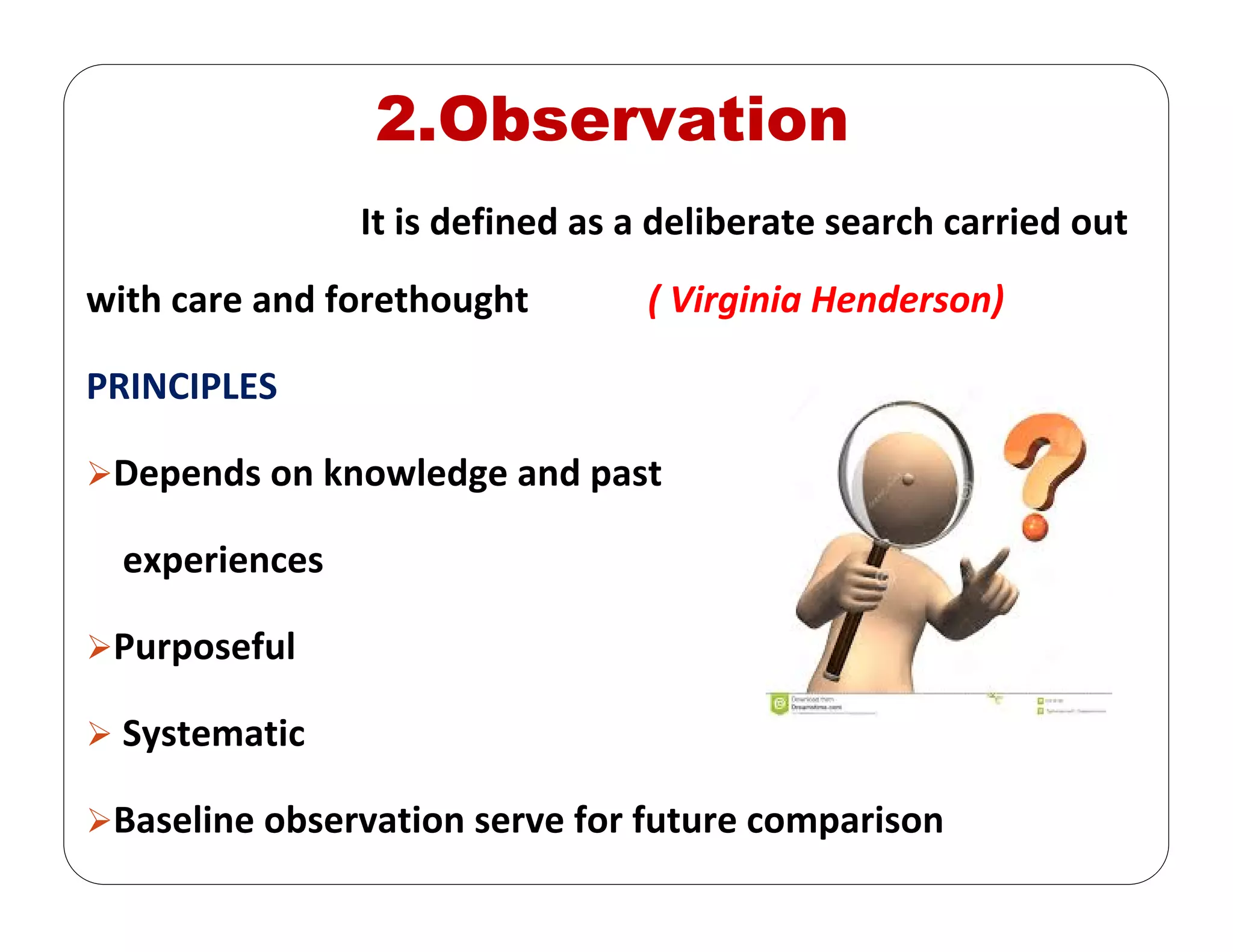
2.Observation
It is defined as a deliberate search carried out 
with care and forethought             ( Virginia Henderson)
PRINCIPLES
Depends on knowledge and past  
experiences
Purposeful
Systematic 
Baseline observation serve for future comparison 
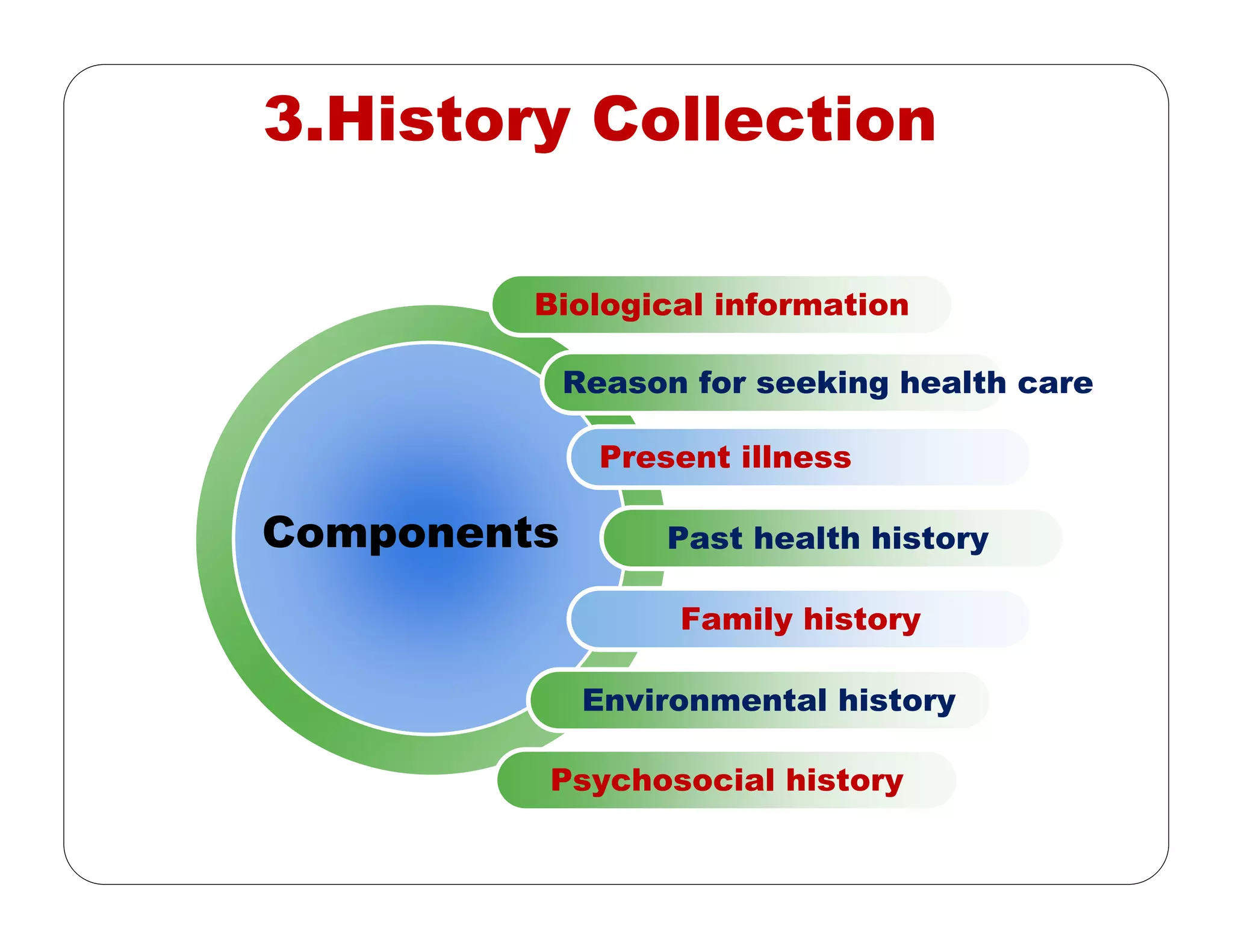
Biological information
Present illness
Past health history
Family history
Environmental history
Components
Reason for seeking health care
Psychosocial history
3.History Collection
4. Physical Examination
5. Lab and Diagnostic tests
Validation prevents  omissions, misunderstandings, and 
incorrect inferences and conclusions
Organising Data
Collected information must be organized to be useful.
Data Clustering is a useful tool to identify issues
Validating Data
Interpreting Data
Distinguish  relevant and irrelevant data
Determine  whether and where there are gaps in the data
Identify  patterns of cause and effect
Documenting Data
Assessment data must be recorded and 
reported. 
Accurate and complete record   communicates  
information to health care team.
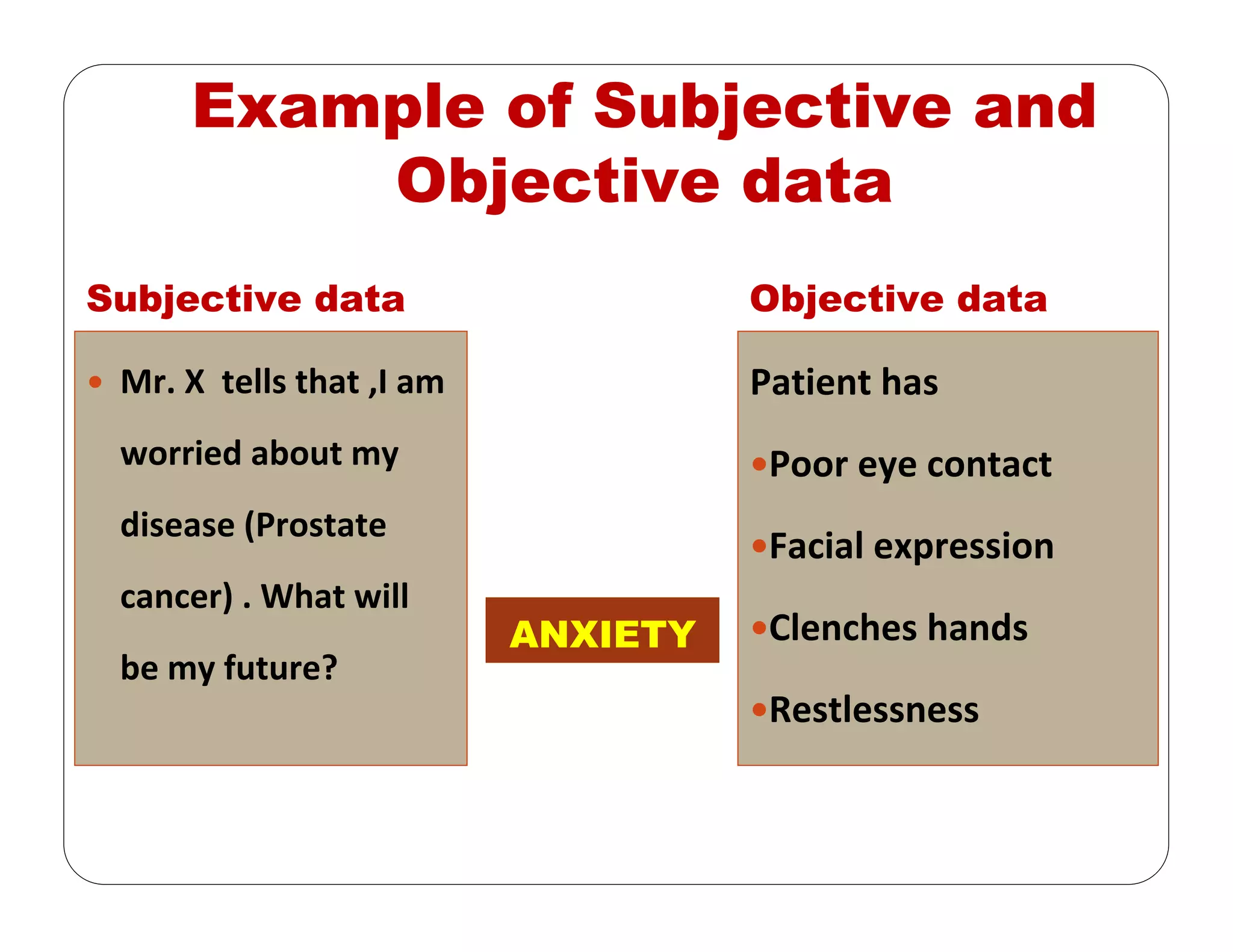
Example of Subjective and
Objective data
Subjective data Objective data
Mr. X  tells that ,I am 
worried about my 
disease (Prostate 
cancer) . What will 
be my future? 
Patient has
Poor eye contact
Facial expression 
Clenches hands
Restlessness
ANXIETY
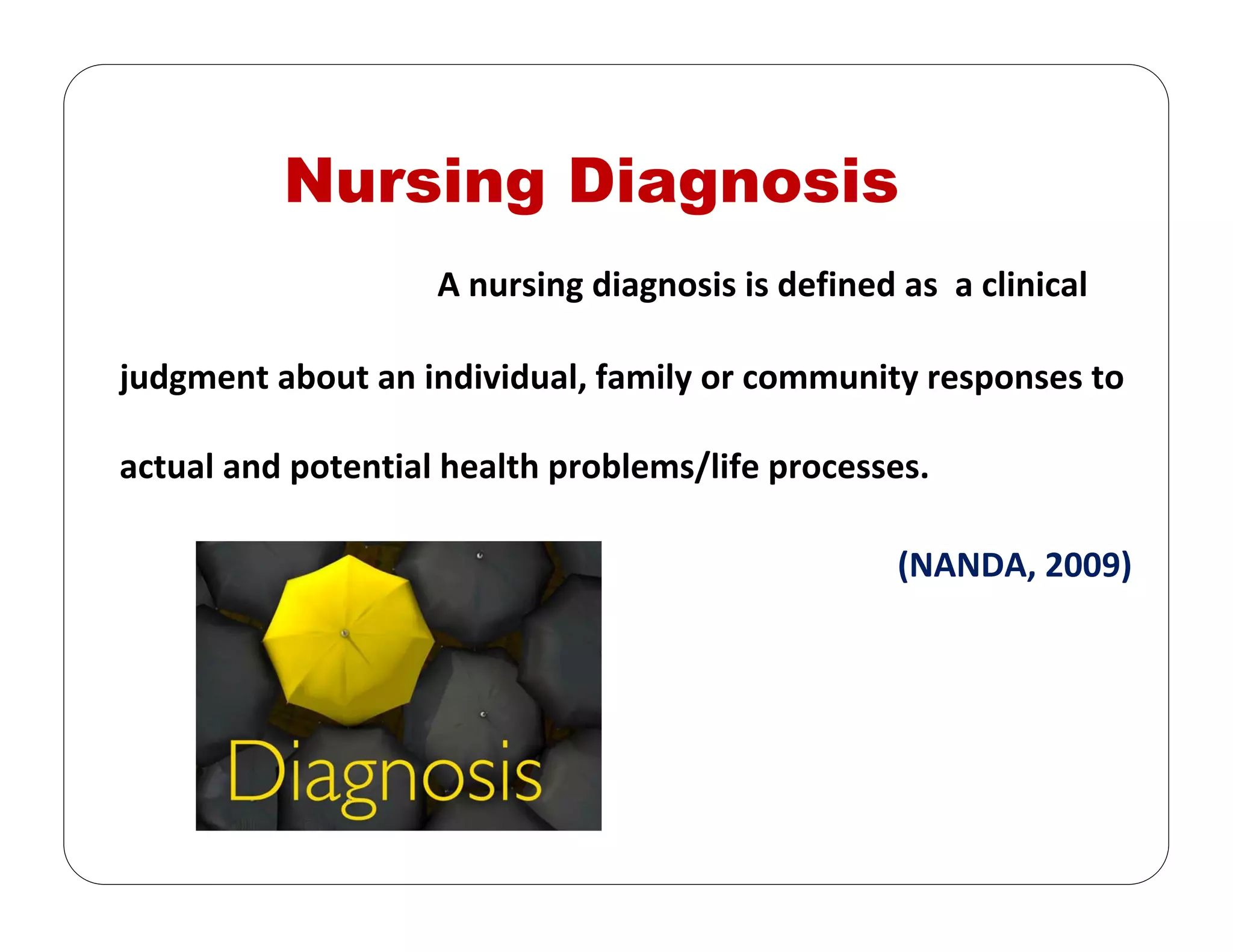
Nursing Diagnosis
A nursing diagnosis is defined as  a clinical 
judgment about an individual, family or community responses to 
actual and potential health problems/life processes. 
(NANDA, 2009) 
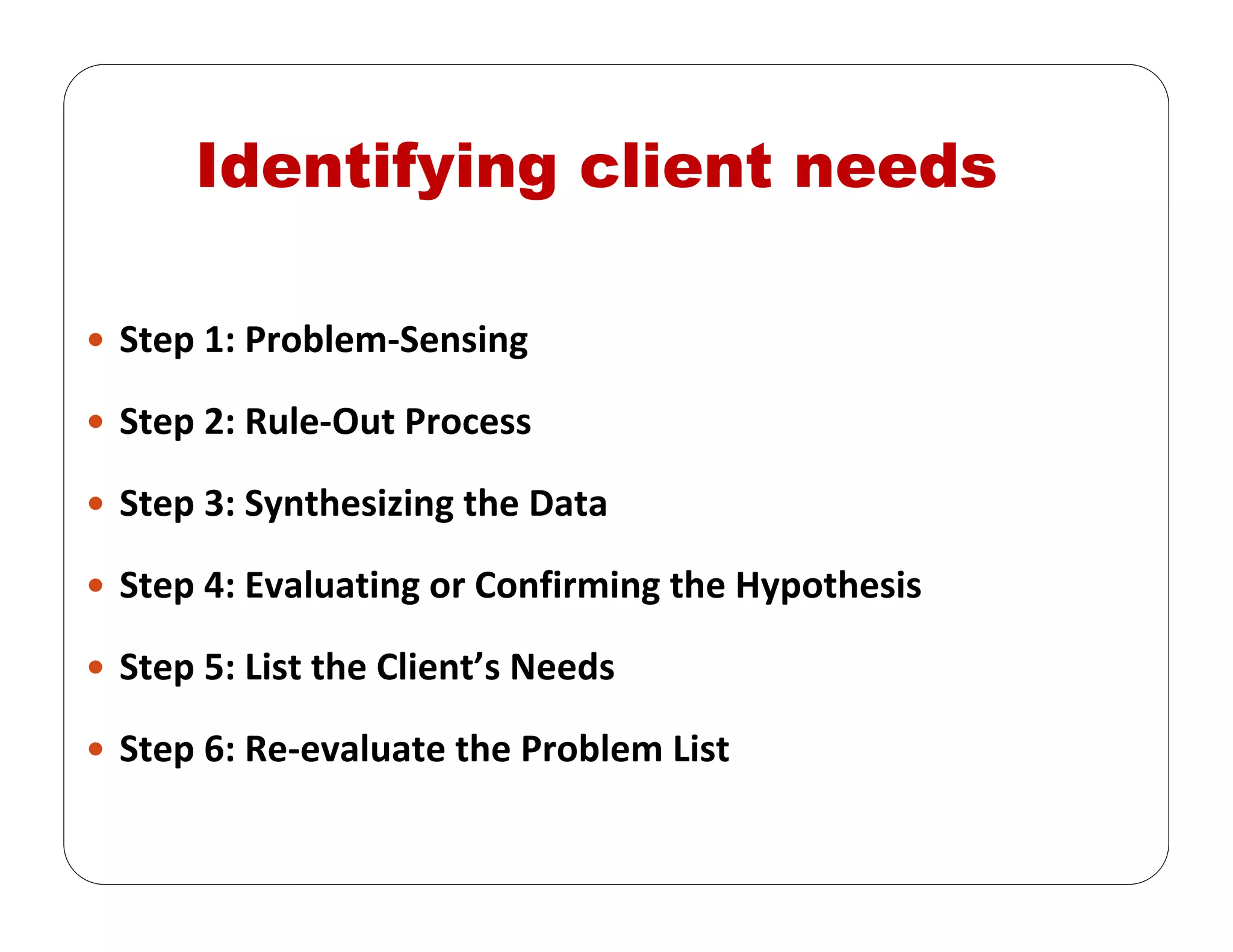
Identifying client needs
Step 1: Problem‐Sensing
Step 2: Rule‐Out Process
Step 3: Synthesizing the Data
Step 4: Evaluating or Confirming the Hypothesis
Step 5: List the Client’s Needs
Step 6: Re‐evaluate the Problem List
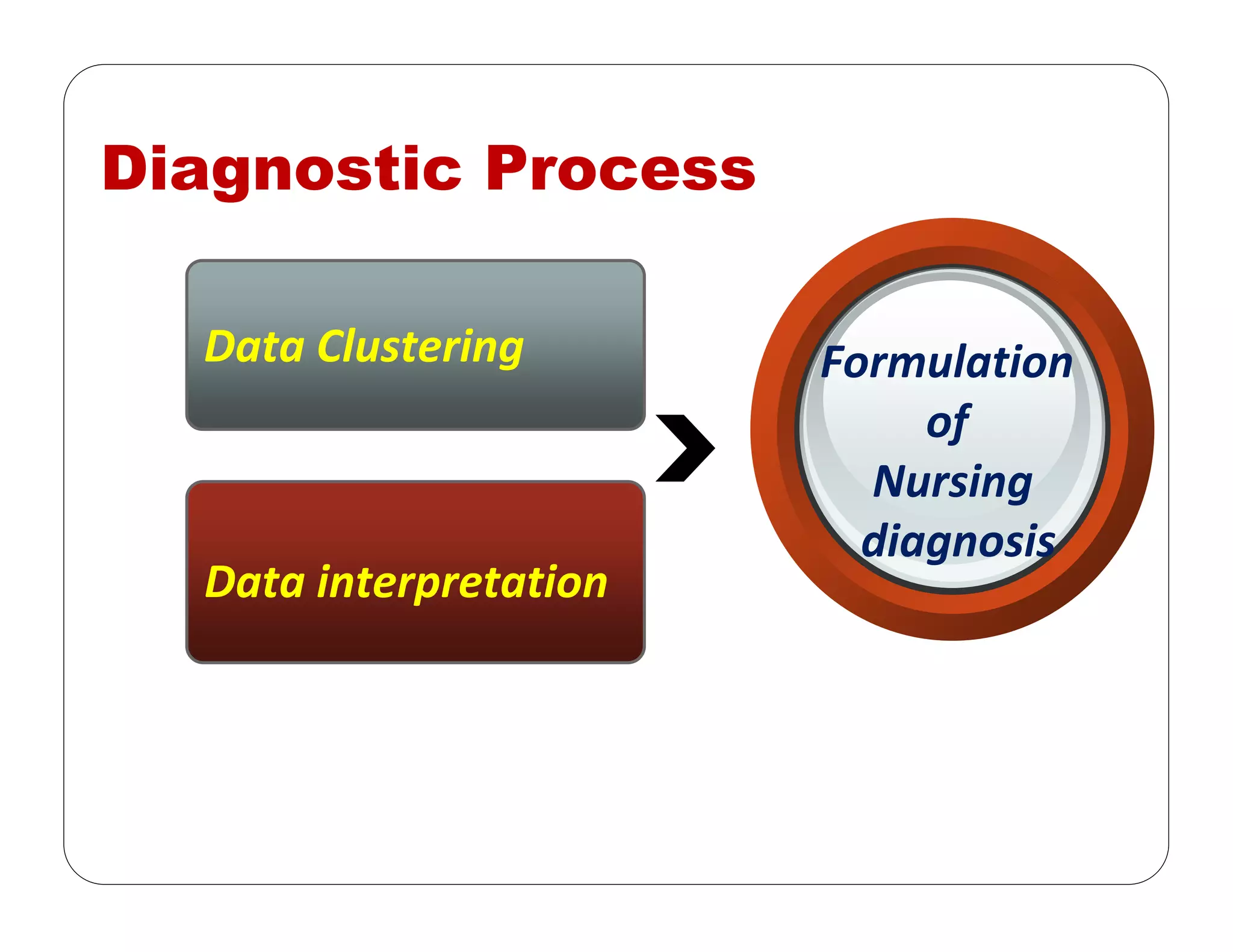
Diagnostic Process
Data Clustering
Data interpretation
Formulation 
of 
Nursing
diagnosis
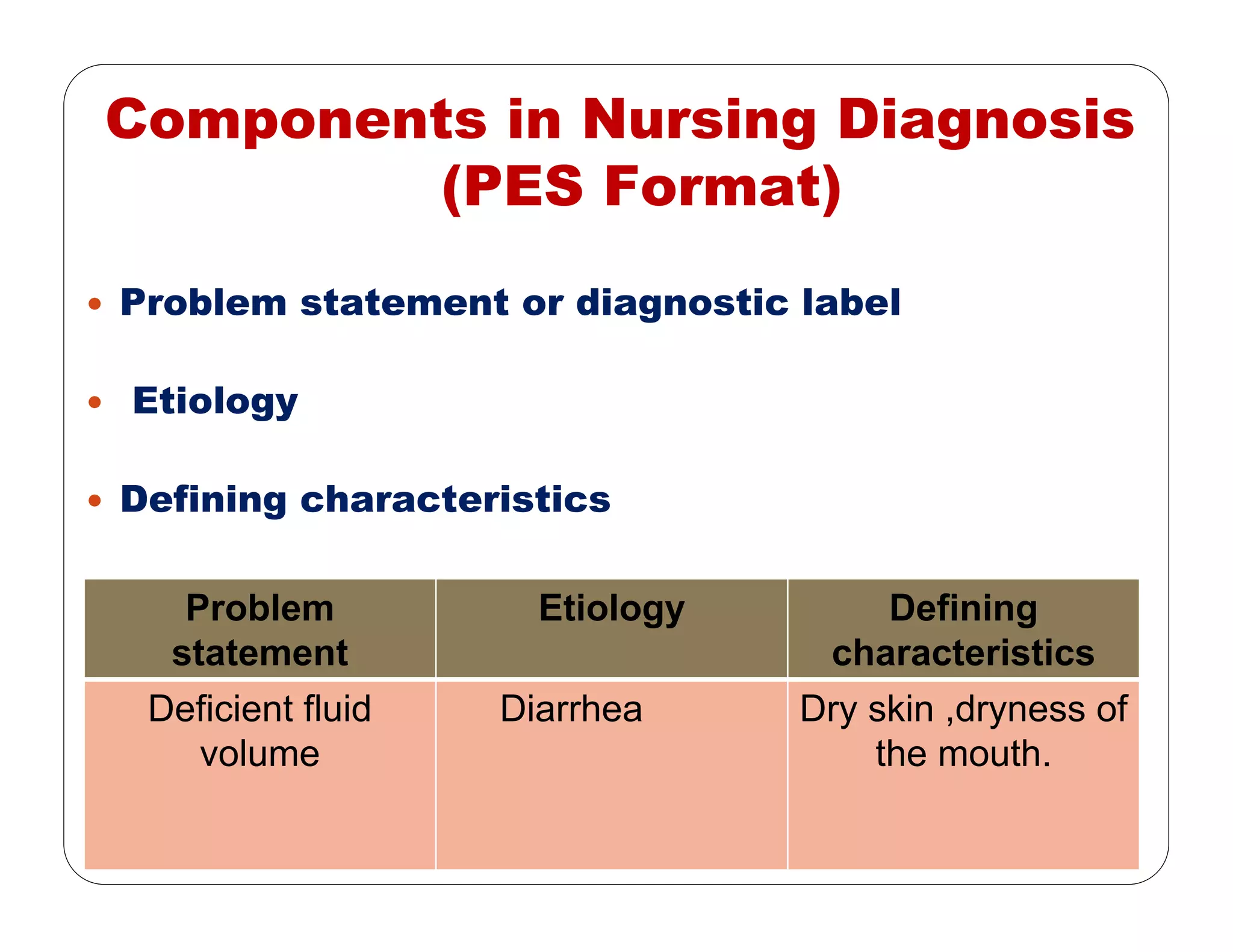
Components in Nursing Diagnosis
(PES Format)
Problem statement or diagnostic label
Etiology
Defining characteristics
Problem
statement
Etiology Defining
characteristics
Deficient fluid
volume
Diarrhea Dry skin ,dryness of
the mouth.
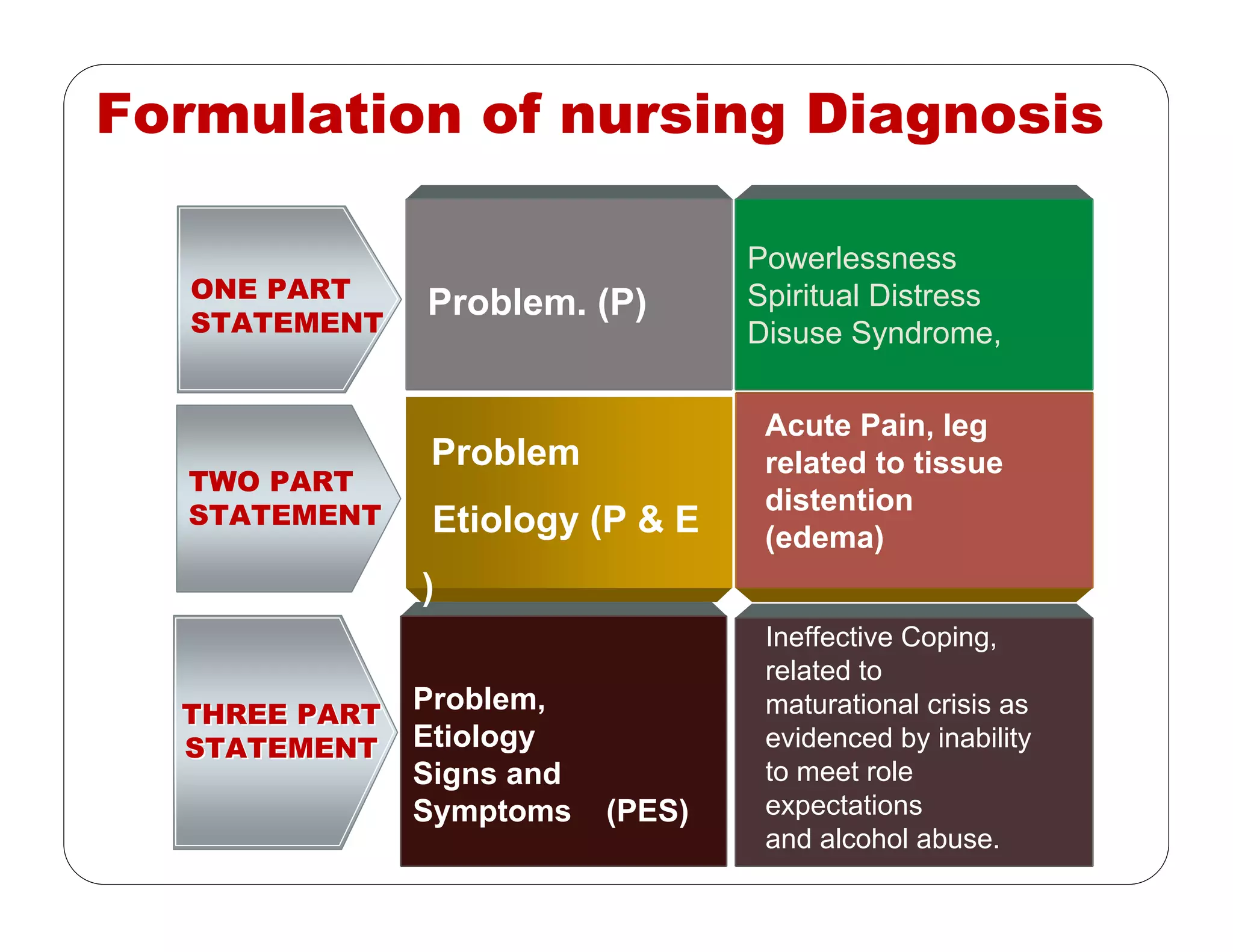
Problem
Etiology (P & E
)
Problem,
Etiology
Signs and
Symptoms (PES)
Title in hereTitle in here
THREE PART
STATEMENT
THREE PART
STATEMENT
Acute Pain, leg
related to tissue
distention
(edema)
Ineffective Coping,
related to
maturational crisis as
evidenced by inability
to meet role
expectations
and alcohol abuse.
Formulation of nursing Diagnosis
TWO PART
STATEMENT
Problem. (P)
Powerlessness
Spiritual Distress
Disuse Syndrome,
ONE PART
STATEMENT
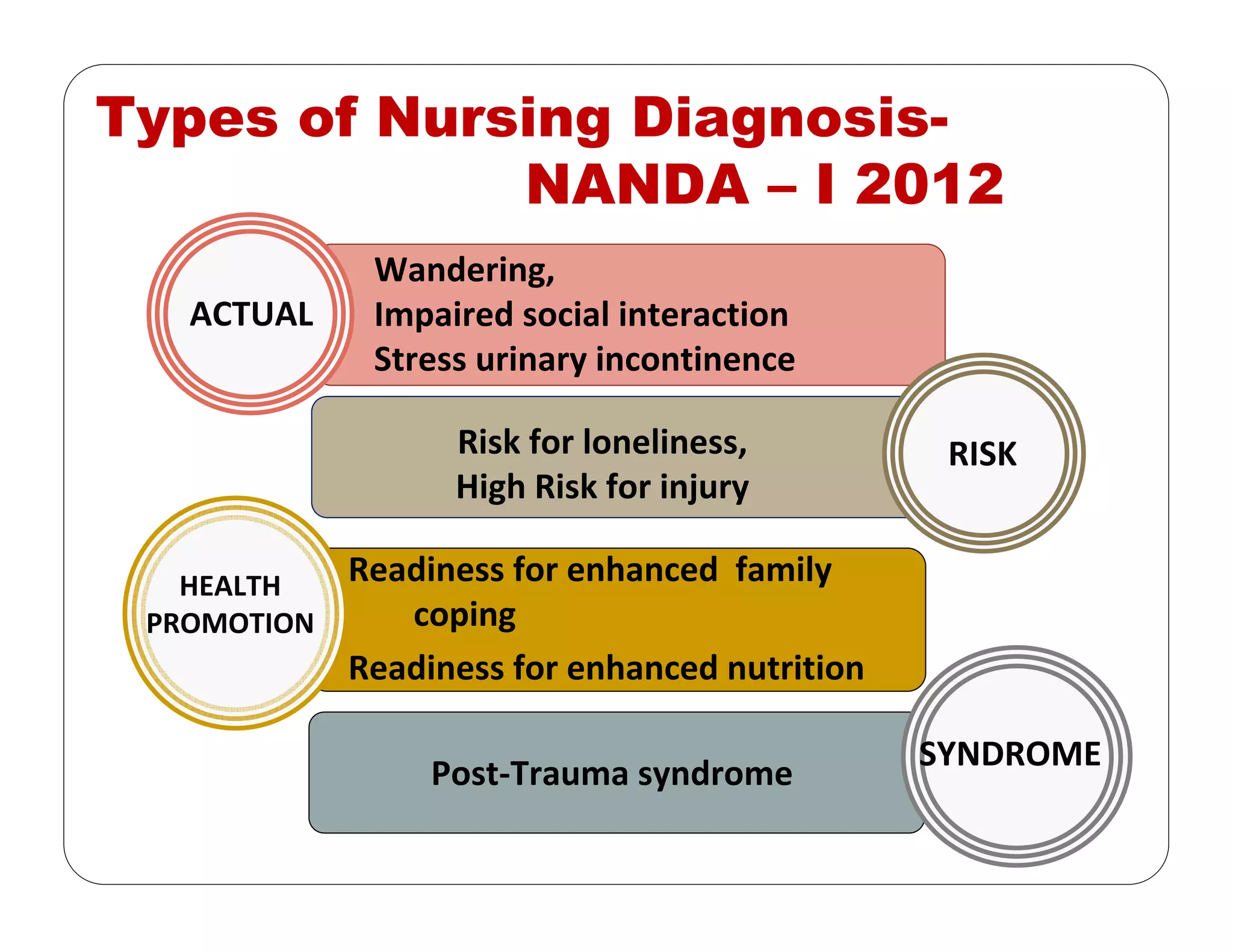
Types of Nursing Diagnosis-
NANDA – I 2012
Wandering,
Impaired social interaction  
Stress urinary incontinence 
ACTUAL
Risk for loneliness,
High Risk for injury
RISK
Readiness for enhanced  family 
coping
Readiness for enhanced nutrition
HEALTH 
PROMOTION
Post‐Trauma syndrome
SYNDROME
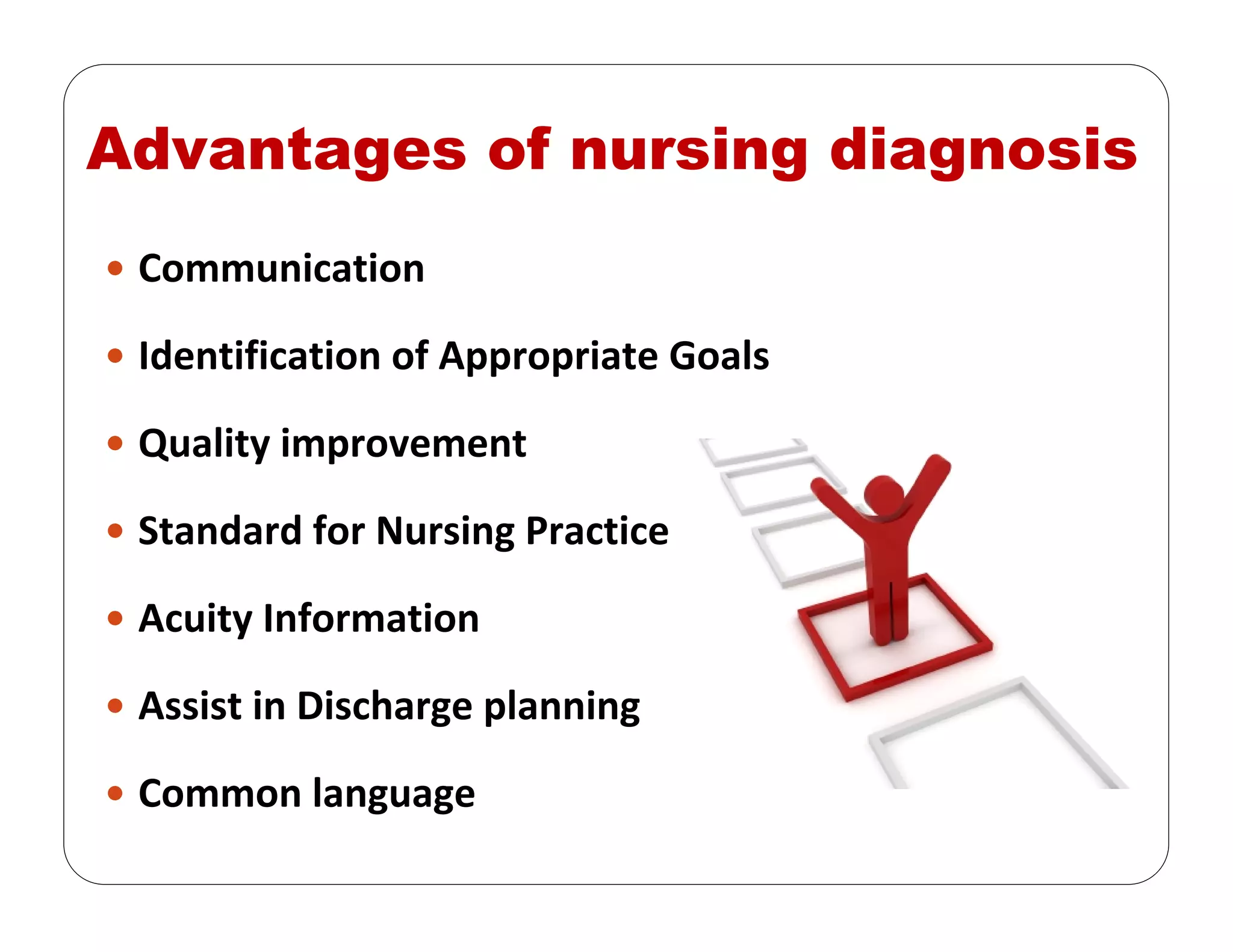
Advantages of nursing diagnosis
Communication 
Identification of Appropriate Goals
Quality improvement
Standard for Nursing Practice
Acuity Information
Assist in Discharge planning
Common language
Limitations of Nursing Diagnosis
Lack of consensus 
Nurses  have less time with clients.
Care is organized around the medical diagnosis. 
Afraid and unwilling to use
The nursing diagnosis list does not  fit the 
client situation.
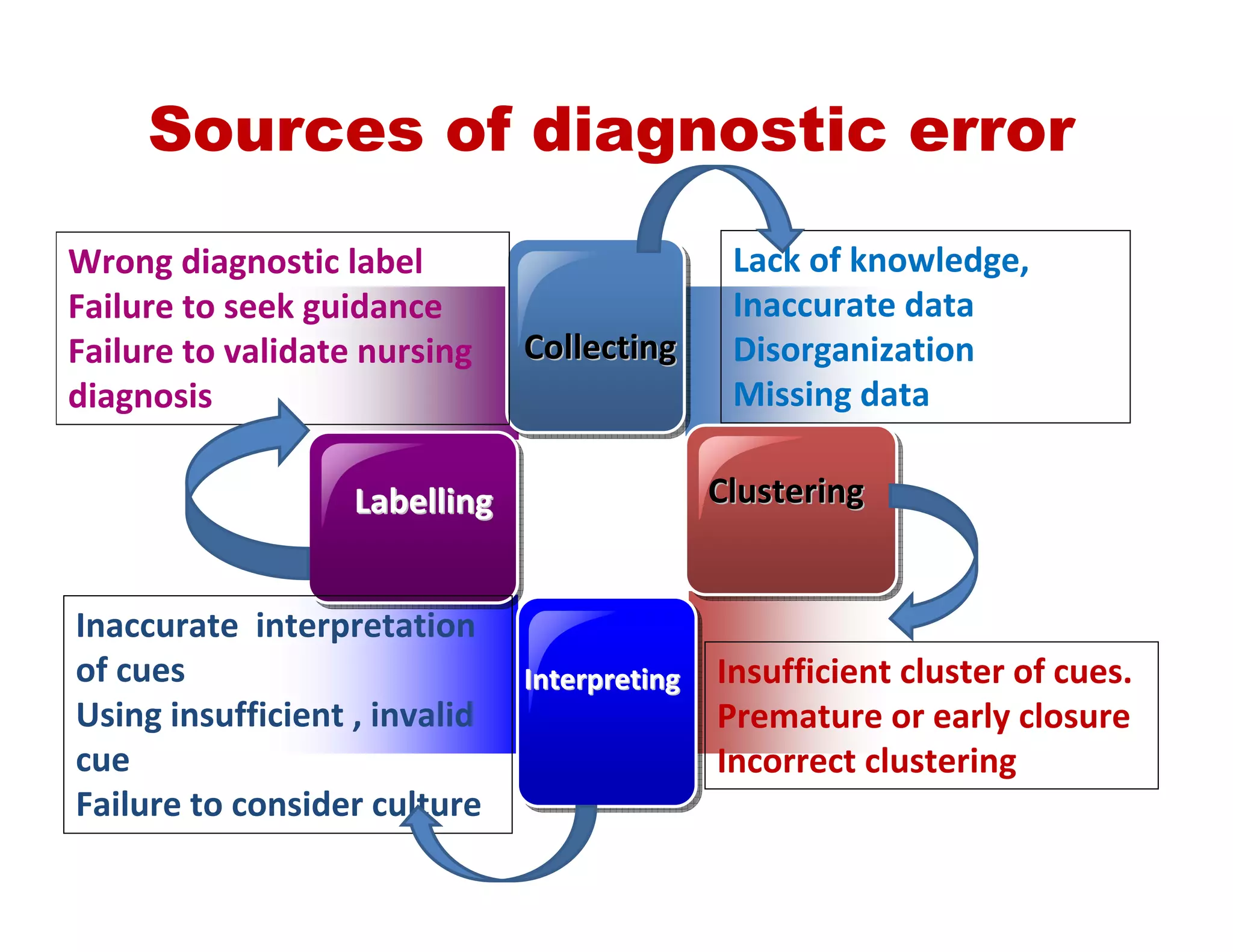
Wrong diagnostic label
Failure to seek guidance
Failure to validate nursing 
diagnosis
Inaccurate  interpretation 
of cues
Using insufficient , invalid 
cue
Failure to consider culture
Lack of knowledge, 
Inaccurate data 
Disorganization
Missing data
Insufficient cluster of cues.
Premature or early closure
Incorrect clustering
CollectingCollecting
InterpretingInterpreting
ClusteringClusteringLabellingLabelling
Sources of diagnostic error
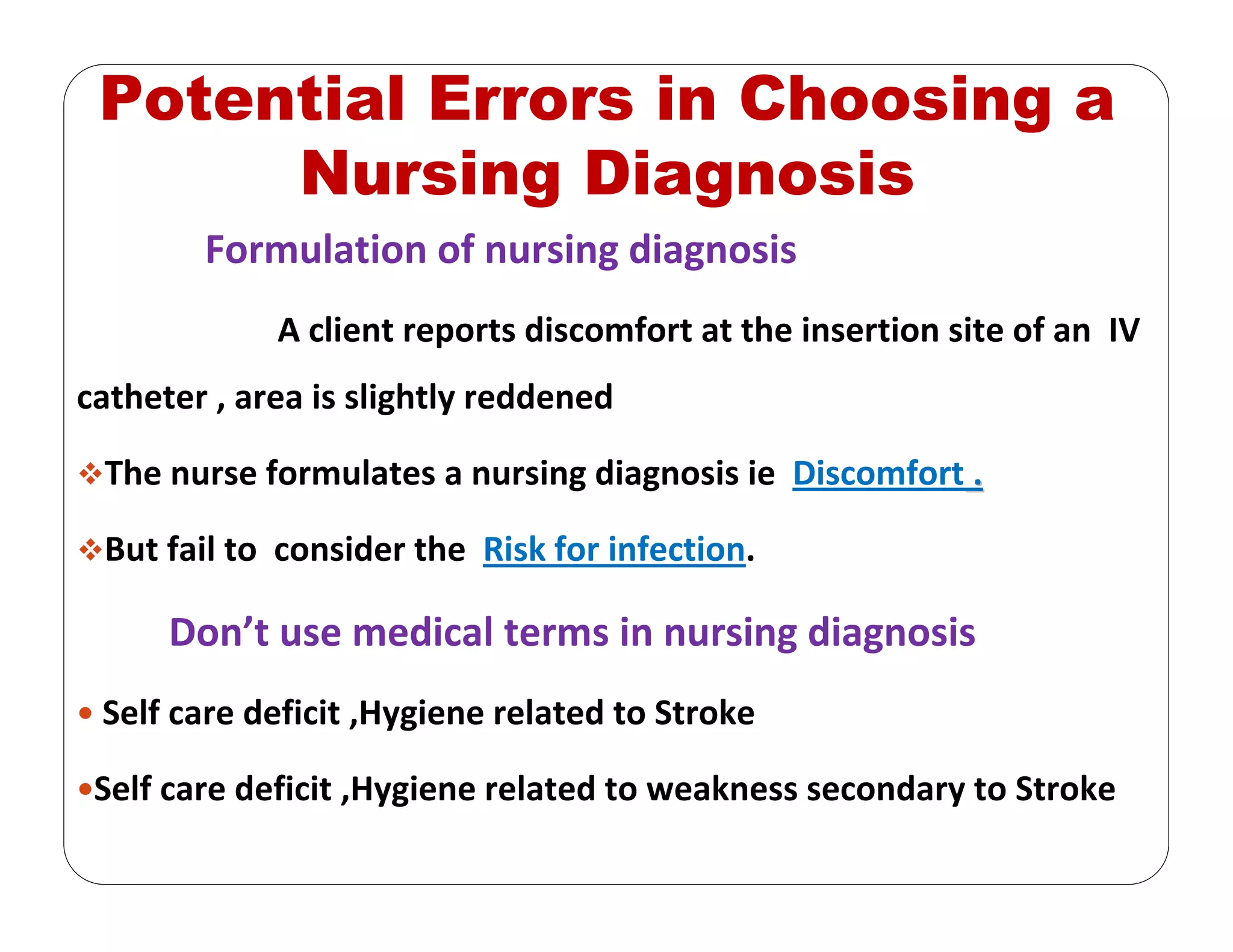
Potential Errors in Choosing a
Nursing Diagnosis
Formulation of nursing diagnosis
A client reports discomfort at the insertion site of an  IV 
catheter , area is slightly reddened
The nurse formulates a nursing diagnosis ie  Discomfort ..
But fail to  consider the  Risk for infection. 
Don’t use medical terms in nursing diagnosis
Self care deficit ,Hygiene related to Stroke 
Self care deficit ,Hygiene related to weakness secondary to Stroke
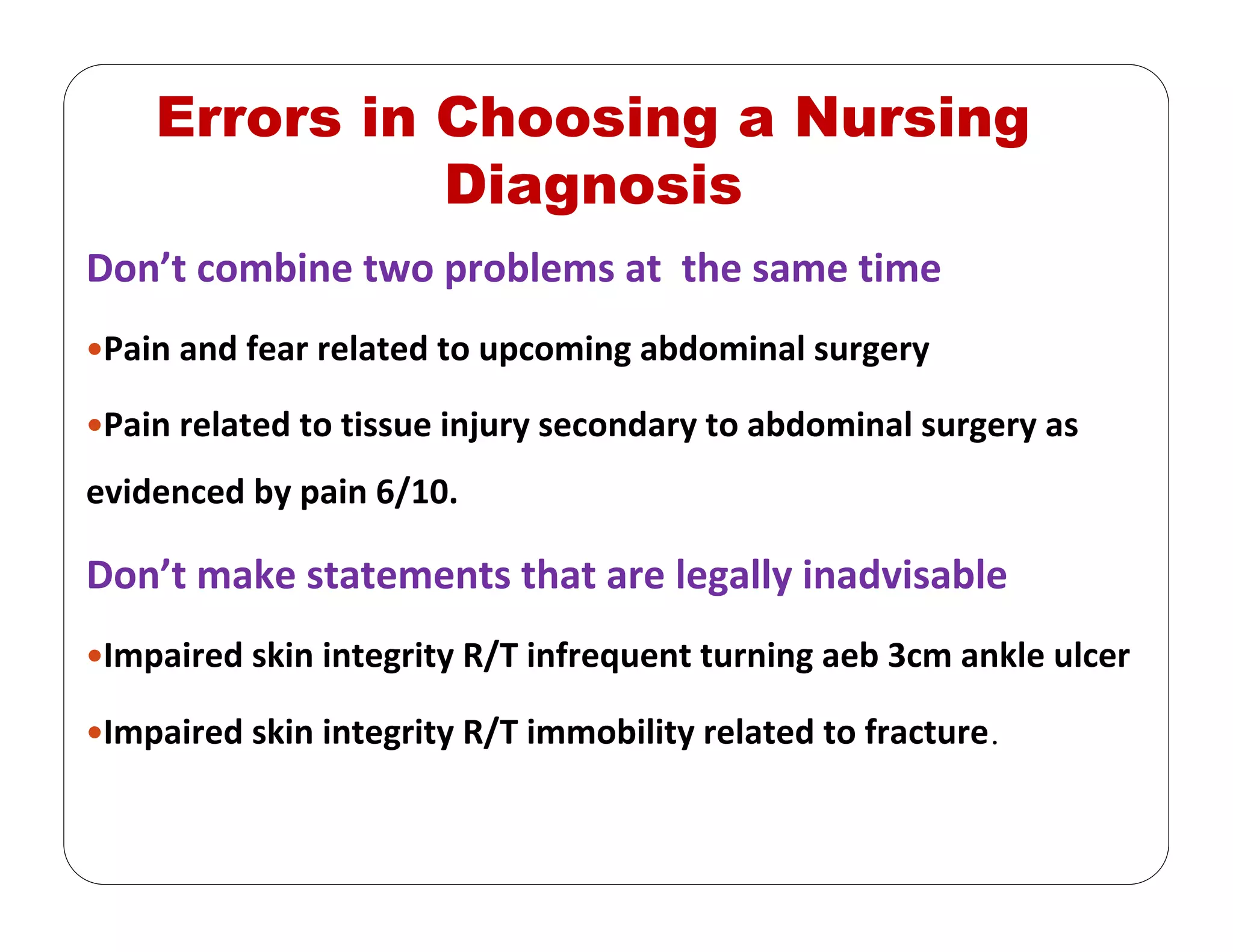
Errors in Choosing a Nursing
Diagnosis
Don’t combine two problems at  the same time
Pain and fear related to upcoming abdominal surgery
Pain related to tissue injury secondary to abdominal surgery as 
evidenced by pain 6/10.
Don’t make statements that are legally inadvisable
Impaired skin integrity R/T infrequent turning aeb 3cm ankle ulcer
Impaired skin integrity R/T immobility related to fracture.
Overcoming Barriers to Nursing
Diagnosis
Familiarity of nursing diagnosis language
Support from  Health care agency  
Enhanced communication 
Document a new nursing diagnosis
Experienced nurses need opportunities to review nursing 
diagnoses. 
Standardized Nursing education programs content
3.Nursing Planning and Outcome
Identification
Planning is a category of nursing behaviour in 
which client centered goals and expected outcomes are 
established and nursing interventions are selected to achieve 
the goals and outcomes of care
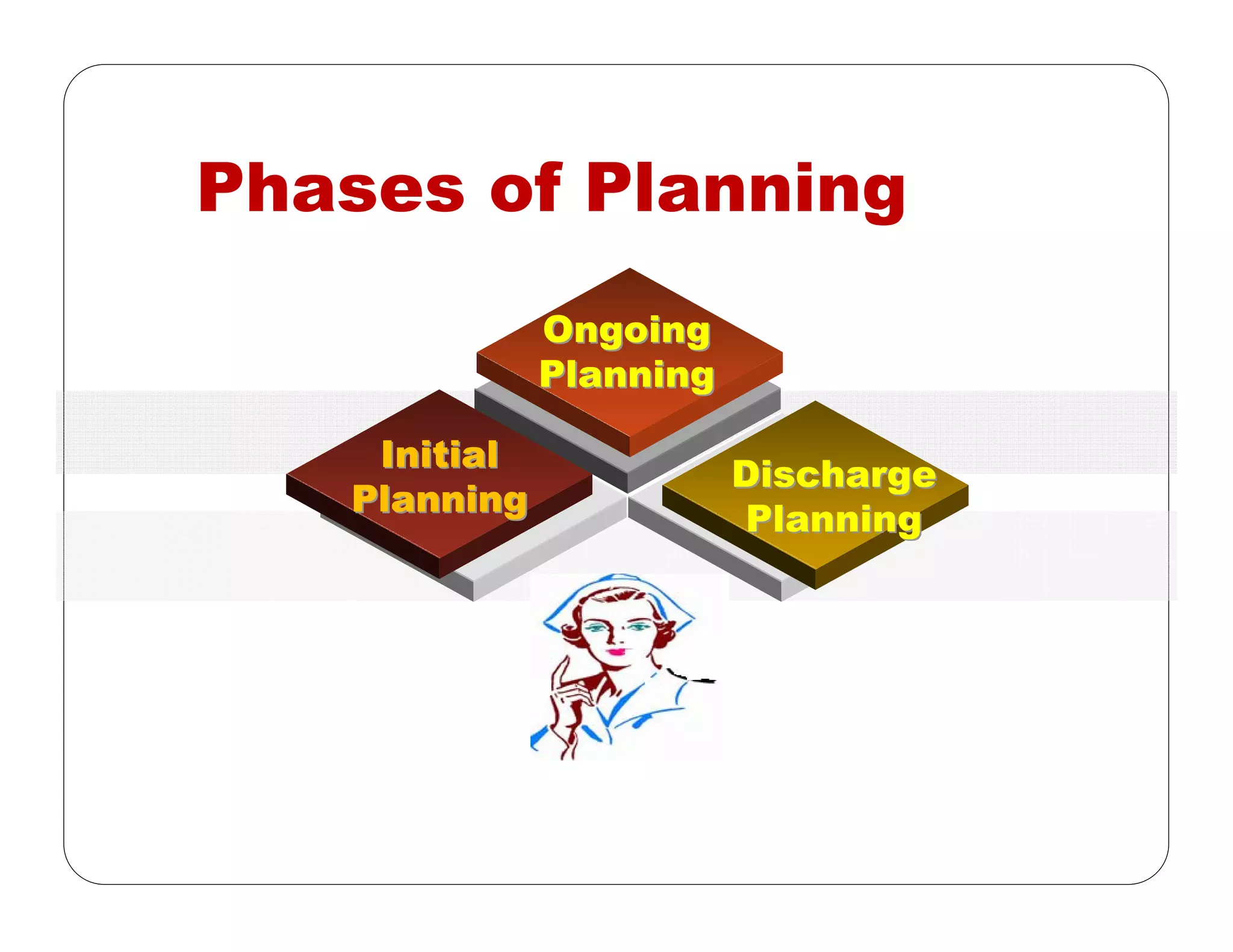
Ongoing
Planning
Ongoing
Planning
Initial
Planning
Initial
Planning
Discharge
Planning
Discharge
Planning
Phases of Planning
PLANNING PROCESS
1‐ Setting priorities.
2‐ Establishing client goals/desired out comes.
3‐ Selecting nursing strategies.
4‐ Writing nursing orders.
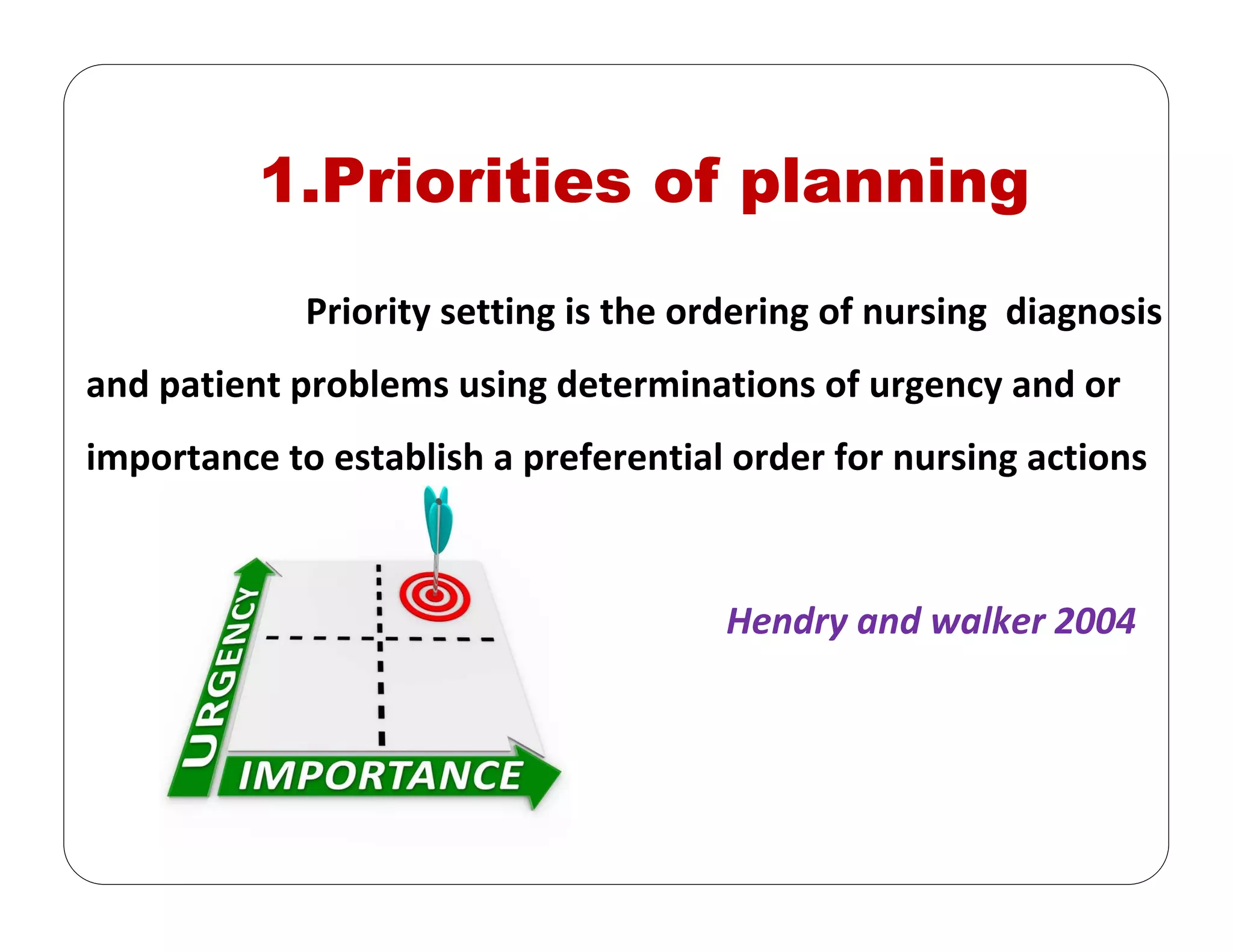
1.Priorities of planning
Priority setting is the ordering of nursing  diagnosis 
and patient problems using determinations of urgency and or 
importance to establish a preferential order for nursing actions
Hendry and walker 2004
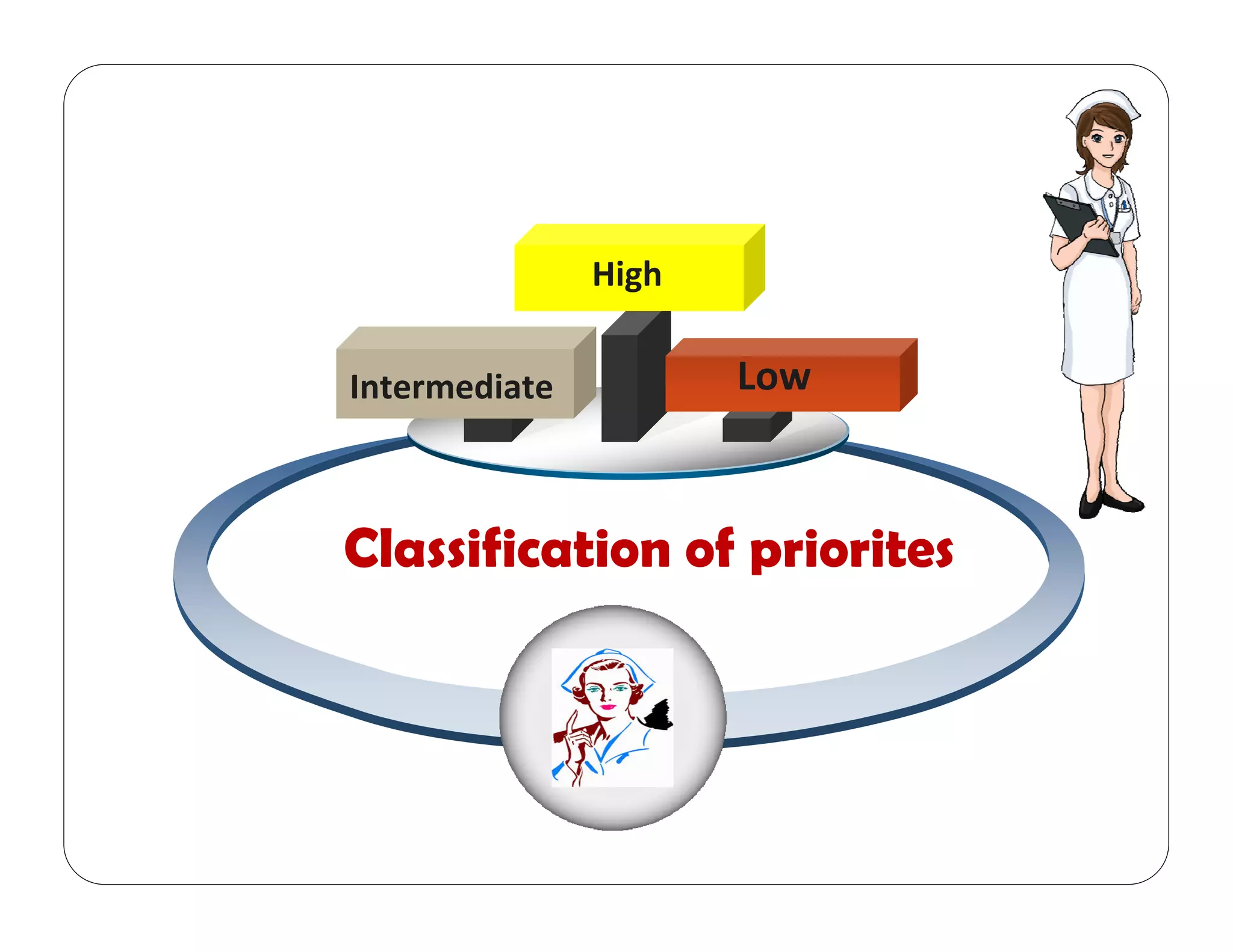
Intermediate Low
High
Classification of priorites
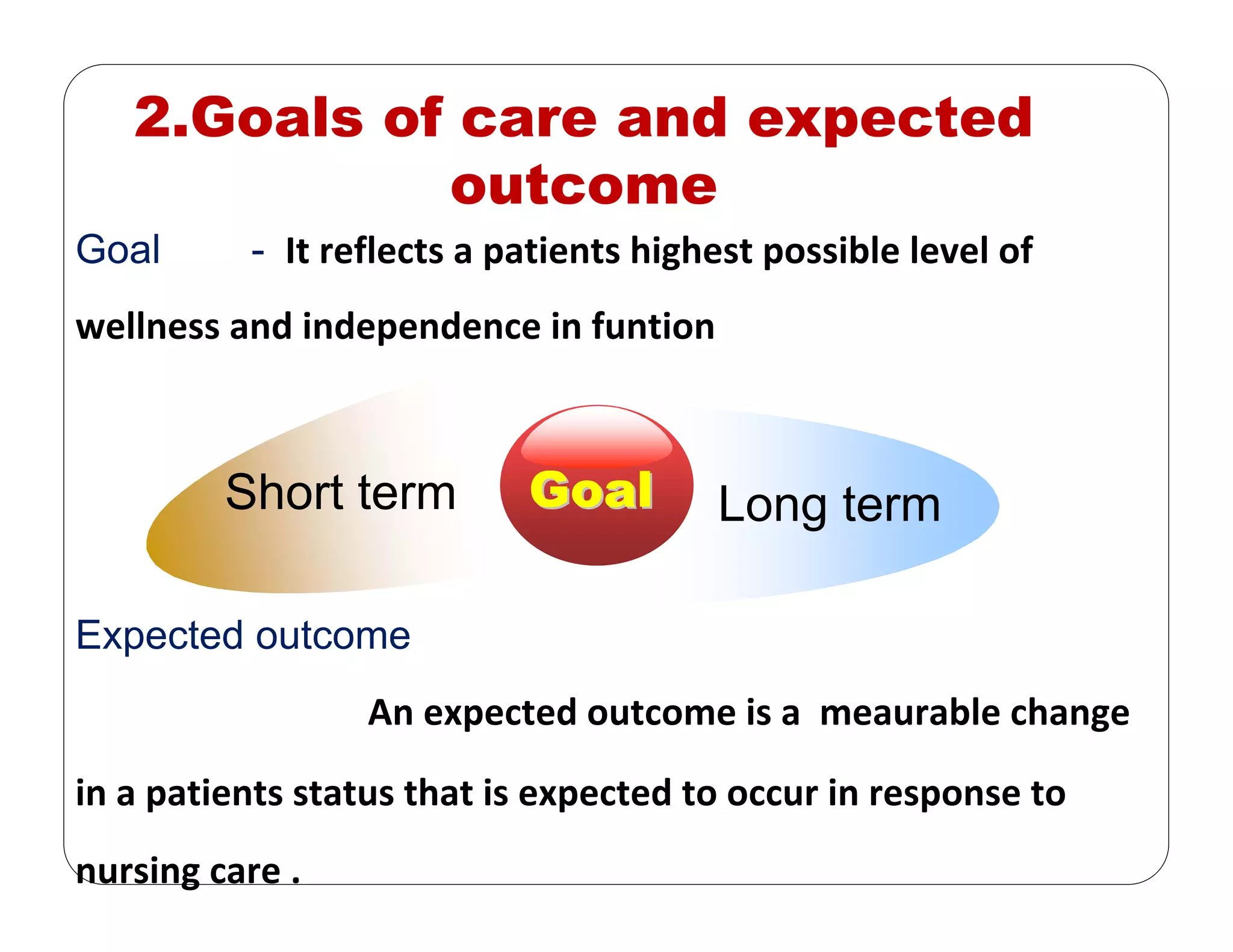
2.Goals of care and expected
outcome
Goal - It reflects a patients highest possible level of 
wellness and independence in funtion
Expected outcome
An expected outcome is a  meaurable change 
in a patients status that is expected to occur in response to 
nursing care .
GoalGoalShort term Long term
MACROS criteria- For Goal
M easurable and observable 
A chievable and time limited
C lient centred
R ealistic
O utcome written
S hort 
Example for Goal and expected
outcome
Goal
Mr. X will ambulate independently in 3 days 
Expected outcome
Mr.X will  turn in bed independently in 24 hours
Mr.X  will get up to chair 3 times daily for next 2 days
Mr.X  will walk with assistance to hallway in 48 hours
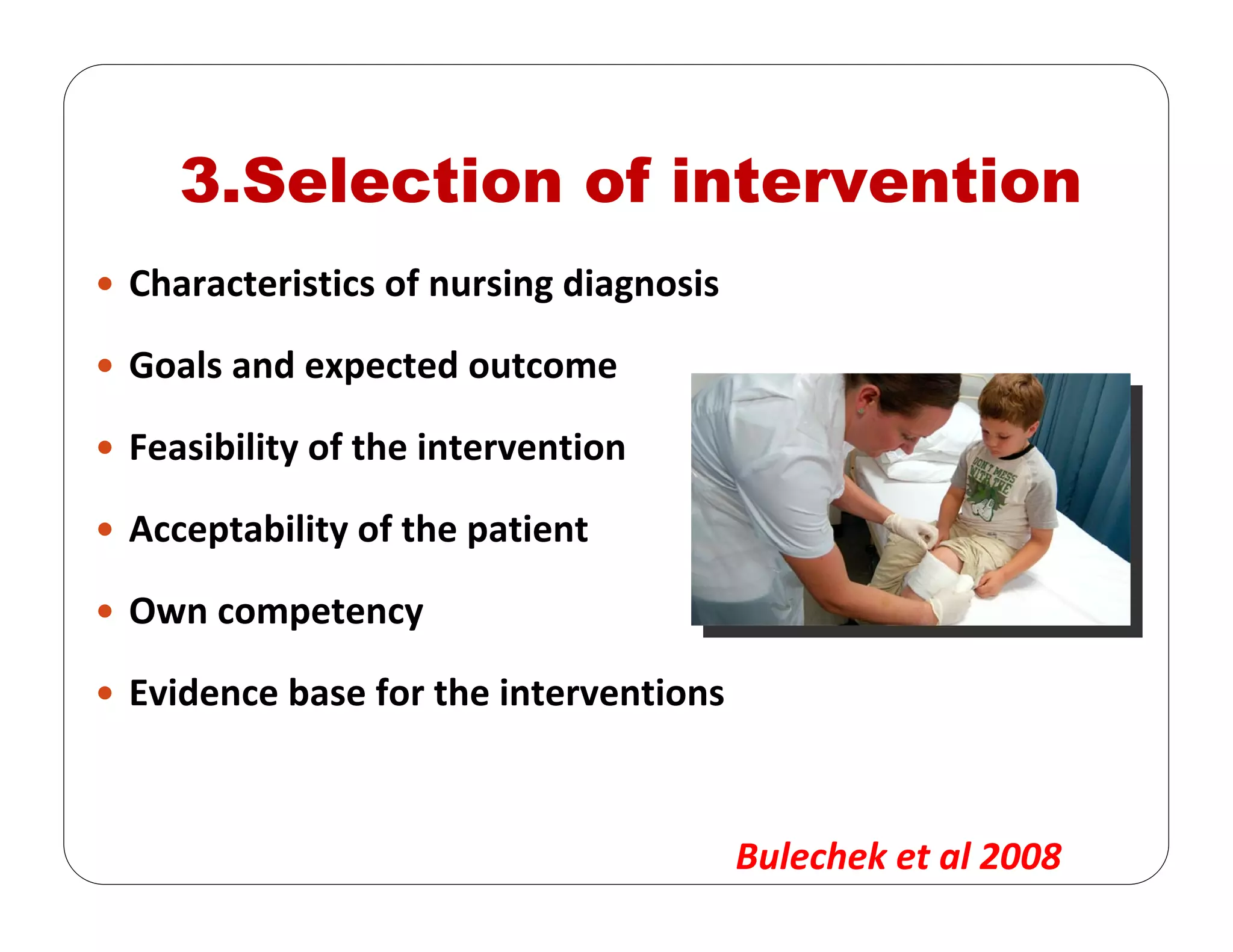
3.Selection of intervention
Characteristics of nursing diagnosis
Goals and expected outcome
Feasibility of the intervention 
Acceptability of the patient
Own competency 
Evidence base for the interventions
Bulechek et al 2008
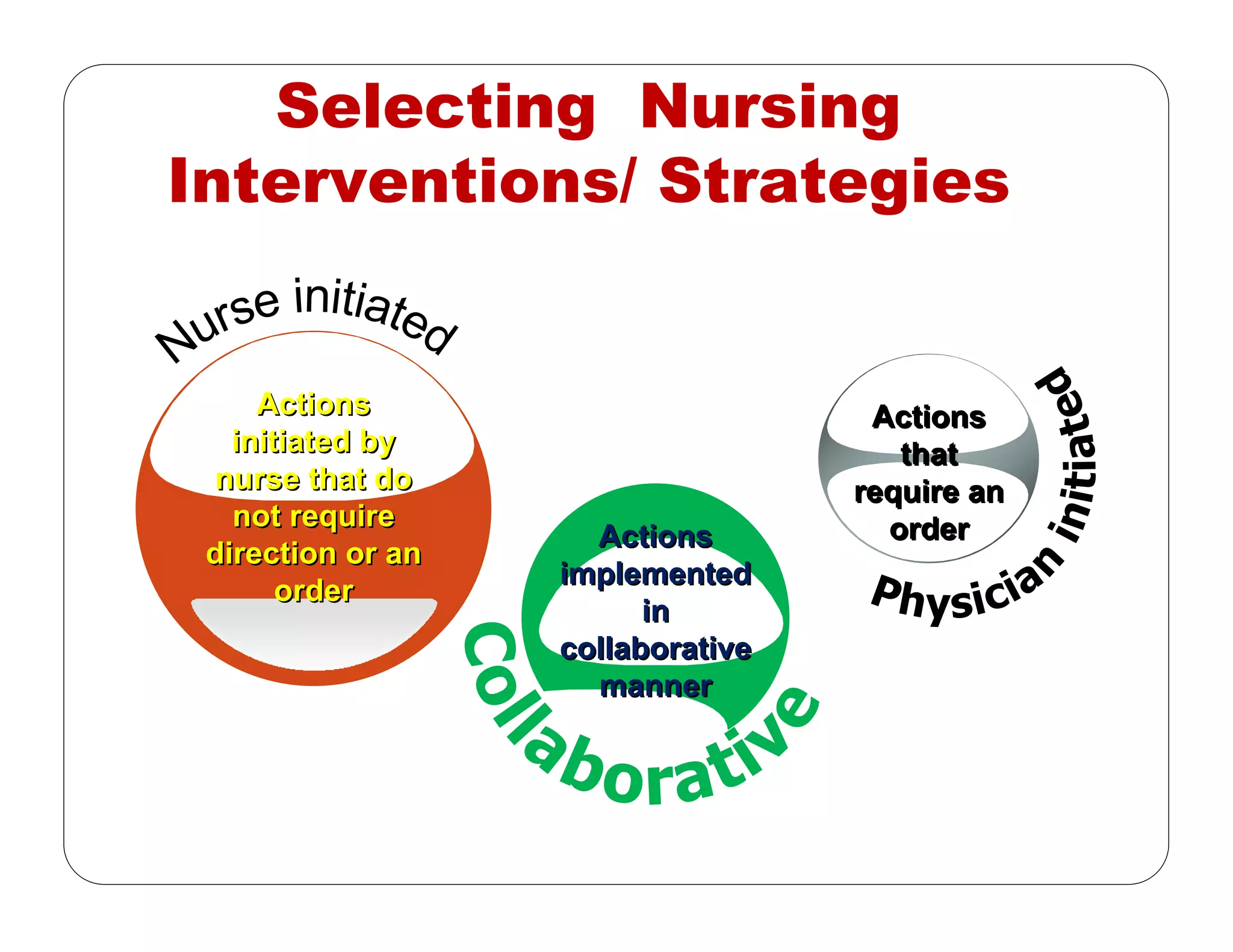
Selecting Nursing
Interventions/ Strategies
Actions
initiated by
nurse that do
not require
direction or an
order
Actions
initiated by
nurse that do
not require
direction or an
order
Actions
implemented
in
collaborative
manner
Actions
implemented
in
collaborative
manner
Actions
that
require an
order
Actions
that
require an
order
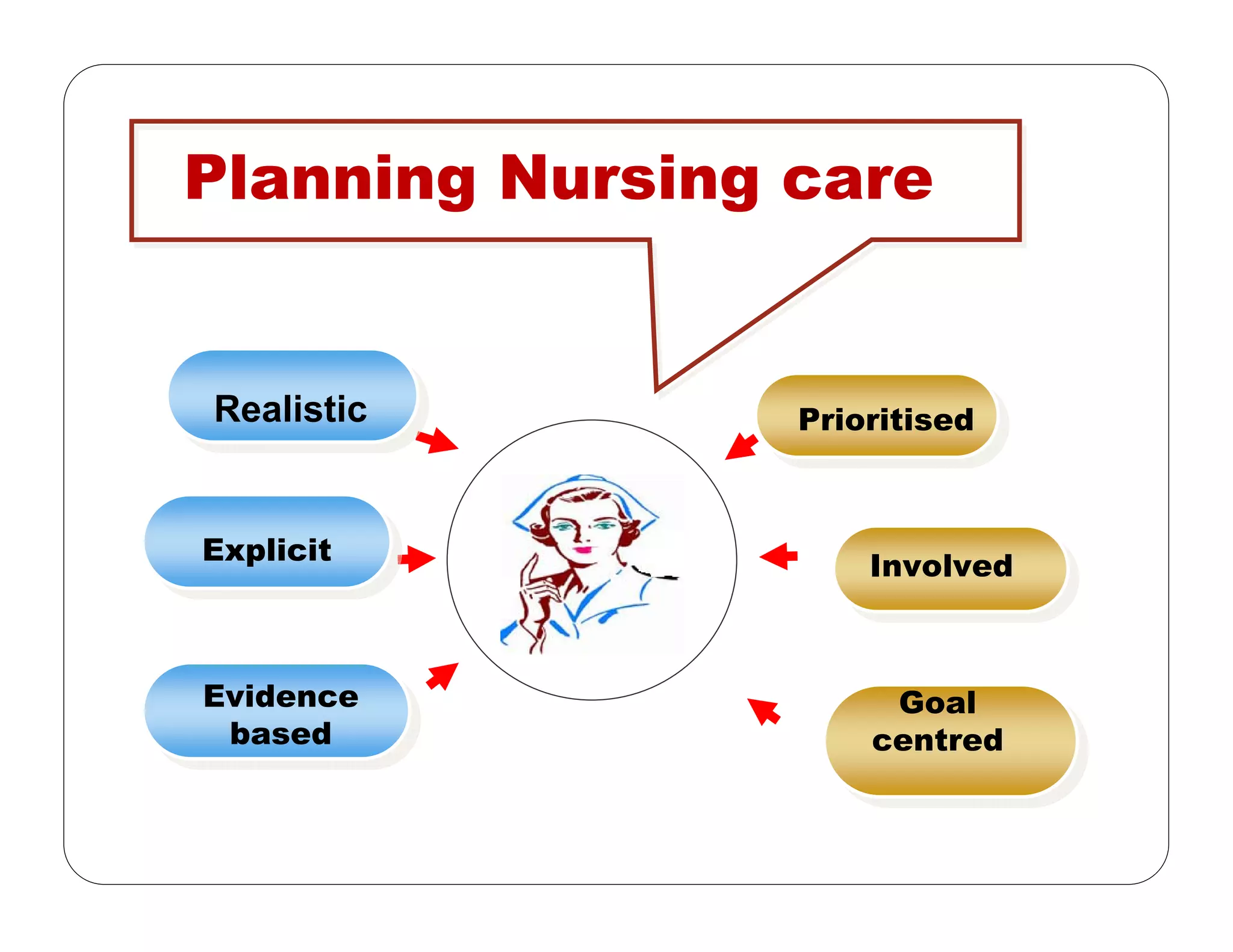
Planning Nursing care
Realistic
Explicit
Evidence
based
Prioritised
Involved
Goal
centred
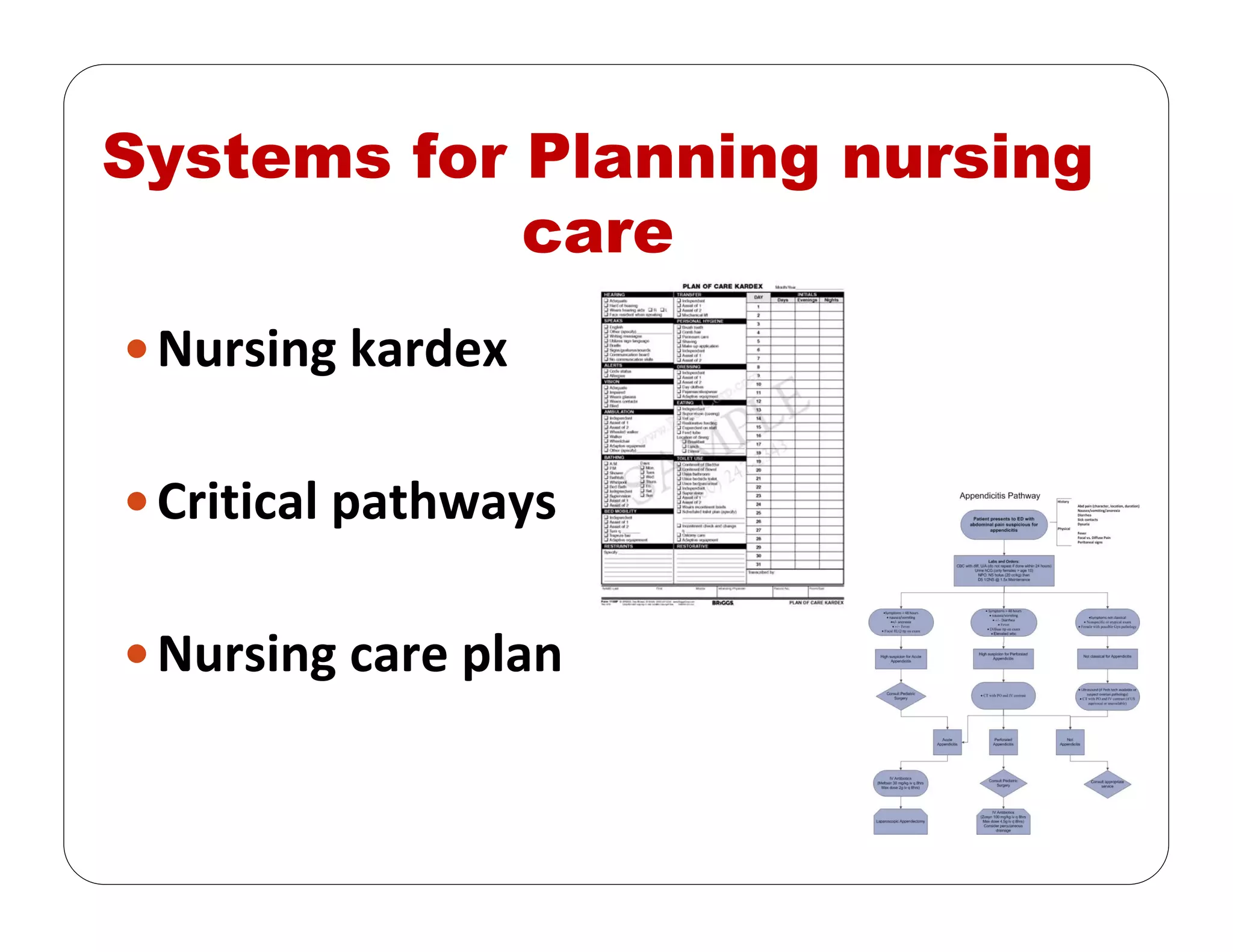
Systems for Planning nursing
care
Nursing kardex 
Critical pathways
Nursing care plan
The Nursing Care Plan
A written guide that organizes data about a 
client’s care into a formal statement of the strategies that will 
be implemented to help the client achieve optimal health.
Purposes
Helps to identify the nursing actions to be delivered
Identify and coordinate resources to deliver nursing care 
Enhance continuity of care 
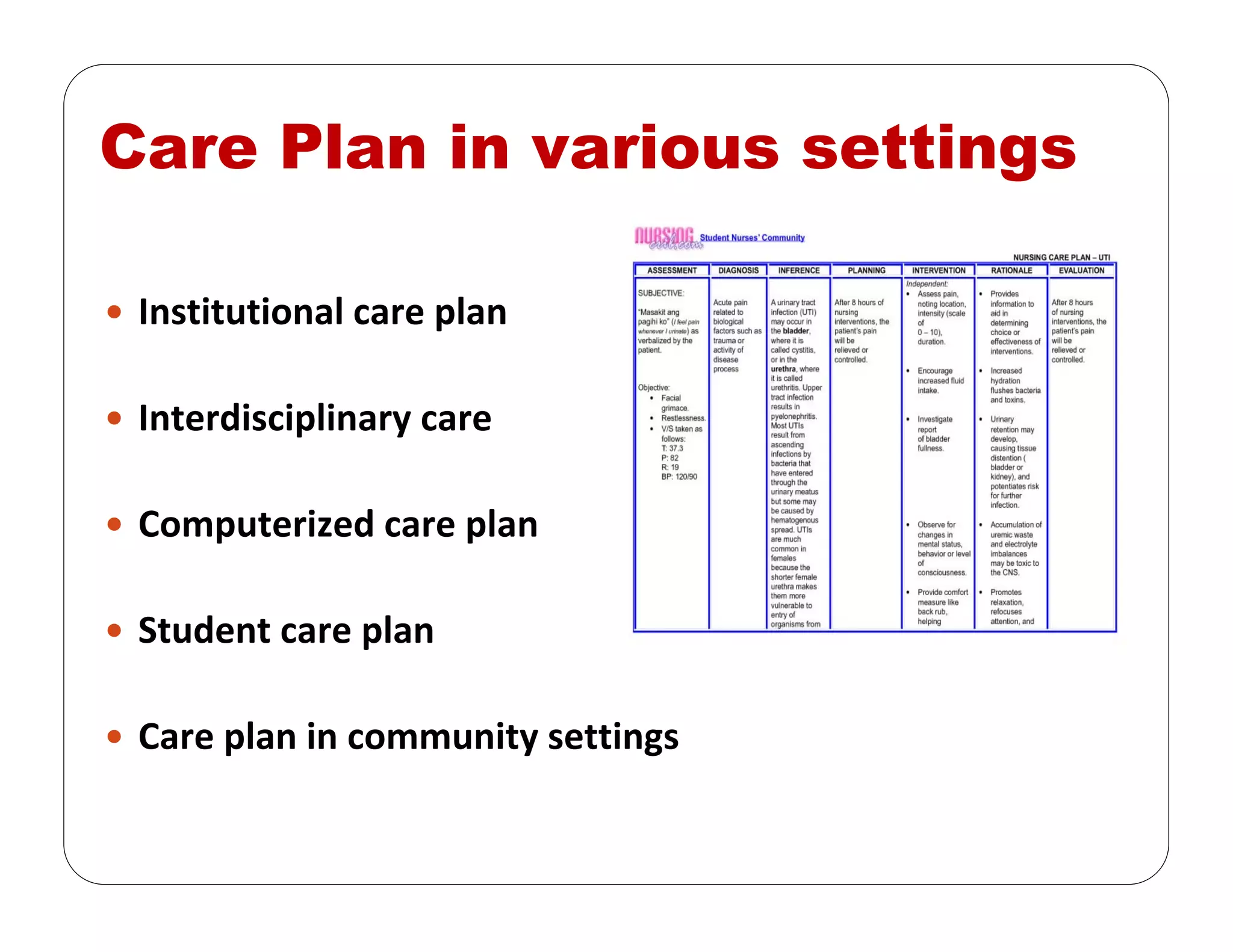
Care Plan in various settings
Institutional care plan
Interdisciplinary care
Computerized care plan
Student care plan
Care plan in community settings
GUIDELINES FOR WRITING
NURSING CARE PLAN
Incorporates preventive , health maintenance  and restorative 
aspects. 
Use standardized Medical or English symbols . Eg. Clean 
wound with H2O2 , b.i.d. 
Be specific. 
Use category headings and  Date and  sign the plan
GUIDELINES FOR WRITING
NURSING CARE PLAN
Refer to procedure books or other sources of information
Tailor the plan to the unique characteristics of the client .
Plan the  interventions for ongoing assessment of the 
client  (eg. Inspect incision q8h)
Include collaborative and co‐ordination activities .
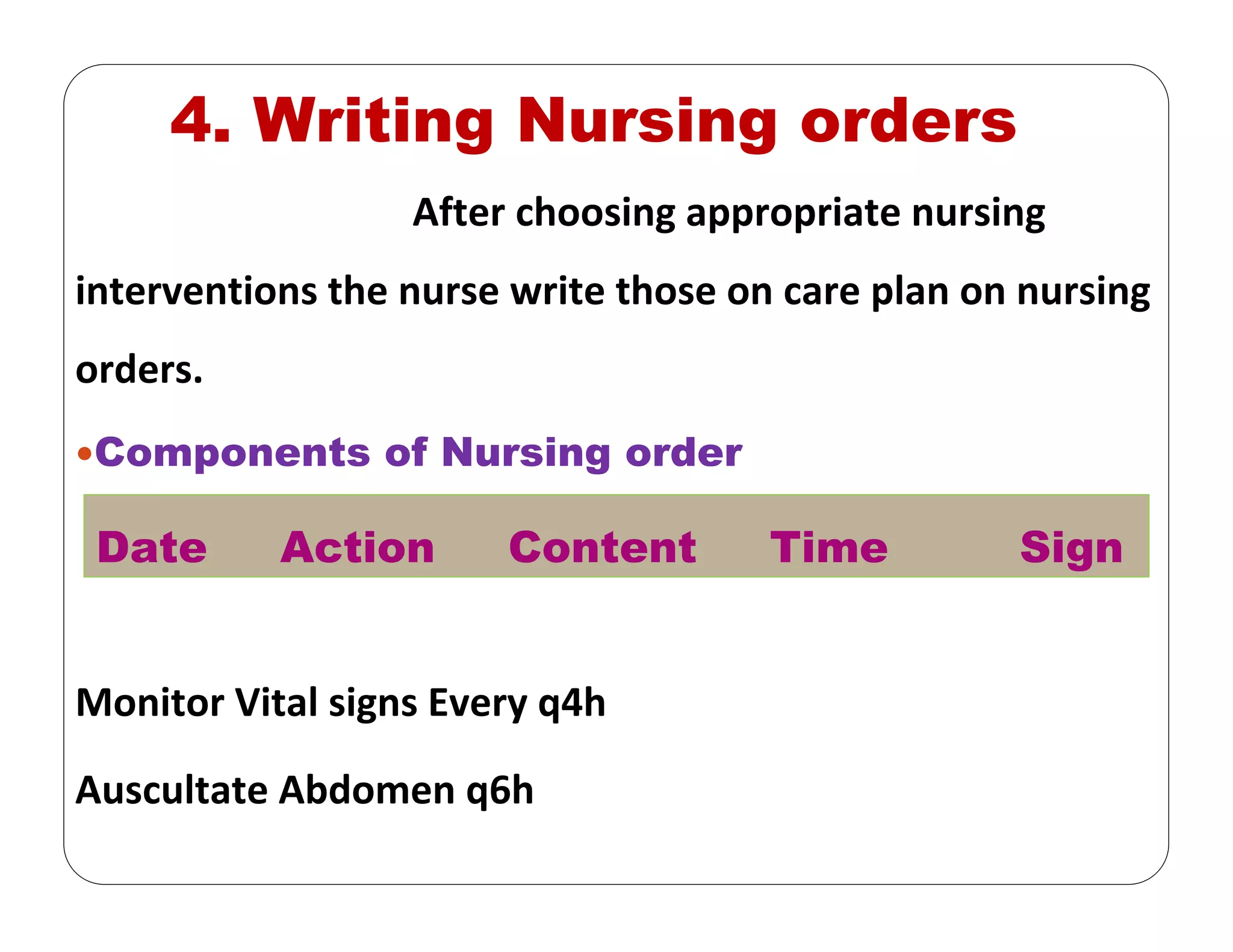
4. Writing Nursing orders
After choosing appropriate nursing 
interventions the nurse write those on care plan on nursing 
orders.
Components of Nursing order
Monitor Vital signs Every q4h 
Auscultate Abdomen q6h 
Date Action Content Time Sign
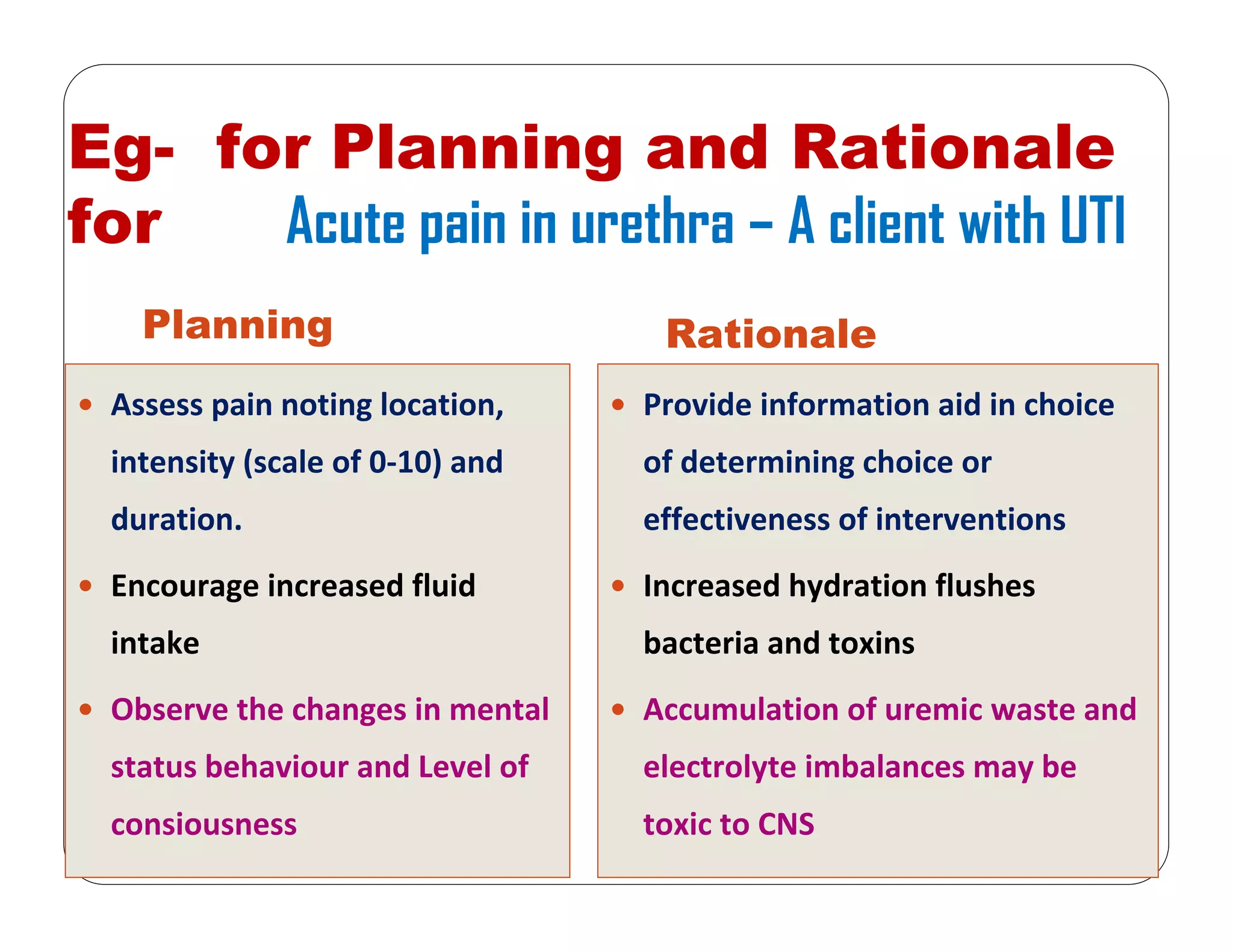
Eg- for Planning and Rationale
for Acute pain in urethra – A client with UTI
Planning Rationale
Assess pain noting location, 
intensity (scale of 0‐10) and 
duration.
Encourage increased fluid 
intake
Observe the changes in mental 
status behaviour and Level of 
consiousness
Provide information aid in choice 
of determining choice or 
effectiveness of interventions
Increased hydration flushes 
bacteria and toxins
Accumulation of uremic waste and  
electrolyte imbalances may be 
toxic to CNS
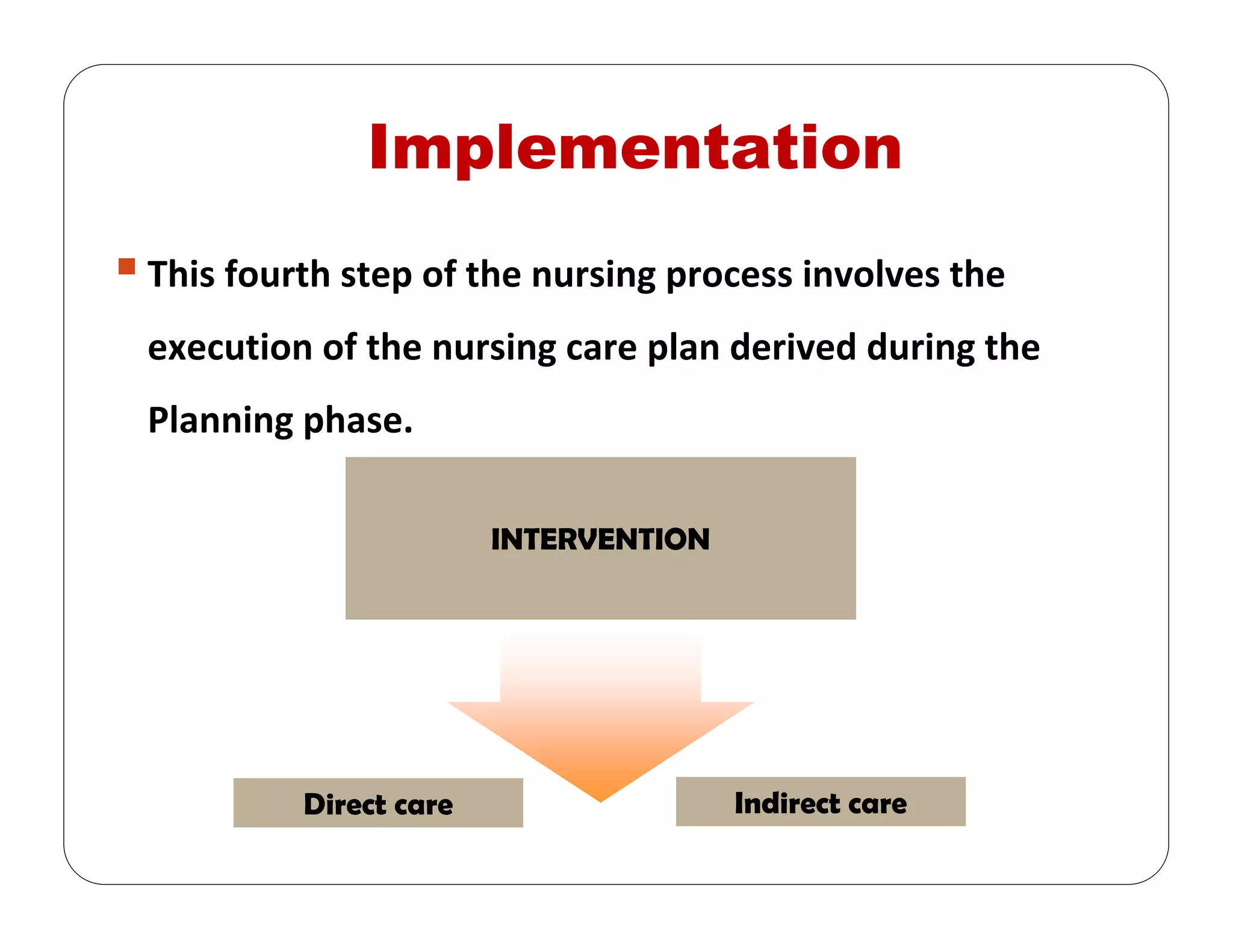
Implementation
This fourth step of the nursing process involves the 
execution of the nursing care plan derived during the 
Planning phase.
Direct care Indirect care
INTERVENTION
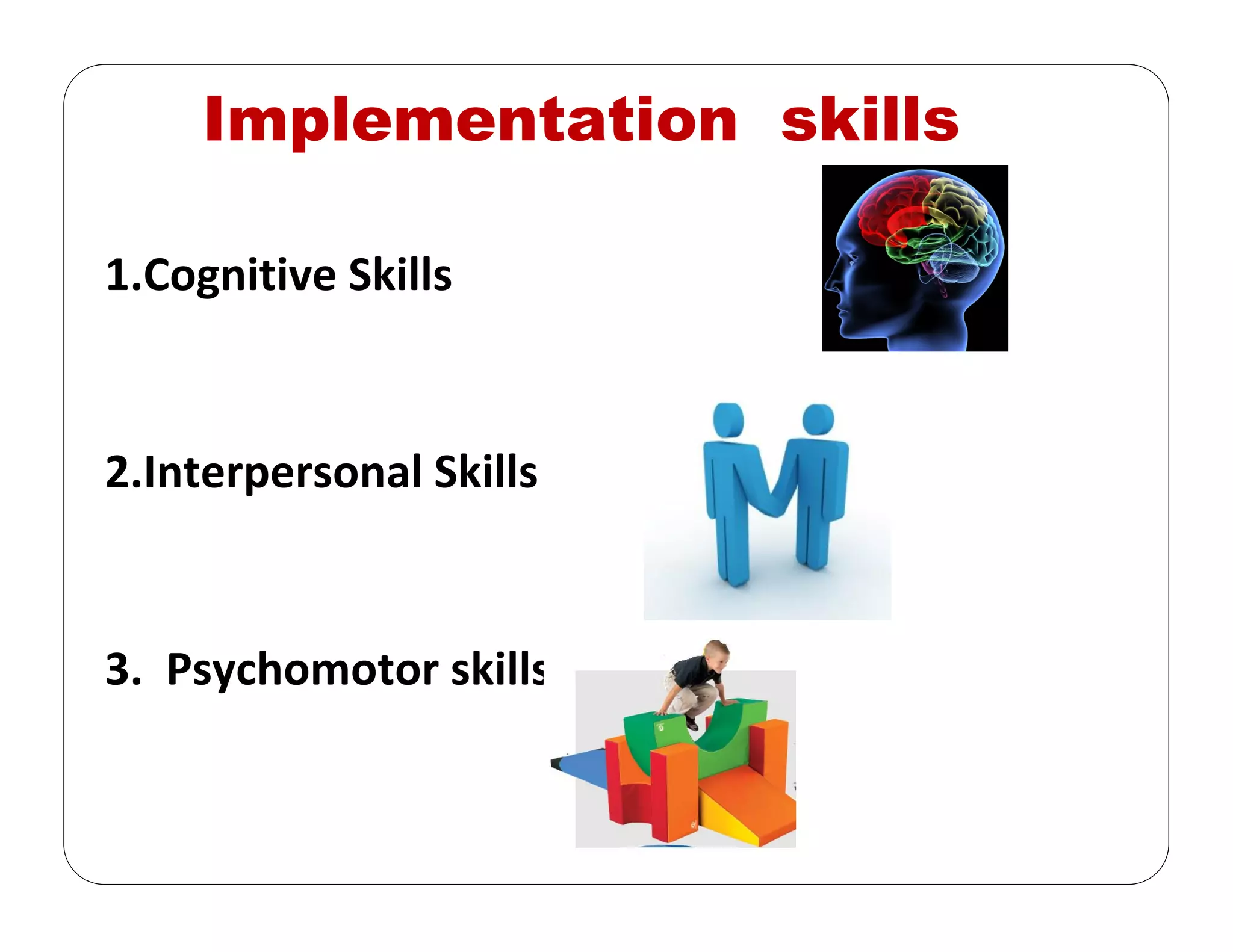
Implementation skills
1.Cognitive Skills 
2.Interpersonal Skills
3.  Psychomotor skills 
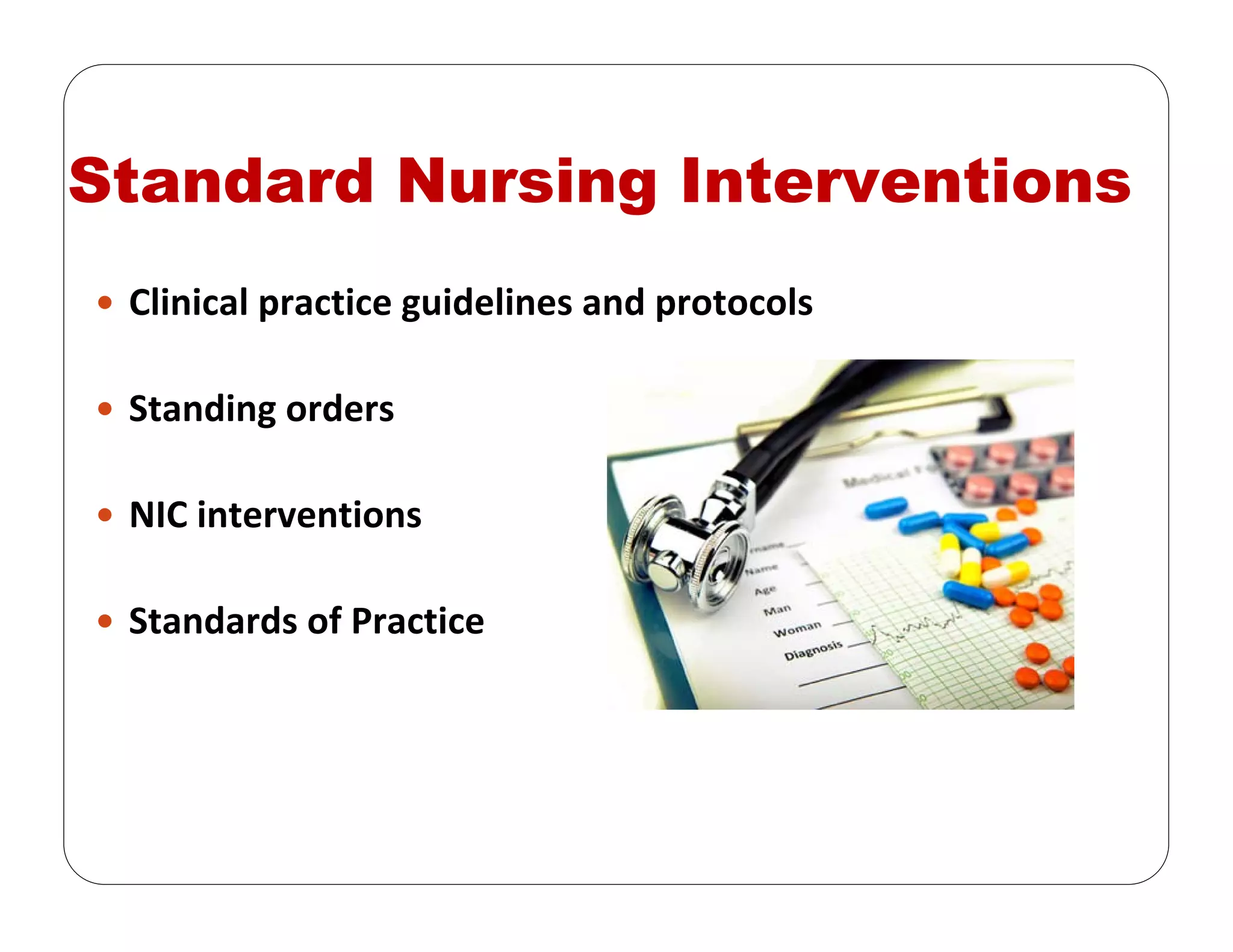
Standard Nursing Interventions
Clinical practice guidelines and protocols
Standing orders
NIC interventions
Standards of Practice
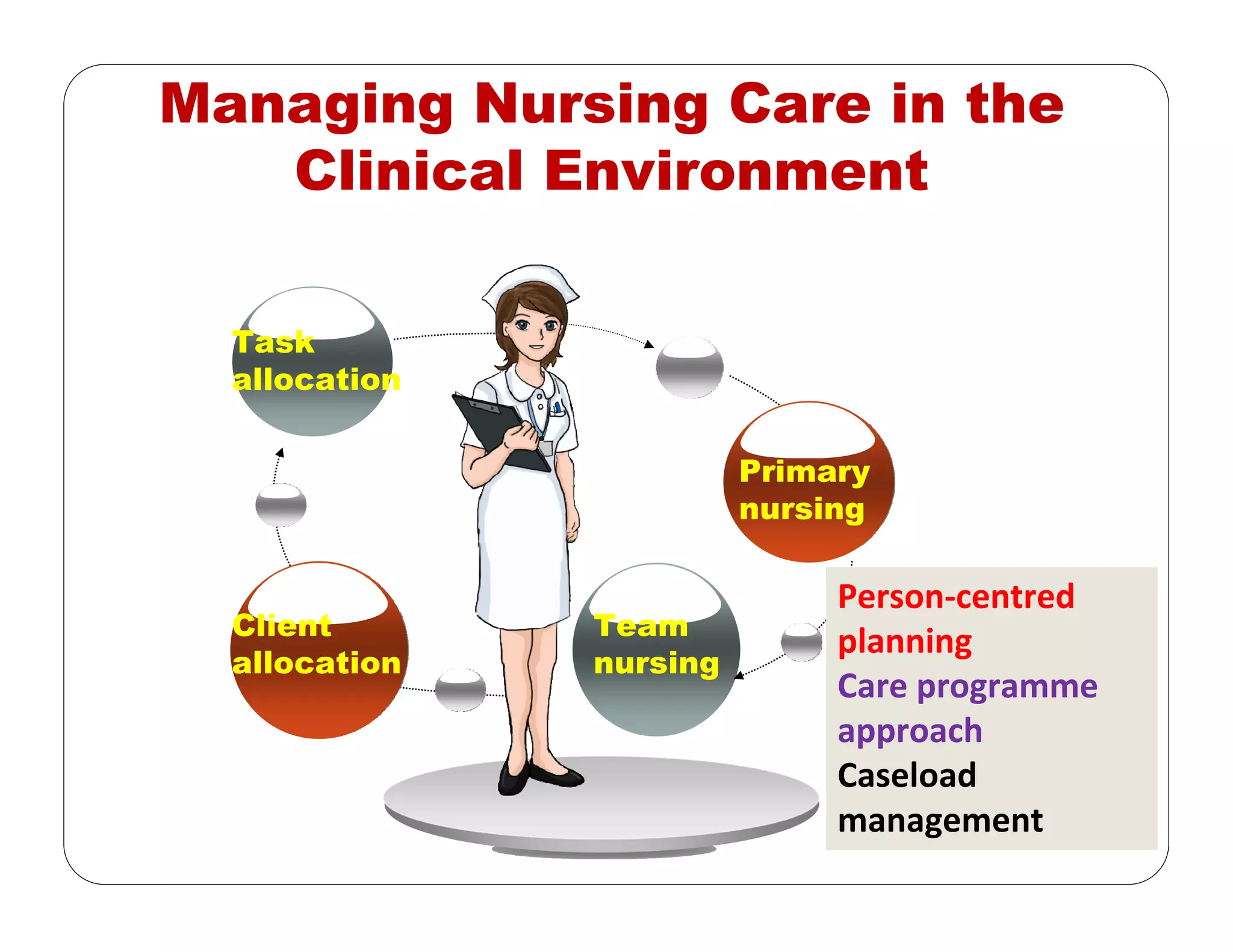
Task
allocation
Title
Managing Nursing Care in the
Clinical Environment
Client
allocation
Team
nursing
Primary
nursing
Person‐centred 
planning
Care programme 
approach
Caseload 
management
Implementation process
1. Reassessing the client
2. Reviewing and revising the existing nursing care plan
3. Organizing resources and care delivery
4. Anticipating and preventing complications
5. Implementing nursing interventions.
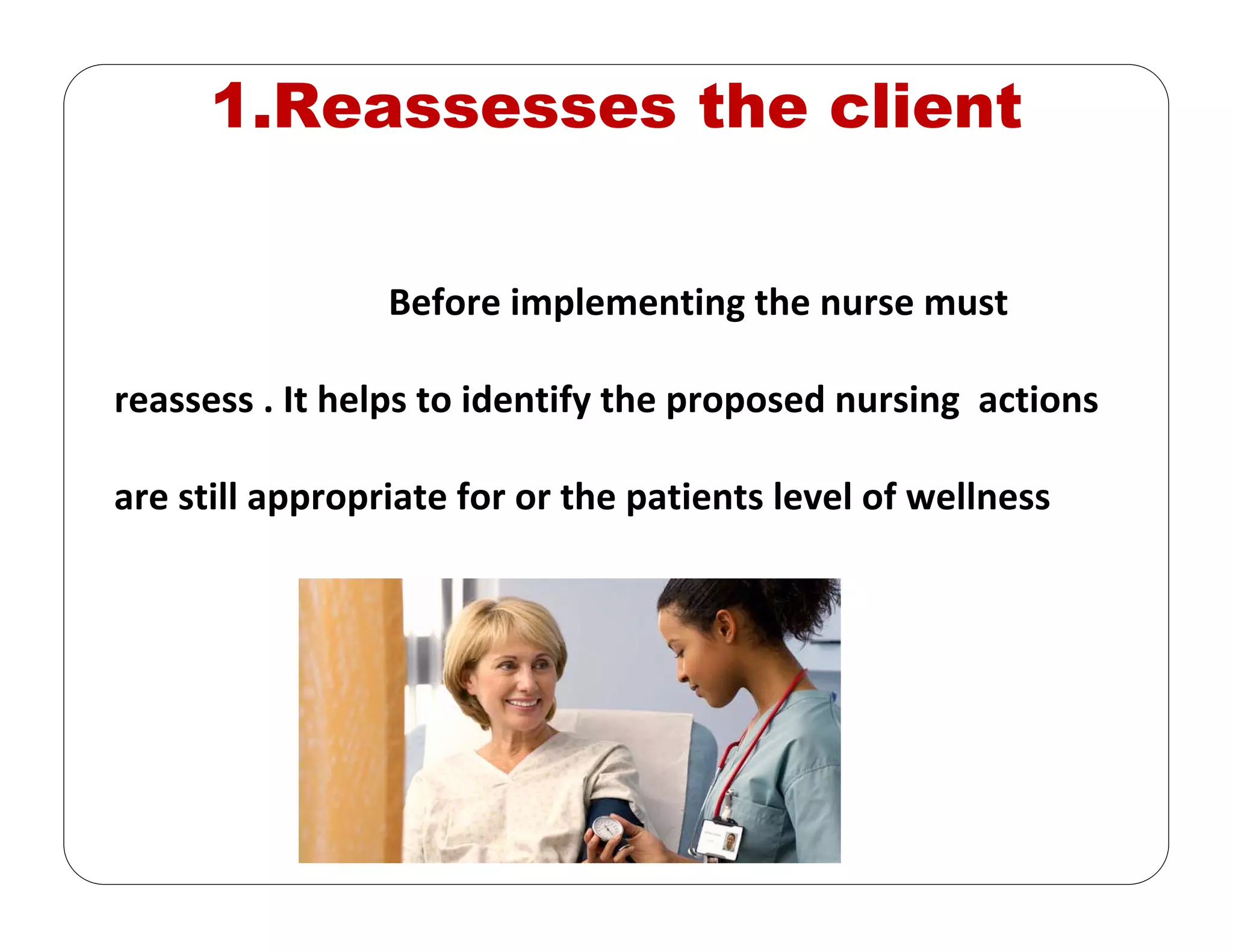
1.Reassesses the client
Before implementing the nurse must
reassess . It helps to identify the proposed nursing  actions 
are still appropriate for or the patients level of wellness
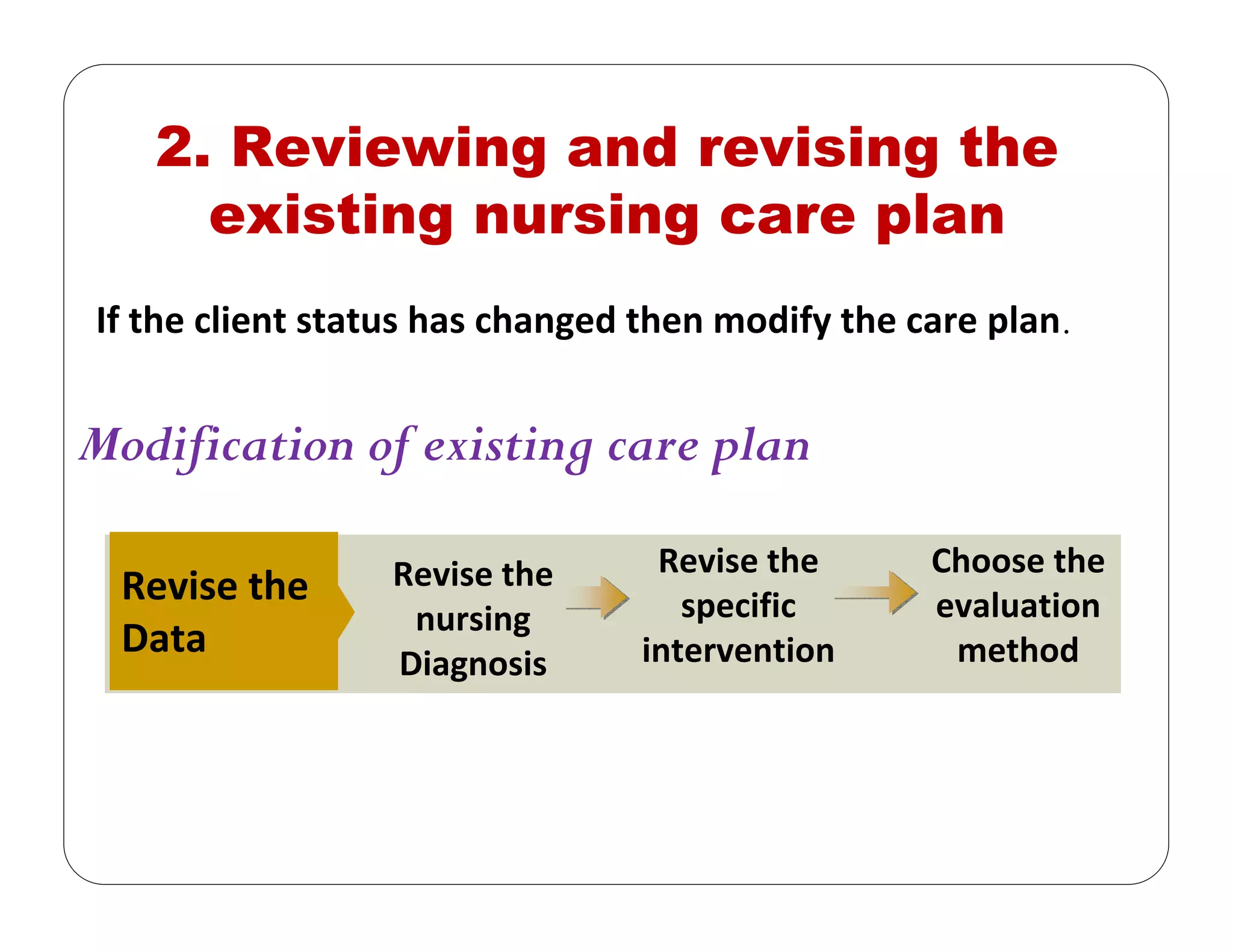
2. Reviewing and revising the
existing nursing care plan
If the client status has changed then modify the care plan.
Modification of existing care plan
Revise the 
Data
Revise the 
nursing 
Diagnosis
Revise the 
specific 
intervention
Choose the 
evaluation 
method
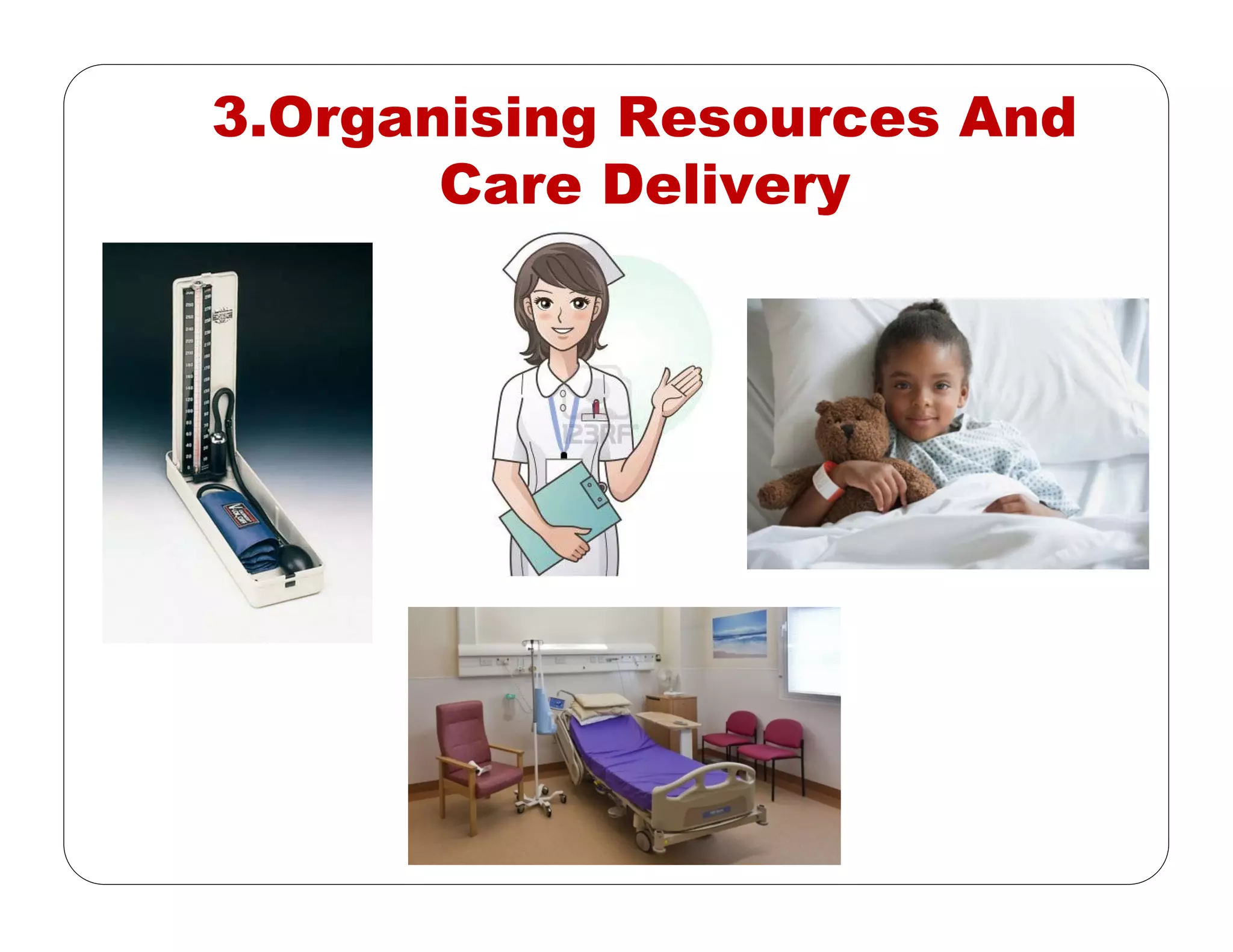
3.Organising Resources And
Care Delivery
4. Anticipating and preventing
complications
It can be resulted from both the illness and 
treatment.
A nurse with a 
Thorough Knowledge on pathophysiology
Thorough   assessment
Scientific rationale for interventions
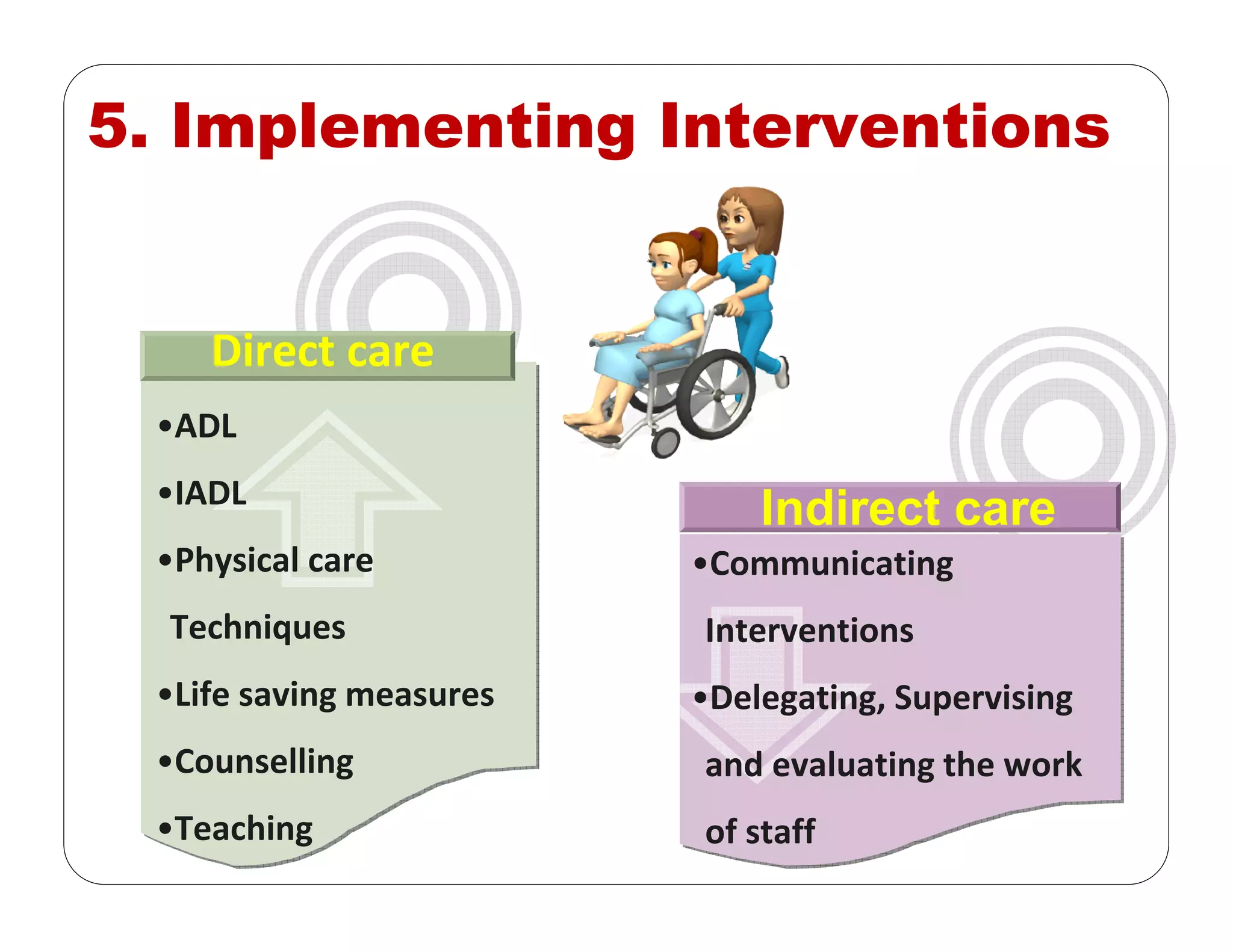
5. Implementing Interventions
Indirect care
Direct care
•ADL
•IADL
•Physical care 
Techniques
•Life saving measures
•Counselling 
•Teaching
•Communicating 
Interventions
•Delegating, Supervising 
and evaluating the work 
of staff
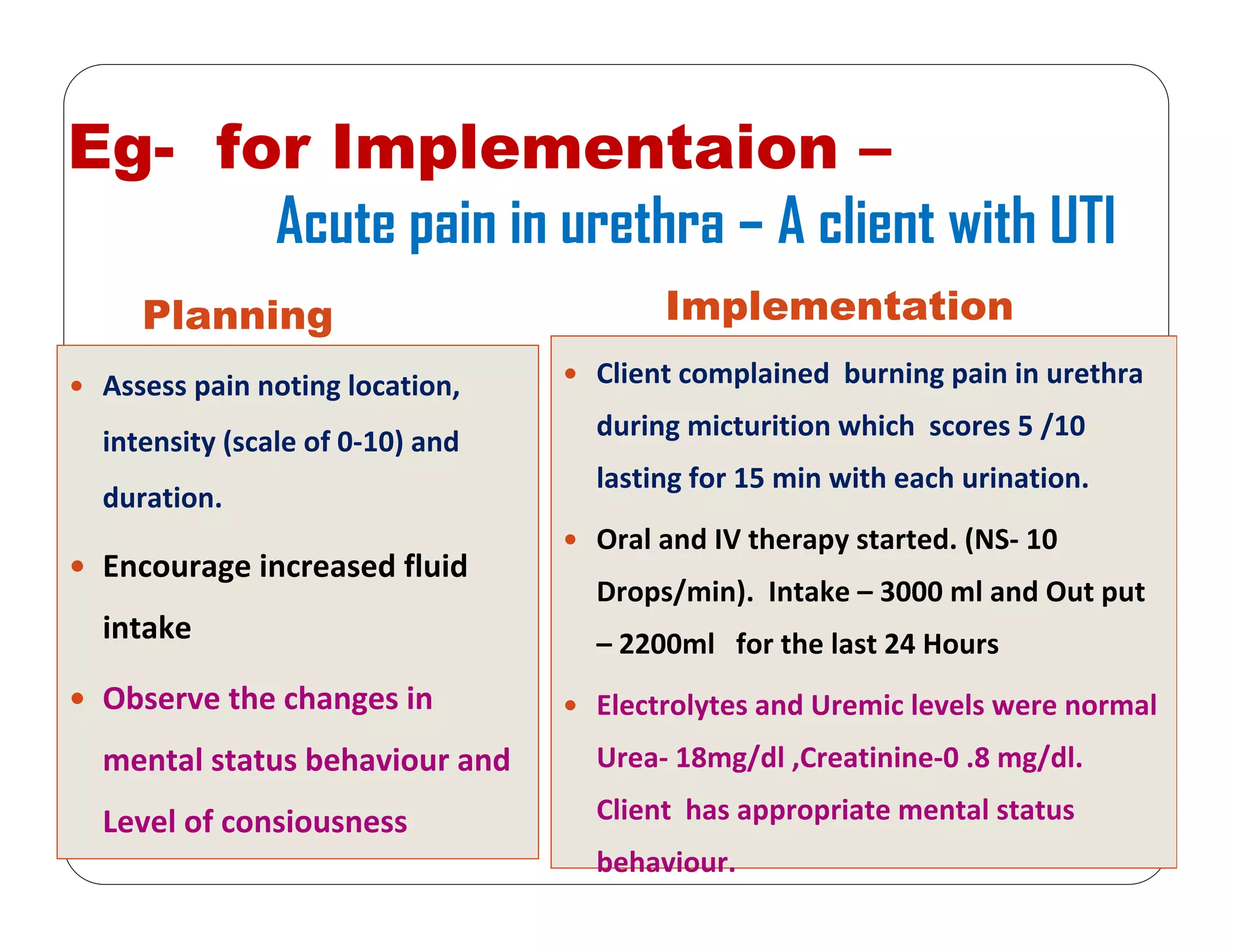
Eg- for Implementaion –
Acute pain in urethra – A client with UTI
Planning Implementation
Assess pain noting location, 
intensity (scale of 0‐10) and 
duration.
Encourage increased fluid 
intake
Observe the changes in 
mental status behaviour and 
Level of consiousness
Client complained  burning pain in urethra 
during micturition which  scores 5 /10 
lasting for 15 min with each urination.
Oral and IV therapy started. (NS‐ 10 
Drops/min).  Intake – 3000 ml and Out put 
– 2200ml   for the last 24 Hours
Electrolytes and Uremic levels were normal  
Urea‐ 18mg/dl ,Creatinine‐0 .8 mg/dl. 
Client  has appropriate mental status   
behaviour. 
Evaluation
Evaluation is defined as the judgment of the 
effectiveness of nursing care to meet client goals; in this 
phase nurse compare the client behavioral responses with 
predetermined client goals and outcome criteria. 
{CRAVEN 1996} 
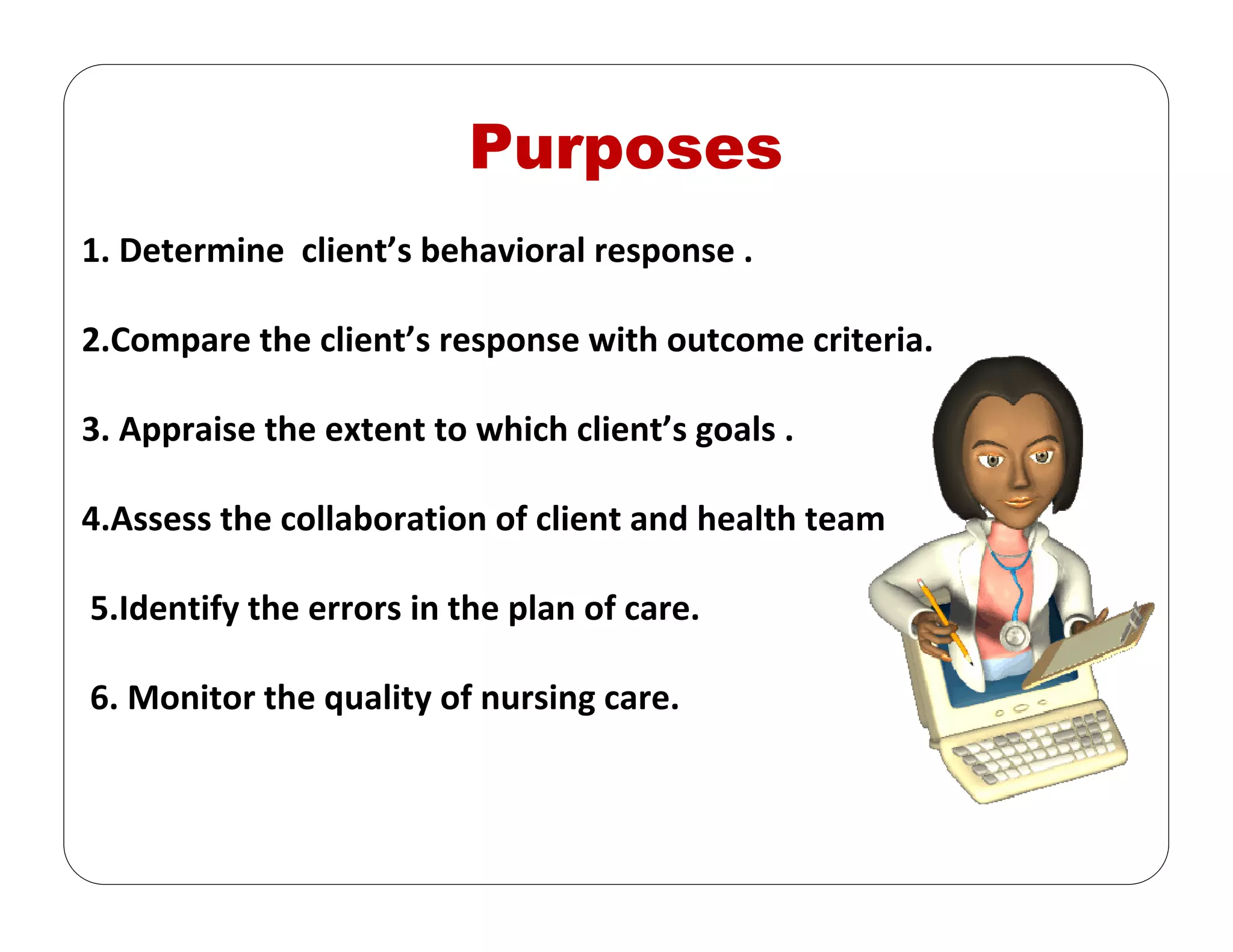
Purposes
1. Determine  client’s behavioral response .
2.Compare the client’s response with outcome criteria.
3. Appraise the extent to which client’s goals .
4.Assess the collaboration of client and health team
5.Identify the errors in the plan of care.
6. Monitor the quality of nursing care. 
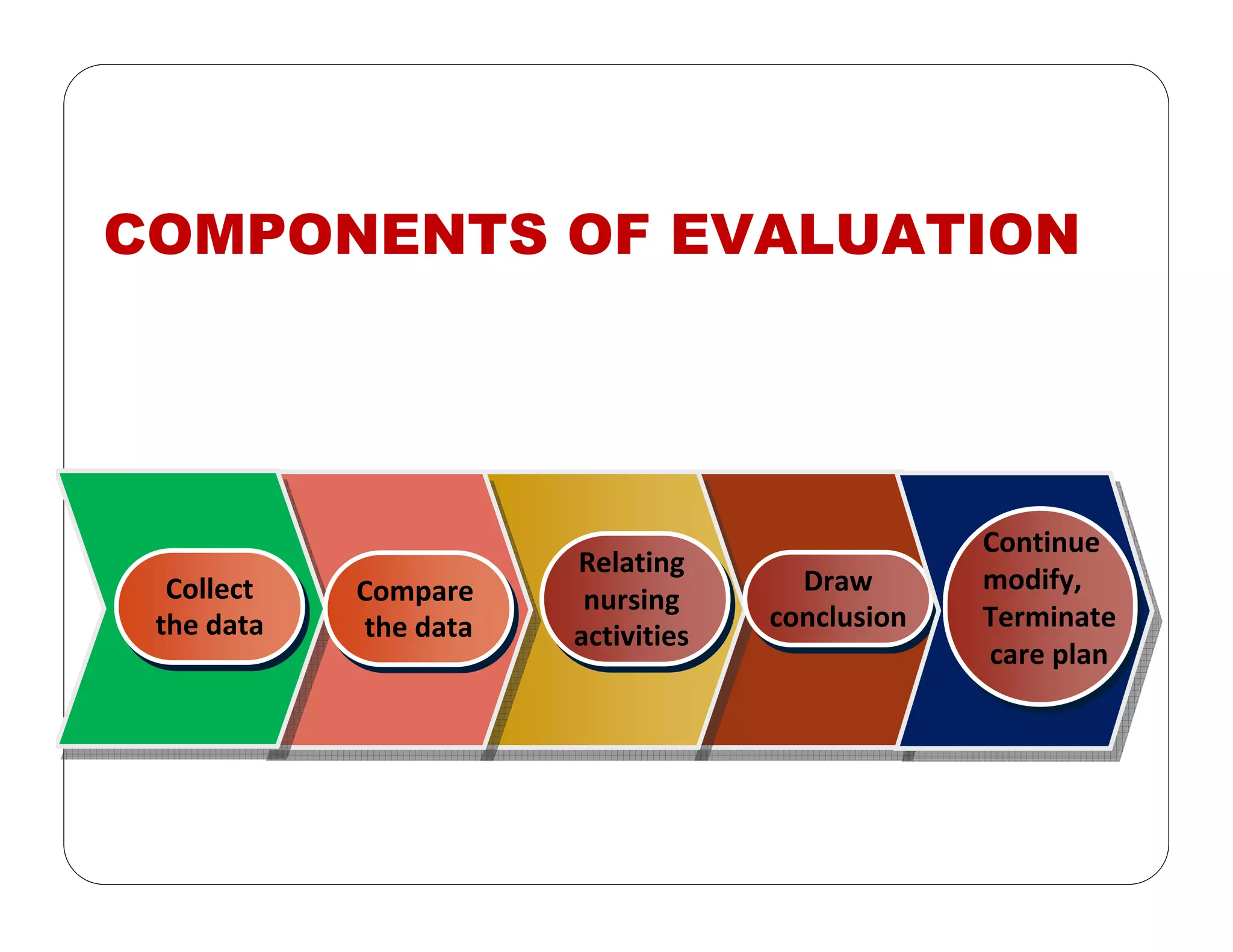
COMPONENTS OF EVALUATION
Draw
conclusion
Draw
conclusion
Collect
the data
Collect
the data
Compare 
the data
Compare 
the data
Continue
modify,  
Terminate 
care plan 
Continue
modify,  
Terminate 
care plan 
Relating 
nursing 
activities 
Relating 
nursing 
activities 
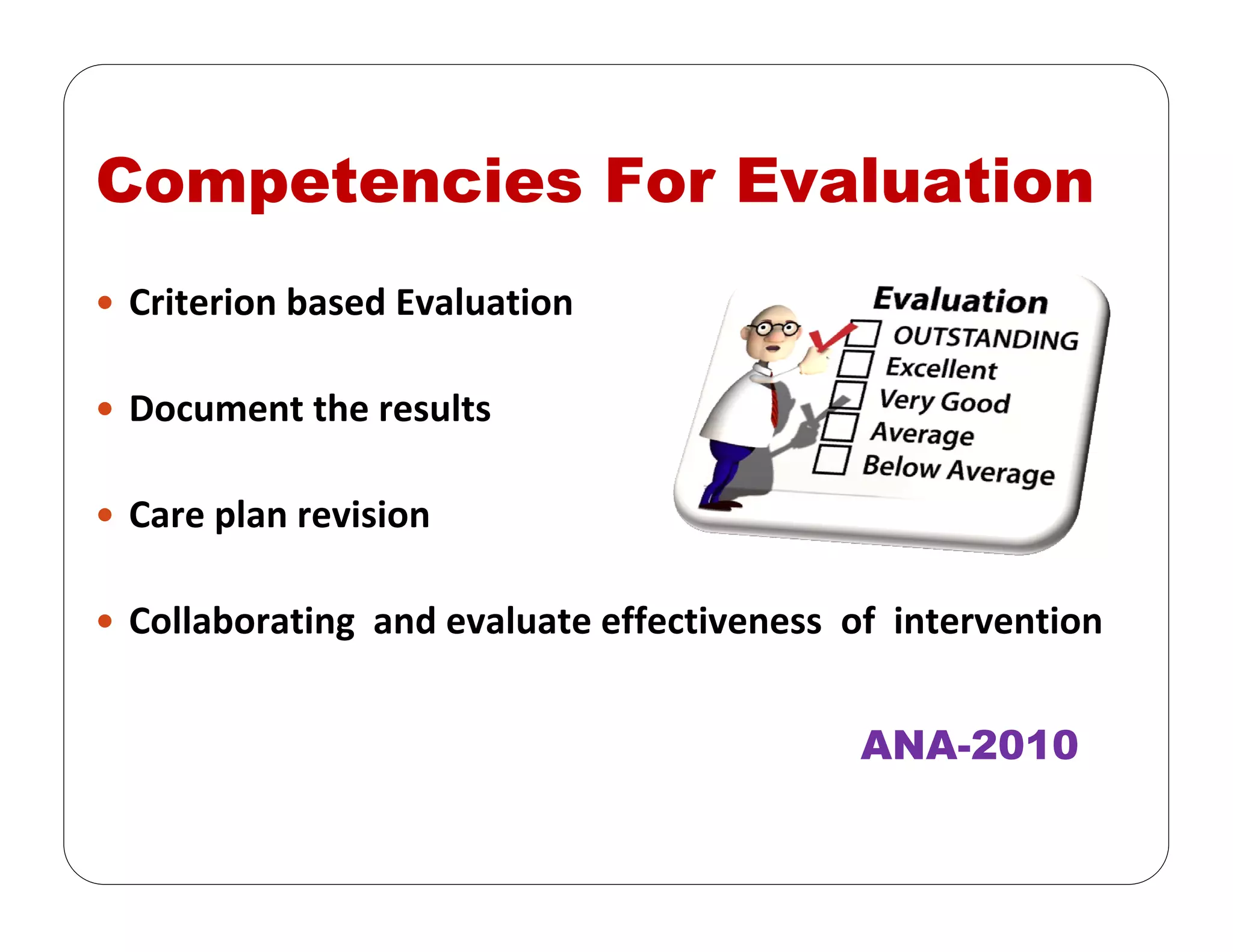
Competencies For Evaluation
Criterion based Evaluation
Document the results
Care plan revision
Collaborating  and evaluate effectiveness  of  intervention
ANA-2010
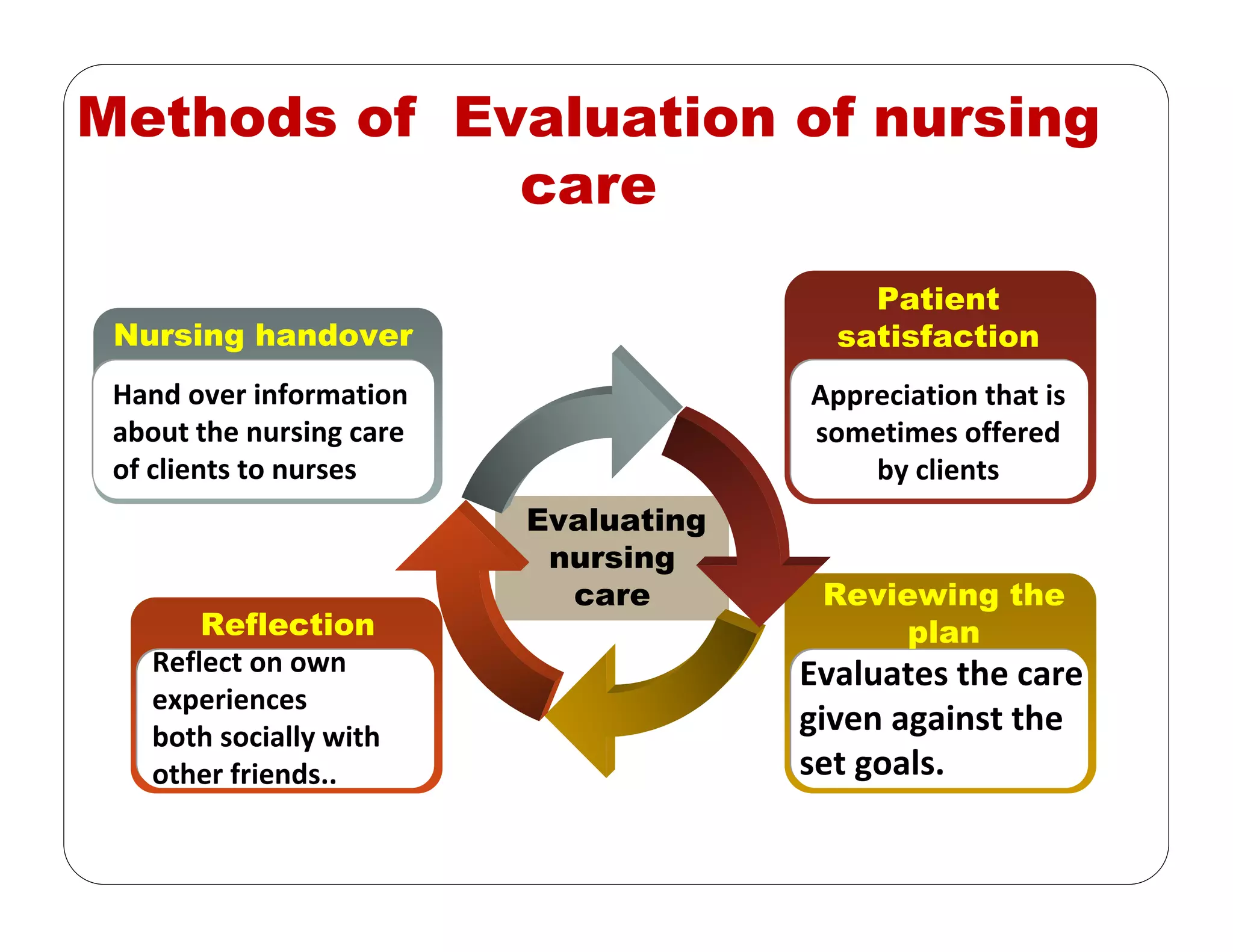
Methods of Evaluation of nursing
care
Evaluating
nursing
care
Reflection
Reflect on own  
experiences
both socially with 
other friends..
Nursing handover
Hand over information 
about the nursing care 
of clients to nurses
Reviewing the
plan
Evaluates the care 
given against the 
set goals.
Patient
satisfaction
Appreciation that is 
sometimes offered 
by clients
Evaluation skill required for
nurses
Know the hospital policies, procedure and protocols of 
interventions and recording
Up to date knowledge and information of many subject. 
Intellectual and technical skill
Knowledge and skill of collecting subjective data and 
objective data. 
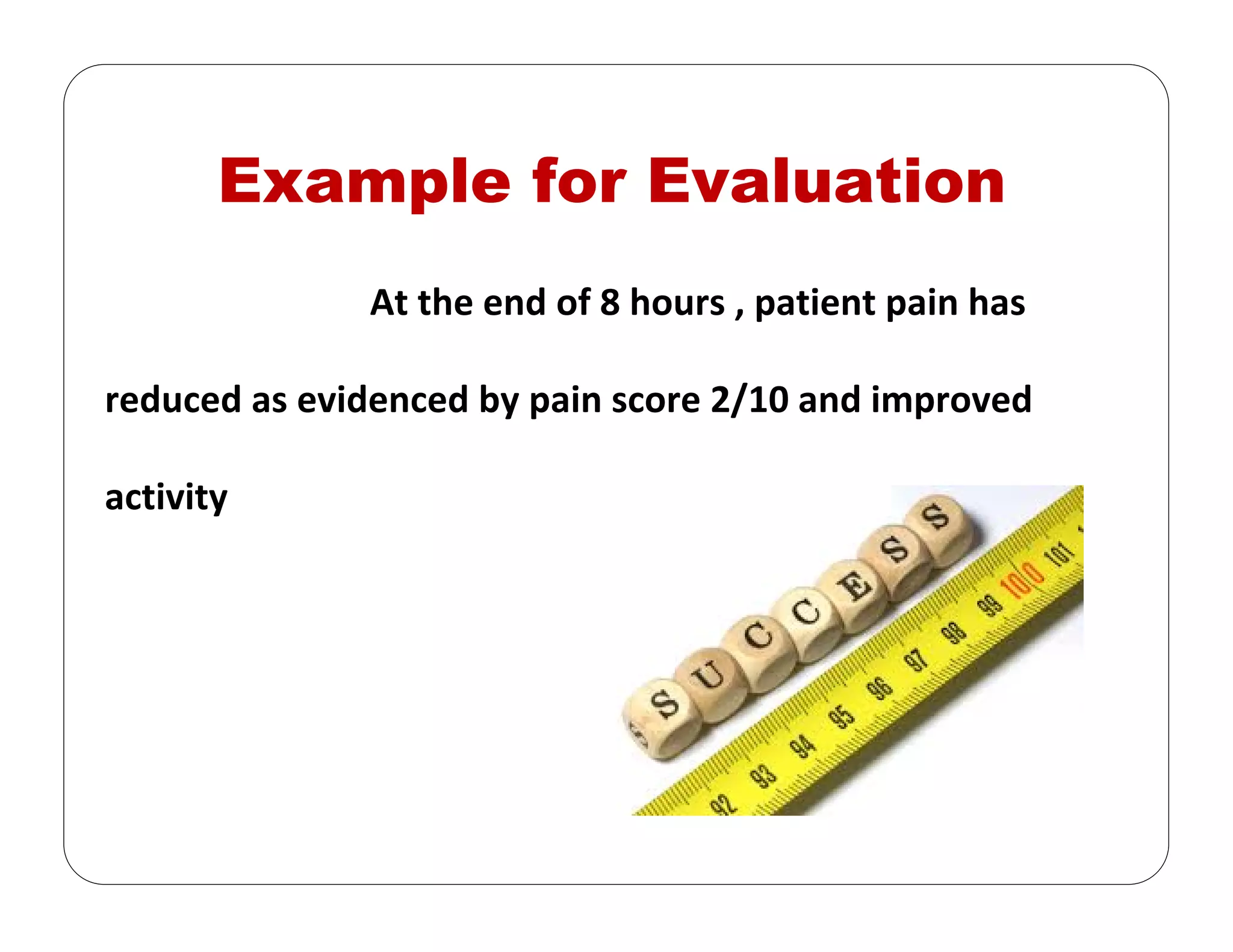
Example for Evaluation
At the end of 8 hours , patient pain has 
reduced as evidenced by pain score 2/10 and improved 
activity 
Steps in nursing process

Steps in nursing process