Consumer Directed Care – More
Choice or Voice for Older People?
Carrie Hayter
PhD Candidate
Faculty of Education and Social Work
University of Sydney
Big Ideas on Ageing
ACH Group
Sir Keith Wilson Oration
South Australian Gerontology Conference
October 2013
Purpose
• Why consumer directed care?
– Different ideological perspectives
– Policy landscape in Australia
– Assumptions of consumer directed care
• What are the proposed benefits of consumer
directed care?
– Choice and control
– Flexibility and innovation
– Hearing the ‘voice’ of older people
Purpose
• What are the risks of consumer directed care?
– Assumptions and mechanisms for choice
– Assumptions and mechanisms for voice
• Implications
– Policy
– Research
– Practice
Methodology
• Literature review
– PhD research
• Historical perspective
– Lessons from reflecting on the history of aged
care policy in Australia
• Reflecting on policy and practice
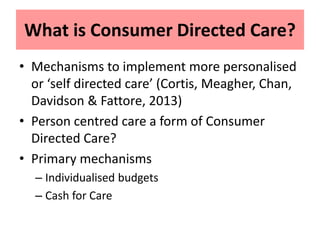
What is Consumer Directed Care?
• Mechanisms to implement more personalised
or ‘self directed care’ (Cortis, Meagher, Chan,
Davidson & Fattore, 2013)
• Person centred care a form of Consumer
Directed Care?
• Primary mechanisms
– Individualised budgets
– Cash for Care
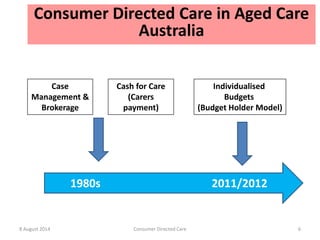
8 August 2014
Case
Management &
Brokerage
Individualised
Budgets
(Budget Holder Model)
Consumer Directed Care 6
Cash for Care
(Carers
payment)
Consumer Directed Care in Aged Care
Australia
1980s 2011/2012
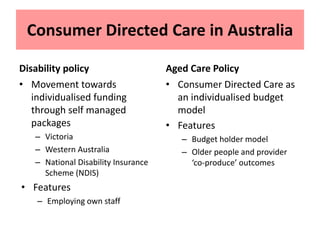
Consumer Directed Care in Australia
Disability policy
• Movement towards
individualised funding
through self managed
packages
– Victoria
– Western Australia
– National Disability Insurance
Scheme (NDIS)
• Features
– Employing own staff
Aged Care Policy
• Consumer Directed Care as
an individualised budget
model
• Features
– Budget holder model
– Older people and provider
‘co-produce’ outcomes
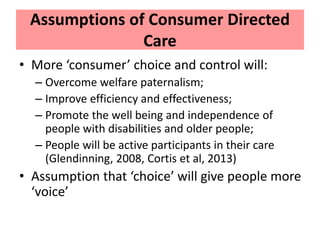
Assumptions of Consumer Directed
Care
• More ‘consumer’ choice and control will:
– Overcome welfare paternalism;
– Improve efficiency and effectiveness;
– Promote the well being and independence of
people with disabilities and older people;
– People will be active participants in their care
(Glendinning, 2008, Cortis et al, 2013)
• Assumption that ‘choice’ will give people more
‘voice’
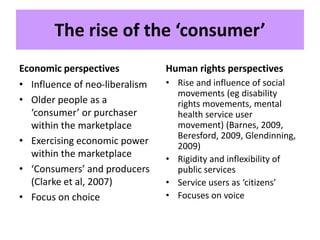
The rise of the ‘consumer’
Economic perspectives
• Influence of neo-liberalism
• Older people as a
‘consumer’ or purchaser
within the marketplace
• Exercising economic power
within the marketplace
• ‘Consumers’ and producers
(Clarke et al, 2007)
• Focus on choice
Human rights perspectives
• Rise and influence of social
movements (eg disability
rights movements, mental
health service user
movement) (Barnes, 2009,
Beresford, 2009, Glendinning,
2009)
• Rigidity and inflexibility of
public services
• Service users as ‘citizens’
• Focuses on voice
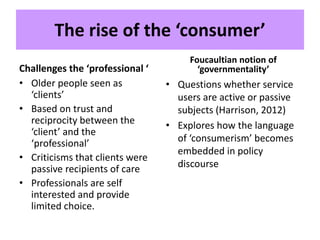
The rise of the ‘consumer’
Challenges the ‘professional ‘
• Older people seen as
‘clients’
• Based on trust and
reciprocity between the
‘client’ and the
‘professional’
• Criticisms that clients were
passive recipients of care
• Professionals are self
interested and provide
limited choice.
Foucaultian notion of
‘governmentality’
• Questions whether service
users are active or passive
subjects (Harrison, 2012)
• Explores how the language
of ‘consumerism’ becomes
embedded in policy
discourse
What does having choice mean?
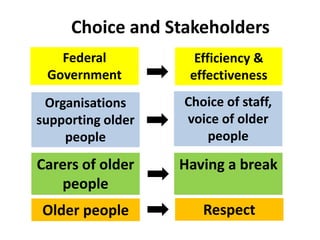
Choice and Stakeholders
Older people
Carers of older
people
Organisations
supporting older
people
Efficiency &
effectiveness
Respect
Having a break
Choice of staff,
voice of older
people
Federal
Government
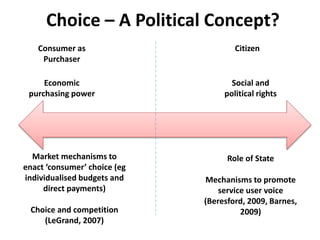
Choice – A Political Concept?
Consumer as
Purchaser
Market mechanisms to
enact ‘consumer’ choice (eg
individualised budgets and
direct payments)
Choice and competition
(LeGrand, 2007)
Citizen
Role of State
Mechanisms to promote
service user voice
(Beresford, 2009, Barnes,
2009)
Social and
political rights
Economic
purchasing power
Risks of Consumer Directed Care
• Service Users
– Access to economic
resources can effect
ability to act as a
‘consumer’
(Glendinning, 2008, Le
Grand, 2007)
– Older people may not
be prepared to act as
‘consumers’ (Moffatt
et al 2011)
• Service Users
• Low take up of
individualised budgets
of older people
(Glendinning et al 2008,
Moran et al, 2013)
• Mixed evidence about
the benefits for older
people.
• Privatisation of care
(Glendinning, 2012)
Risks of Consumer Directed Care
• Workforce
– Move towards
contracting
– Service continuity and job
security
– Income security
– Quality and skills of
workforce (Cortis et al,
2013)
• Providers
– Market may not respond to
the interests of service
users (Glendinning, 2008)
– Appropriate supply of
providers and types of
services
– Administrative costs of
administering
individualised budgets
(Cortis et al, 2013,
Wilberforce et al, 2011)
Risks of Consumer Directed Care
• Government
– Access and equity
– Reduces cross
subsidisation of funding
a feature of block
funding
– Funding may not meet
all needs (Moran et al,
2013)
• Other
– Risks commodifying and
privatising social and
collective responsibilities
for care (Glendinning,
2009, pg 190)
Australia’s Aged Care System
• Mixed economy of care
• Hybrid system where informal supported by the formal
Managed Market
– Hybrid and Competitive Tendering and Contracting (Davidson,
2011/12)
• Limited choice and control for older people (Productivity
Commission, 2011)
• Power is vested in the provider
• Consumer Directed Care - Packaged Care
– Individualised budget holder model
Voice rather than choice?
“I am here to listen but not ask
questions”
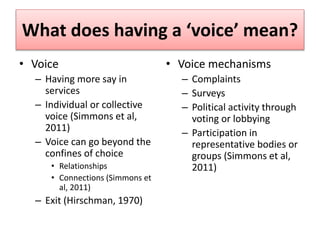
What does having a ‘voice’ mean?
• Voice
– Having more say in
services
– Individual or collective
voice (Simmons et al,
2011)
– Voice can go beyond the
confines of choice
• Relationships
• Connections (Simmons et
al, 2011)
– Exit (Hirschman, 1970)
• Voice mechanisms
– Complaints
– Surveys
– Political activity through
voting or lobbying
– Participation in
representative bodies or
groups (Simmons et al,
2011)
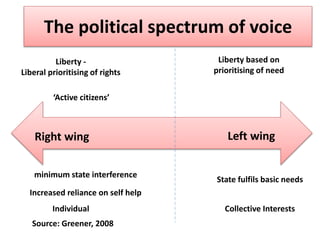
The political spectrum of voice
Liberty -
Liberal prioritising of rights
minimum state interference
State fulfils basic needs
Source: Greener, 2008
Right wing Left wing
Liberty based on
prioritising of need
Increased reliance on self help
Individual
‘Active citizens’
Collective Interests
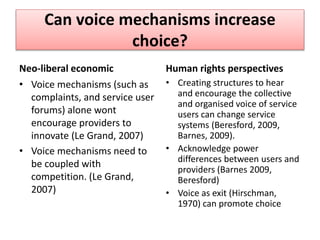
Can voice mechanisms increase
choice?
Neo-liberal economic
• Voice mechanisms (such as
complaints, and service user
forums) alone wont
encourage providers to
innovate (Le Grand, 2007)
• Voice mechanisms need to
be coupled with
competition. (Le Grand,
2007)
Human rights perspectives
• Creating structures to hear
and encourage the collective
and organised voice of service
users can change service
systems (Beresford, 2009,
Barnes, 2009).
• Acknowledge power
differences between users and
providers (Barnes 2009,
Beresford)
• Voice as exit (Hirschman,
1970) can promote choice
Voice mechanisms and Aged Care in
Australia
• Aged care system dominated by interests of professionals,
providers and government (Sax, 1990, Gibson, 1998)
– Older people seen but not heard
• Emergence of voice mechanisms in the late 1980s early
1990s
– User rights strategies through National Standards
– Limited awareness and impact on older people (Gibson, 1998,
House of Representatives Standing Committee on Community
Affairs, 1994)
– Consultative structures for older people in policy processes
(Howe, 1992)
– Impact on policy outcomes and changes?
Voice mechanisms and Aged Care in
Australia
• Organised voice of older people through
consumer groups
– Growing awareness of the ‘voice’ of older people
– Will this translate into changes in practice?
• Challenging staff attitudes to ageing
• Structures to hear the voices of older people (Barnes &
Bennett, 1998)
• Appropriate structures for different groups of older
people
Risks of voice mechanisms and
Consumer Directed Care
• Voice alone wont change behaviour of
providers (Le Grand, 2007)
– Aged care in Australia
• Providers may not ‘hear’ the voices of older
people
– Ignores power differences between older people
and providers (Ottmann et al, 2011).
• ‘Organised voice’ of older people
– Interests they represent
Benefits of voice mechanisms and
Consumer Directed Care
• Citizenship
– Individual and collective mechanisms (Simmons et al,
2011)
– Vehicle for politicising older people
• Opportunity for engagement
– Explore depth of feeling (Simmons et al, 2011)
– Collective or group response (Barnes & Bennett, 1998)
• Partnerships
– Older people and providers co-produce outcomes
Policy Implications of Choice and
Voice
• Risk of ‘one model’ of consumer directed care
– Will individualised budgets cater to the diversity of
older people?
• Mixed evidence of benefits of individualised budgets
for older people in the UK (Moran et al, 2013)
• Resources and support
– How are providers supported to manage and
adapt to changes?
• Diversity of policy responses to respond to the
diversity of older people
Policy Implications of Choice and
Voice
• Older people
– Engaged and politically active
– How to engage people who are vulnerable
because of physical health and or cognitive issues?
– Challenge stereotypes of ageism
– Provide appropriate political structures to ensure
the voices or organised voices of older people are
heard
Further Research
• Research on the perspectives of older people
– How different cohorts of older people respond to
individualised budgets
– Expectations of different cohorts of older people
– Older people from Culturally and Linguistically
Diverse (CALD) backgrounds and Aboriginal and
Torres Strait Islander people
Further Research
• Research on workers experience of consumer
directed models
– Limited research on the experiences of support
workers in consumer directed models
Conclusion
• Choice is not the only fruit
• Voice can be a mechanism for more ‘choice’
• Whose interests are we trading off in the
interests of choice as part of Consumer
Directed Care?
– Trade off conditions of workers will this have a
direct impact on quality of care?
– Preparing and supporting older people
– Engaging and supporting carers
Bibliography
Barnes, M. (2009). Authoritative Consumers or Experts by Experience? User Groups in Health and Social Care In
R. Simmons, Powell, M., & Greener, I., (Ed.), The Consumer in Public Services, Choice, Values and Difference, .
Bristol: The Policy Press
Barnes, M., & Bennett, G. (1998). Frail bodies, courageous voices: older people influencing community care.
Health & Social Care in the Community, 6(2), 102-111. doi: 10.1046/j.1365-2524.1998.00105.x
Boxall , K., Dowson, S., & Beresford, P. (2009) Selling Individual Budgets, Choice and Control: Local and Global
Influences on UK Social Care Policy for People with Learning Difficulties, Policy & Politics, 37(4), 499-515
Barnes, M., & Bennett, G. (1998). Frail bodies, courageous voices: older people influencing community care.
Health & Social Care in the Community, 6(2), 102-111. doi: 10.1046/j.1365-2524.1998.00105.x
Beresford, P. (2009). Differentiated Consumers? A Differentiated View from a Service User Perspective In R.
Simmons, Powell, M., & Greener, I., (Ed.), The Consumer in Public Services, Choice, Values and Difference
Clarke, Newman, J., Smith, N., Vidler, E., & Westermarland, L. (2007). Creating Citizen- Consumers, Changing
Publics and Changing Public Services. London Sage.
Clarke, J., Newman, J., & Westmarland, L. (2008). The Antagonisms of Choice: New Labour and the reform of
public services. Social Policy and Society, 7(02), 245-253. doi: doi:10.1017/S1474746407004198
Bibliography
Clarke, J., Smith, N., & Vidler, E. (2006). The Indeterminacy of Choice: Political, Policy and Organisational
Implications. Social Policy & Society, 5(3), 327–336.
Cortis, N., Meagher, G., Chan, S., Davidson, B., & Fattore, T. (2013). Building an Industry of Choice: Service Quality,
Workforce Capacity and Consumer-Centred Funding in Disability Care. Sydney Social Policy Research Centre
Department of Health Housing Community Services. (1992). It's your choice: National evaluation of community
options projects Canberra: Australian Government Publishing Service
Glendinning, C., Challis, D., Fernández, J., Jacobs, S., Jones, K., Knapp, K., Wilberforce, M. (2008). Evaluation of the
Individual Budgets Pilot Program York: Social Policy Research Unit
Glendinning, C. (2009). The Consumer in Social Care In R. Simmons, Powell, M., & Greener, I., (Ed.), The Consumer
in Public Services, Choice, Values and Difference Bristol The Policy Press
Greener, I. (2008). Choice and Voice – A Review. Social Policy and Society, 7(02), 255-265. doi:
doi:10.1017/S1474746407004204
Le Grand, J. (2007). Choice and
Moran, N., Glendinning, C., Wilberforce, M., Stevens, M., Nettens, N., Jones, K., Manthorpe, J., Knapp, M.,
Fernandez, J., Challis, D., & Jacobs, S. (2013) Older people’s experience of cash-for-care schemes: evidence from
the English Individual Budget pilot projects, Ageing and Society 33, pp 826-851
Bibliography
Ottmann, G., Laragy, C., Allen, J., & Feldman, P. (2011). Coproduction in Practice: Participatory Action Research
to Develop a Model of Community Aged Care. Systemic Practice and Action Research, 24(5), 413-427. doi:
10.1007/s11213-010-9181-5 http://dx.doi.org/10.1007/s11213-011-9192-x
Productivity Commission. (2011 ). Caring for Older Australians, Report no 53, Final Inquiry Report Canberra
Australian Government
Schwartz, B. (2004). The paradox of choice - When more is less? New York Harper Collins Publishers
Simmons, R. (2009). Understanding the Differentiated Consumer in Public Services In R. Simmons, M. Powell &
I. Greener (Eds.), The Consumer in Public Services, Choice, Values and Difference Bristol The Policy Press.
Simmons, R., Birchall, J., & Prout, A. (2011). User Involvement in Public Services: ‘Choice about Voice’. Public
Policy and Administration, 27(1), 3-29. doi: 10.1177/0952076710384903
Wilberforce, M., Glendinning, C, Challis, D, Fernandex, J-L, Jacobs, S., Jones, K., Knapp, M, Manthorpe, J.,
Moran, N., Netten, A., & Stevens, M., (2011) ‘Implementing Consumer Choice in Long-Term Care: The Impact of
Individual Budgets on Social Care Providers in England’, Social Policy & Administration, 45 (5), 593-612
Contact Details
Carrie Hayter
Email: carriehayter@gmail.com
Linked in:http://au.linkedin.com/pub/carrie-
hayter/34/536/517/
Twitter @carriehayter

Consumer Directed Care - More Choice or Voice for Older People?

  • 1.
    Consumer Directed Care– More Choice or Voice for Older People? Carrie Hayter PhD Candidate Faculty of Education and Social Work University of Sydney Big Ideas on Ageing ACH Group Sir Keith Wilson Oration South Australian Gerontology Conference October 2013
  • 2.
    Purpose • Why consumerdirected care? – Different ideological perspectives – Policy landscape in Australia – Assumptions of consumer directed care • What are the proposed benefits of consumer directed care? – Choice and control – Flexibility and innovation – Hearing the ‘voice’ of older people
  • 3.
    Purpose • What arethe risks of consumer directed care? – Assumptions and mechanisms for choice – Assumptions and mechanisms for voice • Implications – Policy – Research – Practice
  • 4.
    Methodology • Literature review –PhD research • Historical perspective – Lessons from reflecting on the history of aged care policy in Australia • Reflecting on policy and practice
  • 5.
    What is ConsumerDirected Care? • Mechanisms to implement more personalised or ‘self directed care’ (Cortis, Meagher, Chan, Davidson & Fattore, 2013) • Person centred care a form of Consumer Directed Care? • Primary mechanisms – Individualised budgets – Cash for Care
  • 6.
    8 August 2014 Case Management& Brokerage Individualised Budgets (Budget Holder Model) Consumer Directed Care 6 Cash for Care (Carers payment) Consumer Directed Care in Aged Care Australia 1980s 2011/2012
  • 7.
    Consumer Directed Carein Australia Disability policy • Movement towards individualised funding through self managed packages – Victoria – Western Australia – National Disability Insurance Scheme (NDIS) • Features – Employing own staff Aged Care Policy • Consumer Directed Care as an individualised budget model • Features – Budget holder model – Older people and provider ‘co-produce’ outcomes
  • 8.
    Assumptions of ConsumerDirected Care • More ‘consumer’ choice and control will: – Overcome welfare paternalism; – Improve efficiency and effectiveness; – Promote the well being and independence of people with disabilities and older people; – People will be active participants in their care (Glendinning, 2008, Cortis et al, 2013) • Assumption that ‘choice’ will give people more ‘voice’
  • 9.
    The rise ofthe ‘consumer’ Economic perspectives • Influence of neo-liberalism • Older people as a ‘consumer’ or purchaser within the marketplace • Exercising economic power within the marketplace • ‘Consumers’ and producers (Clarke et al, 2007) • Focus on choice Human rights perspectives • Rise and influence of social movements (eg disability rights movements, mental health service user movement) (Barnes, 2009, Beresford, 2009, Glendinning, 2009) • Rigidity and inflexibility of public services • Service users as ‘citizens’ • Focuses on voice
  • 10.
    The rise ofthe ‘consumer’ Challenges the ‘professional ‘ • Older people seen as ‘clients’ • Based on trust and reciprocity between the ‘client’ and the ‘professional’ • Criticisms that clients were passive recipients of care • Professionals are self interested and provide limited choice. Foucaultian notion of ‘governmentality’ • Questions whether service users are active or passive subjects (Harrison, 2012) • Explores how the language of ‘consumerism’ becomes embedded in policy discourse
  • 11.
    What does havingchoice mean?
  • 12.
    Choice and Stakeholders Olderpeople Carers of older people Organisations supporting older people Efficiency & effectiveness Respect Having a break Choice of staff, voice of older people Federal Government
  • 13.
    Choice – APolitical Concept? Consumer as Purchaser Market mechanisms to enact ‘consumer’ choice (eg individualised budgets and direct payments) Choice and competition (LeGrand, 2007) Citizen Role of State Mechanisms to promote service user voice (Beresford, 2009, Barnes, 2009) Social and political rights Economic purchasing power
  • 14.
    Risks of ConsumerDirected Care • Service Users – Access to economic resources can effect ability to act as a ‘consumer’ (Glendinning, 2008, Le Grand, 2007) – Older people may not be prepared to act as ‘consumers’ (Moffatt et al 2011) • Service Users • Low take up of individualised budgets of older people (Glendinning et al 2008, Moran et al, 2013) • Mixed evidence about the benefits for older people. • Privatisation of care (Glendinning, 2012)
  • 15.
    Risks of ConsumerDirected Care • Workforce – Move towards contracting – Service continuity and job security – Income security – Quality and skills of workforce (Cortis et al, 2013) • Providers – Market may not respond to the interests of service users (Glendinning, 2008) – Appropriate supply of providers and types of services – Administrative costs of administering individualised budgets (Cortis et al, 2013, Wilberforce et al, 2011)
  • 16.
    Risks of ConsumerDirected Care • Government – Access and equity – Reduces cross subsidisation of funding a feature of block funding – Funding may not meet all needs (Moran et al, 2013) • Other – Risks commodifying and privatising social and collective responsibilities for care (Glendinning, 2009, pg 190)
  • 17.
    Australia’s Aged CareSystem • Mixed economy of care • Hybrid system where informal supported by the formal Managed Market – Hybrid and Competitive Tendering and Contracting (Davidson, 2011/12) • Limited choice and control for older people (Productivity Commission, 2011) • Power is vested in the provider • Consumer Directed Care - Packaged Care – Individualised budget holder model
  • 18.
    Voice rather thanchoice? “I am here to listen but not ask questions”
  • 19.
    What does havinga ‘voice’ mean? • Voice – Having more say in services – Individual or collective voice (Simmons et al, 2011) – Voice can go beyond the confines of choice • Relationships • Connections (Simmons et al, 2011) – Exit (Hirschman, 1970) • Voice mechanisms – Complaints – Surveys – Political activity through voting or lobbying – Participation in representative bodies or groups (Simmons et al, 2011)
  • 20.
    The political spectrumof voice Liberty - Liberal prioritising of rights minimum state interference State fulfils basic needs Source: Greener, 2008 Right wing Left wing Liberty based on prioritising of need Increased reliance on self help Individual ‘Active citizens’ Collective Interests
  • 21.
    Can voice mechanismsincrease choice? Neo-liberal economic • Voice mechanisms (such as complaints, and service user forums) alone wont encourage providers to innovate (Le Grand, 2007) • Voice mechanisms need to be coupled with competition. (Le Grand, 2007) Human rights perspectives • Creating structures to hear and encourage the collective and organised voice of service users can change service systems (Beresford, 2009, Barnes, 2009). • Acknowledge power differences between users and providers (Barnes 2009, Beresford) • Voice as exit (Hirschman, 1970) can promote choice
  • 22.
    Voice mechanisms andAged Care in Australia • Aged care system dominated by interests of professionals, providers and government (Sax, 1990, Gibson, 1998) – Older people seen but not heard • Emergence of voice mechanisms in the late 1980s early 1990s – User rights strategies through National Standards – Limited awareness and impact on older people (Gibson, 1998, House of Representatives Standing Committee on Community Affairs, 1994) – Consultative structures for older people in policy processes (Howe, 1992) – Impact on policy outcomes and changes?
  • 23.
    Voice mechanisms andAged Care in Australia • Organised voice of older people through consumer groups – Growing awareness of the ‘voice’ of older people – Will this translate into changes in practice? • Challenging staff attitudes to ageing • Structures to hear the voices of older people (Barnes & Bennett, 1998) • Appropriate structures for different groups of older people
  • 24.
    Risks of voicemechanisms and Consumer Directed Care • Voice alone wont change behaviour of providers (Le Grand, 2007) – Aged care in Australia • Providers may not ‘hear’ the voices of older people – Ignores power differences between older people and providers (Ottmann et al, 2011). • ‘Organised voice’ of older people – Interests they represent
  • 25.
    Benefits of voicemechanisms and Consumer Directed Care • Citizenship – Individual and collective mechanisms (Simmons et al, 2011) – Vehicle for politicising older people • Opportunity for engagement – Explore depth of feeling (Simmons et al, 2011) – Collective or group response (Barnes & Bennett, 1998) • Partnerships – Older people and providers co-produce outcomes
  • 26.
    Policy Implications ofChoice and Voice • Risk of ‘one model’ of consumer directed care – Will individualised budgets cater to the diversity of older people? • Mixed evidence of benefits of individualised budgets for older people in the UK (Moran et al, 2013) • Resources and support – How are providers supported to manage and adapt to changes? • Diversity of policy responses to respond to the diversity of older people
  • 27.
    Policy Implications ofChoice and Voice • Older people – Engaged and politically active – How to engage people who are vulnerable because of physical health and or cognitive issues? – Challenge stereotypes of ageism – Provide appropriate political structures to ensure the voices or organised voices of older people are heard
  • 28.
    Further Research • Researchon the perspectives of older people – How different cohorts of older people respond to individualised budgets – Expectations of different cohorts of older people – Older people from Culturally and Linguistically Diverse (CALD) backgrounds and Aboriginal and Torres Strait Islander people
  • 29.
    Further Research • Researchon workers experience of consumer directed models – Limited research on the experiences of support workers in consumer directed models
  • 30.
    Conclusion • Choice isnot the only fruit • Voice can be a mechanism for more ‘choice’ • Whose interests are we trading off in the interests of choice as part of Consumer Directed Care? – Trade off conditions of workers will this have a direct impact on quality of care? – Preparing and supporting older people – Engaging and supporting carers
  • 31.
    Bibliography Barnes, M. (2009).Authoritative Consumers or Experts by Experience? User Groups in Health and Social Care In R. Simmons, Powell, M., & Greener, I., (Ed.), The Consumer in Public Services, Choice, Values and Difference, . Bristol: The Policy Press Barnes, M., & Bennett, G. (1998). Frail bodies, courageous voices: older people influencing community care. Health & Social Care in the Community, 6(2), 102-111. doi: 10.1046/j.1365-2524.1998.00105.x Boxall , K., Dowson, S., & Beresford, P. (2009) Selling Individual Budgets, Choice and Control: Local and Global Influences on UK Social Care Policy for People with Learning Difficulties, Policy & Politics, 37(4), 499-515 Barnes, M., & Bennett, G. (1998). Frail bodies, courageous voices: older people influencing community care. Health & Social Care in the Community, 6(2), 102-111. doi: 10.1046/j.1365-2524.1998.00105.x Beresford, P. (2009). Differentiated Consumers? A Differentiated View from a Service User Perspective In R. Simmons, Powell, M., & Greener, I., (Ed.), The Consumer in Public Services, Choice, Values and Difference Clarke, Newman, J., Smith, N., Vidler, E., & Westermarland, L. (2007). Creating Citizen- Consumers, Changing Publics and Changing Public Services. London Sage. Clarke, J., Newman, J., & Westmarland, L. (2008). The Antagonisms of Choice: New Labour and the reform of public services. Social Policy and Society, 7(02), 245-253. doi: doi:10.1017/S1474746407004198
  • 32.
    Bibliography Clarke, J., Smith,N., & Vidler, E. (2006). The Indeterminacy of Choice: Political, Policy and Organisational Implications. Social Policy & Society, 5(3), 327–336. Cortis, N., Meagher, G., Chan, S., Davidson, B., & Fattore, T. (2013). Building an Industry of Choice: Service Quality, Workforce Capacity and Consumer-Centred Funding in Disability Care. Sydney Social Policy Research Centre Department of Health Housing Community Services. (1992). It's your choice: National evaluation of community options projects Canberra: Australian Government Publishing Service Glendinning, C., Challis, D., Fernández, J., Jacobs, S., Jones, K., Knapp, K., Wilberforce, M. (2008). Evaluation of the Individual Budgets Pilot Program York: Social Policy Research Unit Glendinning, C. (2009). The Consumer in Social Care In R. Simmons, Powell, M., & Greener, I., (Ed.), The Consumer in Public Services, Choice, Values and Difference Bristol The Policy Press Greener, I. (2008). Choice and Voice – A Review. Social Policy and Society, 7(02), 255-265. doi: doi:10.1017/S1474746407004204 Le Grand, J. (2007). Choice and Moran, N., Glendinning, C., Wilberforce, M., Stevens, M., Nettens, N., Jones, K., Manthorpe, J., Knapp, M., Fernandez, J., Challis, D., & Jacobs, S. (2013) Older people’s experience of cash-for-care schemes: evidence from the English Individual Budget pilot projects, Ageing and Society 33, pp 826-851
  • 33.
    Bibliography Ottmann, G., Laragy,C., Allen, J., & Feldman, P. (2011). Coproduction in Practice: Participatory Action Research to Develop a Model of Community Aged Care. Systemic Practice and Action Research, 24(5), 413-427. doi: 10.1007/s11213-010-9181-5 http://dx.doi.org/10.1007/s11213-011-9192-x Productivity Commission. (2011 ). Caring for Older Australians, Report no 53, Final Inquiry Report Canberra Australian Government Schwartz, B. (2004). The paradox of choice - When more is less? New York Harper Collins Publishers Simmons, R. (2009). Understanding the Differentiated Consumer in Public Services In R. Simmons, M. Powell & I. Greener (Eds.), The Consumer in Public Services, Choice, Values and Difference Bristol The Policy Press. Simmons, R., Birchall, J., & Prout, A. (2011). User Involvement in Public Services: ‘Choice about Voice’. Public Policy and Administration, 27(1), 3-29. doi: 10.1177/0952076710384903 Wilberforce, M., Glendinning, C, Challis, D, Fernandex, J-L, Jacobs, S., Jones, K., Knapp, M, Manthorpe, J., Moran, N., Netten, A., & Stevens, M., (2011) ‘Implementing Consumer Choice in Long-Term Care: The Impact of Individual Budgets on Social Care Providers in England’, Social Policy & Administration, 45 (5), 593-612
  • 34.
    Contact Details Carrie Hayter Email:carriehayter@gmail.com Linked in:http://au.linkedin.com/pub/carrie- hayter/34/536/517/ Twitter @carriehayter