Abid Hussain
2019-PQAU-2019
AGB(M.Phil.) PIASA
DNA
Structure & Types
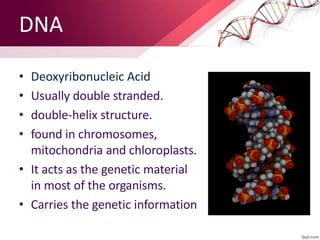
DNA
• Deoxyribonucleic Acid
• Usually double stranded.
• double-helix structure.
• found in chromosomes,
mitochondria and chloroplasts.
• It acts as the genetic material
in most of the organisms.
• Carries the genetic information
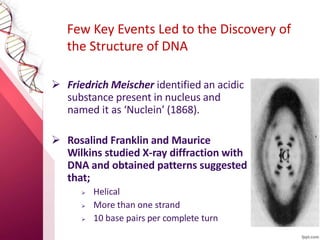
 Friedrich Meischer identified an acidic
substance present in nucleus and
named it as ‘Nuclein’ (1868).
 Rosalind Franklin and Maurice
Wilkins studied X-ray diffraction with
DNA and obtained patterns suggested
that;
 Helical
 More than one strand
 10 base pairs per complete turn
Few Key Events Led to the Discovery of
the Structure of DNA
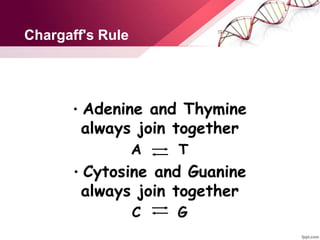
Chargaff's Rule
Watson & Crick Model
• James Watson and
Francis Crick, described
a very simple but famous
Double Helix model for
the structure of DNA
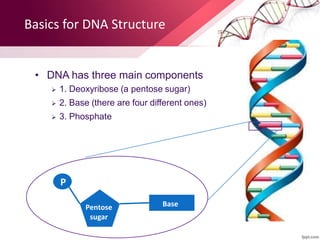
Basics for DNA Structure
• DNA has three main components
 1. Deoxyribose (a pentose sugar)
 2. Base (there are four different ones)
 3. Phosphate
P
Pentose
sugar
Base
Cont.….
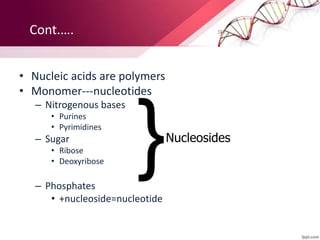
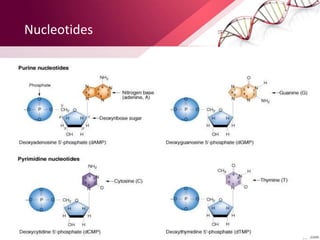
• Nucleic acids are polymers
• Monomer---nucleotides
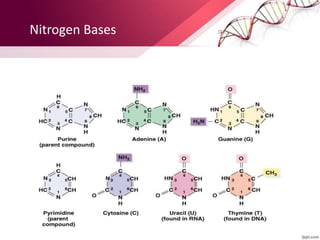
– Nitrogenous bases
• Purines
• Pyrimidines
– Sugar
• Ribose
• Deoxyribose
– Phosphates
• +nucleoside=nucleotide
}Nucleosides
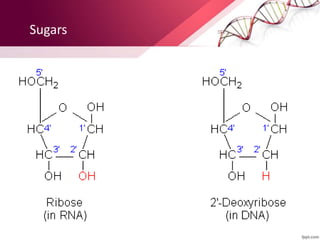
Sugars
NITROGEN BASES
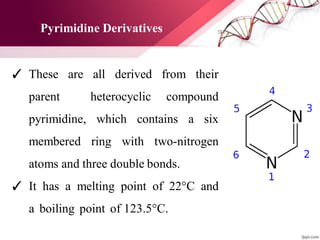
✓ These are all derived from their
parent heterocyclic compound
pyrimidine, which contains a six
membered ring with two-nitrogen
atoms and three double bonds.
✓ It has a melting point of 22°C and
a boiling point of 123.5°C.
Pyrimidine Derivatives
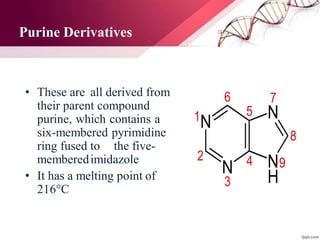
Purine Derivatives
• These are all derived from
their parent compound
purine, which contains a
six-membered pyrimidine
ring fused to the five-
memberedimidazole
• It has a melting point of
216°C
Nitrogen Bases
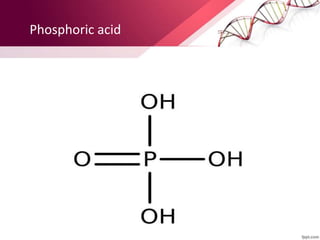
Phosphoric acid
Nucleotides
Structure of DNA
 DNA structure is often divided
into four different levels
 Primary
 Secondary
 Tertiary
 Quaternary.
NH2
N O
N
Bases
O
N O
N
Adenine (A)
Guanine (G)
O
H
Thymine (T)
Backbone
Cytosine (C)
H
H
2′
H
H
H
3′
H
O
O–
O P O CH2
5′
O–
4′
H
H
2′
H
H
H
3′
H
H
O
O
O P O CH2
5′
O–
4′
NH2
N
N
H
N
N
1′
HH
2′
H
HH
O
O
O P O CH2
O–
NH2
N
N
N
H
N
H
H
2′
H
H
H
3′
OH
O
O
O P O CH2
O–
Single
nucleotide
Phosphodiester
linkage
Sugar (deoxyribose)
Phosphate
5′
1′
1′
5′
4′
3′
5′
4′ 1′
CH3
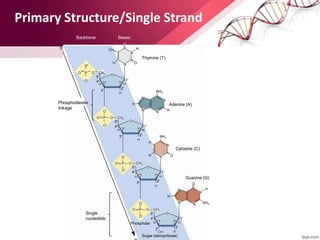
Primary Structure/Single Strand
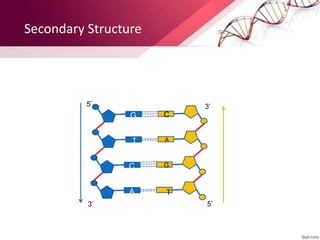
Secondary Structure
G
T
C
A
5’ 3’
3’ 5’
C
A
T
G
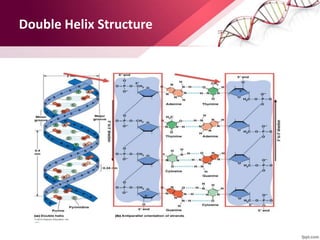
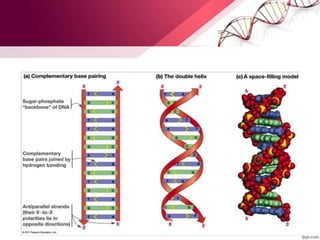
Double Helix Structure
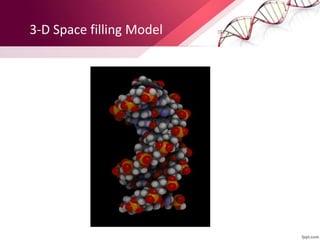
3-D Space filling Model
Tertiary Structure
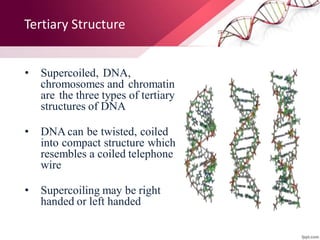
• Supercoiled, DNA,
chromosomes and chromatin
are the three types of tertiary
structures of DNA
• DNA can be twisted, coiled
into compact structure which
resembles a coiled telephone
wire
• Supercoiling may be right
handed or left handed
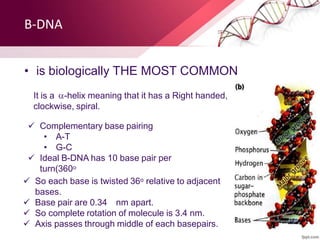
B-DNA
• is biologically THE MOST COMMON
It is a -helix meaning that it has a Right handed, or
clockwise, spiral.
 Complementary base pairing
• A-T
• G-C
 Ideal B-DNA has 10 base pair per
turn(360o
 So each base is twisted 36o relative to adjacent
bases.
 Base pair are 0.34 nm apart.
 So complete rotation of molecule is 3.4 nm.
 Axis passes through middle of each basepairs.
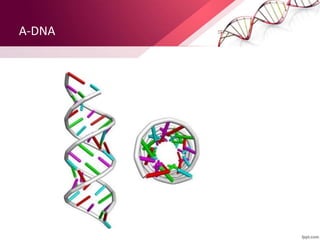
✓ A-DNA appears when the DNA fibre (B-DNA) is
dehydrated, i.e., relative humidity is reduced from 92 to
75% and Na+, K+ and Cs+ ions are present in the
medium. In other words, in solution, DNA assumes the
B form and after dehydration it assusmes theAform.
✓ This is because the phosphate groups in the A-DNA
bind fewer water molecules than the phosphates in B-
DNA.
A-DNA
A-DNA
Z-DNA
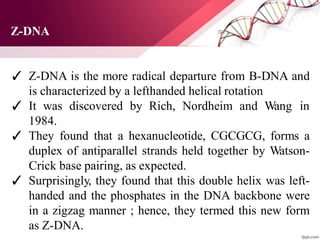
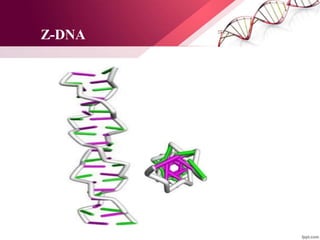
✓ Z-DNA is the more radical departure from B-DNA and
is characterized by a lefthanded helical rotation
✓ It was discovered by Rich, Nordheim and Wang in
1984.
✓ They found that a hexanucleotide, CGCGCG, forms a
duplex of antiparallel strands held together by Watson-
Crick base pairing, as expected.
✓ Surprisingly, they found that this double helix was left-
handed and the phosphates in the DNA backbone were
in a zigzag manner ; hence, they termed this new form
as Z-DNA.
Z-DNA
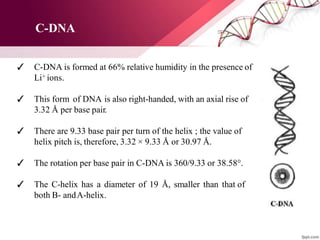
✓ C-DNA is formed at 66% relative humidity in the presence of
Li+ ions.
✓ This form of DNA is also right-handed, with an axial rise of
3.32 Å per base pair.
✓ There are 9.33 base pair per turn of the helix ; the value of
helix pitch is, therefore, 3.32 × 9.33 Å or 30.97 Å.
✓ The rotation per base pair in C-DNA is 360/9.33 or 38.58°.
✓ The C-helix has a diameter of 19 Å, smaller than that of
both B- andA-helix.
C-DNA
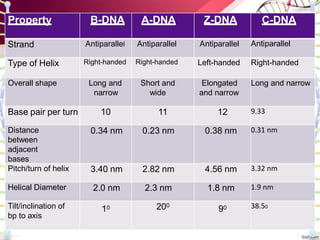
Property B-DNA A-DNA Z-DNA C-DNA
Strand Antiparallel Antiparallel Antiparallel Antiparallel
Type of Helix Right-handed Right-handed Left-handed Right-handed
Overall shape Long and
narrow
Short and
wide
Elongated
and narrow
Long and narrow
Base pair per turn 10 11 12 9.33
Distance
between
adjacent
bases
0.34 nm 0.23 nm 0.38 nm 0.31 nm
Pitch/turn of helix 3.40 nm 2.82 nm 4.56 nm 3.32 nm
Helical Diameter 2.0 nm 2.3 nm 1.8 nm 1.9 nm
Tilt/inclination of
bp to axis
10 200
90 38.50
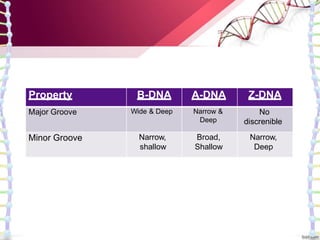
Property B-DNA A-DNA Z-DNA
Major Groove Wide & Deep Narrow &
Deep
No
discrenible
Minor Groove Narrow,
shallow
Broad,
Shallow
Narrow,
Deep
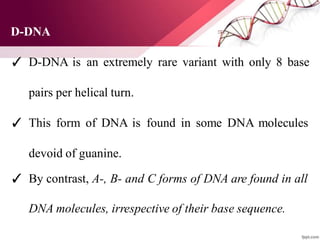
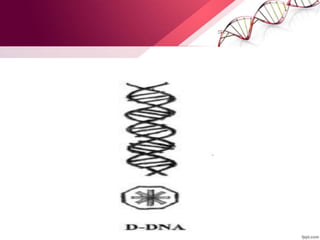
D-DNA
✓ D-DNA is an extremely rare variant with only 8 base
pairs per helical turn.
✓ This form of DNA is found in some DNA molecules
devoid of guanine.
✓ By contrast, A-, B- and C forms of DNA are found in all
DNA molecules, irrespective of their base sequence.
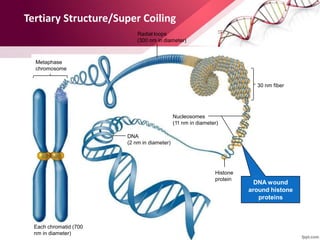
DNA wound
around histone
proteins
Radial loops
(300 nm in diameter)
Metaphase
chromosome
30 nm fiber
Nucleosomes
(11 nm in diameter)
DNA
(2 nm in diameter)
Histone
protein
Each chromatid (700
nm in diameter)
Tertiary Structure/Super Coiling
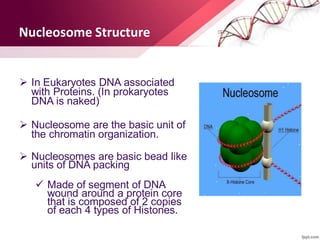
Nucleosome Structure
 In Eukaryotes DNA associated
with Proteins. (In prokaryotes
DNA is naked)
 Nucleosome are the basic unit of
the chromatin organization.
 Nucleosomes are basic bead like
units of DNA packing
 Made of segment of DNA
wound around a protein core
that is composed of 2 copies
of each 4 types of Histones.
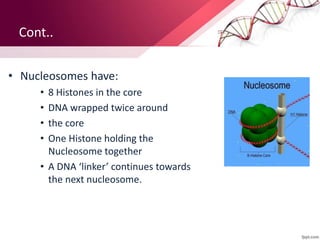
Cont..
• Nucleosomes have:
• 8 Histones in the core
• DNA wrapped twice around
• the core
• One Histone holding the
Nucleosome together
• A DNA ‘linker’ continues towards
the next nucleosome.
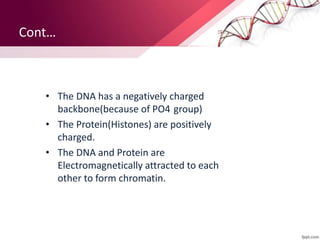
Cont…
• The DNA has a negatively charged
backbone(because of PO4 group)
• The Protein(Histones) are positively
charged.
• The DNA and Protein are
Electromagnetically attracted to each
other to form chromatin.
THANKS

DNA structure and it's forms

  • 1.
  • 2.
    DNA • Deoxyribonucleic Acid •Usually double stranded. • double-helix structure. • found in chromosomes, mitochondria and chloroplasts. • It acts as the genetic material in most of the organisms. • Carries the genetic information
  • 3.
     Friedrich Meischeridentified an acidic substance present in nucleus and named it as ‘Nuclein’ (1868).  Rosalind Franklin and Maurice Wilkins studied X-ray diffraction with DNA and obtained patterns suggested that;  Helical  More than one strand  10 base pairs per complete turn Few Key Events Led to the Discovery of the Structure of DNA
  • 4.
  • 5.
    Watson & CrickModel • James Watson and Francis Crick, described a very simple but famous Double Helix model for the structure of DNA
  • 6.
    Basics for DNAStructure • DNA has three main components  1. Deoxyribose (a pentose sugar)  2. Base (there are four different ones)  3. Phosphate P Pentose sugar Base
  • 7.
    Cont.…. • Nucleic acidsare polymers • Monomer---nucleotides – Nitrogenous bases • Purines • Pyrimidines – Sugar • Ribose • Deoxyribose – Phosphates • +nucleoside=nucleotide }Nucleosides
  • 8.
  • 9.
  • 10.
    ✓ These areall derived from their parent heterocyclic compound pyrimidine, which contains a six membered ring with two-nitrogen atoms and three double bonds. ✓ It has a melting point of 22°C and a boiling point of 123.5°C. Pyrimidine Derivatives
  • 11.
    Purine Derivatives • Theseare all derived from their parent compound purine, which contains a six-membered pyrimidine ring fused to the five- memberedimidazole • It has a melting point of 216°C
  • 12.
  • 13.
  • 14.
  • 15.
    Structure of DNA DNA structure is often divided into four different levels  Primary  Secondary  Tertiary  Quaternary.
  • 16.
    NH2 N O N Bases O N O N Adenine(A) Guanine (G) O H Thymine (T) Backbone Cytosine (C) H H 2′ H H H 3′ H O O– O P O CH2 5′ O– 4′ H H 2′ H H H 3′ H H O O O P O CH2 5′ O– 4′ NH2 N N H N N 1′ HH 2′ H HH O O O P O CH2 O– NH2 N N N H N H H 2′ H H H 3′ OH O O O P O CH2 O– Single nucleotide Phosphodiester linkage Sugar (deoxyribose) Phosphate 5′ 1′ 1′ 5′ 4′ 3′ 5′ 4′ 1′ CH3 Primary Structure/Single Strand
  • 17.
  • 18.
  • 20.
  • 21.
    Tertiary Structure • Supercoiled,DNA, chromosomes and chromatin are the three types of tertiary structures of DNA • DNA can be twisted, coiled into compact structure which resembles a coiled telephone wire • Supercoiling may be right handed or left handed
  • 22.
    B-DNA • is biologicallyTHE MOST COMMON It is a -helix meaning that it has a Right handed, or clockwise, spiral.  Complementary base pairing • A-T • G-C  Ideal B-DNA has 10 base pair per turn(360o  So each base is twisted 36o relative to adjacent bases.  Base pair are 0.34 nm apart.  So complete rotation of molecule is 3.4 nm.  Axis passes through middle of each basepairs.
  • 23.
    ✓ A-DNA appearswhen the DNA fibre (B-DNA) is dehydrated, i.e., relative humidity is reduced from 92 to 75% and Na+, K+ and Cs+ ions are present in the medium. In other words, in solution, DNA assumes the B form and after dehydration it assusmes theAform. ✓ This is because the phosphate groups in the A-DNA bind fewer water molecules than the phosphates in B- DNA. A-DNA
  • 24.
  • 25.
    Z-DNA ✓ Z-DNA isthe more radical departure from B-DNA and is characterized by a lefthanded helical rotation ✓ It was discovered by Rich, Nordheim and Wang in 1984. ✓ They found that a hexanucleotide, CGCGCG, forms a duplex of antiparallel strands held together by Watson- Crick base pairing, as expected. ✓ Surprisingly, they found that this double helix was left- handed and the phosphates in the DNA backbone were in a zigzag manner ; hence, they termed this new form as Z-DNA.
  • 26.
  • 27.
    ✓ C-DNA isformed at 66% relative humidity in the presence of Li+ ions. ✓ This form of DNA is also right-handed, with an axial rise of 3.32 Å per base pair. ✓ There are 9.33 base pair per turn of the helix ; the value of helix pitch is, therefore, 3.32 × 9.33 Å or 30.97 Å. ✓ The rotation per base pair in C-DNA is 360/9.33 or 38.58°. ✓ The C-helix has a diameter of 19 Å, smaller than that of both B- andA-helix. C-DNA
  • 28.
    Property B-DNA A-DNAZ-DNA C-DNA Strand Antiparallel Antiparallel Antiparallel Antiparallel Type of Helix Right-handed Right-handed Left-handed Right-handed Overall shape Long and narrow Short and wide Elongated and narrow Long and narrow Base pair per turn 10 11 12 9.33 Distance between adjacent bases 0.34 nm 0.23 nm 0.38 nm 0.31 nm Pitch/turn of helix 3.40 nm 2.82 nm 4.56 nm 3.32 nm Helical Diameter 2.0 nm 2.3 nm 1.8 nm 1.9 nm Tilt/inclination of bp to axis 10 200 90 38.50
  • 29.
    Property B-DNA A-DNAZ-DNA Major Groove Wide & Deep Narrow & Deep No discrenible Minor Groove Narrow, shallow Broad, Shallow Narrow, Deep
  • 30.
    D-DNA ✓ D-DNA isan extremely rare variant with only 8 base pairs per helical turn. ✓ This form of DNA is found in some DNA molecules devoid of guanine. ✓ By contrast, A-, B- and C forms of DNA are found in all DNA molecules, irrespective of their base sequence.
  • 32.
    DNA wound around histone proteins Radialloops (300 nm in diameter) Metaphase chromosome 30 nm fiber Nucleosomes (11 nm in diameter) DNA (2 nm in diameter) Histone protein Each chromatid (700 nm in diameter) Tertiary Structure/Super Coiling
  • 33.
    Nucleosome Structure  InEukaryotes DNA associated with Proteins. (In prokaryotes DNA is naked)  Nucleosome are the basic unit of the chromatin organization.  Nucleosomes are basic bead like units of DNA packing  Made of segment of DNA wound around a protein core that is composed of 2 copies of each 4 types of Histones.
  • 34.
    Cont.. • Nucleosomes have: •8 Histones in the core • DNA wrapped twice around • the core • One Histone holding the Nucleosome together • A DNA ‘linker’ continues towards the next nucleosome.
  • 35.
    Cont… • The DNAhas a negatively charged backbone(because of PO4 group) • The Protein(Histones) are positively charged. • The DNA and Protein are Electromagnetically attracted to each other to form chromatin.
  • 36.