Basics Of Computers
Dhanuja .N
Contents
 Data representation in computers
 Computer memory and Storage
 Input and Output media
 Current trends in computer
Data representation in computer
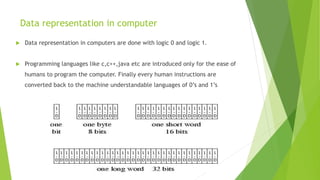
 Data representation in computers are done with logic 0 and logic 1.
 Programming languages like c,c++,java etc are introduced only for the ease of
humans to program the computer. Finally every human instructions are
converted back to the machine understandable languages of 0’s and 1’s
 Machine code
machine language is a set of instructions executed directly by a computer's
central processing unit (CPU). Each instruction performs a very specific task,
such as a load, a jump, or an ALU operation on a unit of data in a CPU register or
memory.
 Compilers
Compilers does the jobs of converting human readble languages into
machine understandable languages
 Data processing and storage
Data’s of 0’s and 1’s are processed by the flipflops ,gates and transistors
internally interms of voltage in the processors and finally stored in computer
registers and storage mediums.
Computer memory and storage
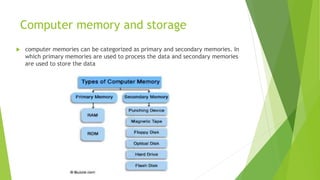
 computer memories can be categorized as primary and secondary memories. In
which primary memories are used to process the data and secondary memories
are used to store the data
 Primary memories
Primary storage, also known as main storage or memory, is the area in a
computer in which data is stored for quick access by the computer's processor.
The terms random access memory (RAM) and memory are often as synonyms for
primary or main storage.
 Primary memories are volatile
Volatile memory is computer storage that only maintains its data while the
device is powered. Most RAM (random access memory) used for primary storage in
personal computers is volatile memory.
 Examples of Primary memory
RAM ( Random Access Memory
ROM (Read Only Memory)
EPROM (Electrically programmable read only memory)
…etc
 Secondary Memory
Secondary memory is where programs and data are kept on a long-term
basis. Common secondary storage devices are the hard disk and optical disks. The
hard disk has enormous storage capacity compared to main memory. The hard
disk is usually contained inside the case of a computer.
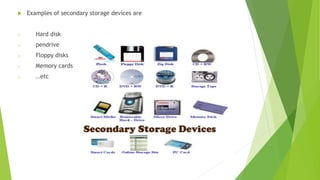
 Examples of secondary storage devices are
o Hard disk
o pendrive
o Floppy disks
o Memory cards
o ..etc
Input and Ouput media
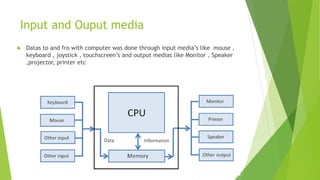
 Datas to and fro with computer was done through input media’s like mouse ,
keyboard , joystick , touchscreen’s and output medias like Monitor , Speaker
,projector, printer etc
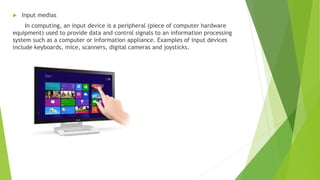
 Input medias
In computing, an input device is a peripheral (piece of computer hardware
equipment) used to provide data and control signals to an information processing
system such as a computer or information appliance. Examples of input devices
include keyboards, mice, scanners, digital cameras and joysticks.
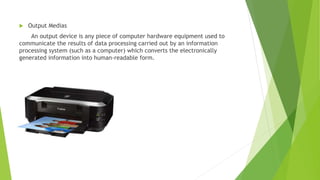
 Output Medias
An output device is any piece of computer hardware equipment used to
communicate the results of data processing carried out by an information
processing system (such as a computer) which converts the electronically
generated information into human-readable form.
current trends in computer
 Computer and information research scientists invent and design new
approaches to computing technology and find innovative uses for existing
technology. They study and solve complex problems in computing for
business, medicine, science, and other fields.
 Such invented and trending technologies of present are
Android OS ported smart computers and gadgets
Multi core processing computers
Highly intelligent robots
etc ..
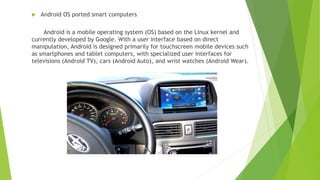
 Android OS ported smart computers
Android is a mobile operating system (OS) based on the Linux kernel and
currently developed by Google. With a user interface based on direct
manipulation, Android is designed primarily for touchscreen mobile devices such
as smartphones and tablet computers, with specialized user interfaces for
televisions (Android TV), cars (Android Auto), and wrist watches (Android Wear).
 Multicore processing computers
A multi-core processor is a single computing component with two or more
independent actual processing units (called "cores"), which are the units that
read and execute program instructions.
 The Internet of Things (IoT)
The Internet of Things is big and it will continue to grow along with user-
oriented computing. Prediction: The Internet of Things will be the focus of digital
business products and processes in industrial and operational contexts. Expect
technology to be embedded everywhere.
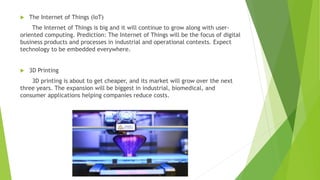
 3D Printing
3D printing is about to get cheaper, and its market will grow over the next
three years. The expansion will be biggest in industrial, biomedical, and
consumer applications helping companies reduce costs.
 Context-Rich Systems
Thanks to embedded intelligence and analytics, systems will become alert and
responsive to their surroundings. Expect context-aware security as well as other trends.
 Intelligent robots
Analytics and context will pave the way for smart machines that can learn for
themselves and act accordingly. These machine helpers will continue to evolve.
Prediction: The smart machines era will be the most disruptive in the history of IT.
 Cloud/Client Architecture
As mobile computing meets cloud computing, centrally coordinated
applications that can be delivered to any device will continue to grow. Apps that
can use intelligence and storage effectively will see lower bandwidth costs.
Expect to be able to use applications simultaneously on multiple devices.
 Web-Scale IT
More and more companies will begin thinking like Amazon, Google and
Facebook. As cloud-optimized and software-defined methods become
mainstream, we’ll see a move towards web-scale IT, starting with DevOps.
 Risk-Based Security and Self-Protection
While 100% security solutions aren’t feasible, advanced risk assessment and
mitigation will come into play in the next few years. Security will move away
from perimeter defense to multi-faceted approaches. Expect security aware
application design, dynamic and static application security testing, and runtime
application self-protection.
Thank you 

BASICS OF COMPUTERS

  • 1.
  • 2.
    Contents  Data representationin computers  Computer memory and Storage  Input and Output media  Current trends in computer
  • 3.
    Data representation incomputer  Data representation in computers are done with logic 0 and logic 1.  Programming languages like c,c++,java etc are introduced only for the ease of humans to program the computer. Finally every human instructions are converted back to the machine understandable languages of 0’s and 1’s
  • 4.
     Machine code machinelanguage is a set of instructions executed directly by a computer's central processing unit (CPU). Each instruction performs a very specific task, such as a load, a jump, or an ALU operation on a unit of data in a CPU register or memory.
  • 5.
     Compilers Compilers doesthe jobs of converting human readble languages into machine understandable languages  Data processing and storage Data’s of 0’s and 1’s are processed by the flipflops ,gates and transistors internally interms of voltage in the processors and finally stored in computer registers and storage mediums.
  • 6.
    Computer memory andstorage  computer memories can be categorized as primary and secondary memories. In which primary memories are used to process the data and secondary memories are used to store the data
  • 7.
     Primary memories Primarystorage, also known as main storage or memory, is the area in a computer in which data is stored for quick access by the computer's processor. The terms random access memory (RAM) and memory are often as synonyms for primary or main storage.  Primary memories are volatile Volatile memory is computer storage that only maintains its data while the device is powered. Most RAM (random access memory) used for primary storage in personal computers is volatile memory.
  • 8.
     Examples ofPrimary memory RAM ( Random Access Memory ROM (Read Only Memory) EPROM (Electrically programmable read only memory) …etc  Secondary Memory Secondary memory is where programs and data are kept on a long-term basis. Common secondary storage devices are the hard disk and optical disks. The hard disk has enormous storage capacity compared to main memory. The hard disk is usually contained inside the case of a computer.
  • 9.
     Examples ofsecondary storage devices are o Hard disk o pendrive o Floppy disks o Memory cards o ..etc
  • 10.
    Input and Ouputmedia  Datas to and fro with computer was done through input media’s like mouse , keyboard , joystick , touchscreen’s and output medias like Monitor , Speaker ,projector, printer etc
  • 11.
     Input medias Incomputing, an input device is a peripheral (piece of computer hardware equipment) used to provide data and control signals to an information processing system such as a computer or information appliance. Examples of input devices include keyboards, mice, scanners, digital cameras and joysticks.
  • 12.
     Output Medias Anoutput device is any piece of computer hardware equipment used to communicate the results of data processing carried out by an information processing system (such as a computer) which converts the electronically generated information into human-readable form.
  • 13.
    current trends incomputer  Computer and information research scientists invent and design new approaches to computing technology and find innovative uses for existing technology. They study and solve complex problems in computing for business, medicine, science, and other fields.  Such invented and trending technologies of present are Android OS ported smart computers and gadgets Multi core processing computers Highly intelligent robots etc ..
  • 14.
     Android OSported smart computers Android is a mobile operating system (OS) based on the Linux kernel and currently developed by Google. With a user interface based on direct manipulation, Android is designed primarily for touchscreen mobile devices such as smartphones and tablet computers, with specialized user interfaces for televisions (Android TV), cars (Android Auto), and wrist watches (Android Wear).
  • 15.
     Multicore processingcomputers A multi-core processor is a single computing component with two or more independent actual processing units (called "cores"), which are the units that read and execute program instructions.
  • 16.
     The Internetof Things (IoT) The Internet of Things is big and it will continue to grow along with user- oriented computing. Prediction: The Internet of Things will be the focus of digital business products and processes in industrial and operational contexts. Expect technology to be embedded everywhere.  3D Printing 3D printing is about to get cheaper, and its market will grow over the next three years. The expansion will be biggest in industrial, biomedical, and consumer applications helping companies reduce costs.
  • 17.
     Context-Rich Systems Thanksto embedded intelligence and analytics, systems will become alert and responsive to their surroundings. Expect context-aware security as well as other trends.  Intelligent robots Analytics and context will pave the way for smart machines that can learn for themselves and act accordingly. These machine helpers will continue to evolve. Prediction: The smart machines era will be the most disruptive in the history of IT.
  • 18.
     Cloud/Client Architecture Asmobile computing meets cloud computing, centrally coordinated applications that can be delivered to any device will continue to grow. Apps that can use intelligence and storage effectively will see lower bandwidth costs. Expect to be able to use applications simultaneously on multiple devices.  Web-Scale IT More and more companies will begin thinking like Amazon, Google and Facebook. As cloud-optimized and software-defined methods become mainstream, we’ll see a move towards web-scale IT, starting with DevOps.  Risk-Based Security and Self-Protection While 100% security solutions aren’t feasible, advanced risk assessment and mitigation will come into play in the next few years. Security will move away from perimeter defense to multi-faceted approaches. Expect security aware application design, dynamic and static application security testing, and runtime application self-protection.
  • 19.