20 October 2016
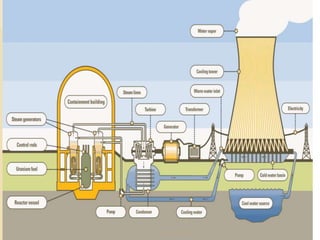
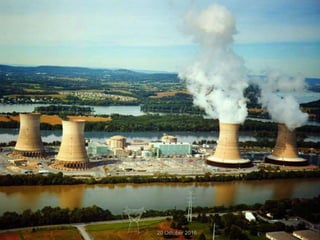
•It is a thermal power station in which the heat source is
a nuclear reactor. As is typical in all conventional
thermalpower stations the heat is used to generate steam
which drives a steam turbine connected to
a generator which produces electricity.
•As of 16 January 2013, the IAEA report there are
439 nuclear power reactors in operation operating in
31 countries.
•Nuclear power plants are usually considered to be base
load stations, since fuel is a small part of the cost of
production.
Nuclear Power Plants
20 October 2016
 Nuclear power is the fourth-largest source
of electricity in India after thermal, hydroelectric and renewabl
e sources of electricity.
 As of 2014, India has 21 nuclear reactors in operation in
7 nuclear power plants, generating 5,780 MW while five other
plants are under construction and are expected to generate
an additional 5700 MW.
20 October 2016
Nuclear Power Plants
FIRST NUCLEAR POWER
PLANT IN INDIA
 Tarapur Atomic Power Station
(T.A.P.S.) was the first nuclear power
plant in India. The construction of the
plant was started in 1962 and the
plant went operational in 1969.
 The 320 MW Tarapur nuclear power
station housed two 160 MW boiling
water reactors (BWRs), the first in
Asia.
20 October 2016
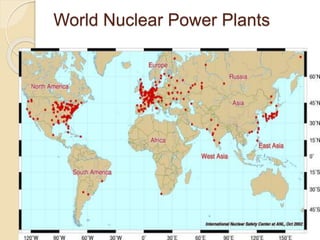
World Nuclear Power Plants
20 October 2016
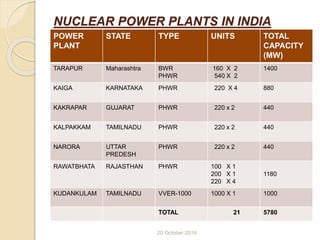
NUCLEAR POWER PLANTS IN INDIA
POWER
PLANT
STATE TYPE UNITS TOTAL
CAPACITY
(MW)
TARAPUR Maharashtra BWR
PHWR
160 X 2
540 X 2
1400
KAIGA KARNATAKA PHWR 220 X 4 880
KAKRAPAR GUJARAT PHWR 220 x 2 440
KALPAKKAM TAMILNADU PHWR 220 x 2 440
NARORA UTTAR
PREDESH
PHWR 220 x 2 440
RAWATBHATA RAJASTHAN PHWR 100 X 1
200 X 1
220 X 4
1180
KUDANKULAM TAMILNADU VVER-1000 1000 X 1 1000
TOTAL 21 5780
20 October 2016
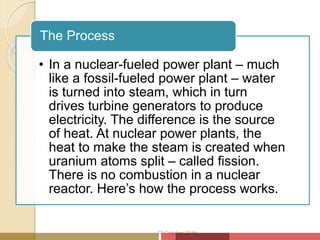
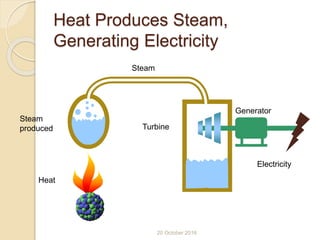
• In a nuclear-fueled power plant – much
like a fossil-fueled power plant – water
is turned into steam, which in turn
drives turbine generators to produce
electricity. The difference is the source
of heat. At nuclear power plants, the
heat to make the steam is created when
uranium atoms split – called fission.
There is no combustion in a nuclear
reactor. Here’s how the process works.
The Process
20 October 2016
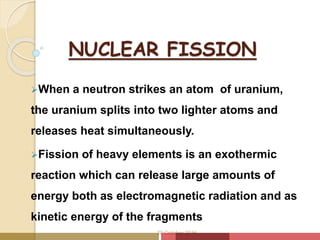
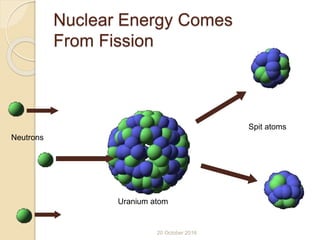
NUCLEAR FISSION
When a neutron strikes an atom of uranium,
the uranium splits into two lighter atoms and
releases heat simultaneously.
Fission of heavy elements is an exothermic
reaction which can release large amounts of
energy both as electromagnetic radiation and as
kinetic energy of the fragments
20 October 2016
NUCLEAR FISSION
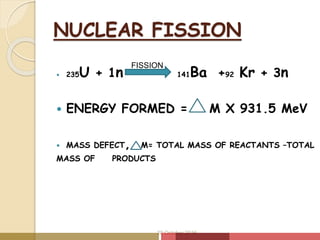
 235U + 1n 141Ba +92 Kr + 3n
 ENERGY FORMED = M X 931.5 MeV
 MASS DEFECT, M= TOTAL MASS OF REACTANTS –TOTAL
MASS OF PRODUCTS
20 October 2016
FISSION
Nuclear Energy Comes
From Fission
20 October 2016
Uranium atom
Neutrons
Spit atoms
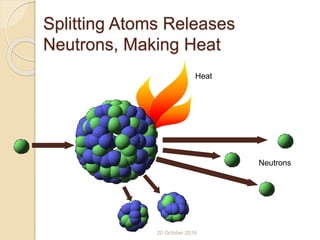
Heat
Splitting Atoms Releases
Neutrons, Making Heat
20 October 2016
Neutrons
Heat Produces Steam,
Generating Electricity
20 October 2016
Heat
Steam
produced
Steam
Turbine
Generator
Electricity
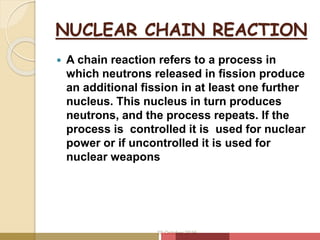
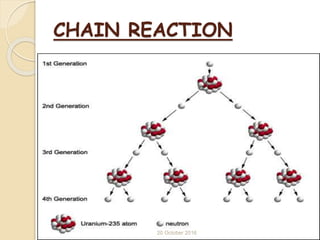
NUCLEAR CHAIN REACTION
 A chain reaction refers to a process in
which neutrons released in fission produce
an additional fission in at least one further
nucleus. This nucleus in turn produces
neutrons, and the process repeats. If the
process is controlled it is used for nuclear
power or if uncontrolled it is used for
nuclear weapons
20 October 2016
CHAIN REACTION
20 October 2016
SYSTEMS IN NUCLEAR POWER
PLANT
Nuclear reactors
Steam turbine
Generator
 Cooling system
Safety valves
Feedwater pump
Emergency power supply
20 October 2016
20 October 2016
NUCLEAR REACTOR
A nuclear reactor is a device in which nuclear
chain reactions are initiated, controlled, and
sustained at a steady rate, as opposed to a
nuclear bomb, in which the chain reaction
occurs in a fraction of a second and is
uncontrolled causing an explosions.
20 October 2016
NUCLEAR REACTOR
2 types,
Boiling water reactor
Pressurized water reactor
20 October 2016
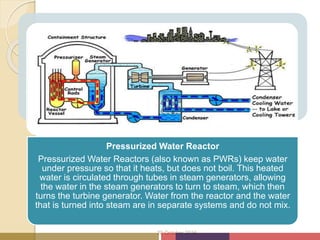
Pressurized Water Reactor
Pressurized Water Reactors (also known as PWRs) keep water
under pressure so that it heats, but does not boil. This heated
water is circulated through tubes in steam generators, allowing
the water in the steam generators to turn to steam, which then
turns the turbine generator. Water from the reactor and the water
that is turned into steam are in separate systems and do not mix.
20 October 2016
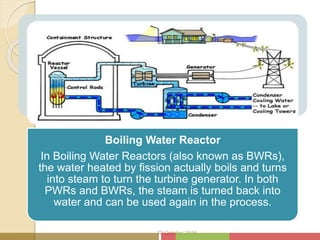
Boiling Water Reactor
In Boiling Water Reactors (also known as BWRs),
the water heated by fission actually boils and turns
into steam to turn the turbine generator. In both
PWRs and BWRs, the steam is turned back into
water and can be used again in the process.
20 October 2016
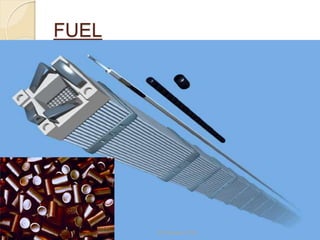
FUEL
 Uranium(92U233 ,92U235 ,92U238) ,
Thorium(90Th232), Plutonium(94PU239,
94PU240 ,94Pu242) Isotopes are using as
fuel.
 Uranium Is Encased in Solid Ceramic
Pellets
 Fuel Rods Filled With Pellets Are
Grouped Into Fuel Assemblies
20 October 2016
FUEL
20 October 2016
CONTROL RODS
Control rods made of a material that absorbs
neutrons are inserted into the bundle using a
mechanism that can rise or lower the control rods.
The control rods essentially contain neutron
absorbers like, boron, cadmium or indium.
When the rods are lowered into the reactor,
they absorb more neutrons and the fission process
slows down. To generate more power, the rods are
raised and more neutrons can crash into uranium
atoms.
20 October 2016
MODERATOR
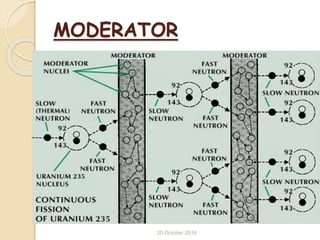
 NEUTRONS PRODUCED BY THE FISSION PROCESS ARE
EJECTED FROM THE NUCLEUS AT A VERY HIGH VELOCITY
ABOUT 1.5 X 10⁷ m/s . FOR MORE EFFECTIVE USE
OF THESE NEUTRONS, WE NEED TO SLOW DOWN THE
FAST NEUTRONS TO SPEED CORRESPONDS TO THE SPEED
OF MOLECULES IN GAS AT NTP. (ABOUT 2.2 X 10³ m/s)
 GRAPHITE, ORDINERY WATER , HEAVY WATER ARE
COMMONLY USING MODERATORS.
20 October 2016
MODERATOR
20 October 2016
STEAM TURBINE
 A steam turbine is a mechanical device
that extracts thermal energy from
pressurized steam, and converts it into
useful mechanical
 Various high-performance alloys and
super alloys have been used for steam
generator tubing.
20 October 2016
Generator
 The generator converts kinetic energy
supplied by the turbine into electrical
energy.
20 October 2016
COOLANT PUMP
The coolant pump pressurizes the coolant
to pressures of the order of 155bar.
The pressure of the coolant loop is
maintained almost constant with the help
of the pump and a pressuriser unit.
20 October 2016
FEED PUMP
Steam coming out of the turbine,
flows through the condenser for
condensation and recirculated for
the next cycle of operation.
The feed pump circulates the
condensed water in the working fluid
loop.
20 October 2016
CONDENSER
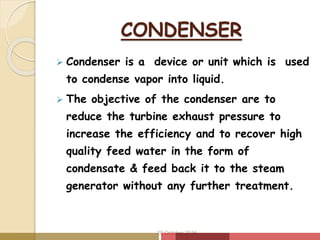
 Condenser is a device or unit which is used
to condense vapor into liquid.
 The objective of the condenser are to
reduce the turbine exhaust pressure to
increase the efficiency and to recover high
quality feed water in the form of
condensate & feed back it to the steam
generator without any further treatment.
20 October 2016
COOLING TOWER
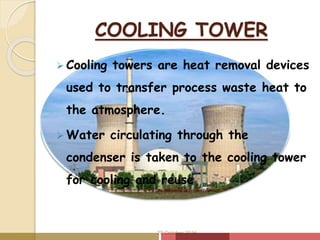
 Cooling towers are heat removal devices
used to transfer process waste heat to
the atmosphere.
 Water circulating through the
condenser is taken to the cooling tower
for cooling and reuse
20 October 2016
Emergency power supply
 The emergency power supplies of a nuclear power
plant are built up by several layers of redundancy,
such as diesel generators, gas turbine generators
and battery buffers.
20 October 2016
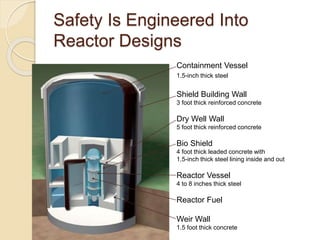
Safety Is Engineered Into
Reactor Designs
Containment Vessel
1.5-inch thick steel
Shield Building Wall
3 foot thick reinforced concrete
Dry Well Wall
5 foot thick reinforced concrete
Bio Shield
4 foot thick leaded concrete with
1.5-inch thick steel lining inside and out
Reactor Vessel
4 to 8 inches thick steel
Reactor Fuel
Weir Wall
1.5 foot thick concrete
20 October 2016
SELECTION OF SITE
 AVAILABILITY OF WATER
 DISTANCE FROM POPULATED AREA
 TRANSPORTATION FACILITIES
 NEARNESS TO LOAD CENTRE
 AVAILABILITY OF SPACE FOR WASTE DISPOSAL
 ACCESSIBILITY
 TYPE OF LAND
20 October 2016
ADVANTAGES
 Amount of fuel required is quite small.
 Demand of coal, oil, and gas will reduced.
 Need less area. A 2000 MW nuclear power plant need 80 acres
whereas coal fired steam plant required 250 acres of land.
 Because of negligible cost of transportation of fuel, can located
near load centres . So primary distribution coast is reduced.
 These plants are most economical and in large capacity
 The output control system extremely flexible.
 Large deposits of nuclear fuel is available all over world. So plant
can ensure continuous supply of electricity for thousands of years.
 a coal fired plant need thousands of tonnes of coal per day. But
nuclear plant need very less quantity of fuel. So it will be very neat
and clean.
 Operating coast is very less, once the installation completed, the
loading of power plant will have no effect on generation coast. So
nuclear power plant is always using as a base load plant.
20 October 2016
DISADVANTAGES
 Nuclear plants are more expensive to build and maintain.
The initial cost is very high
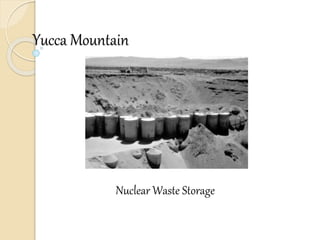
 Waste products are dangerous and need to be carefully
stored for long periods of time. It can cause dangerous
amount of radioactive pollution.
 Wastes are commonly disposed in deep trenches or in sea
away from populated area.
 Fuel is very expensive.
 The fuel is highly radioactive and has to be carefully stored
for many years or decades after use. This adds to the costs.
 Maintenance charges are very high, salary for maintenance
staff is also high as specially trained persons are required to
handle the plant.
20 October 2016
DISADVANTAGES
 Nuclear power plants can be dangerous to its
surroundings and employees. It would cost a lot to clean
in case of spillages.
 There exist safety concerns if the plant is not operated
correctly or conditions arise that were unforeseen when
the plant was developed, as happened at the
Fukushima plant in Japan; the core melted down
following an earthquake and tsunami the plant was not
designed to handle despite the world's strongest
earthquake codes.
20 October 2016
Yucca Mountain
Nuclear Waste Storage
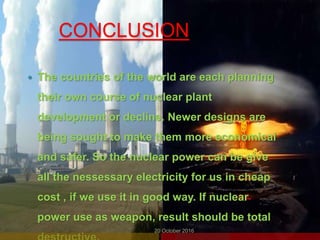
CONCLUSION
 The countries of the world are each planning
their own course of nuclear plant
development or decline. Newer designs are
being sought to make them more economical
and safer. So the nuclear power can be give
all the nessessary electricity for us in cheap
cost , if we use it in good way. If nuclear
power use as weapon, result should be total
20 October 2016
REFERENCE
 www.Wikipedia.com
 www.Seminarpaper.com
 www.slideshare.com
 www.planningcommision.gov.in
20 October 2016
20 October 2016

Nuclear power plant

  • 1.
  • 2.
    •It is athermal power station in which the heat source is a nuclear reactor. As is typical in all conventional thermalpower stations the heat is used to generate steam which drives a steam turbine connected to a generator which produces electricity. •As of 16 January 2013, the IAEA report there are 439 nuclear power reactors in operation operating in 31 countries. •Nuclear power plants are usually considered to be base load stations, since fuel is a small part of the cost of production. Nuclear Power Plants 20 October 2016
  • 3.
     Nuclear poweris the fourth-largest source of electricity in India after thermal, hydroelectric and renewabl e sources of electricity.  As of 2014, India has 21 nuclear reactors in operation in 7 nuclear power plants, generating 5,780 MW while five other plants are under construction and are expected to generate an additional 5700 MW. 20 October 2016 Nuclear Power Plants
  • 4.
    FIRST NUCLEAR POWER PLANTIN INDIA  Tarapur Atomic Power Station (T.A.P.S.) was the first nuclear power plant in India. The construction of the plant was started in 1962 and the plant went operational in 1969.  The 320 MW Tarapur nuclear power station housed two 160 MW boiling water reactors (BWRs), the first in Asia. 20 October 2016
  • 5.
    World Nuclear PowerPlants 20 October 2016
  • 6.
    NUCLEAR POWER PLANTSIN INDIA POWER PLANT STATE TYPE UNITS TOTAL CAPACITY (MW) TARAPUR Maharashtra BWR PHWR 160 X 2 540 X 2 1400 KAIGA KARNATAKA PHWR 220 X 4 880 KAKRAPAR GUJARAT PHWR 220 x 2 440 KALPAKKAM TAMILNADU PHWR 220 x 2 440 NARORA UTTAR PREDESH PHWR 220 x 2 440 RAWATBHATA RAJASTHAN PHWR 100 X 1 200 X 1 220 X 4 1180 KUDANKULAM TAMILNADU VVER-1000 1000 X 1 1000 TOTAL 21 5780 20 October 2016
  • 7.
    • In anuclear-fueled power plant – much like a fossil-fueled power plant – water is turned into steam, which in turn drives turbine generators to produce electricity. The difference is the source of heat. At nuclear power plants, the heat to make the steam is created when uranium atoms split – called fission. There is no combustion in a nuclear reactor. Here’s how the process works. The Process 20 October 2016
  • 8.
    NUCLEAR FISSION When aneutron strikes an atom of uranium, the uranium splits into two lighter atoms and releases heat simultaneously. Fission of heavy elements is an exothermic reaction which can release large amounts of energy both as electromagnetic radiation and as kinetic energy of the fragments 20 October 2016
  • 9.
    NUCLEAR FISSION  235U+ 1n 141Ba +92 Kr + 3n  ENERGY FORMED = M X 931.5 MeV  MASS DEFECT, M= TOTAL MASS OF REACTANTS –TOTAL MASS OF PRODUCTS 20 October 2016 FISSION
  • 10.
    Nuclear Energy Comes FromFission 20 October 2016 Uranium atom Neutrons Spit atoms
  • 11.
    Heat Splitting Atoms Releases Neutrons,Making Heat 20 October 2016 Neutrons
  • 12.
    Heat Produces Steam, GeneratingElectricity 20 October 2016 Heat Steam produced Steam Turbine Generator Electricity
  • 13.
    NUCLEAR CHAIN REACTION A chain reaction refers to a process in which neutrons released in fission produce an additional fission in at least one further nucleus. This nucleus in turn produces neutrons, and the process repeats. If the process is controlled it is used for nuclear power or if uncontrolled it is used for nuclear weapons 20 October 2016
  • 14.
  • 15.
    SYSTEMS IN NUCLEARPOWER PLANT Nuclear reactors Steam turbine Generator  Cooling system Safety valves Feedwater pump Emergency power supply 20 October 2016
  • 16.
  • 17.
    NUCLEAR REACTOR A nuclearreactor is a device in which nuclear chain reactions are initiated, controlled, and sustained at a steady rate, as opposed to a nuclear bomb, in which the chain reaction occurs in a fraction of a second and is uncontrolled causing an explosions. 20 October 2016
  • 18.
    NUCLEAR REACTOR 2 types, Boilingwater reactor Pressurized water reactor 20 October 2016
  • 19.
    Pressurized Water Reactor PressurizedWater Reactors (also known as PWRs) keep water under pressure so that it heats, but does not boil. This heated water is circulated through tubes in steam generators, allowing the water in the steam generators to turn to steam, which then turns the turbine generator. Water from the reactor and the water that is turned into steam are in separate systems and do not mix. 20 October 2016
  • 20.
    Boiling Water Reactor InBoiling Water Reactors (also known as BWRs), the water heated by fission actually boils and turns into steam to turn the turbine generator. In both PWRs and BWRs, the steam is turned back into water and can be used again in the process. 20 October 2016
  • 21.
    FUEL  Uranium(92U233 ,92U235,92U238) , Thorium(90Th232), Plutonium(94PU239, 94PU240 ,94Pu242) Isotopes are using as fuel.  Uranium Is Encased in Solid Ceramic Pellets  Fuel Rods Filled With Pellets Are Grouped Into Fuel Assemblies 20 October 2016
  • 22.
  • 23.
    CONTROL RODS Control rodsmade of a material that absorbs neutrons are inserted into the bundle using a mechanism that can rise or lower the control rods. The control rods essentially contain neutron absorbers like, boron, cadmium or indium. When the rods are lowered into the reactor, they absorb more neutrons and the fission process slows down. To generate more power, the rods are raised and more neutrons can crash into uranium atoms. 20 October 2016
  • 24.
    MODERATOR  NEUTRONS PRODUCEDBY THE FISSION PROCESS ARE EJECTED FROM THE NUCLEUS AT A VERY HIGH VELOCITY ABOUT 1.5 X 10⁷ m/s . FOR MORE EFFECTIVE USE OF THESE NEUTRONS, WE NEED TO SLOW DOWN THE FAST NEUTRONS TO SPEED CORRESPONDS TO THE SPEED OF MOLECULES IN GAS AT NTP. (ABOUT 2.2 X 10³ m/s)  GRAPHITE, ORDINERY WATER , HEAVY WATER ARE COMMONLY USING MODERATORS. 20 October 2016
  • 25.
  • 26.
    STEAM TURBINE  Asteam turbine is a mechanical device that extracts thermal energy from pressurized steam, and converts it into useful mechanical  Various high-performance alloys and super alloys have been used for steam generator tubing. 20 October 2016
  • 27.
    Generator  The generatorconverts kinetic energy supplied by the turbine into electrical energy. 20 October 2016
  • 28.
    COOLANT PUMP The coolantpump pressurizes the coolant to pressures of the order of 155bar. The pressure of the coolant loop is maintained almost constant with the help of the pump and a pressuriser unit. 20 October 2016
  • 29.
    FEED PUMP Steam comingout of the turbine, flows through the condenser for condensation and recirculated for the next cycle of operation. The feed pump circulates the condensed water in the working fluid loop. 20 October 2016
  • 30.
    CONDENSER  Condenser isa device or unit which is used to condense vapor into liquid.  The objective of the condenser are to reduce the turbine exhaust pressure to increase the efficiency and to recover high quality feed water in the form of condensate & feed back it to the steam generator without any further treatment. 20 October 2016
  • 31.
    COOLING TOWER  Coolingtowers are heat removal devices used to transfer process waste heat to the atmosphere.  Water circulating through the condenser is taken to the cooling tower for cooling and reuse 20 October 2016
  • 32.
    Emergency power supply The emergency power supplies of a nuclear power plant are built up by several layers of redundancy, such as diesel generators, gas turbine generators and battery buffers. 20 October 2016
  • 33.
    Safety Is EngineeredInto Reactor Designs Containment Vessel 1.5-inch thick steel Shield Building Wall 3 foot thick reinforced concrete Dry Well Wall 5 foot thick reinforced concrete Bio Shield 4 foot thick leaded concrete with 1.5-inch thick steel lining inside and out Reactor Vessel 4 to 8 inches thick steel Reactor Fuel Weir Wall 1.5 foot thick concrete
  • 34.
  • 35.
    SELECTION OF SITE AVAILABILITY OF WATER  DISTANCE FROM POPULATED AREA  TRANSPORTATION FACILITIES  NEARNESS TO LOAD CENTRE  AVAILABILITY OF SPACE FOR WASTE DISPOSAL  ACCESSIBILITY  TYPE OF LAND 20 October 2016
  • 36.
    ADVANTAGES  Amount offuel required is quite small.  Demand of coal, oil, and gas will reduced.  Need less area. A 2000 MW nuclear power plant need 80 acres whereas coal fired steam plant required 250 acres of land.  Because of negligible cost of transportation of fuel, can located near load centres . So primary distribution coast is reduced.  These plants are most economical and in large capacity  The output control system extremely flexible.  Large deposits of nuclear fuel is available all over world. So plant can ensure continuous supply of electricity for thousands of years.  a coal fired plant need thousands of tonnes of coal per day. But nuclear plant need very less quantity of fuel. So it will be very neat and clean.  Operating coast is very less, once the installation completed, the loading of power plant will have no effect on generation coast. So nuclear power plant is always using as a base load plant. 20 October 2016
  • 37.
    DISADVANTAGES  Nuclear plantsare more expensive to build and maintain. The initial cost is very high  Waste products are dangerous and need to be carefully stored for long periods of time. It can cause dangerous amount of radioactive pollution.  Wastes are commonly disposed in deep trenches or in sea away from populated area.  Fuel is very expensive.  The fuel is highly radioactive and has to be carefully stored for many years or decades after use. This adds to the costs.  Maintenance charges are very high, salary for maintenance staff is also high as specially trained persons are required to handle the plant. 20 October 2016
  • 38.
    DISADVANTAGES  Nuclear powerplants can be dangerous to its surroundings and employees. It would cost a lot to clean in case of spillages.  There exist safety concerns if the plant is not operated correctly or conditions arise that were unforeseen when the plant was developed, as happened at the Fukushima plant in Japan; the core melted down following an earthquake and tsunami the plant was not designed to handle despite the world's strongest earthquake codes. 20 October 2016
  • 39.
  • 40.
    CONCLUSION  The countriesof the world are each planning their own course of nuclear plant development or decline. Newer designs are being sought to make them more economical and safer. So the nuclear power can be give all the nessessary electricity for us in cheap cost , if we use it in good way. If nuclear power use as weapon, result should be total 20 October 2016
  • 41.
    REFERENCE  www.Wikipedia.com  www.Seminarpaper.com www.slideshare.com  www.planningcommision.gov.in 20 October 2016
  • 42.