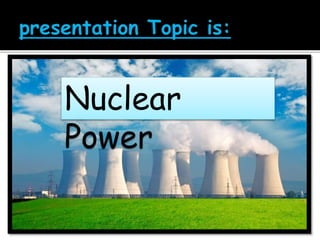
Nuclear
Power
What’s Nuclear
power??
Nuclear power is energy contained in atoms.
This energy can be released as heat from a
chain reaction in a radioactive element such
as uranium. Nuclear power stations use this
heat to produce steam, which drives turbines
to generate electricity.
TWO WAYS TO OBTAIN NUCLEAR
ENERGY:
1. Nuclear fission
2. Nuclear fusion
Nuclear fission and fusion:
Nuclear fusion and nuclear fission are two different types
of energy-releasing reactions in which energy is released
from high-power atomic bonds between the particles within
the nucleus. The main difference between these two
processes is that fission is the splitting of an atom into two
or more smaller ones while fusion is the fusing of two or
more smaller atoms into a larger one.
Uses of nuclear energy:
 Nuclear Transport - There are a number of transport modes like Ships
and Submarines which use Nuclear Based Propulsion.Note for the
Military,Nuclear Submarines are of the most lethal weapons capable of
staying under water for very long periods which diesel submarines are
incapable of.
 Medical Applications – Nuclear Energy finds wide applications in Medical
Science.Use of Nuclear Energy for X-Rays,Chemotherapy Treatments is
widely known and accepted.
Space and Futuristic Applications – While this technology is still
immature and not widely used,Fission Reactors for powering rockets and
space vehicles is very useful as the energy generated by small mass is
possible which is not possible by chemical energy means.Nuclear Fusion has
been said to be the holy grail for generating almost infinite amounts of
energy at low cost.R&D continues to be done to develop this and other
forms of Nuclear Power like Breeder Reactors etc.
 Food and Agriculture – Radioisotopes and radiation used in food and
agriculture.Sterile Insect Technique (SIT) involves rearing large
numbers of insects then irradiating them with gamma radiation before
hatching, to sterilize them. The sterile males are then released in
large numbers in the infested areas. When they mate with females, no
offspring are produced. With repeated releases of sterilized males,
the population of the insect pest in a given area is drastically reduced.
 Electricity - This is the greatest use of Nuclear Power using
Nuclear Fission.According to WNA “Sixteen countries depend on
nuclear power for at least a quarter of their electricity. France gets
around three quarters of its power from nuclear energy, while Belgium,
Bulgaria, Czech Republic, Hungary, Slovakia, South Korea, Sweden,
Switzerland, Slovenia and Ukraine get one third or more. Japan,
Germany and Finland get more than a quarter of their power from
nuclear energy, while in the USA one fifth is from nuclear. Among
countries which do not host nuclear power plants, Italy gets about 10%
of its power from nuclear, and Denmark about 8%.”
Facts of nuclear Energy:
There are roughly 430 nuclear power plants worldwide
There have been three major nuclear power plant disasters which occurred in 1979,
1986,and 2011.
The nuclear accident which occurred in 1979 took 14 years to clean up.
The United States produces more nuclear energy than any other country.
Since the nuclear disaster of 2011, many nuclear power plants have shut down
operation due to
safety concerns.
Radiation and nuclear medicines are used to cure and treat many diseases.
Uranium is a rare earth metal that is commonly used for nuclear energy production.
Africa is the first country in the world to destroy all of its nuclear weapons
voluntarily.
Although there have been three major nuclear power plant accidents, they are said to
actually
be quite safe places.
Fourteen percent of the world's electricity is generated by nuclear energy.
Scientists who study the interactions of atoms' nuclei are called nuclear physicists
Advantages of Nuclear Energy:
 Almost 0 emissions (very low greenhouse gas
emissions).
 They can be sited almost anywhere unlike oil which is
mostly imported.
 The plants almost never experience problems if not
from human error, which almost never happens anyway
because the plant only needs like 10 people to operate
it.
 A small amount of matter creates a large amount of
energy.
 A lot of energy is generated from a single power
plant. Current nuclear waste in the US is over 90%
Uranium.
 If reprocessing were made legal again in the US we
would have enough nuclear material to last hundreds of
years.
 As the core gets hotter the reaction gets
slower, hence a run-away reaction leading to
a melt-down is not possible
Modern reactors have two to ten times more
efficiency than the old generation reactors
currently in use around the US. New reactor
types have been designed to make it physically
impossible to melt down.
Disadvantages of nuclear energy:
Nuclear plants are more expensive to build and maintain.
Waste products are dangerous and need to be carefully stored for long periods
of time. The spent fuel is highly radioactive and has to be carefully stored for
many years or decades after use. This adds to the costs.
There is presently no adequate safe long-term storage for radioactive and
chemical waste produced from early reactors some of which will need to be
safely sealed and stored for thousands of years.
Nuclear power plants can be dangerous to its surroundings and employees. It
would cost a lot to clean in case of spillages.
There exist safety concerns if the plant is not
operated correctly or conditions arise that were
unforeseen when the plant was developed, as
happened at the Fukushima plant in Japan.
nuclear plants can render hundreds of square miles
of land uninhabitable and unsuitable for any use for
years, decades or longer, and kill off entire river
systems .
A lot of waste from early reactors was stored in
containers meant for only a few decades, but is well
past expiration and, resulting, leaks are furthering
contamination.
A nuclear power plant is a type of power station that
generates electricity using heat from nuclear reactions.
These reactions take place within a reactor. The plant also
has machines which remove heat from the reactor to
operate a steam turbine and generator to make electricity.
Electricity made by nuclear power plants is called nuclear
power.
What is nuclear Power plant??
Nuclear Reactor:
A nuclear reactor is a machine that uses fission to generate heat. There are
different designs which use different fuels. Most often, uranium-
235or plutonium-239 are the main components of these fuels.
Most nuclear reactors are used to make electricity. In nuclear power
plants heat from the reactor changes water into steam. The steam is then
used to power electric turbines which make electricity. It is important to
remember that the turbines do not change the temperature of the steam, or
the amount of steam. Instead, the turbines take energy from the movement
of the steam.
Nuclear power plants, and that our
country !! Like a dream, is not it?
The technology-rich countries in
the world's major nuclear power
plants boast. On 02 November last
2011 nuclear power production in
Bangladesh and Russia signed an
agreement. Agreement on behalf
of the Minister of Science and
Technology of Russia and the
Russian Atomic Energy Agency
Osman (ROSATAM) Director
General Sergei kiriyesko signed.
According to the agreement of the
Russian ROSATAM Ishwardi
Rooppur 1000 MW taderarai
financed through credit facilities,
two nuclear power plants, which
means it will sit. Whose work began
in 2014 by the year 2018 is
expected to be finished, and since
2018, at least 1 of the nuclear
plant, according to the power supply
can be found. Note that there is
currently a shortage of electricity,
which is about 1500 MW by the
year 2018 and reach 2000 MW, of
which the demand can be met by
nuclear power plants. The nuclear
power plant project cost is counted
as 1.5 - 2.0 billion. The nuclear
power plants will need to enable
efficient manpower and a half to
three thousand.
Nuclear power plant in our country:
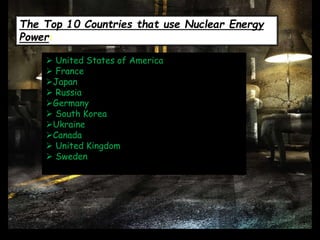
The Top 10 Countries that use Nuclear Energy
Power:
 United States of America
 France
Japan
 Russia
Germany
 South Korea
Ukraine
Canada
 United Kingdom
 Sweden

Nuclear power

  • 1.
  • 2.
    What’s Nuclear power?? Nuclear poweris energy contained in atoms. This energy can be released as heat from a chain reaction in a radioactive element such as uranium. Nuclear power stations use this heat to produce steam, which drives turbines to generate electricity.
  • 3.
    TWO WAYS TOOBTAIN NUCLEAR ENERGY: 1. Nuclear fission 2. Nuclear fusion Nuclear fission and fusion: Nuclear fusion and nuclear fission are two different types of energy-releasing reactions in which energy is released from high-power atomic bonds between the particles within the nucleus. The main difference between these two processes is that fission is the splitting of an atom into two or more smaller ones while fusion is the fusing of two or more smaller atoms into a larger one.
  • 4.
    Uses of nuclearenergy:  Nuclear Transport - There are a number of transport modes like Ships and Submarines which use Nuclear Based Propulsion.Note for the Military,Nuclear Submarines are of the most lethal weapons capable of staying under water for very long periods which diesel submarines are incapable of.  Medical Applications – Nuclear Energy finds wide applications in Medical Science.Use of Nuclear Energy for X-Rays,Chemotherapy Treatments is widely known and accepted. Space and Futuristic Applications – While this technology is still immature and not widely used,Fission Reactors for powering rockets and space vehicles is very useful as the energy generated by small mass is possible which is not possible by chemical energy means.Nuclear Fusion has been said to be the holy grail for generating almost infinite amounts of energy at low cost.R&D continues to be done to develop this and other forms of Nuclear Power like Breeder Reactors etc.
  • 5.
     Food andAgriculture – Radioisotopes and radiation used in food and agriculture.Sterile Insect Technique (SIT) involves rearing large numbers of insects then irradiating them with gamma radiation before hatching, to sterilize them. The sterile males are then released in large numbers in the infested areas. When they mate with females, no offspring are produced. With repeated releases of sterilized males, the population of the insect pest in a given area is drastically reduced.  Electricity - This is the greatest use of Nuclear Power using Nuclear Fission.According to WNA “Sixteen countries depend on nuclear power for at least a quarter of their electricity. France gets around three quarters of its power from nuclear energy, while Belgium, Bulgaria, Czech Republic, Hungary, Slovakia, South Korea, Sweden, Switzerland, Slovenia and Ukraine get one third or more. Japan, Germany and Finland get more than a quarter of their power from nuclear energy, while in the USA one fifth is from nuclear. Among countries which do not host nuclear power plants, Italy gets about 10% of its power from nuclear, and Denmark about 8%.”
  • 6.
    Facts of nuclearEnergy: There are roughly 430 nuclear power plants worldwide There have been three major nuclear power plant disasters which occurred in 1979, 1986,and 2011. The nuclear accident which occurred in 1979 took 14 years to clean up. The United States produces more nuclear energy than any other country. Since the nuclear disaster of 2011, many nuclear power plants have shut down operation due to safety concerns. Radiation and nuclear medicines are used to cure and treat many diseases. Uranium is a rare earth metal that is commonly used for nuclear energy production. Africa is the first country in the world to destroy all of its nuclear weapons voluntarily. Although there have been three major nuclear power plant accidents, they are said to actually be quite safe places. Fourteen percent of the world's electricity is generated by nuclear energy. Scientists who study the interactions of atoms' nuclei are called nuclear physicists
  • 7.
    Advantages of NuclearEnergy:  Almost 0 emissions (very low greenhouse gas emissions).  They can be sited almost anywhere unlike oil which is mostly imported.  The plants almost never experience problems if not from human error, which almost never happens anyway because the plant only needs like 10 people to operate it.  A small amount of matter creates a large amount of energy.  A lot of energy is generated from a single power plant. Current nuclear waste in the US is over 90% Uranium.  If reprocessing were made legal again in the US we would have enough nuclear material to last hundreds of years.
  • 8.
     As thecore gets hotter the reaction gets slower, hence a run-away reaction leading to a melt-down is not possible Modern reactors have two to ten times more efficiency than the old generation reactors currently in use around the US. New reactor types have been designed to make it physically impossible to melt down.
  • 9.
    Disadvantages of nuclearenergy: Nuclear plants are more expensive to build and maintain. Waste products are dangerous and need to be carefully stored for long periods of time. The spent fuel is highly radioactive and has to be carefully stored for many years or decades after use. This adds to the costs. There is presently no adequate safe long-term storage for radioactive and chemical waste produced from early reactors some of which will need to be safely sealed and stored for thousands of years. Nuclear power plants can be dangerous to its surroundings and employees. It would cost a lot to clean in case of spillages.
  • 10.
    There exist safetyconcerns if the plant is not operated correctly or conditions arise that were unforeseen when the plant was developed, as happened at the Fukushima plant in Japan. nuclear plants can render hundreds of square miles of land uninhabitable and unsuitable for any use for years, decades or longer, and kill off entire river systems . A lot of waste from early reactors was stored in containers meant for only a few decades, but is well past expiration and, resulting, leaks are furthering contamination.
  • 11.
    A nuclear powerplant is a type of power station that generates electricity using heat from nuclear reactions. These reactions take place within a reactor. The plant also has machines which remove heat from the reactor to operate a steam turbine and generator to make electricity. Electricity made by nuclear power plants is called nuclear power. What is nuclear Power plant?? Nuclear Reactor: A nuclear reactor is a machine that uses fission to generate heat. There are different designs which use different fuels. Most often, uranium- 235or plutonium-239 are the main components of these fuels. Most nuclear reactors are used to make electricity. In nuclear power plants heat from the reactor changes water into steam. The steam is then used to power electric turbines which make electricity. It is important to remember that the turbines do not change the temperature of the steam, or the amount of steam. Instead, the turbines take energy from the movement of the steam.
  • 12.
    Nuclear power plants,and that our country !! Like a dream, is not it? The technology-rich countries in the world's major nuclear power plants boast. On 02 November last 2011 nuclear power production in Bangladesh and Russia signed an agreement. Agreement on behalf of the Minister of Science and Technology of Russia and the Russian Atomic Energy Agency Osman (ROSATAM) Director General Sergei kiriyesko signed. According to the agreement of the Russian ROSATAM Ishwardi Rooppur 1000 MW taderarai financed through credit facilities, two nuclear power plants, which means it will sit. Whose work began in 2014 by the year 2018 is expected to be finished, and since 2018, at least 1 of the nuclear plant, according to the power supply can be found. Note that there is currently a shortage of electricity, which is about 1500 MW by the year 2018 and reach 2000 MW, of which the demand can be met by nuclear power plants. The nuclear power plant project cost is counted as 1.5 - 2.0 billion. The nuclear power plants will need to enable efficient manpower and a half to three thousand. Nuclear power plant in our country:
  • 13.
    The Top 10Countries that use Nuclear Energy Power:  United States of America  France Japan  Russia Germany  South Korea Ukraine Canada  United Kingdom  Sweden