Contents
 Introduction
 Definition
 History
 Nuclear Fission
 Components of Nuclear Reactor
 Working of Nuclear Reactor
 Refrences
Introduction
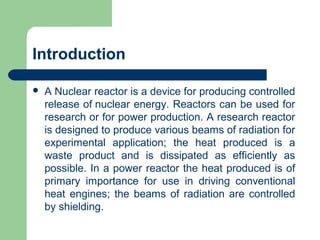
 A Nuclear reactor is a device for producing controlled
release of nuclear energy. Reactors can be used for
research or for power production. A research reactor
is designed to produce various beams of radiation for
experimental application; the heat produced is a
waste product and is dissipated as efficiently as
possible. In a power reactor the heat produced is of
primary importance for use in driving conventional
heat engines; the beams of radiation are controlled
by shielding.
Definition
 A nuclear reactor is device designed to
maintain a chain reaction producing a steady
flow of neutrons generated by the fission of
heavy nuclei. Nuclear Reactors are,
however, differentiated either by their
purpose or by their design features. In terms
of purpose, they are either research reactors
or power reactors.
Early Reactors / History
 The neutron was discovered in 1932. The
concept of a nuclear chain reaction brought
about by nuclear reactions mediated by
neutrons was first realized shortly thereafter,
by Hungarian scientist Leó Szilárd, in 1933.
He filed a patent for his idea of a simple
nuclear reactor .
 Szilárd's idea did not incorporate the idea of
nuclear fission as a neutron source, since
that process was not yet discovered.
Szilárd's ideas for nuclear reactors using
neutron-mediated nuclear chain reactions in
light elements proved unworkable.
Early Reactors / History
 Inspiration for a new type of reactor using
uranium came from the discovery by Lisa
Meitner,Fritz Strassmann and Otto Hahn in
1938 that bombardment of uranium with
neutrons, produced a barium residue, which
they reasoned was created by the fission of
the uranium nuclei.
Early Reactors / History
 Subsequent studies in early 1939 revealed
that several neutrons were also released
during the fission making available the
opportunity for the nuclear chain reaction that
Szilárd had envisioned previously.
Early Reactors / History
 In 1939 Albert Einstein signed a letter to
President Franklin suggesting that the
discovery of uranium's fission could lead to
the development of "extremely powerful
bombs of a new type", giving impetus to the
study of reactors and fission.
 World War II
The first artificial nuclear reactor was
constructed at the University of Chicago, in
late 1942.
Early Reactors / History
 Soon after U.S. military developed a number
of nuclear reactors in 1943. The primary
purpose for the largest reactors was the
mass production of plutonium for nuclear
weapons.
 "World's first nuclear power plant“ was
carried out & operated by the U.S. Atomic
Energy Commission in 1952, having a design
output of 200 kW (electrical).
Early Reactors / History
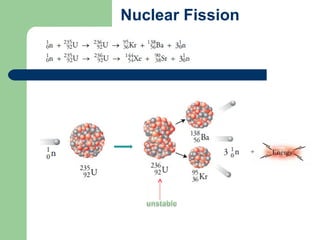
Nuclear Fission
“A mechanism by which a
heavy nucleus absorbing a
neutron might become
unstable and split into two
lighter nuclei.”
Nuclear Fission
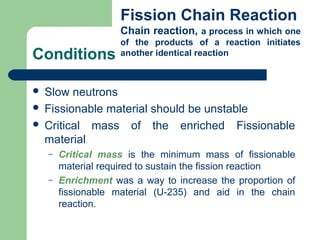
Conditions
 Slow neutrons
 Fissionable material should be unstable
 Critical mass of the enriched Fissionable
material
– Critical mass is the minimum mass of fissionable
material required to sustain the fission reaction
– Enrichment was a way to increase the proportion of
fissionable material (U-235) and aid in the chain
reaction.
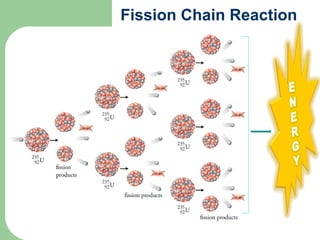
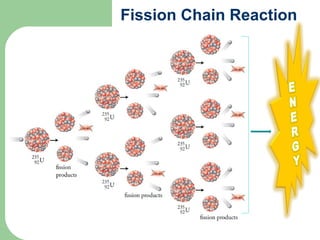
Fission Chain Reaction
Chain reaction, a process in which one
of the products of a reaction initiates
another identical reaction
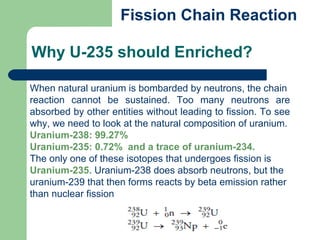
When natural uranium is bombarded by neutrons, the chain
reaction cannot be sustained. Too many neutrons are
absorbed by other entities without leading to fission. To see
why, we need to look at the natural composition of uranium.
Uranium-238: 99.27%
Uranium-235: 0.72% and a trace of uranium-234.
The only one of these isotopes that undergoes fission is
Uranium-235. Uranium-238 does absorb neutrons, but the
uranium-239 that then forms reacts by beta emission rather
than nuclear fission
Why U-235 should Enriched?
Fission Chain Reaction
Products
 2 new smaller nuclei
 2 or 3 free neutrons
 Huge amount of ENERGY
γ-Rays
– Heat
– Sound
– Light
Fission Chain Reaction
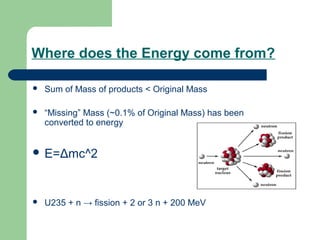
Where does the Energy come from?
 Sum of Mass of products < Original Mass
 “Missing” Mass (~0.1% of Original Mass) has been
converted to energy
 E=Δmc^2
 U235 + n → fission + 2 or 3 n + 200 MeV
E=Δmc^2
 A very small amount of matter is equivalent to a vast
amount of energy.
 For example, 1 kg of matter converted completely
into energy would be equivalent to the energy
released by exploding 22 megatons of TNT.
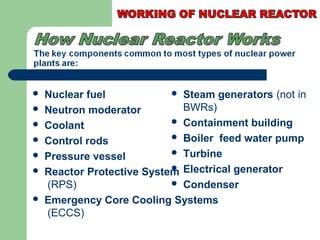
 Nuclear fuel
 Neutron moderator
 Coolant
 Control rods
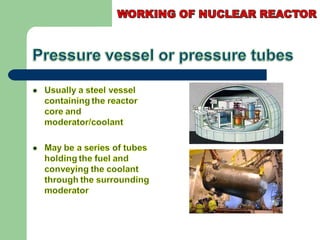
 Pressure vessel
 Reactor Protective System
(RPS)
 Emergency Core Cooling Systems
(ECCS)
 Steam generators (not in
BWRs)
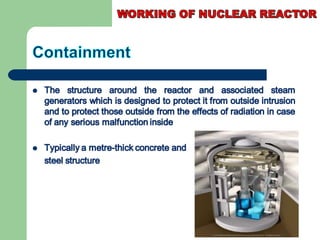
 Containment building
 Boiler feed water pump
 Turbine
 Electrical generator
 Condenser
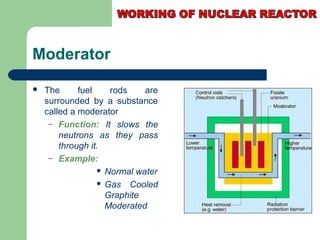
Moderator
 The fuel rods are
surrounded by a substance
called a moderator
– Function: It slows the
neutrons as they pass
through it.
– Example:
 Normal water
 Gas Cooled
Graphite
Moderated
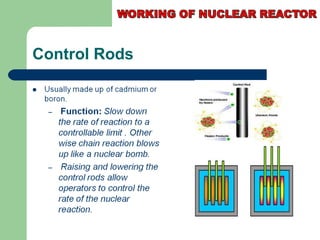
Control Rods
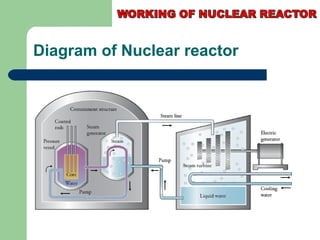
Diagram of Nuclear reactor
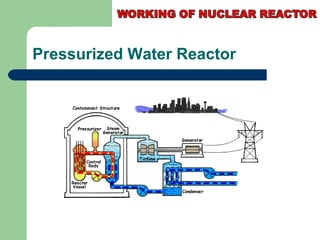
Pressurized Water Reactor
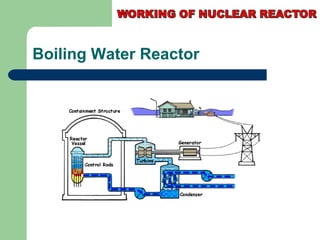
Boiling Water Reactor
References
 “Basic Nuclear Fission.” ThinkQuest. Accessed from: http://library.thinkquest.org/17940/texts/fission/ fission.html?tqskip1=1.
on 2-13-05.
 General Atomics. FusEdWeb: Fusion Energy Educational Web Site. accessed from: http://fusedweb.pppl.gov/. on 2-13-05.
 Godfrey Boyle, Bob Everett, Janet Ramage. Energy Systems and Sustainability. Oxfoord University Press 1998.
 How Stuff Works. “How Nuclear Power Works.” Accessed from: http://people.howstuffworks.com/nuclear-power2.htm. on 2-
13-05.
 “Nuclear Fission and Nuclear Fusion.” Accessed from:http://chemed.chem.purdue.edu/genchem/
topicreview/bp/ch23/fission.html. on 2-13-05.
 http://www.chem.duke.edu/~jds/cruise_chem/nuclear/pros.html
 http://starfire.ne.uiuc.edu/~ne201/1996/kopke/problems.html
 http://members.tripod.com/funk_phenomenon/nuclear/procon.htm
 http://www.world-nuclear.org/info/inf69.htm
 http://nuclearhistory.tripod.com/history.html
 www.chemcases.com

Nuclear reactor

Nuclear reactor

  • 3.
    Contents  Introduction  Definition History  Nuclear Fission  Components of Nuclear Reactor  Working of Nuclear Reactor  Refrences
  • 4.
    Introduction  A Nuclearreactor is a device for producing controlled release of nuclear energy. Reactors can be used for research or for power production. A research reactor is designed to produce various beams of radiation for experimental application; the heat produced is a waste product and is dissipated as efficiently as possible. In a power reactor the heat produced is of primary importance for use in driving conventional heat engines; the beams of radiation are controlled by shielding.
  • 5.
    Definition  A nuclearreactor is device designed to maintain a chain reaction producing a steady flow of neutrons generated by the fission of heavy nuclei. Nuclear Reactors are, however, differentiated either by their purpose or by their design features. In terms of purpose, they are either research reactors or power reactors.
  • 6.
    Early Reactors /History  The neutron was discovered in 1932. The concept of a nuclear chain reaction brought about by nuclear reactions mediated by neutrons was first realized shortly thereafter, by Hungarian scientist Leó Szilárd, in 1933. He filed a patent for his idea of a simple nuclear reactor .
  • 7.
     Szilárd's ideadid not incorporate the idea of nuclear fission as a neutron source, since that process was not yet discovered. Szilárd's ideas for nuclear reactors using neutron-mediated nuclear chain reactions in light elements proved unworkable. Early Reactors / History
  • 8.
     Inspiration fora new type of reactor using uranium came from the discovery by Lisa Meitner,Fritz Strassmann and Otto Hahn in 1938 that bombardment of uranium with neutrons, produced a barium residue, which they reasoned was created by the fission of the uranium nuclei. Early Reactors / History
  • 9.
     Subsequent studiesin early 1939 revealed that several neutrons were also released during the fission making available the opportunity for the nuclear chain reaction that Szilárd had envisioned previously. Early Reactors / History
  • 10.
     In 1939Albert Einstein signed a letter to President Franklin suggesting that the discovery of uranium's fission could lead to the development of "extremely powerful bombs of a new type", giving impetus to the study of reactors and fission.  World War II The first artificial nuclear reactor was constructed at the University of Chicago, in late 1942. Early Reactors / History
  • 11.
     Soon afterU.S. military developed a number of nuclear reactors in 1943. The primary purpose for the largest reactors was the mass production of plutonium for nuclear weapons.  "World's first nuclear power plant“ was carried out & operated by the U.S. Atomic Energy Commission in 1952, having a design output of 200 kW (electrical). Early Reactors / History
  • 12.
    Nuclear Fission “A mechanismby which a heavy nucleus absorbing a neutron might become unstable and split into two lighter nuclei.”
  • 13.
  • 14.
    Conditions  Slow neutrons Fissionable material should be unstable  Critical mass of the enriched Fissionable material – Critical mass is the minimum mass of fissionable material required to sustain the fission reaction – Enrichment was a way to increase the proportion of fissionable material (U-235) and aid in the chain reaction. Fission Chain Reaction Chain reaction, a process in which one of the products of a reaction initiates another identical reaction
  • 15.
    When natural uraniumis bombarded by neutrons, the chain reaction cannot be sustained. Too many neutrons are absorbed by other entities without leading to fission. To see why, we need to look at the natural composition of uranium. Uranium-238: 99.27% Uranium-235: 0.72% and a trace of uranium-234. The only one of these isotopes that undergoes fission is Uranium-235. Uranium-238 does absorb neutrons, but the uranium-239 that then forms reacts by beta emission rather than nuclear fission Why U-235 should Enriched? Fission Chain Reaction
  • 16.
  • 17.
  • 18.
    Products  2 newsmaller nuclei  2 or 3 free neutrons  Huge amount of ENERGY γ-Rays – Heat – Sound – Light Fission Chain Reaction
  • 19.
    Where does theEnergy come from?  Sum of Mass of products < Original Mass  “Missing” Mass (~0.1% of Original Mass) has been converted to energy  E=Δmc^2  U235 + n → fission + 2 or 3 n + 200 MeV
  • 20.
    E=Δmc^2  A verysmall amount of matter is equivalent to a vast amount of energy.  For example, 1 kg of matter converted completely into energy would be equivalent to the energy released by exploding 22 megatons of TNT.
  • 21.
     Nuclear fuel Neutron moderator  Coolant  Control rods  Pressure vessel  Reactor Protective System (RPS)  Emergency Core Cooling Systems (ECCS)  Steam generators (not in BWRs)  Containment building  Boiler feed water pump  Turbine  Electrical generator  Condenser
  • 23.
    Moderator  The fuelrods are surrounded by a substance called a moderator – Function: It slows the neutrons as they pass through it. – Example:  Normal water  Gas Cooled Graphite Moderated
  • 25.
  • 28.
  • 29.
  • 30.
  • 31.
    References  “Basic NuclearFission.” ThinkQuest. Accessed from: http://library.thinkquest.org/17940/texts/fission/ fission.html?tqskip1=1. on 2-13-05.  General Atomics. FusEdWeb: Fusion Energy Educational Web Site. accessed from: http://fusedweb.pppl.gov/. on 2-13-05.  Godfrey Boyle, Bob Everett, Janet Ramage. Energy Systems and Sustainability. Oxfoord University Press 1998.  How Stuff Works. “How Nuclear Power Works.” Accessed from: http://people.howstuffworks.com/nuclear-power2.htm. on 2- 13-05.  “Nuclear Fission and Nuclear Fusion.” Accessed from:http://chemed.chem.purdue.edu/genchem/ topicreview/bp/ch23/fission.html. on 2-13-05.  http://www.chem.duke.edu/~jds/cruise_chem/nuclear/pros.html  http://starfire.ne.uiuc.edu/~ne201/1996/kopke/problems.html  http://members.tripod.com/funk_phenomenon/nuclear/procon.htm  http://www.world-nuclear.org/info/inf69.htm  http://nuclearhistory.tripod.com/history.html  www.chemcases.com 