NUCLEAR POWER
         PLANT
    MET401 POWERPLANT ENGINEERING
CONTENT
 Nuclear fission & neutron energies

 Radioactive decay and half life

 Temperature distribution, Heat transfer and fluid flow in nuclear
   reactor

 Types of reactor
   Pressurized water reactor (PWR)
   Boiling water reactor (BWR)
   Gas cooled reactor
   Liquid metal fast breeder reactor
   Heavy water reactor
   Fusion power reactor
Nuclear Fission
 Nuclear Fission energy is released when a very heavy atomic nucleus absorbs a
   neutron and splits into two lighter fragments. The energy release in this
   process is enormous. It is 10 million times greater than the energy released
   when one atom of carbon from a fossil fuel is burned.

 There are 3 nuclear isotopes of importance to nuclear power that exhibit this
   behavior.
      235U (Uranium-235)
      239Pu (Plutonium-239)

      233U (Uranium-233)

   Of the 3, only 235U is found naturally on Earth. Natural Uranium found on Earth
   consists of 99.3 % 238U and 0.7% 235U. The two other isotopes, 239Pu and 233U can be
   created from the far more abundant 238U and Thorium nuclei via advanced Nuclear
   techniques.

Nuclear fission video
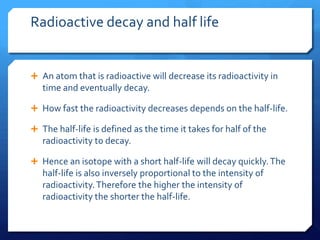
Radioactive decay and half life


 An atom that is radioactive will decrease its radioactivity in
   time and eventually decay.

 How fast the radioactivity decreases depends on the half-life.

 The half-life is defined as the time it takes for half of the
   radioactivity to decay.

 Hence an isotope with a short half-life will decay quickly. The
   half-life is also inversely proportional to the intensity of
   radioactivity. Therefore the higher the intensity of
   radioactivity the shorter the half-life.
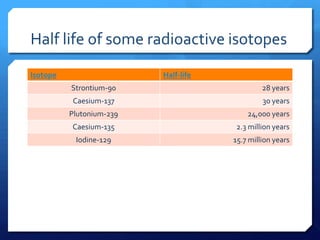
Half life of some radioactive isotopes
Isotope                   Half-life
          Strontium-90                         28 years
          Caesium-137                          30 years
          Plutonium-239                   24,000 years
          Caesium-135                  2.3 million years
           Iodine-129                 15.7 million years
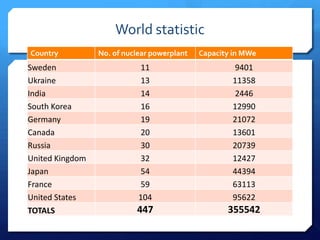
World statistic
Country          No. of nuclear powerplant   Capacity in MWe
Sweden                       11                      9401
Ukraine                      13                      11358
India                        14                      2446
South Korea                  16                      12990
Germany                      19                      21072
Canada                       20                      13601
Russia                       30                      20739
United Kingdom               32                      12427
Japan                        54                      44394
France                       59                      63113
United States               104                      95622
TOTALS                     447                      355542
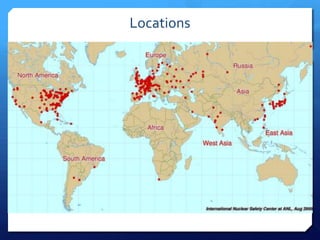
Locations
Types of nuclear reactors
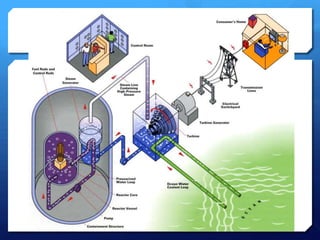
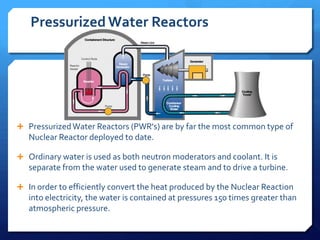
Pressurized Water Reactors


 Pressurized Water Reactors (PWR's) are by far the most common type of
   Nuclear Reactor deployed to date.

 Ordinary water is used as both neutron moderators and coolant. It is
   separate from the water used to generate steam and to drive a turbine.

 In order to efficiently convert the heat produced by the Nuclear Reaction
   into electricity, the water is contained at pressures 150 times greater than
   atmospheric pressure.
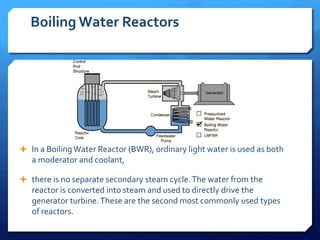
Boiling Water Reactors


 In a Boiling Water Reactor (BWR), ordinary light water is used as both
   a moderator and coolant,

 there is no separate secondary steam cycle. The water from the
   reactor is converted into steam and used to directly drive the
   generator turbine. These are the second most commonly used types
   of reactors.
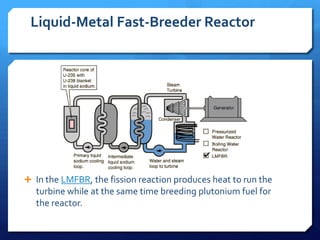
Liquid-Metal Fast-Breeder Reactor


 In the LMFBR, the fission reaction produces heat to run the
  turbine while at the same time breeding plutonium fuel for
  the reactor.
High Temperature Gas Cooled Reactors


 High Temperature gas cooled reactors operate at significantly
  higher temperatures than PWRs and use a gas as the primary
  coolant.

 The nuclear reaction is mostly moderated by carbon. These
  reactors can achieve significantly higher efficiencies than PWRs but
  the power output per reactor is limited by the less efficient cooling
  power of the gas.
Heavy Water Reactors


 Heavy Water reactors are similar to PWRs but use water
  enriched with the deuterium isotope of Hydrogen as the
  moderator and coolant.

 The "heavy water" and makes up about 0.022 parts per
  million of water found on Earth.

 The advantage of using Heavy water as the moderator is that
  natural, un-enriched Uranium can be used to drive the
  nuclear reactor.
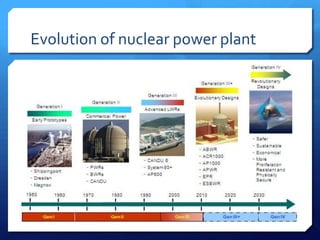
Evolution of nuclear power plant
Fukushima incident

 watch video

MET 401 Chapter 8 -_nuclear_power_plant

  • 1.
    NUCLEAR POWER PLANT MET401 POWERPLANT ENGINEERING
  • 2.
    CONTENT  Nuclear fission& neutron energies  Radioactive decay and half life  Temperature distribution, Heat transfer and fluid flow in nuclear reactor  Types of reactor  Pressurized water reactor (PWR)  Boiling water reactor (BWR)  Gas cooled reactor  Liquid metal fast breeder reactor  Heavy water reactor  Fusion power reactor
  • 3.
    Nuclear Fission  NuclearFission energy is released when a very heavy atomic nucleus absorbs a neutron and splits into two lighter fragments. The energy release in this process is enormous. It is 10 million times greater than the energy released when one atom of carbon from a fossil fuel is burned.  There are 3 nuclear isotopes of importance to nuclear power that exhibit this behavior.  235U (Uranium-235)  239Pu (Plutonium-239)  233U (Uranium-233) Of the 3, only 235U is found naturally on Earth. Natural Uranium found on Earth consists of 99.3 % 238U and 0.7% 235U. The two other isotopes, 239Pu and 233U can be created from the far more abundant 238U and Thorium nuclei via advanced Nuclear techniques. Nuclear fission video
  • 4.
    Radioactive decay andhalf life  An atom that is radioactive will decrease its radioactivity in time and eventually decay.  How fast the radioactivity decreases depends on the half-life.  The half-life is defined as the time it takes for half of the radioactivity to decay.  Hence an isotope with a short half-life will decay quickly. The half-life is also inversely proportional to the intensity of radioactivity. Therefore the higher the intensity of radioactivity the shorter the half-life.
  • 5.
    Half life ofsome radioactive isotopes Isotope Half-life Strontium-90 28 years Caesium-137 30 years Plutonium-239 24,000 years Caesium-135 2.3 million years Iodine-129 15.7 million years
  • 7.
    World statistic Country No. of nuclear powerplant Capacity in MWe Sweden 11 9401 Ukraine 13 11358 India 14 2446 South Korea 16 12990 Germany 19 21072 Canada 20 13601 Russia 30 20739 United Kingdom 32 12427 Japan 54 44394 France 59 63113 United States 104 95622 TOTALS 447 355542
  • 8.
  • 9.
  • 10.
    Pressurized Water Reactors Pressurized Water Reactors (PWR's) are by far the most common type of Nuclear Reactor deployed to date.  Ordinary water is used as both neutron moderators and coolant. It is separate from the water used to generate steam and to drive a turbine.  In order to efficiently convert the heat produced by the Nuclear Reaction into electricity, the water is contained at pressures 150 times greater than atmospheric pressure.
  • 11.
    Boiling Water Reactors In a Boiling Water Reactor (BWR), ordinary light water is used as both a moderator and coolant,  there is no separate secondary steam cycle. The water from the reactor is converted into steam and used to directly drive the generator turbine. These are the second most commonly used types of reactors.
  • 12.
    Liquid-Metal Fast-Breeder Reactor In the LMFBR, the fission reaction produces heat to run the turbine while at the same time breeding plutonium fuel for the reactor.
  • 13.
    High Temperature GasCooled Reactors  High Temperature gas cooled reactors operate at significantly higher temperatures than PWRs and use a gas as the primary coolant.  The nuclear reaction is mostly moderated by carbon. These reactors can achieve significantly higher efficiencies than PWRs but the power output per reactor is limited by the less efficient cooling power of the gas.
  • 14.
    Heavy Water Reactors Heavy Water reactors are similar to PWRs but use water enriched with the deuterium isotope of Hydrogen as the moderator and coolant.  The "heavy water" and makes up about 0.022 parts per million of water found on Earth.  The advantage of using Heavy water as the moderator is that natural, un-enriched Uranium can be used to drive the nuclear reactor.
  • 15.
  • 16.