


Nature of Energy
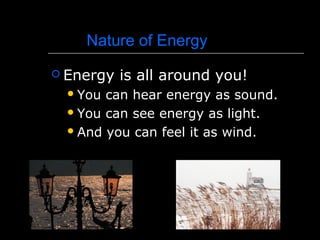
 Energy is all around you!
You can hear energy as sound.
You can see energy as light.
And you can feel it as wind.
Forms of Energy
 The five main forms
of energy are:
Heat
Chemical
Electromagnetic
Nuclear
Mechanical
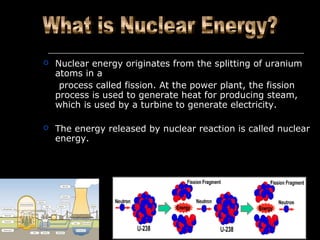
 Nuclear energy originates from the splitting of uranium
atoms in a
process called fission. At the power plant, the fission
process is used to generate heat for producing steam,
which is used by a turbine to generate electricity.
 The energy released by nuclear reaction is called nuclear
energy.
Brief History
 Nuclear energy was first discovered in
1934 by Enrico Fermi. The first nuclear
bombs were built in 1945 as a result of
the infamous Manhattan Project. The first
plutonium bomb, code-named Trinity, was
detonated on July 16, 1945 in New
Mexico. On August 6th
1945 the first
uranium bomb was detonated over
Hiroshima. Three days later a plutonium
bomb was dropped on Nagasaki. There is
over 200,000 deaths associated with
these detonations. Electricity wasn’t
produced with nuclear energy until 1951.
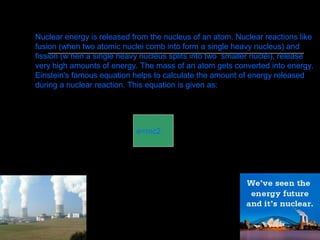
e=mc2
Nuclear energy is released from the nucleus of an atom. Nuclear reactions like
fusion (when two atomic nuclei comb into form a single heavy nucleus) and
fission (w hen a single heavy nucleus splits into two smaller nuclei), release
very high amounts of energy. The mass of an atom gets converted into energy.
Einstein's famous equation helps to calculate the amount of energy released
during a nuclear reaction. This equation is given as:
Nuclear Energy
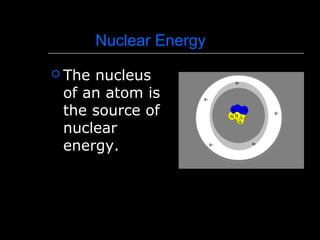
 The nucleus
of an atom is
the source of
nuclear
energy.
Nuclear Energy
 When the nucleus splits (fission),
nuclear energy is released in the
form of heat energy and light
energy.
 Nuclear energy is also released
when nuclei collide at high speeds
and join (fuse).
Nuclear Energy
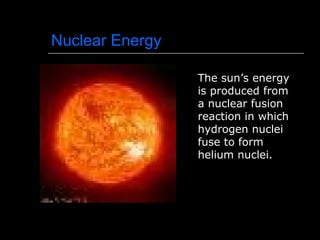
The sun’s energy
is produced from
a nuclear fusion
reaction in which
hydrogen nuclei
fuse to form
helium nuclei.
Nuclear Energy
 Nuclear
energy is the
most
concentrated
form of
energy.
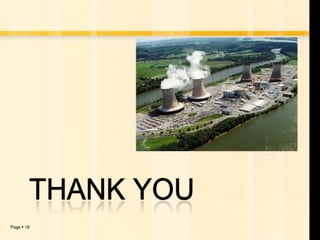
Most of us live within 10 miles of the Surry
Nuclear Power Plant which converts nuclear
energy into electromagnetic energy.
Nuclear energy is one of the safest energies that can be used to achieve many desired
results, provided it's used safely with due precautions. It can be used in diversified fields
for peaceful purposes such as electricity generation, medicinal purposes, reducing
pollution, etc. Here's an elaborate explanation about its benefits.
Advantages
 Very small amount of raw material
is required
Advantages
 Very small amount of raw material
is required
 Very less amount of pollution
Advantages
 Very small amount of raw material
is required
 Very less amount of pollution
 Cheap electricity
Advantages
 Very small amount of raw material
is required
 Very less amount of pollution
 Cheap electricity
 Waste produce is also small
Advantages
 Very small amount of raw material
is required
 Very less amount of pollution
 Cheap electricity
 Waste produce is also small
 Save environment because of not
creat green house effect
Advantages
 Very small amount of raw material
is required
 Very less amount of pollution
 Cheap electricity
 Waste produce is also small
 Save environment because of not
create green house effect
Advantages
 Very small amount of raw material
is required
 Very less amount of pollution
 Cheap electricity
 Waste produce is also small
 Save environment because of not
create green house effect
 Easy transportation
Advantages
 Very small amount of raw material
is required
 Very less amount of pollution
 Cheap electricity
 Waste produce is also small
 Save environment because of not
create green house effect
 Easy transportation
 Grow Indian economy
Economic Advantages
 The energy in one pound of highly enriched
Uranium is comparable to that of one million gallons
of gasoline.
 One million times as much energy in one pound of
Uranium as in one pound of coal.
 Nuclear energy annually prevents 5.1 million tons of
sulfur 2.4 million tons of nitrogen oxide 164 metric
tons of carbon
 First commercial power plant, England 1956
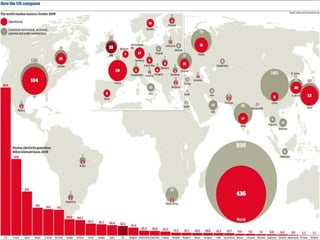
 17% of world’s electricity is from nuclear power
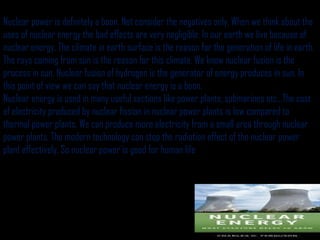
Nuclear power is definitely a boon. Not consider the negatives only. When we think about the
uses of nuclear energy the bad effects are very negligible. In our earth we live because of
nuclear energy. The climate in earth surface is the reason for the generation of life in earth.
The rays coming from sun is the reason for this climate. We know nuclear fusion is the
process in sun. Nuclear fusion of hydrogen is the generator of energy produces in sun. In
this point of view we can say that nuclear energy is a boon.
Nuclear energy is used in many useful sections like power plants, submarines etc...The cost
of electricity produced by nuclear fission in nuclear power plants is low compared to
thermal power plants. We can produce more electricity from a small area through nuclear
power plants. The modern technology can stop the radiation effect of the nuclear power
plant effectively. So nuclear power is good for human life
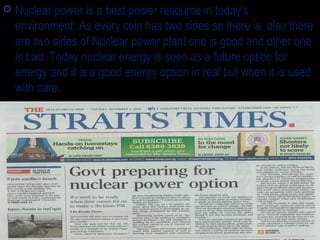
 Nuclear power is a best power resource in today's
environment .As every coin has two sides so there is also there
are two sides of Nuclear power plant one is good and other one
is bad .Today nuclear energy is seen as a future option for
energy and it is a good energy option in real but when it is used
with care.
Economic Benefits of Nuclear Power
 Nuclear power plants provide low-cost, predictable power at
stable prices and are essential in maintaining the reliability of the
U.S. electric power system. Nuclear power is a major national
energy source. Nuclear energy is our nation's largest source of
emission-free electricity and our second largest source of power.
The 103 U.S. nuclear units supply about 20 percent of the
electricity produced in the United States. The only fuel source
that produced more electricity was coal.
Environmental benefits
Of all energy sources, nuclear energy
has perhaps t he lowest impact on t he
environment especially in relat ion t o
kilowat t s produced because nuclear
plant s do not emit harmf ul gases,
require a relat ively small area, and
ef f ect ively minimize or negat e ot her
impact s. I n ot her words, nuclear
energy is t he most "ecologically
ef f icient " of all energy sources
 Nuclear power plants have long periods of operation. Nuclear
power plants are designed to operate continuously for long
periods of time. They can run about 540 days before they are
shut down for refueling. The longest continuous run by a light
water reactor is Three Mile Island, Unit 1, in Pennsylvania,
which completed a 688-day run. The longest run of any type of
reactor is 894 days, achieved by the Pickering 7 plant, a heavy-
water reactor in Ontario, Canada (Canadian CANDU reactors
can be refueled while operating).
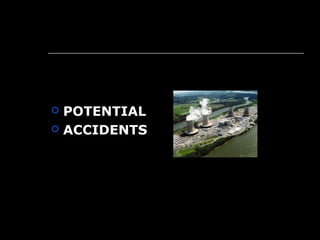
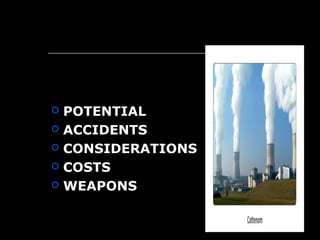
 POTENTIAL
 POTENTIAL
 ACCIDENTS
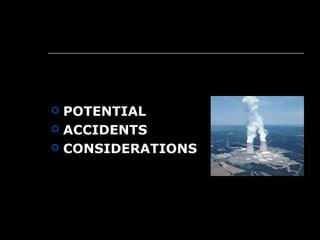
 POTENTIAL
 ACCIDENTS
 CONSIDERATIONS
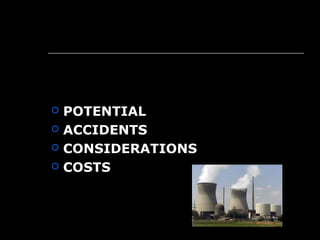
 POTENTIAL
 ACCIDENTS
 CONSIDERATIONS
 COSTS
 POTENTIAL
 ACCIDENTS
 CONSIDERATIONS
 COSTS
 WEAPONS
 POTENTIAL
 ACCIDENTS
 CONSIDERATIONS
 COSTS
 WEAPONS
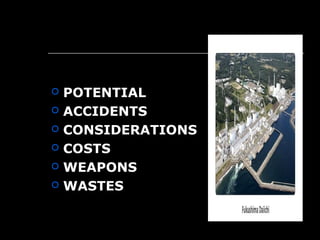
 WASTES
 POTENTIAL
 ACCIDENTS
 CONSIDERATIONS
 COSTS
 WEAPONS
 WASTES
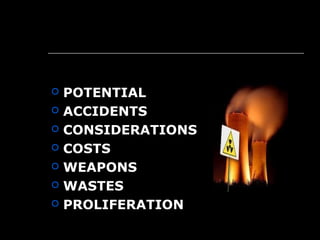
 PROLIFERATION
 POTENTIAL
 ACCIDENTS
 CONSIDERATIONS
 COSTS
 WEAPONS
 WASTES
 PROLIFERATION
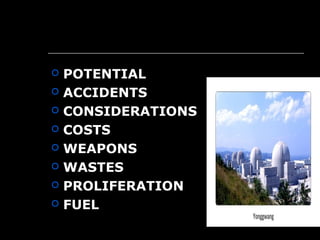
 FUEL
Nuclear Energy

Nuclear Energy

  • 4.
    Nature of Energy Energy is all around you! You can hear energy as sound. You can see energy as light. And you can feel it as wind.
  • 5.
    Forms of Energy The five main forms of energy are: Heat Chemical Electromagnetic Nuclear Mechanical
  • 6.
     Nuclear energyoriginates from the splitting of uranium atoms in a process called fission. At the power plant, the fission process is used to generate heat for producing steam, which is used by a turbine to generate electricity.  The energy released by nuclear reaction is called nuclear energy.
  • 7.
    Brief History  Nuclearenergy was first discovered in 1934 by Enrico Fermi. The first nuclear bombs were built in 1945 as a result of the infamous Manhattan Project. The first plutonium bomb, code-named Trinity, was detonated on July 16, 1945 in New Mexico. On August 6th 1945 the first uranium bomb was detonated over Hiroshima. Three days later a plutonium bomb was dropped on Nagasaki. There is over 200,000 deaths associated with these detonations. Electricity wasn’t produced with nuclear energy until 1951.
  • 8.
    e=mc2 Nuclear energy isreleased from the nucleus of an atom. Nuclear reactions like fusion (when two atomic nuclei comb into form a single heavy nucleus) and fission (w hen a single heavy nucleus splits into two smaller nuclei), release very high amounts of energy. The mass of an atom gets converted into energy. Einstein's famous equation helps to calculate the amount of energy released during a nuclear reaction. This equation is given as:
  • 9.
    Nuclear Energy  Thenucleus of an atom is the source of nuclear energy.
  • 10.
    Nuclear Energy  Whenthe nucleus splits (fission), nuclear energy is released in the form of heat energy and light energy.  Nuclear energy is also released when nuclei collide at high speeds and join (fuse).
  • 11.
    Nuclear Energy The sun’senergy is produced from a nuclear fusion reaction in which hydrogen nuclei fuse to form helium nuclei.
  • 12.
    Nuclear Energy  Nuclear energyis the most concentrated form of energy. Most of us live within 10 miles of the Surry Nuclear Power Plant which converts nuclear energy into electromagnetic energy.
  • 15.
    Nuclear energy isone of the safest energies that can be used to achieve many desired results, provided it's used safely with due precautions. It can be used in diversified fields for peaceful purposes such as electricity generation, medicinal purposes, reducing pollution, etc. Here's an elaborate explanation about its benefits.
  • 17.
    Advantages  Very smallamount of raw material is required
  • 18.
    Advantages  Very smallamount of raw material is required  Very less amount of pollution
  • 19.
    Advantages  Very smallamount of raw material is required  Very less amount of pollution  Cheap electricity
  • 20.
    Advantages  Very smallamount of raw material is required  Very less amount of pollution  Cheap electricity  Waste produce is also small
  • 21.
    Advantages  Very smallamount of raw material is required  Very less amount of pollution  Cheap electricity  Waste produce is also small  Save environment because of not creat green house effect
  • 22.
    Advantages  Very smallamount of raw material is required  Very less amount of pollution  Cheap electricity  Waste produce is also small  Save environment because of not create green house effect
  • 23.
    Advantages  Very smallamount of raw material is required  Very less amount of pollution  Cheap electricity  Waste produce is also small  Save environment because of not create green house effect  Easy transportation
  • 24.
    Advantages  Very smallamount of raw material is required  Very less amount of pollution  Cheap electricity  Waste produce is also small  Save environment because of not create green house effect  Easy transportation  Grow Indian economy
  • 25.
    Economic Advantages  Theenergy in one pound of highly enriched Uranium is comparable to that of one million gallons of gasoline.  One million times as much energy in one pound of Uranium as in one pound of coal.  Nuclear energy annually prevents 5.1 million tons of sulfur 2.4 million tons of nitrogen oxide 164 metric tons of carbon  First commercial power plant, England 1956  17% of world’s electricity is from nuclear power
  • 26.
    Nuclear power isdefinitely a boon. Not consider the negatives only. When we think about the uses of nuclear energy the bad effects are very negligible. In our earth we live because of nuclear energy. The climate in earth surface is the reason for the generation of life in earth. The rays coming from sun is the reason for this climate. We know nuclear fusion is the process in sun. Nuclear fusion of hydrogen is the generator of energy produces in sun. In this point of view we can say that nuclear energy is a boon. Nuclear energy is used in many useful sections like power plants, submarines etc...The cost of electricity produced by nuclear fission in nuclear power plants is low compared to thermal power plants. We can produce more electricity from a small area through nuclear power plants. The modern technology can stop the radiation effect of the nuclear power plant effectively. So nuclear power is good for human life
  • 27.
     Nuclear poweris a best power resource in today's environment .As every coin has two sides so there is also there are two sides of Nuclear power plant one is good and other one is bad .Today nuclear energy is seen as a future option for energy and it is a good energy option in real but when it is used with care.
  • 28.
    Economic Benefits ofNuclear Power  Nuclear power plants provide low-cost, predictable power at stable prices and are essential in maintaining the reliability of the U.S. electric power system. Nuclear power is a major national energy source. Nuclear energy is our nation's largest source of emission-free electricity and our second largest source of power. The 103 U.S. nuclear units supply about 20 percent of the electricity produced in the United States. The only fuel source that produced more electricity was coal.
  • 29.
    Environmental benefits Of allenergy sources, nuclear energy has perhaps t he lowest impact on t he environment especially in relat ion t o kilowat t s produced because nuclear plant s do not emit harmf ul gases, require a relat ively small area, and ef f ect ively minimize or negat e ot her impact s. I n ot her words, nuclear energy is t he most "ecologically ef f icient " of all energy sources
  • 30.
     Nuclear powerplants have long periods of operation. Nuclear power plants are designed to operate continuously for long periods of time. They can run about 540 days before they are shut down for refueling. The longest continuous run by a light water reactor is Three Mile Island, Unit 1, in Pennsylvania, which completed a 688-day run. The longest run of any type of reactor is 894 days, achieved by the Pickering 7 plant, a heavy- water reactor in Ontario, Canada (Canadian CANDU reactors can be refueled while operating).
  • 32.
  • 33.
  • 34.
  • 35.
     POTENTIAL  ACCIDENTS CONSIDERATIONS  COSTS
  • 36.
     POTENTIAL  ACCIDENTS CONSIDERATIONS  COSTS  WEAPONS
  • 37.
     POTENTIAL  ACCIDENTS CONSIDERATIONS  COSTS  WEAPONS  WASTES
  • 38.
     POTENTIAL  ACCIDENTS CONSIDERATIONS  COSTS  WEAPONS  WASTES  PROLIFERATION
  • 39.
     POTENTIAL  ACCIDENTS CONSIDERATIONS  COSTS  WEAPONS  WASTES  PROLIFERATION  FUEL